
World War Two
Published 21 Oct 2023The Germans engineer a coup in Hungary to keep the Hungarian army in the war, but the Allies have finally entered Germany in force, taking Aachen in the west. The Soviets liberate Belgrade in the east, and launch new attacks in Baltics, and at the other end of the world come American landings in the Philippines, and the recall of Vinegar Joe Stilwell from China.
00:00 Intro
01:00 Recap
01:21 Raids on the Philippines
04:42 The Invasion of Leyte
06:11 Joe Stilwell is recalled from China
08:12 The Battle of Aachen
12:24 Battle of the Scheldt
14:03 Soviet attacks in the Baltics
16:23 Horthy’s fall- a coup in Hungary
19:45 Germans close in on Slovakia
21:55 Belgrade Liberated
24:47 Summary
25:01 Conclusion
(more…)
October 22, 2023
SS Commando Coup in Hungary – WW2 – Week 269 – October 21, 1944
“Grandpa Nambu” Japanese Pistol
Forgotten Weapons
Published 15 Nov 2016The 1902 “Grandpa” Nambu is one of the first wave of successful military automatic pistols, developed by Kijiro Nambu and his team over the course of five years, from 1897 to 1902. It was the first automatic pistol to be used by the Japanese military, although it was a private-purchase sidearm for officers and not formally purchased or issued by the military. It took several design cues from the C96 Mauser, in the form of a pivoting locking block and a bottlenecked cartridge.
The Grandpa was only made from 1902 until 1906, with less than 2400 examples produced in total — many of which were sold to Thailand. In 1906 a series of improvements were made to the gun, including increasing the size of the trigger and trigger guard, a swiveling lanyard ring, a slightly larger grip, new magazine, and deletion of the shoulder stock slot that had been standard on all previous Nambu pistols. The formal Japanese designation (Type A) did not change as a result, but in American collector parlance the new model became the “Papa” Nambu.
Cool Forgotten Weapons Merch! http://shop.bbtv.com/collections/forg…
QotD: The changes in Roman legionary equipment attributed to the “Marian reforms”
There only two parts of this narrative unambiguously suggested by our sources are equipment changes: that Marius introduced a new type of pilum (Plut. Mar. 25) and that he standardized legionary standards around the aquila, the eagle standard (Plin. NH 10.16).
For the pilum, Plutarch says that Marius designed it to incorporate a wooden rivet where the long metal shank met the heavy wooden shaft, replacing one of the two iron nails with a wooden rivet that would break on impact, in order to better disable the shield. The problem is that the pilum is actually archaeologically one of the best attested Roman weapons with the result that we can follow its development fairly closely. And the late, great Peter Connolly did exactly that in a series of articles in the Journal of Roman Military Equipment Studies1 and while the design of the pilum does develop over time, there’s simply no evidence for what Plutarch describes. The “broad tanged” pilum type could have been modified this way, but we’ve never found one actually so modified; instead the pila of this type we find all have rivets (two of them) in place (where rivets are preserved at all). Moreoever, most pila of that “broad tanged” type, both before and after Marius, have the edges of that broad tang bent over at the sides, which would prevent the sort of sliding action Plutarch describes even if one of the rivets broke. Meanwhile, by the first century there are three types of pila around (socketed, broad-tanged and spike-tanged) only one of which could be modified in this way (the broad-tanged type), and that type doesn’t dominate during the first century when one might expect Marius’ new-style pila to be in use. In practice then the conclusion seems to be that Plutarch made up or misunderstood this “innovation” in the pilum or, at best, the design was adopted briefly and then abandoned.
On to the aquila. Now, it is absolutely true that the aquila, the legionary eagle, became a key standard for the Roman legions. Pliny the Elder notes that before Marius it was merely the foremost of five standards, the others being the wolf, minotaur, horse and boar (Plin. HN 10.16). But even a brief glance as legionary standards into the early empire (see Keppie (1984), 205-213 for an incomplete and somewhat dated list) shows that bulls, boars and wolves remained pretty common legionary emblems (alongside the eagle) into the empire. The eagle seems to have been something of a personal totem for Marius (e.g. Plut. Mar. 36.5-6) so it is hardly surprising he’d have emphasized it, the same way that legions founded by Caesar – or which wanted to be seen as founded by Caesar – adopted the bull emblem, quite a lot. But this is a weak accomplishment, since Pliny already notes that the eagle was, even before Marius, already prima cum quattuor aliis (“first among four others”), and so it remained: first among a range of other emblems and standards. Though of all of the things we may credit Marius with instituting, this perhaps gets the closest, if we believe Pliny that Marius further elevated the eagle into its particular position.
Then there is the institution of the Roman marching pack and the furca to carry it, such that Marius’ soldiers became known as “Marius’ mules” because he made them carry all of their own kit rather than, as previous legions had supposedly done, carrying it all on mules. Surely this extremely famous element of the narrative cannot be flawed? And Plutarch sort of says this, he notes that, “Setting out on the expedition, he laboured to perfect his army as it went along, practicing the men in all kinds of running and in long marches, and compelling them to carry their own baggage and to prepare their own food. Hence, in after times, men who were fond of toil and did whatever was enjoined upon them contentedly and without a murmur, were called Marian mules” (Plut. 13.1; trans. B. Perrin). Except that doesn’t say anything about instituting the classic Roman pack that we see, for instance, depicted on Trajan’s column, does it? It just says Marius made his men carry their baggage and prepare their own food, leading to the nickname for men who did toil without complaint.
The problem is that those two things – making soldiers carry their baggage and cook their own food (along with kicking out camp followers) – are ubiquitous commonplaces of good generalship with instances that pre-date Marius. P. Cornelius Scipio Aemilianus does exactly this – getting rid of camp servants, wagons and pack animals, making soldiers cook their own food and kicking out the camp followers – according to Appian in 134 when he besieged Numantia (which fell in 133, App. Hisp. 85). And then Q. Caecilius Metellus, Marius’ own former commander, does the exact same thing in 109 when he takes command against Jugurtha in North Africa, kicking the sutlers out of the camp, getting rid of pack animals and private servants, making soldiers cook their own food, carry their own rations and their own weapons (Sall. Iug. 42.2; note that Sallust dies in in the 30s BC, 80-odd years before Plutarch is born, so Plutarch may well be getting this trope from Sallust and then attributing it to the wrong Roman). Critiques of generals who issued rations rather than making their soldiers cook or praise for generals who didn’t remained standard into the empire (e.g. Tac. Hist. 2.88; Hdn. 4.7.4-6; Dio Cass. 62.5.5). In short this trope was not new to Marius nor was it new to Plutarch’s version of Marius; it was a standard trope of generals restoring good discipline to their soldiers. Plutarch even hedges noting another story that the term “Marius’ mules” might actually have come how well Marius as a junior officer got along with animals (Plut. Mar. 13.2)!
Well, fine enough, but what about the idea that state-issued equipment is emerging in this period? Well, it might be but our evidence is not great. As noted when we discussed the dilectus, Polybius implies – and his schematic for conscription makes little sense otherwise – that the Romans are in that period buying their own equipment. He also notes that the quaestors deduct from a soldier’s pay the price of their rations (if they are Romans; socii eat for free), their clothing and any additional equipment they need (Polyb. 6.39.14). It makes sense; if a fellow forgot a sword or his breaks, you need to get that replaced, so you fine him the value of it and then issue him one from the common store.
Now Keppie (1984) assumes this system changes during the tribunate(s) of Gaius Gracchus (123-2) and you can see the temptation in this idea. If Gaius Gracchus shifts equipment to being issued at state expense, then suddenly there’s no reason not to recruit the landless proletarii (discussed below) opening the door for Marius to do so (discussed below) and fundamentally transforming the Roman army into the longer-service, professional form we see in the empire. The problem is that, well, it didn’t happen. First, we have no evidence at all that Gaius Gracchus did anything related to soldier’s arms and armor; what we have is a single line from Plutarch that soldiers should be issued clothing at state expense with nothing deducted from their pay to meet this cost (Plut. C. Gracch. 5.1). The assumption here is that this also covered arms and armor, but Plutarch doesn’t say that at all. The more fatal flaw is that we can be very, extremely sure this reform didn’t stick, because we have a bunch of Roman “pay stubs” from the imperial period (from Egypt, naturally) and regular deductions vestimentis, “for clothing” show up as standard.2 Indeed, they show up alongside deductions for food and replacement socks, boots and so on, exactly as Polybius would have us expect. Apart from the fact that this is presumably being done by a procurator instead of a quaestor (a change in the structure of administration in the provinces run directly by the emperor), this is the same system.
Now there are reasons to think that at least some equipment was state supplied or contracted (even if it may have been billed to the accounts of the soldiers who got it). Scipio creates a public armaments production center in Carthago Nova in 210, but this may be a one off. Seemingly more centralized production of arms under contract are more common in the late Republic and by the imperial period we start to see evidence of fabricae which seem to be central production sites for military equipment.3 But we have no hint in the sources of any sudden reform to this system. It may well be a gradual change as the “mix” of personal and state-ordered equipment slowly tilts in favor of the latter; the system Polybius describes could accommodate both situations, so there’s no need for a sudden big shift. Alternately, the preponderance of state-produced equipment might well be connected to the formalization of a long-service professional army under Augustus. Even then, we still find pieces of equipment in Roman imperial sites which were clearly personal; soldiers could still go and get a fancy version of standard kit, stamp their name in it and call it theirs. All I think we can say with any degree of confidence is that self-purchased equipment seems to be the norm in Polybius’ day whereas state-issued equipment seems to be the norm by the end of the first century. But Marius has nothing to do with it, as far as we can tell and no ancient source claims that he did.
Oh and by the by, if you are picking up from all of this (and our discussion of Lycurgus) that Plutarch is a difficult source that needs to be treated with a lot of caution because he never lets the facts get in the way of a good story … well, that’s true.
Bret Devereaux, “Collections: The Marian Reforms Weren’t a Thing”, A Collection of Unmitigated Pedantry, 2023-06-30.
1. “Pilum, Gladius and Pugio in the Late Republic”, JRMES 5 (1997), then “The Reconstruction and Use of Roman Weaponry in the Second Century BC”, JRMES 11 (2000) and then “The pilum from Marius to Nero – a reconsideration of its development and function”, JRMES 12/13 (2001/2).
2. On this, see R.O. Fink, Roman Military Records on Papyrus (1971).
3. On all this, see Bishop and Coulston, Roman Military Equipment (2006), 233-240.
October 21, 2023
QotD: The US Army’s Korean War blooding
For his own sake and for that of those around him, a man must be prepared for the awful, shrieking moment of truth when he realizes he is all alone on a hill ten thousand miles from home, and that he may be killed in the next second.
The young men of America, from whatever strata, are raised in a permissive society. The increasing alienation of their education from the harsher realities of life makes their reorientation, once enlisted, doubly important.
Prior to 1950 they got no reorientation. They put on the uniform, but continued to get by, doing things rather more or less. They had no time for sergeants.
As discipline deteriorated, the generals themselves were hardly affected. They still had their position, their pomp and ceremonies. Surrounded by professionals of the old school, largely field rank, they still thought their rod was iron, for, seemingly, their own orders were obeyed.
But ground battle is a series of platoon actions. No longer can a field commander stand on a hill, like Lee or Grant, and oversee his formations. Orders in combat — the orders that kill men or get them killed, are not given by generals, or even by majors. They are given by lieutenants and sergeants, and sometimes by PFC’s.
When a sergeant gives a soldier an order in battle, it must have the same weight as that of a four-star general.
Such orders cannot be given by men who are some of the boys. Men willingly take orders to die only from those they are trained to regard as superior beings.
It was not until the summer of 1950, when the legions went forth, that the generals realized what they had agreed to, and what they had wrought.
The Old Army, outcast and alien and remote from the warm bosom of society, officer and man alike, ordered into Korea, would have gone without questioning. It would have died without counting. As on Bataan, it would not have listened for the angel’s trumpet or the clarion call. It would have heard the hard sound of its own bugles, and hard-bitten, cynical, wise in bitter ways, it would have kept its eyes on its sergeants.
It would have died. It would have retreated, or surrendered, only in the last extremity. In the enemy prison camps, exhausted, sick, it would have spat upon its captors, despising them to the last.
It would have died, but it might have held.
T.R. Fehrenbach, This Kind of War: A Study in Unpreparedness, 1963.
October 20, 2023
Zulu Kingdom’s Last Stand – The Anglo-Zulu War 1879
Real Time History
Published 18 Oct 2023The Anglo-Zulu War in 1879 is one of the most well known colonial wars of the British Empire. And while the British ultimately won and annexed the Zulu Kingdom, at the Battle of Isandlwana they suffered one of their worst defeats.
(more…)
Orwell on “Boys’ Weeklies” (aka “penny dreadfuls”)
David Friedman is enjoying re-reading some of George Orwell’s collected essays and has some comments on one that I’m quite fond of as well — Orwell’s survey of “Boy’s weeklies” first published in Horizon March of 1940:
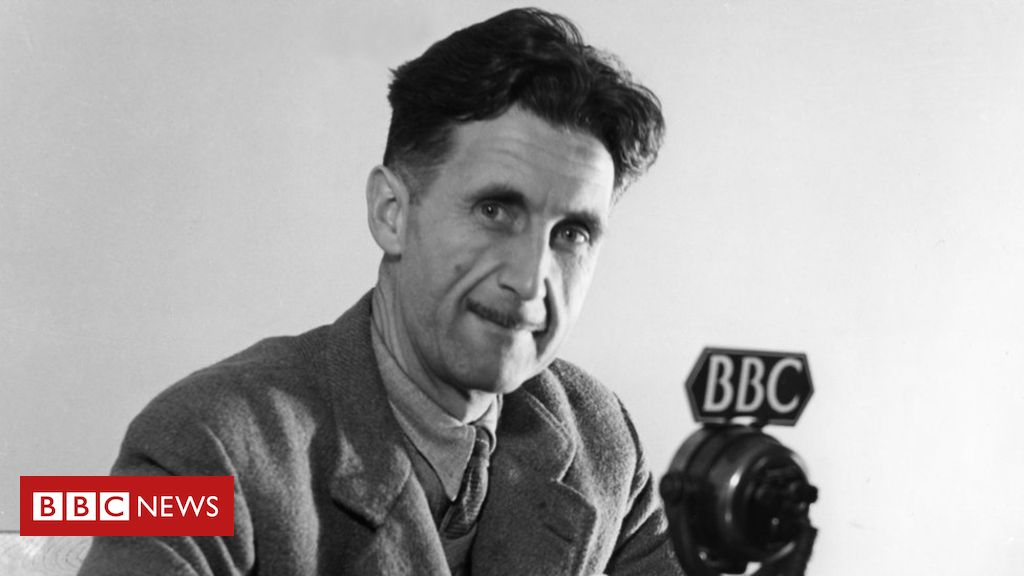
The Weeklies, of which Orwell identifies ten, produced by two different publishers and including two older series somewhat different from the others, were very popular reading, targeted at boys up to about fourteen or fifteen. All of the stories in the two older ones and many in the others were set in British public schools; Orwell suggests, plausibly enough, that much of the inspiration for the setting was Kipling’s Stalky and Company.
Orwell focuses mostly on the two older ones, each of which had a stock cast of characters and a setting that showed no sign of changing for the thirty years over which they had been coming out and recognizably stylized plots and dialog. He comments that although each claims to be written by a single named author — “Frank Richards” for one series and “Martin Clifford” for the other — it is obvious that a single author could not have done thirty years of weekly stories and that the stylized writing is in part a way of maintaining the illusion of a single author.
The essay is interesting both for the detailed, and to some extent sympathetic, description of the weeklies
In the Gem and Magnet there is a model for very nearly everybody. There is the normal athletic, high-spirited boy (Tom Merry, Jack Blake, Frank Nugent), a slightly rowdier version of this type (Bob Cherry), a more aristocratic version (Talbot, Manners), a quieter, more serious version (Harry Wharton), and a stolid, “bulldog” version (Johnny Bull). Then there is the reckless, dare-devil type of boy (Vernon-Smith), the definitely “clever”, studious boy (Mark Linley, Dick Penfold), and the eccentric boy who is not good at games but possesses some special talent (Skinner Wibley). And there is the scholarship-boy (Tom Redwing), an important figure in this class of story because he makes it possible for boys from very poor homes to project themselves into the public-school atmosphere. In addition there are Australian, Irish, Welsh, Manx, Yorkshire and Lancashire boys to play upon local patriotism. But the subtlety of characterization goes deeper than this. If one studies the correspondence columns one sees that there is probably no character in the Gem and Magnet whom some or other reader does not identify with, except the out-and-out comics, Coker, Billy Bunter, Fisher T. Fish (the money-grabbing American boy) and, of course, the masters.
and for Orwell’s analysis of their political implications. He thinks they are designed, probably deliberately by the owners of the firms that publish them, to indoctrinate boys with conservative views — respectful towards the upper classes, ignorantly patriotic, contemptuous of foreigners, blind to the real problems of British society.
Here is the stuff that is read somewhere between the ages of twelve and eighteen by a very large proportion, perhaps an actual majority, of English boys, including many who will never read anything else except newspapers; and along with it they are absorbing a set of beliefs which would be regarded as hopelessly out of date in the Central Office of the Conservative Party. All the better because it is done indirectly, there is being pumped into them the conviction that the major problems of our time do not exist, that there is nothing wrong with laissez-faire capitalism, that foreigners are un-important comics and that the British Empire is a sort of charity-concern which will last for ever. Considering who owns these papers, it is difficult to believe that this is un-intentional. Of the twelve papers I have been discussing (i.e. twelve including the Thriller and Detective Weekly) seven are the property of the Amalgamated Press, which is one of the biggest press-combines in the world and controls more than a hundred different papers. The Gem and Magnet, therefore, are closely linked up with the Daily Telegraph and the Financial Times. This in itself would be enough to rouse certain suspicions, even if it were not obvious that the stories in the boys’ weeklies are politically vetted. So it appears that if you feel the need of a fantasy-life in which you travel to Mars and fight lions bare-handed (and what boy doesn’t?), you can only have it by delivering yourself over, mentally, to people like Lord Camrose.
The essay ends with a somewhat tentative suggestion that someone ought to produce a left-wing equivalent and a discussion of some problems in doing so.
It is an interesting essay on its own merits. Still more interesting is the response, an article by Frank Richards rebutting Orwell and defending his own work. It turns out that, contrary to Orwell’s confident claim, most of thirty years of weekly stories by “Frank Richards” were produced by the same person, with occasional stories by other authors when he was for some reason not available. Further, as Orwell comments in a later footnote to his essay, Frank Richards was also Martin Clifford, so the same person produced, for thirty years, most of the contents of two different weekly magazines for boys.
His response shows him to be an intelligent and articulate writer. His views are conservative in a general sense; he makes it clear that the setting of the stories is an unchanging 1910 England because he does not think much of the changes since. But he also makes it clear that the reason his stories do not include strikes, unemployment, labor unions, and a variety of other features of the real world is that he believes that providing boys an imaginative foundation in a secure world helps equip them to face future difficulties in a world much less secure.
Of strikes, slumps, unemployment, etc., complains Mr Orwell, there is no mention. But are these really subjects for young people to meditate upon ? It is true that we live in an insecure world: but why should not youth feel as secure as possible? It is true that burglars break into houses: but what parent in his senses would tell a child that a masked face may look in at the nursery window ! A boy of fifteen or sixteen is on the threshold of life: and life is a tough proposition; but will he be better prepared for it by telling him how tough it may possibly be? I am sure that the reverse is the case. Gray — another obsolete poet, Mr Orwell! — tells us that sorrows never come too late, and happiness too swiftly flies. Let youth be happy, or as happy as possible. Happiness is the best preparation for misery, if misery must come. At least, the poor kid will have had something! He may, at twenty, be hunting for a job and not finding it — why should his fifteenth year be clouded by worrying about that in advance? He may, at thirty, get the sack — why tell him so at twelve? He may, at forty, be a wreck on Labour’s scrap-heap — but how will it benefit him to know that at fourteen? Even if making miserable children would make happy adults, it would not be justifiable. But the truth is that the adult will be all the more miserable if he was miserable as a child. Every day of happiness, illusory or otherwise — and most happiness is illusory — is so much to the good. It will help to give the boy confidence and hope. Frank Richards tells him that there are some splendid fellows in a world that is, after all, a decent sort of place. He likes to think himself like one of these fellows, and is happy in his daydreams. Mr Orwell would have him told that he is a shabby little blighter, his father an ill-used serf, his world a dirty, muddled, rotten sort of show. I don’t think it would be fair play to take his twopence for telling him that!
As a child in England in the early 1960s, I didn’t encounter any of the stories by Frank Richards (at least, I strongly doubt it), but many of the storylines and tropes of his work were still echoed by later authors, especially in the British comics (Lion, Tiger, Valiant, Rover, and The Hotspur among the many offerings). Alongside the heroic adventure stories, the war stories, science fiction, and the (omnipresent) football stories, there were still some that might well have been comic versions of Mr. Richards’ originals.
I missed them after we emigrated, but I was delighted find that the W.H. Smith bookshop at Sherway Gardens carried a few of them (at a significant mark-up, of course) so I was still getting my occasional comic fix until about 1974.
Look at Life – Oil Aboard (1963)
Classic Vehicle Channel
Published 18 Apr 2020The oil industry and the manufacture of fuel.
QotD: The Gen-X-Files
I wasn’t in any way political back then. If forced to pick a side, I’d have been reflexively liberal, like all college kids are. I didn’t know the first thing about what was going on out in the world, let alone in the corridors of power in Washington, but even I found that pretty farfetched.
More importantly, the zeitgeist I saw was rapidly changing. X Files creator Chris Carter was born in 1956 and grew up in sunny SoCal (his wiki entry makes sure to give us his favorite surfing stance), so he more than most probably wrestled with the dilemma of how to bring Flower Power into Ronald Reagan’s 1980s. Hence the weird disconnect of the early 1990s, when Bill Clinton got his groovy, greasy, chicken-fried hippie self into the White House: The same people who, in their own college days, had nothing but hatred for the CIA and their domestic Mini-Me, the FBI, were all of a sudden kinda sorta coming around on the idea that The Feds are our friends — since, you know, the Feds are now us. It’s probably not a coincidence that Agent Mulder, FBI, was the star of The X-Files.
Explains a lot about “Gen X”, don’t it? When every single authority figure in your life, from the President on down, tells you to Fight the Power, the only way out of the clown show is to be, you know, like, whateverrr about everything — learned helplessness, 1994 version.
But smoked-out, flannel-clad, and apathetic is no way to go through life, and so we turned into a generation of suck-ups and toadies. Oh, the lunatic Marxists in the Teachers’ Unions want to encourage kids to “transition” in elementary school. Dude … you know, like, whateverrr. The college kids of 1994 are the middle managers, the Deep Staters, the lever-pullers of 2021. It’s working out about as well as you might’ve expected. You don’t need Agent Mulder to solve this mystery.
Severian, “1994”, Rotten Chestnuts, 2021-04-15.
October 19, 2023
Why there are no regional refuges available to Gazan civilians
Ed West outlines the sad story of Palestinian civilians uprooted from their homes by the many conflicts that have convulsed the region:
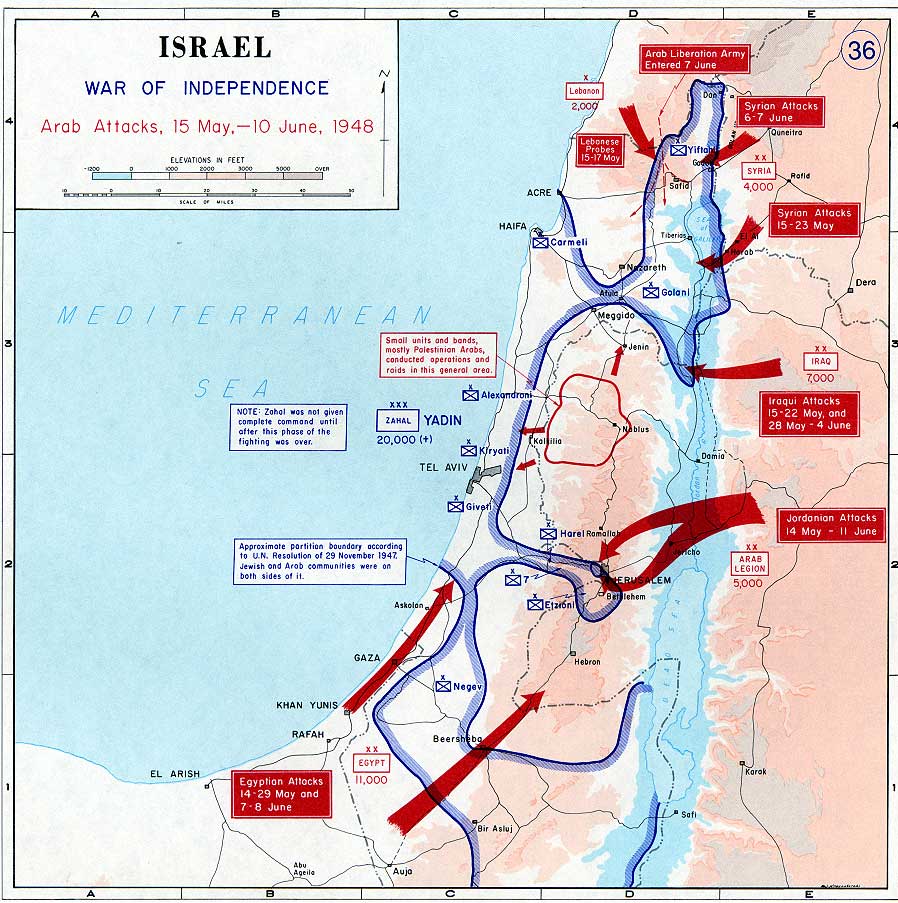
Arab attacks in May and June 1948.
United States Military Academy Atlas, Link.
It is generally a good idea for refugees to be housed in neighbouring countries rather than on different continents, for a number of reasons, but we should be wary of casually stating that Arab states should house Gazans. In a difficult region many of these countries have already put themselves under enormous strain through acts of immense generosity, and none more so than Jordan.
[…]
The survival of Jordan’s monarchy has been one of the more surprising outcomes of the past few decades, and experts have repeatedly bet against it. The country has an unusually bad hand in many ways. Situated beside the disputed Holy Land, it lacks the natural resources of neighbouring Saudi Arabia and Iraq, while also being more remote than Lebanon or Syria, which had long been at the heart of Mediterranean trading networks and far more plugged into European markets.
But most of all it has suffered the destabilising effect of refugees. Abdullah is named after his great-grandfather, the first King of Jordan, whose assassination in 1951 forms the opening of Hussein’s autobiography; indeed he calls it “the most profound influence of my life”. He was just 15 years-old when he travelled with his grandfather to Jerusalem to perform Friday prayers, where the monarch was shot dead by a Palestinian. The gunman then fired at Hussein but the bullet struck a medal his grandfather had given him.
Abdullah I had ruled the new kingdom for just five years, and it endured an incredibly bad start with defeat in the 1948 Arab-Israeli war, which led to a surge of refugees. Estimates of exact numbers seem to vary hugely, but in Lion of Jordan, Avi Shlaim writes that 700,000 Palestinians left in 1948, and of these “450,000 ended up in Jordan, which did more than any other Arab state to help them resettle and integrate with the rest of society”.
He wrote: “The refugees in Jordan wanted to preserve their separate Palestinian identity, but this ran counter to Abdullah’s policy of ‘Jordanization’.” He gave them citizenship rights “but the refugees were a great burden on the weak Jordanian economy; it simply did not have the financial resources to cope with a humanitarian tragedy on such a vast scale.” Many ended up in resentful poverty and “the Palestinians thus became an important factor in domestic Jordanian politics”.
Another source suggests that in 1949, “Jordan welcomed approximately 900,000 refugees by amending the country’s 1928 Law of Nationality to grant equal citizenship to Palestinians; the 1954 Law of Jordanian Nationality later extended citizenship to Palestinians who arrived in Jordan after the 1949 addendum.”
After another defeat against Israel in 1967, up to 300,000 displaced Palestinians in the West Bank retained Jordanian citizenship, and today around 40% of the Jordanian population descend from Palestinian refugees, although the figure may be higher (again, they vary hugely). What seems certain is that about 40% of displaced Palestinians and their descendants live in Jordan, with another 10% in Syria (although many of those have since fled to Lebanon).
The Hashemites, unlike some Arab countries, were keen to integrate the newcomers and to avoid them having to endure a permanent refugee existence; that is why three-quarters of Palestinians in Jordan are Jordanian citizens, although Palestinians from Gaza aren’t, that area having been part of Egypt before the Six-Day War.
In contrast Palestinians who fled to Syria were not given citizenship, for all the talk of solidarity, and often remained in refugee camp-cities for decades (many of which were heavily affected by the Syrian war).
In Lebanon it was even worse; there the Palestinians could neither gain citizenship, nor in many cases access things like healthcare, education or work. The situation here was uniquely dangerous, because their arrival tipped the country’s incredibly delicate balance between Christians, Shia, Sunni and Druze; in 1975 the country descended into civil war, a horror that saw a modern example of shibboleths where Christian militiamen would present tomatoes to suspected Palestinians and ask them to pronounce the name.
This refugee surge had a destabilising effect on Jordan. Already in 1958 things were so bad that Hussein hoped to form a tripartite union with Saudi Arabia and Iraq to counter the influence of Gamal Abdel Nasser’s Egypt. Neither neighbour was too keen on the idea, and Saudi prince Abd al-Ilah remarked that “Hussein’s trouble stemmed from the fact that 70 per cent of his subjects were Palestinians with no loyalty to the throne”.
But in 1970, three years after the Six-Day War, it reached a crisis point, with the British ambassador commenting that “the mixture became so volatile that the container exploded”. There now came full civil war in Jordan between the army and the Palestinian fedayeen.
Jordan had become home to the Palestinian Liberation Organisation, but this umbrella group was itself split into different factions, Fatah being the largest and most moderate. They were reluctant to get involved in the internal affairs of other Arab states, but this was not the case with the more extreme Popular Front for the Liberation of Palestine led by Dr George Habash (who, as his name suggests, was a Christian) and the Marxist-Leninist Popular Democratic Front for the Liberation of Palestine (yes, it does get very Life of Brian).
QotD: Revolutionary terrorism in Tsarist Russia
Country estates were burnt down and businesses were extorted or blown up. Bombs were tossed at random into railroad carriages, restaurants, and theaters. Far from regretting the death and maiming of innocent bystanders, terrorists boasted of killing as many as possible, either because the victims were likely bourgeois or because any murder helped bring down the old order. A group of anarchocommunists threw bombs laced with nails into a café bustling with two hundred customers in order “to see how the foul bourgeois will squirm in death agony”.
Instead of the pendulum’s swinging back — a metaphor of inevitability that excuses people from taking a stand — the killing grew and grew, both in numbers and in cruelty. Sadism replaced simple killing. As Geifman explains, “The need to inflict pain was transformed from an abnormal irrational compulsion experienced only by unbalanced personalities into a formally verbalized obligation for all committed revolutionaries”. One group threw “traitors” into vats of boiling water. Others were still more inventive. Women torturers were especially admired.
What do you think was the response of “moderate” Russians to all of this? Academics and journalists and liberal politicians and forward-thinking businessmen, that sort of people. If your guess is that it horrified them and caused them to grudgingly support the forces of order, you would be … wrong. In fact, quite the opposite: making excuses for terrorism became trendy. Lawyers and teachers and doctors and engineers held fundraisers for terrorists, donated to charities that supported insurrectionary behavior, and turned their offices into safe houses. Apparently chaos and death were one thing, but it was much, much scarier for your friends and neighbors to think you might be a reactionary. Naturally this same class of people were the first to be herded into the camps, or into the cork-lined cellars in the basement of the Lubyanka. Despite all my boundless cynicism about human nature, I still can’t quite believe that this all actually happened.
Dostoevsky predicted it 50 years beforehand.
John Psmith, “REVIEW: Demons, by Fyodor Dostoevsky”, Mr. and Mrs. Psmith’s Bookshelf, 2023-07-17.
October 18, 2023
George Orwell’s views on Rudyard Kipling’s worldview
David Friedman comments on Orwell’s essay “Rudyard Kipling“, published a few years after the poet’s death in Horizon, September 1941:
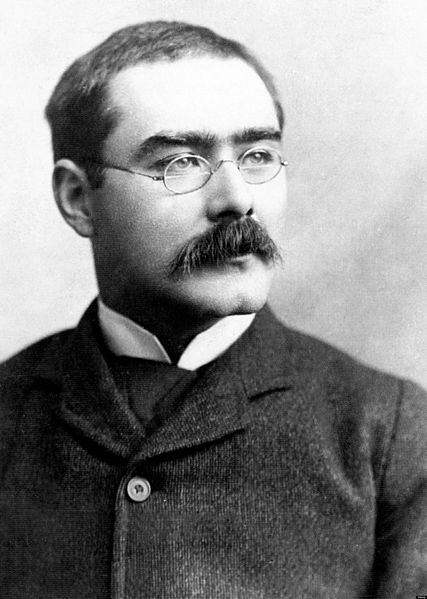
Portrait of Rudyard Kipling from the biography Rudyard Kipling by John Palmer, 1895.
Photo via Wikimedia Commons.
During five literary generations every enlightened person has despised him, and at the end of that time nine-tenths of those enlightened persons are forgotten and Kipling is in some sense still there.
Orwell’s essay on Rudyard Kipling in the Letters and Essays is both more favorable and more perceptive than one would expect of a discussion of Kipling by a British left-wing intellectual c. 1940. Orwell recognizes Kipling’s intelligence and his talent as a writer, pointing out how often people, including people who loath Kipling, use his phrases, sometimes without knowing their source. And Orwell argues, I think correctly, that Kipling not only was not a fascist but was further from a fascist than almost any of Orwell’s contemporaries, left or right, since he believed that there were things that mattered beyond power, that pride comes before a fall, that there is a fundamental mistake in
heathen heart that puts her trust
In reeking tube and iron shard,
All valiant dust that builds on dust,
And guarding, calls not Thee to guard,But while there is a good deal of truth in Orwell’s discussion of Kipling it is mistaken in two different ways, one having to do with Kipling’s view of the world, one with his art.
Orwell writes:
It is no use claiming, for instance, that when Kipling describes a British soldier beating a ‘nigger’ with a cleaning rod in order to get money out of him, he is acting merely as a reporter and does not necessarily approve what he describes. There is not the slightest sign anywhere in Kipling’s work that he disapproves of that kind of conduct — on the contrary, there is a definite strain of sadism in him, over and above the brutality which a writer of that type has to have.
There are passages in Kipling, not “Loot“, the poem Orwell quotes but bits of Stalky and Company, which support the charge of a “strain of sadism”. But the central element which Orwell is misreading is not sadism but realism. Soldiers loot when given the opportunity and there is no point to pretending they don’t. School boys beat each other up. Schoolmasters puff up their own importance by abusing their authority to ridicule the boys they are supposed to be teaching. Life is not fair. And Kipling’s attitude, I think made quite clear in Stalky and Company, is that complaining about it is not only a waste of time but a confession of weakness. You should shut up and deal with it instead.
A more important error in Orwell’s essay is his underestimate of Kipling as an artist, both poet and short story writer. Responding to Elliot’s claim that Kipling wrote verse rather than poetry, Orwell claims that Kipling was actually a good bad poet:
What (Elliot) does not say, and what I think one ought to start by saying in any discussion of Kipling, is that most of Kipling’s verse is so horribly vulgar that it gives one the same sensation as one gets from watching a third-rate music-hall performer recite ‘The Pigtail of Wu Fang Fu’ with the purple limelight on his face, AND yet there is much of it that is capable of giving pleasure to people who know what poetry means. At his worst, and also his most vital, in poems like ‘Gunga Din’ or ‘Danny Deever’, Kipling is almost a shameful pleasure, like the taste for cheap sweets that some people secretly carry into middle life. But even with his best passages one has the same sense of being seduced by something spurious, and yet unquestionably seduced.
I am left with the suspicion that Orwell is basing his opinion almost entirely on Kipling’s best known poems, such as the two he cites here, both written when he was 24. He was a popular writer, hence his best known pieces are those most accessible to a wide range of readers. He did indeed use his very considerable talents to tell stories and to make simple and compelling arguments, but that is not all he did. There is no way to objectively prove that Kipling wrote quite a lot of good poetry and neither Orwell nor Elliot, unfortunately, is still alive to prove it to, but I can at least offer a few examples …
QotD: The role of violence in historical societies
This is true even in historical societies that glorified war! Taking, for instance, medieval mounted warrior-aristocrats (read: knights), we find a far more complex set of values and social bonds. Military excellence was a key value among the medieval knightly aristocracy, but so was Christian religious belief and observance, so were expectations about courtly conduct, and so were bonds between family and oath-bound aristocrats. In short there were many forms of authority beyond violence even among military aristocrats. Consequently individuals could be – and often were! – lionized for exceptional success in these other domains, often even when their military performance was at best lackluster.
Roman political speech, meanwhile, is full of words to express authority without violence. Most obviously is the word auctoritas, from which we get authority. J.E. Lendon (in Empire of Honor: The Art of Government in the Roman World (1997)), expresses the complex interaction whereby the past performance of virtus (“strength, worth, bravery, excellence, skill, capacity”, which might be military, but it might also be virtus demonstrated in civilian fields like speaking, writing, court-room excellence, etc) produced honor which in turn invested an individual with dignitas (“worth, merit”), a legitimate claim to certain forms of deferential behavior from others (including peers; two individuals both with dignitas might owe mutual deference to each other). Such an individual, when acting or especially speaking was said to have gravitas (“weight”), an effort by the Romans to describe the feeling of emotional pressure that the dignitas of such a person demanded; a person speaking who had dignitas must be listened to seriously and respected, even if disagreed with in the end. An individual with tremendous honor might be described as having a super-charged dignitas such that not merely was some polite but serious deference, but active compliance, such was the force of their considerable honor; this was called auctoritas. As documented by Carlin Barton (in Roman Honor: Fire in the Bones (2001)), the Romans felt these weights keenly and have a robust language describing the emotional impact such feelings had.
Note that there is no necessary violence here. These things cannot be enforced through violence, they are emotional responses that the Romans report having (because their culture has conditioned them to have them) in the presence of individuals with dignitas. And such dignitas might also not be connected to violence. Cicero clearly at points in his career commanded such deference and he was at best an indifferent soldier. Instead, it was his excellence in speaking and his clear service to the Republic that commanded such respect. Other individuals might command particular auctoritas because of their role as priests, their reputation for piety or wisdom, or their history of service to the community. And of course beyond that were bonds of family, religion, social group, and so on.
And these are, to be clear, two societies run by military aristocrats as described by those same military aristocrats. If anyone was likely to represent these societies as being entirely about the commission of violence, it would be these fellows. And they simply don’t.
Bret Devereaux, “Collections: The Universal Warrior, Part III: The Cult of the Badass”, A Collection of Unmitigated Pedantry, 2021-02-05.
October 17, 2023
Why WW1 Cavalry Was Essential On The Battlefield
The Great War
Published 13 Oct 2023The First World War was a catalyst for modern warfare with tanks, poison gas, flamethrowers and more. Cavalry didn’t have a place anymore on the modern battlefield – or so the common misconception goes. In this video we show how useful cavalry still was in WW1.
(more…)
An appropriate task for AI – reading the Herculaneum scrolls
Colby Cosh discusses the possibility of finally being able to read the carbonized scolls found in the buried remains of a wealthy Roman’s country villa in 1750:
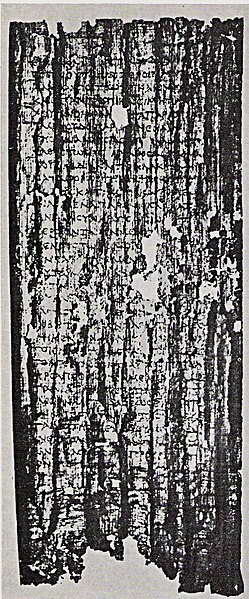
Unrolled papyrus scroll recovered from the Villa of the Papyri.
Picture published in a pamphlet called “Herculaneum and the Villa of the Papyri” by Amedeo Maiuri in 1974. (Wikimedia Commons)
From the standpoint of fragile human life, a volcanic eruption is the worst possible thing that can happen anywhere in your general vicinity, up to and probably including the detonation of a nuclear weapon.
It goes without saying that pyroclastic flows are also bad for animals or buildings or vegetation … or documents. And yet: as a consequence of the eruption of Vesuvius, there exists a near-complete library of papyrus scrolls retrieved from the buried ruins of a splendid Roman villa.
The “Villa of the Papyri” in Herculaneum was found in 1750 by farmers and was quickly subjected to archeological excavation, an art then in its infancy.
These scrolls, which today number about 1,800 in all, are often described as the only known library to have physically survived from antiquity. The problem, of course, is that they have all been burned literally to a crisp, with only a few easily readable fragments here and there.
The incinerated scrolls are so sensitive that they tend to explode into a cloud of ash at the slightest touch. Occasional attempts to unravel the scrolls — which were rolled very tightly for storage in the first place — have been made over the past 300 years; the chemist Sir Humphry Davy (1778-1829), for example, gave it a shot using newfangled stuff called chlorine. But none of these projects ever came especially close to success, and they typically involved destruction of some of the “books” in the library.
In recent years 3D imaging techniques for “reading” documents like this in a non-invasive way have been making great headway. The leader in the field is a University of Kentucky computer scientist named Brent Seales, who in 2015 led efforts to read a fragile, desiccated Hebrew Bible parchment scroll dating to the third or fourth century AD.
The text was from the book of Leviticus, and proved to be a letter-for-letter match with the Torah of today — which is a disappointment to scholars from one point of view, and a finding of awesome significance from another. (It goes without saying that this scroll came from the territory of Israel, near a kibbutz: this is a fact that would, in any other political context, be regarded as a supreme affirmation of indigeneity.)
Seales has been able to “unroll” some Herculaneum scrolls and detect the presence of inks using CT scanning, but reading the pages is a profound challenge. Roman ink was carbon-based, meaning researchers are trying to “read” traces of carbon on carbonized pages rolled up into three dimensions.


