
Historigraph
Published on 24 Nov 2018So it’s probably worth noting here that when Dreadnought made all other battleships irrelevant, it didn’t do so equally. For example, Japan had constructed two ‘semi-dreadnoughts’ a couple of years earlier, with more 10-inch guns than was standard at the time. The Americans too were moving towards building an ‘all-big-gun’ battleship, but they were much slower at getting them built than the British.
If you enjoyed this video and want to see more made, consider supporting my efforts on Patreon: https://www.patreon.com/historigraph
Sources:
Robert K. Massie, Dreadnought: Britain, Germany and the Coming of the Great War
Ben Wilson, Empire of the Deep: The Rise and Fall of the British Navy
December 14, 2018
Dreadnought: The Battleship that Changed Everything
Comments Off on Dreadnought: The Battleship that Changed Everything
December 11, 2018
Viking Expansion – Lies – Extra History
Extra Credits
Published on 8 Dec 2018Writer Rob Rath talks about all the cool stories and facts we didn’t get to cover in the already expansive Viking Expansion series.
Join us on Patreon! http://bit.ly/EHPatreon
7:08 – Rob learns he has a linguistic tic about being able to correctly distinguish “ancestor” and “descendant”
17:10 – Olga of Kiev scared Matt to death… really though…
25:23 – Walpole Connection
28:05 – what’s next on Extra HistorySome other works to check out: The Sea Wolves: A History of the Vikings, by Lars Brownworth / The Vikings, by Else Roesdahl / Podcast: Norse by Northwest
Comments Off on Viking Expansion – Lies – Extra History
December 9, 2018
The Invasion of Finland – WW2 – 015 8 December 1939
World War Two
Published on 8 Dec 2018When the Red Army invades Finland they get a cold reception and a pretty nasty surprise. It looks like team Stalin might just be skating on some very thin ice.
WW2 day by day, every day is now live on our Instagram account @World_war_two_realtime https://www.instagram.com/world_war_t…
Between 2 Wars: https://www.youtube.com/playlist?list…
Join us on Patreon: https://www.patreon.com/TimeGhostHistory
Or join The TimeGhost Army directly at: https://timeghost.tvWritten and Hosted by: Indy Neidell
Produced and Directed by: Spartacus Olsson and Astrid Deinhard
Executive Producers: Bodo Rittenauer, Astrid Deinhard, Indy Neidell, Spartacus Olsson
Research by: Indy Neidell
Edited by: Iryna Dolka
Map animations by: Mikk Tali aka Eastory
Community Manager: Joram AppelColoring by Spartacus Olsson and Norman Stewart, Thumbnail character courtesy of Olga Sharina aka Klimbim
Eastory’s channel: https://www.youtube.com/channel/UCEly…
Norman’s pictures https://oldtimesincolor.blogspot.com/
Archive by Screenocean/Reuters https://www.screenocean.com
A TimeGhost chronological documentary produced by OnLion Entertainment GmbH
Comments Off on The Invasion of Finland – WW2 – 015 8 December 1939
December 2, 2018
The Winter War – WW2 – 014 December 1 1939
World War Two
Published on 1 Dec 2018On the last day of November 1939 the Red Army of the USSR invades Finland and the Winter War begins.
WW2 day by day, every day is now live on our Instagram account @World_war_two_realtime https://www.instagram.com/world_war_t…
Between 2 Wars: https://www.youtube.com/playlist?list…
Join us on Patreon: https://www.patreon.com/TimeGhostHistory
Or join The TimeGhost Army directly at: https://timeghost.tvWritten and Hosted by: Indy Neidell
Produced and Directed by: Spartacus Olsson and Astrid Deinhard
Executive Producers: Bodo Rittenauer, Astrid Deinhard, Indy Neidell, Spartacus Olsson
Research by: Indy Neidell
Edited by: Iryna Dolka
Community Manager: Joram AppelColoring by Spartacus Olsson and Norman Stewart
Norman’s pictures https://oldtimesincolor.blogspot.com/Archive by Screenocean/Reuters https://www.screenocean.com
A TimeGhost chronological documentary produced by OnLion Entertainment GmbH
Comments Off on The Winter War – WW2 – 014 December 1 1939
November 30, 2018
Defense of Poland – Under Siege – Extra History – #2
Extra Credits
Published on 29 Nov 2018This series is brought to you by World of Tanks PC. Check out the game at https://redir.wargaming.net/z3ehuthn/… and use the code ORLIK for extra goodies.
Poland, alone, faces off both Soviet Russia armies and the Germans for five long weeks. Foreign reporter Julien Bryan captures footage of the siege of Warsaw to deliver to the outside world. A resistance builds inside.
Join us on Patreon! http://bit.ly/EHPatreon
Comments Off on Defense of Poland – Under Siege – Extra History – #2
November 29, 2018
The Kerch Strait stand-off
The Russians are attempting to cut off Ukrainian access to the Sea of Azov, cloaking that action in standard disinformation to claim that Ukraine is the aggressor, etc. Shoshana Bryen outlines the situation at the moment:
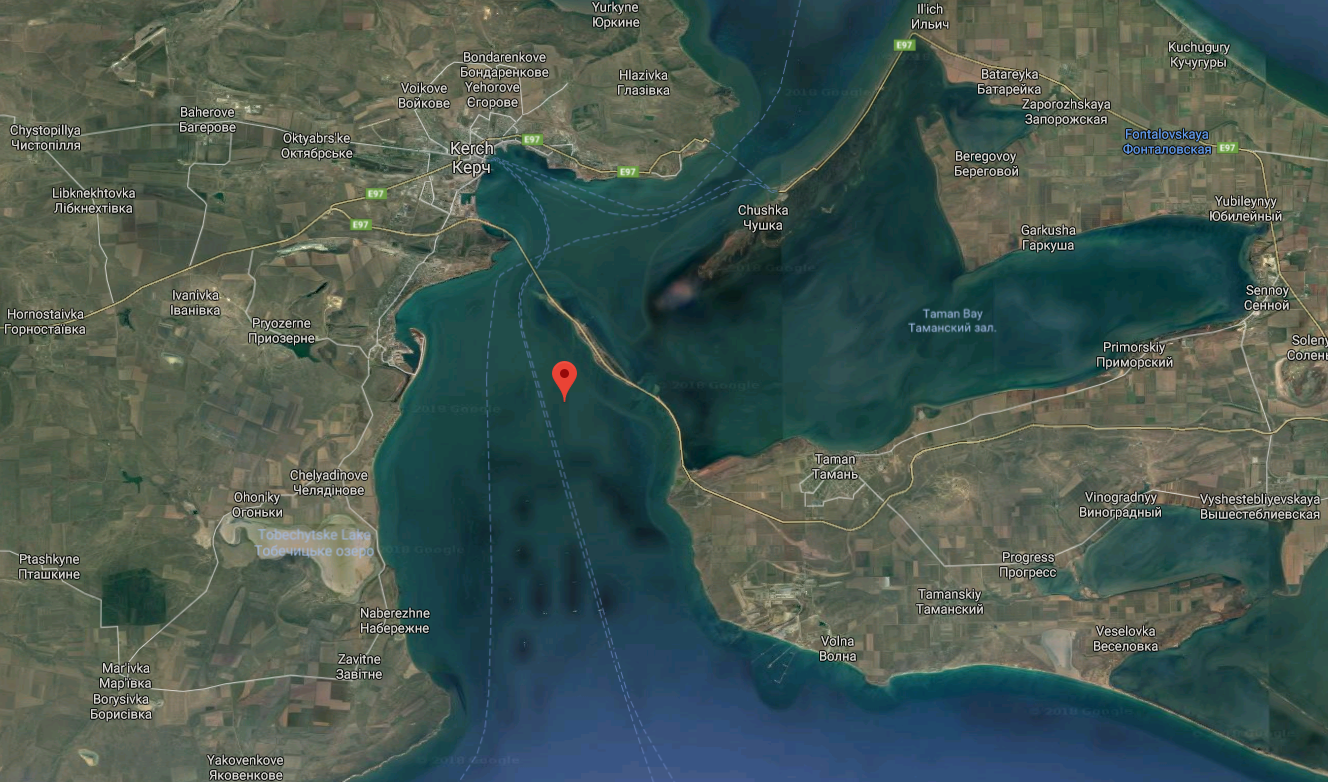
Satellite view of the Kerch Strait via Google Maps
Every story has a starting point. Don’t start with the Russian capture this week of two (or three) Ukrainian ships and the injury to three (or six) Ukrainian sailors. The Russian habit is to do as it likes with smaller countries and then announce that the other guy did it (or it never happened at all). That is the story of the Russian war in Ukraine and the 2014 illegal annexation of Crimea, and that is the Russian story of the Ukrainian ships – two ships, not three, three injured not six; anyhow, Ukraine was sailing out of its lane.
Start instead with the bridge over the narrow Kerch Strait that opened earlier in 2018. It is the only entrance to the Azov Sea from the Black Sea, spanning the Taman Peninsula in Russia and the Kerch Peninsula in Crimea. Earlier plans for the bridge were completed between Russia and Ukraine, but that was before the Russians occupied Crimea. There is an agreement for Ukrainian passage to its two ports along the Azov Sea, but Ukraine has complained that the bridge is the beginning of a blockade that would ultimately control or end Ukrainian shipping. There have been delays for Ukrainian ships passing through, sometimes days, and oh, by the way, the bridge is very low – nearly flat – over the water, meaning that Ukrainian ships over 115 feet can’t pass at all. And now there is a Russian ship parked under the bridge, blocking traffic.
It is estimated that Ukrainian shipping through the strait is down nearly 25% since the bridge opened – as the Ukrainians feared and as the Russians planned.
Austin Bay looks at the military and diplomatic side:
Closing the Kerch Strait effectively blockades Berdyansk and Mariupol, two Ukrainian ports on the Sea of Azov’s north coast.
In 2015, while visiting Crimea, Vladimir Putin himself said he hoped there would be no “full-scale direct clashes” between Ukrainian and Russian forces.
But on Nov. 25, Russia’s war against Ukraine escalated as verifiably Russian coast guard forces under the command of the Russian Federal Security Service intercepted (rammed says Ukraine), boarded and seized two verifiably Ukrainian naval vessels and a Ukrainian tugboat. The 24 Ukrainians on board the ships became Russian prisoners.
The Kremlin claimed the Ukrainian vessels had conducted “dangerous maneuvers” in Russian territorial water.
Putin’s Kremlin specializes in adding complex twists to blatant falsehoods. There is no evidence the Ukrainian ships did anything but try to avoid being intercepted. Russian territorial water? To buy that you must accept Russia’s illegal seizure of the peninsula. However, the strait is an internationally recognized waterway open to transit by commercial shipping and naval vessels. Kerch is comparable to other straits around the globe, like the Strait of Hormuz at the mouth of the Persian Gulf. Iran routinely threatens to close Hormuz to shipping, but to do so would violate freedom of navigation and constitute an act of war.
Defense One reported that Kiev had informed Moscow that its naval vessels would transit the strait. Moreover, the Russians who boarded the Ukrainian ships were special operations commandos.
The Ukrainian ships were making a legal transit. As recently as 2003, Russia guaranteed Ukraine’s right to transit the strait. The 2003 treaty made the strait and Sea of Azov shared territory.
Like invading Crimea, the Russian seizure of Ukrainian ships is a calculated act of war. Russia has now anchored an oil tanker in the main sealane beneath the bridge, blocking all ship traffic.
Ukrainian Foreign Minister Pavlo Klimkin said ramming a Ukrainian vessel was an “act of armed aggression” and that Russia had violated “the freedom of maritime traffic.” He also cited specific articles in the United Nations Convention on the Law of the Sea that “bans the obstruction of peaceful transit across the Kerch Strait.”
Several articles referenced the possibility that NATO would … do something. Other than the usual diplomatic protests, I doubt that there’s much NATO can do in a situation like this. Direct military action should not even be considered an option (not that it’ll stop the odd wild-eyed editorial writer), as NATO does not have a direct interest at risk here. All western nations do have an interest in preserving and upholding freedom of the seas, but Russia knows that the west won’t likely risk getting into a shooting war over incidents like this.
You can get a very useful list of links including the current Kerch Strait confrontation from MILNEWS.ca.
Comments Off on The Kerch Strait stand-off
November 26, 2018
Will the Kriegsmarine Rule the Waves? – WW2 – 013 24 November 1939
World War Two
Published on 24 Nov 2018The European Allies seek a countermeasure to the mysterious German mines, in China the Japanese advance, and in Poland it is the beginning of the Warsaw Ghetto.
WW2 day by day, every day is now live on our Instagram account @World_war_two_realtime https://www.instagram.com/world_war_t…
Join us on Patreon: https://www.patreon.com/TimeGhostHistory
Or join The TimeGhost Army directly at: https://timeghost.tvWritten and Hosted by: Indy Neidell
Produced and Directed by: Spartacus Olsson and Astrid Deinhard
Executive Producers: Bodo Rittenauer, Astrid Deinhard, Indy Neidell, Spartacus Olsson
Research by: Indy Neidell
Edited by: Wieke Kapteijns and Spartacus Olsson
Community Manager: Joram AppelColoring by Spartacus Olsson and Norman Stewart
Norman’s pictures https://oldtimesincolor.blogspot.com/Archive by Screenocean/Reuters https://www.screenocean.com
A TimeGhost chronological documentary produced by OnLion Entertainment GmbH
Comments Off on Will the Kriegsmarine Rule the Waves? – WW2 – 013 24 November 1939
November 25, 2018
Lenin’s death and Stalin’s rise to Power I BETWEEN 2 WARS I 1924 Part 1 of 2
TimeGhost History
Published on 24 Nov 2018As Lenin’s health starts to fail, the struggle to become his successor picks up speed with Stalin maneuvering closer and closer to power. The outcome of this struggle will define a century of world events.
First off: sorry for some sound issues this was recorded before we built our studio. Again we jump ahead a bit to cover events in the 1920s that have a huge impact on the current events in our WW2 In Real Time series. Our TimeGhost Army member Kamil Szadkowski made this episode possible with his research and balanced views on the events of 1924. Also many, many thanks to Olga Shirnina for providing us with the excellent colorized images for this episode. Check out Olga’s amazing volume of work here: https://klimbim2014.wordpress.com.
Join us on Patreon: https://www.patreon.com/TimeGhostHistory
Hosted by: Indy Neidell
Written and directed by: Spartacus Olsson
Research Contributed by: Kamil Szadkowski
Produced by: Astrid Deinhard
Executive Producers: Bodo Rittenauer, Astrid Deinhard, Indy Neidell, Spartacus Olsson
Community Manager: Joram AppelArchive by Screenocean/Reuter https://www.screenocean.com
A TimeGhost chronological documentary produced by OnLion Entertainment GmbH
Miracle on the Vistula – Polish Soviet War I BETWEEN 2 WARS I 1920 Part 1 of 4
https://www.youtube.com/watch?v=Equ7u…Russia Before the 1917 Revolution I THE GREAT WAR Special
https://www.youtube.com/watch?v=t1b3f…The Russian February Revolution 1917 I THE GREAT WAR Week 137
https://www.youtube.com/watch?v=5SyO5…The Russian October Revolution 1917 I THE GREAT WAR Week 172
https://www.youtube.com/watch?v=2uoLo…The Last Tsar of Russia – Nicholas II I WHO DID WHAT IN WW1?
https://www.youtube.com/watch?v=2OnTL…Lenin & Trotsky – Their Rise To Power I WHO DID WHAT IN WW1?
https://www.youtube.com/watch?v=CPoJ6…
Comments Off on Lenin’s death and Stalin’s rise to Power I BETWEEN 2 WARS I 1924 Part 1 of 2
November 19, 2018
Viking Expansion – The Lands of the Rus – Extra History – #4
Extra Credits
Published on 17 Nov 2018The Rus Vikings headed further inland into eastern Europe, raiding Constantinople (unsuccessfully) at first, and then eventually falling into negotiations with the Byzantines and changing their own culture over time. One of their most famous descending rulers was Olga of Kiev, who was also the grandmother of Vladimir.
Join us on Patreon! http://bit.ly/EHPatreon
Comments Off on Viking Expansion – The Lands of the Rus – Extra History – #4
November 18, 2018
The Mysterious Threat to the Royal Navy – WW2 – 012 17 November 1939
World War Two
Published on 17 Nov 2018While the Finns and the Soviets seem to be moving ever closer to war, the Royal Navy is losing ships at a frightening rate to an explosive threat not yet understood.
WW2 day by day, every day is now live on our Instagram account @World_war_two_realtime https://www.instagram.com/world_war_t…
Between 2 Wars: https://www.youtube.com/playlist?list…
Join us on Patreon: https://www.patreon.com/TimeGhostHistory
Or join The TimeGhost Army directly at: https://timeghost.tvWritten and Hosted by: Indy Neidell
Produced and Directed by: Spartacus Olsson and Astrid Deinhard
Executive Producers: Bodo Rittenauer, Astrid Deinhard, Indy Neidell, Spartacus Olsson
Research by: Indy Neidell
Edited by: Wieke Kapteijns and Spartacus Olsson
Community Manager: Joram AppelColoring by Spartacus Olsson
Archive by Screenocean/Reuters https://www.screenocean.com
A TimeGhost chronological documentary produced by OnLion Entertainment GmbH
Comments Off on The Mysterious Threat to the Royal Navy – WW2 – 012 17 November 1939
November 11, 2018
Hitler Almost Killed – WW2 – 011 10 November 1939
World War Two
Published on 10 Nov 2018As Hitler drives for a fast invasion he faces covert and open resistance, even an assignation attempt. In the background British and German agents and double agents play a game of betrayal and counter-betrayal.
WW2 day by day, every day is now live on our Instagram account @World_war_two_realtime https://www.instagram.com/world_war_t…
Join us on Patreon: https://www.patreon.com/TimeGhostHistory
Or join The TimeGhost Army directly at: https://timeghost.tvWritten and Hosted by: Indy Neidell
Produced and Directed by: Spartacus Olsson and Astrid Deinhard
Executive Producers: Bodo Rittenauer, Astrid Deinhard, Indy Neidell, Spartacus Olsson
Research by: Indy Neidell
Edited by: Ben Ollerenshaw and Spartacus OlssonColoring by Spartacus Olsson and Sarvesh
Archive by Screenocean/Reuters https://www.screenocean.com
A TimeGhost chronological documentary produced by OnLion Entertainment GmbH
Comments Off on Hitler Almost Killed – WW2 – 011 10 November 1939
November 4, 2018
Molotov’s Heel on Finland and Nobody to Fight in the West – WW2 – 010 3 November 1939
World War Two
Published on 3 Nov 2018Ten weeks into World War Two, and the Allied ground forces are bored in France. In North-Eastern Europe, Poland’s suffering has no end and Finland is in the crosshairs of the USSR.
WW2 day by day, every day is now live on our Instagram account @World_war_two_realtime https://www.instagram.com/world_war_t…
Between 2 Wars: https://www.youtube.com/playlist?list…
Join us on Patreon: https://www.patreon.com/TimeGhostHistory
Or join The TimeGhost Army directly at: https://timeghost.tvWritten and Hosted by: Indy Neidell
Produced and Directed by: Spartacus Olsson and Astrid Deinhard
Executive Producers: Bodo Rittenauer, Astrid Deinhard, Indy Neidell, Spartacus Olsson
Research by: Indy Neidell
Edited by: Wieke Kapteijns and Spartacus OlssonColoring by Spartacus Olsson and Sarvesh
Archive by Screenocean/Reuters https://www.screenocean.com
A TimeGhost chronological documentary produced by OnLion Entertainment GmbH
Comments Off on Molotov’s Heel on Finland and Nobody to Fight in the West – WW2 – 010 3 November 1939
October 28, 2018
Stalin’s Murderous Adventures – WW2 – 009 October 27 1939
World War Two
Published on 27 Oct 2018The persecution, incarceration, enslavement and murder of the Polish people in occupied Poland is driven by ideological hatred for both Nazi Germany and Soviet Russia, but it’s also a personal matter for Joseph Stalin.
WW2 day by day, every day is now live on our Instagram account @World_war_two_realtime
Cuban Missile Crisis Day by Day: https://www.youtube.com/watch?v=oo2Av…
Between 2 Wars: https://www.youtube.com/playlist?list…
Join us on Patreon: https://www.patreon.com/TimeGhostHistory
Or join The TimeGhost Army directly at: https://timeghost.tvWritten and Hosted by: Indy Neidell
Produced and Directed by: Spartacus Olsson and Astrid Deinhard
Executive Producers: Bodo Rittenauer, Astrid Deinhard, Indy Neidell, Spartacus Olsson
Research by: Indy Neidell
Edited by: Spartacus Olsson an Ben Ollerenshaw
Trainee editor SarveshColoring by Spartacus Olsson, Olga Shirnina and Norman Stewart
Olga’s pictures: https://klimbim2014.wordpress.com
Norman’s pictures https://oldtimesincolor.blogspot.com/Archive by Screenocean/Reuters https://www.screenocean.com
A TimeGhost chronological documentary produced by OnLion Entertainment GmbH
Comments Off on Stalin’s Murderous Adventures – WW2 – 009 October 27 1939
October 21, 2018
The Submarine War – WW2 – 008 October 20 1939
World War Two
Published on 20 Oct 2018For the men in the navies of the warring nations in Europe, there was nothing phony about WW2 in October 1939 – mortal danger was immediately under the cold surface at the receiving end of a torpedo or a depth charge…
Join us on Patreon: https://www.patreon.com/TimeGhostHistory
Or join The TimeGhost Army directly at: https://timeghost.tvWritten and Hosted by: Indy Neidell
Produced and Directed by: Spartacus Olsson and Astrid Deinhard
Executive Producers: Bodo Rittenauer, Astrid Deinhard, Indy Neidell, Spartacus Olsson
Research by: Indy Neidell
Edited by: Spartacus Olsson an Ben Ollerenshaw
Trainee editor SarveshColoring by Spartacus Olsson, Olga Shirnina and Norman Stewart
Olga’s pictures: https://klimbim2014.wordpress.com
Norman’s pictures https://oldtimesincolor.blogspot.com/Archive by Screenocean/Reuters https://www.screenocean.com
A TimeGhost chronological documentary produced by OnLion Entertainment GmbH
Comments Off on The Submarine War – WW2 – 008 October 20 1939
October 14, 2018
The Baltic in Stalin’s Squeeze – WW2 – 007 13 October 1939
World War Two
Published on 13 Oct 2018While the Third Reich and USSR consolidate their Polish conquest, their leaders are wary of each other but turn the attention to the next prize. Stalin moves to the North and Hitler pushes for an attack in the West.
Join us on Patreon: https://www.patreon.com/TimeGhostHistory
Or join The TimeGhost Army directly at: https://timeghost.tvWritten and Hosted by: Indy Neidell
Produced and Directed by: Spartacus Olsson and Astrid Deinhard
Executive Producers: Bodo Rittenauer, Astrid Deinhard, Indy Neidell, Spartacus Olsson
Research by: Indy Neidell
Edited by: Spartacus Olsson and Ben OllerenshawColorized Pictures by Spartacus Olsson, Olga Shirnina and Norman Stewart
Olga’s pictures: https://klimbim2014.wordpress.com
Norman’s pictures https://oldtimesincolor.blogspot.com/Archive by Screenocean/Reuters https://www.screenocean.com
A TimeGhost chronological documentary produced by OnLion Entertainment GmbH
Comments Off on The Baltic in Stalin’s Squeeze – WW2 – 007 13 October 1939


