
Feral Historian
Published 16 Aug 2024A dive into 1984 in relation to modern politics can’t be done without pissin’ in everyone’s Froot-Loops, so grab a tall glass of Victory Gin and let’s talk about how The Party functions, how doublethink makes us crazy, and how it’s not just those nutters on the other side that do it.
I take a few jabs at current sacred cows of the Left and Right here. Hopefully the comments won’t look like Hate Week.
00:00 Intro
01:46 Thoughtcrime and Doublethink
12:27 War is Peace
17:46 Oligarchal Collectivism
22:12 MiniTruePost-release edit: It’s been pointed out that I grossly oversimplified the military analysis later in the video, which is true. Man-portable air defense systems and maneuver warfare are a lot more complicated than this video implies. As for that one particular doublethink example mentioned so very briefly, some of the counterpoints have been … impressive contortions of language in their own right. But not interesting enough to discuss the matter further.
April 29, 2025
1984 and the Politicizing of Language
April 28, 2025
Stalin and Tito fight over the Balkans: Greek Civil War part 2 – W2W 24 – 1948 Q4
TimeGhost History
Published 27 Apr 20251948 plunges Greece deeper into civil war as foreign aid fuels brutality on both sides. The Nationalist government launches ruthless crackdowns, establishing notorious prison camps, while the Communist Democratic Army desperately seeks aid from Yugoslavia and Stalin’s Soviet Union. But when Stalin rejects the rebellion, Yugoslavia’s Tito steps in — until a stunning feud erupts, leaving Greek communists stranded. Will this power struggle decide Greece’s fate?
(more…)
April 27, 2025
Nuking the Reich: What If the War Had Dragged On? – Out of the Foxholes Live
World War Two
Published 26 Apr 2025Indy and Sparty bring you another episode of Out of the Foxholes Live! Today they talk about Thailand’s relationship with Japan, ask why the Americans firebombed Japanese cities even after cutting off the country’s supplies, and they tackle a big one: would the Allies have nuked Germany?
(more…)
“[T]he practical reality of electoral politics throughout the west: the choice is between a Leftward Ho! party and a Ratchet party”
Mark Steyn on the steady leftward march of pretty much every western nation that never, ever stops and only rarely slows down:
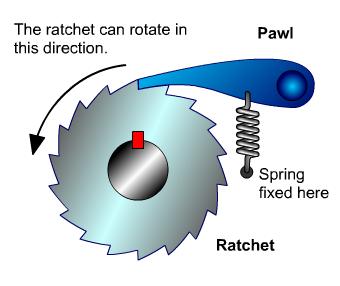
A ratchet allows rotation in one direction, but prevents rotation in the other direction. That’s been a common explanation of most western governments for decades … leftward motion occurs, but can only be stopped, never reversed.
In a shrewd assessment of the current campaign Down Under, Paul Collits cites a certain “niche Canadian”:
Mark Steyn says that we cannot vote our way out of the Western mess. The 2025 Australian election is living proof of the truth of his claim. Whoever wins here will inherit an unholy mess, and will not have the will to address it.
Of course, he could be talking about next week’s Canadian election or last month’s German election. As we have noted, Fred Merz, the incoming chancellor in Berlin, has yet to take office but what Americans call the honeymoon is over before the coalition has been officially pronounced man and wife. Hermann Binkert, head honcho of Germany’s INSA polling agency, says the country has never seen loss of approval on this scale between the election and the formation of the government. The so-called “far-right” AfD is now leading in multiple polls. Which would be super-exciting if voting hadn’t already taken place.
In America, the new administration certainly has the “will to address” the “unholy mess” but the Trumpian Gulliver is beset on all sides by District Court Lilliputians whose position is that what a Democrat president has done cannot “lawfully” be undone. This is a pseudo-“constitutional” recognition of the practical reality of electoral politics throughout the west: the choice is between a Leftward Ho! party and a Ratchet party. If the Left wins, they dissolve the border and trannify your kids. If the “Right” wins (Stephen Harper, Scott Morrison), they may pause some of the more obviously crazy stuff but they never actually reverse the direction of travel. Unless they’re the UK Tories (Cameron, May, Johnson, Sunak), in which case they stay in the leftie lane without even shifting down to third gear.
So “politics”, as increasingly narrowly defined, is less and less likely to save you. Because the gap between “politics” and reality grows ever wider. Consider the instructive example of one Hashem Abedi. Mr Abedi and his brother plotted the Ariana Grande concert bombing in Manchester. It was, from the Abedi viewpoint, a huge success: twenty-two dead, half of them kids, plus a thousand injured. It was a big deal at the time: lots of flowers, teddy bears, and heart-rending renditions of “Don’t Look Back in Anger”.
So you’d have thought even the British state would have at least pretended to take it seriously. Hashem Abedi was detained at His Majesty’s Pleasure, and under one of the three supposedly toughest prison regimes in England and Wales. Nevertheless, on April 12th he put three of his guards in hospital with what were described as “life-threatening injuries“. A fortnight later, two are still there. How did a maximum-security prisoner manage to do that? Well, he used boiling cooking oil and weaponised kitchen utensils.
So how did he get hold of boiling cooking oil? Was he a finalist for Maximum Security Masterchef? Ah, well. The details remain vague, and as usual the worthless UK media has shown not the slightest curiosity in how the Ariana Grande perp came close to bulking up his death toll by fifteen per cent.
In the Footsteps of 45 Commando: 60 Miles Across the Falklands
Forgotten Weapons
Published 28 Dec 2024I was recently joined by my friends Les Winner (Polaris Logistics) and Jari Laine (Varusteleka) for an epic trek across East Falkland in the footsteps of 45 Commando of the British Royal Marines. In 1982, the Marines landed to rebuff the Argentine invasion of the islands. Specifically, they landed at Port San Carlos on the far western side of the island, planning to use heavy-lift helicopters to move east to attack the Argentine positions around Stanley. However, the Chinooks they were counting on were on the Atlantic Conveyor, which was sunk by Argentine Exocet attack on May 25. That left the Marines with no choice but to hike the 60 miles or so overland. They did so overland in the South Atlantic winter, with combat loads and full rucksacks — it was a brutal movement that they executed with aplomb.
Les, Jari, and I wanted to see the ground, and so we headed out to follow the same path, albeit without the weapons or ammunition and in the summer. We took four days to complete the distance, meeting some really cool people and making lots of blisters along the way. This video is a record of that trip.
(more…)
April 26, 2025
A proposal for cutting the Channel crossing phenomenon
In The Conservative Woman, David Wright suggests a concrete plan to stem the tide of “refugees” arriving in the south of England from Calais and other French Channel ports:
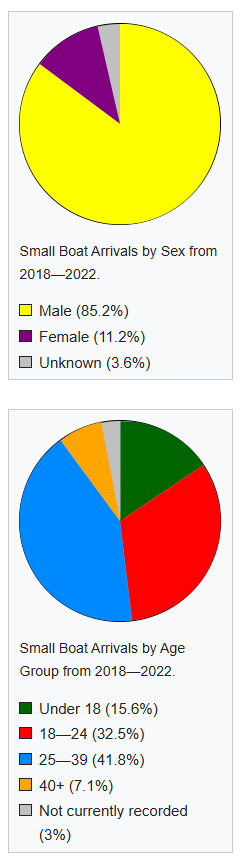
Illegal Channel crossings by rubber dinghies overloaded predominantly with young men have been an increasingly worrying trend for many years yet successive governments have made no serious or workable attempts to do anything about it.
Migrant crossings are up by more than 40 per cent on last year and a record for daily arrivals has been set. A total of 705 migrants in 12 boats crossed the Channel on Tuesday April 15, days after the previous record of 656 was set the previous Saturday. The total number of arrivals in 2025, at 8,888, is 42 per cent higher than at the same point last year and 81 per cent higher than at this stage in 2023. More arrivals were recorded in January to April than in the equivalent four-month period in any year since data on Channel crossings began in 2018.
The French authorities are providing lifejackets to ensure migrants can cross the Channel safely. The jackets are returned to the French once the migrants have been escorted to the mid-point of the Channel and are rescued by the British authorities, so that they can be re-used for future crossings.
We have seen French police on the beach at Calais standing idly by while migrants board dinghies to Dover.
[…]
The boats should be painted grey, a small gun mounted on the foredeck, and manned with recently retired RN personnel. (There would be no shortage of volunteers.) A small support base should be built in Folkestone harbour, initially using Portakabins for rapid start-up, with fuelling facilities, a small workshop, an accommodation block and a canteen. This could be achieved relatively quickly and at a modest cost to the defence budget. These boats would be tasked with patrolling the Dover Strait every day from dawn to dusk, three or four at a time. Drones could also be used to detect dinghies and direct the patrolling boats to them. They would not need to be at sea in weather too rough for small smuggler-boat crossings.
They should be tasked to intercept the smugglers wherever they are in the Channel, approaching our shores, over the mid-way line or just leaving French beaches, and turned back and escorted. On approach to the smugglers’ beach the Border Force vessel should stand off and launch a RIB (rigid inflatable boat) manned by four staff who would escort them until they grounded on the beach. With two of them standing guard with weapons the others, using box cutters, would slash long holes in the rubber dinghies and remove the outboard motors and drop them into the water to render them unserviceable. On completion the RIB should return to its vessel and the vessel withdraw to resume patrol. Input from serving senior naval officers would be needed to provide detailed operating procedures. Once deployed this division would be under the command of a senior serving officer.
Of course, French President Emmanuel Macron would immediately be protesting. But he hasn’t got a leg to stand on. France is a signatory to the Schengen Agreement which requires migrants/asylum seekers to be processed in the first safe country they enter. Not only that but Britain has paid France almost half a billion pounds to stop the migrants arriving at the beaches and boarding dinghies to Dover.
France has not only done nothing but trouser this cash while its navy continues to escort the dinghies into UK waters and hand them off to our Border Force or the RNLI.

The Fairey Battle – Light Bomber, Heavy Losses
Rex’s Hangar
Published 17 Nov 2021Originally conceived in the early 1930s, by the time the first prototype of the Fairey Battle flew in 1936 it was already becoming obsolete. However, the RAF desperately needed combat aircraft, and so the Battle was put into production. It would go on to fight in the Battle of France, where it would take exceptionally heavy losses due to its slow speed and poor defensive armament. After being retired from front-line duty, the Fairey Battle would go on to becoming a successful training aircraft for the RAF and Commonwealth forces, serving the needs of combat flight schools in Canada, South Africa, Australia and New Zealand.
****
Producing these videos is a hobby of mine. I have a passion for history, and personally own a large collection of books, journals and other texts, and endeavor to do as much research as possible. However if there are any mistakes, please don’t hesitate to reach out and correct anything 🙂
April 25, 2025
Is Anschluss Back on the Menu? – Rise of Hitler 15, March 1931
World War Two
Published 24 Apr 2025March 1931 sees President Hindenburg unleash a controversial emergency decree, suspending key civil liberties to crush political violence in Germany. Meanwhile, Hitler promises legality but openly prepares the SA for the “Third Reich”, and the Nazi coalition in Thuringia collapses dramatically. Germany’s proposed customs union with Austria sparks international alarm — could this trigger another European conflict?
(more…)
What Were Georgian Attitudes Towards Sex? | Georgian Pleasures
History Hit
Published 12 Sept 2024Historian Dr Kate Lister removes Bridgerton‘s rose-tinted glasses, unlaces the corsets and unbuttons the breaches of the Georgians. Join Kate as she investigates how s*x and the world of celebrity were a big thing long before the 20th century.
The fabulous wealthy elite of Bridgerton look perfectly preened, their teeth, hair, make up, even their sex scenes are all filled with opulent glamour! But in reality a lot of people in Georgian society, including the wealthy, were dealing with a myriad of issues, from syphilis, teeth decay and scandals to laudanum and gin addictions. All of this would have been rife and incredibly visible on the big city streets during the booming industrial revolution.
Kate uncovers what went on betwixt the Georgian sheets: who’s doing what, where, how and with whom. Along the way she’ll explore extraordinary guides to s*x work in London and Edinburgh and unwrap the world of 18th century condoms, syphilis and even high profile and hidden sex clubs. All of this will help to unearth the real lives of the people stomping the streets, pubs and back alleys of these lavish Georgian cities. No stone is left unturned in the quest to reveal the real lives of Georgian society!
(more…)
April 24, 2025
Berlin Airlift: From Bombs to Candy – W2W 23 – 1948 Q3
TimeGhost History
Published 23 Apr 2025In 1948, Stalin blockades West Berlin, isolating over two million people without food, fuel, or supplies. Refusing to surrender the city, Western powers launch the Berlin Airlift, history’s largest aerial supply mission, to deliver food, coal, and even candy. As tensions soar, planes defy Soviet threats around the clock — can the Allies really sustain a city from the sky?
(more…)
Saving German democracy by banning the most popular party
As eugyppius frequently points out, German democracy is at risk of being taken over by mere voters, so the great and the good of the nation seem to be leaning toward making the Alternative für Deutschland only the third political party to be banned in modern German history:

I fear they will try to ban Alternative für Deutschland.
I spent many months last year saying this would not happen, and my reasons were fourfold:
1) Key figures in the major parties, including Chancellor Olaf Scholz of the SPD and Friedrich Merz of the CDU, opposed banning the AfD.
2) Marco Wanderwitz’s much-publicised initiative to ban the AfD was therefore a doomed movement among Bundestag backbenchers, overhyped by idiotic German journalists. As I predicted, it went nowhere.
3) Throughout much of 2024, the AfD were strong enough to be a problem, but not quite strong enough to cause prohibitive difficulties for the political cartel that runs the Federal Republic. They persisted in a sweet spot that ruined the risk-reward calculus of trying to ban them.
4) Through last summer, the NGO-coordinated and government-led “fight against the right” succeeded in seriously damaging AfD support. If the AfD could be kept in bounds via propaganda, a ban seemed additionally unlikely.
None of these considerations apply anymore: Support for banning the AfD is building within both the SPD and the CDU. Much more serious efforts to the ban the party are on the horizon; the Wanderwitz clownshow is yesterday’s foible. The AfD seem increasingly immune to state media propaganda and leftist political agitation.
More important than all of that, however, is the fact that the CDU have proven vastly more incompetent than I or anybody else anticipated. Through their own failures they are making the AfD into the strongest political party of the Federal Republic. Soon they will be in a position to threaten outright majorities in the East. This was going to happen sooner or later, but the CDU have accelerated the process massively. Things that should’ve taken years are now taking months, and that is very dangerous. It is far from inconceivable that the AfD will end up with a Minister President (i.e., a governor) in Mecklenburg-Vorpommern or Sachsen-Anhalt following the state elections in 2026. And however that turns out, the 2029 federal elections will be a nightmare. By then the AfD will be so strong that all other parties will have to form the world’s shittiest of shit coalitions to keep them out of power.
CDU General Secretary Carsten Linnemann warned in January that “if we in the democratic middle don’t stop illegal migration, the fringes will become so strong in the next election that they will be able to govern alone“. Well, it turns out that the “parliamentary middle” have no interest in stopping mass migration, not even to ensure their own political survival. Men like Friedrich Merz and Lars Klingbeil are like automata, locked via institutional imponderables on a predetermined course of national and political self-destruction. Unable to change their politics, they will try instead to remove the AfD from the map. If you can just ban the opposition you don’t have to solve problems, you don’t have to win arguments and you don’t have to persuade voters of anything.
Last October, Merz said he would be open to banning the AfD, if and when the Federal Office for the Protection of the Constitution (BfV) upgrades their political status. Later thinly sourced reports have Merz emphasising again at a closed CDU meeting that he would be “open” to banning the AfD, but that this would have to wait until “just after” the February elections.
At issue is a long-awaited report on the political crimes of the AfD from the domestic intelligence agents of the BfV. As of now, the BfV classifies the AfD as being “under suspicion of right-wing extremism”. This has been the case since 2021, and the classification has allowed the BfV to use their wealth of spy agency tactics against the party. They tap their phones, read their emails and send their agents to infiltrate AfD ranks.
Modernizing Le Clairon: the FAMAS Valorisé
Forgotten Weapons
Published 25 Dec 2024The FAMAS was the best bullpup rifle of its era, but it was a difficult platform to modernize with optics. In 1995, the “FELIN” (Fantassin à Équipement et Liaisons INtégrés; Integrated Infantry Equipment and Communications) was commissioned to create a next-generation weapons platform for the French soldier. This used a computerized multi-function optic mounted to a lowered rails system and a control keypad on a new front grip on the rifle. Like the American Objective Force Warrior and other similar programs, FELIN was not successful — but the base rifle did have a future. By dropping the new keypad-integrated lower assembly for the original FAMAS F1 lower but keeping the lowered upper assembly with its Picatinny rail, the FAMAS Valorisé was created, allowing much improved optics mounting.
These new rifles still used the FAMAS 25-round magazine, but now had Beretta-made barrels with 1:9 rifling, suitable for M855 and other heavy 5.56mm loadings. The Valorisé also included a small piece of rail specifically for an IR laser and added pivot to the bipod (which remained free-floated from the barrel). A total of 18,500 rifles were converted, and in 2015 they were used to equip 17 French regiments — and they saw some combat use in Afghanistan. Had the FAMAS platform been retained, this would have been the basis for its further modernization — but with adoption of the H&K 416F instead, the Valorisé rifles are being decommissioned.
(more…)
QotD: The Phalanx
… we need to distinguish what sort of phalanx because this is not the older hoplite phalanx in two very important ways: first, it is equipped and fights differently, but second it has a very different place in the overall tactical system: the Macedonian phalanx may be the “backbone” of a Hellenistic army, but it is not the decisive arm of the system.
So let’s start with the equipment, formation and fighting style. The older hoplite phalanx was a shield wall, using the large, c. 90cm diameter aspis and a one-handed thrusting spear, the dory. Only the front rank in a formation like this engaged the enemy, with the rear ranks providing replacements should the front hoplites fall as well as a morale force of cohesion by their presence which allowed the formation to hold up under the intense mental stress of combat. But while hoplites notionally covered each other with their shields, they were mostly engaged in what were basically a series of individual combats. As we noted with our bit on shield walls, the spacing here seems to have been wide enough that while the aspis of your neighbor is protecting you in that it occupies physical space that enemy weapons cannot pass through, you are not necessarily hunkered down shoulder-to-shoulder hiding behind your neighbor’s shield.
The Macedonian or sarisa-phalanx evolves out of this type of combat, but ends up quite different indeed. And this is the point where what should be a sentence or two is going to turn into a long section. The easy version of this section goes like this: the standard Macedonian phalangite (that is, the soldier in the phalanx) carried a sarisa, a two-handed, 5.8m long (about 19ft) pike, along with an aspis, a round shield of c. 75cm carried with an arm and neck strap, a sword as a backup weapon, a helmet and a tube-and-yoke cuirass, probably made out of textile. Officers, who stood in the first rank (the hegemones) wore heavier armor, probably consisting of either a muscle cuirass or a metal reinforced (that is, it has metal scales over parts of it) tube-and-yoke cuirass. I am actually quite confident that sentence is basically right, but I’m going to have to explain every part of it, because in popular treatments, many outdated reconstructions of all of this equipment survive which are wrong. Bear witness, for instance, to the Wikipedia article on the sarisa which gets nearly all of this wrong.
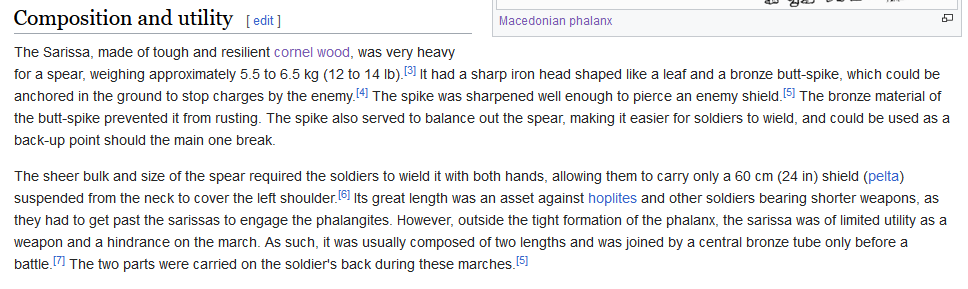
Wikipedia‘s article on the topic as of January, 2024. Let me point out the errors here.
1) The wrong wood, the correct wood is probably ash, not cornel – the one thing Connolly gets wrong on this weapon (but Sekunda, op. cit. gets right).
2) The wrong weight, entirely too heavy. The correct weight should be around 4kg, as Connolly shows.
3) Butt-spikes were not exclusively in bronze. The Vergina/Aigai spike is iron, though the Newcastle butt is bronze (but provenance, ????)
4) They could be anchored in the ground to stop cavalry. This pike is 5.8m long, its balance point (c. 1.6m from the back) held at waist height (c. 1m), so it would be angled up at something like 40 degrees, so anchoring the butt in the ground puts the head of the sarisa some 3.7m (12 feet) in the air – a might bit too high, I may suggest. The point could be brought down substantially if the man was kneeling, which might be workable. More to the point, the only source that suggests this is Lucian, a second century AD satirist (Dial Mort. 27), writing two centuries after this weapon and its formation had ceased to exist; skepticism is advised.
5) We’ll get to shield size, but assuming they all used the 60cm shield is wrong.
6) As noted, I don’t think these weapons were ever used in two parts joined by a tube and also the tube at Vergina/Aigai was in iron. Andronikos is really clear here, it is a talon en fer and a douille en fer. Not sure how that gets messed up.Sigh. So in detail we must go. Let us begin with the sarisa (or sarissa; Greek uses both spellings). This was the primary weapon of the phalanx, a long pike rather than the hoplite‘s one-handed spear (the dory). And we must discuss its structure, including length, because this is a case where a lot of the information in public-facing work on this is based on outdated scholarship, compounded by the fact that the initial reconstructions of the weapon, done by Minor Markle and Manolis Andronikos, were both entirely unworkable and, I think, quite clearly wrong. The key works to actually read are the articles by Peter Connolly and Nicholas Sekunda.1 If you are seeing things which are not working from Connolly and Sekunda, you may safely discard them.
Let’s start with length; one sees a very wide range of lengths for the sarisa, based in part on the ancient sources. Theophrastus (early third century BC) says it was 12 cubits long, Polybius (mid-second century) says it was 14 cubits, while Asclepiodotus (first century AD) says the shortest were 10 cubits, while Polyaenus (second century AD) says that the length was 16 cubits in the late fourth century.2 Two concerns come up immediately: the first is that the last two sources wrote long after no one was using this weapon and as a result are deeply suspect, whereas Theophrastus and Polybius saw it in use. However, the general progression of 12 to 14 to 16 – even though Polyaenus’ word on this point is almost worthless – has led to the suggestion that the sarisa got longer over time, often paired to notions that the Macedonian phalanx became less flexible. That naturally leads into the second question, “how much is a cubit?” which you will recall from our shield-wall article. Connolly, I think, has this clearly right: Polybius is using a military double-cubit that is arms-length (c. 417mm for a single cubit, 834mm for the double), while Theophrastus is certainly using the Athenian cubit (487mm), which means Theophrastus’ sarisa is 5.8m long and Polybius’ sarisa is … 5.8m long. The sarisa isn’t getting longer, these two fellows have given us the same measurement in slightly different units. This shaft is then tapered, thinner to the tip, thicker to the butt, to handle the weight; Connolly physically reconstructed these, armed a pike troupe with them, and had the weapon perform as described in the sources, which I why I am so definitively confident he is right. The end product is not the horribly heavy 6-8kg reconstructions of older scholars, but a manageable (but still quite heavy) c. 4kg weapon.
Of all of the things, the one thing we know for certain about the sarisa is that it worked.
Next are the metal components. Here the problem is that Manolis Andronikos, the archaeologist who discovered what remains our only complete set of sarisa-components in the Macedonian royal tombs at Vergina/Aigai managed to misidentify almost every single component (and then poor Minor Markle spent ages trying to figure out how to make the weapon work with the wrong bits in the wrong place; poor fellow). The tip of the weapon is actually tiny, an iron tip made with a hollow mid-ridge massing just 100g, because it is at the end of a very long lever and so must be very light, while the butt of the weapon is a large flanged iron butt (0.8-1.1kg) that provides a counter-weight. Finally, Andronikos proposed that a metal sleeve roughly 20cm in length might have been used to join two halves of wood, allowing the sarisa to be broken down for transport or storage; this subsequently gets reported as fact. But no ancient source reports this about the weapon and no ancient artwork shows a sarisa with a metal sleeve in the middle (and we have a decent amount of ancient artwork with sarisae in them), so I think not.3
Polybius is clear how the weapon was used, being held four cubits (c. 1.6m) from the rear (to provide balance), the points of the first five ranks could project beyond the front man, providing a lethal forward hedge of pike-points.4 As Connolly noted in his tests, while raised, you can maneuver quite well with this weapon, but once the tips are leveled down, the formation cannot readily turn, though it can advance. Connolly noted he was able to get a English Civil War re-enactment group, Sir Thomas Glemham’s Regiment of the Sealed Knot Society, not merely to do basic maneuvers but “after advancing in formation they broke into a run and charged”. This is not necessarily a laboriously slow formation – once the sarisae are leveled, it cannot turn, but it can move forward at speed.
The shield used by these formations is a modified form of the old hoplite aspis, a round, somewhat dished shield with a wooden core, generally faced in bronze.5 Whereas the hoplite aspis was around 90cm in diameter, the shield of the sarisa-phalanx was smaller. Greek tends to use two words for round shields, aspis and pelte, the former being bigger and the latter being smaller, but they shift over time in confusing ways, leading to mistakes like the one in the Wikipedia snippet above. In the classical period, the aspis was the large hoplite shield, while the pelte was the smaller shield of light, skirmishing troops (peltastai, “peltast troops”). In the Hellenistic period, it is clear that the shield of the sarisa-phalanx is called an “aspis” – these troops are leukaspides, chalkaspides, argyraspides (“white shields”, “bronze shields”, “silver shields” – note the aspides, pl. of aspis in there). This aspis is modestly smaller than the hoplite aspis, around 75cm or so in diameter; that’s still quite big, but not as big.
Then we have some elite units from this period which get called peltastai but have almost nothing to do with classical period peltastai. Those older peltasts were javelin-equipped light infantry skirmishers. But Hellenistic peltastai seem to be elite units within the phalanx who might carry the sarisa (but perhaps a shorter one) and use a smaller shield which gets called the pelte but is not the pelte of the classical period. Instead, it is built exactly like the Hellenistic aspis – complete with a strap-suspension system suspending it from the shoulder – but is smaller, only around 65cm in diameter. These sarisa-armed peltastai are a bit of a puzzle, though Asclepiodotus (1.2) in describing an ideal Hellenistic army notes that these guys are supposed to be heavier than “light” (psiloi) troops, but lighter than the main phalanx, carrying a smaller shield and a shorter sarisa, so we might understand them as an elite force of infantry perhaps intended to have a bit more mobility than the main body, but still be able to fight in a sarisa-phalanx. They may also have had less body-armor, contributing that the role as elite “medium” infantry with more mobility.6
Finally, our phalangites are armored, though how much and with what becomes really tricky, fast. We have an inscription from Amphipolis7 setting out military regulations for the Antigonid army which notes fines for failure to have the right equipment and requires officers (hegemones, these men would stand in the front rank in fighting formation) to wear either a thorax or a hemithorakion, and for regular soldiers where we might expect body armor, it specifies a kottybos. All of these words have tricky interpretations. A thorax is chest armor (literally just “a chest”), most often somewhat rigid armor like a muscle cuirass in bronze or a linothorax in textile (which we generally think means the tube-and-yoke cuirass), but the word is sometimes used of mail as well.8 A hemithorakion is clearly a half-thorax, but what that means is unclear; we have no ancient evidence for the kind of front-plate without back-plate configuration we get in the Middle Ages, so it probably isn’t that. And we just straight up don’t know what a kottybos is, although the etymology seems to suggest some sort of leather or textile object.9
In practice there are basically two working reconstructions out of that evidence. The “heavy” reconstruction10 assumes that what is meant by kottybos is a tube-and-yoke cuirass, and thus the thorax and hemithorakion must mean a muscle cuirass and a metal-reinforced tube-and-yoke cuirass respectively. So you have a metal-armored front line (but not entirely muscle cuirasses by any means) and a tube-and-yoke armored back set of ranks. I would argue the representational evidence tends to favor this; we most often see phalangites associated with tube-and-yoke cuirasses, rarely with muscle cuirasses (but sometimes!) and not often at all in situations where they have the rest of their battle kit (helmet, shield, sarisa) as required for the regular infantry by the inscription but no armor.
Then there is the “light” reconstruction11 which instead reads this to mean that only the front rank had any body armor at all and the back ranks only had what amounted to thick travel cloaks. Somewhat ironically, it would be really convenient for the arguments I make in scholarly venues if Sekunda was right about this … but I honestly don’t think he is. My judgment rebels against the notion that these formations were almost entirely unarmored and I think our other evidence cuts against it.12
Still, even if we take the “heavy” reconstruction here, when it comes to armor, we’re a touch less well armored compared to that older hoplite phalanx. The textile tube-and-yoke cuirass, as far as we can tell, was the cost-cutting “cheap” armor option for hoplites (as compared to more expensive bell- and later muscle-cuirasses in bronze). That actually dovetails with helmets: Hellenistic helmets are lighter and offer less coverage than Archaic and Classical helmets do as well. Now that’s by no means a light formation; the tube-and-yoke cuirass still offers good protection (though scholars currently differ on how to reconstruct it in terms of materials). But of course all of this makes sense: we don’t need to be as heavily armored, because we have our formation.
Bret Devereaux, “Collections: Phalanx’s Twilight, Legion’s Triumph, Part Ia: Heirs of Alexander”, A Collection of Unmitigated Pedantry, 2024-01-19.
1. So to be clear, that means the useful is P. Connolly, “Experiments with the sarissa” JRMES 11 (2000) and N. Sekunda, “The Sarissa” Acta Universitatis Lodziensis 23 (2001). The parade of outdated scholarship is Andronikos, “Sarissa” BCH 94 (1970); M. Markle, “The Macedonian sarissa” AJA 81 (1977) and “Macedonian arms and tactics” in Macedonia and Greece in Late Classical and Early Hellenistic Times, (1982), P.A. Manti, “The sarissa of the Macedonian infantry” Ancient World 23.2 (1992) and “The Macedonian sarissa again” Ancient World 25.2 (1994), J.R. Mixter, “The length of the Macedonian sarissa” Ancient World 23.2 (1992). These weren’t, to be clear, bad articles, but they are stages of development in our understanding, which are now past.
2. Theophrastus HP 3.12.2. Polyb. 18.29.2. Asclepiodotus Tact. 5.1; Polyaenus Strat. 2.29.2. Also Leo Tact. 6.39 and Aelian Tact. 14.2 use Polybius’ figure, probably quoting him.
3. Also, what very great fool wants his primary weapon, which is – again – a 5.8m long pike that masses around 4kg to be held together in combat entirely by the tension and friction of a c. 20cm metal sleeve?
4. Christopher Matthew, op. cit., argues that Polybius must be wrong because if the weapon is gripped four cubits from the rear, it will foul the rank behind. I find this objection unconvincing because, as noted above and below, Peter Connolly did field drills with a pike troupe using the weapon and it worked. Also, we should be slow to doubt Polybius who probably saw the weapon and its fighting system first hand.
5. What follows is drawn from K. Liampi, Makedonische Schild (1998), which is the best sustained study of Hellenistic period shields.
6. Sekunda reconstructs them this way, without body armor, in Macedonian Armies after Alexander, (2013). I think that’s plausible, but not certain.
7. Greek text is in Hatzopoulos, op. cit.
8. Polyb. 30.25.2. Also of scale, Hdt. 9.22, Paus. 1.21.6.
9. The derivation assumed to be from κοσύμβη or κόσσυμβος, which are a sort of shepherd’s heavy cloak.
10. Favored by Hatzopoulos, Everson and Connolly.
11. Favored by Sekunda and older scholarship, as well as E. Borza, In the Shadow of Olympus (1990), 204-5, 298-9.
12. Representational evidence, but also the report that when Alexander got fresh armor for his army, he burned 25,000 sets of old, worn out armor. Curtius 9.3.21; Diodorus 17.95.4. Alexander does not have 25,000 hegemones, this must be the armor of the general soldiery and if he’s burning it, it must be made of organic materials. I think the correct reading here is that Alexander’s soldiers mostly wore textile tube-and-yoke cuirasses.
April 23, 2025
Germany’s extremely extreme extreme right AfD now the most popular party
Friedrich Merz, the leader of the “main” right-wing party in the Bundesrat seems to have a problem with math, as he keeps promising to cut the AfD support in half, yet ends up doubling it:
Many years ago – in 2018, to be precise – a man named Friedrich Merz was in the running to succeed Merkel as chairman of the CDU.
Merz said many interesting things back then. On 14 November 2018, for example, he gave an interview to BILD, in which he denounced Alternative für Deutschland as a party “that does not distance itself from the right” and said that “this makes them unsuitable for any coalition”. Merz pledged to win back all the CDU voters who had defected to the AfD over the years. “In the short term,” he said, “it will probably be impossible to get rid of the AfD,” but if he were chosen to succeed Merkel, he pledged that he could “cut their support in half“.
The very next day he tweeted the exact same thing – promising to lead the CDU back to 40% in the polls and to “halve the AfD“.
At a regional CDU conference around this time, Merz yet again promised to “cut the AfD in half,” adding that “this really is possible”. If I looked harder, I could probably find even more examples of Merz repeating this exact same promise. He made it such a core component of his campaign for the party chairmanship that the Frankfurter Allgemeine Zeitung observed in retrospect: “The whole idea of Merz as party chairman was based on the notion that he would win back votes that Angela Merkel had lost“.
[…]
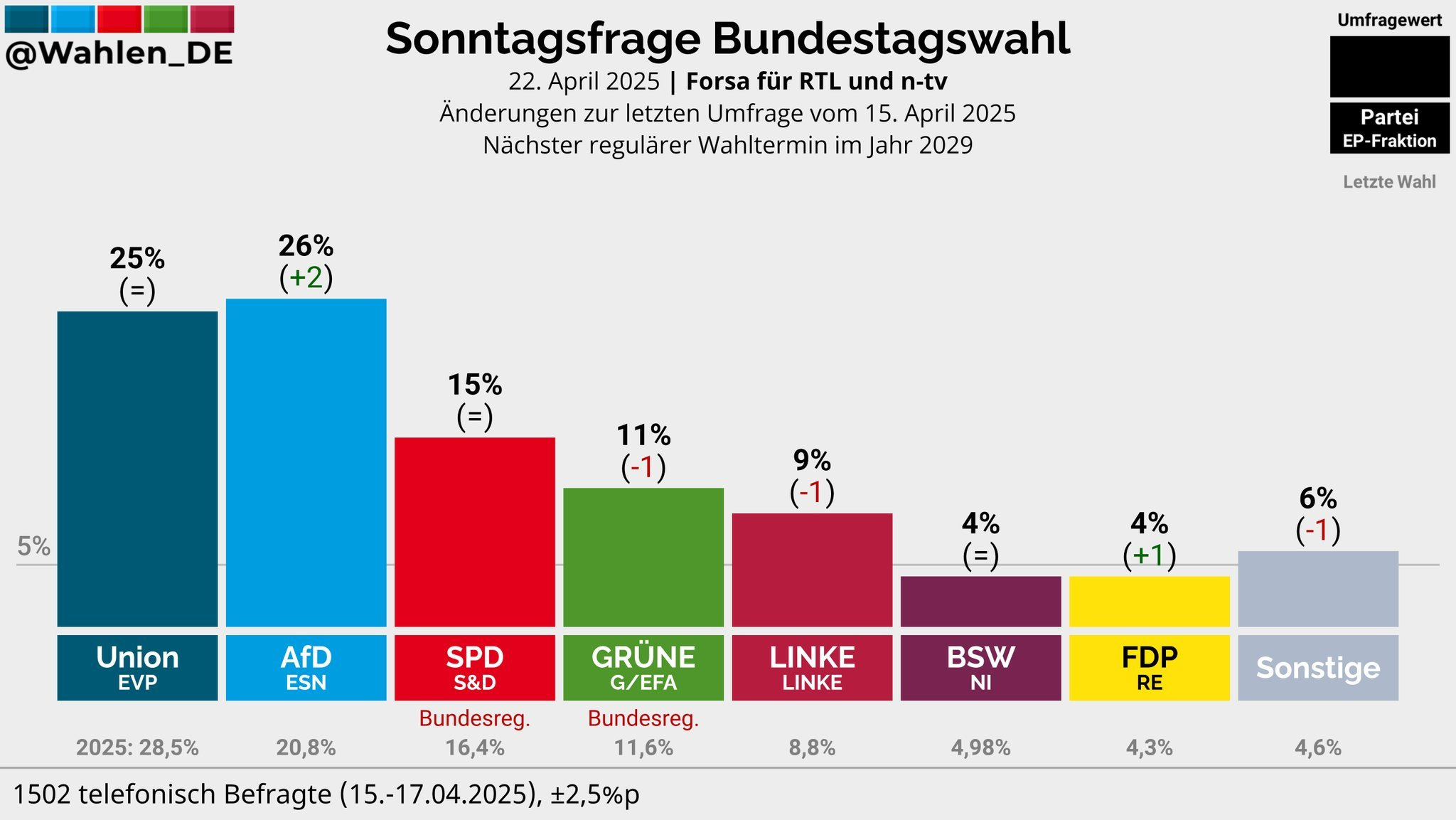
The latest Forsa poll (conducted for RTL and ntv) has Alternative für Deutschland at a cool 26%. That is their best result in history, and it makes them the strongest party in the Federal Republic. This is the second such poll that places AfD in first place, following an Ipsos survey from 9 April that pegged them at 25%.
Merz has indeed done something to AfD support involving the operand of 2. It’s just not exactly what he imagined.
Now all of that rhetoric we one once heard from the cartel parties – about the importance of dealing with the AfD on the issues and of making convincing appeals to the “democratically inclined” among AfD voters – have become yesteryear’s pablum. They are going to try to ban the AfD now. Because they can’t beat them in any other way, and because they believe Germans shouldn’t be allowed to cast their votes beyond the narrow confines of the political cartel that runs the Federal Republic, they’re going to try to remove the AfD from the board via legal trickery.

Of course, if the AfD is now the most popular party in Germany, it must be suppressed ASAP, and the individual members of the party must be punished “to save democracy”:

In Germany, owning guns is a privilege that can be taken away — not for breaking the law, but for holding the wrong political opinion.
Members and supporters of the right-leaning Alternative für Deutschland (AfD) party are now facing mass gun license revocations. The reason? The German government has labeled the AfD a “right-wing extremist” group — a political designation that suddenly makes its members “unreliable” under the country’s gun laws. And just like that, firearms must be surrendered or destroyed.
If that sounds outrageous, it should. But it’s not surprising.
[…]
In 2021, Germany’s domestic intelligence agency, the Bundesamt für Verfassungsschutz (BfV), designated the entire AfD as a “suspected threat to democracy”. That move allowed the government to surveil, wiretap, and investigate the party and its members.
It didn’t stop there.
Courts have now upheld revoking gun licenses from AfD members, based solely on their political affiliation. In one case, a couple in North Rhine-Westphalia lost legal ownership of over 200 firearms. They weren’t criminals. They weren’t accused of wrongdoing. They were just AfD members.
Another court in Thuringia blocked a blanket gun ban for all AfD members — but left the door wide open for revocations on a case-by-case basis.
In Saxony-Anhalt, officials are reviewing the gun licenses of 109 AfD members. As of last fall, 72 had already been targeted for revocation, with the rest under active review. The justification? Supporting a party the state now claims is “working against the constitutional order”.
And the courts are backing it up. According to a March 2024 ruling, former or current AfD supporters “lack the reliability” required to legally own firearms.
This Way Toward Enemy – How The Bomb Didn’t Quite Go Boom
HardThrasher
Published 17 Feb 2023I can do nothing about the way I say Nuclear. If that upsets you please don’t bother commenting
A brief history of the many ways that nuclear weapons nearly killed us all
(more…)


