
Published on 16 Mar 2017
The protests that emerged in Russia this week are growing stronger and the Tsar is increasingly isolated until even his generals are pushing for his abdication. And after 300 years of Romanov rule, Tsar Nicholai II abdicates and when his brother refuses to take up the throne, the dynasty is no more. Meanwhile in the Middle East, the British are taking Baghdad effectively seizing control over a large area.
March 17, 2017
The Tsar Abdicates – Baghdad Falls I THE GREAT WAR Week 138
Comments Off on The Tsar Abdicates – Baghdad Falls I THE GREAT WAR Week 138
Jeremy Clarkson’s view of off road cars – Clarksons Car Years – BBC
Uploaded on 21 Sep 2008
Jeremy has his say about 4x4s and his novel take on the school run.
Comments Off on Jeremy Clarkson’s view of off road cars – Clarksons Car Years – BBC
QotD: No True Irishman
I speak for every true potato-loving mick on the planet when I say that St. Patrick’s Day is a genuine Irish holiday that’s been corrupted into Amateur Drunk Day by us filthy Americans. Nobody in Ireland really cared much about it until dumb American tourists started going over there every March, demanding green beer and tunelessly bellowing “Danny Boy” out of their vomit-encrusted cakeholes. St. Paddy’s Day is fake. It’s Kwanzaa for white people.
Jim Treacher, “No True Irishman Loves St. Patrick’s Day”, The Daily Caller, 2016-03-17.
Comments Off on QotD: No True Irishman
March 16, 2017
Origins of the Silk Road
I’ve been quietly fascinated by the ancient Silk Road trading route spanning from the Middle East to China since I first heard about it as a kid. (The most recent book I read on the topic, Foreign Devils on the Silk Road, blended bits of the history of the route with the activities of European spies in the area preceding the start of the First World War.) At Ars Technica, Annalee Newitz summarizes some recent work in Nature that pushes back the origins of the Silk Road more than two millennia:
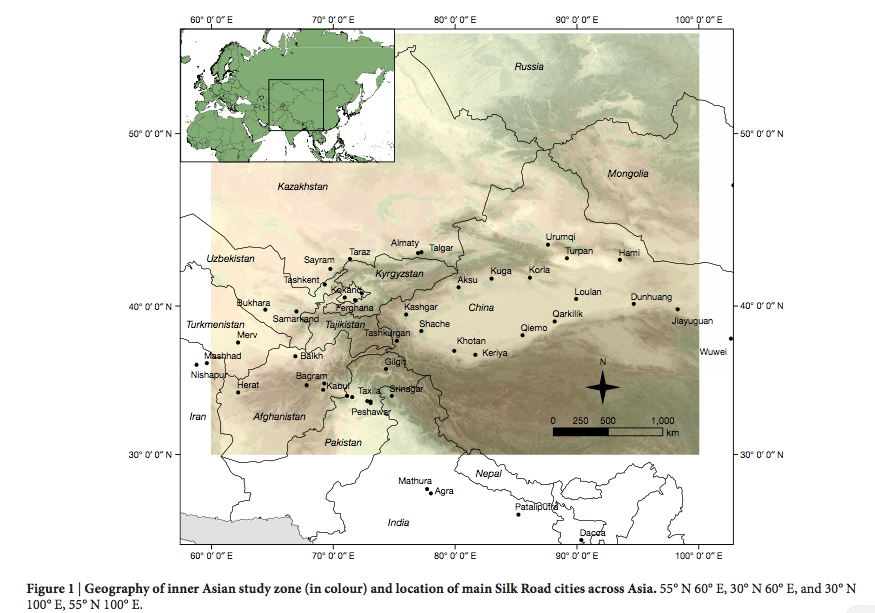
The Silk Road was a series of ancient trading routes that spanned Asia, reaching as far as the Middle East and Europe. Self-organizing and vast, it fell under the control of various empires — but never for long. The polyglot civilizations of traders who lived along its routes are the subject of legends, and more recently the Silk Road lent its name to an infamous darknet market. Historians usually date the Silk Road from roughly the 200s to the 1400s. But a new study in Nature suggests the trade routes may be 2,500 years older than previously believed and its origins much humbler than the rich cities it spawned.
Historical accounts of the Silk Road begin in China in the 100s, when the Han Dynasty used its many routes to trade with the peoples of Central and South Asia. Han soldiers protected the roads and maintained regular outposts on them, allowing wealth and knowledge to flow across the continent. Monks wandering the Silk Road brought Buddhism from India to China, while merchants brought spices, gems, textiles, books, horses, and other valuables from one part of the continent to the other. Great Silk Road cities such as Chang’an (today called Xi’an) and Samarkand grew fat on wealth from the routes that passed outside their walls.
But Washington University in St. Louis anthropologist Michael Frachetti and his colleagues wondered how people traversed the many difficult stretches of the Silk Road that switchbacked through the mountains of Central Asia. Even though these routes weren’t urban or under the protection of soldiers, people used them all the time to pass between Asia and the Middle East. We can see where these travelers camped at over 600 archaeological sites in the mountains. Writing in Nature, Frachetti and his colleagues describe how they had to devise a new approach to track the routes people took between these camps.
The problem was that previous scholars assumed people took routes that resembled what a “least cost” algorithm would draw — essentially the easiest path. This is “largely effective in lowland zones where economic networks and mobility between urban centers are consistent with ease of travel,” the researchers write in their paper. But those algorithms won’t work in the mountains, on uneven terrain that was often barren.
NHK and CCTV did a 12-part documentary on the Silk Road, with beautiful theme music by Kitaro:
Published on 18 Sep 2013
Camels plodding across the desert, and a sense of timelessness evoked by Kitaro’s theme music… NHK devoted 17 years to the planning, shooting and production of The Silk Road, which unearthed trade routes linking long-lost civilizations of East and West. A landmark in broadcasting history, this series told the story of the rise and fall of ancient civilizations.
The NHK Tokushu and China’s CCTV documentary series The Silk Road began on April 7, 1980. The program started with the memorable scene of a camel caravan crossing the desert against the setting sun, with Kitaro’s music and a sense of timelessness. It was the start of an epic televisual poem.The first journey described in the series began in Chang’an (now Xi’an), at the eastern end of the ancient route. On 450,000 feet of film, the NHK crew recorded the path westward to the Pamir Heights at the Pakistan border and this material was edited to make 12 monthly broadcasts. In response to viewers’ requests that the series be extended to cover the Silk Road all the way to Rome, sequels were made over the next 10 years. Seventeen years after the program was conceived, the project was completed.
1) The Glories of Ancient Chang-An
Chang-An – China’s old center. The journey begins from Chang-An, current Xi-an that was more than 1,000 years a capital in China, and the melting pot of international influences.
Comments Off on Origins of the Silk Road
March 15, 2017
Serbian Field Marshal Stepa Stepanovic I WHO DID WHAT IN WW1?
Published on 14 Mar 2017
Serbia’s turbulent history of the late 19th and early 20th century created some hard-boiled military leaders to the front lines of World War 1. One of these was Stepa Stepanovic – but he was not just hard boiled, he also stood with his country throughout the entire war which included the Serbian Exodus to Korfu.
Comments Off on Serbian Field Marshal Stepa Stepanovic I WHO DID WHAT IN WW1?
March 14, 2017
British India During World War 1 I THE GREAT WAR Special
Published on 13 Mar 2017
India was part of the British Empire during World War 1 and it was of vital importance to the war effort. Resources, manufacturing power and over 1.3 million men that served in the Army meant a great price for India to pay during the war. But even before the conflict, the call for independence grew louder and louder.
Comments Off on British India During World War 1 I THE GREAT WAR Special
QotD: Individual conscience and collective guilt
I’m sure there are good men in Saudi Arabia who find it abhorrent and painful that women can’t drive, for instance. I’m also sure they enforce that rule on their women because they don’t want them fined or imprisoned or worse. They can’t DO anything. Not as individuals. And they’re too busy feeding their families to organize and run campaigns [to] free women. Also, there have been some men who have organized and tried to make a difference, but there weren’t enough of them. That “grain of sand” stuff only works dramatically in movies. In real life, it’s more one generation raising the other; one friend talking to the other – until the balance TIPS.
And once it does making them feel guilty would be a counterproductive. Sorry for breaking Godwin’s law, but did we persecute ALL of the German people for Hitler’s crimes? No. Could any of them have spoken up? Many did. But most people who were alive at that time were good people caught in a social mechanic they couldn’t break out of – not individually. And they weren’t connected enough to form cohesive groups.
While we’re speaking of Germany, look at collective guilt and collective punishment for “crimes” that people supposedly committed which no individual could have stopped. If you’ve studied the mechanics of the avalanche leading to WWI (I have. There’s a novel about the Red Baron and time traveling started, and it will eventually get done) there was a certain unstoppable force to it. It was going to start sometime. Someone was going to fire the first shot.
It was Germany. They invaded other countries. The “Hun” entered European mythology of the early twentieth for reasons both good and bad. (Google WWI Belgian Nuns, for instance. Much of it was propaganda, but a lot of it, doubtless, happened.)
When they lost the war, they were treated as if they and they alone and they collectively were guilty. The penalty levied was so high they could not and would not pay and that it was crushing the man in the street.
There were other reasons leading to the rise of Hitler. However, THAT punishment facilitated it. It might not have happened without it. The “in for a lamb, in for a sheep” is a normal human reaction. If you’re held constantly guilty of things you did NOT do and could not have changed, you’re going to DO something anyway. I mean, how can it get worse?
To a certain type of woman – or man, though we’re only giving some tenured college professor males that kind of power – it is sweet to be able to play the victim ad nauseam. Particularly when you’ve never actually been victimized. And it is great to be able to make men squirm with stories of past injustice and feel guilty for things they are either way too young to have done (anyone born after the fifties, pretty much) or could not have changed if they tried, but which many of them mitigated in small ways.
And to a certain type of man – or woman, but in this case it doesn’t apply – it’s a great feeling to go around apologizing for the crimes of your ancestors. If you feel your accomplishments are diminished by theirs, apologizing gives a quick leveling. You recognize they did wrong, therefore you must be better than them. It’s a stupid feeling that ignores that you’re probably also doing things that your descendants will apologize for, but hey, it’s much better than actually trying to achieve something. Less work. Instant boost.
This dynamic gives power to passive-aggressives and bullies, the exact type of person you don’t want to have any power. And it makes good people feel like they’re bad and if they’re bad they might as well act it. It can, for instance, make young men very attracted to religions that DO oppress women (and no, sorry, that’s not most main line Christian religions, where you can leave if you want to.) Frankly, I think it’s a miracle more of my son’s generation hasn’t converted to one of those. I think it’s a witness to their essential decency, given the books, the movies and everything else designed to make them feel guilty for crimes they never committed.
Sarah Hoyt, “The Sharp Edge of Guilt, a blast from the past March 2010”, According to Hoyt, 2015-06-05.
Comments Off on QotD: Individual conscience and collective guilt
March 12, 2017
Camouflage Patterns – Funerary Practices – Prisoner Exchange I OUT OF THE TRENCHES
Published on 11 Mar 2017
Comments Off on Camouflage Patterns – Funerary Practices – Prisoner Exchange I OUT OF THE TRENCHES
Reasons for THE INDUSTRIAL REVOLUTION
Published on 26 Feb 2015
The Industrial Revolution transformed and shaped our modern world as we know it. Why did the fundamental changes of the Industrial Revolution begin in Great Britain? In our first episode about the era of Industrial Revolution, Brett explains how the agricultural revolution, a few inventions in the textile industry, the steam machine, improving means of transport and an overall changing society created a solid basis for the coming changes of the late 18th century.
Comments Off on Reasons for THE INDUSTRIAL REVOLUTION
March 11, 2017
Catherine the Great – III: Empress Catherine at Last – Extra History
Published on Feb 11, 2017
When the conspiracy to seat Catherine on the throne of Russia was exposed, she had to move quickly. While Peter III blundered through a day of miscommunications, Catherine swiftly seized power, secured the loyalty of the army, and demanded his abdication.
Comments Off on Catherine the Great – III: Empress Catherine at Last – Extra History
March 10, 2017
The Russian February Revolution 1917 I THE GREAT WAR Week 137
Published on 9 Mar 2017
Food shortages, an overall desolate supply situation and great political turmoil make Russia ripe for revolution and this week 100 years ago, the people take to the streets. The US adopts a policy of armed neutrality.
Comments Off on The Russian February Revolution 1917 I THE GREAT WAR Week 137
March 8, 2017
History Of The Cossacks Until World War 1 I THE GREAT WAR Special
Published on 7 Mar 2017
The Cossacks are surrounded my myths and legends. For some they were the “Tsar’s dogs” for others they were more comparable to the cowboys of the Wild West. In any case, their history and culture is unique and is deeply intertwined with the rise and end of the Romanov dynasty. And that’s why we are taking a look further back than usual to introduce to the Cossacks.
Comments Off on History Of The Cossacks Until World War 1 I THE GREAT WAR Special
March 7, 2017
Russia Before the 1917 Revolution I THE GREAT WAR Special
Published on 6 Mar 2017
Russia’s history in the decades leading up to World War 1 where a time of great turmoil and social changes. The Romanov tsars held a tight grip on the country which remained an autocracy even though the people requested change. And by 1917, three years into World War 1, the people demanded change again.
Comments Off on Russia Before the 1917 Revolution I THE GREAT WAR Special
March 6, 2017
David Fletcher’s Tank Chats #1: The A13 Cruiser
Published on 13 Feb 2015
The first in a series of short films about some of the vehicles in our collection presented by The Tank Museum’s historian David Fletcher MBE.
The A13 was the first British tank to have Christie Suspension. With a top speed of 40 miles per hour, it was much faster than the German Panzers, and had one of the best guns of its time. Despite this, many were lost in the battle for France in 1940. They fared better in the desert when their speed enabled them to cut off and defeat a huge Italian Army at Beda Fomm in Libya.
Comments Off on David Fletcher’s Tank Chats #1: The A13 Cruiser
March 5, 2017
Liechtenstein, San Marino, Monaco and Andorra in WW1 – Live And Let Live I OUT OF THE TRENCHES
Published on 4 Mar 2017
Batman is answering your questions about World War 1, oddly enough. This week we talk about the European micro nations and about the quieter sectors on the Western Front.
Comments Off on Liechtenstein, San Marino, Monaco and Andorra in WW1 – Live And Let Live I OUT OF THE TRENCHES


