
The Tank Museum
Published on 24 Feb 2017The thirty second in a series of short films about some of the vehicles in our collection, presented by The Tank Museum’s historian David Fletcher MBE. The Second World War, British, Cromwell tank was one of the fastest tanks of the war.
July 4, 2018
Tank Chats #32 Cromwell | The Tank Museum
Comments Off on Tank Chats #32 Cromwell | The Tank Museum
July 3, 2018
French North Africa in World War 1 I THE GREAT WAR Special
The Great War
Published on 2 Jul 2018Algeria, Tunisia and Morocco were all part of French North Africa before and during World War 1. They all contributed in material and men to the war effort and the French colonial soldiers were praised for their bravery.
Comments Off on French North Africa in World War 1 I THE GREAT WAR Special
The Animals – The House of the Rising Sun
José Antonio
Published on Sep 3, 2010By José Antonio…. Because the original version of this video, has low quality in both audio and video, I took the trouble to improve with better sound, better image quality, better zoom and better edition with the best of intentions, thanks.
En vista de que la versión original de este video, tiene baja calidad tanto en audio como en video, me tomé la molestia de mejorarlo con mejor sonido, mejor calidad de imágen, mejor zoom y mejor edición con la mejor de las intenciones, gracias.
Comments Off on The Animals – The House of the Rising Sun
July 2, 2018
Mark Steyn on 49th Parallel
His annual Canada Day post this year featured a World War 2 British film about Canada intended for Americans:
The film stars, in order of billing, Leslie Howard, Laurence Olivier, Raymond Massey, Anton Walbrook, Eric Portman “and the music of Ralph Vaughan Williams”, which gets an above-the-title credit – as well it should. Vaughan Williams’ score is an integral part of the picture and, if not especially Canadian (save for a very short evocation of Calixa Lavallée’s “O Canada” right at the beginning), accompanies the country’s physical landscape beautifully, particularly in the opening travelogue, mostly shot by Freddie Young leaning out of a plane with a hand-held camera and edited back in England by David Lean. (Lean and Young, of course, subsequently worked together on Lawrence of Arabia, Doctor Zhivago and Ryan’s Daughter.) And, if you’re thinking that (with one exception) none of these participants seems terribly Canuck, well, if it’s any consolation, the English also get to play all the Nazis, too. The Canadians are largely relegated to small roles and extras – like the real seamen who play the survivors of the Canadian ship torpedoed in the Gulf of St Lawrence at the opening of the picture. “So,” pronounces the German U-boat commander, “the curtain rises on Canada.”
U-37 decides to flee to Hudson’s Bay to evade the RCAF and RCN patrols looking for it. Six Germans are put ashore to scout for supplies. But, even as they set foot on land, they hear the swoop of planes and look back to see Canadian bombers destroying their submarine. In order to lend verisimilitude to the scene, Michael Powell destroyed a real – or real-ish – sub, built for him in Halifax, Nova Scotia. The RCAF gave him two thousand-pound bombs to make it look good, and he put them on “U-37” and was cunning enough to neglect to tell the actors, lest it made them nervous. The sub was then towed to the Strait of Belle Isle between Labrador and Newfoundland to be blown sky high. That was Powell’s only mistake. Notwithstanding that he named the film after Canada’s southern border, the director’s grip on the country’s eastern border was a little hazier. He had forgotten that Newfoundland was not (yet) in Canada but was a British possession in its own right. So HM Customs impounded “U-37” and Powell had to go directly to the Governor to get it back.
Other than that, he and Pressburger didn’t put a foot wrong. The location footage was impressive in its day, and still striking in ours; Pressburger’s script is subtle and humane; and the episodic structure allows for plenty of variety. Following the loss of U-37, the six Germans are now beached in northern Canada and have to figure out a way to get to safe, neutral America. They make their way to a Hudson’s Bay trading post, where the factor (played by the great Scots actor Finlay Currie) is welcoming back an old friend who’s spent the last eleven months hunting in the wilds and so has no idea Canada is at war. Johnny is a French-Canadian trapper played by – who else? – Laurence Olivier. We first meet him in the bath tub singing “Alouette”, and, as often with Olivier, the attention to detail on the accent is so good that it becomes oddly intrusive: “Diss is one big country, but verra few pipple. Ever-wan know ever-body. You can’t make goosestep trew it widdout da police fine out,” he tells the senior German officer (Eric Portman).
The window shot Michael Powell uses to get the Nazis into the factor’s small cabin is cool and clinical and all the more chilling for it. The six Germans enter and announce that they’re now in control. When you’ve just come in off the tundra after eleven months and you want to have a soak in the tub and unwind, the Master Race showing up is a bit of a downer. “Okay, you are German. Why yell about it? I am Canadian,” says the Frenchie. “He is Canadian” – he points to the Scots factor – “and he is Canadian” – and to the smiling eskimo lad: French, English and Inuit all with the same unhyphenated label “Canadian”. That’s a lot simpler than the fractious diversity at Parliament Hill earlier today.
The Nazi lieutenant attempts to beguile his captives with a copy of Mein Kampf, but Trapper Johnny isn’t interested. “What’s the matter with Negroes?” he asks.
“They’re semi-apes,” explains the German. “One step above the Jews.” This is something of a remote concern at a Hudson’s Bay trading post. The Nazis seems as enraged by their prisoners’ geniality as by anything else. As they depart, one tears a portrait of the King and Queen off the wall and carves a swastika into the space.
Pressburger’s plot follows as you’d expect: There are six Germans, and soon there will be five, and then four, three, two… From Hudson’s Bay, they commandeer a seaplane that crashes near a Hutterite community in Manitoba, where a young pre-Mary Poppins Glynis Johns is sweetly trusting of them. They make their way to Indian Day in Banff National Park, for a rather Hitchcockian scene, and thence to a camp in the Rockies, where an arty pacifist (Leslie Howard) is discoursing on Thomas Mann. The tone is set by Olivier’s Frenchie coming in from the bush: He may not be interested in war, and nor is Glynis Johns or Leslie Howard. But war is interested in them. This was the purpose of the film, as the British Ministry of Information saw it: That’s why they wanted it set in Canada, rather than in, say, England, across the Channel from Occupied Europe. These trappers, Hutterites, and pacifists didn’t come looking for trouble. But, even five thousand miles from the fighting, trouble came looking for them – in big, empty, peaceable Canada. And the implicit message to America was: In the end, it will come for you, too. There is no 49th Parallel. Whichever side of it you’re on, it’s the same side.
Comments Off on Mark Steyn on 49th Parallel
The holy book of Marx and the religion of progress
In the latest Libertarian Enterprise, Sarah Hoyt discusses the religious nature of progressive thought in the western world:
While the left not only filled every nook and cranny of twentieth century “narrative industries” to the point the only way a conservative could work in one of those was under deep, deep cover, the engineers made the internet.
The left didn’t even know it really had any serious opposition left. You can’t blame them too much. Even those of us who were very opposed and very disgusted kept it polite in public and treated them as retarded children who couldn’t take opposition.
Would it have made any difference if we’d talked back, say 30 years ago?
I doubt it.
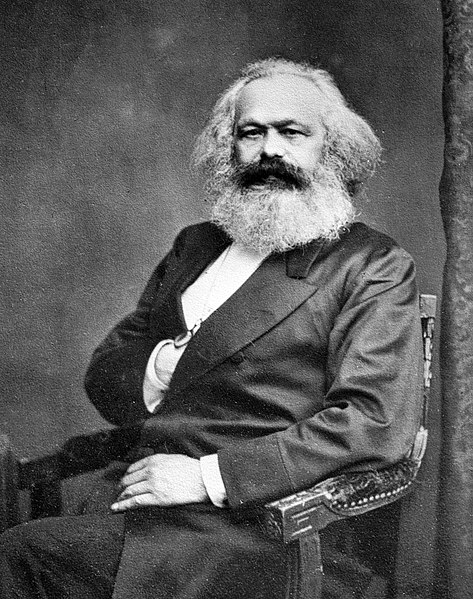
You see, leftism is as much as anything else a religion. The crazy Marx with his vision of the future created an entire narrative from paradise (pre-capitalism, i.e. it never existed, guys, not even as apes. Apes, as we now know, trade) through fall into capitalism to eventual paradise again, where the New Man (what used to be called the Soviet Man) will be so altruistic and communally oriented that a government isn’t needed. (Like the peace of Islam, there’s only one way to obtain that, and no. Just no. Worldwide species extinction is as fantastical as the idea of that primordial paradise. Humans are humans, and someone will survive. I’m just not interested in letting them send us back ten thousand years.)
You hear it in the talk of the left — particularly the rather intellectually inbred fourth generation, who ate the pap the older people fed them and never had an original thought in their lives — stuff like calling us “reactionaries” (when they’re the ones in power, and have been for a long time, and the ones knee-jerk reacting) and talking about “the future” as belonging utterly to them, and the arrow of history, as though history were the chart in their book, with an arrow beneath.
Their faith doesn’t align particularly well with reality. For instance there’s the whole thing of them talking about us — always — as though we were the ones in power, when they have all the gatekeeping positions and all the contacts.
This dissonance has required them to make up invisible monsters that give us all the power: Patriarchy (a laughable idiocy in America and weak everywhere in the west. While they refuse to see it in the Middle East and Latin America where it actually exists in spades.) Micro aggressions. White privilege (which is so strong that it gives an edge to concentration camp survivors.)
All the while they refuse to admit the real privilege: Leftist privilege. The fastest way to rise in the narrative fields is to be lefter-than-thou. Because they’re in charge and that’s how the system is setup, so they can stay in charge.
Unfortunately this has created their isolation. You see, every song, every movie, ever history book, every fictional book, assures them they’ll win. They know that “the people united shall never be defeated.” They also know that though held back by patriarchy, racism, sexism and all the micro aggressions, the people really are with them. HAVE TO BE, because they’re ideology of the future, and history’s arrow points to their paradise. Every book, movie, etc. says so either subtly or openly. So they KNOW. Everybody knows.
Comments Off on The holy book of Marx and the religion of progress
July 1, 2018
Mapping medieval trade routes
Open Culture linked to a fascinating new map by a Swedish grad student, showing trade routes during the Medieval period:
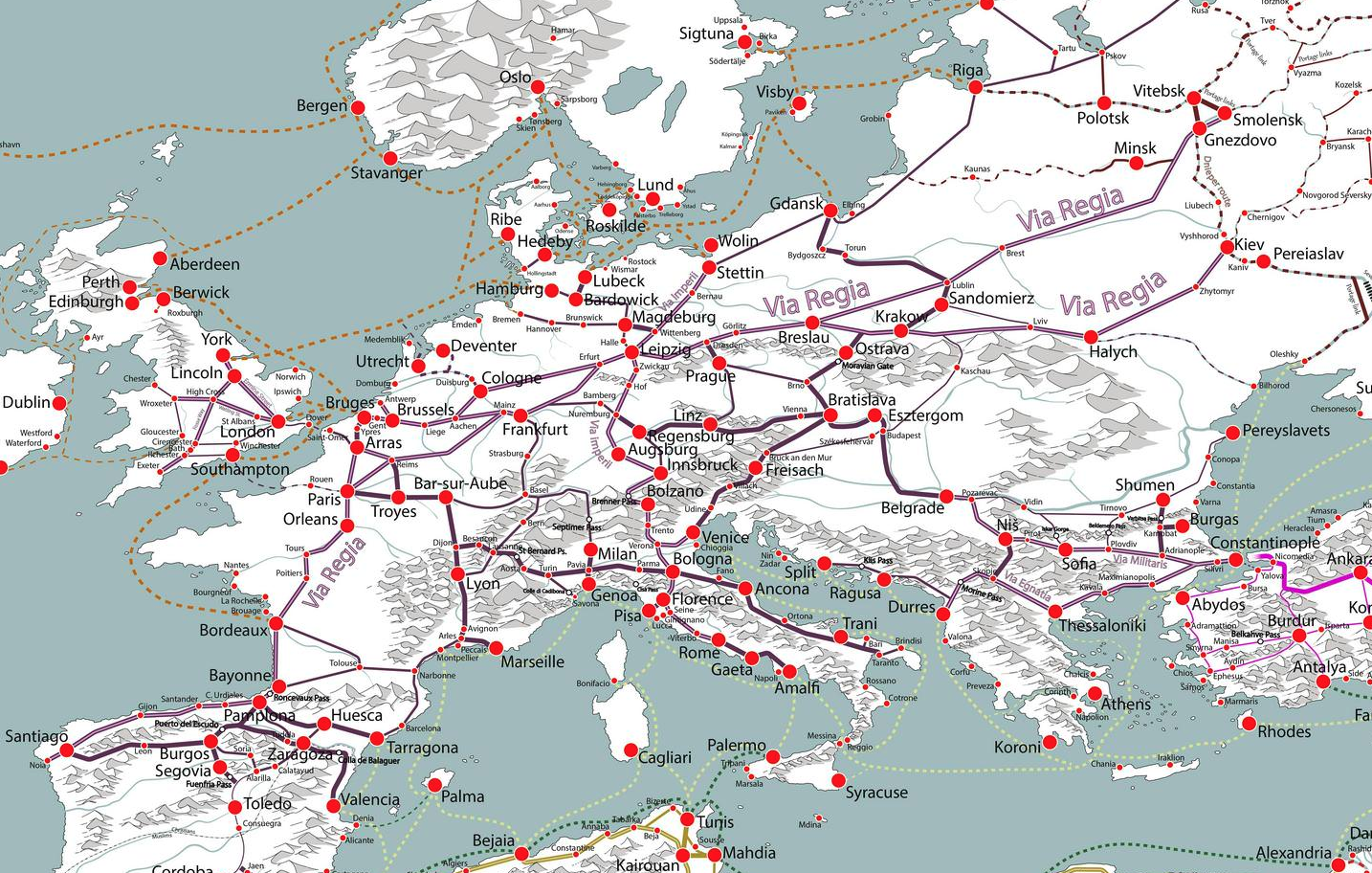
A small portion of Martin Jan Månsson’s trade map of the Middle Ages.
“I think trade routes and topography explains world history in the most concise way,” Månsson explains in the very small print at the map’s lower right corner. “By simply studying the map, one can understand why some areas were especially important–and remained successful even up to modern times.”
The map covers 200 years, spanning both the 11th and 12th centuries, and “depicts the main trading arteries of the high Middle Ages, just after the decline of the Vikings and before the rise of the Mongols, the Hansa and well before the Portuguese rounded the Cape of Good Hope.”
It also shows the complex routes already available to Africa and Asia, and the areas where Muslim and Christian traders would meet. The open-to-trade Song Dynasty ruled China, and the competitive kingdoms in the Indonesia region provided both Muslims and Europeans with spice.
Looking like a railway map, Månsson’s work shows how interconnected we really were back in the Middle Ages, from Greenland in the west to Kikai and Kagoshima in the East, from Arkhangelsk in the frozen north to Sofala in modern-day Mozambique.
The full-sized, high-resolution map can be downloaded here.
Update: Tim Worstall was kind enough to link to this post and uses Månsson’s map to help explain the gravity model of trade:
A standard observation is that places which are closer together trade with each other more than places which are further apart. Add to that the thought that larger economies will trade more with other larger economies – well, you know, more economic activity means more economic activity – and you get the gravity model of trade. So, therefore Britain’s trade future lies with those places nearby, in the EU, than with places further away like the Commonwealth or the US.
This is, sadly, actually the level of debate over Brexit at times. We should trade with France because it’s 26 miles away, so there. The point being that while the gravity model is true – among the best empirically supported of all economic observations – that’s not actually what it says. Rather, that those places which are closer by trade distance trade more with each other. Trade distance being a more complex point than mere geographical location.
[…]
The point here being that by showing the trade routes it is showing us this trade, or perhaps economic, distance which is what the gravity model is about. Valencia and Palma were very much closer – and trade very much more – than Valencia and Toledo, despite roughly equal distances crowfly wise.
Over-generous subsidies encourage fraud and waste
At Catallaxy Files, Rafe Champion continues discussing Matt Ridley’s book Climate Science: The Facts:
Ridley went on to criticise biodiesel programs and the promotion of diesel cars. Then he mentioned one of the most outlandish schemes – the clearing of forests on the west coast of the US to convert into wood pellets to burn in British furnaces instead of coal to generate electricity. The Daily Mail reported that this was one of the legacies of Energy Secretary Chris Huhne.
Mr Huhne, who served in the coalition government and was later jailed for perverting the course of justice, championed the energy source in office and is now European chairmen of Zilka Biomass, a US supplier of wood pellets.
Nice work if you can get it.
And then there are the household biomass furnaces in Britain, promoted by Huhne under the Renewable Heat Incentive (RHI) scheme whereby businesses and households pay for a renewable energy boiler upfront then receive payments for up to 20 years depending on the amount of heat they produce.
Some unscrupulous homeowners can double the amount they produce by using heat generated under the RHI to dry wood or other materials.
This can then be fed back into the boiler to burn it and generate even more heat – and money from the public purse.
The scheme was started in 2011 by Chris Huhne, then Liberal Democrat energy secretary, for businesses then extended to domestic customers three years later. Households and firms can apply for grants to switch from fossil fuel heating systems to renewable ones such as biomass boilers, which burn wood pellets, chips or logs.
As the scheme is open to applications until 2021, final payments to participants will run to at least 2041. By this time, the bill for taxpayers is expected to hit £23billion.
Closely related is the the Irish “Cash for Ash” scandal that paid more than the cost of the fuel. An orgy of corruption was sparked by renewables in Spain and there was the strange phenomenon of solar power generated in the dark because the Spanish subsidy was initially so generous is was worthwhile to shine diesel-powered lights on the panels overnight.
Comments Off on Over-generous subsidies encourage fraud and waste
June 30, 2018
Crown Prince Wilhelm – Front Line Visits – Trench Entertainment I OUT OF THE TRENCHES
The Great War
Published on 30 Jun 2018Chair of Wisdom Time!
Comments Off on Crown Prince Wilhelm – Front Line Visits – Trench Entertainment I OUT OF THE TRENCHES
Adventures in Sicilian non-verbal communication
At El Reg, Alistair Dabbs recounts some tales from a recent trip to Italy:
This isn’t the first time I have strayed into a Twilight Zone of cross-lingual and intercultural bafflement during this vacation. Throwing caution to the wind a few days earlier, I’d rashly allowed Google Maps to plot a walking route from the centre of Palermo to La Zisa. Why I did this, I cannot say, especially given my poor experience of Google Maps’ walking routes in the past. This is, after all, the app that once directed me to walk through the centre of an unlit Hyde Park at 2am and whose audio inexplicably but routinely barks “Turn left!” when you’re supposed to turn right.
On this occasion, Google Maps decided to take me on a scenic tour of the city’s most impoverished slums. Given that what few pavements existed along the way were knee high in refuse and canine excretia, it was less of a walking route than a wading route. The final 100 metres appeared to be some kind of theme park attraction along the lines of Disney World’s “Pirates of the Caribbean”, except this was “Dope-addled Inbreds of the Mediterranean”.
To access this den of iniquità, I had to pass through one of those pedestrian gates design to stop cyclists from riding through it. It was blocked by a tweenager who’d been trying to ride his bicycle through it and got stuck. The unlikely resolution of such an attempt was emphasised by two obvious challenges: it was an adult bike and the boy was so fat that he looked like an inflatable sofa. Both the bicycle and his body were at least two sizes too big for him.
By waving his arms around, he indicated that I was welcome to pass through the gate. By waving my arms back at him, I indicated that I would certainly do so after he had extricated himself. This attracted some shifty onlookers who helpfully grunted and waved their arms around at both of us until eventually we were all gesticulating like delegates at a semaphore convention.
Fearing an unfortunate outcome from this clash of cultures in unfamiliar territory, I coaxed the fat kid and his bike out of the gate and taught him to play the banjo he was carrying, ending with a spontaneous duet between the two of us. It was only by sheer luck that I’d remembered to pack my bagpipes.
Comments Off on Adventures in Sicilian non-verbal communication
June 29, 2018
The Run For The Baku Oil Fields I THE GREAT WAR Week 205
The Great War
Published on 28 Jun 2018While the Ottoman Army of Islam is marching on Baku and the Caspian Sea, multiple other players are trying to stake their claim of the Baku oil fields.
Comments Off on The Run For The Baku Oil Fields I THE GREAT WAR Week 205
June 28, 2018
Shifting attitudes toward mass immigration in Europe
At Gates of Vienna, Baron Bodissey maps the way public sympathies are changing in the wake of the immigration/refugee waves of the last few years:
From Szczecin in the Baltic to Trieste in the Adriatic, a Razor-Wire Curtain Has Descended…
Immigration-related events are moving rapidly this in Europe summer. The situation is in such flux that now would be a good time to step back and try to get an overview of the process.
Three years ago the dead baby hysteria, followed by Chancellor Merkel’s invitation to the world (“Y’all come in and set a spell, bitte!“), launched the Great European Migration Crisis. Since then I’ve read hundreds of news articles and analyses about the flow of “refugees” and the reactions to their violent and fragrant arrival in Western Europe.
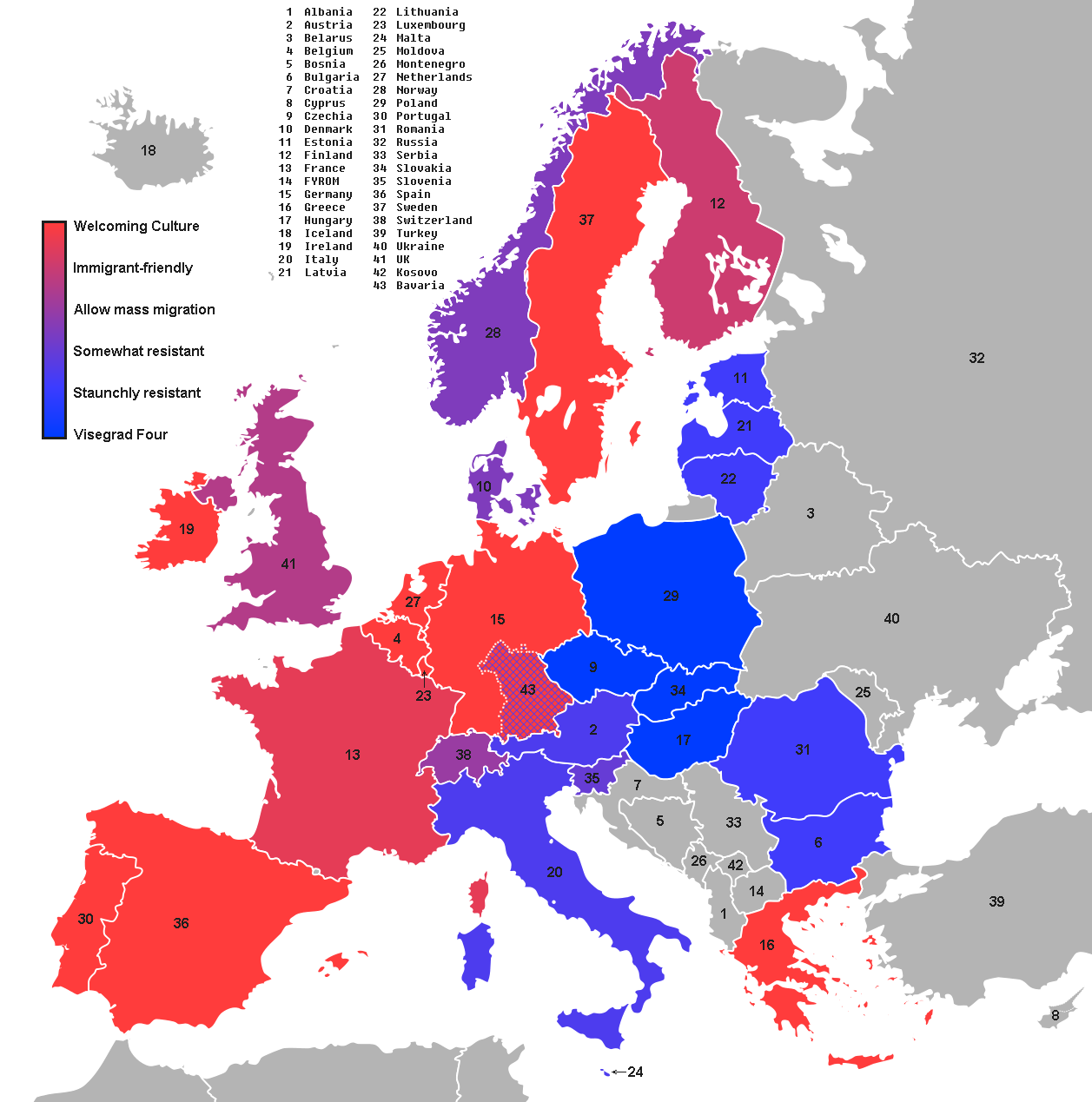
After digesting all that information I created the following map, which presents my subjective evaluation of the different approaches to migration by various European countries. I’ve rated the policies of 28 different countries (the EU 27 minus Croatia, plus Switzerland) on a scale from 0 to 100, from zero (red) for the open-borders attitude of the “Welcoming Culture” to 100 (blue) for the absolute refusal of mass migration by the Visegrád Four (Hungary, Poland, Slovakia, and the Czech Republic). Data from the last six months weighs more heavily in the score assigned to each country — for example, Spain and Italy recently changed governments, which has strongly affected each country’s migration policy.
[Click to see full-sized image]
The grouping of countries based on their stance on migration bears a striking resemblance to the division of Europe into East and West by the Iron Curtain. This is especially true if we roll the clock back three months — back then Italy and Bavaria would have been quite red. And the analogy becomes even more apt if we remember that Austria was occupied by Soviet troops until 1955, which gives it one foot in the Eastern camp.
The biggest change in the past three months has been the formation of a new anti-immigration government in Italy. The “xenophobia” of the East Bloc has now broken through the razor-wire curtain and gained a foothold in Western Europe. No wonder EU politics is in such turmoil! After failing to contain the “anti-European” attitudes of Poland and Hungary, Brussels now has to contend with Matteo Salvini. Italy is one of the “big four” pillars of the European Union, so its defection to the anti-migration side carries enormous significance for continental politics.
The situation is metamorphosing rapidly, but before we analyze the process of change — the “delta”, as they say in the military-industrial complex — let’s go over the snapshot of current European migration policies.
Comments Off on Shifting attitudes toward mass immigration in Europe
Mary Seacole – II: Mother Seacole in the Crimea – Extra History
Extra Credits
Published on 16 Jan 2016Unable to find any official sponsors, Mary Seacole decided to send herself to the Crimea. She recruited her husband’s cousin, a fellow business person, and the two of them set off for the war zone. Unlike London, where she’d met a chilly reception, Mary’s help was welcomed by the overworked doctors and suffering soldiers. She built a new version of her British Hotel and invited officers to dine or shop there, using their money to buy medical supplies and creature comforts for the poorer soldiers. She had set herself up next to the army camp, and during battles she helped provide emergency care. But when at last the city of Sevastopol fell, Mary’s medical services were no longer in much demand. She enjoyed a few months of prosperity as the soldiers celebrated their newfound time off, but in March of 1856, a treaty was signed and troops began returning home. Many of them left unpaid debts, and Mary could no longer sell her supplies, so she and her business partner were forced to return home to London and declare bankruptcy. When that news got out, the soldiers she’d cared for rallied to her aid, donating money to help pay her debts. Although Mary tried to continue serving soldiers in warzones, the government never recognized her and in the end, only her homeland of Jamaica remembered her contributions after her death. In the 2000s, her story came back to light in the United Kingdom and she was recognized in 2004 as the Greatest Black Briton.
Comments Off on Mary Seacole – II: Mother Seacole in the Crimea – Extra History
June 27, 2018
Calico prohibition
In the current issue of Reason, Virginia Postrel outlines an eighteenth-century French government attempt to prohibit calico cloth:
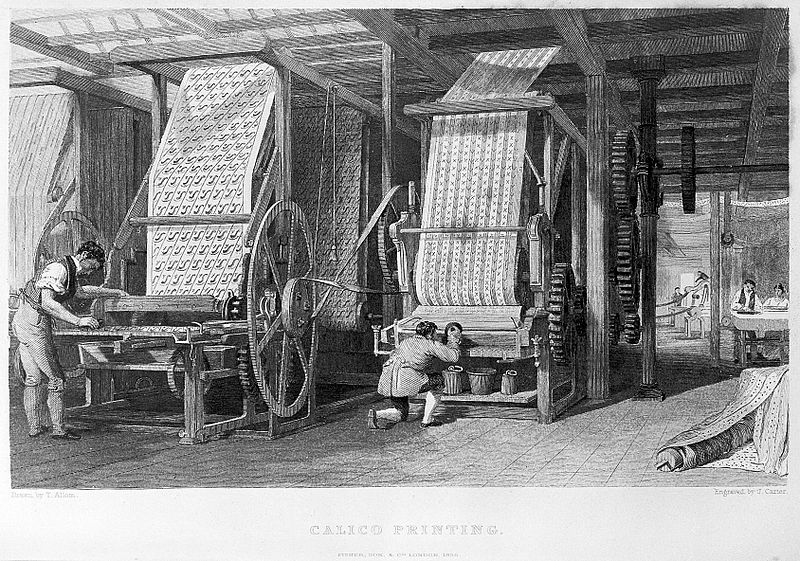
Calico printing, an image from Wellcome Images, via Wikimedia Commons
On a shopping trip to the butcher’s, young Miss la Genne wore her new, form-fitting jacket, a stylish cotton print with large brown flowers and red stripes on a white background. It got her arrested.
Another young woman stood in the door of her boss’ wine shop sporting a similar jacket with red flowers. She too was arrested. So were Madame de Ville, the lady Coulange, and Madame Boite. Through the windows of their homes, law enforcement authorities spotted these unlucky women in clothing with red flowers printed on white. They were busted for possession.
It was Paris in 1730, and the printed cotton fabrics known as toiles peintes or indiennes — in English, calicoes, chintzes, or muslins — had been illegal since 1686. It was an extreme version of trade protectionism, designed to shelter French textile producers from Indian cottons. Every few years the authorities would tweak the law, but the fashion refused to die.
Frustrated by rampant smuggling and ubiquitous scofflaws, in 1726 the government increased penalties for traffickers and anyone helping them. Offenders could be sentenced to years in galleys, with violent smugglers put to death. Local authorities were given the power to detain without trial anyone who merely wore the forbidden fabrics or upholstered furniture with them.
“The exasperation of the lawmakers, after forty years of successive edicts and ordinances which had been largely ignored, flouted or circumvented on a wholesale basis, can be sensed in this law,” writes the fashion historian Gillian Crosby in a 2015 dissertation on the ban. Her archival research shows a spike in arrests for simple possession. “Impotent at stopping the cross-border trade, printing or the peddling of goods,” she writes, “government officials concentrated on making an example of individual wearers, in an attempt to halt the fashion.”
They failed.
In the annals of prohibition, the French war on printed fabrics is one of the strangest, most futile, and most extreme chapters. It’s also one of the most intellectually consequential, producing many of the earliest arguments for economic liberalism. “Long before the more famous debates about the liberalisation of the grain trade, about taxation, or even about the monopoly of the French Indies Company, philosophes and Enlightenment political economists saw the calico debate as their first important battleground,” writes the historian Felicia Gottmann in Global Trade, Smuggling, and the Making of Economic Liberalism (Palgrave Macmillan).
Comments Off on Calico prohibition
Mary Seacole – I: A Bold Front to Fortune – Extra History
Extra Credits
Published on 9 Jan 2016Mary Seacole treated soldiers during the Crimean War – but she took a long path to get there. She grew up in Jamaica, the daughter of a local hotel owner and a Scottish soldier. She admired her doctress mother and wanted to be like her, but she also yearned to travel and see the world. In 1821 she accepted a relative’s invitation to visit London, and turned herself from a tourist to a businesswoman by importing Jamaican food preserves. She traveled with her business for several years before returning home to Jamaica, where she married a white man named Edwin Seacole and started a general store. Their venture failed, and disaster struck: fire destroyed most of Kingstown, and both Mary’s husband and her mother died in 1843. Mary survived and rebuilt the hotel, but she set out to start a new life in Panama and was immediately greeted by a cholera epidemic. She helped contain it, and earned a reputation that helped her start her own business across the street from her half-brother’s. When word reached her that the Crimean War back in Europe needed nurses, she left her business behind and went to sign up. Both the War Office and Florence Nightingale’s expedition rejected her, but Mary determined to find her own way there.
Comments Off on Mary Seacole – I: A Bold Front to Fortune – Extra History
QotD: Male homosexuality in ancient and modern times
Most educated people in the U.S. and Europe have a default model or construction of homosexual behavior which I will call “romantic homosexuality”. Romantic homosexuality is homoeroticism between equals; men or women of roughly the same age and social position, with the relationship having affective elements similar to the emotional range in heterosexual relationships (from one-night stand through lifetime marriage).
[…]
Over and over again, the pattern of male homosexual behavior in pre-modern sources is overwhelmingly one of pederasty and domination sex. And not just in pre-modern sources but in most of the present-day world as well. […] We may further note that there are, broadly speaking, two contending models of “normal” — acceptable or semi-acceptable male homosexual behavior — observable in human cultures. In one model, that of the modern West, romantic homosexuality is relatively tolerated, while pederasty and domination sex are considered far more deviant. I’ll call this the homophilic construction. It’s what most of my readers accept as normal.
But in the other, older model, pederasty and domination sex are considered more “normal” than romantic homosexuality. In cultures with this model, the “top” in an episode of pederasty or domination sex is not necessarily considered homosexual or deviant at all; any stigma attaches to the passive partner. Romantic homosexuality is considered far more perverse, because it feminizes both partners. I think of this as the “classical” construction of homosexuality, as it describes the attitudes of ancient Rome – but it persists in cultures as near to our own as South America and the Mediterranean littoral.
It’s the classical construction that is the rule in human cultures. The homophilic one is the exception; in fact, I am not able to identify any culture which held to it until after the Industrial Revolution in Europe. And not all of Europe has acquired it yet. Even in the English-speaking countries, where the homophilic construction is most entrenched, the connotations of sexual insults and threats in our language still reflect the older model.
To put it another way, the male homosexuals of the last two centuries in our culture have engaged in a massive reinvention of homosexuality that is still underway. Specifically the male homosexuals; lesbians began the game with romantic homosexuality as their dominant mode. I have not identified any culture in which it was considered more normal for lesbians to have sex with prepubescent girls or with dominated inferiors.
[…]
This analysis raises two interesting questions. The first one is about the past: what changed? That is, how did the homophilic construction replace the classical one, where it did? I’m only speculating here, but I think the proximate cause may have been the sentimentalization of family life around the turn of the 19th century in Europe, which in turn was enabled by a sharp fall in infant mortality rates. Both processes started earlier and moved faster in England and the Anglosphere than they did elsewhere.
The other interesting question is whether this reinvention is sustainable in the longer term. If my analysis is correct, modern homosexuals are bucking a pretty strong biological headwind. How strong can be judged by a chilling little statistic I picked up years ago from a how-to manual written by homosexual SM practitioners for newbies, er, learning the ropes; it noted that, adjusted for population size, male homosexuals murder each other at a rate 26 times that of the general population.
That suggests to me that a tendency for male homosexuals to drift into the darker corners of domination sex is still wired in beneath the modern homophilic construction. It might take actual genetic engineering, of a kind we don’t yet have, to fix that wiring. Until then, I wish them luck. Because (and here I make the first and only value claim in this essay) whatever one’s opinion of homophilic homosexuals might be, the behaviors associated with the pederastic/dominating classical style are entangled with abuse and degradation in a way that can only be described as evil. Modern homosexuals deserve praise for their attempt to get shut of them.
Eric S. Raymond, “Reinventing Homosexuality”, Armed and Dangerous, 2009-06-17.
Comments Off on QotD: Male homosexuality in ancient and modern times


