
The Great War
Published on 14 Jul 2018Markus and Indy give you some background on our recent special episode.
July 15, 2018
More Info About Alsace-Lorraine in WW1 I OUT OF THE ETHER
Comments Off on More Info About Alsace-Lorraine in WW1 I OUT OF THE ETHER
Soviet Gear – Why it Didn’t Die | Feature Fittings
Feature History
Published on 23 Jun 2018———————————————————————————————————–
Patreon
https://www.patreon.com/FeatureHistory
https://twitter.com/Feature_History
———————————————————————————————————–
I do the research, writing, narration, art, and animation. Yes, it is very lonelyIntro Song
Ross Bugden – ChosenMusic by Epidemic Sound: http://epidemicsound.com
Comments Off on Soviet Gear – Why it Didn’t Die | Feature Fittings
July 13, 2018
The Gardeners Of Salonica Prepare A New Offensive I THE GREAT WAR Week 207
The Great War
Published on 12 Jul 2018The Macedonian Front has been quite since the recapture of Monastir except for some minor battles like at Skra. But the five nation Army of the Orient wants to change that and is readying a new offensive.
Comments Off on The Gardeners Of Salonica Prepare A New Offensive I THE GREAT WAR Week 207
July 12, 2018
Infrastructure has costs as well as benefits
Tim Worstall makes a sensible point that applies (to a greater or lesser extent) to most of these “we’re dropping down the league tables in telecommunications” stories:
The Daily Mail is reacting with horror to the thought that the UK has slipped down the broadband tables. We’re only 35th in the world for average speed now! The correct answer to which is that yes, of course the UK’s broad band speeds are slow, we’re a developed and rich country. Which doesn’t mean that yes we’ll have the latest in shiny infrastructure. Rather, it means that we put in infrastructure some time ago and thus have the infrastructure from some time ago. You know, having infrastructure being one of the things which makes you a rich and developed nation?
Britain has slipped four places in the world broadband speed league, leaving its network lagging well behind the likes of Latvia, Lithuania, Hungary and Romania.
The UK is the sixth largest economy in the world but has dropped to 35th in the rankings after being overtaken by France and even Madagascar, according to the latest analysis.
As other countries rush to install fibre-optic cable networks which are capable of providing superfast download speeds, much of Britain continues to rely on old copper telephone wires to connect homes to the web.
Well, yes, the point being that we had a copper based network which went to pretty much everywhere. Thus we’ve not rushed to put in the fibreoptic because we’ve actually not needed it. Hey, sure, maybe it would be nice. Maybe it’s something we will install everywhere in the future. But we’ve not done it as yet because there’s not been a pressing case for that investment.
You see, our forebears already invested in the copper for us.
As a general rule of thumb, the earlier you invested in your telecommunications network, the slower it will be compared to current technology. At some point, it becomes economical to replace the installed network, but as long as the existing infrastructure is providing a profit, there isn’t the sense of urgency that most of these “the sky is falling” articles imply.
Comments Off on Infrastructure has costs as well as benefits
July 11, 2018
Men of Harlech
Mark Mains
Published on 16 Apr 2011This stirring music first appeared as “March of the Men of Harlech” in Musical and Poetical Relics of the Welsh Bards (Edward Jones, London 1784). The song was also used in the movie Zulu (1964). To learn more visit: http://www.rorkesdriftvc.com/myths/my… http://en.wikipedia.org/wiki/Men_of_H…
Comments Off on Men of Harlech
July 10, 2018
Mountain Combat In The Vosges – The Battle For Alsace-Lorraine I THE GREAT WAR Special
The Great War
Published on 9 Jul 2018The Battle for Alsace-Lorraine in the Vosges was unforgiving and brutal. Both the French and the German troops were fighting in extreme conditions for a extremely symbolic stretch of land.
Comments Off on Mountain Combat In The Vosges – The Battle For Alsace-Lorraine I THE GREAT WAR Special
Operation Husky with the “D-Day Dodgers”
On this day in 1943, the Allies invaded Sicily as their first step toward knocking Italy out of the war. It was the first major allied operation (other than the abortive Operation Jubilee in 1942) in which a major formation of the Canadian Army took part. The 1st Canadian Infantry Division under the command of Major General Guy Simonds was part of General Montgomery‘s Eighth Army, which landed on the southeast coast of the island.
The Canada History Project describes the Canadian participation in Operation Husky:
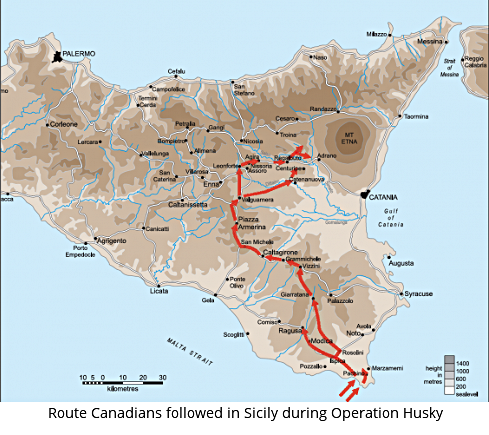
The men were young, of course, many just 18 to 24 years old. The roads were narrow dirt tracks switchbacking over steep, volcanic mountains. Temperatures hovered around 37 degrees, turning water bottles into hot water bottles, as one soldier put it. Three dry and dusty weeks into the campaign, there was a five-hour downpour, and all the troops relished the chance to shower off the dirt caked to their skin. By this time they were well into the middle of the island where their enemy was the fierce Hermann Goering division of the German army.
For six weeks, from July 10th to August 17th 1943, the Canadians, fighting as an independent unit for the first time, slogged through the interior of Sicily as part of Operation Husky, the first stage of taking back Europe from the Nazis after four years of war. Meanwhile, the Americans skirted the more level western coastline of the island and the British came up the east side, each competing with the other for glory.
American General Patton wrote in a letter, “This is a horse race in which the prestige of the US Army is at stake…we must take Messina before the British.”
That may be the way the generals saw it. For the soldiers, pushing through, village by village, mountaintop by mountaintop, it was no game.
Sicily, a rural mountainous island known for its orange groves and almond orchards, olives and the Mafia, sits strategically in the Mediterranean off the foot of Italy. The Canadian contingent was 25,000 strong. All men and materials were brought in by sea, making it the largest amphibious operation yet, though D-Day, a year later, would be bigger still.
In the first few days the Canadians passed through an area that is now a Unesco World Heritage site. Today tourists come to this southeast corner of Sicily to see the restored baroque architecture. But the young Canadian lads were eyeing the pillboxes, watching for snipers and lookouts. In the early days many Italian soldiers surrendered without too much resistance and the local people gave them grapes and oranges to quench their thirst in the scorching heat.
[…]
Operation Husky did succeed in gaining back the first European soil for the Allies. In the midst of it, Mussolini resigned and soon after Italy surrendered, another goal of the campaign. It started a second front forcing Hitler to back off his aggressive attack on our ally, Russia. And it provided a rehearsal for the larger amphibious landing on the beaches of Normandy, France in June of 1944. As well, it was the first time Canadians had fought as an independent unit. Their young commander was Guy Simonds. 1200 Canadians were wounded in Sicily and 562 died there. 490 of them are buried in the Canadian cemetery at Agira.
For their efforts, the soldiers fighting in Sicily and Italy became known as the “D-Day Dodgers”, a careless epithet supposedly delivered by Lady Astor, but embraced by the soldiers themselves who, with some sarcastic humour, turned it into the song, “We are the D-Day Dodgers, in sunny Italy…”
The Canadian part of the campaign from canadiansoldiers.com:
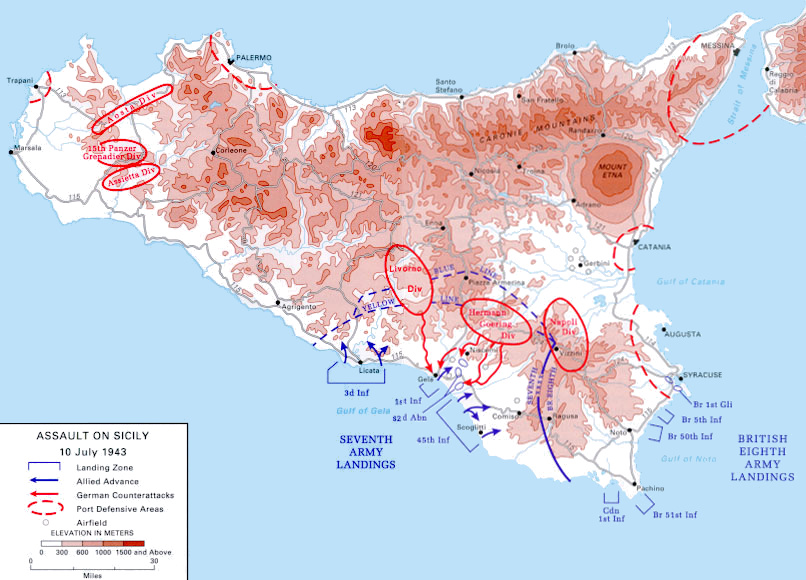
Sailing secretly at the end of June, the Division took its place on the left flank of General Bernard Montgomery’s famed Eighth Army for the Sicilian landings. The amphibious attack against Pachino peninsula was an unqualified success. The defenders were surprised and overrun with very few Allied casualties, and so began a controversial 38-day campaign. General Simonds’ troops advanced inland under difficulties:
The weather was extremely hot, the roads extremely dusty, and there was little transport; the troops were fresh from a temperate climate and a long voyage in crowded ships; and even though for a time there was scarcely any opposition, mere marching was a very exhausting experience under these conditions.
Continuing over the rocky terrain, they had their first fight with the Germans at Grammichele on 15 July. Three days later they captured Valguarnera. Both were rear-guard actions by a withdrawing enemy, and the first real tests came on the July 20 at Assoro and Leonforte. At the former, the 1st Brigade launched a surprise attack at night against an ancient Norman stronghold on the summit of a lofty peak. They seized and held their place in the face of fierce counter attacks, the records for the 15th Panzer Grenadier Division afterwards revealing generous tributes to the fieldcraft (Indianerkrieg) of the Canadians. Leonforte, an equally difficult situation, was captured by the 2nd Brigade after a bitter fight. These three days cost the Division about 275 casualties.
The advance then turned the east towards Adrano, at the base of Mount Etna. In their path stood Agira, “one of the most imposing of Sicily’s innumerable hill-towns,” and in the neighbouring hills the enemy put up a stubborn resistance. Both the 1st and 2nd Brigades were heavily engaged during the last week of July. The operations were, however, effectively supported by Canadian tanks and by the divisional artillery, reinforced by units of the Royal Artillery. General Simonds also had temporarily under his command the 231st British Infantry Brigade (the Malta Brigade), which threatened German communications from the south. After a bitter struggle Agira was captured on the 28th. Between Agira and Adrano the Hermann Goering Division made a stand at Regalbuto, using tanks as pillboxes in the debris of the town. While part of the 1st Division loosened the enemy’s grip on this town, the 3rd Brigade, temporarily under the command of the British 78th Infantry Division, assisted that formation in the Dittaino Valley.
American encircling operations in the western and northern districts of the island, combined with steady British pressure north of the Catania Plain, forced the enemy out of the defences based on Etna, and the campaign ended when the Allies entered Messina on 16-17 Aug. The 1st Division had performed all of its allotted tasks and had acquired valuable battle experience at a total cost of 2,155 casualties. The measure of the achievement was contained in General Montgomery’s statement: “I now consider you one of my veteran Divisions.”
The Division passed from XXX Corps to XIII Corps on 10 Aug, and moved to a concentration area in the rear on 11-13 Aug, relieved of operational responsibilities. Divisional headquarters moved to Francofonte. During the battle of Sicily they had travelled 120 miles, over largely rough and mountainous terrain.
Comments Off on Operation Husky with the “D-Day Dodgers”
QotD: Epicurean philosophy
Epicurus was born in 341 B.C., only six years after Plato’s death. He was 18 when Alexander the Great died. This event conventionally separates the classical Greece of independent city-states from the Hellenistic period, when Alexander’s generals and their dynasties ruled vast kingdoms in the former Persian Empire. He set up his school in a Garden in the outskirt of Athens. There is very little that survived from his many books. But fortunately, the work of his Roman disciple Lucretius, who lived in the first century B.C., De Rerum Natura, or On the Nature of Things, was rediscovered in the 15th century.
Through this work, Epicureanism had a major influence on the development of science in the following centuries. Epicurus had borrowed and refined the atomic hypothesis of earlier philosophers, and De Rerum Natura was studied and discussed by most scientists and philosophers of the West. The physics of Epicureanism, which explains that worlds spontaneously emerge from the interaction of millions of tiny particles, still looks amazingly modern. It is the only scientific view coming out of the Ancient World that one can still read today and find relevant.
Those influenced by Epicureanism include Hobbes, Mandeville, Hume, Locke, Smith, and many of the British moralists up to the 19th century. They not only discussed the Atomic theory, but Epicurean ethics, his views on the origin of society, on religion, his evolutionary account of life, and other aspects of his philosophy.
To me, Epicureanism is the closest thing to a libertarian philosophy that you can find in Antiquity. Plato, Aristotle, the Stoics, were all statists to various degrees, glorified political involvement, and devised political programs for their audiences of rich and well-connected aristocrats. Epicurus focused on the individual search for happiness, counselled not to get involved in politics because of the personal trouble it brings, and thought that politics was irrelevant. His school included women and slaves. He had no political program to offer and one can find no concept of collective virtues or order or justice in his teachings. On the contrary, the search for happiness implied that individuals should be as free as possible to plan their lives. To him, as one of his sayings goes “natural justice is a pledge guaranteeing mutual advantage, to prevent one from harming others and to keep oneself from being harmed.”
Martin Masse, “The Epicurean roots of some classical liberal and Misesian concepts“, speaking at the Austrian Scholars Conference, Auburn Alabama, 2005-03-18.
July 8, 2018
Postal Service – Trench Deployment – US Air Force I OUT OF THE TRENCHES
The Great War
Published on 7 Jul 2018Chair of Wisdom Time!
Comments Off on Postal Service – Trench Deployment – US Air Force I OUT OF THE TRENCHES
Swedish home defence
Last week, Strategy Page took a look at Sweden’s home defence arrangements, including their first surprise mobilization of the Hemvärnet – Nationella skyddsstyrkorna (Home Guard) in over 40 years:
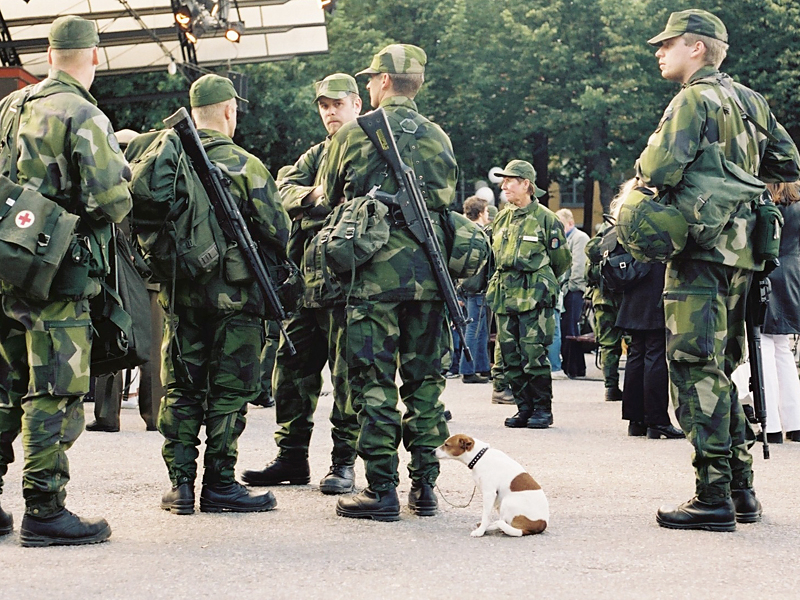
Swedish Home Guard soldiers in Kungsträdgården, Stockholm on 6 August, 2001.
Photo by Peter Fristedt, via Wikimedia Commons.
On June 4th Sweden held its first nationwide, unannounced mobilization of the Home Guard since 1975. This is another effort to prepare Sweden to deal with the renewed Russian threat. The Home Guard consists of reservists and volunteers whose job is local defense and maintenance of order in a national or local emergency. The Home Guard currently has about 22,000 members organized into 70 infantry battalions (each with 2-5 companies) that are assigned to areas where their part-time soldiers work and live. The Home Guard was created in 1940 and now depends on volunteers who are either former full time or reservist personnel who have at least three months of basic training. Twice a year Home Guard personnel two four day long training exercises. These four-day events involve practicing mobilization and doing what they are expected to do in wartime or a major emergency. In addition, most Home Guard companies (about 70 troops each) hold weekend training sessions ten times a year.
The unannounced mobilization of the Home Guard serves to find out how well the Home Guard as a whole would function. The Home Guard is voluntary and members can leave the force any time they choose to. Since 2014 there have been more volunteers and the Home Guard units could be more selective in who they accepted. The Home Guard mobilization is but the latest effort by Sweden to rebuild its traditional defense. The Home Guard take their training and readiness very seriously, especially when there is an obvious threat. In 1940 it was the Germans but after 1945 it was the Russians, at least until 1991. Now the Russians are once more a threat and the government had to agree that the Home Guard required more attention, resources and training.
Yet the Home Guard is more a police and emergency services than a military one. While the guardsmen are armed they are not expected to be a primary defense against invaders. This point was made when the people of Gotland Island recently pointed out that the local Home Guard was not enough to protect areas like Gotland from a surprise attack. The resulted in the government taking action to put a military garrison back on Gotland.
The Home Guard is not the only component of Swedish military readiness being tested. In late 2017 Sweden held its largest military exercises since the 1990s. Some 19,000 full-time soldiers and reservists were involved and the exercise was based on Russia attempting to seize and hold the island of Gotland after a surprise attack. The defense of Gotland has been an issue in Sweden ever since conscription was ended in 2010. Since the 1990s the military budget and number of full-time troops were cut. That led to the elimination of the Gotland garrison, a small force of full-time soldiers to watch for a Russian surprise attack and alert the reserve forces on the island to mobilize. With the end of conscription, it proved impossible to attract enough volunteers from Gotland to sustain the traditional force of military reservists, who would quickly mobilize and confront the invaders.
Comments Off on Swedish home defence
Western Approaches – the bunker from which they won the war
Lindybeige
Published on 17 Jun 2018The command bunker ‘Western Approaches’ is now a museum in Liverpool. I was invited to take a look before it re-opened.
Support me on Patreon: https://www.patreon.com/LindybeigeThe Museum’s website: http://www.liverpoolwarmuseum.co.uk
Many thanks to Richard MacDonald for inviting me and showing me around (you saw him plugging the big fuse in).
Lindybeige: a channel of archaeology, ancient and medieval warfare, rants, swing dance, travelogues, evolution, and whatever else occurs to me to make.
Comments Off on Western Approaches – the bunker from which they won the war
July 6, 2018
The First Modern Battle – The Battle of Hamel I THE GREAT WAR Week 206
The Great War
Published on 5 Jul 2018Meet us at the Tank Museum: http://bit.ly/TankMuseumFanMeeting
The Battle of Hamel is considered as the first modern battle. Masterminded by Australian general John Monash, it included meticulous planning and integrated tanks, artillery, airplanes and infantry into one cohesive strategy.
Comments Off on The First Modern Battle – The Battle of Hamel I THE GREAT WAR Week 206
Funny British Army Recruitment Video
Matsimus
Published on 9 Jun 2018
Some old school British Army recruitment video which was very well made but also just hilarious lol!Hope you enjoy!!
(DISCLAIMER: This video is for entertainment purposes only. The views and opinion come from personal experience or information from public accessible sources.)
Comments Off on Funny British Army Recruitment Video
July 5, 2018
Tales of Cromwell tanks
Lindybeige
Published on 6 Apr 2016War memoirs are filled with amazing anecdotes. Here I relate two, and ramble a bit about British WW2 tank units.
Support me on Patreon: https://www.patreon.com/LindybeigeI am likely to return to this topic – anecdotes from war memoirs. It is a rich vein of stories. These come from Troop Leader by Bill Bellamy, which describes the author’s time commanding a trio of fast Cromwell tanks in World War Two, when fighting the Germans in Holland.
Lindybeige: a channel of archaeology, ancient and medieval warfare, rants, swing dance, travelogues, evolution, and whatever else occurs to me to make.
Comments Off on Tales of Cromwell tanks
July 4, 2018
The War of 1812 on the frontier
Danny Sjursen on what he calls the “Forgotten and Peculiar War of 1812”, specifically the odd situation on the US/Canadian border:
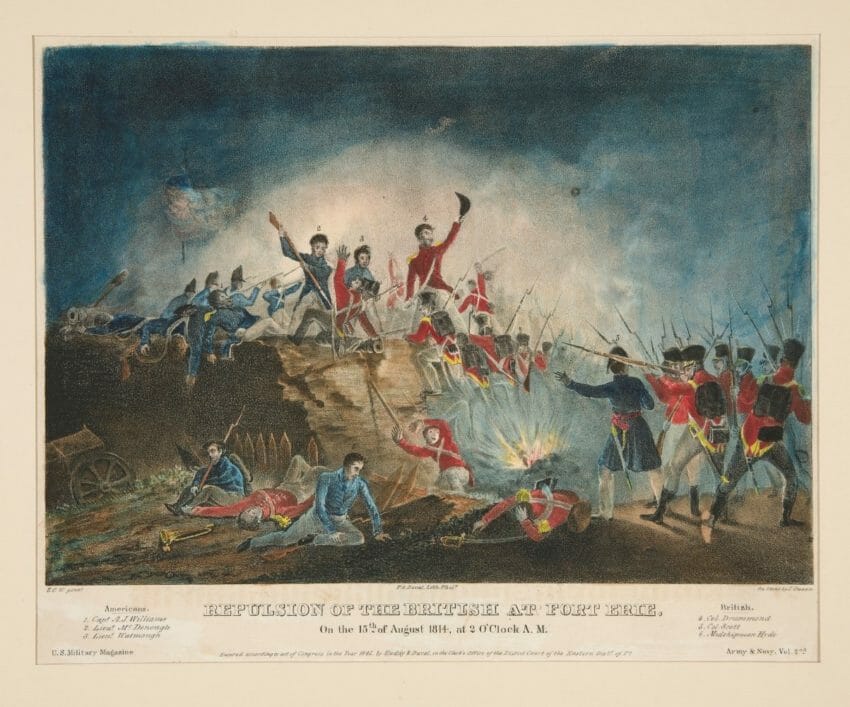
A lithograph based on an E.C. Watmough painting titled “Repulsion of the British at Fort Erie, 15 August 1814.” It depicts an attack that occurred at the U.S.-Canadian border during the War of 1812.
Image via AntiWar.com
“The acquisition of Canada, this year, as far as the neighborhood of Quebec, will be a mere matter of marching.” —Thomas Jefferson (1812)
“People speaking the same language, having the same laws, manners and religion, and in all the connections of social intercourse, can never be depended upon as enemies.” —Baron Frederick de Gaugreben, British officer, in 1815
No one seems to know this (or care), but the United States had long coveted Canada. In two sequential wars, the U.S. Army invaded its northern neighbor and intrigued for Canada’s incorporation into the republic deep into the 19th century. Here, on the Canadian front, the conflict most resembled a civil war.
Canada was primarily (though sparsely) populated by two types of people: French Canadians and former American loyalists — refugees from the late Revolutionary War. Some, the “true” loyalists, fled north just after the end of the war for independence. The majority, however, the “late” loyalists, had more recently settled in Upper Canada between 1790 and 1812. Most came because land was cheaper and taxes lower north of the border. Far from being the despotic kingdom of American fantasies, Canada offered a life rather similar to that within the republic. Indeed, this was a war between two of the freest societies on earth. So much for modern political scientists’ notions of a “Democratic Peace Theory” — the belief that two democracies will never engage in war. Britain had a king, certainly, but also had a mixed constitution and one of the world’s more representative political institutions.
In many cases families were divided by the porous American-Canadian border. Loyalties were fluid, and citizens on both sides spoke a common language, practiced a common religion and shared a common culture. Still, if and when an American invasion came, the small body of British regular troops would count on these recent Americans — these “late” loyalists — to rally to the defense of mother Canada.
And came the invasion did. Right at the outset of the war in fact. Though the justification for war was maritime and naval, the conflict opened with a three-pronged American land invasion of Canada. The Americans, for their part, expected the inverse of the British hopes — the “late” loyalists, it was thought, would flock to the American standard and support the invasion. It never happened. Remarkably, a solid base of Canadians fought as militiamen for the British and against the southern invaders. Most, of course, took no side and sought only to be let alone.
It turned out the invading Americans found few friends in Canada and often alienated the locals with their propensity for plundering and military blunder. Though the war raged along the border — primarily near Niagara Falls and Detroit — for nearly three years the American campaign for Canada proved to be an embarrassing fiasco. Defeats piled up, and Canada would emerge from the war firmly in British hands. In the civil war along the border, the Americans were, more often than not, the aggressors and the losers.
[…]
The Treaty of Ghent, which ended the war, changed nothing. There was no change of borders, and the British said nothing about impressment — the purported casus belli! So just what had those thousands died for?
Certainly it was no American victory that forced the British to the peace table. By 1814 the war had become a debacle. Two consecutive American invasions of Canada had been stymied. Napoleon was defeated in April 1814, and the British finally began sending thousands of regular troops across the Atlantic to teach the impetuous Americans a lesson — even burning Washington, D.C., to the ground! (Though in fairness it should be noted that the Americans had earlier done the same to the Canadian capital at York.) The U.S. coastline was blockaded from Long Island to the Gulf of Mexico; despite a few early single ship victories in 1812, the U.S. Navy was all but finished by 1814; the U.S. Treasury was broke and defaulted (for the first time in the nation’s history) on its loans and debt; and 12 percent of U.S. troops had deserted during the war.
The Americans held few victorious cards by the end of 1814, but Britain was exhausted after two decades of war. Besides, they had never meant to reconquer the U.S. in the first place. A status quo treaty that made no concessions to the Americans and preserved the independence of Canada suited London just fine.
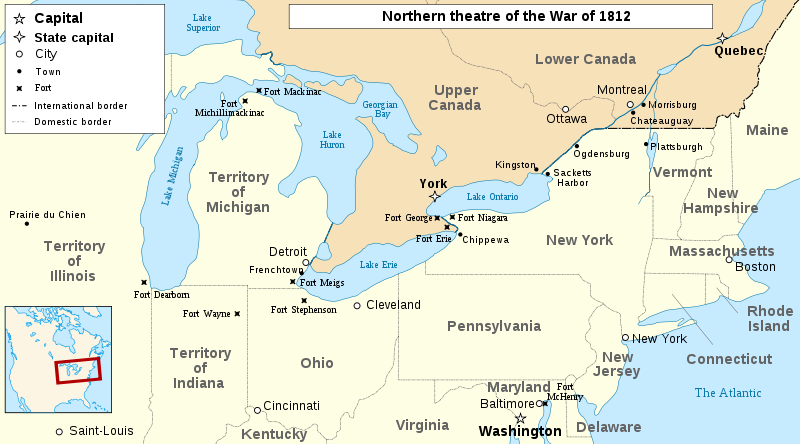
Northern theatre of the War of 1812 (note that Ottawa was not founded until 1826 and shouldn’t appear in this view, and the Niagara River is shown at least 45 degrees off its actual course)
Image via Wikimedia Commons
Comments Off on The War of 1812 on the frontier


