Thersites the Historian
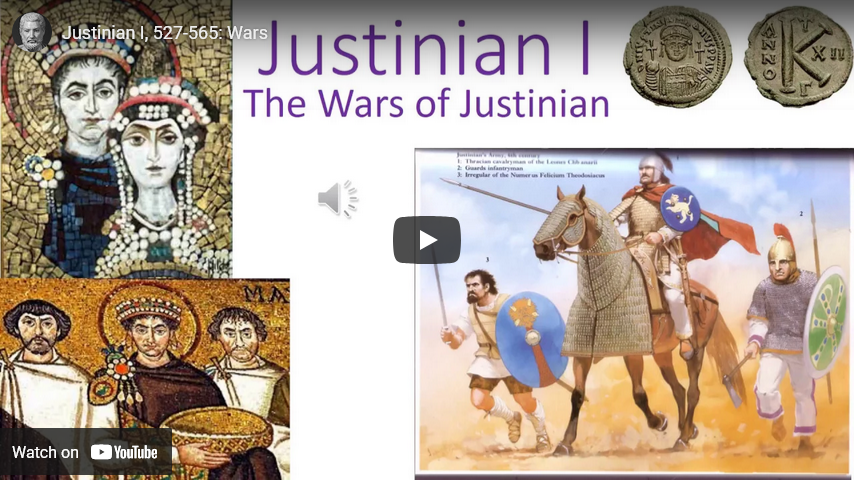
Published 21 Sep 2017In this video, I look at the wars of conquest waged by the Emperor Justinian and explore whether or not these conflicts advanced the long-term interests of the Byzantine state.

Thersites the Historian
Published 21 Sep 2017In this video, I look at the wars of conquest waged by the Emperor Justinian and explore whether or not these conflicts advanced the long-term interests of the Byzantine state.
At An Eccentric Culinary History, H.D. Miller makes a strong case for pizza being more an American dish than an Italian one:

“Pizza” by rdpeyton
Today, standing atop the sprawling edifice that is the American restaurant industry, it’s hard to imagine a time when pizza wasn’t popular. But, prior to World War Two, pizza was barely known in the United States outside of a few Italian enclaves in the Northeast. For all of the praise heaped upon Lombardi’s in New York City, until the war, few people north of Houston Street had heard of it, or the dish it served.
From the mid-19th century forward, there were plenty of Italians in America, in places like New York, New Orleans and San Francisco. Most of those early Italian immigrants — around 75,000 before 1880 — were from northern Italy, not the South, and the restaurants they built were usually serving multi-course, table d’hôte meals of meat, bread, macaroni, wine and coffee at reasonable prices. The model was Caffe Moretti’s in Manhattan. Established in 1858 by Stefano Morretti, an ex-seminarian from the Veneto, Morretti’s offered diners generous portions and cheap prices. It did not, however, offer pizzas.
I have to emphasize this, you couldn’t order a pizza in the vast majority of Italian restaurants in America prior to 1945. And the reason you couldn’t order a pizza in Italian restaurants is because pizza isn’t Italian.
Let me repeat that: Pizza isn’t Italian.
Pizza is Neapolitan. It’s a distinct speciality of Naples, developed at at time when Italy didn’t even exist as a nation. Saying pizza is Italian is like saying haggis is British. It might be technically true, but not really.
As in America, prior to the 1950’s, pizza wasn’t something most Italians knew or cared about. In 1900, there were supposedly no pizzerias in Italy anywhere outside of the medieval walls of Napoli. You couldn’t even get pizza in the suburbs. Pizza was strictly street food for poor people in the crowded tangled alleys near the port. […]
In other words, pizza was not something the average Tuscan, Ligurian or Venetian would have thought suitable for a sit-down meal. Or, if they ever did think of it, it was to revile pizza as oily, unappetizing and a likely vector of cholera. This is because Naples was really famous at the time for being dirty and disease-ridden. (If you’re serious about early pizza history, one that strips away the just-so stories, then go read Inventing the Pizzeria by Antonio Mattozzi.)
What brought pizza to America was the mass immigration of southern Italians between 1880 and 1910, when more than 4 million people moved to the United States. That’s why Lombardi’s didn’t get going until 1905, when there were finally enough Neapolitans in Little Italy to keep the doors open.
The same dynamic played out in South America, in Argentina, Uruguay and Brazil. The first successful pizza restaurant in the world located outside of Naples was founded in Buenos Aires in 1882, when a Neapolitan immigrant baker named Nicolas Vaccarezza started selling the pies out of his shop in Boca. For reference purposes, a decade earlier, an attempt to open a pizzeria in Rome, Italy, had ended in bankruptcy, meaning, at the turn of the last century, you could get a pizza in Buenos Aries, São Paulo or New York, but not in Rome, Florence or Venice.
H/T to Ed Driscoll for the link.
Overly Sarcastic Productions
Published 14 Jul 2017Huge thanks to our friend Shad at Shadiversity! Check out his channel for historical weaponry and much more: https://www.youtube.com/user/shadmbrooks
Grab your swords and hop in your longboats, because it’s time to learn a thing or two about the Vikings!
This video was produced with assistance from the Boston University Undergraduate Research Opportunities Program.
Thanks to patron Karl Erik L Hoftaniska for suggesting this topic!
PATREON: www.patreon.com/user?u=4664797
MERCH LINKS:
Shirts – https://overlysarcasticproducts.threa…
All the other stuff – http://www.cafepress.com/OverlySarcas…Find us on Twitter @OSPYouTube!
From the comments:
Finn Chitwood
4 years ago
In the words of a brilliant Icelandic magazine: “Viking was a seasonal, temporary occupation, not an ethnicity.”
World War Two
Published 5 Feb 2022This week sees the 10th anniversary of Hitler’s ascension to power in Germany, but while there may be celebrations and speeches in Germany, the Battle of Stalingrad comes to its end with the surrender of the German 6th Army. The Soviets are on the move all over, launching yet more winter offensives. It is the Axis who are attacking in Tunisia, and in the Solomon Islands … well, the Allies aren’t sure what the Japanese are up to.
(more…)
Forgotten Weapons
Published 4 Oct 2021http://www.patreon.com/ForgottenWeapons
https://www.floatplane.com/channel/Fo…
Cool Forgotten Weapons merch! http://shop.forgottenweapons.com
Here’s a rifle with an interesting twisting history …
This began life as a German military Gewehr 71/84, made in 1888. It was issued to a unit, but eventually replaced by the Gewehr 1888. It was sold to the Francis Bannerman company at some point around 1900, as part of a big batch of surplus weapons (Bannerman was a massive international dealer in arms and military equipment). Moving ahead a few years, World War One breaks out and prompts the organization of a couple Canadian “Home Guard” units. The Montreal Home Guard has some money, and buys a batch of Savage Model 99 lever action rifles (in .303 Savage, interestingly). The Quebec Home Guard isn’t quite so well-heeled, so they go to Bannerman to see what they can afford. Bannerman sells them a batch of Gewehr 71/84 tube-magazine repeating rifles, in the same configuration as when they were sold off by the German military.
Incidentally, I believe these become the only Mauser rifles formally purchased and issued by the Canadian government, when they are acquired by the Home Guard. At any rate, after the war ends, a subset of those old rifles are given to the Quebec Papal Zouaves, a ceremonial vestige of the Quebecois military volunteers who went to Italy in the 1860s to help defend the Papacy during Italian unification. By this time, the Zouaves are basically just acting as guards in parades, and they crudely cut down the 71/84s, removed their magazines, and fit them with cut-down British Snider bayonets for use as single-shot, blank-firing arms.
Quite the journey, right? And also a reminder that sometimes what looks like sporterized junk is actually something with distinct historical provenance …
Many thanks to Mike Carrick of Arms Heritage Magazine for providing me access to film this example!
Contact:
Forgotten Weapons
6281 N. Oracle 36270
Tucson, AZ 85740

Marcus Tullius Cicero was one of the most gifted and successful politicians of his day. Unlike nearly all of his peers in the Roman Senate, his family had not been in Roman politics for generations on generations, but rather was new to it. Cicero’s family was a wealthy one, but hailed from the town of Arpinum, about 60 miles from Rome, making Cicero an outsider to elite Roman politics. He made his name as a legal advocate, rather than (in more typical Roman fashion) as a military man. He was the first of his family to enter the Roman Senate (making him a novus homo or “new man”) and was the first such new man to rise all the way to the consulship (the highest Roman office) in thirty years, which should give some sense of the magnitude of that achievement. Moreover, Cicero had managed to get elected in the first year he was eligible, which would have been a banner achievement even for a member of Rome’s traditional upper-class. During that consulship (63 B.C.), he further distinguished himself by foiling a planned coup centered around the influential figure of Catiline (L. Sergius Catilina).
Cicero was a key politician in the Late Republic, but it was his misfortune that his life was spent in an era where words meant less than weapons. He sided with Pompey against Caesar, but was granted clemency after Pompey’s defeat. He was not involved in Caesar’s assassination – he was still too much an outsider for some of the stuck-up Roman elitists who made up the conspiracy (though he correctly pointed out at the time that leaving Antony alive would be a fatal mistake). In the aftermath of the assassination, he identified (correctly) Antony as the key threat to the Republic and worked to discredit him politically in a devastating series of speeches named the Philippics (in honor of a similar set of speeches made by the Athenian Demosthenes against Philip II of Macedon, father of Alexander). Cicero’s political assault on Antony succeeded – his reputation was ruined and his popularity in Rome never recovered – but it cost Cicero his life when Antony, in league with Octavian, moved into the capital and had Cicero murdered. Cicero’s literary legacy survived him, however, in part because it was useful for Augustus’ own political ends (e.g. Plut. Cic. 49.5-6).
Cicero’s position as the most eloquent orator of the Latin language – and probably its best prose stylist – is largely uncontested. It was his speaking skills – honed in the courts – that made him so politically successful. He was also a prolific writer and a tremendous amount of his writings survive, including both legal and political speeches, private letters, handbooks on oratory, and a set of philosophical works. As anyone who has read Cicero can tell you, he also has a deserved reputation for pride and self-aggrandizement. While many of Cicero’s contemporaries and readers down to the modern era have been impressed by Cicero’s thinking and eloquence, I feel confident in asserting no one – alive or dead – will ever be more impressed by Cicero than Cicero was impressed by himself.
Bret Devereaux, “Collections: A Trip Through Cicero (Natural Law)”, A Collection of Unmitigated Pedantry, 2019-12-12.
Overly Sarcastic Productions
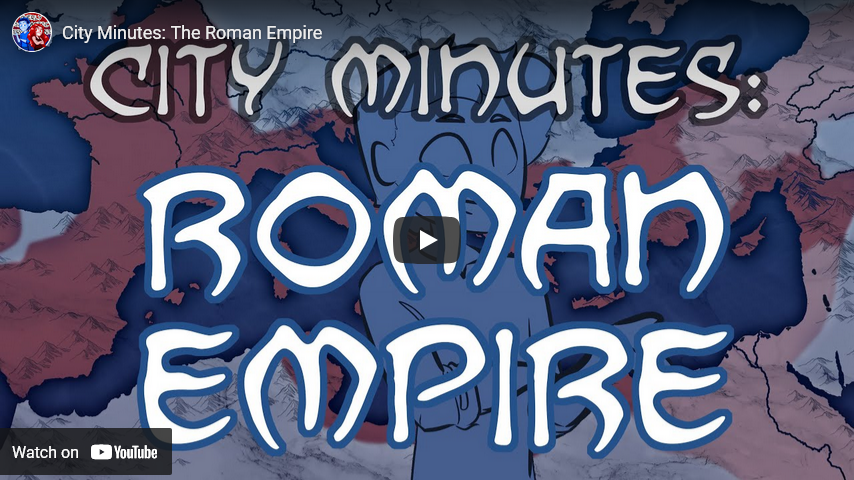
Published 4 Feb 2022The funny thing about Empire is that ~*Rome*~ includes far more than just the City of Rome. Spread out across every corner of the Mediterranean — and then some — Roman Civilization was always adapting to local circumstances and changing over time. Today we’ll look at 5 cities that show the diversity of just how much “Rome” could really mean in the days of the empire.
The Great Cities In History by John Julius Norwich, “A Wonder of the World – Ephesus” from The Great Tours: Greece and Turkey, from Athens to Istanbul by John R. Hale, “Ephesus”, “Leptis Magna”, “Roman Britain”, “Pompeii” from World History Encyclopedia https://www.worldhistory.org/ephesos/, https://www.worldhistory.org/Lepcis_Magna, https://www.worldhistory.org/Roman_Britain, https://www.worldhistory.org/pompeii/. “Ephesus”, “Leptis Magna” “London”, “Pompeii” from Britannica https://www.britannica.com/place/Ephesus, https://www.britannica.com/place/Leptis-Magna, https://www.britannica.com/place/Lond…, https://www.britannica.com/place/Pompeii. I also have a degree in Classical Studies.
Chapters:
0:00 — Rome
0:58 — Ephesus
2:00 — Leptis Magna
3:03 — Londinium
4:12 — Pompeii
5:17 — ConclusionOur content is intended for teenage audiences and up.
PATREON: https://www.Patreon.com/OSP
PODCAST: https://overlysarcasticpodcast.transi…
DISCORD: https://discord.gg/osp
MERCH LINKS: http://rdbl.co/osp
OUR WEBSITE: https://www.OverlySarcasticProductions.com
Find us on Twitter https://www.Twitter.com/OSPYouTube
Find us on Reddit https://www.Reddit.com/r/OSP/
For a man who’s never been elected to Parliament, Nigel Farage has been a major mover-and-shaker in British politics. In the Literary Review, Steve Richards reviews One Party After Another: The Disruptive Life of Nigel Farage by Michael Crick:

Most political figures come and go. Nigel Farage, in contrast, seems always to be around, close to the centre of the political stage. Sometimes he is leading a political party. Occasionally he is setting up a new one. Between such roles he is on television. Currently, the former leader of UKIP and the Brexit Party hosts a nightly show on GB News.
The consequences of Farage’s ubiquity have been seismic, reshaping the UK and the wider political landscape. He sought a referendum on Britain’s membership of the EU and then a hard Brexit, and ultimately got everything he wanted. The Conservative Party’s embrace of a form of English nationalism was partly a response to the threat that Farage posed. The near-silence of the Labour leader, Keir Starmer, on the subject of Brexit is a form of vindication for him. Starmer knows that Brexit is having calamitous consequences but does not dare to say so. No wonder Michael Crick concludes that “it’s hard to think of any other politician in the last 150 years who has had so much impact on British history without being a senior member of one of the major parties at the time”.
Among Crick’s admirable passions is his interest in those individuals or forces that have shaped the major political parties from outside the mainstream. He wrote an important book on Militant, the left-wing group that in the 1980s sought to infiltrate the Labour Party and for a time made life hellish for Michael Foot and Neil Kinnock, the two party leaders during that stormy decade. His biography of Jeffrey Archer, the Conservative MP who became a bestselling author and then a convicted prisoner, was revelatory. Now he has set his sights on Farage, who has never been an MP and yet has been such a prominent figure in recent years.
As Crick always does with his subjects, he has researched meticulously every twist and turn in Farage’s life. He regrets that his investigations were constrained by the pandemic. He need not worry too much. His diligence has enabled him seemingly to have unearthed every internal dispute in UKIP and the Brexit Party, along with the eccentric figures who lined up on different sides in them. The characters that emerge would fit neatly into a Dickens novel. One of the most unsavoury right-wingers to feature in the book is now an avid supporter of the Green Party, lives in Germany and is passionately opposed to Brexit – a novelistic metamorphosis. We are also reintroduced to Farage’s old friend Godfrey Bloom, a UKIP MEP and economics spokesman, who in 2013 famously hit Crick with a party conference brochure as the journalist pursued him down the street after he had made characteristically indiscreet and outrageous remarks in a speech to UKIP members.
This book is full of fights, usually between party members. We see Farage repeatedly falling out with other potential leaders. More prominent members who cannot hide their real views in public have to be admonished. Some flirt with the BNP. Even during the triumphant 2016 referendum campaign, there were two pro-Brexit camps, one led by Farage and the other by Dominic Cummings. Farage and Cummings loathe each other and their campaign groups fought bitterly for pre-eminence. This is the most striking theme of the book. UKIP and the Brexit Party, which Farage set up in 2019 to campaign for a hard Brexit, were utterly dysfunctional most of the time. They make the UK’s main political parties, all going through various existential crises at the moment, seem models of smooth, sophisticated professionalism. The amateurism extended well beyond the eccentric characters near or close to the top. Neither party offered coherent policy programmes beyond opposition to the UK’s membership of the EU.
H/T to Colby Cosh for the link.
Mark Felton Productions
Published 22 Oct 2020The Centurion, the famous Cold War tank, was actually developed to take on the dreaded German Tiger in WW2. Find out whether they ever met on the battlefield in 1945.
Dr. Mark Felton is a well-known British historian, the author of 22 non-fiction books, including bestsellers Zero Night and Castle of the Eagles, both currently being developed into movies in Hollywood. In addition to writing, Mark also appears regularly in television documentaries around the world, including on The History Channel, Netflix, National Geographic, Quest, American Heroes Channel and RMC Decouverte. His books have formed the background to several TV and radio documentaries. More information about Mark can be found at: https://en.wikipedia.org/wiki/Mark_Fe…
Visit my audio book channel ‘War Stories with Mark Felton’: https://youtu.be/xszsAzbHcPE
Help support my channel:
https://www.paypal.me/markfeltonprodu…
https://www.patreon.com/markfeltonpro…Disclaimer: All opinions and comments expressed in the ‘Comments’ section do not reflect the opinions of Mark Felton Productions. All opinions and comments should contribute to the dialogue. Mark Felton Productions does not condone written attacks, insults, racism, sexism, extremism, violence or otherwise questionable comments or material in the ‘Comments’ section, and reserves the right to delete any comment violating this rule or to block any poster from the channel.
Credits: David Holt; Simon Q.; Tony Hisgett; Danie van der Merwe; Oliver Gottlob.
Thumbnail: The Tank Museum

His new band, anyway, consists of four competent but unimaginative player-songwriters, and him. And the album’s a turgid lukewarm brew of reworked Oasis numbers which Liam’s brother Noel, every bit as ugly, every bit as unpleasant but a fraction less stupid would have rejected; the band switch between a dazzling selection of Rickenbaker and Gretsch guitars — funny, isn’t it, how a fiddler will manage with one Stradivarius, Robert Johnson played only a two-dollar guitar, Rory Gallagher the same battered old Strat and yet the current lot switch from one expensive instrument to another between songs, maybe even during songs, the rock’n’roll of Consumerism — to produce the same sounds, the same chords, the same figures over and over, to sing the same harmonies, the same shouty, angry, miserable, hateful, retarded adolescent drivel, tripe, every fucking bar of it; Liam, stooped inside his ugliness, howling and frothing his whining, meaningless doggerel; forty year old men, there oughta be a law against them doing this shit. Liam, rock hero caricature posturing, grunts at one point that this is whaditsallabout knoworramean, fucking keeping on playing and touring, selling the albums, to the kids, otherwise I’d end up working in fucking McDonalds, knoworramean; setting his sights way too high, there, overestimating his personal qualities, I mean, Billy Bragg might get a job in McD’s, on the mop bucket, Paul Weller, maybe, but they wouldn’t let Gallagher within a hundred yards.
Ishmael, “The Sunday Ishmael 31/10/2021”, Call Me Ishmael, 2021-10-31.
Real Time History
Published 3 Feb 2022https://curiositystream.com/realtimeh… – get Nebula and CuriosityStream for less than $15 for an entire year.
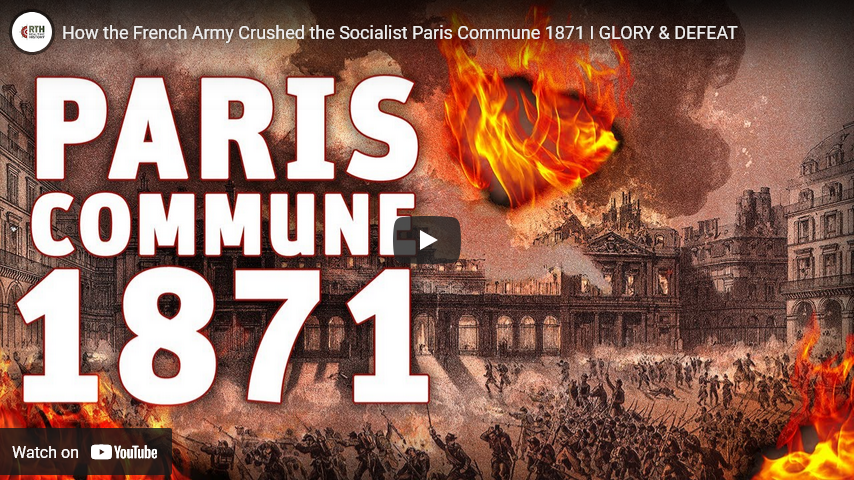
The siege of Paris and the end of the Franco-Prussian War had brought social unrest in Paris (and other French cities) to a boiling point. Radical citizens take up arms and proclaim La Commune, a self-organized alternative to the French Republic. But soon the French Army is cracking down and Paris experiences a Week of Blood.
» THANK YOU TO OUR CO-PRODUCERS
John Ozment, James Darcangelo, Jacob Carter Landt, Thomas Brendan, Kurt Gillies, Scott Deederly, John Belland, Adam Smith, Taylor Allen, Rustem Sharipov, Christoph Wolf, Simen Røste, Marcus Bondura, Ramon Rijkhoek, Theodore Patrick Shannon, Philip Schoffman, Avi Woolf, Daniel L Garza, Chris Daley, Manfred Billenstein, Simdoom, Malcolm Swan» OUR PODCAST
https://realtimehistory.net/podcast – interviews with historians and background info for the show.» LITERATURE
Arand, Tobias: 1870/71. Der Deutsch-Französische Krieg erzählt in Einzelschicksalen. Hamburg 2018Bauer, Gerhard u.a. (Hrsg.): Ausst.-Kat. MHM Dresden‚ Krieg – Macht – Nation. Wie das deutsche Kaiserreich entstand. Dresden 2020
Buk-Swienty, Tom: Feuer und Blut. Hauptmann Dinesen. Hamburg 2014
Gouttman, Alain: La grande défaite. 1870-1871. Paris 2015
Horne, Alistair: Es zogen die Preußen wohl über den Rhein. Bern, München, Wien 1967
» SOURCES
Bernhardt, Sarah: Ma double vie. Memoires. Paris 1907
Déclaration de la Commune de Paris. (19 avril 1871) https://gallica.bnf.fr/ark:/12148/bpt…
Goncourt, Edmond de: Journal des Goncourts. II.1. 1870-1871. Paris 1890
Hérisson, Maurice d’: Nouveau Journal d’un officier d’ordonannce. Paris 1889
Hoppenstedt, Julius von: Ein neues Wörth. Ein Schlachtenbild der Zukunft. Berlin 1909
Hugo, Victor: Choses vues, 2e série. Ollendorf 1913.
Kühnhauser, Florian: Kriegs-Erinnerungen eines Soldaten des königlich-bayerischen Infanterie-Leib-Regiments. Partenkirchen 1898
Meisner, Heinrich Otto (Hrsg.). Kaiser Friedrich III. Kriegstagebuch 1870/71. Berlin, Leipzig 1926
Plitt, Franz: Rückerinnerungen eines Dreiundachtzigers. Kassel 1903
Zola, Émile: La Débâcle. Paris 1892
» OUR STORE
Website: https://realtimehistory.net»CREDITS
Presented by: Jesse Alexander
Written by: Cathérine Pfauth, Prof. Dr. Tobias Arand, Jesse Alexander
Director: Toni Steller & Florian Wittig
Director of Photography: Toni Steller
Sound: Above Zero
Editing: Toni Steller
Motion Design: Philipp Appelt
Mixing, Mastering & Sound Design: http://above-zero.com
Maps: Battlefield Design
Research by: Cathérine Pfauth, Prof. Dr. Tobias Arand
Fact checking: Cathérine Pfauth, Prof. Dr. Tobias ArandChannel Design: Battlefield Design
Contains licensed material by getty images
All rights reserved – Real Time History GmbH 2022
In The Line, “Tommy Conway” explains why it makes no sense to take Canadian government and military leaders’ talking points on the situation in Ukraine seriously:
Canada has not done these things. We say we’re not sending weapons because “diplomacy is the solution”, but the reality is we can’t send anything meaningful. Any small arms we send would likely be on a NATO standard, and thus not very useful for Ukrainian forces who use Soviet calibers. As for the stuff the Kyiv really needs — the anti-tank and anti-air systems that the Americans, British, and Balts are sending — we are not sending them because we barely have any. Our anti-tank capability is mostly theoretical. Because we have not replaced older, worn-out systems, we have less anti-tank capability now than we did during the “decade of darkness” in the 1990s. We’ve known for decades that we need to equip the infantry with highly-portable, effective guided missiles like the U.S. Javelin, but we haven’t bothered, save for a few Spike missile systems for our special forces. Maybe our regular ground forces will get something similar by 2033. We have literally no air defence capability besides shooting machine guns in the air and hoping for the best, so we have no air defence missiles to send. Besides the fact that we can’t support Ukraine with weapons, we can’t really support NATO allies with reinforcements either because our units, on a modern battlefield, would lack the ability to defend themselves. We might be welcome as a political gesture, but we might also just be in the way.
Our deficiencies go deeper than weapons. CAF is well below strength. But instead of doubling down on core capabilities, CAF leadership insists on putting more people and resources into newer, faddish capabilities like cyber and information warfare, when we already have an entire government agency that does cyber. Our brigades — the core of the Canadian Army’s fighting power, are under-strength, and the army’s recent “Force 2025” concept concedes that the army should hope to field small, combat team elements as the core of any near-future operational deployment. To put this in perspective, a combat team makes up part of a battlegroup, which makes up part of a brigade. The Russians have 50 battlegroup equivalents on the Ukrainian border, and roughly 16 in the Kaliningrad exclave bordering Poland and Lithuania.
A Canadian deployment of a few combat teams would be too small a force even to help manage a large number of refugees in an active combat zone. We might be able to scrape together a battlegroup, but it would be vulnerable to air and tanks — in other words, not very useful. Once it was destroyed, that would probably be the majority of the Canadian Army’s combat power gone, with no hope of reconstituting it.
It would be one thing if the army sold this reorganization as a necessary evil in lean times, but this sort of hollowing-out is instead presented as allowing the army to “remain[…] ready to operate not only in the land domain, but pan-domain in a joint environment beyond simply reinforcing its existing capabilities.” Strip away the jargon, and it should be obvious that this phrasing is the victim of too much powerpoint and too little thinking. Junior NCOs and junior officers alike are instructed to build a “priority of work” into their plans for even small, simple operations. Given that we don’t have realistic “current capabilities”, reinforcing our shell of an army should obviously be on the top of the list before we commit resources to new things. At the very least we should be open and honest about what we can and can’t do.
If you ask most talking heads in the Canadian “defence space”, battlegroups that can’t battle aren’t a big deal. The idea that modern war will be won on social media or through “integration” and digital technologies, thus making the old ground-pounders outdated, is a common staple among civilian defence academics. It’s also present in the government’s defence policy, which goes on at length about space and cyberwar and climate change and “ungoverned spaces”, but little about building a realistic fighting force. This hopeful language about an army that can operate in a chaotic world without much messy stuff like hurting people or breaking things is obviously nonsense, but novelty and wishful thinking are pretty standard fare for academics and politicians. It’s much more concerning to see supposedly practical military people hold reality in such low regard.
The officer class’ shoddy thinking comes from decades of misguided pseudo-intellectual development. After the Somalia Affair in the 1990s, the CAF turned to liberal arts education as a way to buy credibility. There was nothing wrong with the idea of intellectual broadening in theory — the officer corps obviously needed reform. But the reforms were rushed and packaged, so they replaced one set of intellectual deficiencies with another.
World War Two
Published 3 Feb 2022“Who dares, wins”. Nowadays the British SAS — Special Air Service — is considered one of the best special forces in the world. Yet its wartime origins are shrouded in mysteries and legends. From the first ideas of top-secret “special raiding squadrons”, to the first raids in North Africa accompanying the Long Range Desert Group, the SAS’s beginnings resemble one big experiment. An experiment from which a truly legendary special service would emerge.
(more…)
Forgotten Weapons
Published 27 Sep 2021http://www.patreon.com/ForgottenWeapons
https://www.floatplane.com/channel/Fo…
Cool Forgotten Weapons merch! http://shop.forgottenweapons.com
While the Indian Army was looked down upon by much of the British military, it saw much more combat service than its European counterpart. The Indian Army was actually faster than the British to recognize and adopt a number of small arms improvements, and the CLLE MkI India Pattern is a good example.
When the mobile charger guide was first adopted by the British military, no effort was made to retrofit earlier rifles with it. The Indians, however, saw the advantage and began to convert Long Lees to the Charger-Loading configuration as early as 1905. Between then and 1909, some 22,000 of these MkI I.P. rifles were assembled at the Ishapore Arsenal. Following the adoption of the fixed charger bridge, a MkII I.P. became the new standard, with the fixed guide instead of the mobile one.
Contact:
Forgotten Weapons
6281 N. Oracle 36270
Tucson, AZ 85740

Historia Civilis
Published 29 Jan 2022Patreon | http://historiacivilis.com/patreon
Donate | http://historiacivilis.com/donate
Merch | historiacivilis.com/merch
Mailing List | http://historiacivilis.com/mailinglist
Twitter | http://historiacivilis.com/twitter
Website | http://historiacivilis.comSources:
Wolfram Siemann, Metternich: Strategist and Visionary | https://amzn.to/3Glc5c8
Eric Hobsbawm, The Age of Revolution, 1789-1848 | https://amzn.to/3zOQWV4
Adam Zamoyski, Rites of Peace: The Fall of Napoleon and the Congress of Vienna | https://amzn.to/3zSpcir
Richard J. Evans, The Pursuit of Power: Europe 1815-1914 | https://amzn.to/3qhFE8G
A. Wess Mitchell, The Grand Strategy of the Habsburg Empire | https://amzn.to/332Sorj
Robert K. Massie, Dreadnought: Britain, Germany, and the Coming of the Great War | https://amzn.to/3r6jllP
—
N. Gash, “After Waterloo: British Society and the Legacy of the Napoleonic Wars”, from Transactions of the Royal Historical Society, vol. 28, 1978, pp. 145-157. | https://www.jstor.org/stable/3679205
The Annual Register, 1815, Preface | https://hdl.handle.net/2027/mdp.39015…
Voltaire, “An Essay on Universal History, the Manners, and Spirit of Nations” | https://amzn.to/34BGbtL
The History of Parliament: The 5th Parliament of the United Kingdom | https://www.historyofparliamentonline…Music:
“Like,” by Nctrnm
“But Enough About Me Bill Paxton,” by Chris Zabriskie
“I Don’t See the Branches, I See the Leaves,” by Chris Zabriskie
“Orion,” by Josh Stewart
“CGI Snake,” by Chris Zabriskie
“Gown,” by Nctrnm
“Hallon,” by Christian BjoerklundWe are a participant in the Amazon Services LLC Associates Program, an affiliate advertising program designed to provide a means for us to earn fees by linking to Amazon.com and affiliated sites.




Powered by WordPress