
The first efforts at strategic bombing were made in WWI, though once again the technology wasn’t ready. The range for fixed-wing aircraft was still very limited; the aforementioned Farman F.50 had a range of only 420km, nowhere near enough to really bring entire countries under the threat of bombing. Dirigibles – zeppelins – could manage much longer ranges and the Germans did attempt to bomb British cities with them starting in 1915. The problem was that once aircraft powerful enough to climb to the zeppelin’s altitude were developed, the slow and fragile zeppelins were sitting ducks: lighter than air airships could hardly be armored, after all. Moreover, the bomb loads of zeppelins had always been far too low to make effective strategic bombing possible beyond the initial shock of it.
What no one could have known in WWI was not merely that the technology for effective conventional strategic bombing wasn’t ready, but that it would probably never be ready. Interwar air-power theorists, seeing the potential of strategic airpower to bypass the trench stalemate by flying over it began to try to work out how this would be done. Giulio Douhet (1869-1930) argued that future wars would be fought and won in the air, with fleets of bombers using high explosives and chemical weapons to massacre enemy civilian centers, until civilians forced their governments to surrender. Douhet was not alone; his vision of airpower as shared, for instance, by the “father of the RAF”, Hugh Trenchard (1873-1956).
This concept, “morale bombing” as it is sometimes called, probably deserves its own post discussing its failures. But in brief, the concept was tested, with far larger amounts of bombs than Douhet or any other interwar theorist could have ever dreamed of, during WWII. The argument by air theorists that high altitude bombers could not be stopped was proved false when the British did exactly this, stopping German bombers over Britain in 1940. Moreover, terror bombing against civilian targets in Britain didn’t lead to surrender, but hardened resolve. Likewise, “morale” bombing against German targets by the allies didn’t lead to surrender, but hardened resolve. Later efforts to demoralize the North Vietnamese through a American bombing campaign in the Vietnam War didn’t lead to surrender, but hardened resolve. More recent efforts to demoralize or destroy terrorists and the Taliban through the use of airpower hasn’t lead to surrender, but rather hardened resolve. Likewise, efforts by the Syrian regime to defeat various opposition groups in Syria through the use of chemical weapon-based terror bombing didn’t lead to surrender (siege-and-starve tactics did), but hardened resolve.
It turns out the fundamental premise of the entire idea of morale bombing – that being bombed will make people want to stop fighting – was flawed. Morale bombing has been, depending on how hard you squint at the US air campaign over Japan in WWII (including the use of nuclear weapons) successful either once (out of many attempts) or never. In most cases, the sustained bombing of civilian centers has been shown to increase a population’s willingness to resist, making the strategy worse than useless.
The case for strategic bombing against industrial targets is marginally better, but only marginally. While airpower advocates, particularly in the United States promised throughout WWII that bombing campaigns against German industry could lead to the collapse of the German war machine, in the end many historians posit that the real achievement of the campaign was to lure the Luftwaffe into the air where it could be destroyed, thus denying the German army of air cover and close air support, particularly on the Eastern Front. Some dimunition of German industrial capabilities was accomplished (though it is not clear that this ever approached the vast resources poured into producing the large numbers of extremely expensive bombers used to do it, though the allies had such an industrial advantage over Germany, forcing the Germans to fight in expensive ways in the sky was a winning trade anyway), but the collapse of German industry never happened. As Richard Overy notes, German industrial output continued to rise during strategic bombing and only began to fall as a result of the loss of territory on the ground. Needless to say, “strategic bombing can sucker the enemy into wasting their close air support” was not the result that airpower advocates had promised, nor could it have broken the stalemate.
I don’t want to oversimplify the continued debate over the efficacy of strategic airpower here too much so let’s just say that the jury is still very much out as to if strategic airpower works even with modern technology; it certainly wouldn’t have worked with WWI era technology.
Bret Devereaux, “Collections: No Man’s Land, Part II: Breaking the Stalemate”, A Collection of Unmitigated Pedantry, 2021-09-24.
June 26, 2022
QotD: Breaking the trench stalemate with strategic air power
June 25, 2022
Why Russia’s Smartest General Failed in 1916 (the Brusilov Offensive)
The Great War
Published 24 Jun 2022Sign up for Curiosity Stream and get Nebula bundled in and SAVE 26%:
https://curiositystream.com/thegreatwarThe start of the Brusilov Offensive was the most successful Russian military operation during the First World War. It crippled the Austro-Hungarian Army and forced the Germans to divert troops from Verdun. But the Brusilov Offensive ultimately was a failure and cost the Russians an enormous number of men. What went wrong?
» SUPPORT THE CHANNEL
Patreon: https://www.patreon.com/realtimehistory» THANKS TO OUR CO-PRODUCERS
John Ozment, James Darcangelo, Jacob Carter Landt, Thomas Brendan, Kurt Gillies, Scott Deederly, John Belland, Adam Smith, Taylor Allen, Rustem Sharipov, Christoph Wolf, Simen Røste, Marcus Bondura, Ramon Rijkhoek, Theodore Patrick Shannon, Philip Schoffman, Avi Woolf, Emile Bouffard, William Kincade, Daniel L Garza, Stefan Weiß, Matt Barnes, Chris Daley, Marco Kuhnert, Simdoom» SOURCES
Buttar, Prit, Russia’s Last Gasp: The Eastern Front 1916-1917, (Oxford: Osprey Publishing, 2016)Dowling, Timothy C., The Brusilov Offensive, (Indianapolis: Indiana University Press, 2008)
Golovin, Nicholas, “Brusilov’s Offensive: The Galician Battle of 1916”, The Slavonic and East European Review, Volume 13, Number 39, (1935)
Schindler, John, “Steamrollered in Galicia: The Austro-Hungarian Army and the Brusilov Offensive, 1916”, War in History, Volume 10, Number 1, (2003)
Stone, David R., The Russian Army in the Great War: The Eastern Front, 1914-1917, (Lawrence, KS: University Press of Kansas, 2015)
Tunstall, Graydon A., “Austria-Hungary and the Brusilov Offensive of 1916”, The Historian, Volume 70, Issue 1, (2008)
Uzefovich, Alexis M., “Russia in the World War, 1914-1918”, The Military Engineer, Volume 33, Number 190, (1941)
» OUR SISTER CHANNEL
https://youtube.com/realtimehistory»CREDITS
Presented by: Jesse Alexander
Written by: Jesse Alexander
Director: Toni Steller & Florian Wittig
Director of Photography: Toni Steller
Sound: Toni Steller
Editing: Toni Steller
Motion Design: Toni Steller
Mixing, Mastering & Sound Design: http://above-zero.com
Research by: Jesse Alexander
Fact checking: Florian WittigChannel Design: Yves Thimian
Contains licensed material by getty images
Maps: MapTiler/OpenStreetMap Contributors & GEOlayers3
All rights reserved – Real Time History GmbH 2022
Colonial Berthiers: 1902 Indochina and 1907 Senegalese
Forgotten Weapons
Published 21 Jul 2017http://www.patreon.com/ForgottenWeapons
The sharpshooters of the French colonial forces in Indochina (the Tirailleurs Indochinois) had never been issued Lebel rifles, and were still using single shot Gras rifles at the turn of the century. The Indochinese soldiers were rather short statured, and the Lebel was simply too long for them to use efficiently. The colonial government requested a special weapon for these men, and the result was the 1902 Berthier.
The Berthier carbine was much more compact than the Lebel, and it was also less expensive to manufacture and simpler to instruct troops with. So after some brief experimentation, a version was produced with a 25 inch (635mm) long barrel, which was a nice balance between the carbines and the Lebel rifle. In my opinion, the 1902 is the ideal size for a Berthier, and I think it handles best of all the different variations made.
An initial production run of 22,500 of these 1902 rifles was made by Chatellerault between 1902 and 1912. A second batch of about 25,000 more would be produced in the 1920s, but we will discuss these in a separate video, as they incorporated the 1916 upgrades.
With the successful implementation of the Berthier in the Indochinese colonial forces, it would stand out as an obvious solution for the need to upgrade the arms of France’s African colonial troops as well. These soldiers were not short, but also had outdated Gras rifles, and Lebel production was no longer active by 1907. As a result, a further lengthened Berthier was suggested for the Senegalese troops, with a barrel 31.5 inches (800mm) long; equal to that of the Lebel. This was accepted into service, and 25,000 were manufactured by Chatellerault between 1907 and the beginning of the Great War in 1914.
With the urgent need for more rifles because of World War One, the 1907 Berthier (renamed to the 1907 Colonial and issued to colonial troops besides just the Senegalese as of 1908) would attract the interest of the military because it was cheaper to manufacture than the Lebel, and still in active production. The result would be the 07/15 Berthier, which would become a dual standard infantry rifle alongside the 1886 Lebel in the war.
If you enjoy Forgotten Weapons, check out its sister channel, InRangeTV! http://www.youtube.com/InRangeTVShow

June 24, 2022
“… most of the ‘mental health crisis’ is just loneliness”
Ed West believes we’re suffering so many social ailments because we’re social creatures, evolutionarily speaking, and modern society has reduced or eliminated so many traditional community social gatherings — made far, far worse by arbitrary lockdown rules and harsh enforcement during the Wuhan Coronavirus panicdemic. He’s talking specifically about Britain and Europe, but the same definitely applies here in North America:
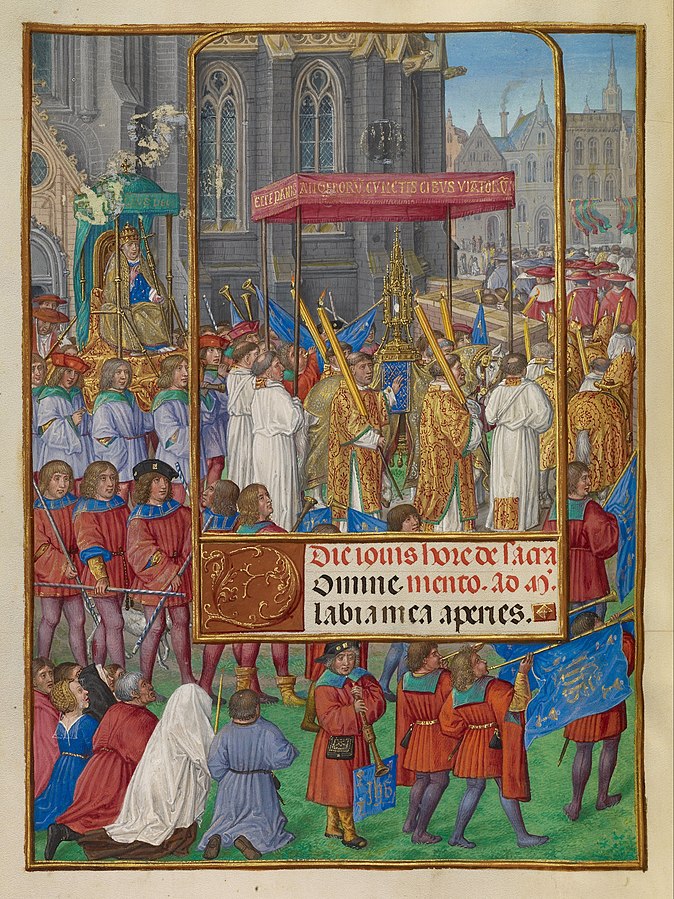
“Procession for Corpus Christi” attributed to Master of James IV of Scotland (Flemish, before 1465 – about 1541), illuminator.
Original illumination in the Getty Center Collection via Wikimedia Commons.
Last week, for example, most of continental Europe got a holiday to mark Corpus Christi, once a huge event in England but killed off by the Reformation. Why can’t we have a holiday too? It was 27 degrees in London last Thursday — it would have been great.
We’re all aware, on some subconscious level, that there is a need for communal feasts and holidays, and in some ways the idea of a June procession to celebrate the official religion has made a comeback with Pride. The feast-shaped hole in our lives is why, from time to time, the great and the good come up with very boring ideas for substitutes feasts, the latest being “Celebration Day”. The idea is for “one day in the year when we can all take a pause in our busy lives to reflect, remember and celebrate the lives of people no longer here”. You mean, like the feast of All Saints’ and All Souls’, which again was a huge part of our calendar once and is still marked in Catholic countries? Like that one?
[…]
Contrary to the fashionable Noughties takes about the evils of supernatural belief, religion has huge psychological benefits. There is a vast array of evidence showing that attending religious ceremonies increases dopamine responses in the brain. Overcoming our fear of death is not even the key part; it is meeting other people and taking part in a common ritual, which has huge benefits, including reduced risk of suicide or addiction. Religious attendance is “associated with lower psychological distress” and “related to higher well-being”.
Modernity, diet and substance abuse may have slightly increased rates of extreme mental illness such as schizophrenia, while social media has allowed people with personality disorders to become prevalent, especially in politics. But most of the “mental health crisis” is just loneliness. People attend fewer communal events because of the decline of religion, they see other people less regularly and they have fewer friends — of course they’re unhappy! Humans are not just social mammals, we are ultra-social by the standards of other species; that’s why we need common rituals and why we’re chasing that religious feeling everywhere and can’t find it. It is why, as Madeline Grant wrote in the Telegraph this week, that as well as progressive institutions adopting religious-type feasts, even exercise classes increasingly resemble Mass.
Lockdown, traumatic though it was, was merely an extreme version of the trend towards solitude already underway (with working from home, online shopping and various other lockdown activities on the rise before 2020). Most traditional societies would consider our everyday lives in non-Covid times to be a form of lockdown, with historically very unusual levels of isolation. That is why the extreme loneliness of lockdown gave rise to ersatz rituals such as Clap for Carers.
Yet you just can’t beat the real thing. As Parker wrote at the time, ritual decline was a real sadness in our lives: “From the Middle Ages until the first half of the 20th century, Whitsun and the week that followed was the chief summer holiday of the year in Britain. It was a time for all kinds of communal merry-making, varying over the centuries but consistent in spirit: the season for feasts and fairs, dancing and drinking, school and church processions, and generally having a good time.”
Tank Chat #150 Lynx C&R Vehicle | The Tank Museum
The Tank Museum
Published 4 Mar 2022► JOIN OUR PATREON: Our Patreons have already enjoyed Early Access and AD free viewing of our weekly YouTube video! Consider becoming a Patreon Supporter today: https://www.patreon.com/tankmuseum
► TIMESTAMP:
00:00 – INTRO
00:39 – FEATURES► SHOP THE TANK MUSEUM: tankmuseumshop.org
► FOLLOW THE TANK MUSEUM:
Instagram: https://www.instagram.com/tankmuseum/
Twitter: https://twitter.com/TankMuseum
Website: https://tankmuseum.org/
________________________◈ Created by The Tank Museum
#tankmuseum #tankchats #DavidFletcher

June 23, 2022
1177 B.C.: When Civilization Collapsed | Eric Cline
Long Now Foundation
Published 19 Apr 2020Consider this, optimists. All the societies in the world can collapse simultaneously. It has happened before.
In the 12th century BCE the great Bronze Age civilizations of the Mediterranean — all of them — suddenly fell apart. Their empires evaporated, their cities emptied out, their technologies disappeared, and famine ruled. Mycenae, Minos, Assyria, Hittites, Canaan, Cyprus — all gone. Even Egypt fell into a steep decline. The Bronze Age was over.
The event should live in history as one of the great cautionary tales, but it hasn’t because its causes were considered a mystery. How can we know what to be cautious of? Eric Cline has taken on on the mystery. An archaeologist-historian at George Washington University, he is the author of 1177 B.C.: The Year Civilization Collapsed. The failure, he suggests, was systemic. The highly complex, richly interconnected system of the world tipped all at once into chaos.
“1177 B.C.: When Civilization Collapsed” was given on January 11, 2016 as part of Long Now’s Seminar series. The series was started in 2003 to build a compelling body of ideas about long-term thinking from some of the world’s leading thinkers. The Seminars take place in San Francisco and are curated and hosted by Stewart Brand. To follow the talks, you can:
Subscribe to our podcasts: http://longnow.org/seminars/podcast
Explore the full series: http://longnow.org/seminars
More ideas on long-term thinking: http://blog.longnow.orgThe Long Now Foundation is a non-profit dedicated to fostering long-term thinking and responsibility. Our projects include a 10,000 Year Clock, endangered language preservation, thousand year+ data storage, and Long Bets, an arena for accountable predictions.
Become a Long Now member to support this series, join our community, and connect with our ongoing work to explore and deepen long-term thinking: http://longnow.org/membership
Follow us on Twitter: https://www.twitter.com/longnow
Subscribe to our channel: https://www.youtube.com/longnow

June 22, 2022
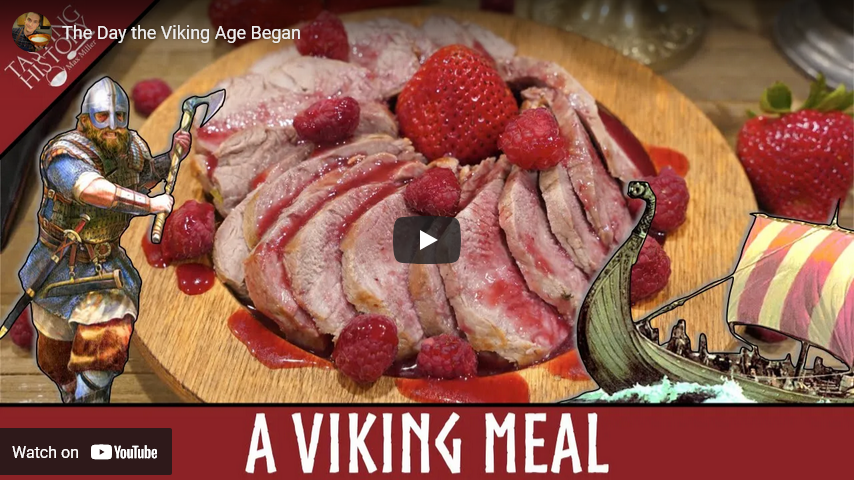
The Day the Viking Age Began
Tasting History with Max Miller
Published 21 Jun 2022For 15% off your first order with Porter Road, click the link https://porterroad.com/MAXMILLER
VIKING BLOD MEAD: https://bit.ly/meadandmore
Support the Channel with PATREON ► https://www.patreon.com/tastinghistory
Merch ► https://crowdmade.com/collections/tas…
Instagram ► https://www.instagram.com/tastinghist…
Twitter ► https://twitter.com/TastingHistory1
Tiktok ► TastingHistory
Reddit ► https://www.reddit.com/r/TastingHistory/
Discord ► https://discord.gg/d7nbEpy
Amazon Wish List ► https://amzn.to/3i0mwGtSend mail to:
Tasting History
22647 Ventura Blvd, Suite 323
Los Angeles, CA 91364LINKS TO SOURCES**
An Early Meal by Daniel Serra & Hanna Tunberg: https://amzn.to/3MOJSNb
Anglo Saxon Chronicle: https://amzn.to/3tBBoCx
The Oxford History of the Vikings by Peter Sawyer: https://amzn.to/3zElwmlRECIPE
1 pound (½ kg) pork meat
Salt for seasoning
2 tablespoons (25g) Lard or another oil for cooking
1 ½ cups (125g) chopped spring onion, or leek
2 teaspoons brown mustard seeds, roughly crushed
1 teaspoon chopped mint
1 pound (½ kg) fresh berries
½ cup (120ml) water
½ cup (120ml) mead1. Season the meat, then heat the lard/oil in a pot on the stove. Sear the meat for 5-7 minutes until well browned. Then remove it and set aside.
2. Add the onion to the pot and cook for 2-3 minutes, then add the water and mead and bring to a simmer. Add the mustard seed and mint and return the pork to the pot. Return to a simmer then cover the pot and place it in an oven at 325°F/160°C for 15-25 minutes or until the pork reaches 145°F. Then remove the pot from the oven and remove the pork to let it rest.
3. Add the berries into the pot with the braising liquid and cook on the stove for 7-10 minutes or until very soft. Mash the berries, then pour everything through a strainer. Return the liquid to the pot and simmer for several minutes or until the sauce reduces down. The sauce will not become too thick without the addition of starch (optional).
4. Slice the pork and serve with the sauce, extra berries, and mint.
**Some of the links and other products that appear on this video are from companies which Tasting History will earn an affiliate commission or referral bonus. Each purchase made from these links will help to support this channel with no additional cost to you. The content in this video is accurate as of the posting date. Some of the offers mentioned may no longer be available.
Subtitles: Jose Mendoza | IG @worldagainstjose
PHOTO
Lindisfarne Priory: Mstanyauk, CC BY-SA 3.0 https://creativecommons.org/licenses/…, via Wikimedia Commons
Disneyland: Sean MacEntee via Flickr, CC BY-SA 3.0 https://creativecommons.org/licenses/…, via Wikimedia Commons
France Relics: Dennis Jarvis via Flickr, CC BY-SA 3.0 https://creativecommons.org/licenses/…, via Wikimedia Commons
Holy Island Sunrise (again): By Chris Combe from York, UK – CC BY 2.0, https://commons.wikimedia.org/w/index…
Viking Age Map: By en:User:Bogdangiusca – Earth map by NASA; Data based on w:File:Viking Age.png (now: File:Vikingen tijd.png), which is in turn based on http://home.online.no/~anlun/tipi/vro… and other maps., CC BY-SA 3.0, https://creativecommons.org/licenses/…” rel=”noopener” target=”_blank”>https://commons.wikimedia.org/w/index…
Lindisfarne Priory Ruins: Nilfanion, CC BY-SA 3.0 https://creativecommons.org/licenses/…, via Wikimedia Commons
Statue of Rollo: By Delusion23 – Own work, CC BY-SA 4.0, https://commons.wikimedia.org/w/index…MUSIC
Battle of the Creek by Alexander Nakarada (www.serpentsoundstudios.com)
Licensed under Creative Commons BY Attribution 4.0 License
http://creativecommons.org/licenses/b…#tastinghistory #viking
Johnson M1941 Rifle
Forgotten Weapons
Published 3 Oct 2016Cool Forgotten Weapons Merch! http://shop.bbtv.com/collections/forg…
Designed in 1936 by Melvin Johnson, the M1941 Johnson Automatic Rifle was a competitor to the M1 Garand, but not introduced in time to actually be adopted in place of the Garand. Instead, Johnson hoped to have his rifle accepted as a parallel second option for the US military in case something went wrong with the rollout of the Garand, or production simply couldn’t meet the required levels.
However, Johnson was not able to make his case to the military successfully. A small number of Johnson Light Machine Guns were acquired by the US Paramarines and the First Special Service Force, and a large order (30,000 rifles) was placed by the Dutch government for shipment to the colonies in southeast Asia (it is from this order that the M1941 designation comes). However, those colonies fell to the Japanese before a significant number of rifles were able to be shipped out. This left a substantial number of rifles orphaned in the US, and a small number of these were unofficially put in service by acquisitive Marines, mostly in the Pacific theater.
Mechanically, the Johnson is a short recoil system with a rotating bolt (very similar to the later AR-15 bolt, which Johnson would influence). It is chambered for the standard .30-06 cartridge, and feeds from a 10-round rotary fixed magazine which can be fed by stripper clips or with individual cartridges.

QotD: Sparta without the helots could not have existed
And in sheer numerical terms, the helots were Sparta. If we want to talk about drawing boxes, the box we ought to draw is not around the spartiates, but around the helots. The helots so decisively outnumber the spartiates that any assessment of this society has to be about the quality of helot life (which is terrible). To draw boxes as Burns wants would be like putting a box around Jeff Bezos and declaring that America was the first all-billionaire society. In actual fact, American millionaires represent roughly the same percentage of America as the spartiates represent of Sparta, roughly six percent.
This is a fundamental flaw in how we teach Sparta – in high schools and in college. We teach Sparta like it was a free citizen society with a regrettable slave population that, while horrific, was typical for its time – something more like Rome. But it wasn’t: Sparta was a society that consisted almost entirely of slaves, with a tiny elite aristocracy. The spartiates were not the common citizens of Sparta, but rather the hereditary nobility – the knights, counts and dukes, as it were. We should as soon judge 17th century France by the first two estates as judge Sparta only by the spartiates.
Bret Devereaux, “Collections: This. Isn’t. Sparta. Part II: Spartan Equality”, A Collection of Unmitigated Pedantry, 2019-08-23.
June 21, 2022
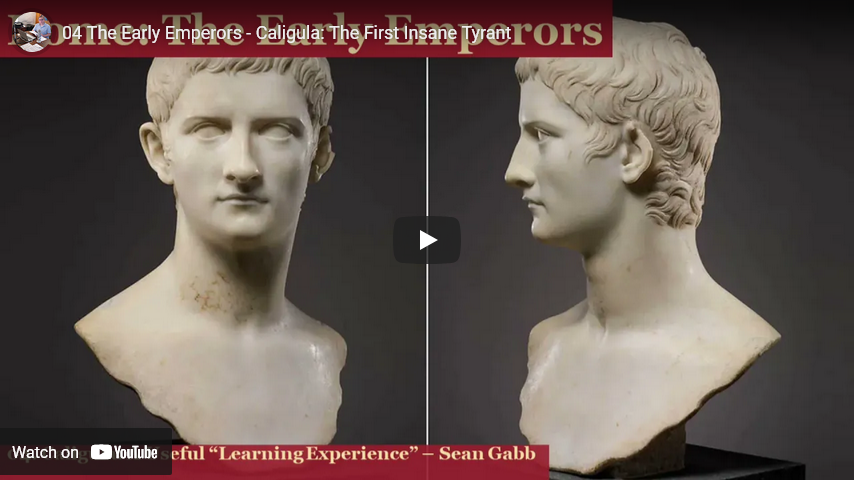
The Early Emperors – Part 4: Caligula, The First Insane Tyrant
seangabb
Published 31 Oct 2021The Roman Empire was the last and the greatest of the ancient empires. It is the origin from which springs the history of Western Europe and those nations that descend from the Western Roman Empire. It is the political entity within which the Christian faith was born, and the growth of the Church within the Empire, and its eventual establishment as the sole faith of the Empire, have left an indelible impression on all modern denominations. Its history, together with that of the ancient Greeks and the Jews, is our history. To understand how the Empire emerged from a great though finally dysfunctional republic, and how it was consolidated by its early rulers, is partly how we understand ourselves.
Here is a series of lectures given by Sean Gabb in late 2021, in which he discusses and tries to explain the achievement of the early Emperors. For reasons of politeness and data protection, all student contributions have been removed.
More by Sean Gabb on the Ancient World: https://www.classicstuition.co.uk/
Learn Latin or Greek or both with him: https://www.udemy.com/user/sean-gabb/
His historical novels (under the pen name “Richard Blake”): https://www.amazon.co.uk/Richard-Blak…
“Maybe black people generally prefer black music because it’s far superior to the standard ‘landfill indie’ that ‘Glasto’ is mired in?”
At Spiked, Julie Burchill wonders what happened to Lenny Henry:
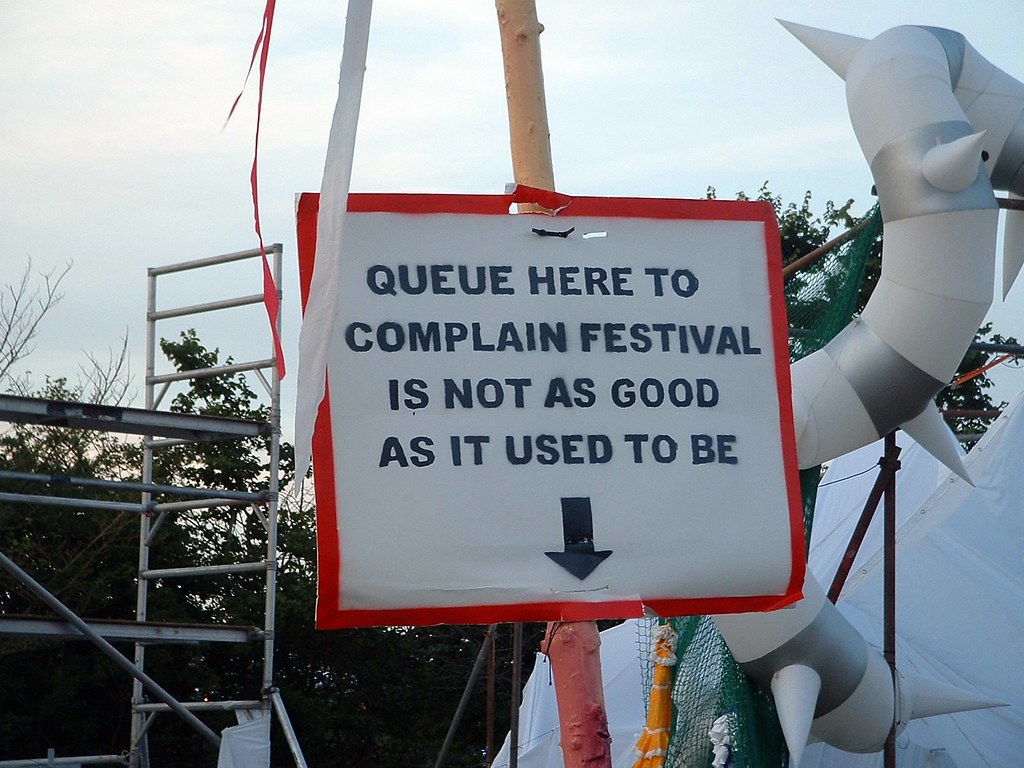
“Sign of the times @ Glastonbury Festival” by timparkinson is licensed under CC BY 2.0 
 .
.
Spare a thought for Sir Lenworth George Henry, Commander of the Order of the British Empire and knight of the realm. He works without interruption or unemployment at a job he loves (and in his spare time makes television commercials for Premier Inn hotels – megabucks payday ahoy!) and has done so from the age of 16. He is now 63 and, unusually, is becoming more attractive as he ages. He has sailed a trimaran from Plymouth to Antigua, performed on a record alongside Kate Bush and Prince, and escaped from marriage to Dawn French. Whereas some comedians become sad shadows of themselves – capering clowns who are laughed at, not with – in middle age he became a serious actor. His radio documentary, Lenny and Will, sent him “in search of the magic of Shakespeare”, whose plays he has since performed in to great acclaim. Not only is he very rich, he has also helped raise millions of pounds for charity as co-founder of Comic Relief.
But despite all of this wonderful success, Henry has in recent years taken to griping about things which really aren’t worth bothering about. Sir Len, where did it all go wrong? Well, I’d wager that it went wrong when Henry realised that if he identified as happy people might start thinking that he chose showbiz as a way to show off and get handsomely rewarded for it. And where would that leave him in the Victimhood Olympics? Nowhere near the podium.
His latest gripe is about Glastonbury. “It’s interesting to watch Glastonbury and look at the audience and not see any black people there. I’m always surprised by the lack of black and brown faces at festivals. I think, ‘Wow, that’s still very much a dominant culture thing'”, he told the Radio Times this week.
Here’s a thought. Maybe black people generally prefer black music because it’s far superior to the standard “landfill indie” that “Glasto” is mired in? And maybe they’re keener on personal hygiene than a bunch of scruffy, middle-class students roughing it on their gap year before going home to a cushy billet arranged by a friend of their father? You won’t find many white working-class people at festivals, either, for the same reasons.
I speak from personal experience. As a teenage reporter at the New Musical Express I got sent to a festival – Reading – as punishment for one of my many juvenile misdemeanours. The moment my stilettos sunk into the mud, I turned back to the station, thus facing a further trouncing from the editor. Every night, after an evening watching some rubbish punk band, I would go home and dance around the room to the sweet soul licks of the Isley Brothers until the awful white racket was forgotten.
I prefer more foreign things than I do indigenous things – from curry to gospel music – but I’m not some self-loathing idiot who believes that this country was worthless when it was white; if diversity is so great, does that mean that India and China and Africa were uninteresting before the West barged in? And don’t bother trying to make the countryside “more accessible” – I’ve never wanted to go on a ramble in my life. Why should I and my fellow mud-dodging citizens of various ethnic heritage be bussed into the racist countryside from the cities we built and love?
History of Rome in 15 Buildings 14. Sant’Andrea al Quirinale
toldinstone
Published 2 Oct 2018Coke vs. Pepsi. Kramer vs. Kramer. Alien vs. Predator. Everyone loves a rivalry – and so, discussions of art and architecture in Baroque Rome never fail to mention the antagonism between the ebullient Gianlorenzo Bernini and grim Francesco Borromini. This fourteenth episode in our History of Rome follows suit.
To see the story and photo essay associated with this video, go to:
https://toldinstone.com/santandrea-al…

June 20, 2022
Japan – Liberators of India? – WAH 065 – June 19, 1943
World War Two
Published 19 Jun 2022As the people of Bengal and Iran continue to be tormented by hunger, so are the people of Germany and Yugoslavia by bombs. In Eastern Europe, the Germans continue to kill anyone they deem an enemy.
(more…)
Claude Chappe and the Napoleon Telegraph
The History Guy: History Deserves to Be Remembered
Published 2 Mar 2022The development of technology for speedy long-distance communication dates back to antiquity, and reached its pre-electronic peak in the telegraph before Samuel Morse’s telegraph. Before wires crossed the world, Napoleonic France could send a message from Paris to Lille, a distance of some 250 kilometers, in ten minutes.
Check out our new community for fans and supporters! https://thehistoryguyguild.locals.com/
This is original content based on research by The History Guy. Images in the Public Domain are carefully selected and provide illustration. As very few images of the actual event are available in the Public Domain, images of similar objects and events are used for illustration.
You can purchase the bow tie worn in this episode at The Tie Bar:
https://www.thetiebar.com/?utm_campai…All events are portrayed in historical context and for educational purposes. No images or content are primarily intended to shock and disgust. Those who do not learn from history are doomed to repeat it. Non censuram.
Find The History Guy at:
New community!: https://thehistoryguyguild.locals.com/
Please send suggestions for future episodes: Suggestions@TheHistoryGuy.netThe History Guy: History Deserves to Be Remembered is the place to find short snippets of forgotten history from five to fifteen minutes long. If you like history too, this is the channel for you.
Awesome The History Guy merchandise is available at:
teespring.com/stores/the-history-guyScript by THG
#history #thehistoryguy #France

June 19, 2022
Kursk: Soviets Dig-In for Blitzkrieg – WW2 – 199 – June 18, 1943
World War Two
Published 18 Jun 2022The Soviets have put civilians to work by the hundreds of thousands, building line after line of defenses in the Kursk salient, where they are sure the Germans are soon to attack. Meanwhile the Allies are making moves in preparations for two big upcoming offensives of their own — in Sicily and the Central Solomon Islands.
(more…)


