
Valour Canada
Published 28 Dec 2015This video describes the Royal Canadian Navy’s (RCN) invaluable contributions to the invasion on D-Day, June 6, 1944. Operation Neptune was the name of the English Channel-crossing portion of the larger Normandy invasion (named Operation Overlord).
1. Overview (0:00)
Dawn. June 6, 1944. D-Day. Operation Overlord, the largest amphibious invasion in history, is about to begin. This is a description of the battlefield prior to the attack and also tells how the RCN played an important role both in the English Channel and along the French coast.2. Stop the U-boats (2:55)
Churchill said that the only thing that scared him during the war were the U-boats. This describes the problematic German U-boats and how the British and Canadian Navies (Operation Neptune) worked together to find, track, and destroy the underwater menace prior to D-Day.3. Clear the Mines (6:27)
“There is no doubt that the mine is our greatest obstacle to success” – British Admiral Bertram Ramsay. The size and effectiveness of the German minefield that guarded the D-Day beaches and how the Allied Navies worked together to prepare a route through which the invasion could occur.4. Cover the Beaches (9:49)
The Canadian Tribal-class destroyers played a significant role in eliminating the German Navy’s major surface warships’ threat to the invasion fleet. The RCN destroyer squadron and their mission of clearing the English Channel of German ships before, during, and after the invasion. A battle between the Canadian destroyers Haida and Huron and four German ships near the port of Brest on June 9 is discussed. Also covered are the two Canadian destroyers, Algonquin and Sioux, that were tasked with shore bombardment at Juno Beach.5. Land the Troops (13:01)
Shortly after dawn and following a forty-minute naval barrage at Juno Beach, the first Canadian soldiers came ashore. By noon, the beach was held by the Canadians and millions of tons of supplies were being brought ashore. This section describes the first waves of the invasion and the tanks, artillery, vehicles, and supplies that were soon to follow.
(more…)
June 4, 2023
D-Day Series: RCN and Operation Neptune
June 3, 2023
Why Was Normandy Selected For D-Day?
Real Engineering
Published 28 Mar 2020In the debut episode of the Logistics of D-Day we explore the logic and planning that resulted in Normandy being chosen as the location for the largest amphibious invasion in the history of human kind.
(more…)
June 2, 2023
“Montgomery was a military talent; Slim was a military genius”
Dr. Robert Lyman is a known fan of Field Marshal Slim (as am I, for the record), not only for his brilliant military achievements, but also as a writer:
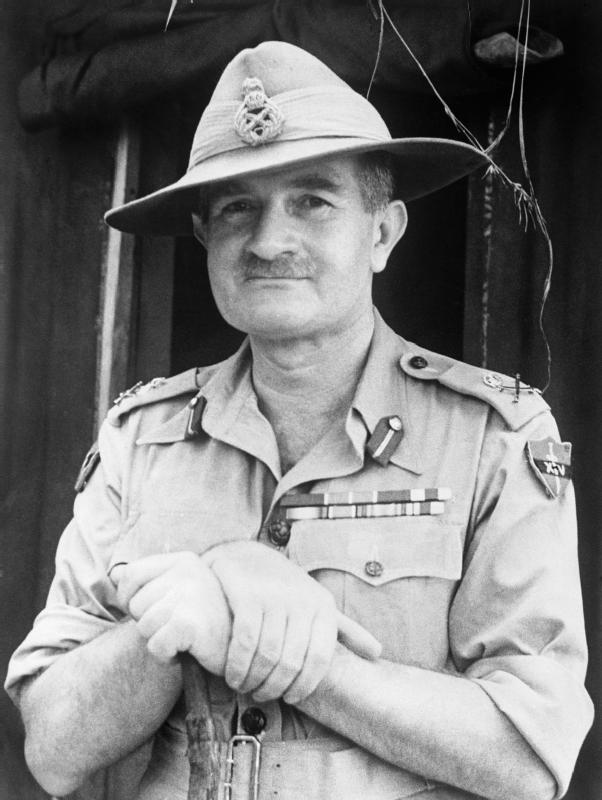
Field Marshal Sir William Slim (1891-1970), during his time as GOC XIVth Army.
Portrait by No. 9 Army Film & Photographic Unit via Wikimedia Commons.
How many British generals have been able to write as well as they could fight? Strangely perhaps, quite a few. Field Marshal Sir Michael Carver (Dilemmas of the Desert War, The Seven Ages of the British Army), General Sir David Fraser (And We Shall Shock Them), General Sir John Hackett (The Third World War) and Major General John Strawson (Beggars in Red) are four outstanding soldier-writers that spring immediately to mind. Even Monty wrote his memoirs. And in our own day I’ve read plenty of competent books from a slew of men who’ve reached the top of the profession of arms. The work of some, like that of General Sir Richard Sherriff (2017: War with Russia), Major General Mungo Melvin (Manstein) and Brigadier Allan Mallinson (Too Important for the Generals et al), could be described as outstanding. Julian Thompson and Richard Dannatt also fit this bill. But by far and away the best of Britain’s soldier-writers in the last century was also probably the greatest soldier – and field commander – of them all: Bill Slim. He was, more properly, Field Marshal William J. Slim KG, GCB, GCMG, GCVO, GBE, DSO, MC, KStJ, the onetime General Officer Commanding the famous 14th Army – the so-called Forgotten Army – of Burma fame. He was, in this author’s view, the greatest British general of the last war (to avoid further debate, let’s just agree that Monty failed as a coalition commander, whereas Slim excelled). Slim’s ability as a general is perfectly summed up by the historian Frank McLynn:
Slim’s encirclement of the Japanese on the Irrawaddy deserves to rank with the great military achievements of all time – Alexander at Gaugamela in 331 BC, Hannibal at Cannae (216 BC), Julius Caesar at Alesia (58 BC), the Mongol general Subudei at Mohi (1241) or Napoleon at Austerlitz (1805). The often made – but actually ludicrous – comparison between Montgomery and Slim is relevant here … there is no Montgomery equivalent of the Irrawaddy campaign … Montgomery was a military talent; Slim was a military genius.1
Some hint of Bill Slim’s fluency with the written word to complement his ability as a soldier came with the publication of Defeat into Victory in 1956, his superb retelling of the Burma story. Apart from its remarkable tale – the humiliation of British Arms in 1942 eventually overturned by a triumphant (and largely Indian) army in 1945 (87% of Slim’s army was Indian) – the quality of the writing was astonishing. Its author, a man who would be appointed Chief of the Imperial General Staff in 1949 (following Monty), the first Sepoy General ever to do so, and by Attlee no less, could clearly wield a pen every bit as he could destroy Japanese armies in battle (a feat he achieved twice, first in 1944 and again in 1945). When the book was first published it was an instant publishing sensation with the first edition of 20,000 selling out immediately. The Field recorded: “Of all the world’s greatest records of war and military adventure, this story must surely take its place among the greatest. It is told with a wealth of human understanding, a gift of vivid description, and a revelation of the indomitable spirit of the fighting man that can seldom have been equalled – let alone surpassed – in military history.” The London Evening Standard was as effusive in its praise: “He has written the best general’s book of World War II. Nobody who reads his account of the war, meticulously honest yet deeply moving, will doubt that here is a soldier of stature and a man among men.” The author John Masters, who served in the 14th Army, wrote in the New York Times on 19 November 1961 that it was “a dramatic story with one principal character and several hundred subordinate characters”, arguing that Slim was “an expert soldier and an expert writer”. The book remains a best seller today.
The following year Slim also published an anthology of speeches and lectures, loosely based on the theme of leadership, called Courage and Other Broadcasts. Then in 1959 he published his second book, Unofficial History, which bears out in full Masters’ description of Slim as a superb writer. It was a deeply personal, honest though light hearted account of events during his service. It received widespread acclaim. The author John Connell described it as “for the most part uproarious fun. If Bill Slim hadn’t been a first-rate soldier, what a short story writer he might have made.” For its part, The National Review wrote: “One of the most significant aspects of Field Marshal Slim’s book is the affectionate respect he shows when he writes about British and Indian soldiers. He finds plenty to amuse him too. I doubt whether a kindlier or truer description of the contemporary soldier has been given anywhere than in Unofficial History … It is one of the most delightful and amusing books about modern campaigning I have ever read.”
1. The General Wondered Why https://amzn.eu/d/45gHfOH
Germany Adopts the PPSh in 9mm: the MP-41(r)
Forgotten Weapons
Published 20 Feb 2023During World War Two, both German and Russian soldiers often thought that the other side’s weapons were better than their own. In particular, both sides often preferred their opponents’ SMGs. In late 1941, a group of German officers formally requested that Germany simply copy and produce the PPSh-41. This led to the HWA formally studying the question of PPSh-41 vs MP-40 … and they found that the German gun was better, but the Russian magazine was better.
Naturally, as a result of this finding, the German military chose to convert captured Russian PPSh-41s to use MP-40 magazines. The conversion used standard MP40 magazines, and required magazine well adapters and new 9mm barrels. Some 10,000 such conversions were made in total. Some used cast magwell adapters and some were stamped, and the barrels were made from standard MP40 barrels turned down to fit PPSh trunnions.
The standard 7.62mm PPSh-41 in German service was designated MP-717(r), while the ones changed to 9x19mm like this were designated MP-41(r). Many thanks to Limex for giving me access to film this one for you!
(more…)
June 1, 2023
Recent discoveries in ancient DNA
The Psmiths, John and Jane, decided to jointly review a book by David Reich called Who We Are and How We Got Here: Ancient DNA and the New Science of the Human Past. This is Jane’s first contribution to an extended email thread between the Psmiths:

The problem with history is that there just isn’t enough of it. We’ve been around for, what, fifty thousand years? Conservatively.1 And we’ve barely written things down for a tenth of that. Archaeological excavation can take you a little farther back, but as the archaeologists always like to remind us, pots are not people. If you get lucky with a society that made things out of durable materials in a cold and/or dry environment (or you get very lucky with anaerobic preservation of organic materials, like in ice or bogs), maybe you can trace a material culture’s expansion and contraction across time and space. But that won’t tell you whether it’s a function of people moving and taking their stuff with them, or people’s neighbors going “ooh, using string to make patterns on your pots, that’s cool” and copying it. It certainly doesn’t tell you what their descendants were doing several thousand years later, potentially in an entirely different place and probably using an entirely different suite of technologies. Trying to understand what happened in the human past based on the historical and archaeological records is like walking into a room where a bomb has gone off and trying to reconstruct the locations of all the objects before the explosion. You can get some idea, but it’s all very broad strokes. And actually it’s worse than that, because it wasn’t just one explosion, it was lots, and we wouldn’t even know how many if we didn’t have a way of winding the clock back. But these days we do, and it’s ancient DNA.
Sometime between when my grandfather gave me a copy of Luca Cavalli-Sforza’s Genes, Peoples, and Languages for my birthday and when you and I decided to read Reich’s book together, two big things happened: humans got really, really good at sequencing and reading genomes, and Svante Pääbo’s lab in Leipzig got really, really good at extracting DNA from ancient bones. (How they developed their procedures is actually a really interesting story, which Pääbo retells in his book, but Reich — whose lab uses the same techniques on an industrial scale — gives a good, brief summary of how it works.) Together, these two advances unlocked … well, not quite everything about the deep past, but an absolutely enormous amount. Suddenly we can track the people, not just the pots, and the story is more complicated and fascinating than anything we might have expected. I’ve written elsewhere about some of the aDNA discoveries about human evolution (Neanderthal admixture, the Denisovans, etc.), but I’m even more excited about what ancient DNA reveals about our more recent past. Luckily, that’s what Reich spends most of the book on, with discussion of ancient ghost populations who now exist only in admixture and then chapters on the specific population genetic histories of Europe, India, North America, East Asia, and Africa, each of which contains some discoveries that would make (at least the more sensible) archaeologists and historical linguists go “well, duh” and others that are real surprises.
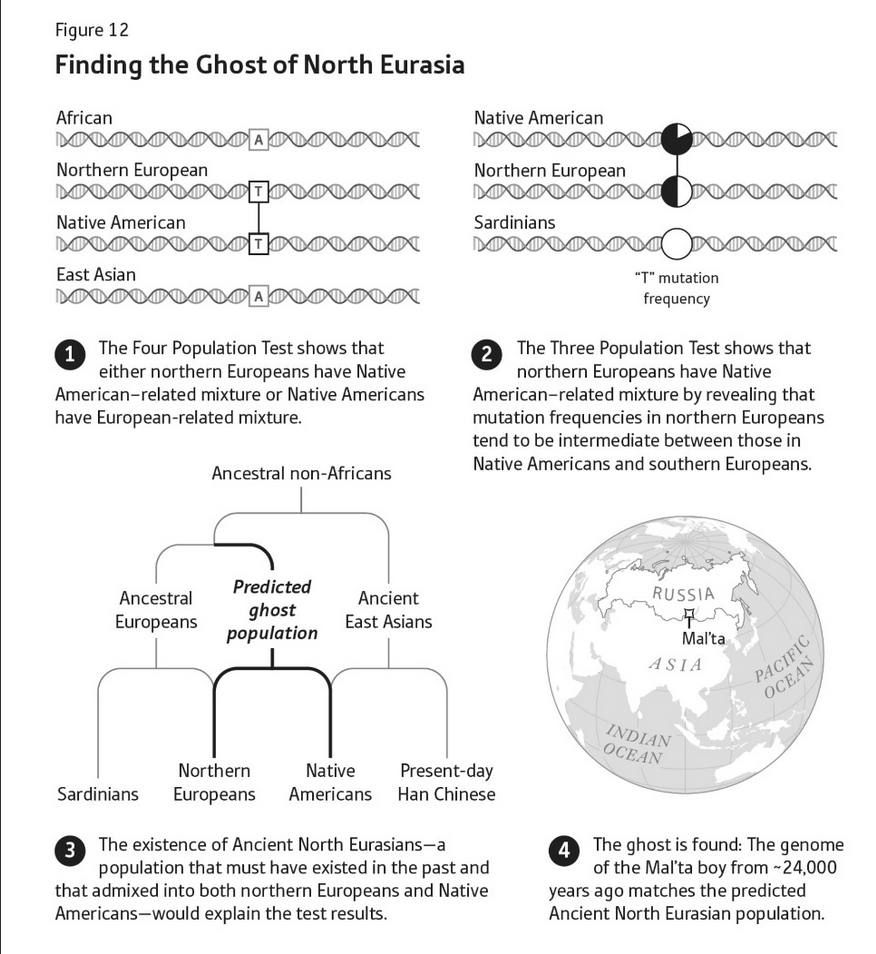
One of the “duh” stories is the final, conclusive identification of the people who brought horses, wagons, and Indo-European languages to Europe with the Yamnaya culture of the Pontic Steppe and their descendants. (David Anthony gives a very good overview of the archaeological case for this in The Wheel, the Horse, and Language, including some very cool experimental archaeology about horse teeth; you have my permission to skim the sections on pots.) My favorite surprising result, though, comes from a little farther north. People usually assume that Native Americans and East Asians share a common ancestor who split from the ancestors of Europeans and Africans before dividing into those two populations, but when Reich’s lab was trying to test the idea they found, to their surprise, that in places where Northern European genomes differ from Africans’, they are closer to Native Americans than to East Asians. Then, using a different set of statistical techniques, they found that Northern European populations were the product of mixture between two groups, one very similar to Sardinians (who are themselves almost-unmixed descendants of the first European farmers) and one that is most similar to Native Americans. They theorized a “ghost” population, which they called the “Ancient North Eurasians”, who had contributed DNA both to the population that would eventually cross the Bering land bridge and to the non-Early European Farmer ancestors of modern Northern Europeans. Several years later, another team sequenced the genome of a boy who died in Siberia 24kya and who was a perfect match for that theorized ghost ANE population.
But we’ve already established that I’m the prehistory nerd in this family; were you as jazzed as I was to read about the discovery of the Ancient North Eurasians?
1. That’s the latest plausible date for the arrival of full “behavioral modernity” in Africa, though our genus goes back about two million years, tool use probably three million, and I think there’s a good case that Homo was meaningfully “us” by 500kya. (That’s “thousand years ago” in “I talk about deep history so much I need an acronym”, fyi.)
Banning Roger Waters would be playing his game
In Spiked, Daniel Ben-Ami explains why we should reject the arguments about banning Roger Waters, formerly the frontman for Pink Floyd, and lately a pretty out-there antisemite:

Screencapture from a YouTube video.
Pressure is mounting to ban Roger Waters from performing in Britain. The former Pink Floyd frontman and veteran anti-Israel activist stands accused of anti-Semitism. But whatever one makes of Waters’s antics, his performances should not be cancelled.
Waters is set to perform his first UK show tonight in Birmingham, with further concerts scheduled for Glasgow, London and Manchester. These are part of his controversial “This Is Not a Drill” tour, which began its European leg a few months ago. The show contains a number of controversial elements, such as Waters dressing up in a Nazi-style uniform and brandishing a gun, while Anne Frank’s name is projected above the stage. In past tours, he has floated an inflatable pig with a Star of David on it above the stage.
The Waters row came to a head earlier this month, when local authorities in Frankfurt attempted to ban his concert. The ban was successfully challenged by Waters in court and the concert went ahead, despite protests. Waters is now being investigated by the German police for wearing a Nazi-style uniform on stage at his Berlin gig (the display of Nazi symbols is illegal in Germany, except for educational or artistic purposes). According to Waters, he donned the uniform not to endorse Nazism, but in order to make a “scathing critique” of it.
Jewish community organisations in the UK have condemned Waters, with some calling for him to be censored. The Board of Deputies of British Jews has argued that his concerts are probably better described as political rallies. The National Jewish Assembly has called on the UK government to condemn Waters. The Campaign Against Antisemitism, a volunteer-led charity, has not only launched a petition to stop venues hosting him – it has also written to cinema chains demanding they cancel film screenings of his concerts.
[…]
There are also more practical reasons to challenge these attempts to cancel Waters. The campaign against him, first in Germany and now in Britain, has allowed Waters to present himself as a free-speech martyr. To some, this will lend credence to his dubious claim that he is the victim of shadowy, covert forces determined to silence his advocacy for the oppressed.
Besides, banning displays of anti-Semitism does not make the problem go away. On the contrary, it only encourages anti-Semitism to take on more disguised forms. This often includes the demonisation of Israel or of Zionism, rather than Jews as such. Even those who do genuinely hate Jews will rarely admit to it openly. Instead, they typically use coded language, which is harder to challenge and confront.
By all means, protest outside Waters’s concerts and challenge his outrageous antics. But the attempts to ban his concerts are an affront to freedom. And they will do nothing to help the struggle against anti-Semitism. Roger Waters must have the right to perform.
QotD: “The Puritans were the SJWs of their day”
Predestination is Calvinism’s fundamental doctrine. To the Calvinist, all human effort is utterly futile, since nothing we could ever possibly do could affect our salvation, or lack thereof, which was decreed by God long before the foundations of the world were laid. How the hell you get from “all human effort is futile” to “we must totally remake society” is above my pay grade, feel free to check Walzer if you want to give it a go, but it’s obvious that the Calvinists did get there — see the English Civil Wars, which themselves were a sideshow to the whole charming episode we pros call The Period of the Wars of Religion, 1517-1648.
The Puritans, as English Calvinists were called, wrote difficult prose, but in translation it sounds shockingly modern. The Puritans were the SJWs of their day, obsessed with their own pwecious widdle selves. They didn’t get around to making up xzheyr own pronouns, but they did give themselves self-righteous new names — when Ben Johnson called his caricature Puritan Zeal-of-the-Land Busy he got big laughs, but he wasn’t really joking, they really did stuff like that. To be a Puritan requires two things: An obsessive focus on the tiniest micro-movements of your own soul …
… and an equally obsessive focus on forcing other people to disclose the tiniest micro-movements of their souls. There’s nothing anyone could ever do, so trivial that a Puritan could in good conscience overlook it. Calvin’s Geneva was the closest thing to a police state 16th century technology allowed, and when their turn came, Oliver Cromwell and the boys gave importing it to England the old college try. And, of course, Plymouth Bay Colony started as a Puritan police state …
Ideology, then, removes the distinction between public and private. You can’t simply say you’re a Puritan, you really have to BE one — constantly, perfectly, since there’s nothing that Puritanism doesn’t touch. And the only way to do that, of course, is to do everything in full public view at all times. Calvin did — as Walzer remarks, John Calvin, the man, is almost completely absent from Calvin’s writings. (Unlike Luther, whose idiosyncratic, not to say lunatic, personality comes through in practically every sentence). Calvin achieved that clear windowpane prose Orwell claimed was the mark of a great writer — nothing between audience and subject at all. Calvin would, indeed, take the remark that he’s almost a complete cipher, personally, as a very high compliment.
Severian, “Ideology II”, Rotten Chestnuts, 2020-11-09.
May 31, 2023
Improvised Weapons of WW2 | Anti-Tank Chats #8 | The Tank Museum
The Tank Museum
Published 10 Feb 2023Historian Stuart Wheeler is back with another Anti-Tank Chat. In this episode, he looks at the development and use of improvised, thrown and placed infantry anti-tank weapons, available to British and Commonwealth forces in World War II.
(more…)
May 30, 2023
Ban all the words!
Chris Bray reflects on the historical context of literature bans:
Before the Civil War, Southern states banned abolitionist literature. That ban meant that postmasters (illegally!) searched the mail, seized anti-slavery tracts, and burned them. And it meant that people caught with abolitionist pamphlets faced the likelihood of arrest. The District of Columbia considered a ban, then didn’t pass the thing, but Reuben Crandall was still arrested and tried for seditious libel in 1833 when he was caught with abolitionist literature. He was acquitted, then died of illness from a brutal pre-trial detention. Seizure, destruction, arrest: abolitionist literature was banned.
The Soviet writer Yevgeny Zamyatin wrote a 1924 novel, We, depicting a world in which an all-powerful government minutely controlled every aspect of life for an enervated population, finding as an endpoint for their ideological project a surgery that destroyed the centers of the brain that allowed ordinary people to have will and imagination. The Soviet government banned Zamyatin’s work: They seized and destroyed all known copies, told editors and publishers the author was no longer to allowed to publish, and sent Zamyatin into exile, where he died without ever seeing his own country again. Seizure, destruction, exile: Yevgeny Zamyatin’s work was banned.
During World War I, the federal government banned literature that discouraged military service, including tracts that criticized conscription. Subsequently, “socialists Charles Schenck and Elizabeth Baer distributed leaflets declaring that the draft violated the Thirteenth Amendment prohibition against involuntary servitude”. They were arrested, convicted, and imprisoned. The Supreme Court upheld the conviction. Anti-conscription literature was banned: It was seized and destroyed, and people caught distributing it were sent to prison.
In 2023, the tedious midwit poet Amanda Gorman posted on Twitter that she was “gutted” — the standard emotion for tedious midwits — to discover that one of her poems had been “banned” by a school in Florida. The news media raced to proclaim that Florida schools are banning books, the leading edge of the Ron DeSantis fascist wave.
As others have already said, Gorman’s boring poem was moved from an elementary school library shelf to a middle school library shelf, without leaving the library

M1886 Lebel Rifle at the Range
Forgotten Weapons
Published 17 Mar 2013The French M1886 Lebel was the first smallbore smokeless powder rifle adopted by a major military, and was a game changer in the European arms race in the 1880s. It wasn’t an outstanding design in many ways (like the slow-loading tube magazine and requirement to use a screwdriver to remove the bolt), but its 8mm smokeless cartridge jumped France to the front of the technological race regardless. Today, we’re taking one out to the range to see how it shoots.
May 29, 2023
“I’m starting to think that Just Stop Oil is a Big Oil plant”
Tom Slater on the amazing tone-deafness of the Just Stop Oil “activists”:
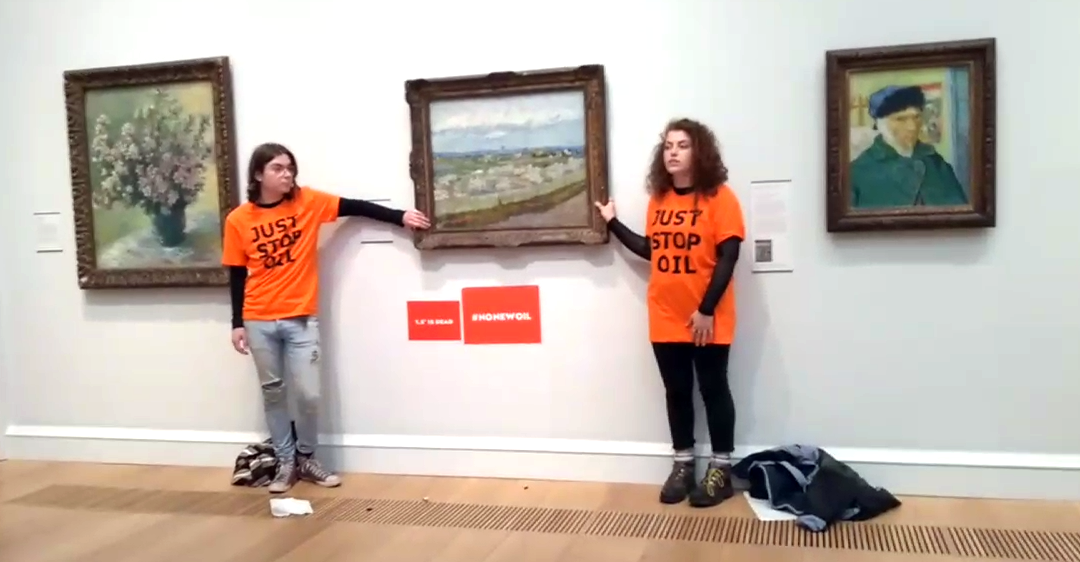
“Just Stop Oil Courtauld Gallery 30062022” by Just Stop Oil is licensed under CC BY-SA 4.0 

 .
.
I’m starting to think that Just Stop Oil is a Big Oil plant. What else could explain these campaigners’ phenomenal ability to turn the public against them and confirm their critics’ worst prejudices. Namely, that this environmental activism / amdram troupe is stuffed with upper-middle-class irritants who couldn’t give a damn about working-class people. Surely, this has got to be on purpose?
Take their recent “slow marches” through London, aimed at bringing traffic to a standstill. The whole point of these stunts seems to be to force cab drivers, delivery men and builders to sit in traffic so that these protesters can preach their miserable little gospel. And as Edred Whittingham‘s (don’t laugh) deranged antics at the Crucible recently showed us, you now can’t even escape these bourgeois millenarians during your leisure time.
That this new generation of environmentalists are almost uniformly posh is an established empirical fact. An academic survey of those involved in Extinction Rebellion – the mothership organisation from which Just Stop Oil and Insulate Britain were spawned – found, to the surprise of precisely no one, that they were overwhelmingly middle class, highly educated and from the south. A full 85 per cent of them have some form of university degree.
So what we have here is the comfortably off classes – those with sufficient free time to glue themselves to roads on a Wednesday mid-morning – forcing their weird hangups on everyone else. Time and again, when they are criticised for making people’s lives a misery, they offer only patronising lectures. “We’re so sorry that we have to disrupt the lives of ordinary people”, said Just Stop Oil’s Eben Lazarus (I know) to Vice last year, but “hopefully people will see, further down the line, that the disruption we’re causing is microscopic compared to the disruption that we’re going to face because of the climate crisis”. Translation: we know better, you cretins.
No wonder that so many now respond to these cunning stunts with instant, visceral fury. First there was the Battle of Canning Town in 2019, when east-London commuters pulled two Extinction Rebellion people down from the top of a Tube train. And as police have failed to deal with these protests – they now seem to escort rather than stop these “slow marches” – motorists have increasingly decided to take matters into their own hands. Several clips of workers clashing – sometimes physically – with Just Stop Oil activists have gone viral in the past week alone, including one of a man shoving JSOers on Blackfriars Bridge, before promptly being arrested.
The Moment D-Day Was Announced
World War Two
Published 28 May 2023D-Day is just around the corner, we’re in the end game now. You can learn more about the project and how to get involved at http://DDay.TimeGhost.tv
May 28, 2023
Breakout from Anzio! – WW2 – Week 248 – May 27, 1944
World War Two
Published 27 May 2023After four months, the Allies breakout from their bridgehead at Anzio and meet with the advancing troops heading north after the fall of Monte Cassino last week. The Japanese begin phase two of their big operation in China, and both the Soviets and the Western Allies continue making plans for their massive June offensives to squeeze the Axis from both sides of Europe.
(more…)
Musical copyrights – crazy as they are now – were far worse in history
Ted Gioia outlines just how the concept of musical copyrights produced even more distortions in the past than they do today:
Assignments of copyrights photostat copies by mollyali (CC BY-NC 2.0) https://flic.kr/p/5JbsPE
People tell me it was never this bad before. But they’re wrong. The music copyright situation was even crazier 500 years ago.
The Italians took the lead in this, and it all started with Ottaviano Petrucci gaining a patent from the Venetian Senate for publishing polyphonic music with a printing press back in 1498. Andrea Antico secured a similar privilege from Pope Leo X, which covered the Papal States.
It’s hard to imagine a Pope making decisions on music IP, but that was how the game was played back then. In 1516, Pope Leo actually took away Petrucci’s monopoly on organ music, and gave it to Antico instead. You had to please the pontiff to publish pieces for the pipes.
Over time, this practice spread elsewhere. In a famous case, the composer Lully was granted total control over all operas performed in France. He died a very wealthy man — with five houses in Paris and two in the country. His estate was valued at 800,000 livres—some 500 times the salary of a typical court musician.
But the most extreme case of music copyright comes from Elizabethan England. Here the Queen gave William Byrd and Thomas Tallis a patent covering all music publishing for a period of 21 years. Not only did the two composers secure a monopoly over English music, but they also could prevent retailers or other entrepreneurs in the country from selling “songs made and printed in any foreign country.”
If anybody violated this patent, the fine was 40 shillings. And the music itself was seized and given to Tallis and Byrd. They probably had quite a nice private library of scores by the time the patent expired.
But that’s not all. Byrd and Tallis’s stranglehold on music was so extreme it even covered the printing of blank music paper. That meant that other composers had to pay Tallis and Byrd even before they had written down a single note. Not even the Marvin Gaye estate makes those kinds of demands.
Tallis died a decade after the patent was granted—putting Byrd in sole charge of English music. I’d like to tell you that he exercised his monopoly with a fair and open mind—especially because I so greatly esteem Byrd’s music, and also I’d like to think that composers are better at arts management than profit-driven businesses. But the flourishing of music publishing in England after the expiration of the patent — when, for a brief spell, anybody could issue scores — makes clear that Byrd did more to constrain than empower other composers.
May 27, 2023
The true purpose of the Great Exhibition of 1851
In the latest Age of Invention newsletter, Anton Howes considers the “why” of the 1851 Great Exhibition:
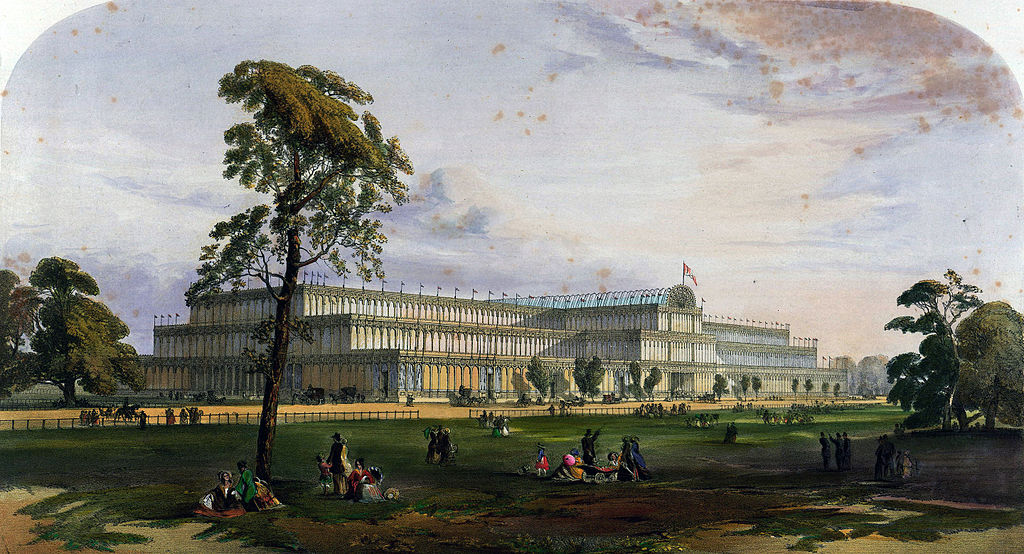
The Crystal Palace from the northeast during the Great Exhibition of 1851, image from the 1852 book Dickinsons’ comprehensive pictures of the Great Exhibition of 1851
Wikimedia Commons.
Ever since researching my book on the history of the Royal Society of Arts, I’ve been fascinated by the Great Exhibition of 1851, which they initiated. Like most people, I had once assumed that the exhibition was just a big celebration of Victorian technological superiority — a brash excuse to rub the British Industrial Revolution in the rest of the world’s faces. But my research into the origins of the event revealed that it was almost the opposite. Far from being a jingoistic expression of superiority, it was actually motivated by a worry that Britain was rapidly losing its place. It was an attempt to prevent decline by learning from other countries. It was largely about not falling behind.
Industrial exhibitions already had a long history in 1851, as a crucial weapon in other countries’ innovation policy arsenals. They were used by countries like France in particular — which held an exhibition every few years from 1798 — as a means of catching up with Britain’s technology. This sounds strange nowadays, when the closest apparent parallels are vanity projects like the Millennium Experience, the recent controversial “Festival of Brexit” that ended up just being a bunch of temporary visitor attractions all over the country, and glitzy mega-events like the World’s Fairs. But the World’s Fairs, albeit notional successors to the Great Exhibition, have strayed very far from the original vision and purpose. They’re now more about celebration, infotainment and national branding, whereas the original industrial exhibitions had concrete economic aims.
Industrial exhibitions were originally much more akin to specialist industry fairs, with producers showing off their latest products, sort of combined with academic conferences, with scientists demonstrating their latest advances. Unlike modern industry fairs and conferences, however, which tend to be highly specialised, appealing to just a few people with niche interests, industrial exhibitions showed everything, altogether, all at once. They achieved a more widespread appeal to the public by being a gigantic event that was so much more than the sum of its parts — often helped along by the impressive edifices that housed them. The closest parallel is perhaps the Consumer Electronics Show, held since 1967 in the United States. But even this only focuses on particular categories of industry, and is largely catered towards attendees already interested in “tech”. Industrial exhibitions were like the CES, but for everything.
The point of all this, rather than just being an event for its own sake, was to actually improve the things on display. This happened in a number of ways, each of them complementing the other.
Concentration generated serendipity. By having such a vast variety of industries and discoveries presented at the same event, exhibitions greatly raised the chances of serendipitous discovery. A manufacturer exhibiting textiles might come across a new material from an unfamiliar region, prompting them to import it for the first time. An inventor working on a niche problem might see the scientific demonstration of a concept that had not occurred to them, providing a solution.
Comparison bred emulation. Producers, by seeing their competitors’ products physically alongside their own, would see how things could be done better. They could learn from their competitors, with the laggards being embarrassed into improving their products for next time. And this could take place at a much broader, country-wide level, revealing the places that were outperforming others and giving would-be reformers the evidence they needed to discover and adopt policies from elsewhere.
Exposure shattered complacency. The visiting public, as users and buyers of the things on display, would be exposed to superior products. This was especially effective for international exhibitions of industry, of which the Great Exhibition was the first, and simulated an effect that had only ever really been achieved through expensive foreign travel — by being exposed to things they hadn’t realised could already be so much better than what they were accustomed to, consumers raised their standards. They forced the usual suppliers of their products to either raise their game or lose out to foreign ones.


