
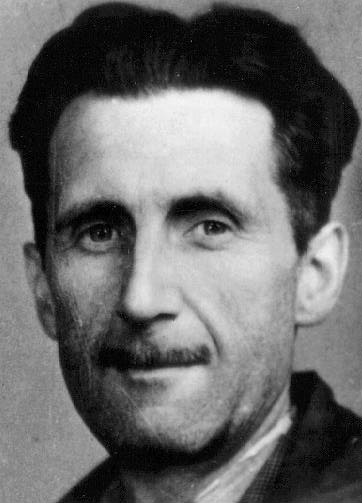
Orwell’s press card portrait, 1943
For years past I have been an industrious collector of pamphlets, and a fairly steady reader of political literature of all kinds. […] When I look through my collection of pamphlets — Conservative, Communist, Catholic, Trotskyist, Pacifist, Anarchist or what-have-you — it seems to me that almost all of them have the same mental atmosphere, though the points of emphasis vary. Nobody is searching for the truth, everybody is putting forward a “case” with complete disregard for fairness or accuracy, and the most plainly obvious facts can be ignored by those who don’t want to see them. The same propaganda tricks are to be found almost everywhere. It would take many pages of this paper merely to classify them, but here I draw attention to one very widespread controversial habit — disregard of an opponent’s motives. The key-word here is “objectively”.
We are told that it is only people’s objective actions that matter, and their subjective feelings are of no importance. Thus pacifists, by obstructing the war effort, are “objectively” aiding the Nazis; and therefore the fact that they may be personally hostile to Fascism is irrelevant. I have been guilty of saying this myself more than once. The same argument is applied to Trotskyism. Trotskyists are often credited, at any rate by Communists, with being active and conscious agents of Hitler; but when you point out the many and obvious reasons why this is unlikely to be true, the “objectively” line of talk is brought forward again. To criticize the Soviet Union helps Hitler: therefore “Trotskyism is Fascism”. And when this has been established, the accusation of conscious treachery is usually repeated.
This is not only dishonest; it also carries a severe penalty with it. If you disregard people’s motives, it becomes much harder to foresee their actions. For there are occasions when even the most misguided person can see the results of what he is doing. Here is a crude but quite possible illustration. A pacifist is working in some job which gives him access to important military information, and is approached by a German secret agent. In those circumstances his subjective feelings do make a difference. If he is subjectively pro-Nazi he will sell his country, and if he isn’t, he won’t. And situations essentially similar though less dramatic are constantly arising.
In my opinion a few pacifists are inwardly pro-Nazi, and extremist left-wing parties will inevitably contain Fascist spies. The important thing is to discover which individuals are honest and which are not, and the usual blanket accusation merely makes this more difficult. The atmosphere of hatred in which controversy is conducted blinds people to considerations of this kind. To admit that an opponent might be both honest and intelligent is felt to be intolerable. It is more immediately satisfying to shout that he is a fool or a scoundrel, or both, than to find out what he is really like. It is this habit of mind, among other things, that has made political prediction in our time so remarkably unsuccessful.
George Orwell, “As I Please”, Tribune, 1944-12-08.
June 10, 2023
QotD: The word “objectively”
June 8, 2023
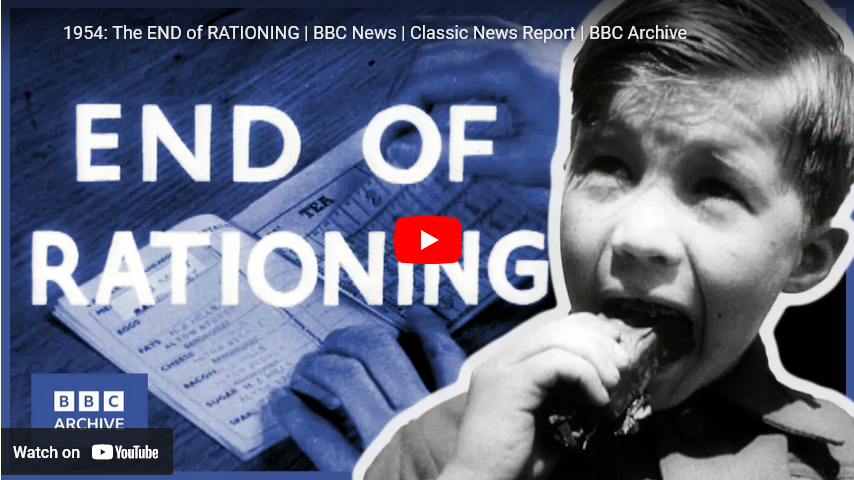
1954: The END of RATIONING
BBC Archive
Published 5 Mar 2023“The ration book has done its job. It’s been a long job. Indeed, children up to school-leaving age have never known life without the ration book.”
On the fourth of July, the rationing of meat in Britain came to an end, the final step in dismantling Britain’s whole wartime system of food distribution. After fourteen long years, Britons can at last tear up their ration books.
Richard Baker looks back at some of the key moments in the story of rationing and de-rationing.
Originally broadcast 5 July, 1954.
QotD: Heroes, demi-gods and gods in the ancient Greek world
A handful of heroes from Greek mythology become gods as part of their story. The most famous of these is Heracles, raised to godhood at his death, along with Castor and Pollux – twin demi-god heroes with enough divinity between them to make one of them god and they alternated the honor. Leucothea (lit: the white goddess) – the divine form of the woman Ino – makes her appearance in the Odyssey (Book 5!) to save Odysseus.
These figures – complete with tales of being swept up into divinity while still alive or at the moment of their death – are in some way atypical of hero worship in the Greek world. More typical is a figure like Achilles, who very definitely was mortal and very definitely died and whose spirit is very much in the Underworld in the Odyssey (and neatly contrasted with Heracles – only Heracles’ shade is in the underworld, for his soul was divine; but cf. Pindar on Achilles, Olympia 2.75-85). Our sources (e.g. Plin. Nat. 4.26) continue to speak of Achilles as a man, with a physical tomb. And yet Alexander pays him honors (Arr. Anab. 1.12.1) and we have ample evidence for cult observances of Achilles in the Greek world. it was possible to be a man in life, and yet have enough influence to be worthy of cult in death.
This sounds strange, but its worth noting that some of the most common mortal figures to receive this kind of cult worship were founder figures – people (often legendary or mythical in nature) credited with the foundation of a community. We’ve actually discussed that here before in Lycurgus and Theseus, but as you might imagine, such figures were very common. It is not entirely crazy to assume that these figures have some power to shape your world or life, because they already have – you live in the city they founded! They deeds in life continue to shape the confines of your experience – why wouldn’t that influence, in some way, carry with them?
(And while I’m here, I should note that the American architectural veneration of our founder figures on the National Mall is explicitly framed in terms of Mediterranean cult observance. The Lincoln and Jefferson memorials both borrow their forms from Roman temples and contain super-life-sized cult statues exactly as and where a Roman temple would has the cult statue of the god, while the Washington Monument – as an Egyptian style obelisk – mimics Egyptian practice quite intentionally. We even have our monuments to the di manes [the divine shades of your dead ancestors who watch over you] in our war memorials, framed around collective veneration. A Roman time-traveler would have no problem interpreting the display, and might think the many millions of visitors coming from all corners quite pious in their observance.)
Bret Devereaux, “Collections: Practical Polytheism, Part IV: Little Gods and Big People”, A Collection of Unmitigated Pedantry, 2019-11-15.
June 7, 2023
German Counterattack – D-Day [Part 4]
World War Two
Published 6 Jun 2023When the amphibious landings begin, they run straight into Hitler’s Atlantic Wall. Eisenhower has predicted a third of his troops may fall. While they land, the news breaks across the world.
(more…)
Piercing the Atlantic Wall – D-Day [Part 3]
World War Two
Published 6 Jun 2023With wide gaps struck in the Atlantic Wall, it is now up to the Allies to secure the beachheads and move inland. There they will face off with new German defenses, and the Norman geography.
(more…)
A Harbour goes to France – Mulberry Harbours – Normandy Landings
British Army Documentaries
Published 24 Jun 2020Mulberry harbours were temporary portable harbours developed by the United Kingdom during the Second World War to facilitate the rapid offloading of cargo onto beaches during the Allied invasion of Normandy in June 1944. After the Allies successfully held beachheads following D-Day, two prefabricated harbours were taken in sections across the English Channel from UK with the invading army and assembled off Omaha Beach (Mulberry “A”) and Gold Beach (Mulberry “B”).
(more…)
QotD: A “second front” in 1943
There are some points in their favour. The invasions of North Africa definitely took resources that could have been built up in Britain, and therefore slowed things down. (And the withdrawal of the new escort carriers, escort groups, and shipping from the Battle of the Atlantic for the North African adventure, definitely did huge damage in the loss of shipping and supplies, slowing things down further.) As a result the huge buildup in North Africa was much easier to use against Italy before moving on to France. Certainly another distraction or delay … but only if you don’t think that knocking Italy out of the war would make Germany weaker!
But once Sledgehammer [the plan to invade France in 1942] was abandoned, this operation was the only possible way to get US troops into combat in Europe, short of shipping some to Russia. It was also the only possible way of coming close to keeping Roosevelt’s ridiculous promise to the Russians.
[…]
Nonetheless it is wrong to think that the British never had any intention of [mounting Operation] Roundup. Despite what Roosevelt and many other Americans convinced themselves, the British were, at the start of 1942, far more optimistic about the possibility of invading Europe through France in 1943 than they had been about Sledgehammer. Their studies seemed to show that Germany would only have to be weaker, not suddenly collapse, to make invasion in 1943 a realistic possibility. Realistic that is as long as the rest of the plans for training and shipping troops, building and concentrating invasion craft, and moving enough supplies to make it sustainable, all came together.
They didn’t.
For the British, the middle of 1942 revealed how little would be available in time for the middle of 1943. Even on the best assumptions of American training and preparation, there was no chance that the majority of forces for Roundup would not be British … assuming they could supply them either. In practice mid-1942 saw the Axis continue to advance on every front. Burma collapsed; the Allied position in New Guinea was under threat; the Japanese were still expanding to places like Guadalcanal; Rommel was advancing in Egypt; the Germans were advancing on the Caucasian oil fields and towards the Middle East; and more and more was needed just to keep Russia in the war. As a result British troops, shipping and supplies were continuing to flow away from Britain, not towards it.
Much of the Royal Navy was trying to save the dangerous losses caused by [US Chief of Naval Operations Admiral] King’s refusal to have convoys in American waters (too “defensive-minded” he thought.) These alone, the worst eight months of the war, were threatening to scupper Roundup. The rest was so busily deployed in the Indian and Pacific Oceans against the Japanese, or North Atlantic trying to fight supplies through to Russia (a high proportion of tanks and planes defending Moscow were British-supplied), that there was virtually nothing left in the Med to slow Rommel’s advance. The merchant ships surviving the fight across the oceans were actually more vitally needed to take men and equipment from the UK to other places than to bring in a buildup for the UK.
Nor was the American buildup going to plan. Less well-trained troops were becoming available too slowly, could not be shipped in adequate numbers anyway, and were in no condition to face German veterans. (The very best US units to go into action in 1942 – the Marines in Guadalcanal – and 1943 – the 1st Infantry and 1st Armored divisions which were actually professional troops not conscripts in North Africa – had very steep learning curves. Particularly at Kasserine. They were clearly not fit to face German veterans yet.
And American resource buildup was also not up to promises. King and MacArthur were milking supplies far beyond what had originally been agreed under “Germany first”. In practical terms they were doing so for the same reasons the British were: an immediate desperate situation had to be saved before a future ideal one could be pursued.
Nonetheless I have read all sorts of apparently serious suggestions that after North Africa was cleared, or at the very least after Sicily was cleared, an invasion of France should have happened.
Delusional.
Nigel Davies, “The ‘Invasion of France in 1943’ lunacy”, rethinking history, 2021-06-21.
June 6, 2023
Through The Gates of Hell – D-Day [Part 2]
World War Two
Published 6 Jun 2023When the amphibious landings begin, they run straight into Hitler’s Atlantic Wall. Eisenhower has predicted a third of his troops may fall. While they land, the news breaks across the world.
(more…)
Invasion by Air – D-Day [Part 1]
World War Two
Published 5 Jun 2023In the early hours it is up to the Allied airborne troops to secure the battlefield perimeter, and protect the operation. Now they will find out if the Germans have been deceived, or are ready and waiting with mortal force.
(more…)
Juno Beach: The Fighting Canadians on D-Day | History Traveler Episode 194
The History Underground
Published 6 Feb 2022When one thinks about where the most violent fighting took place on D-Day, you wouldn’t be wrong in citing Omaha Beach where the highest number of casualties were inflicted. But as a percentage of the landing force, the Canadians on Juno Beach suffered more than any other Allied nation. In this episode, we’re joined by Paul Woodadge of @WW2TV to explore a few of the areas along Juno Beach where men to the 3rd Canadian Infantry Division landed on June 6th.
(more…)
QotD: “A second front” in 1942
[…]
A plan put together for the incredibly unlikely event of sudden German collapse, was Sledgehammer. This was the understanding of Sledgehammer adopted by most Americans. A very limited offensive by very inadequate forces, which could only succeed had Germany already gone close to collapse. Given the circumstances this was somewhat delusional, but it never hurts to plan for eventualities, and the British were happy to go along with this sort of plan.
[…]
Any attempt at Sledgehammer would of course have failed. The German army had not yet been bled dry on the Eastern front, and the Luftwaffe was still a terrifying force which could be (and regularly was) easily moved from Russian mud to Mediterranean sunshine and back again in mere weeks. Even ignoring the opposition, the British were gloomily aware that the Americans had not a clue of the complexities of such a huge amphibious operation. At the time of discussion – May 1942 – the British were using their first ever Landing Ship Tanks and troopships equipped with landing craft to launch a brigade-size pre-emptive operation against the Vichy French on Madagascar. (Another move many historians think was useless. But coming only months after the Vichy had invited the Japanese into Indo-China – fatally undermining the defenses of Malaya – and the Germans into Syria, it was probably a very sensible precaution. Certainly Japanese submarines based in Madagascar [could] have finally caused the allies to lose the war at sea!)
The British deployed two modern aircraft carriers, and a fleet of battleships, cruisers, destroyers and escorts and a large number of support ships, on this relatively small operation. It was the first proper combined arms amphibious operation of the war, and was very helpful to the British to reveal the scale of amphibious transport needed for future operations. By contrast the US Marines hit Guadalcanal six months later from similar light landing craft, and with virtually the same Great War-vintage helmets and guns that the ANZACS had used at Gallipoli. Anyone who reads the details of the months of hanging on by the fingernails at Guadalcanal against very under-resourced Japanese troops, will be very grateful that the same troops did not have to face veteran German Panzer divisions for several years.
So I do not know of any serious historian who imagines that an invasion of France in 1942 could have led to anything except disaster. There are no serious generals who thought it either. (Only Marshall and his “yes-man” Eisenhower consistently argued that it might be possible. And Eisenhower later came to realise – when he was in charge of his third or fourth such difficult operation – that his boss was completely delusional in his underestimation of the difficulties involved. See Dear General: Eisenhower’s Wartime Letters to Marshall for Eisenhower’s belated attempts to quash Marshalls tactical ignorance about parachute drops and dispersed landings for D-Day.)
In practice no matter how much Marshall pushed for it, only British troops were availabe for such a sacrificial gesture, and the British were not unnaturally reluctant to throw away a dozen carefully nurtured and irreplaceable divisions on a “forlorn hope”, when they would prefer to save them for a real and practical invasion … when circumstances changed enough to make it possible.
Unfortunately Roosevelt told the Soviet foreign minister Molotov that “we expect the formation of a second front this year”, without asking even Marshall, let alone wihtout consulting his British allies who would have to do it with virtually no American involvement. The British Chiefs of Staff only had to show Churchill the limited numbers of landing craft that could be available, and the limited number of troops and tanks they could carry, to make it clear that this was ridiculous. Clearly this stupidity was just another example of Roosevelt saying stupid things without asking anyone (like “unconditional surrender”) that did so much to embitter staff relations during the war, and internationaly relations postwar. But it seems likely that the British refusal to even consider such nonsense was taken by Marshall and Stimson as a sample of the British being duplicitous about “examining planning options”.
The British fixed on a “compromise” to pretend that a “second front” could be possible. North Africa, could be conquered without prohibitive losses. It was not ideal, and in practical terms not even very useful. But it might satisfy the Americans and the Russians. Nothing else could.
Marshall in particular spent the rest of the war believing that when the British assessment clearly demonstrated that action in Europe was impractical and impossible, they had just been prevaricating to get what they always intended: operations in the Med. In some ways he was correct. The British had done the studies on France despite thinking that it was unlikely they would be practical, and were proved right. Marshall and Eisenhower had just deluded themselves into thinking an invasion might be practical, and could not accept that there was not a shred of evidence in favour of their delusion.
Nigel Davies, “The ‘Invasion of France in 1943’ lunacy”, rethinking history, 2021-06-21.
June 5, 2023
The poster child for truly antisocial behaviour
Not following the news closely, I don’t think I’d heard of “Mizzy” until perhaps a week or two back, but if he’d tried pulling this kind of behaviour in the US, his career would likely have been a lot shorter and much more violent:

Screen capture from a YouTube video
What’s the big deal about Mizzy? Surely one idiot 18 year old doesn’t merit the full glare of the British media, you may be thinking (at least if you haven’t been paying attention). Certainly the Guardian didn’t seem to think so — lagging two days behind reporting of the story in the Daily Mail, Telegraph, Independent and BBC. We at the Critic were kind enough to point this out and the Guardian have since seen fit to lower themselves to the story — an unhelpful distraction no doubt from more serious stories their exhaustive coverage of Philip Schofield’s departure from British breakfast TV.
One reason to care, is that despite claims to be a mere prankster, Mizzy’s actions are profoundly serious, terrifying to his victims, and suggest an escalating pattern of behaviour that could very plausibly lead to greater crimes. In a series of videos clearly intended to menace his targets, he decided to steal a dog from an old lady, burst into the home of a young family, and, in one truly shocking incident, comes up to a woman alone at night and asks her if she wants to die. It’s obvious, taken together, that these incidents are not pranks taken too far, but deliberate and calculated attempts to terrify and intimidate innocent people, often women, children or the elderly.
Anyone who has been subject to what we often euphemistically call “anti-social behaviour” and middle class columnists like to frame as teenagers with “too little to do” (blame the closed youth centre or something), knows all too well what Mizzy is up to. It’s the local drug addict who always follows you late at night, leering. It’s the teenagers who let their pitbull bark and snarl at you, smirking all the while. It’s the men who sit outside your house drinking, and stare at you as you walk down the road. Men and boys who take pleasure in the fear of others, often to compensate for absences in their own life — a job, a father, a girlfriend, a future. And sometimes the absence has no obvious explanation — there’s just something missing inside, a hole that demands to be filled, an appetite for brutality and cruelty muzzled but not tamed by modern society.
So what’s so special about Mizzy? He’s got a TikTok channel, on which he proudly posts these petty acts of barbarity for the pleasure of his thousands of followers. And this fact tells a story, an important story, about both the present and future of British society.
In the present, it’s a tale of an unpoliced and anti-social public realm; an increasingly familiar and despairing story of police and judicial passivity in the face of open criminality. Under Blair we reclassified petty crime as “anti-social behaviour” and instead of prison, or a suspended sentence and an ankle monitor, judges handed down things along the lines of “you must not be in the East Shield shopping centre after 10pm”. ASBO recipients, having been briefly hauled up, generally swiftly resume their trajectory towards criminality, creating more victims in the process.
Mizzy, having spent months openly terrorising people, was, amidst national attention and outrage, given the successor to the ASBO — a CBO (Criminal Behaviour Order). Shortly after appearing on national TV and complaining that he was the victim of racism, and only two days after receiving his CBO, Mizzy had already breached its terms, having posted yet more videos.
So much for the present — but what does the tiresome tale of narcissism and cruelty tell us about our future? Nothing good. Mizzy has blended street thuggery with online harassment, creating entertainment out of fear and pain. He’s part of a new flamboyant and triumphalist form of bullying and criminality, which finds an enthusiastic audience online.
Joe Baron instantly recognized Mizzy’s type from his own experiences as a teacher:
Piers Morgan is right. Mizzy is a moron. For those of you unfamiliar with the story, “Mizzy” is 18-year-old Bacari-Bronze O’Garro, who attracts followers on TikTok by filming himself engaged in criminal activity. He terrifies families by invading their homes, steals the dogs of elderly women, physically assaults unsuspecting commuters, and threateningly asks random people if they’d like to die.
[…]
As a teacher I recognised him immediately. So many youngsters betray the same peculiarities: entitled, self-satisfied and utterly irresponsible.
Why are these traits so commonplace among our young people? There are several reasons, bad parenting being the most notable. Either through fear or convenience, parents no longer discipline their children. If a teacher attempts to do so, the parents often complain, presumably in a bid to appease their volatile offspring and maintain a quiet life at home.
This month, I had a furious encounter with a parent who could only be described as deranged. My crime: issuing her daughter with a 30-minute detention for forgetting her exercise book. In an earlier incident, another parent physically assaulted a colleague, attempting to strangle him for disciplining his daughter. She had slapped a book out of his hand during classroom changeover. Anxious and stressed, my colleague left the school soon after, and several weeks later, his attacker’s daughter viciously assaulted another pupil, who then needed hospital treatment.
Parents also have to take responsibility for the devastating effects of divorce on their children. Nearly half of all marriages end in failure. That’s a huge number of broken homes and broken children. And it often leads to poor behaviour. Fecklessness begets fecklessness. When will we wake up to this reality and encourage prospective parents to take their vows more seriously? That’s if there is a marriage in the first place. Or even a father present in the home.
Furthermore, adults have surrendered their authority to children. For example, recalcitrant pupils are not effectively disciplined because, contrary to the Christian doctrine of Original Sin, children are now seen as pure, infallible and morally unimpeachable, and adults as iniquitous and corrupting influences. Consequently, a child’s misbehaviour must be the fault of the adult or teacher. In addition, if a child should make a statement concerning an incident, and the statement contradicts his or her teacher’s version of events, the child’s claims must take precedence, even if they’re completely bogus.

The Longest Day: 75 Things You Don’t Need to Know
A Million Movies
Published 6 Jun 2019In honor of the 75th anniversary of the D-Day invasion, I’m taking a look at my favorite D-Day movie … The Longest Day.
Also, unlike most of my other videos, there are some things in here I think you do need to know. Number one on that list is to hear some of the true stories of the men and women featured in this movie. They, along with hundreds of thousands of other heroes and heroines, saved the world.
Fair warning: My pronunciation of anything French is going to be amazingly bad. No disrespect intended.
June 4, 2023
“[T]he unspoken truth about the English and protesting. Reader, we are crap at it.”
William Atkinson has lost patience with the posh idiots who make up the useful idiot brigade of Just Stop Oil and other Extinction Rebellion spawn:
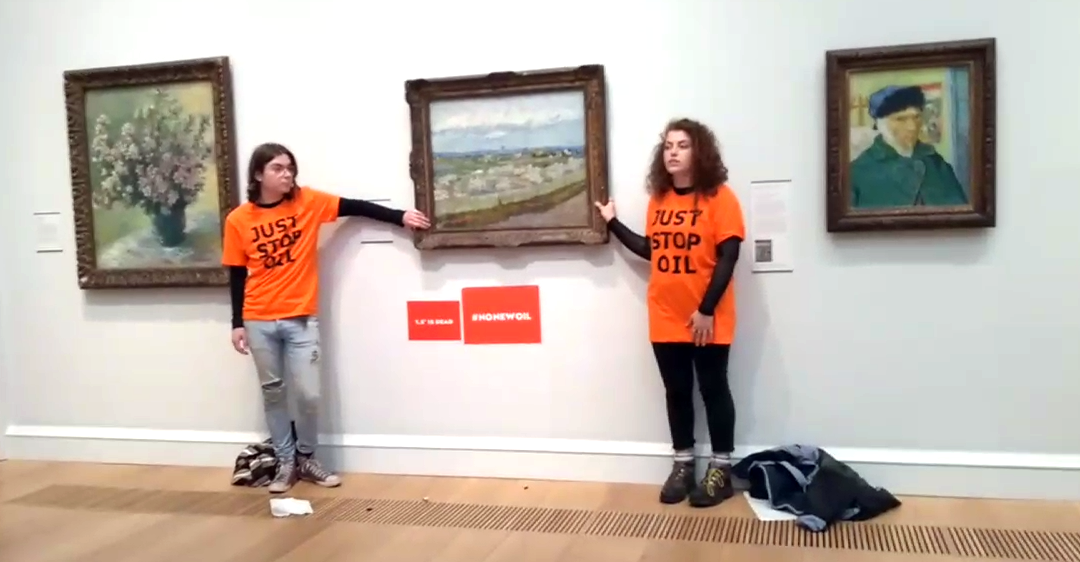
“Just Stop Oil Courtauld Gallery 30062022” by Just Stop Oil is licensed under CC BY-SA 4.0 

 .
.
I’m sorry, readers, but Just Stop Oil have gone too far this time.
I’ve previously been pretty sanguine about the eco-loonies. I don’t drive a car, a decent number of my friends are w*ke, and as I am trying to market myself as Britain’s first pro-climate change commentator – all that sparkling wine! – anything that raises the issue’s salience is a bonus. Coppers standing limply by glue-enthusiasts is fine by me.
That was until this morning. But the decision of these pound-shop Rainbow Warriors to hold up the England team on their way to Lord’s is indefensible. If Just Stop Oil really claim to care about the future of the planet, they should surely want to protect the most beautiful thing on it: the glorious, sainted game of Test cricket? Arrest them all, throw away the key, and apologise profusely to Ben Stokes.
What is even more surprising about this act of sporting vandalism is that one would usually expect cricket to be something of which Just Stop Oil and other protestors are quite fond. They are, after all, rather conservative. That is not just in a historic sense – nobody was more reactionary than the Luddites! – but because they are made up of exactly the sorts of people one would expect to vote Tory.
A University of Exeter study showed that supporters of Extinction Rebellion in 2019 were overwhelmingly middle-class, highly-educated women from the South of England. Some 85% had degrees, two-thirds identified as middle-class, a high proportion were self-employed, and three-quarters lived in southern England – a third from the West Country. Surely the Blue Wall personified?
Why have Deborah from Totnes and Agnes from Frome decided to start gluing themselves to motorways and mistaking Heinz for Dulux? Professor Clare Saunders, whose analysis I just quoted, said that because these people are “not natural protestors” or “natural law-breakers”, it must show they were “already persuaded by the rightness of the climate cause”. Unsurprisingly, I disagree.
Our over-proliferation of graduates in recent decades, combined with the increasing tendency of women to vote for left-wing parties, was naturally going to produce some form of radicalisation. But add in Brexit, the possibility of blocking some houses, and the opportunity to reclaim some form of lost youth, and suddenly giving it the gilet jaune seems like a nice day out.
In that lies the unspoken truth about the English and protesting. Reader, we are crap at it. The French shut down Paris, lose lives, and burn down municipal buildings in protest at a raise in the pension age, all we can manage are posh girls mucking around with soup, blue-haired Oxford undergrads sticking themselves to a floor, or railwayman who now openly admit a year of strikes has been pointless.
H/T to Johnathan Pearce for the link.
The Allies are Driving for Rome – WW2 – Week 249 – June 3, 1944
World War Two
Published 3 Jun 2023The Allies head north in Italy after the fall of Monte Cassino last week; the Japanese head south in China in a new phase of their offensive; and the Soviets and the Western Allies make ever more concrete plans for their huge offensives, to go off very soon.
(more…)


