
Bee Here Now
Published 23 Oct 2023The Stockton-Darlington Railway wasn’t the first time steam locomotives had been used to pull people, but it was the first time they had been used to pull passengers over any distance worth talking about. In 1825 that day came when a line running all the way from the coal pits in the hills around County Durham to the River Tees at Stockton was opened officially. This was an experiment, a practice, a great endeavour by local businessmen and engineers, such as the famous George Stephenson, who astounded crowds of onlookers with the introduction of Locomotion 1 halfway along the line, which began pulling people towards Darlington and then the docks at Stockton.
This was a day that would not only transform human transportation forever, but accelerate the industrial revolution to a blistering pace.
In this video I want to look at what remains of that line — not the bit still in use between the two towns, but the bit out in the coalfields. And I want to see how those early trailblazers tackled the rolling hills, with horses and stationary steam engines to create a true amalgamation of old-world and new-world technologies.
(more…)
February 16, 2024
What remains of the “first” steam powered passenger railway line?
February 15, 2024
Artillery! A WW2 Special
World War Two
Published 14 Feb 2024The modern artillery of the Great War was responsible for the vast majority of military deaths in that conflict, but how has artillery developed from that war to this one? Today we take a look at some of the artillery of WW2.
(more…)
Tune in for the propaganda, stay tuned for the epic meltdowns
Are you old enough to remember when “news” in the legacy media was, well, calmly presented factoids (accurate or not) that might get you upset, but the emotional content wasn’t heightened or enacted by the hairspray heads in front of the camera? Those days are long enough past that they might never have happened, as Chris Bray illustrates:
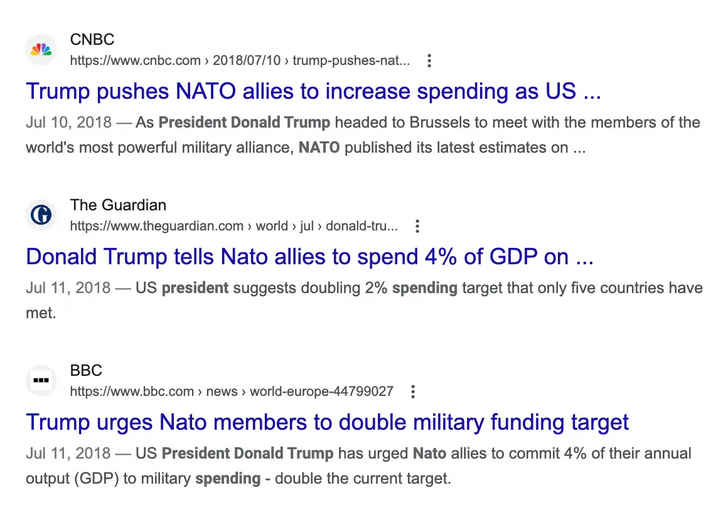
Spend a minute of your life looking at a chart that shows how much countries spend on their militaries as a percentage of GDP. The US spends about 3.5%, while Germany spends about 1.4%. For years, hawks have argued that the US should spend 4% of GDP on defense, in a well-known debate about reasonable funding for security. NATO members commit to a target of 2% or better, and many don’t make that goal. Donald Trump says he told the leaders of NATO countries that they should make or beat their military spending targets to ensure their own security, and as a negotiating ploy he poked at them and said that he wouldn’t bother to defend people who wouldn’t bother to pay for their own defense.
You can agree with his argument or disagree with his argument, and make whatever argument you want about the carefulness or recklessness of Trump’s rhetorical style, but none of this is obscure.
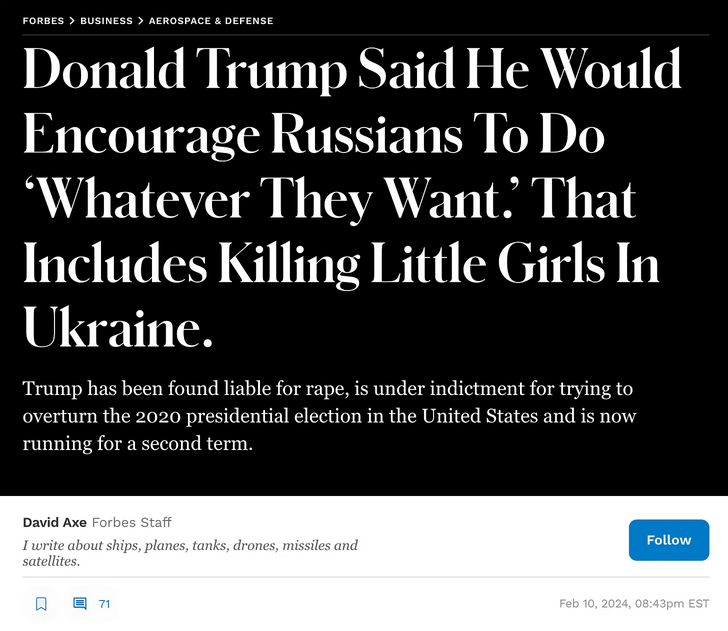
And so now we’re living through an ORANGE MAN LITERALLY HITLER CRISIS, as Orange Satan Drumpf tells the Putin Devil to absolutely MURDER all the Europeans and the world teeters in agony at the very brink of a harvest of slaughter. Here, let Forbes just give you the news, straight and factual and to-the-point:
THE MEAN MAN SAYING FOR THE PUTIN DEVIL TO MURDER ALL THE LITTLE BABIES professional journalists calmly explain, absolutely biting through the rubber nipple on their pacifiers. Sackcloth, ashes, endlessly refillable SSRI prescription: journalist starter kit.
In the car a few minutes ago, I turned on the radio mid-interview to hear a hysterical NPR anchor begging a European pundit to agree that Trump is a vicious monster, and the European — I missed his name — sighed and said that look, this is a debate that we’ve been having for a while, it’s a pretty normal discussion. BUT DON’T YOU THINK HE’S AN ORANGE MURDER DEVIL!?!?!? Then they played an important clip of Slow Joe Biden slurring and fake-shouting about Trump’s un-American cruelty, sounding almost as angry as he was when he talked about how many actual chips they put in the potato chip bags. This is why I listen to NPR in short bursts, like a gun run from an A-10. Brrrrrrrrrt, and off.
But what’s inescapable about this extremely dull moment, yet again, is that an allegedly elite layer of political, academic, and media figures are taking something routine and willfully inflating it into a five-alarm global crisis. It … must be a day ending in -y? Nothing is ever bad, or disagreeable, or arguable; every event is The Absolute Worst. Every development must be discussed in hyperemotional terms; every objectionable act is devastating, terrifying, destructive, ruinous, treasonous, unforgivable. No one disagrees with us; rather, they are ENEMIES OF EVERYTHING WE STAND FOR!!!!!
The Big Picture – NATO: Partners in Peace (1954)
Army University Press
Published Nov 13, 2023NATO: Partners in Peace follows the creation and impact of the North Atlantic Treaty Organization (NATO). Created in April 1949 with twelve founding members, this organization’s goal was to protect the inherent rights of individual states through collective defense. In this episode from The Big Picture series, General Dwight D. Eisenhower offers a speech before he deploys to Europe to become the first Supreme Allied Commander Europe (SACEUR). This is followed with footage of the buildup and training of European forces. Once Eisenhower leaves NATO to campaign for the presidency, General Matthew Ridgway replaces him as NATO commander. One significant problem NATO forces faced was the fact that each nation had its own weapon systems and ammunition, an issue the U.S. wanted to address with the standardization of the 7.62mm cartridge. Perhaps as a deterrent to the Soviet Union, NATO: Partners in Peace depicts new weapons that could be used against a large enemy force such as remote-controlled missiles, napalm bombs, and the massive atomic cannon.
February 14, 2024
Soviet World War Two Swords? The M1927 Shashka
Cossack forces have long been a key cavalry element of the Russian military, and this did not change during the Soviet era. The Cossacks had their own rather distinctive style of sword, the shashka, and the Red Army maintained the tradition of issuing them to Cossack cavalry troopers. In 1927, a new pattern was adopted, and it was produced and issued from 1928 until 1946. The shashka has a slightly curved, single-edged blade and no handguard. The model 1927 military type was initially made with a rather decorative pommel, but this was simplified to just a plain 5-pointed star as German advances into Russia really stressed Soviet industrial production. However, production and issue of the shashka continued uninterrupted throughout the war.
Originally there were separate trooper and officer versions of the model 1927, with the trooper version including the ability to stow the trooper’s Mosin-Nagant rifle bayonet on the side of the shaskha scabbard. As cavalry, the Cossacks were not expected to carry their rifles with bayonets fixed, and this served in lieu of a bayonet sheath. By 1944 this feature was omitted, as the M91/30 was replaced by the M38 and M44 carbines and submachine guns, which did not use bayonets.
The decorations returned to the M1927 shashka in 1945, with a series made for the Victory Day parade celebrating the defeat of Germany. Today’s example is one of these, and in beautiful condition.
February 13, 2024
“I am a proud member of the Airfix generation”
I didn’t realize that Peter Caddick-Adams is the same age as me, but it does seem that our interests pretty much ran parallel for a while:
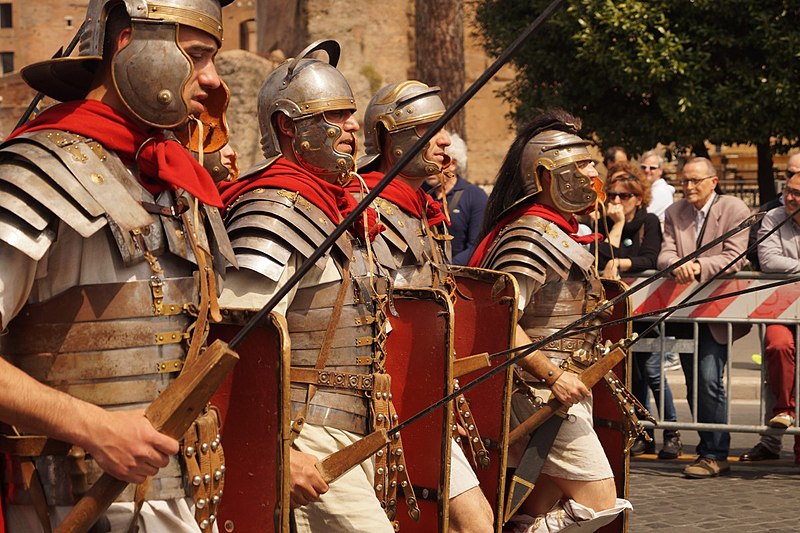
Re-enactors in Roman legionary gear, 19 May, 2021.
Original photo from https://pxhere.com/en/photo/883133 via Wikimedia Commons.
I am a proud member of the Airfix generation. The desire (less so the ability) to assemble and paint plastic model kits of aircraft, tanks and ships hit me squarely between the eyes on my tenth birthday in 1970. Several aunts and uncles had arrived at the same solution to bring out my inner Spitfire on the same day. Who needed the high of polystyrene cement and Humbrol enamel when you could refight D-Day across your bedroom floor with kits costing as little as 1/6d? Although Airfix was the premium producer of scale kits, other competing brands included Frog, Tamiya, Monogram, Hasegawa and Revell. I wish I knew what I did with them all, but many of the aircraft I recall casting out of upstairs windows, set on fire by match and candle. Looking back, I can see how it sewed the seeds of my becoming a professional military historian decades later. From little acorns, eh?
Two years later, I discovered I was interested in anything historical when my parents packed us into a train (great excitement in itself) for a trip to London. Although long past the days of steam, I can remember my father walking me down to thank the engine driver for getting us safely into Euston and then the true adventure began. The arrival at the British Museum to see the Tutankhamun Exhibition, which ran from March to December 1972. When it ended, besides the young Caddick-Adams, 1.6 million visitors had passed through the exhibition doors, making it the most popular attraction in the museum’s history. My favourite art class activity thereafter altered from drawing Spitfires and Messerschmitts chasing each other across every page to depicting ghostly, golden burial masks. Ever since, I have held an unbelievably soft spot for the old BM, always remembering that due to its vastness, it is best to go there to see something specific, rather than wander hither and thither, lost in its many treasures.
Then in 1977, when studying Ancient History for “A” Level, it was the turn of the Royal Academy in Piccadilly to capture my imagination with its Pompeii AD 79 exhibition. Mosaics, personal possessions, wall paintings and plaster casts of Romans and their animals caught in the moment of death as toxic gases, ashes, molten rock and pulverized pumice froze them forever, like insects in amber, likewise left a profound mark on my understanding of the bigger wheels of history.
The other day I was more than happy to be reunited with my old friend, the British Museum, this time hosting another Roman exhibition, which promises to be every bit as impactful as the Tutankhamun and Pompeii antecedents. Just unveiled, Legion: Life in the Roman Army is an inspired portrayal of an institution which numbered around 450,000 at its peak in AD 211 (33 legions and c. 400 auxiliary regiments), although numbers always fluctuated. The first amazing realisation is how little archaeological evidence remains of this vast organisation that endured for many centuries. The second is how well the scanty remnants in this exhibition have been preserved and interpreted.
Here, the British Museum has assembled the best surviving examples of arms, armour and personal possessions from collections around the world, in over 200 artefacts from 28 lenders. Though we view gleaming bronze helmets, swords long-rusted into scabbards, a pile of near-fossilised chainmail, it is incredible to think that there is only one intact example remaining of all those hundreds of thousands of rectangular and curved legionary shields (called a scutum), still bearing its decoration and crimson dye. This one comes from Syria.
There are some fine funerary carvings of Roman officers from around the empire, then we encounter some of the battlefield detritus including breastplate armour found near Kalkriese, in the Teutoburgerwald of Lower Saxony. This is where a coalition of Germanic tribes led by a rebel chieftain called Arminius ambushed 3 legions led by Publius Quinctilius Varus in 9 AD. The story of discovering this battle terrain was as dramatic as the assault itself. It was the result of a meticulous British soldier who combed an area north of his base at Osnabrück with a metal detector in 1987. Major Tony Clunn recorded each discovery of Roman coins and sling shot, making it possible to reconstruct the route taken by Roman legionaries under Varus and determine where they were ambushed and massacred.
Greek History and Civilisation, Part 2 – Sparta and Athens: Contrasting Societies
seangabb
Published Feb 11, 2024This second lecture in the course contrasts Athens and Sparta, the two leading societies in Greece — one a commercial society with high levels of personal freedom and citizen participation, the other a militarised oligarchy.
[NR: Some additional information to supplement Dr. Gabb’s lecture:
– “Citizenship” in the ancient and clasical world
– Sparta had Lycurgus, while Athens had Solon … who at least actually existed
– The Constitution of Athens
– The Constitution of the Spartans
– The Myth of Spartan Equality
– Relative wealth among the Spartiates
– Sparta’s military reputation as “the best warriors in all of Greece”
– Sparta – the North Korea of the Classical era
– Spartan glossary]
(more…)
QotD: War elephant logistics
From trunk to tail, elephants are a logistics nightmare.
And that begins almost literally at birth. For areas where elephants are native, nature (combined, typically, with the local human terrain) create a local “supply”. In India this meant the elephant forests of North/North-Eastern India; the range of the North African elephant (Loxodonta africana pharaohensis, the most likely source of Ptolemaic and Carthaginian war elephants) is not known. Thus for many elephant-wielding powers, trade was going to always be a key source for the animals – either trade with far away kingdoms (the Seleucids traded with the Mauyran Indian kingdom for their superior Asian elephants) or with thinly ruled peripheral peoples who lived in the forests the elephants were native to.
(We’re about to get into some of the specifics of elephant biology. If you are curious on this topic, I am relying heavily on R. Sukumar, The Asian Elephant: Ecology and Management (1989). I’ve found that information on Asian elephants (Elephas maximus) much easier to come by than information on African elephants (Loxodonta africana and Loxodonta cyclotis).)
In that light, creating a breeding program – as was done with horses – seems like a great idea. Except there is one major problem: a horse requires about four years to reach maturity, a mare gestates a foal in eleven months and can go into heat almost immediately thereafter. By contrast, elephants reach adulthood after seventeen years, take 18-22 months to gestate and female elephants do not typically mate until their calf is weaned, four to five years after its birth. A ruler looking to build a stable of cavalry horses thus may start small and grow rapidly; a ruler looking to build a corps of war elephants is looking at a very slow process. This is compounded by the fact that elephants are notoriously difficult to breed in captivity. There is some speculation that the Seleucids nonetheless attempted this at Apamea, where they based their elephants – in any event, they seem to have remained dependent on imported Indian elephants to maintain the elephant corps. If a self-sustaining elephant breeding program for war elephants was ever created, we do not know about it.
To make matters worse, elephants require massive amounts of food and water. In video-games, this is often represented through a high elephant “upkeep” cost – but this often falls well short of the reality of keeping these animals for war. Let’s take Total War: Rome II as an example: a unit of Roman (auxiliary) African elephants (12 animals), costs 180 upkeep, compared to 90 to 110 upkeep for 80 horses of auxiliary cavalry (there are quite a few types) – so one elephant (with a mahout) costs 15 upkeep against around 1.25 for a horse and rider (a 12:1 ratio). Paradox’s Imperator does something similar, with a single unit of war elephants requiring 1.08 upkeep, compared to just 0.32 for light cavalry; along with this, elephants have a heavy “supply weight” – twice that of an equivalent number of cavalry (so something like a 2:1 or 3:1 ratio of cost).
Believe it or not, this understates just how hungry – and expensive – elephants are. The standard barley ration for a Roman horse was 7kg of barley per day (7 Attic medimnoi per month; Plb. 6.39.12); this would be supplemented by grazing. Estimates for the food requirements of elephants vary widely (in part, it is hard to measure the dietary needs of grazing animals), but elephants require in excess of 1.5% of their body-weight in food per day. Estimates for the dietary requirements of the Asian elephant can range from 135 to 300kg per day in a mix of grazing and fodder – and remember, the preference in war elephants is for large, mature adult males, meaning that most war elephants will be towards the top of this range. Accounting for some grazing (probably significantly less than half of dietary needs) a large adult male elephant is thus likely to need something like 15 to 30 times the food to sustain itself as a stable-fed horse.
In peacetime, these elephants have to be fed and maintained, but on campaign the difficulty of supplying these elephants on the march is layered on top of that. We’ve discussed elsewhere the difficulty in supplying an army with food, but large groups of elephants magnify this problem immensely. The 54 elephants the Seleucids brought to Magnesia might have consumed as much food as 1,000 cavalrymen (that’s a rider, a horse and a servant to tend that horse and its rider).
But that still understates the cost intensity of elephants. Bringing a horse to battle in the ancient world required the horse, a rider and typically a servant (this is neatly implied by the more generous rations to cavalrymen, who would be expected to have a servant to be the horse’s groom, unlike the poorer infantry, see Plb. above). But getting a war elephant to battle was a team effort. Trautmann (2015) notes that elephant stables required riders, drivers, guards, trainers, cooks, feeders, guards, attendants, doctors and specialist foot-chainers (along with specialist hunters to capture the elephants in the first place!). Many of these men were highly trained specialists and thus had to be quite well paid.
Now – and this is important – pre-modern states are not building their militaries from the ground up. What they have is a package of legacy systems. In Rome’s case, the defeat of Carthage in the Second Punic War resulted in Rome having North African allies who already had elephants. Rome could accept those elephant allied troops, or say “no” and probably get nothing to replace them. In that case – if the choice is between “elephants or nothing” – then you take the elephants. What is telling is that – as Rome was able to exert more control over how these regions were exploited – the elephants vanished, presumably as the Romans dismantled or neglected the systems for capturing and training them (which they now controlled directly).
That resolves part of our puzzle: why did the Romans use elephants in the second and early first centuries B.C.? Because they had allies whose own military systems involved elephants. But that leaves the second part of the puzzle – Rome doesn’t simply fail to build an elephant program. Rome absorbs an elephant program and then lets it die. Why?
For states with scarce resources – and all states have scarce resources – using elephants meant not directing those resources (food, money, personnel, time and administrative capacity) for something else. If the elephant had no other value (we’ll look at one other use next week), then developing elephants becomes a simple, if difficult, calculation: are the elephants more likely to win the battle for me than the equivalent resources spent on something else, like cavalry. As we’ve seen above, that boils down to comparisons between having just dozens of elephants or potentially hundreds or thousands of cavalry.
The Romans obviously made the bet that investing in cavalry or infantry was a better use of time, money and resources than investing in elephants, because they thought elephants were unlikely to win battles. Given Rome’s subsequent spectacular battlefield success, it is hard to avoid the conclusion they were right, at least in the Mediterranean context.
Bret Devereaux, “Collections: War Elephants, Part II: Elephants against Wolves”, A Collection of Unmitigated Pedantry, 2019-08-02.
February 12, 2024
A mustard lover’s journey
Every week, Substack helpfully sends along a collection of new-to-me Substacks to entice me to subscribe to yet another — in Substack’s ideal world, I’d be a paid subscriber to many, but I don’t live in that world, I’m afraid. Saturday’s mailing included Chloe List’s paean to the condiment mustard, in all its many guises:

A Mustard Deep Dive
I have so many feelings about mustard I don’t even know where to start. It’s my favorite color (marigold, mustard yellow, same difference). I’m from Chicago. I love hot dogs. If you don’t understand, google “chicago ketchup”. I blow through jars of dijon like it’s nobody’s business because can you even make a good salad dressing without it? Just last week, I went to a German restaurant and ordered a plate-sized chicken schnitzel that was more or less a vessel for eating their incredible mustards (one sweet, one spicy). All to say, it’s a perfect condiment and it doesn’t get the love and respect it deserves. And let me tell you, the Mustard Rabbit Hole did not disappoint. The packaging is so inspiring and sincere, and I’m this close to booking a flight to Europe so I can buy some mustard in a tube (more on that below). Anyways, please enjoy this deep dive into a product category that is seemingly untouched by trendy packaging design in the best way. But first …
1. Mustard for the person who has the palate of a 277-year-old
Grey Poupon was founded in 1866. Colman’s was founded in 1814. Maille was founded in 1747! I didn’t know just how old these legacy brands were until I started researching this letter, but after digging further it’s not all that surprising. Mustard as a spice is one of the earliest on record, appearing in Sanskrit manuscripts around 3000 BCE, and mustard as a condiment dates back to the early Romans. I’d love to see how they were storing this colorful condiment back then, but I’m quite pleased with how these brands are jarring it today. Per usual, this is one of my favorite categories in this deep dive because of that whole “timeless cool” thing that always wins for me when it comes to packaging design. Side note, I’m now obsessed with vintage mustard pots.
2. Mustard for the person who longs for the days of “Harvest Gold”
What’s “harvest gold”, you may be asking? Picture the “before” photo of a fixer-upper kitchen remodel in Domino. Or any number of recent brands that have been bringing back that avocado green and orange/yellow palette. All to say, these bottles and jars look like they could be set pieces on The Brady Bunch or That ’70s Show. And because apparently mustard brands can do no wrong, these are all working. They don’t feel try-hard or overly designed, but rather truly feel like they time traveled 50 years to the future. I especially love that top left bottle of Finnish mustard and the type on Mister Mustard. Also, Mustard Girl would be a great Halloween costume.
Yalta, When Stalin Split the World – a WW2 Special
World War Two
Published 11 February 2024Indy and Sparty take you through the negotiations at Yalta as The Big Three thrash out the shape of the postwar world. As the splits between East and West continue to deepen, who will come out on top?
(more…)
Look at Life – Amphibian DUKW (1962)
Classic Vehicle Channel
Published Apr 23, 2020The military have finished with their amphibious truck know as the DUKW. They’re sold off to the general public for use in civilian life, including divers and even a group of monks.
February 11, 2024
The Battle of Manila Begins – WW2 – Week 285 – February 10, 1945
World War Two
Published 10 Feb 2024The American advance on Luzon has reached the Philippine capital, and it looks like they have a real fight on their hands with the Japanese there. There are supposed to be two new Allied operations starting in Western Europe, but one is delayed by flooding. The Allies do manage to eliminate the Colmar Pocket in the west, though. On the Eastern Front, there are new Soviet attacks in Pomerania and East Prussia, as well as out of the Steinau Bridgehead to the south, and in Budapest, it looks like the Soviet siege might soon end in victory.
(more…)
February 10, 2024
The War Goals to End WW2 in 1945 – a WW2 Special
World War Two
Published Feb 8, 2024While World War Two looks like it is about to end, the belligerent powers have vastly different goals for that end. Differences that may or may not prolong the war, will decide the survival of tens of millions of people, and the future fate of all of Humanity.
(more…)
“Ukraine is running out of soldiers to man the front”
In the second part of his review of the situation in the Russo-Ukrainian War, Niccolo Soldo discusses why the plight of Ukraine’s military is getting worse, not better:
Since the previous entry was published, several key developments continue to make the outlook for Ukraine even gloomier than it already was then. The Ukrainian-held city of Avdiivka is now falling to Russian forces. This city is right next to Donetsk, the largest city in the Donbass. It is from Avdiivka that the Ukrainian Armed Forces (UAF) have been shelling that city for almost a decade now. It is considered by many to be the location with the strongest fortifications along the entire front line. Its capture by the Russians would be a significant victory, not just because of the size of the battle, but especially because it would spare the city of Donetsk from any future artillery barrages from the Ukrainian side.
Since the last entry, the ongoing fight between President Zelensky and his top general, Valeri Zaluzhny, has broken out into the open. Zelensky has indicated that he will be replacing Zaluzhny (and others) in order to “shake up” Ukraine’s war effort, a move that the general refuses to accept. The two Z’s do not see eye-to-eye, with observers informing us that Zaluzhny has called for the UAF to pull out of Avdiivka in order to buy time and not lose more men and arms in defending a city that they would lose in due time. [NR: Zelensky announced that Oleksandr Syrsky has replaced Zaluzhny on February 9th.]
Making matters even worse for the Ukrainians, the US Senate failed to agree to send more money to Kiev to help them in their fight against the Russians. Ukrainian officials told the Guardian that the failure in the US Senate “… will have real consequences in terms of lives on the battlefield and Kyiv’s ability to hold off Russian forces on the frontline”. US Aid For Ukraine President Yuriy Boyechko sounded an even gloomier note:
Everyone was hoping that US won’t let us down, and now we find ourselves at a very difficult place. People are losing hope little by little. We don’t have time for this because we see what’s going on at the front. The more time we give for the Russians to build up their stockpiles, even if the aid is going to show up it might be too little too late.
Newly-elected Polish Premier Donald Tusk criticized Senate Republicans by invoking the memory of Ronald Reagan:
And not to be outdone, Politico is blaming who else but Donald Trump.
The EU did finally manage to convince Hungary to agree to a new 50 Billion EUR package for Ukraine, but European leaders all agree that it is “nowhere near enough”, and requires the USA to chip in just as much as a minimum to sustain the war effort. This package is to be spread out until 2027, but Ukraine faces a funding shortfall of 40 Billion USD this year alone! From the linked article:
“Everyone realizes that €50 billion is not enough,” said Johan Van Overtveldt, a Belgian conservative who chairs the European Parliament’s Budget Committee. “Europe realizes that it needs to step up its efforts.” And by that, he means finding money from elsewhere.
World Bank estimates put Ukraine’s long-term needs for reconstruction at $411 billion.
Money is one thing (and a very, very important thing at that), but all the money in the world doesn’t address the elephant in the room: Ukraine is running out of soldiers to man the front.


Napoleon’s Revenge: Wagram 1809
Epic History TV
Published Jun 21, 2019Six weeks after his bloody repulse at the Battle of Aspern-Essling, Napoleon led his reinforced army back across the Danube. The resulting clash with Archduke Charles’s Austrian army was the biggest and bloodiest battle yet seen in European history, and despite heavy French losses, resulted in a decisive strategic victory for the French Emperor.
(more…)


