
toldinstone
Published Dec 15, 2023The greatest achievements of the Roman military engineers.
Chapters:
0:00 Introduction
0:38 Marching camps
1:36 Bridges
2:40 Siegeworks
3:26 PIA VPN
4:32 Permanent forts
5:49 Roads
6:24 Frontier defenses
7:41 Canals
8:21 Civilian projects
8:54 The aqueduct of Saldae
(more…)
March 23, 2024
The Roman Army’s Biggest Building Projects
Comments Off on The Roman Army’s Biggest Building Projects
March 22, 2024
Rome conquered Greece … militarily, anyway
In The Critic, Gavin McCormick reviews Charles Freeman’s new book The Children of Athena: Greek writers and thinkers in the age of Rome, 150BC – 400AD:
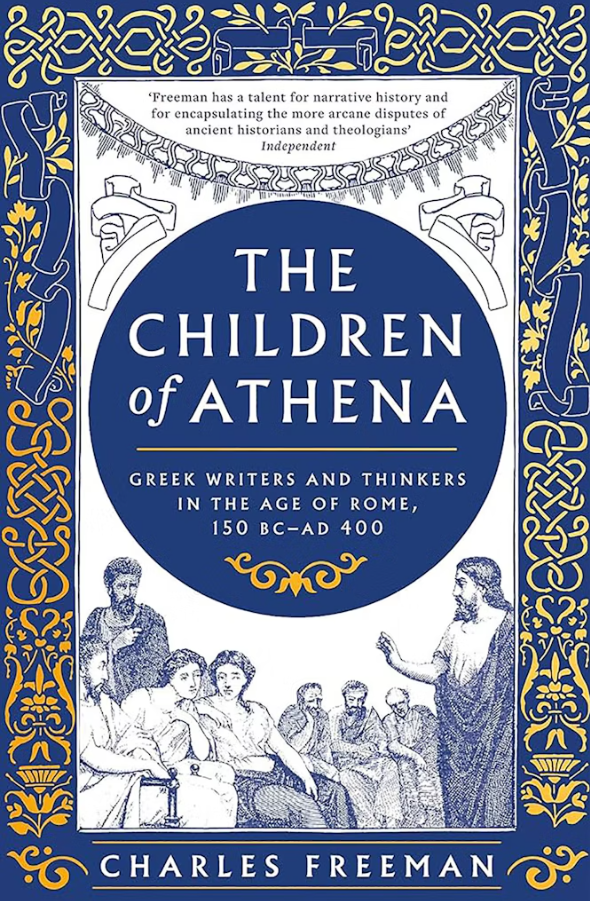
“To a wise man,” said the first-century wonderworker Apollonius of Tyana, “everywhere is Greece.” That is to say, Greece is not a mere place, but a special state of mind. For Apollonius, on his extensive travels around the Greco-Roman world, the purported truth of this maxim is seldom open to doubt.
The author of Apollonius’s colourful biography, Philostratus, depicts his hero as not just a philosopher but also an impossibly accomplished champion of culture — a confounder of logic and expectations who could vanish in plain sight, now fascinating Roman emperors and foreign sages, now inspiring whole towns into acts of celebration and renewal. The guiding ideology that drove this hero is a heady mix of philosophy, religion, magic and political insouciance — or, to give it another name, Hellenism.
In the context of the third-century world, where Christianity was an increasingly noteworthy presence in the towns and cities of the Roman empire, pagans such as Philostratus were keen to highlight what their own tradition had to offer.
In fact, he seems almost to present his hero as a pagan rival to Jesus. And, in turn, Apollonius — in his successful renewal of the shrines and local cults of Hellas — seems to hint at what Philostratus would like to see happen in his own contemporary context.
Despite living under Rome, Apollonius (and Philostratus) wants to celebrate an emphatically Greek form of culture. The celebration of Greek culture in the Roman world was, of course, nothing new, and it was something the Romans themselves had long enjoyed.
Alongside their admiration for Greek literature, philosophy, art and architecture, there was the successful movement known as the “Second Sophistic” — whose parade of Greek-speaking intellectuals left a heavy imprint on the public life of the High Roman Empire.
But it is striking nonetheless that the virtues of Hellas — not Rome itself — were what many educated citizens of the empire turned to when they thought of cultural renewal. Indeed his was precisely the route taken later in the fourth century by the last pagan emperor of Rome, himself a champion of all things Greek, Julian the so-called Apostate.
Charles Freeman’s latest book, Children of Athena, is a highly readable tour through the lives and accomplishments of some of the great exponents of Greek culture under Rome. He introduces readers to a bracingly varied and energetic cast of characters — the geographers, doctors, polymaths, botanists, satirists, and orators are just part of the repertoire. In an early chapter, we meet the brilliant Greek historian Polybius, who wrote in the tradition of Herodotus and Thucydides, while training his sights on the rise of Rome in his own time.
Comments Off on Rome conquered Greece … militarily, anyway
Four years later
Kulak hits the highlights of the last four years in government overstretch, civil liberties shrinkage, the rise of tyrants local and national, and the palpably still-growing anger of the victims:

4 years ago, at this exact moment, we were in the “two weeks” that were supposed to flatten the Curve of Covid.
4 years ago you were still a “conspiracy theorist” if you thought it would be anything more than a minor inconvenience that would last less than a month.
Of course if you predicted that this would not last 2 weeks, but over 2 years; that within 2 months anti-lockdown protests would end in storming of state houses and false-flag FBI manufactured kidnapping attempts of Governors; that within 3 riots would burn a dozens of American cities; that the election would be inconclusive; that matters would go before the US Supreme Court, again; that a riot/mass entrapment would take place within the halls of congress … And then that this was just the Beginning …
That Big-Pharma would rush a vaccine which may well have been more dangerous that the virus; that Australia and various countries would build concentration camps for unvaccinated; that nearly all employers would be pressured or mandated to FORCE this vaccine on their employees; that vaccine passports would be implemented to track your biological status; that Canada and several other countries would implement travel restrictions on the unvaccinated and collude with their neighbors to prevent their population escaping; and then that, nearly 2 years from 2weeks to slow the spread, Canadians!? would mount one of the most logistically complex protests in human history, in the dead of winter, besieging Ottawa and blockading the US border to all trade in an apocalyptic showdown to break free of lockdowns …
Well … not even Alex Jones predicted all of that, though he got a remarkable amount of it.
Indeed the reverence with which Jones is now treated, a Cassandra-like oracle who predicts the future with seemingly (and memeably) 100% clairvoyance only to doomed to disbelief. That alone would have been unpredictable, or unbelievable in those waning days of the long 2019, those first 2-3 months when you could imagine 2020 would MERELY be an Trumpianly heated election cycle like 2016, and not a moment Fukuyama’s veil threatened to tear and History pour back into the world.
Oh, and also the bloodiest European war since the death of Stalin broke out.
Comments Off on Four years later
Char B1 V Panzer III | Size doesn’t matter – it’s how you use it!
The Tank Museum
Published Dec 15, 2023Two tanks that fought against each other in the early part of World War Two. On one side, the heavily armoured French Char B1 … on the other, the mobile German Panzer III. On paper it’s no contest – but what actually happened when these two tanks fought it out in 1940?
00:00 | Intro
00:49 | Char B1 History
02:16 | Radio Communications
02:45 | Panzer III Crew
03:43 | Char B1 Crew
05:16 | Char B1 V Panzer III
(more…)
Comments Off on Char B1 V Panzer III | Size doesn’t matter – it’s how you use it!
March 21, 2024
Banksy is “a jester to the woke court, the cheeky clown of received opinion”
As a certified curmudgeon, I’ve never seen the attraction of Banksy’s various bits of artistic … whatever it is properly called. At Spiked, Brendan O’Neill helps put Banksy into proper perspective:

I guess it wasn’t enough that us polluting plebs are chided for our transgressions against Mother Nature every time we watch a BBC nature documentary. And by politicians of all persuasions. And by columnists who summer in Tuscany. And by aristocratic arseholes called Edred and Poppy who won’t even let us enjoy the football or the snooker without cutting through the fun with their cut-glass tones to remind us we’re hazardous to Gaia. No, we also have to be walloped with an eco-sermon as we cycle to work down the Hornsey Road.
Unsurprisingly, the elites are lapping up Banksy’s latest missive in spray paint. A Radio 4 expert on Banksy – I’m dying – raved to the BBC that his message is “clear” and it “really resonates”: “Nature’s struggling and it is up to us to help it grow back.” The founder of Haringey Tree Protectors – I’m not making this up – gushed in the Guardian about how Banksy’s “stark image” reminds us that “in the climate crisis we just can’t continue treating our tree canopy with such savagery”. Pruning leaves is barbarism now. You just know that when green-fingered Charles III saw the Banksy pic during his morning peruse of the papers he gave it a kingly nod of approval.
That’s what Banksy is, isn’t it – a jester to the woke court, the cheeky clown of received opinion? He larps as rebellious, sneaking about in the dead of night to put up his technically illegal “art”, but in truth he has not once voiced an opinion that wouldn’t win noisy murmurs of approval at a soirée in Daunt Books. Brexit is bad, Israel is insane, the paparazzi are scum, don’t vote Tory, capitalism is a rat race, Save the Planet – honestly, browsing Banksy’s back catalogue of stencilled eyesores is like being stuck in a lift with one of those craft-beer centrists who says cockwomble a lot.
His Finsbury Park fake tree captures the conformist thinking that hides in his guerrilla-art performance. It’s a public-information campaign masquerading as graffiti. “Save the trees” – Rishi Sunak could say that. He has, in fact. He recently announced a ban on felling trees without “proper consultation”. Banksy’s tree also has that whiff of hysteria that always attends dinner-party efforts to alter the behaviour of the lower orders. The idea that we’re obliterating trees with “savagery” is bullshit. London’s a forest. Literally. The UN defines a forest as anywhere that is at least 20 per cent trees – London is 21 per cent trees. The “world’s largest urban forest”, as Time Out puts it.
So relax, Banksy. Chill in the no doubt cushy pad you bought from selling your graffiti to philistine luvvies. London’s fine. If anything were to make me leave this great city, it wouldn’t be a want of trees but the oversupply of your sixth-former propaganda. Only a few months ago he put up a “STOP” sign in Peckham decorated with three drones to signal his desire for a ceasefire in Gaza. Radical.
Look, it can be irritating when artists decide to épater la bourgeoisie. That slogan, dreamt up by the decadent poets of late 19th-century France, means to take glee in scandalising the middle classes. But surely Banksy’s style of pandering to the middle classes – let’s call it servir la bourgeoisie – is worse? He is simply smuggling the received wisdom of society’s self-styled betters under the cover of edgy graffiti. From his anti-Brexit mural showing a workman sadly chipping one of the yellow stars from the EU flag to his image of Brits pledging their allegiance to the flag of Tesco – consumerism is slavery, y’all – his every utterance is chattering class to the core.
Comments Off on Banksy is “a jester to the woke court, the cheeky clown of received opinion”
French NATO Standardization: the MAS 49-56 in 7.62mm
Forgotten Weapons
Published May 27, 2019In the late 1950s, France was still part of the NATO integrated military structure. When the 7.62x51mm cartridge was adopted as standard for the alliance, France looked to be in a good position to simply convert their MAS 49-56 rifles to use it. After all, the 7.5mm cartridge the rifle was designed for was very similar to the new NATO round. After several years of trials, however, the project was dropped as impractical. It turned out that the much different pressure curve of the 7.62mm round would require significant redesign of the MAS rifles. They suffered from poor extraction, broken parts from high bolt velocity, and other issues (not coincidentally, the exact same problems reported with the 308 MAS 49-56 rifles imported by Century …). The St Etienne factory only made a total of 150 of them in 7.62x51mm before the project ended.
(more…)
Comments Off on French NATO Standardization: the MAS 49-56 in 7.62mm
March 20, 2024
QotD: Ancient Greek tyranny
The normal expectation for Greek tyranny is that the system works like the Empire from Star Wars: A New Hope, where the new tyrant abolishes the Senate, appoints his own cronies to formal positions as rulers and generally makes himself Very Obviously and Formally In Charge. But this isn’t how tyranny generally worked: the tyrant was Very Obviously but not formally in charge, because he ruled extra-constitutionally, rather than abolishing the constitution. This is what separates tyranny, a form of extra-constitutional one man rule, from monarchy, a form of traditional and thus constitutional one-man rule.
We see the first major wave of tyrannies emerging in Greek poleis in the sixth century, although this is also about the horizon where we can see political developments generally in the Greek world, still our sources seem to understand this development to have been somewhat novel at the time and it is certainly tempting to see the emergence of tyranny and democracy in this period both as responses to the same sorts of pressures and fragility found in traditional polis oligarchies, but again our evidence is thin. Tyrants tend to come from the elite, oligarchic class and often utilize anti-oligarchic movements (civil strife or stasis, στάσις) to come to power.
Because most poleis are small, the amount of force a tyrant needed to seize power was also often small. Polycrates supposedly seized power in Samos with just fifteen soldiers (Hdt. 3.120), though we may doubt the truth of the report and elsewhere Herodotus notes that he did so in conspiracy with his two brothers of whom he killed one and banished the other (Hdt. 3.39). I’ve discussed Peisistratos’ takeover(s) in Athens before but they were similarly small-ball affairs. In Corinth, Cypselus seized power by using his position as polemarch (war leader) to have the army (which, remember, is going to be a collection of the non-elite but still well-to-do citizenry, although this is early enough that if I call it a hoplite phalanx I’ll have an argument on my hands) expel the Bacchiadae, a closed single-clan oligarchy. A move by any member of the elite to put together their own bodyguard (even one just armed with clubs) was a fairly clear indicator of an attempt to form a tyranny and the continued maintenance of a bodyguard was a staple of how the Greeks understood a tyrant.
Having seized power, those tyrants do not seem to have abolished key civic institutions: they do not disband the ekklesia or the law courts. Instead, the tyrant controls these things by co-opting the remaining elite families, using violence and the threat of violence against those who would resist and installing cronies in positions of power. Tyrants also seem to have bought a degree of public acquiescence from the demos by generally targeting the oligoi, as with Cypselus and his son Periander killing and banishing the elite Bacchiadae from Corinth (Hdt. 5.92). But this is a system of government where in practice the laws appeared to still be in force and the major institutions appeared to still be functioning but that in practice the tyrant, with his co-opted elites, armed bodyguard and well-rewarded cadre of followers among the demos, monopolized power. And it isn’t hard to see how the fiction of a functioning polis government could be a useful tool for a tyrant to maintain power.
That extra-constitutional nature of tyranny, where the tyrant exists outside of the formal political system (even though he may hold a formal office of some sort) also seems to have contributed to tyranny’s fragility. Thales was supposedly asked what the strangest thing he had ever seen was and his answer was, “An aged tyrant” (Diog. Laert. 1.6.36) and indeed tyranny was fragile. Tyrants struggled to hold power and while most seem to have tried to pass that power to an heir, few succeed; no tyrant ever achieves the dream of establishing a stable, monarchical dynasty. Instead, tyrants tend to be overthrown, leading to a return to either democratic or oligarchic polis government, since the institutions of those forms of government remained.
Bret Devereaux, “Collections: How to Polis, 101, Part IIa: Politeia in the Polis”, A Collection of Unmitigated Pedantry, 2023-03-17.
Comments Off on QotD: Ancient Greek tyranny
March 19, 2024
Greek History and Civilization, Part 5 – The Greeks Fight Back
seangabb
Published Mar 17, 2024This fifth lecture in the course deals with the defeat of Persian invasion of Greece in 480 BC, ending with the creation of the Delian League and the varying fortunes of Xerxes and Themistocles.
(more…)
Comments Off on Greek History and Civilization, Part 5 – The Greeks Fight Back
March 18, 2024
Slimy “nudgers” want to manipulate the food you buy by “denormalizing” what you enjoy
Christopher Snowden on the self-imagined elites’ desire for you dirt people to eat a different diet than you would voluntarily choose for yourselves:

On Thursday, Legal & General Investment Management’s senior global environmental, social and governance (ESG) manager told Nestlé to sell less sugar. It’s not for want of trying. In 2018, Nestlé launched Milkybar Wowsomes with 30% less sugar than a Milkybar. The company described it as a “great tasting product” that was the result of “a scientific breakthrough” but when it was discontinued in 2020, Nestlé lamented that demand for it had been “underwhelming”. In 2021, it launched a non-HFSS version of Shreddies called Shreddies The Simple One which contained just four ingredients. The company said:
We know that consumers are looking to eat more healthily, especially following the pandemic. Shreddies The Simple One is an exciting new addition to the breakfast table that caters to growing demand, with a delicious taste consumers will love.
Consumers did not, in fact, love it and it was withdrawn from sale the following year.
Today, the King’s Fund has added its voice to the call for mandatory reformulation targets enforced with heavy fines. The King’s Fund’s job has traditionally been to get more money for the NHS but it is under new management with Sarah Woolnough, a former trustee of Action on Smoking and Health and former CEO of Cancer Research UK, so it is now involved in lifestyle regulation.
Compelling food manufacturers to strip out large amounts of fat, salt and sugar would help “denormalise” the routine consumption of unhealthy food, Sarah Woolnough, the chief executive of the King’s Fund, told the Guardian.
The word “denormalise” is taken straight from the anti-tobacco playbook. See how it works yet?
As the Guardian points out, the King’s Fund has done some polling which finds that reformulation is hugely popular in the abstract.
Overall, 67.3% of Britons agree that the government should require companies to reduce the amount of fat, salt and sugar they put in their products, a survey for the influential health thinktank undertaken by Ipsos Mori found. Only 5% disagreed.
This is a beautiful example of the difference between stated preferences and revealed preferences. People love the idea of fat, salt and sugar being removed from food. Who wouldn’t, so long as the food tasted the same? But it doesn’t taste the same. It tastes considerably worse. And when reformulation isn’t physically possible — for example, with nearly all confectionery, biscuits and cakes — the only way to meet the target is by shrinking the product. Some chocolate bars are now so small that a dual pack is the default (and so, as with the sugar tax, big business is doing rather well out of it). And, yes, that is because of the government’s reformulation scheme.
If pollsters asked people if they are in favour of shrinkflation, I doubt many would say yes. As for reformulation, the only way to get an informed opinion would be to do a taste test using the “before” and “after” versions of popular food products and ask people whether the government should mandate the reformulated version and ban the original version. Again, I doubt many people would give unqualified support for reformulation.
Fortunately, we don’t need to carry out such experiments because the public have been offered reformulated products many times in the real world. Sometimes they become popular — in which case there is no need for government coercion — but very often they are a flop, and in many cases they cannot even be attempted.
The British public have put up with a lot from meddlesome puritans in the last 20 years, but I strongly suspect that if the government tried to force us to eat the likes of Milkybar Wowsomes and Shreddies The Simple One, the thin blue line would finally snap.
March 17, 2024
Smiling Albert Takes Command – WW2 – Week 290 – March 16, 1945
World War Two
Published 16 Mar 2024After the Allies took a Rhine Bridge last week, Adolf Hitler has again shuffled his commanders, moving Kesselring to the west. Meanwhile, the German offensive in Hungary comes to its end — and it does not end well for the Germans. The Japanese are nearly defeated on Iwo Jima, are feeling a bit of desperation in Burma, but are far, far from defeated on Luzon.
01:02 Recap
01:33 Remagen Bridge and the Western Front
06:44 Army Group Courland and 3rd Belorussian Front
10:23 Konev’s new attacks
11:29 Operation Spring Awakening ends
15:00 A German surrender in Italy?
17:01 Japanese being ground down on Iwo Jima
18:12 The war in the Philippines
20:48 The war in Burma
23:07 Summary
23:36 Conclusion
(more…)
Comments Off on Smiling Albert Takes Command – WW2 – Week 290 – March 16, 1945
Problematic art, again
David Thompson calls to our attention yet another outbreak of problematic racist white supremacy in … landscape paintings?
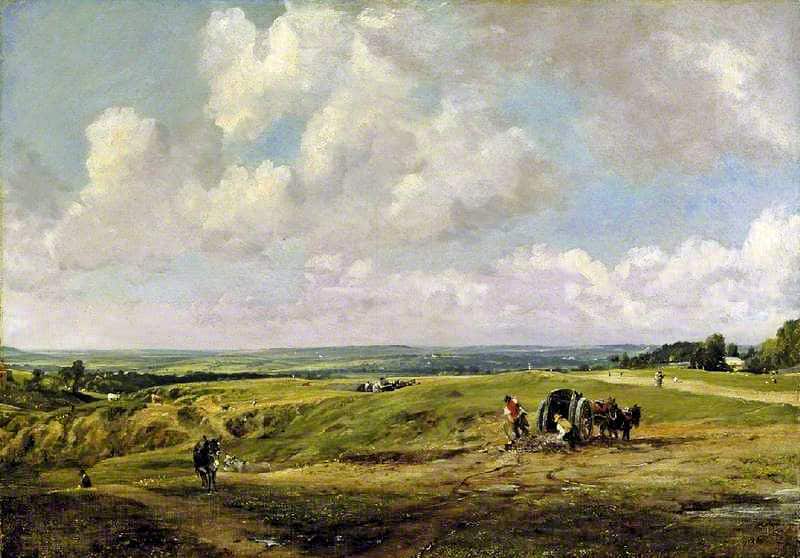
Hampstead Heath by John Constable, 1820.
Above, John Constable’s Hampstead Heath, circa 1820. Beware its morally corrupting influence.
The problem, we’re told, is that paintings from the eighteenth and nineteenth centuries are “leaving very little room for representations of people of colour”. And obviously, even the past must be made “inclusive and representative”. Which seems to mean that we must all pretend that our islands’ population and cultural assumptions have always looked like those of, say, twenty-first century London, a city whose demographics bear little relationship to those of the country as a whole, even in the twenty-first century.
It occurs to me that notions of racial “representation” will likely be distorted by the embrace of rather parochial progressive conceits, and by proximity to the nation’s capital, which in my lifetime has gone from a native white-majority city, over 90%, to a native white-minority one, around 35%, and which is wildly out of step with the rest of the nation. Things that are denounced as “horribly white”, or whatever the current term of disapproval is, may not seem so to people who live in, say, Chesterfield or Plymouth.
But apparently, museum visitors must be warned that the sight of a Constable landscape may trigger TERRIFYING BLOOD AND SOIL TENDENCIES. Or at least inspire thoughts of historical attachment, continuity, and belonging – thoughts that may be disconcerting or very much frowned upon, if only by the – wait for it – keepers of our heritage.
Green Beer (You Suck at Cooking) Episode 87
You Suck At Cooking
Published Mar 17, 2019The history of Ireland is a long and storied one, and one I know next to nothing about. The history of St. Patrick is a short one, relative to the length of the history of the world. The current St. Patrick’s day celebrating has little or nothing to do with the actual St. Patrick, and that’s the way we like it.
The first step to making green beer is to add a few drops of food coloring, then add beer. When selecting a glass to drink it out of, make sure it’s transparent, that way you are able to see the green part of the beer not only from the top or from within the stomach, but also from the side while drinking beer.
While pouring the beer, making sure not to pour it from a great height. This will decrease the amount of bubbles that end up in the beer when you are drinking it, and therefore the enjoyment. If you were aware of the lengths that the manufacturers went to in order to get bubbles inside of that beer in the first place, you wouldn’t even drink it at all.
While drinking the beer, make sure you don’t allow the beer to come into contact with anything that could get stained, such as your clothes, dog, or mouth. If you swallow quickly enough you can keep your mouth from turning green permanently.
If you dislike drinking beverages that are colored green but want to get into the festive spirit, simply tape green construction paper around your drinking vessel, and dye your beer purple instead.
Comments Off on Green Beer (You Suck at Cooking) Episode 87
QotD: Imperial Japan and Nazi Germany never had a “long game” … but Stalin did
The Russians, meanwhile, never stopped playing the long game. While Goebbels made a few token gestures at rapprochement with “the West” (yeah, they called it that), and to sell Nazism to ditto, his heart wasn’t in it, any more than the Japanese’s heart was in their “Greater East Asia Co-Prosperity Sphere” hooey. Stalin, by contrast, was always pimping Communism to the West — even in the deepest, darkest days of the war, when it looked like the Wehrmacht was about to march into Moscow, the propaganda directed at the West continued full blast.
Like the German and Japanese aircraft industries, the German propaganda industry was ideologically locked into its core mission: To sell Nazism to Germans. And they were aces at it, no doubt … but then the mission changed. The smart thing for the Germans (and Japanese) to have done with their conquered territories was, in the context of the war, to ease up on the Nazi shit for the duration. The Nazis could’ve had zillions of Ukrainians fighting for them in 1941 just as the Japanese probably could’ve waltzed into India in 1941 had they not been so … well, so Japanese, in the rest of the Pacific rim. Stalin would’ve done it in a heartbeat, had the situation been reversed, and to hell with “authentic” Marxism-Leninism. Win the war first; square the ideology later.
As this is running way long, one example should suffice. Goebbels approached the task of selling Nazism to Germans in the most German way possible: He created the Reich Culture Chamber, which controlled all newspapers, radio broadcasts, film distribution, etc. And it worked, as far as it went — Goebbels deserves his “evil genius” rep — but as we’ve seen, that locked the leadership into an ideological straightjacket. Telling the Wehrmacht to ignore the Commissar Order and buddy up with the Ukrainians would’ve been the smart thing to do, militarily, but it was culturally impossible. Goebbels did his job too well … and then the mission changed.
The Soviets had a similar problem inside the USSR, but — here’s Stalin’s evil genius — they had free reign in propagandizing the West. Goebbels hardly bothered, but the Soviets poured massive resources into it. Forget, as far as you can, everything you think you know about “Nazism” […]. Even if you look at it as objectively as possible, it still seems ridiculous, and there’s a simple explanation for that — it’s not for you. Unless you were a pure blooded Aryan, actually living in Germany (or within Germany’s potential military reach), [they] couldn’t care less about you. Which made being a “Nazi” in, say, America uniquely pointless — you just look like a bigot at best, a traitorous bigot at worst.
Being a “Communist”, though? That was universal. Indeed, that made you a Smart person, a very very smart person, and morally superior to boot. Why? Because you care so much that you’ve mastered this large body of deliberately esoteric doctrine, comrade … all straight out of the NKVD playbook. And if actual life as it was lived in the Soviet Union didn’t quite measure up to the promises, well, that’s because they didn’t have the right people — people like YOU — running things. It’s fucking brilliant — a totally ideologically closed, indeed brutal, system at home, presented as the most open-minded, enlightened, tolerant one possible abroad.
Which is why Joey G. needed a huge Reich Culture Chamber that never came close to justifying its budget, and Stalin needed, effectively, nothing. Being so very, very Smart, wannabe “elites” in the West were happy to spread Commie propaganda for free. The NKVD, let alone the Gestapo, ain’t got shit on the Junior Volunteer Thought Police of Twitter and Facebook …
… which forces us to confront the question: Which model of propaganda are our rulers using? Has the one morphed into the other? Is it real, or is it just “German efficiency”?
Severian, “The Myth of German Efficiency”, Rotten Chestnuts, 2021-05-26.
Comments Off on QotD: Imperial Japan and Nazi Germany never had a “long game” … but Stalin did
March 16, 2024
Orwell – The New Life (DJ Taylor in discussion with Les Hurst)
The Orwell Society
Published Jun 9, 2023DJ Taylor discusses his new biography of Orwell with Les Hurst
Part 2:
The Orwell Society
Published Jun 26, 2023DJ Taylor answers questions and discusses issues raised by Orwell Society members.
Comments Off on Orwell – The New Life (DJ Taylor in discussion with Les Hurst)
March 15, 2024
Woke Shakespeare?
Andrew Doyle wonders if even the Bard can survive the incessant assaults of the ultra woke, the new Puritans:
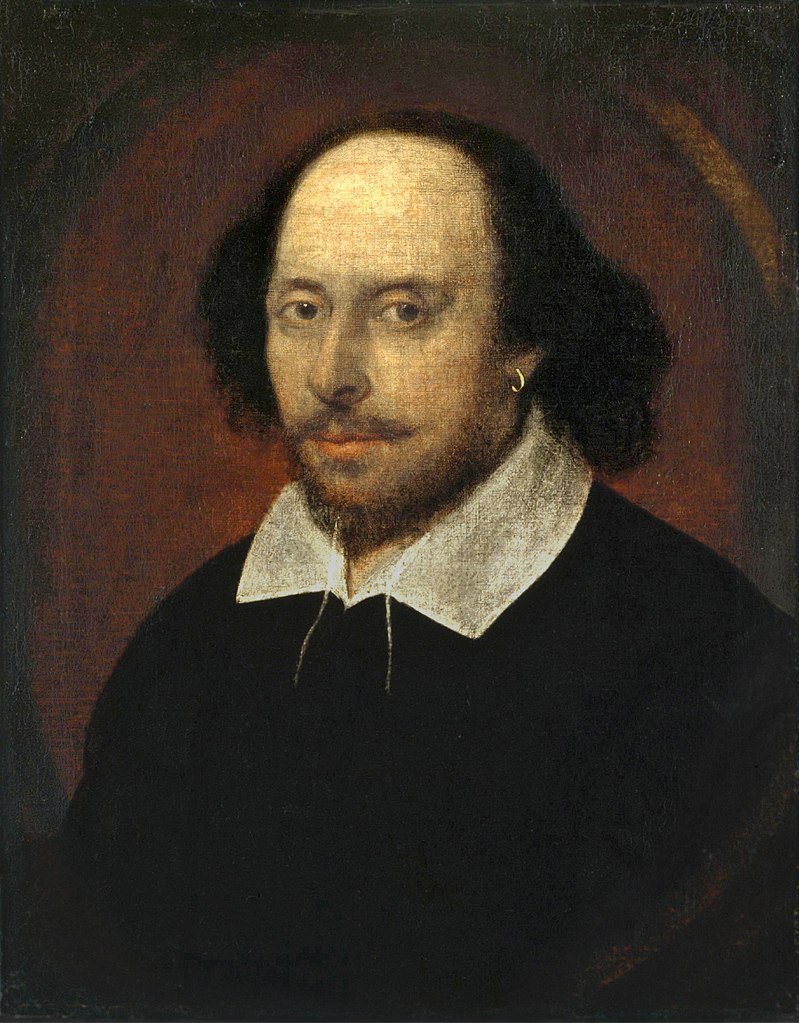
This was long thought to be the only portrait of William Shakespeare that had any claim to have been painted from life, until another possible life portrait, the Cobbe portrait, was revealed in 2009. The portrait is known as the “Chandos portrait” after a previous owner, James Brydges, 1st Duke of Chandos. It was the first portrait to be acquired by the National Portrait Gallery in 1856. The artist may be by a painter called John Taylor who was an important member of the Painter-Stainers’ Company.
National Portrait Gallery image via Wikimedia Commons.
The puritans had it in for Shakespeare. With the exception of the plague, they were perhaps the most persistent threat to his livelihood. As far as these zealots were concerned, the theatre was a realm of “adulterers, adulteresses, whoremasters, whores, bawds, panders, ruffians, roarers, drunkards, prodigals, cheaters, idle, infamous, base, profane, and godless persons”.
These were the words of the polemicist William Prynne from his Histrio-Mastix (1633). He was eventually to get his way in 1642 when the puritan-led parliament shut the theatres down. When the ban was lifted on the accession of Charles II, older plays had to be dusted off to satisfy the public’s appetite for drama. It was Shakespeare’s work that proved to be the most popular, establishing a trend that has never waned.
Now the bard faces another breed of puritan, more censorial than the last. We are living in conformist times, and inexplicably those in the creative arts have turned out to the be most conformist of all. Nowhere is this more evident than the theatre industry, where wrongthink is outlawed and artistic freedom is sacrificed on the altar of identity politics. Virtually all productions of Shakespeare’s plays I have seen in recent years have been mangled to promote the regressive fashions of our time. Today’s audiences are seeing a vague shadow of these masterworks through a narrow and uninspiring prism.
Even so, many of us are reluctant to give up on the theatre altogether. We tolerate the gender-neutral toilets that nobody asked for, the rainbow lanyards worn by ushers, and the little sermons in the programmes by directors who think their job is to educate the masses. One friend remarked that so long as the preaching only amounts to 20% of the show’s content, he is willing to accept it. I suppose it’s like going for dinner in an especially pious household, and having to put up with a long-winded prayer before a delicious meal.
Theatregoers might have a better experience if they opt for productions of plays written many years before this new state religion took hold. Shakespeare, as a playwright who has never been bettered, is surely the safest choice. In his work we find ourselves unmolested by ideology. We know nothing of Shakespeare’s opinions on matters of politics or religion, and attempting to glean any suggestions from his works is futile. I think A. L. Rowse put it best when he pointed out that Shakespeare “saw through everybody equally”. Neither prince nor pauper escapes his sceptical gaze.
Comments Off on Woke Shakespeare?


