
WW2 Pod: We Have Ways of Making You Talk
Published Mar 7, 2024Comedian Al Murray and historian James Holland look at a picture of a Cromwell tank jumping over a ramp in 1944. Was this the best Allied tank of WW2?
June 13, 2024
The Best Allied Tank Of WW2
Comments Off on The Best Allied Tank Of WW2
June 12, 2024
“Consumption inequality” really has fallen significantly since Orwell’s day
Tim Worstall on some of the points raised by Christopher Snowdon’s new introduction to Orwell’s Nineteen Eighty-Four:
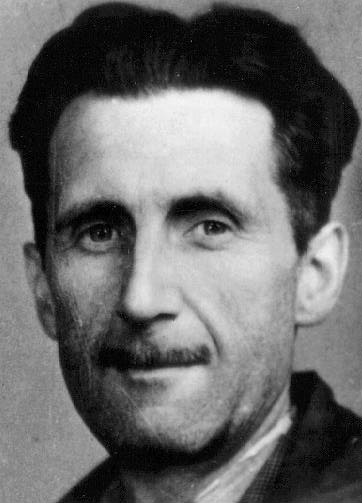
Eric (“George Orwell”) Blair’s press card portrait, 1943
Eric Blair, the useful one, once pointed out that:
In a world in which everyone worked short hours, had enough to eat, lived in a house with a bathroom and a refrigerator, and possessed a motor-car or even an aeroplane, the most obvious and perhaps the most important form of inequality would already have disappeared. If it once became general, wealth would confer no distinction.
That’s from Chris Snowdon’s new intro to 1984 – you should buy a copy.
Not that Eric knew enough economics to know this but what he’s talking about is consumption inequality.
Sure, we’ve Oxfam squealing that wealth inequality is rising summat fearsome. It ain’t — they fail to account for what we already do to reduce wealth inequality. Many tell us that income inequality is rising summat fearsome. It ain’t. Global income inequality has been falling this past 40 years and as all men are indeed brothers it’s the global number that matters.
But the one that’s really fallen like a stone is that consumption inequality. Consumption is also really the only one of the three that matters. Sure, a world in which there are those without three squares and a crib is not a good one. But once all do have three squares etc. then whatever other inequality there is is, well, it’s not actually all that important is it?
[…]
We really have got to what Orwell thought would be equality. In 1930s England (which was his mental reference point) all of these things – all – were signifiers of significant wealth or income:
As a poorer country the UK was a little behind on these things but my best guess would be that we’re ahead of the US on washing machines today (the US still has a habit of communal machines in apartment blocks). And it amuses that central heating isn’t even on the list. This was something very middle class indeed in the 1960s, really only became “normal” in the UK in the late 70s into the 80s. As with double glazing. These days you’re defined as being in fuel poverty if you cannot heat your house, always and all of it, to a level that no one at all could before that central heating. No, really, coal fire heated houses might average 10oC in winter and that would only be in rooms with an actual fire — others would be at 0oC.
This is not to get into a Four Yorkshiremen but people would be astonished at how cold houses were 1970s and earlier. My own arrival in the US in 1981 had me wondering how they had heating systems that heated all the house, properly, all winter. How could anyone afford that?

Comments Off on “Consumption inequality” really has fallen significantly since Orwell’s day
England “is a parochial country doomed to nostalgia and irrelevance by its unwavering belief in a series of grandiose historical myths”
In The Critic, Fred Skulthorp reviews England: Seven Myths That Changed a Country and How to Set Them Straight by Tom Baldwin and Marc Stears:

Should Keir Starmer find himself in Downing Street after the next election, he will have little to play with in terms of zeitgeist. Unlike Blair, there is no Cool Britannia to tap into. There are few unifying cultural figures and despair seems the only discernible national mood. Starmer has only the recent success of the Lionesses and an oft-quoted anecdote about his dad being a toolmaker to inspire the nation.
But there is one nation-renewing narrative on the centre-left that has emerged since 2016. England, unlike the rest of Europe, is a parochial country doomed to nostalgia and irrelevance by its unwavering belief in a series of grandiose historical myths. The real 21st century England is being held back by people singing “Rule Britannia” at the Last Night of the Proms and the fantasies of Daniel Hannan.
In England: Seven Myths That Changed a Country, Starmer’s biographer Tom Baldwin and former Labour Party speechwriter Mike Stears embark on a journey to set us free from such falsehoods. In Hull we find that William Wilberforce has given the nation an unqualified moral superiority. In Plymouth we discover that Sir Francis Drake is the inspiration for “the aggressively macho nationalist idea” that Brexit can “restore the country’s global reach”. In Runnymede we find that Magna Carta has given rise to the idea of an “Anglo-Saxon birthright sealed with the blood of dead kings”.
Whether anyone actually believes these things is beside the point. These national myths, the authors insist, can account for everything from the popularity of Michael Portillo’s railway documentaries to the 2016 vote to leave the European Union.
Journeys in search of England tend to lend themselves more to projection than discovery. This book presents the worst of that sin. Reading Seven Myths is a bit like being stuck on a very long car journey and regretting having asked the driver: “Whatever happened to the legacy of the London 2012 Olympics?”
Unsurprisingly, much of what follows spouts repackaged Blairite clichés about football, curry and the NHS. Lingering behind their polemic is the tedious psychodrama of the Corbyn years and Labour infighting about how the party should allow itself to feel patriotic. This book is as much about two middle-aged Starmerites trying to work out what it is acceptable to like between their party, the electorate and the limited scope of their inquiry into the England of the 2020s.
And the scope is indeed limited. Reportage and interview, where the book is allowed to breathe away from the grating polemic, is cramped, incomplete and tokenistic. The most memorable soundbite is from Nigel Farage, who tells them — perhaps half-mockingly — that his favourite place in England is London: “It gets faster and more trendy every year that comes”.
Interactions with the public are even more painful. “What do you think of Enoch Powell?” one “brown-skinned man” is asked in Wolverhampton. A refugee from Hong Kong is asked “Does Magna Carta mean anything to you?” Unsurprisingly these conversations don’t return much, but they pave the way for the eye-rollingly mundane conclusion that when it comes to English identity there is “complexity everywhere” (as if anyone’s sense of national identity were ever simple).
Still from the 1964 movie Zulu with Michael Caine as Lieutenant Gonville Bromhead, 24th Regiment of Foot.
For a book that spends nearly 400 pages debunking myths and trying to correct the course of English history, its sources require a lot of reading between the lines. Many can be narrowed down to soundbites from a few politicians and forgotten op-eds in the Telegraph (one quoted is dated as far back as 2004).
All this generates endless false dichotomies, strawmen and reductive statements to account for a grander myth loosely referred to as “English exceptionalism”. At times, attempts to source these myths in the body politic come across as comically desperate. Zulu (1964) becomes a film which kept alive the “British Empire myth” and which “the current generation of politicians would have watched growing up”.
Ironically, the writing itself is laced with the sins of myth-making: boring, trite, incoherent, lazy and unfunny. At times it veers into self-parody. In Runnymede, the “high iron gates” of a housing development near the Magna Carta memorial serve to remind us that national identity myths can “make others feel excluded”. In Plymouth, Greta Thunberg is placed in a pantheon alongside Darwin and Drake who both set sail from the Devon port: “None of these dead Englishmen have as much relevance right now as [the voyage] undertaken from the same city by a Swedish Girl”.

Comments Off on England “is a parochial country doomed to nostalgia and irrelevance by its unwavering belief in a series of grandiose historical myths”
June 11, 2024
We’ve descended into some sort of bizarre hellworld where Jeremy Clarkson can be described as an “unlikely national treasure”
In The Critic, Kara Kennedy considers the possibility that Jeremy Clarkson, the petrolhead’s petrolhead, might actually have a soul:

Screencap from Jeremy Clarkson’s banned Hawkstone Lager ad
The last truly poignant thing I watched on television was a show about a grumpy farmer raising piglets. He’s a city gentleman new to farming, but what may have started out as a gimmick has, over three growing seasons, transformed into a real calling. Or a passion, even. And one that, in some moments, sees him battle with life and death. Unfortunately, for a lot of the little piglets, it was death. After watching their births — their first moments and last, after their delinquent pig mothers smothered them without a care in the world — I cried. My husband cried. The friends who we harangued to watch the season again with us cried. And Jeremy Clarkson cried.
Yes, I am talking about Jeremy Clarkson on Clarkson’s Farm, streaming on Amazon Prime Video. Clarkson, over the last few decades, has made a career for himself in part by being easy to hate. It is uncomfortable for everybody, himself included, that the miserable boomer has turned into an unlikely national treasure, and all it took was some honest work.
Clarkson is cultural marmite. After 35 years on the BBC’s Top Gear, he is revered in the petrolhead community as a god. Newspapers love him because he’s impolite and will sell some prime “you can’t say anything anymore” content. Meghan Markle hates him after he once wrote he was “dreaming of the day” that British crowds threw lumps of shit at her. Feminists hate him for mostly that same reason. Leftists hate him for writing once that striking workers should be “shot in front of their families”. As for the denizens of the countryside, he has maintained a multi-decade fight in his newspaper column with ramblers.
Basically, the answer to whether you like Clarkson relies really on whether you take what a funny old guy says seriously. But there are some legitimate grievances towards the presenter too. When he was finally bounced from the Beeb, it was because he punched a producer. And as annoying as the people who had long had it in for Clarkson had always been, it is not some new Gen Z norm or innovation of “cancel culture” to say you can’t physically assault your colleague. That said, the producer in question did sue him for racial injury, which is a bit closer. (He called him Irish, for God’s sake!) The crux of it, anyway, is that Clarkson is badly behaved and probably too inconsistent to be trusted by any major TV network. He wound up on Amazon Prime’s The Grand Tour, a just-changed-enough-to-be-legal Top Gear clone, once again drawing a massive and mostly male audience that loves to memorise the 0-60 times of cars only oligarchs can ever afford.
But, once The Grand Tour began winding down — it now returns just for the occasional travel special — the old presenters went off to make spinoffs for Amazon. And Clarkson decided to make his, and to rejigger his Times column, around his 1000 acre country farm in the Cotswolds. And that is where, through epiphany, necessity, human nature, act of God, or sheer growing up, Clarkson was reborn as someone who not just the lovers of edgy humour and high horsepower figures can admire.
Comments Off on We’ve descended into some sort of bizarre hellworld where Jeremy Clarkson can be described as an “unlikely national treasure”
EUquake 2024
Although the European elites have managed to move as much as they can out of the reach of democratic institutions, they still have to allow the illusion that the few things ordinary people can vote for still kinda, sorta matter. Ordinary people seem to have noticed this:
“I cannot act as if nothing has happened”, said a weary, dejected Emmanuel Macron, in an unplanned address to his nation last night. The French president, bruised by an unprecedented showing for the right-wing populist National Rally (RN) on Sunday’s European Parliament elections, immediately dissolved the French parliament and announced snap legislative elections. The first round will take place in just three weeks’ time.
When Macron was elected president in 2017, he promised the French people that they will “no longer have a single reason to vote for the extremes”. Pro-EU centrists hailed his apparent defeat of nationalist, populist forces. Seven years later, RN is on course to achieve its best-ever result in an EU election. Marine Le Pen’s party is projected to win double the vote share of the president’s liberal, centrist Renaissance group. Clearly, the French feel that they have more reasons than ever to revolt against the mainstream.
The French are not alone in this. The hard-right Alternative for Germany (AfD), despite two of its leading MEP candidates being dogged by major scandals, came second behind the centre-right CDU. Crucially, it beat all three of the parties in Germany’s governing coalition. The Social Democrats (SPD), led by chancellor Olaf Scholz, suffered its worst result of any nationwide election since the 1940s. According to one pollster, around a million people who supported the left-leaning parties in the “traffic light” coalition have since defected to the AfD. Pressure is now mounting on Scholz to call his own snap election. In Italy, meanwhile, Giorgia Meloni and her Brothers of Italy topped the European polls, exceeding the vote share that swept her into power in 2022’s national elections. Populist, right-wing and hard-right parties, therefore, came in first or second place in all three of the major EU nations.
Even Belgium, at the epicentre of the EU empire, has been struck by the populist earthquake. Prime minister Alexander de Croo announced his resignation last night as his party was beaten to below 10 per cent in Sunday’s federal parliamentary elections and to around five per cent in the European elections – squeezed by Flemish separatist parties. Hard-right parties also came first in Austria and second in the Netherlands.
While Macron has been forced to react to the scale of his defeat, acknowledging euphemistically that these elections were “not a good result for the parties that defend Europe”, others in the Brussels oligarchy have tried to bury their heads in the sand. On Sunday evening, European Commission president Ursula von der Leyen declared – delusionally – that “the centre is holding”.
She is right in one, very narrow, sense. The centre-left Progressive Alliance of Socialists and Democrats (S&D), the centre-right European People’s Party (EPP) and the liberal Renew group have likely gained enough seats between them for business as usual to resume in the European Parliament. The two groupings to their right – the European Conservatives and Reformists (ECR) and Identity and Democracy (ID) – have not made enough gains, even when combined, to start throwing their weight around in Brussels. Von der Leyen’s own position as Commission president is likely secure, not least because her EPP is the single largest grouping in parliament. The new populist MEPs will likely be shut out of key decisions, including the vetting of new EU commissioners. The EU has never allowed the democratic wishes of the public to intrude on its affairs before, so it is unlikely to start now.
But Brussels cannot hide from reality forever. These elections clearly show that the EU and its boosters are failing to contain the public’s anger. European elites have pulled every trick in the book to try to put the brakes on the populist surge, seemingly to little avail.
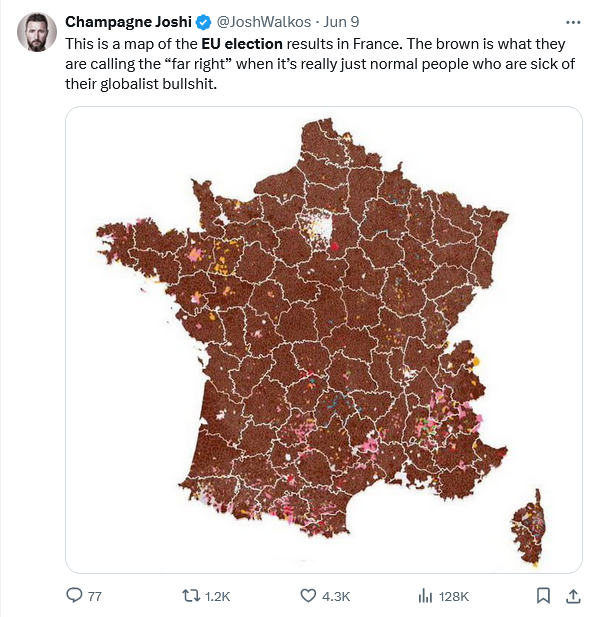
How bad was the rejection of the kakistocrats in France? This bad:
Mark Steyn on Nigel Farage
This is from his Friday round-up post at SteynOnline:
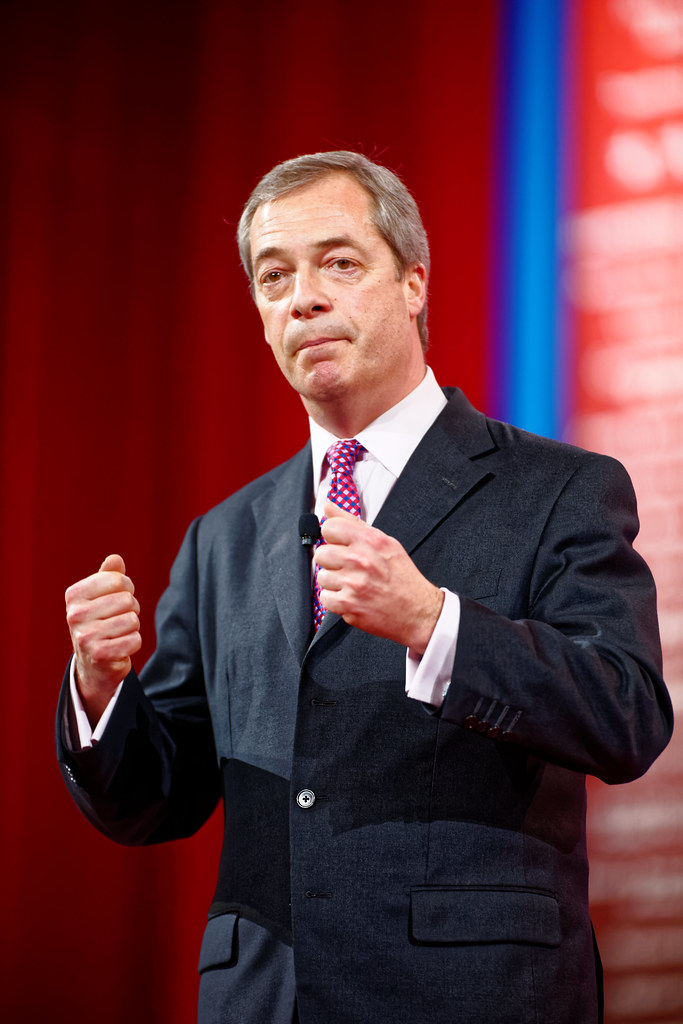
“Nigel Farage” by Michael Vadon is licensed under CC BY-SA 2.0 

 .
.
Demography is relentless. Douglas Murray notes that the BBC is always warning that the “far right” is “on the march“, but in the west it is demographic transformation that is truly on the march, quietly and unreported, picking up pace every month. By comparison, the wretched Sunak/Starmer dinner-theatre of the UK election campaign is completely irrelevant to Britain’s future. So I am glad to see that Nigel Farage has had a change of heart and opted to join the battle. Back in 2016, in the days after the Brexit vote, I said he was the most consequential figure in UK politics since Mrs Thatcher. Which was true. Alas, people most Britons have never heard of then set about subverting Brexit, and very effectively.
So here we are eight years later, with half-a-million Anglo-Celts abandoning the UK each year and a million Pushtun warlords and Sudanese clitoridectomists and Albanian sex-traffickers taking their place. Demography is relentless, and the hour is late.
Over a decade ago — in fact, closer to two, as I estimate it — Nigel Farage said to me that the first thing you have to do when you found a new political party on the right is to accept the burden of being its only member — at least for a while. Because the first 10,000 people who want to join are neo-Nazis and skinheads and the like. It was a clever insight, and he spread it around. So I had it told back to me many times over the years by populist politicians from all over the Continent, Danes and Dutch, Swedes and Spaniards alike.
Nigel took his gatekeeping seriously — and not just on the domestic front, “distancing” himself from Tommy Robinson and Tommy-associated issues such as Islam and the industrial-scale sex-slavery of thousands of English girls. As Gavin Mortimer reminds us, a decade ago Farage also rejected any Euro-collaboration with Marine Le Pen because her party had “anti-Semitism and general prejudice in its DNA“. Geert Wilders (for whose fine book I am proud to have written the introduction) was furious with Farage and attempted to broker a rapprochement. Nigel was having none of it.
So here we are a decade later:
* in the Netherlands, Wilders is currently the most powerful politician, leading the most popular party, and has helped move the electorate significantly;
* in France, Mme Le Pen’s party will, in just two days’ time, win the European elections. She is the de facto leader of the opposition, and her caucus in the National Assembly is the largest and most effective opponent to Macron. She has also helped move the electorate significantly;
* in the United Kingdom, by contrast, voters are about to elect a left-wing government led by a fellow, Sir Vics Starmer, who thinks men can have a cervix.
I think Nigel over-gatekept.
He has been very good at founding personal vehicles (Ukip, the Brexit Party) that deflate like punctured soufflés when he steps down as leader. Yes, he was very watchable in the jungle on “I’m a Celebrity — Get Me Out of Here”, and, in my GB News days, he certainly handed me a bigger audience at 8pm than any of his guest-hosts. But, as that station’s currently Farageless ratings reveal, you can’t build a sustained movement on one man. Nigel’s advice was clever twenty years ago. Wilders, LePen, Meloni et al were wise to recognise its limitations.
So I’m pleased Farage changed his mind on this election. He should change his mind on the over-gatekeeping, too.
Time and demography march on.
Comments Off on Mark Steyn on Nigel Farage
QotD: Mandatory fun
Mandatory, government-sponsored fun has been on the European Left’s agenda practically since the Estates General. All of that stuff — hiking clubs, guitar clubs, model this-and-that clubs — falls under “building Socialism”, and the idea is either to totally replace a community’s organic ties with State-mandated bonds, or to restore a community’s organic ties via State-mandated bonds, depending on whether the “Socialism” you’re building is of the Soviet or Nazi variety.
The Soviets, at least, went so far as to organize an entire massive government bureaucracy around the idea of Proletkult, which aimed at replacing “bourgeois” art wholesale with the “proletarian” version. You’re free to slog through the novels of guys like Maxim Gorky to see if it worked or not; for now I’ll simply note that the first head of Proletkult, Anatoly Lunacharsky, officially carried the title “Enlightenment Commissar”. […]
The other way the European Left built socialism was with sports, of course, and though it will never happen under the current dispensation, I’d love to read a solid academic history of the USSR’s Olympic teams. Viktor Suvorov (of the famous “Suvorov Thesis” of the Ostfront) insisted that pretty much all Soviet travel teams were comprised entirely of Spetsnaz commandos, and while I don’t doubt this is largely true, there were, on the other hand, “military” teams that were almost entirely civilian. To take one famous example, NHL legend Sergei Fedorov came up with CSKA Moscow, which — for some mysterious reason — you have to dig a bit to learn was the official Red Army hockey team. As in, Fedorov — though only sixteen — was in the Soviet Army, specifically to play hockey, and he wasn’t the only one. There was such a thing as “pro” hockey in the USSR, and it was very popular, but all the best “pros” played for Armed Forces teams, because anyone good enough at hockey to go “pro” would find himself drafted …
Severian, “Marx Was Right After All (an ongoing series)”, Rotten Chestnuts, 2021-01-12.
Comments Off on QotD: Mandatory fun
June 10, 2024
Elite contempt for democracy is fuelling anti-immigration “far right” sentiment in the west
Even for people who are generally happy with robust immigration, the numbers being recorded (or, more likely, under-recorded) in Canada, the United States and Europe are far too high to pretend that the new arrivals will quickly integrate into their new countries, and they are generally not being encouraged to do so anyway. Complaints to the people who have enabled these massive inflows — at best — are waved off or ignored, but often are seized upon as examples of hateful far-right xenophobia to be punished and suppressed:
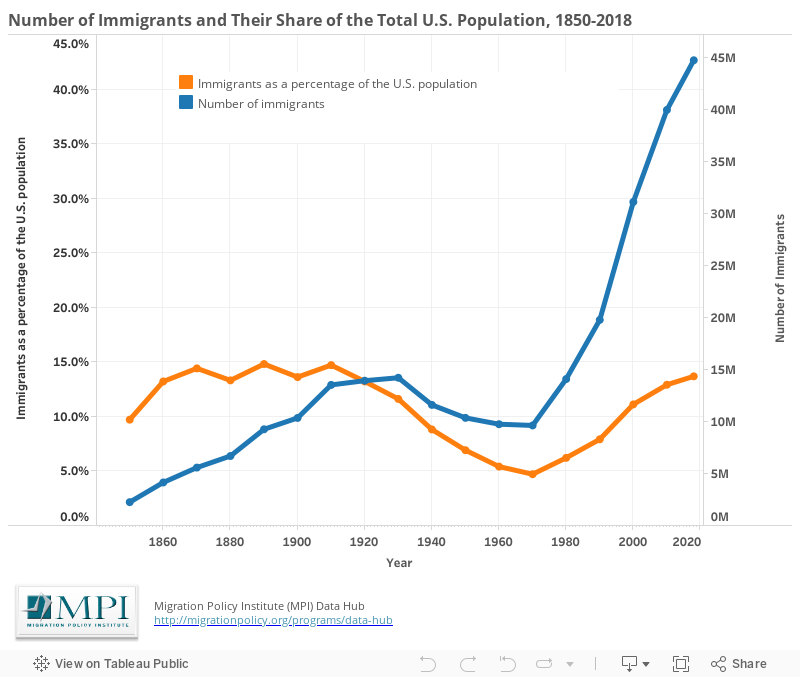
Not so long ago, as many of us reeled from the political earthquakes of Brexit and Trump, it seemed sensible for responsible mainstream political parties to adopt tighter immigration control to keep the populist right at bay. Mass migration in Europe had led to a far-right resurgence; in the US and UK, Trump and the Johnson-era Tories seemed to grasp this and moved to co-opt the anti-immigrant fervor. Democracy was working to accommodate a shift in the public mood.
Or so it seemed. Nearly a decade later, something else has happened: an immigration explosion. In response to a volatile public mood, Western elites actually intensified their policy of importing millions of people from the developing world to replace their insufficiently diverse and declining domestic populations.
The recent figures from the US, UK and Canada are mind-blowing. The graphs all look like a hockey stick, with a massive spike in the last three years alone. Under Trump, the average number of illegal crossings a year was around 500,000; under Biden, that has quadrupled to two million a year — from a much more diverse group, from Africa, China and India. To add insult to injury, Biden has also all but shut down immigration enforcement in the interior; and abused his parole power to usher in nearly 1.3 million illegal migrants in 2023 alone. The number of undetained illegal migrants living in the US has thereby ballooned under Biden: from 3.7 million in 2021 to 6.2 million in 2023, according to ICE. If a fraction of those millions turns up for asylum hearings, I’ll be gob-smacked.
Canada has seen something similar. For much of the 21st century, Canada had around 200,000 to 300,000 immigrants a year; but in the last two years, this has nearly doubled. In Britain, the same story. In 2015, the year before Brexit, net migration (the numbers of people immigrating minus the number emigrating) was 329,000; in the last two years, it has more than doubled to over 700,000. And whereas most immigration before Brexit was from the EU, today, immigrants from the developing world outnumber European immigrants by almost 10 to 1. For those Brits who voted for Brexit to lower the number of foreigners in the country, it’s been surreal.
If you want to understand why Biden keeps trailing in the swing states, why the Tories are about to be wiped out in a historic collapse, and why Trudeau is at all-time low in approval at 28 percent, this seems to me to be key. As the public tried to express a desire to slow down the pace of demographic change, elites in London, Ottawa, and Washington chose to massively accelerate it. It’s as if they saw the rise in the popularity of the far right and said to themselves: well now, how can we really get it to take off?
This week, CNN ran a poll on Biden and immigration. Here’s what they found: in May 2020, only one percent of Americans put immigration as their top concern — in 15th place among issues; in May 2024, 18 percent put it first. In 2020, Biden edged Trump by one percent on who was best to tackle the border crisis; four years later, Trump is ahead on the issue by 27 points. As a coup de grâce, CNN also found that foreign-born Americans preferred Trump to Biden on immigration by 47 to 44 percent. Turns out that this immigrant’s worries are widely shared by my fellow new Americans.
Biden, of course, is now desperately scrambling to salvage something from this disaster. This week, he contradicted himself by saying he has the unilateral capacity as president to shut down the border, and attempted to blame the GOP for the problem. Yes, the GOP was unhelpful and cynically political earlier this year — but that won’t muddy the waters for most voters who have been conscious for the past three years. But I am grateful nonetheless to hear the president echo what the Dish has been saying for years now, and for which I was routinely called a racist:
To protect America as a land that welcomes immigrants, we must first secure the border and secure it now. The simple truth is there is a worldwide migrant crisis, and if the United States doesn’t secure our border, there is no limit to the number of people who may try to come here, because there is no better place on the planet than the United States of America.
Now that didn’t hurt, did it? But why did he keep telling us there was no crisis for the last three and a half years? And why would anyone trust a re-elected Biden to enact this if he had a Congressional majority? I sure don’t.
Even under Biden’s “crackdown”, he is still prepared to admit at least 1.75 million illegal immigrants a year! Last week, Chuck Schumer declared that the ultimate goal was to legalize every single illegal immigrant — because Americans are not having enough children. Without open borders, of course, our economy wouldn’t look so good: in the last year, according to the Bureau of Labor Statistics, foreign-born workers gained 600,000 new jobs, while native-born Americans lost 300,000. But don’t you dare mention the “Great Replacement Theory“!
Comments Off on Elite contempt for democracy is fuelling anti-immigration “far right” sentiment in the west
Bigger Isn’t Always Better: A1E1 Independent | Tank Chats Reloaded
The Tank Museum
Published Mar 1, 2024A bigger tank is a better tank, right? Wrong.
Meet the Interwar Vickers A1E1 Independent: a failed prototype, a prototype that proved bigger isn’t always better. Impractical and expensive, it was never accepted into service – but it is said to have inspired equally cumbersome designs including the German Neubaufahrzeug and the Soviet T-35.
Join David Willey, The Tank Museum Curator, as he examines one of the more unusual vehicles in the collection – and discover how it became a focus for political espionage in the early 1930’s.
00:00 | Introduction
02:56 | Tank Design & Vickers
03:28 | Heavy Tank Requirements
05:38 | Initial Blueprints & Prototypes
11:08 | Test-bed Vehicle
14:50 | Myths, Issues and Life after Trials
19:25 | Does it lead to anything?This video features archive footage courtesy of British Pathé.
#tankmuseum #davidwilley #Interwar #heavytanks
Comments Off on Bigger Isn’t Always Better: A1E1 Independent | Tank Chats Reloaded
QotD: The British sweet tooth
George Orwell, “British Cookery”, 1946. (Originally commissioned by the British Council, but refused by them and later published in abbreviated form.)
Comments Off on QotD: The British sweet tooth
June 9, 2024
Rishi Sunak “promised to run Britain like a start-up. On that account, he has delivered. Over one-third of start-ups crash and burn within two years.”
Christopher Gage pokes a bit of goodnatured fun at British Prime Minister Rishi Sunak’s awful start to his re-election campaign:
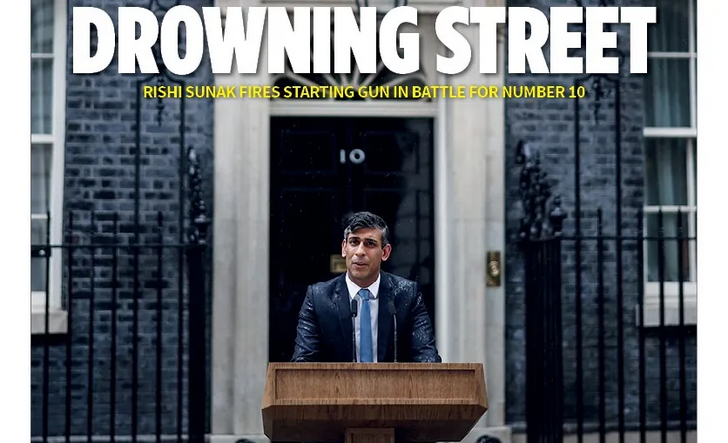
This week on the campaign trail might just enter the political history books. Rishi Sunak, the man who themed his cheese-melting campaign on national pride and security, slipped off home early from the D-Day commemorations in France.
World leaders gathered at the event on Thursday to honour the eightieth anniversary of the Normandy landings. You know, the one attended by a dwindling platoon of demigod veterans in what might be the final year graced by their presence. To riot in understatement, this Irish goodbye was inadvisable. Sunak might as well have fed Dame Judi Dench to a ravenous gang of XL bullies.
Our prime minister is one of life’s thoroughbred winners. From one of the most exclusive schools in the country, Sunak went on to Oxford and then to Stanford university. Cultured in our meritocratic petri-dish, Sunak has never failed a thing in his 44 years. Until now.
Twenty-odd points behind Sir Keir Starmer’s Labour, Sunak is on course to finish third in a two-horse race.
It gets worse. This week, Nigel Farage announced he would stand for election as the Reform Party candidate in Clacton. That Essex seat is the living, breathing symbol of pissed-off, left-behind, white-working-class, fucking furious Great Britain.
The polls have broken Tory brains. Clamped around the Conservative Party’s noodle neck is Reform’s roid-head paws. The right-wing upstarts trail the Tories by just two points. And that was before Sunak committed the social equivalent of tarmacking over the Princess Diana memorial garden on Mothering Sunday.
Sunak is a one-colour pie chart of hubris. After losing the Tory leadership election to the ludicrous Liz Truss, Sunak got handed the top job by knowing the right string-pullers.
Breathless commentary from back then christened Sunak as a Silicon Valley start-up guru, furnishing the boy wonder with LinkedIn adjectives such as “brilliant” and “dynamic”.
Sunak parrots the pediculous babble beloved of that skulk of Babbitts. With blue-sky thinking, and by sticking to core competencies, Sunak has a plan to deliver. He promised to run Britain like a start-up. On that account, he has delivered. Over one-third of start-ups crash and burn within two years.
What went wrong? Sunak’s indulgent reboots have crashed his operating system. Not so long ago, he was an anti-woke culture warrior reeling off tiresome jibes about trans people. Then came spartan Sunak, trusted centurion of the Telegraph comment section.
Too late. For the best part of two years, Sunak has circulated in meme-form around this teetering island, his existence a boundless source of second-hand embarrassment and ridicule.
With each reboot, Sunak sunk further. Ordinary people have a radar for bullshit. They don’t see such shapeshifting as necessary brand correction to meet market demands. They see duplicity and serpentine salesmanship bordering on fraud. In the plain English of my council-estate youth: Sunak is full of shit.
With his wings smeared in beeswax, Rishi Sunak is Icarus. And Nigel Farage is the sun.
Farage is more than the sun. Farage is Wetherspoon Man.
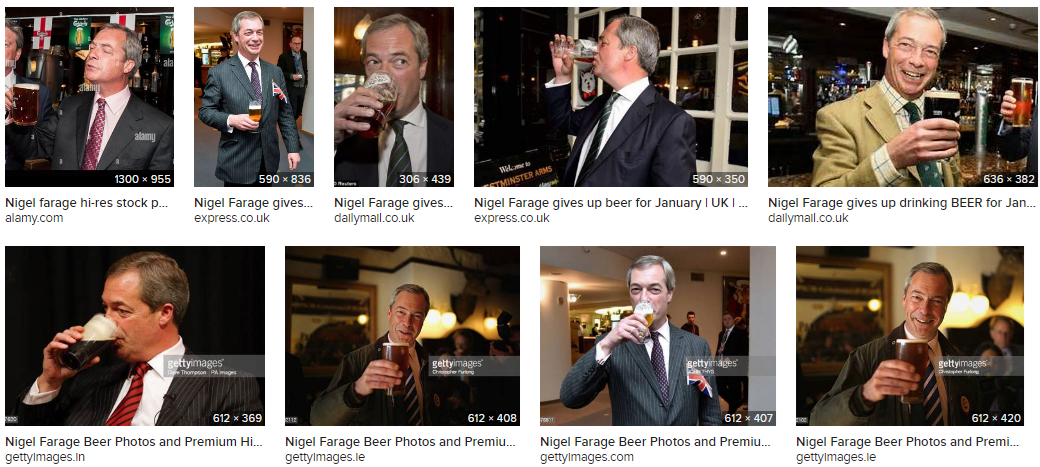
A quick image search for “Nigel Farage beer” provides lots of evidence for “Wetherspoon Man”During his visit to Clacton, Farage fittingly visited a Wetherspoon pub. For the unfamiliar, Wetherspoon pubs owe their undeniable success to their reliability and recognition. Wherever you may be in Britain, you know what you’ll get in one of Wetherspoons’ 800-odd cavernous boozers: A decent burger, chips, and a pint for half an hour on the minimum wage, alongside cheap, cheap booze.
Critics scoff. But they’ll never find a Wetherspoon empty at any time of day or on any day of the week.
Farage announced his plans and doubled the Reform vote in Clacton. His appeal relies on the Wetherspoon model. Farage is the same wherever he may be and to whomever he may talk. Dressed like a hobbyist gamekeeper, he sinks pints, smokes fags, and cracks jokes. “Nigel” says what a sizeable swathe of left-behind Britain thinks and wants to hear.
His many detractors don’t get it. How can a privately educated former metals trader claim to speak for the people? For the same reason that populist parties are lapping at the walls of power across Europe: their erstwhile champions are too busy peacocking their pronouns in their Twitter bios.
Operation Downfall: 2 Million Men to Invade Japan – WW2 – Week 302 – June 8, 1945
World War Two
Published 8 Jun 2024The plans to invade the Japanese Home Islands in the fall grow ever more concrete, with the main issue being not just how to transport men by the millions around the world, but where to put them once they get there. On land the fight continues in Okinawa and the Philippines, and at sea the American fleet is savaged by a typhoon for the second time in six months.
Chapters
00:34 Recap
01:22 The Allied Control Commission
02:29 Okinawa
03:50 The War in the Philippines
06:22 Halsey and another typhoon
09:13 Operation Downfall
19:07 Summary
19:24 Conclusion
20:28 Dedication to Donald Wilson Round
(more…)
Comments Off on Operation Downfall: 2 Million Men to Invade Japan – WW2 – Week 302 – June 8, 1945
Men In Armour (1949) – The origins and operation of tanks
FWD Publishing
Published Feb 18, 2024Lengthy documentary made in 1949 about the men and tanks of the Royal Armoured Corps (RAC).
Comments Off on Men In Armour (1949) – The origins and operation of tanks
QotD: The biological importance of salt to humans
A population deprived of salt was thus one that was weaker and more prone to disease — and at a time when the vast majority of the economy’s energy supply came from the straining of muscle, both human and animal, that weakness in effect meant a severe energy shortage. Although the main fuels for muscle power were carb-heavy grains like wheat, rye, oats, and rice, the indispensable ingredient to getting the most out of these grains was salt — just as how nuclear power uses uranium as its fuel, but also requires a suitable neutron moderator. A population deprived of salt would quite literally be more lethargic and sluggish, making it less productive and poorer too.
Salt’s unique properties made it a serious tool of state. In 1633 king Charles I’s newly-appointed Lord Deputy for Ireland, Baron Wentworth, advised controlling its salt supply as a way to make the Irish utterly economically dependent on England. Given salt was “that which preserves and gives value to all their native staple commodities” — herrings, butter and beef — then “how can they depart from us without nakedness and beggary?” Salt would be a method of control, and a profitable one too, being “of so absolute necessity” that it could be sold to the Irish at inflated prices without much dampening demand: salt “must be had whether they will or no, and may at all times be raised in price”.2 Much like economists today, Wentworth saw revenue-raising potential in taxing goods with such unresponsive or “inelastic” demand.
Wentworth’s scheme to control the Irish never came to be. But a great many other countries did choose to tax it. Given a minimum amount of salt had to be consumed by absolutely everyone, monopolising its sale — and levying what was effectively a tax by inflating the price well above the costs of importing or producing it — could function as kind of indirect poll tax, levied more or less per head of both people and livestock, but without any of the administrative hassle of taking and maintaining an accurate census in order to impose such a tax directly.
When compared to other necessities like grain, salt did not need to be traded in especially large quantities either, meaning that its supply could be monopolised with relative ease. And it could not be produced everywhere. Salt tended to be lacking the further you got from the sea coast, unless there happened to be some relatively rare inland sources like salt lakes, brine springs, or rock salt mines. And it could even be lacking on the sea coast where it was either too humid or too cold to get salt cheaply by evaporating seawater using the sun, or where there was insufficient fuel for boiling the brine. These places were thus prone to being charged inflated prices, while the states that controlled places where the costs of production were low — in warmer and drier climes where the salty water of coastal marshes could cheaply be evaporated using only the heat of the summer sun — could extract especially large monopoly profits from the difference. The revenue from controlling solar salt thus became the basis of many kingdoms, some unusually powerful republics, and even empires.
Anton Howes, “The Second Soul”, Age of Invention, 2024-03-08.
1. Roy Moxham, “Salt Starvation in British India: Consequences of High Salt Taxation in Bengal Presidency, 1765 to 1878”, Economic and Political Weekly 36, no. 25 (2001): p.2270–74.
2. George O’Brien, The Economic History of Ireland in the Seventeenth Century (Maunsel and Company Limited, 1919), p.244, which has the transcription of Wentworth’s proposal
Comments Off on QotD: The biological importance of salt to humans
June 8, 2024
Battlefield Normandy – The battles for Norrey, Bretteville & Putot
The AceDestroyer
Published Jun 27, 2019Hello, welcome to The AceDestroyer and welcome to the third and final episode of the Battlefield Normandy Series. In this episode we follow the Canadians defending Putot-en-Bessin, Bretteville-L’Orgueilleuse and Norrey-en-Bessin. In the two days of heavy combat with the 12th SS Hitlerjugend, the 7th Canadian Infantry brigade managed to hold on to all three towns. Find out how in this episode …
(more…)
Comments Off on Battlefield Normandy – The battles for Norrey, Bretteville & Putot


