
Real Time History
Published Mar 1, 2024In May 1940, Nazi Germany attacks in the West. The Allied armies of France, Britain, Belgium, and the Netherlands have more men, guns, and tanks than the Germans do – and the French army is considered the best in the world. But in just six weeks, German forces shock the world and smash the Allies. So how did Germany win so convincingly, so fast?
(more…)
June 26, 2024
Why the Allies Lost The Battle of France
Comments Off on Why the Allies Lost The Battle of France
June 25, 2024
The ebbing tide of Corbynism
In Spiked, Brendan O’Neill finds the humour in the staggering collapse of the Corbynist wing of the British Labour Party, from being tantalizingly close to forming a government to today’s political knife-fight for a single seat in North London:

Jeremy Corbyn, then-leader of the Labour Party speaking at a rally in Hayfield, Peak District, in 2018.
Photo by Sophie Brown via Wikimedia Commons.
Schadenfreude is an unbecoming emotion, I know. But if you think I am not going to derive at least fleeting pleasure from the fact that the Corbynista movement went from being on the cusp of government to fighting tooth and nail to hold on to one poxy constituency in north London, then you are off your rocker. We must all find mirth wherever we can in this drabbest of elections. And I find mine in the staggering contraction of Corbynism, the almost total collapse of this cause that was once so beloved of every trustafarian Trot, Glasto wanker and they / them fruitloop.
It’s nearly too funny for words. Five years ago, Jeremy Corbyn and his crew were eyeing up Downing Street. They were in the running to run the country. Now they’re entirely concentrated in Islington North. Corbyn once commanded vast crowds of affluent youths at Glastonbury, basking in their posh chant of “Oh, Jeremy Corbyn!”. He had whole armies of time-rich tweeters who put their expensive education to good use by barking at us “gammon” about how “Jez” was “the absolute boy”. Now he can just about rustle up a few score political anoraks to go canvassing for him in a little bit of north London. It would require a heart of stone not to laugh.
Much has changed for “Jez” in the past five years. He was leader of the Labour Party back then. Now he isn’t even a member of the Labour Party. He was suspended in 2020 after he said the scale of Labour’s anti-Semitism problem under his leadership from 2015 to 2020 had been “dramatically overstated for political reasons“. Then he was officially expelled this year after he announced his intention to stand as an independent in Islington North, the constituency he represented for Labour since 1983. The man who wanted to be PM is now fighting for his life to remain an MP. We’ve gone from “socialism in one country” to “socialism in one constituency”.
Die-hard Corbynistas are flocking to Islington North as if it were the Paris Commune under attack from Versailles. They’re beating the streets to plead with constituents to return the absolute boy to parliament in order that socialism might yet live. The list of starry names Corbyn has dragooned to his door-knocking cause reads like a Sky News producer’s rolodex of wankers. Shola Mos-Shogbamimu, anyone? Yes, I’m sure her post-truth bollocks about “all white people [having] white privilege” will go down a treat among the white working classes on the council estates of Archway.
There’s Grace Blakeley, too, a privately educated flapper-girl socialist who thinks flouncing out of a book festival is “collective action“. That’s how she described her decision to withdraw from the Hay Festival over its receipt of funds from the investment management firm, Baillie Gifford. Tweeting “I’ve decided not to go to Hay” is the well-heeled millennial’s Battle of Orgreave. Perhaps Ms Blakeley will compare her class-war wounds with those of some old Irish fella she meets in a pub in Holloway when she’s out electioneering for the boy.
Comments Off on The ebbing tide of Corbynism
“Nigel Farage’s sin […] was to tell the truth which our rulers and their bought, sycophantic media are desperate to hide from us”
As the British general election rumbles into its final days, most media outlets reacted very strongly to Nigel Farage’s willingness to break with the narrative over the outbreak of the Russo-Ukrainian war:

Nigel Farage has really got the elites and their prostitute mainstream media panicking, this time by being the only politician who dares tell the truth about the origins of the Russia-Ukraine war.
First let me stress that I am not condoning Putin’s invasion of Ukraine. But Putin has made it very clear for at least the last 15 years that he saw Ukraine and Georgia, which both have long borders with Russia, joining Nato as an existential threat to his country and warned “not an inch eastwards”.
The West arrogantly ignored Putin’s warnings. That was dumb.
At a conference in April 2008, where Putin was invited to address Nato leaders, he warned that inviting Ukraine and Georgia to join Nato, and thus parking Nato troops and missiles directly on Russia’s borders, would be seen as an existential threat to Russia’s security. This was even reported in the BBC’s in-house rag, the Guardian, on April 4 2008: “The Russian president, Vladimir Putin, today repeated his warning that Moscow would view any attempt to expand Nato to its borders as a ‘direct threat'”.
In December 2021, Putin yet again warned the West that allowing Ukraine and Georgia to join Nato would be unacceptable, in the first minute of this three-minute video. In this video Putin (sensibly in my opinion) asks whether the US would allow Russian troops and missiles to be positioned along its borders with Canada or Mexico and reiterates his “not an inch eastwards” threat.
Yet in January 2022, the US presented its written response to Russian demands on Ukraine not joining Nato and on Nato troops being withdrawn from Romania and Bulgaria, but made clear that it did not change Washington’s support for Ukraine’s right to pursue Nato membership, the most contentious issue in relations with Moscow.
The reply, which was delivered to the Russian Foreign Ministry by the US ambassador in Moscow, John Sullivan, repeated the US offer to negotiate with Russia over some aspects of European security, but the Secretary of State, Antony Blinken, said the issue of eventual Ukrainian membership of the alliance was one of principle.
Blinken was speaking hours after his Russian counterpart, Sergei Lavrov, threatened “retaliatory measures” if the US response did not satisfy the Kremlin.
“Without going to the specifics of the document, I can tell you that it reiterates what we said publicly for many weeks, and in a sense for many, many years. That we will uphold the principle of Nato’s open door”, Blinken said, adding: “There is no change. There will be no change.”
Comments Off on “Nigel Farage’s sin […] was to tell the truth which our rulers and their bought, sycophantic media are desperate to hide from us”
A Travel Guide to Crete in the Sixties (1964) | British Pathé
British Pathé
Published Apr 13, 2014This segment of Pathé Pictorial gives a snapshot of what the beautiful island of Crete, Greece looked like in the nineteen-sixties. From a rich history that is ever present in the architecture of the city to sunny beaches, Crete truly has it all.
A look at the many attractions on the island of Crete.
Various shots of tourists water skiing or lying on the beach in swimsuits and eating in restaurants. Various shots of the seashore caves where locals live in the summer. Various shots as they harvest grain, bake bread and weave outside. There are also shots of windmills in the fields and men milking goats.
People play the lyre and dance in a circle. Various shots of the ruined palace at Knossos including the pots, and paintings on the walls. Several more shots of holidaymakers on the beach.
(more…)
Comments Off on A Travel Guide to Crete in the Sixties (1964) | British Pathé
QotD: Progress and decline
The past has always interested me more than the future. This backward-looking tendency has only been reinforced by reaching, somewhat unexpectedly, the age of 70. I can’t say that I don’t feel my age because I don’t know what feeling any particular age is like — but one repeatedly hears that 60 is the new 40, 70 is the new 50, and so on; certainly, the human aging process has slowed since I was born. When I look at photos of people who were 50 in the year of my birth, 1949, they look much older and more worn-out than do 50-year-olds now; and if I had lived only to my life expectancy at birth, I would be dead these last four years.
So progress must have occurred in the intervening time, despite the pessimism that infects those who, like me, are of retrospective temperament and hypersensitive to deterioration. It is not hard to enumerate many things that have improved. They relate principally, but not only, to material conditions. My best friend when I was very young was one of the last children in Britain to suffer from polio, which paralyzed him from the waist down. The quickest form of written communication was then the telegram, and anything other than local telephone calls had to go through an operator. To call across the Atlantic required a reservation and was ferociously expensive; the resultant conversation always seemed to take place during a violent storm. In England, the food was generally disgusting, and meals were to be endured as a regrettable necessity instead of enjoyed (it puzzles me still how people could have cooked so badly). Cars broke down frequently, and every November, pollution produced fogs so thick that you couldn’t see the hand in front of your face (I loved them). Rationing continued for eight years after the war, and disused bomb shelters, present in every park, were where illicit sexual fumbles and smoking took place. Incidentally, for an adult male not to smoke was unusual (75 percent did so); we must have lived in a perpetual fog of foul-smelling tobacco, to judge by the distaste caused by even a single lit cigarette in these virtuous times. Poverty, as raw necessity, still existed. Murderers were sometimes hanged — as well as, more rarely, the innocent. Overt racial prejudice was, if not quite the norm, certainly prevalent.
Yet not everything has improved, though the deterioration has been less tangible than the progress. To give one example: by age 11, I was free to roam London, or at least its better areas, by myself or with a friend of the same age. The sight of an 11-year-old child wandering the city on his own did not suggest to anyone that he was neglected or abused. I remember, too, the evening papers piled up at newsstands; people would throw coins on top of the pile and take their copy. It never occurred to anyone that the money might get stolen; nowadays, it would never occur to anyone that the money would not be stolen. The crime statistics bear out this sea change in national character.
Theodore Dalrymple, “What Seventy Years Have Wrought”, New English Review, 2019-10-26.
Comments Off on QotD: Progress and decline
June 24, 2024
History Summarized: Augustus Versus Antony
Overly Sarcastic Productions
Published Apr 6, 2018Now that Caesar’s assassins are out of the picture, which would-be dictator will defeat the other to become the sole-ruler of Rome? In today’s episode of “How Long Before There’s Another Civil War?”: Not a lot … honestly not a very long time … BUT THEN WE GET THE ROMAN EMPIRE WOOOOOOOOO~~~
Comments Off on History Summarized: Augustus Versus Antony
June 23, 2024
Okinawa Ends – WW2 – Week 304 – June 22, 1945
World War Two
Published 22 Jun 2024Mitsuru Ushijima’s forces are defeated and the Battle of Okinawa is officially over. However, since most of the Japanese fought to the death, victory comes at a bloody cost – over 50,000 US casualties and over 100,000 Japanese and also possibly that many Okinawan deaths. The fight on North Borneo continues, there’s a raid on Wake Island, and the Japanese powers that be meet to actually discuss making some sort of peace with the Allies.
00:00 Intro
01:25 Truman And The Interim Committee
05:00 Battle Of Okinawa
08:06 The End Of Okinawa
13:22 Raid On Wake Island
14:23 Battle Of North Borneo
15:33 Hirohito Wants Peace
16:54 Conclusion
(more…)
Comments Off on Okinawa Ends – WW2 – Week 304 – June 22, 1945
The amazing range of things Britain’s Ofcom gets its tentacles into
Earlier this week, Mark Steyn discussed the British government’s Office of Communications (Ofcom) and the way it rigs regulates who can say what during British election campaigns:

Why do I think the UK state censor Ofcom should be put out of business? Because there are very few areas of British life that this strange, secretive body does not “regulate”. Take, for example, this current UK election campaign, which the media are keen to keep as a torpid Potemkin struggle between TweedleLeft and TweedleRight. So, on Thursday night, BBC bigshot Fiona Bruce will host a debate between the four party leaders – that’s to say, the head honchos of the Conservatives, Labour, the Liberal Democrats and the Greens.
Wait a minute: what about Nigel Farage, leader of the Reform party? Since the beginning of the year, Reform has been third-placed in the polls, ahead of the LibDems and Greens, and last week they rose to second place ahead of the unlovely Tories.
So why wouldn’t the second-place party get a spot in the leaders’ telly debate?
Ah, well, you’re looking at it all wrong, you hick. Here’s how the Beeb explain it:
The Ofcom guidance gives “greater weight on the actual performance of a political party in elections over opinion poll data” taking into account the “greater uncertainty associated with support in opinion polls”.
The “actual performance of a political party” refers to their results in the two previous elections — 2019 and 2015 — when Reform didn’t exist. A lot of other things didn’t exist in 2015: Brexit, Covid, lockdown, the Ukraine war, legions of vaccine victims, the massed ranks of Albanian males occupying English country-house hotels …
But, per “Ofcom guidance”, Campaign 2024 has to be conducted on the basis of how things stood a decade ago.
You know who would also be ineligible to participate under Ofcom’s rules? Everyone’s favourite Lana Turner sweater-girl in Kiev, Volodymyr Zelenskyyyyy. He only formed his Servant of the People party in late 2017, so no election debates for you, sweater-girl. And don’t try blaming it on Putin, because it’s “Ofcom guidance” so we all know it’s on the up-and-up.Because, as their barrister assured the High Court, Ofcom are “expert regulators”. Lord Grade and Dame Melanie Dawes probably did a module in regulation at Rotherham Polytechnic or whatever.
I can see why the likes of Naomi Wolf’s creepy stalker-boy Matthew Sweet like this system: it’s a club and they get to decide who’s admitted. It’s less obvious why the generality of the citizenry put up with it. At any rate, get set for another thrilling BBC election debate in which all four “opponents” agree on Covid, climate, Ukraine, the joys of mass Muslim immigration and the inviolability of the NHS … but ever more furiously denounce each other for not tossing enough money that doesn’t exist into the sinkhole.
Don’t get me wrong, I quite like that pixie Green leader who describes herself as a “pansexual vegan”, and I certainly don’t have the personal baggage with her that I have with Nige. But under what rational conception of media “regulation” does the six per cent basement-dweller get guaranteed a seat at the table but not Reform?
And you wonder why nothing changes?
Comments Off on The amazing range of things Britain’s Ofcom gets its tentacles into
The Original Chef Boyardee Spaghetti Dinner
Tasting History with Max Miller
Published 13 Mar 2024Absolutely fantastic tomato and meat sauce served over spaghetti tossed with butter and parmesan
City/Region: Cleveland, Ohio
Time Period: 1930sChef Boyardee was not born in Cleveland (sorry, 30 Rock), but in Borganovo, just outside of Piacenza in Italy. And his name was not Hector Boyardee, but Ettore Boiardi (boy-AR-dee). He opened an Italian restaurant in Cleveland in 1924, where the food was so popular that he frequently sent patrons home with bottles of his spaghetti sauce.
We can’t know exactly what that original sauce was, but this is from a family recipe and is probably pretty close. And it’s phenomenal. It’s fairly simple, but so good. You get a lot of the fresh basil, and the creaminess from mixing the butter and parmesan directly with the pasta is delicious. I don’t often make dishes from the show again, but I can see myself making this any day of the week.
(more…)
Comments Off on The Original Chef Boyardee Spaghetti Dinner
June 22, 2024
The End of Everything
In First Things, Francis X. Maier reviews Victor Davis Hanson’s recent work The End of Everything: How Wars Descend into Annihilation:
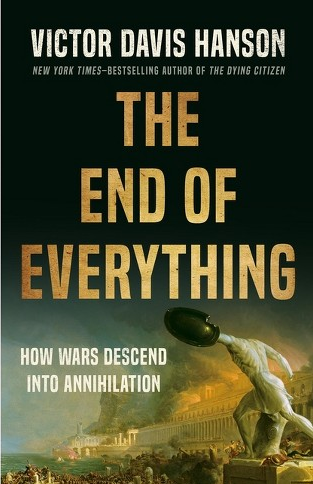
A senior fellow in military history and classics at Stanford University’s Hoover Institution, Hanson is a specialist on the human dimension and costs of war. His focus in The End of Everything is, as usual, on the past; specifically, the destruction of four great civilizations: ancient Thebes, Carthage, Constantinople, and the Aztec Empire. In each case, an otherwise enduring civilization was not merely conquered, but “annihilated” — in other words, completely erased and replaced. How such catastrophes could happen is the substance of Hanson’s book. And the lessons therein are worth noting.
In every case, the defeated suffered from fatal delusions. Each civilization overestimated its own strength or skill; each misread the willingness of allies to support it; and each underestimated the determination, strength, and ferocity of its enemy.
Thebes had a superb military heritage, but the Thebans’ tactics were outdated and their leadership no match for Macedon’s Alexander the Great. The city was razed and its surviving population scattered. Carthage — a thriving commercial center of 500,000 even after two military defeats by Rome — misread the greed, jealousy, and hatred of Rome, and Roman willingness to violate its own favorable treaty terms to extinguish its former enemy. The long Roman siege of the Third Punic War saw the killing or starvation of 450,000 Carthaginians, the survivors sold into slavery, the city leveled, and the land rendered uninhabitable for a century.
The Byzantine Empire, Rome’s successor in the East, survived for a millennium on superior military technology, genius diplomacy, impregnable fortifications, and confidence in the protection of heaven. By 1453, a shrunken and sclerotic Byzantine state could rely on none of these advantages, nor on any real help from the Christian West. But it nonetheless clung to a belief in the mantle of heaven and its own ability to withstand a determined Ottoman siege. The result was not merely defeat, but the erasure of any significant Greek and Christian presence in Constantinople. As for the Aztecs, they fatally misread Spanish intentions, ruthlessness, and duplicity, as well as the hatred of their conquered “allies” who switched sides and fought alongside the conquistadors.
The industrial-scale nature of human sacrifice and sacred cannibalism practiced by the Aztecs — more than 20,000 captives were ritually butchered each year — horrified the Spanish. It reinforced their fury and worked to justify their own ferocious violence, just as the Carthaginian practice of infant sacrifice had enraged the Romans. In the end, despite the seemingly massive strength of Aztec armies, a small group of Spanish adventurers utterly destroyed Tenochtitlán, the beautiful and architecturally elaborate Aztec capital, and wiped out an entire culture.
History never repeats itself, but patterns of human thought and behavior repeat themselves all the time. We humans are capable of astonishing acts of virtue, unselfish service, and heroism. We’re also capable of obscene, unimaginable violence. Anyone doubting the latter need only check the record of the last century. Or last year’s October 7 savagery, courtesy of Hamas.
The takeaway from Hanson’s book might be summarized in passages like this one:
Modern civilization faces a toxic paradox. The more that technologically advanced mankind develops the ability to wipe out wartime enemies, the more it develops a postmodern conceit that total war is an obsolete exercise, [assuming, mistakenly] that disagreements among civilized people will always be arbitrated by the cooler, more sophisticated, and more diplomatically minded. The same hubris that posits that complex tools of mass destruction can be created but never used, also fuels the fatal vanity that war itself is an anachronism and no longer an existential concern—at least in comparison to the supposedly greater threats of naturally occurring pandemics, meteoric impacts, man-made climate change, or overpopulation.
Or this one:
The gullibility, and indeed ignorance, of contemporary governments and leaders about the intent, hatred, ruthlessness, and capability of their enemies are not surprising. The retreat to comfortable nonchalance and credulousness, often the cargo of affluence and leisure, is predictable given unchanging human nature, despite the pretensions of a postmodern technologically advanced global village.
I suppose the lesson is this: There’s nothing sacred about the Pax Americana. Nothing guarantees its survival, legitimacy, comforts, power, or wealth. A sardonic observer like the Roman poet Juvenal — were he alive — might even observe that today’s America seems less like the “city on a hill” of Scripture, and more like a Carthaginian tophet, or the ritual site of child sacrifice. Of course, that would be unfair. A biblical leaven remains in the American experiment, and many good people still believe in its best ideals.
Comments Off on The End of Everything
The Curious Case of Hitler’s Corpse – War Against Humanity 136
World War Two
Published 21 Jun 2024Joseph Stalin claims that Adolf Hitler managed to escape Berlin and is now living somewhere in hiding. It’s complete nonsense of course. But it raises some interesting questions. What remains do we have of Hitler? How do we know they belong to the Fuhrer? And, why is Stalin spreading these far-fetched lies?
(more…)
Comments Off on The Curious Case of Hitler’s Corpse – War Against Humanity 136
“We can learn a lot about our betters from looking at each exception to their rules”
Julie Burchill isn’t a soccer fan, but she points out that the “exceptions” to the usual “rules” that the kakistocrats allow during international soccer tournaments tell us a lot about them:

Patriotism is not the only “bad” thing we’re suddenly “allowed” to do in the weeks when the national team plays on the world stage. The BBC in particular reminds men that they can disregard the finger-wagging for a few brief weeks. In EastEnders, male characters cringingly ask their mates to “get the beers in for the game”. Alcohol would generally be condemned as a public-health menace by Auntie, but during “The Game”, one more “cheeky” tipple apparently won’t hurt you.
We can learn a lot about our betters from looking at each exception to their rules. Don’t be racist – except against Jews. Believe all women about sexual assault – unless they’re Israeli. Oh, and be careful not to “culturally appropriate” the slightest thing from any other nationality, even to the point of never wearing a sombrero in a Mexican restaurant – but it’s fine to be a cross-dressing man culturally appropriating my sex. Meanwhile, if you’re a woman, be a good little Transmaid and stand by smiling, even if you call yourself a feminist.
Like most other places in the West in these dog days of civilisation, England feels like a nation devoid of hope and pride. Even so, being allowed to take pride in some overpaid ball-kickers, but not in the fact that this country contributed massively to ending slavery – lest we be called out as White Saviours – is a somewhat surreal situation to find ourselves in, after all those centuries of blood, sweat and struggle.
Flying the flag for the duration of the Euros is like being a eunuch who’s permitted to have his nuts back for a couple of weeks – for old times’ sake – and wear them as earrings. But those who indulge must be sure to tear their St George’s down sharpish once the festivities are over, lest they be fingered as a fascist for liking their own flag more than others. Remember, the only flag that can be flown constantly now is the Pride flag. This must be saluted respectfully wherever it pops up – failure to do so may identify you as an unworthy citizen of Soft Play Pit Nation.
Comments Off on “We can learn a lot about our betters from looking at each exception to their rules”
Why and when did the Romans start wearing different clothing and armor?
Maiorianus
Published Mar 5, 2024
Comments Off on Why and when did the Romans start wearing different clothing and armor?
QotD: The rise of post-modernism
Perhaps the present brand of postmodernism was born primarily in France as well. After the humiliating drive of the Panzers through the Ardennes in May, 1940, the collapse of Europe’s largest army in six weeks, and the rescue by the Americans and the British in August, 1944, theories were easier to accept than facts. For a few elite but stunned postwar Frenchmen, fiction was more palatable than reality, text and discourse a refuge from a truth as unacceptable as it was bothersome.
Victor Davis Hanson, Ripples of Battle, 2003.
Comments Off on QotD: The rise of post-modernism
June 21, 2024
From “invention” to “tradition”
At Astral Codex Ten, Scott Alexander considers some “traditions” which were clearly invented much more recently than participants might believe:

Two NYC synagogues, one in Moorish Revival style and the other is some form of modernism (you can tell it’s not Brutalism because it’s not all decaying concrete). Like Scott, I vastly prefer the one on the left even if it isn’t totally faithful to the Moroccan original design.
A: I like Indian food.
B: Oh, so you like a few bites of flavorless rice daily? Because India is a very poor country, and that’s a more realistic depiction of what the average Indian person eats. And India has poor food safety laws – do you like eating in unsanitary restaurants full of rats? And are you condoning Narendra Modi’s fascist policies?
A: I just like paneer tikka.
This is how most arguments about being “trad” sound to me. Someone points out that they like some feature of the past. Then other people object that this feature is idealized, the past wasn’t universally like that, and the past had many other bad things.
But “of the past” is just meant to be a pointer! “Indian food” is a good pointer to paneer tikka even if it’s an idealized view of how Indians actually eat, even if India has lots of other problems!
In the same way, when people say they like Moorish Revival architecture or the 1950s family structure or whatever, I think of these as pointers. It’s fine if the Moors also had some bad buildings, or not all 1950s families were really like that. Everyone knows what they mean!
But there’s another anti-tradition argument which goes deeper than this. It’s something like “ah, but you’re a hypocrite, because the people of the past weren’t trying to return to some idealized history. They just did what made sense in their present environment.”
There were hints of this in Sam Kriss’ otherwise-excellent article about a fertility festival in Hastings, England. A celebrant dressed up as a green agricultural deity figure, paraded through the street, and then got ritually murdered. Then everyone drank and partied and had a good time.
Most of the people involved assumed it derived from the Druids or something. It was popular not just as a good party, but because it felt like a connection to primeval days of magic and mystery. But actually, the Hastings festival dates from 1983. If you really stretch things, it’s loosely based on similar rituals from the 1790s. There’s no connection to anything older than that.
Kriss wrote:
I don’t think the Jack in the Green is worse because it’s not really an ancient fertility rite, but I do think it’s a little worse because it pretends to be … tradition pretends to be a respect for the past, but it refuses to let the past inhabit its own particular time: it turns the past into eternity. The opposite of tradition is invention.
Tradition is fake, and invention is real. Most of the human activity of the past consists of people just doing stuff … they didn’t need a reason. It didn’t need to be part of anything ancient. They were having fun.
I’ve been thinking a lot about [a seagull float in the Hastings parade] … in the procession, the shape of the seagull became totemic. It had the intensity of a symbol, without needing to symbolise anything in particular. Another word for a symbol that burns through any referent is a god. I wasn’t kidding when I said I felt the faint urge to worship it. I don’t think it would be any more meaningful if someone had dug up some thousand-year-old seagull fetishes from a nearby field. It’s powerful simply because of what it is. Invention, just doing stuff, is the nebula that nurses newborn gods.
I’m nervous to ever disagree with Sam Kriss about ancient history, but this strikes me as totally false.
Modern traditionalists look back fondly on Victorian times. But the Victorians didn’t get their culture by just doing stuff without ever thinking of the past. They were writing pseudo-Arthurian poetry, building neo-Gothic palaces, and painting pre-Raphaelite art hearkening back to the early Renaissance. And the Renaissance itself was based on the idea of a re-naissance of Greco-Roman culture. And the Roman Empire at its peak spent half of its cultural energy obsessing over restoring the virtue of the ancient days of the Roman Republic:
Then none was for a party;
Then all were for the state;
Then the great man helped the poor,
And the poor man loved the great:
Then lands were fairly portioned;
Then spoils were fairly sold:
The Romans were like brothers
In the brave days of old.Now Roman is to Roman
More hateful than a foe,
And the Tribunes beard the high,
And the Fathers grind the low.
As we wax hot in faction,
In battle we wax cold:
Wherefore men fight not as they fought
In the brave days of old.(of course, this isn’t from a real Imperial Roman poem — it’s by a Victorian Brit pretending to be a later Roman yearning for the grand old days of Republican Rome. And it’s still better than any poem of the last fifty years, fight me.)
As for the ancient Roman Republic, they spoke fondly of a Golden Age when they were ruled by the god Saturn. As far as anyone knows, Saturn is a wholly mythical figure. But if he did exist, there are good odds he inspired his people (supposedly the fauns and nymphs) through stories of some even Goldener Age that came before.
Comments Off on From “invention” to “tradition”


