
The Tank Museum
Published 28 Oct 2022How much do you know about the Panhard EBR? Join David Willey for this week’s Tank Chat as he covers the development, design and use of this French armoured car.
(more…)
February 11, 2023
Tank Chats #167 | French Panhard EBR | The Tank Museum
Comments Off on Tank Chats #167 | French Panhard EBR | The Tank Museum
February 8, 2023
The ghastly Thirty Years’ War in Europe
In The Critic, Peter Caddick-Adams outlines the state of Europe four hundred years ago:
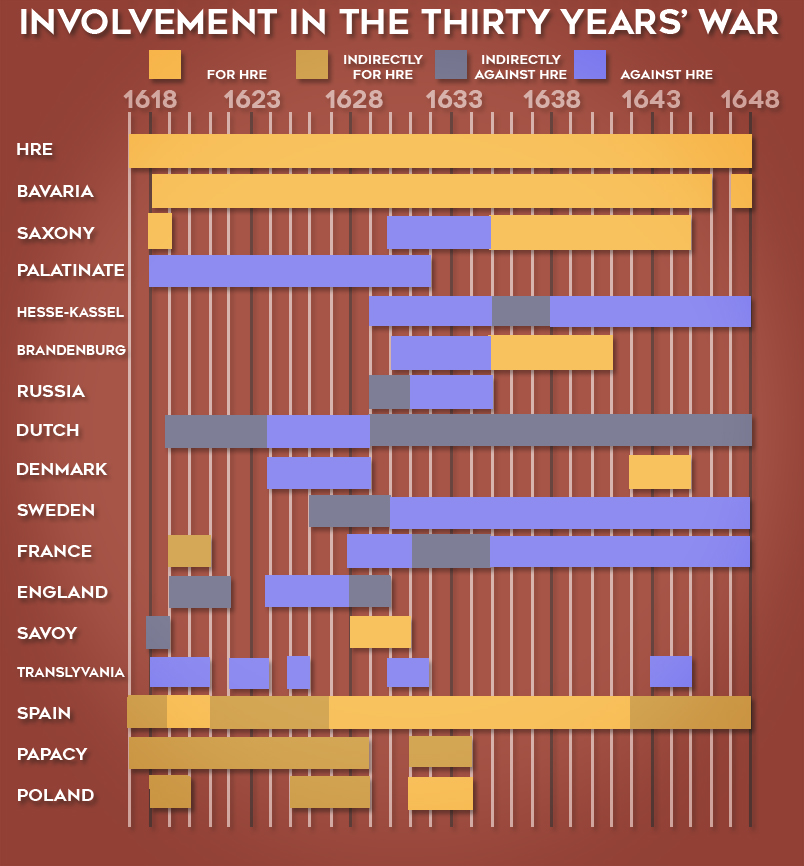
A war as long and as complex requires something like this to help keep the narrative somewhat understandable.
Exactly four hundred years ago, a dark shadow was slithering across mainland Europe. It stretched its bleak, cold presence into each hearth and home. Everything it touched turned to ruin. Musket and rapier, smoke and fire, ruled supreme. Nothing was immune. Animals and children starved to death, mothers and adolescent girls were abused and tortured. The lucky ones died, alongside their brothers and fathers, slain in battle. Possessions were looted, crops destroyed, barns and houses burned. There seemed no end to the evil and pestilence. Sixteen generations ago, many believed the end of the world had arrived.
This was not a tale of Middle Earth. The place was central Europe in the early 17th century. In 1618 the future Holy Roman emperor Ferdinand II, a zealous follower of the Jesuits, had attempted to restore the Catholic Church as the only religion in the Empire and exterminate any form of religious dissent. Protestant nobles in Bohemia and Austria rose up in rebellion. The conflict soon widened, fuelled by the political ambitions of adjacent powers. In Europe’s heartland, three denominations fought it out: Roman Catholicism, Lutheranism and Calvinism.
The result was an interwoven tangle of diplomatic plot twists, temporary alliances and coalitions, as princes, bishops and potentates beseeched outside powers to help. The struggle, which lasted for thirty years, boiled down to the Roman Catholic and Habsburg-led Holy Roman Empire, fighting an incongruous array of Protestant towns and statelets, aided by the anti-Catholic powers of Sweden under Gustavus Adolphus, and the United Netherlands. France and Spain also took advantage of the distractions of war to indulge in their own sub-campaigns. Britain took no formal part but was about to become embroiled in her own civil war.
The principal battleground for this collective contest of arms centred on the towns and principalities of what would become Germany, northern Italy, the Netherlands and the Czech Republic. The war devastated many regions on a scale unseen again until 1944–45. For example, at Magdeburg on the River Elbe, 20,000 of 25,000 inhabitants died, with 1,700 of its 1,900 buildings ruined. In Czech Bohemia, 40 per cent of the population perished, with 100 towns and more than a thousand villages laid waste. At Nordlingen in 1634, around 16,000 soldiers were killed in a single day’s battle. The town took three centuries for its population to return to pre-war levels. Refugees from smaller settlements swelled the many walled cities, increasing hunger and spreading disease.
Too diminutive to defend themselves, all states hired mercenaries, of whom a huge number flourished in the era, enticed by the prospect of quick wealth in exchange for proficiency with sword and musket. Employed by every antagonist, but beholden to no one, these armed brigands — regiments would be too grand a term for the uniformed thugs they were — roamed at will. With their pikes and their muskets, they plundered the countryside in search of booty, food and transport. In their wake, they left burning towns, ruined villages, pillaged farms. Lead was stripped from houses and church roofs for ammunition.
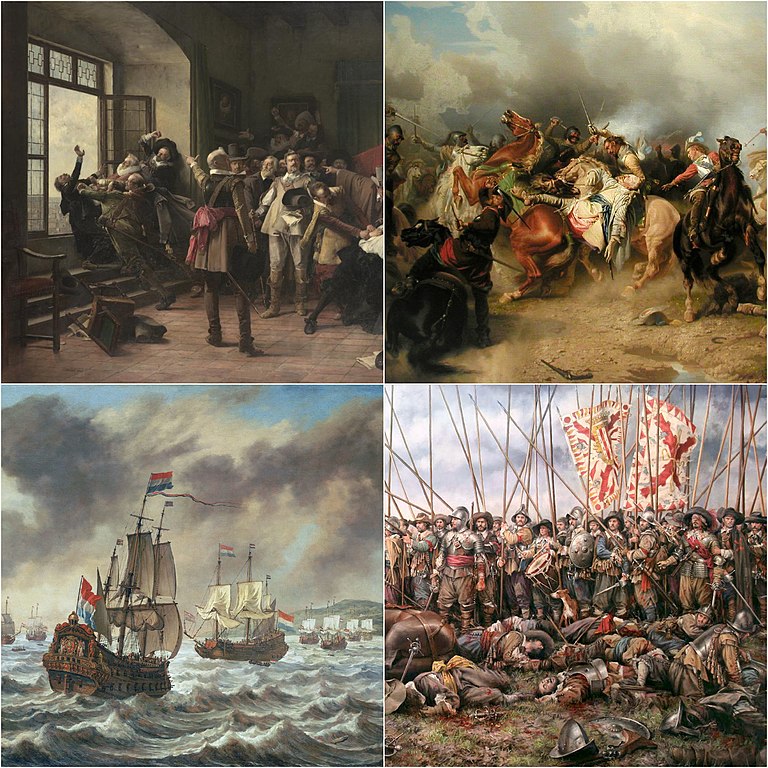
Left to right:
The Defenestration of Prague (23 May, 1618), The death of Gustavus Adolphus at Lützen (16 November, 1632), Dutch warships prior to the Battle of the Downs (21 October, 1639), and The Battle of Rocroi (19 May, 1643).
Collage by David Dijkgraaf via Wikimedia Commons.When in the winter of 1634 Swedish mercenaries were refused food and wine by the inhabitants of Linden, a tiny Bavarian settlement, they raped and looted their way through the village, leaving it uninhabitable. Across Europe, travellers noted the human and animal carcasses that decorated the meadows, streams polluted by the dead and rotting crops, presided over only by ravens and wolves. No respect was shown for the lifeless. Survivors stripped corpses of clothing and valuables; if lucky, the deceased were tossed into unmarked mass graves, since lost to history.
Having triggered the war, Ferdinand predeceased its end. We can never know how many died in Europe’s last major conflagration triggered by religion. Archives perished in the flames, and survivors were not interested in computations. Historians now put the death toll at between 8 and 12 million. Probably 500,000 perished in battle, with the rest, mostly civilians, expiring through starvation and disease. We think these casualties may equate to as much as 20 per cent of mainland Europe’s population and perhaps one-third of those in modern Germany, bringing the Thirty Years’ War a potency similar to the Black Death or either world war. The region did not recover for at least three generations.
Economic activity, land use and ownership altered terminally. When the exhausted powers finally met in October 1648 at Osnabrück and Münster in the German province of Westphalia to end the directionless slaughter, of whom self-serving militias were the only beneficiaries, Europe’s balance of power had shifted tectonically. Fresh rules of conflict and the legitimacy of a new network of 300 sovereign states, independent from a Holy Roman Emperor or a Pope, marked the struggle as a watershed moment, leading to the Enlightenment and an era that disappeared only with Napoleon.
Comments Off on The ghastly Thirty Years’ War in Europe
February 5, 2023
Leningrad: NO STEP BACK! – Week 232 – February 4, 1944
World War Two
Published 4 Feb 2023The Allies begin a new operation in the Pacific this week: assaulting the Marshall Islands. They also make big attacks from their beachhead in Italy at Anzio, but these are called off after only a few days in the face of heavy enemy resistance. However, in the USSR there are several successes against the Axis, as they are pushed back both in the far north and the far south of the front, and still surrounded near Korsun.
(more…)
Comments Off on Leningrad: NO STEP BACK! – Week 232 – February 4, 1944
February 3, 2023
Tank Chats #166 | SOMUA S35 | The Tank Museum
The Tank Museum
Published 14 Oct 2022Join David Willey in this week’s Tank Chat as he details the history of the SOMUA S35, a French cavalry tank of the Second World War.
(more…)
Comments Off on Tank Chats #166 | SOMUA S35 | The Tank Museum
February 2, 2023
MAC Model 1947 Prototype SMGs
Forgotten Weapons
Published 12 Oct 2022Immediately upon the liberation of France in 1944, the French military began a process of developing a whole new suite of small arms. As it applied to SMGs, the desire was for a design in 9mm Parabellum (no more 7.65mm French Long), with an emphasis on something light, handy, and foldable. All three of the French state arsenals (MAC, MAS, and MAT) developed designs to meet the requirement, and today we are looking at the first pair of offerings from Chatellerault (MAC). These are the 1947 pattern, a very light lever-delayed system with (frankly) terrible ergonomics.
Many thanks to the French IRCGN (Criminal Research Institute of the National Gendarmerie) for generously giving me access to film these unique specimens for you!
Today’s video — and many others — have been made possible in part by my friend Shéhérazade (Shazzi) Samimi-Hoflack. She is a real estate agent in Paris who specializes in working with English-speakers, and she has helped me arrange places to stay while I’m filming in France. I know that exchange rates make this a good time for Americans to invest in Europe, and if you are interested in Parisian real estate I would highly recommend her. She can be reached at: samimiconsulting@gmail.com
(Note: she did not pay for this endorsement)
(more…)
Comments Off on MAC Model 1947 Prototype SMGs
January 29, 2023
Anzio Begins – Allies Already Pinned Down – Week 231 – January 28, 1944
World War Two
Published 28 Jan 2023Some big news is the Allies amphibious offensive to hit the Germans behind their lines at Anzio in Italy, some other big news is that after nearly two and a half years, the Soviets have broken the siege of Leningrad and their twin northern offensives keep pushing back the enemy. Yet more big news is that the Soviets have managed to surround and cut off over 50,000 Axis troops near Korsun. This is one big week of action!
(more…)
Comments Off on Anzio Begins – Allies Already Pinned Down – Week 231 – January 28, 1944
France’s Ultimate WW1 Selfloading Rifle: The RSC-1918
Forgotten Weapons
Published 14 Sept 2017The French RSC-1917 semiauto rifle was a major step forward in arms technology during World War One, offering a reliable and effective self-loading rifle for issue to squad leaders, expert marksmen, and other particularly experienced and effective troops. No other military was able to field a semiauto combat shoulder rifle during this was in anything but very limited numbers. However, the RSC-1917 definitely had some shortcomings:
– It was just too long, at the same size as the Lebel
– The specialized clip was a logistical problem
– The gas system was fragile and difficult to clean or disassemble
– The magazine cover was easily damagedThese issues were all addressed in the Model 1918 upgrade of the rifle, although it was too late to see active service in the Great War. The new pattern was substantially shorter (both the stock and barrel), it used the standard Berthier 5-round clip, it had a substantially strengthened magazine cover, and a much improved gas system.
Today, we will compare the various features of the 1917 and 1918 rifles, and disassemble the 1918 gas system to show how it worked.
(more…)
Comments Off on France’s Ultimate WW1 Selfloading Rifle: The RSC-1918
January 27, 2023
January 22, 2023
QotD: Evolution of the nation-state
The Hundred Years’ War laid the foundations for the modern state. Exaggerating only a little for effect, when “England” and “France” went to war over some convoluted feudal nonsense in 1337, nobody not directly in the armies’ path cared. By 1453, though, both sides had to clearly articulate just why they were fighting in order to keep the war going. “National chauvinism” turned out to be a pretty good answer for the French — who, after all, were on the receiving end of most of the physical damage — but it worked ok for England, too. Early Modern English history makes a lot more sense when you know about the Pale of Calais.
It took the rest of Europe another 150 years, but the Thirty Years’ War did the trick. What started as another of the endless doctrinal conflicts kicked off by the Reformation ended with the creation of the modern nation-state. Cardinal Richelieu really was a Cardinal — a prince of the Roman Catholic Church, a guy with a legitimate chance of being elected Pope. This man brought Catholic France into the war on the Protestant side for “reasons of state”. This made sense in 1631 … and the war still had another 17 years to run.
Speaking of, the treaty that ended the Thirty Years’ War, the famous Peace of Westphalia, is credited with creating the modern nation-state. Which it did, but since we decided back in 1946 that nationalism was the worst possible sin, we Postmoderns forgot what everyone around the treaty table knew: That “nation” and “state” are inseparable. The nation-state, which for clarity’s sake will henceforth be known as the ethno-state, is the biggest stable form of human organization.
Severian, “The Libertarian Moment?”, Rotten Chestnuts, 2020-03-19.
Comments Off on QotD: Evolution of the nation-state
January 19, 2023
Tanks Chats #164 | M-50 Sherman | The Tank Museum
The Tank Museum
Published 23 Sep 2022In this episode of Tank Chats, David Willey discusses the history of the M-50 version of the Sherman.
(more…)
Comments Off on Tanks Chats #164 | M-50 Sherman | The Tank Museum
January 18, 2023
L’affaire Dreyfus
Robert Zaretsky on an espionage scandal that convulsed the French Third Republic and still has resonance down to today:
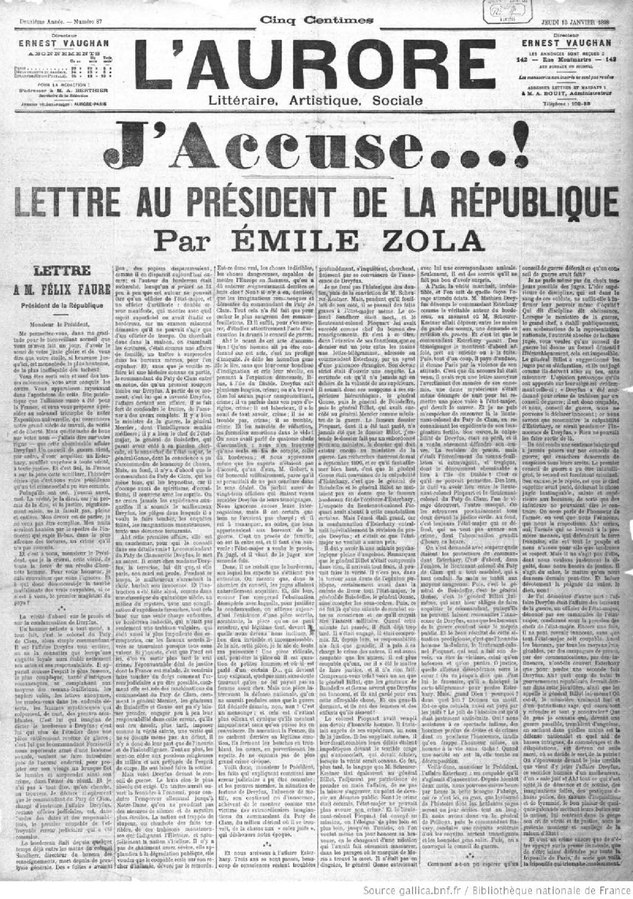
Front page of L’Aurore for 13 January, 1898 with Zola’s J’Accuse headline.
Wikimedia Commons.
On January 13, 1898, Parisians awoke to the chorus of hundreds of news criers who, striding along the grand boulevards and brandishing copies of the newspaper L’Aurore, were shouting passages from the article that sprawled across the front page. It had originally been titled by its author, the novelist Émile Zola, “A Letter to M. Félix Faure, President of the Republique”. But with a flair for the sensational, the newspaper’s editor, Georges Clemenceau, slapped on a punchier headline. Stepping out of a department store or stepping down from a carriage, sitting at a café or standing at an intersection, pedestrians were greeted by two words that continue to resonate 125 years to the day after their first publication: “J’Accuse!”
With this exclamation, Zola’s letter transformed une affaire judiciare into l’affaire Dreyfus or, more simply, the Dreyfus Affair. It catapulted the French novelist onto the world stage at a critical moment in the history of his country, which was reeling from the forces of globalisation and industrialisation and riven by opposing understandings of its revolutionary heritage. It is thus hardly surprising that Zola’s fame rests more heavily on the letter than on his sweeping 20-volume masterpiece of literary realism, the Rougon-Macquart. It took a novelist to heave the facts of this affair into a narrative which, more than a century later, thrums with equal urgency. Moreover, as with the novels of the Rougon-Macquart, the letter thrusts onto centre-stage a lone individual swept up, and all too often swept under, the political and social, irrational and ideological forces of the modern age.
It all began with the contents of a rubbish bin. In September 1894, a cleaning woman at the German Embassy, in the pay of France’s military intelligence service, delivered her nightly harvest to her employers. Buried in the mound of discarded papers was a memorandum, known as the bordereau or note, revealing top secret advances in French artillery technology and tactics. In a frantic scramble to find its author, the war ministry’s suspicion settled on Captain Alfred Dreyfus, an officer in the High Command who stood out for his standoffishness and Jewishness.
Upon being arrested and charged, a bewildered Dreyfus denied the charges, pointing out several things mentioned in the bordereau he could not possibly have known. The seven members of the military tribunal, ignoring these inconsistencies as well as the insistence of their own graphologist that Dreyfus’s handwriting did not match the bordereau‘s, unanimously found him guilty. He was sentenced to life imprisonment in solitary confinement on Devil’s Island, a malarial rock off the coast of French Guyana.
But first came a remarkable ritual of public humiliation. Dreyfus was marched into the courtyard of the École militaire, the renowned military academy a short distance from the recently erected Eiffel Tower. In the shadow of that monument to modernity, an officer preceded to snap Dreyfus’s sword — broken and soldered back together with tin the night before, to make the gesture seem effortless — and tear off his insignia — whose threads were already loosened — while a dense crowd howled with calls for the death of the “Jewish traitor!”
Two years later, as Dreyfus wasted away in solitary confinement, Colonel Georges Picquart, the newly appointed head of military intelligence, found that another missive about French military plans had ended up in the rubbish bin at the German Embassy. Moreover, the handwriting on this new document, which matched that of the bordereau, also matched the hand of Ferdinand Esterhazy, an officer notorious for his womanising and gambling.
Picquart disliked Jews as much as his many of his fellow officers did. But when his commanding officer asked him why it mattered if “this Jew remains on Devil’s Island”, Picquart replied: “Because he is innocent!” The answer earned Picquart a rapid transfer to a desert outpost in North Africa. Before he was packed off, though, Picquart vowed that he would not “carry this secret to my grave”. He then shared what he knew with Auguste Scheurer-Kestner, the leader of Dreyfusards, a small but growing coterie of politicians and writers seeking a retrial for Dreyfus.
In late 1897, Zola met with Scheurer-Kestner, who told him about Picquart’s discovery. As the mesmerised novelist listened, he glimpsed the theatrical as well as moral dimensions of the affair. “It’s thrilling!” he gasped. “It’s frightful! But it is also drama on the grand scale!” It took Zola to scale it to greatness by flipping Oscar Wilde’s sly quip that anyone could make history, but only a great man could write it. Instead, Zola showed, a man becomes truly great only by, in every sense of the word, making history.
Comments Off on L’affaire Dreyfus
QotD: Tanks for Ukraine?
It looks like the inhibition on sending tanks is finally cracking, though. While Germany is still dithering over letting Poland send some of its Leopard 2’s, Britain has announced it’s sending 14 Challenger 2 main battle tanks.
I found that particular number interesting. Late Cold War and post-Cold War Russian armored units use three-tank platoons and three platoons plus a commander’s tank make a ten tank company.
The British Army, from whose stores the Challengers will be pulled, uses some archaic TO&E, possibly left over from the Wars of the Roses or Cromwell’s New Model Army, wherein four tanks equal a Bonnet*, and four Bonnets plus two more tanks in a headquarters Bonnet equal an eighteen-tank Spanner†.
Fourteen tanks, however, is enough for three four-tank platoons plus two tanks for an HQ platoon, equalling a fourteen tank US-style armored company. Apparently the Ukies are using a US/(most of)NATO TO&E for their armored units. So the Ukrainians will have at least one company of Western MBTs.
* Bonnet = Troop
† Spanner = SquadronTamara Keel, “Clank Clank Goes the Tank”, View From The Porch, 2023-01-15.
Comments Off on QotD: Tanks for Ukraine?
January 16, 2023
Paul Johnson on Jean-Jacques Rousseau
The book Paul Johnson may best be known for is Intellectuals, an essay collection highly critical of many of the “great men” of intellectual history. Birth of the Modern, the first Johnson book I read, was also skeptical of the bright lights of European intellectualism, but Intellectuals is where he concentrated on the biographical details of many of them. Ed West selected some of Johnson’s essay on Jean-Jacques Rousseau as part of his obituary post:
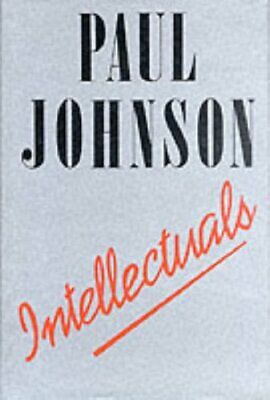
… Johnson is best known to many for his history books, one of the most entertaining being Intellectuals. Published in 1989 and structured as a series of – very critical – biographies of great philosophers, poets, playwrights and novelists, Johnson’s book got to the essence of the intellectual mindset in all its worst aspects: their intense selfishness and narcissism, their callousness towards friends and lovers, and their fondness for giving moral support to some of the worst ideas and regimes in history.
One of the most prominent Catholics in British journalism, Johnson saw secular intellectuals as modern successors to the theologians of the medieval Church, the difference being that, without the restraints of religious institutions, their egotism was uncontrolled.
Writers and artists are often incredibly selfish people, and this is true across the political spectrum, but of course it’s far more satisfying to read about those men who claimed to be the saviour of the poor and humble yet were so relentlessly horrible to actual people around them. That’s what makes the book – published just as the system imagined by one of its subjects came crashing down in eastern Europe – so satisfying.
One of the targets, er, I mean “subjects” of Intellectuals was Jean-Jacques Rousseau, who was quite the piece of work indeed:
It begins with Jean-Jacques Rousseau, the “first of the modern intellectuals” and perhaps the subject of Johnson’s most intense vitriol.
“Older men like Voltaire had started the work of demolishing the altars and enthroning reason,” he wrote: “But Rousseau was the first to combine all the salient characteristics of the modern Promethean: the assertion of his right to reject the existing order in its entirety; confidence in his capacity to refashion it from the bottom in accordance with principles of his own devising belief that this could be achieved by the political process; and, not least, recognition of the huge part instinct, intuition and impulse play in human conduct.
“He believed he had a unique love for humanity and had been endowed with unprecedented gifts and insights to increase its felicity.” He was also an appalling human being.
[…]
Madame Louise d’Épinay, a lover who he treated terribly, said “I still feel moved by the simple and original way in which he recounted his misfortunes”. Another mistress, Madame de Warens, effectively supported him in hard times but, when she fell into destitution, he did nothing to prevent her dying of malnutrition.
Rousseau had a “pseudo-wedding” with his mistress Therese Levasseur where he gave a speech about himself, saying there would be statues erected to him one day and “it will then be no empty honour to have been a friend of Jean-Jacques Rousseau”. He later accused her brother of stealing his 42 fine shirts and when he had guests for dinner she was not allowed to sit down. He praised her as “a simple girl without flirtatiousness”, “timorous and easily dominated”.This easily-dominated woman gave birth to five of his children, whom he had sent to an orphanage where two-thirds of babies died within the first year and just one in 20 reached adulthood, usually becoming beggars. He made almost no attempt to ever track them down, and said having children was “an inconvenience”.
“How could I achieve the tranquillity of mind necessary for my work, my garret filled with domestic cares and the noise of children?” He would have been forced to do degrading work “to all those infamous acts which fill me with such justified horror”.
He was spared that horror and instead given time to develop his ideas, which were fashionable, attractive and completely unworkable. “The fruits of the earth belong to us all, the earth itself to none”, he said, and hoped that “the rich and the privileged would be replaced by the state which reflected the general will”.
What would this mean in practice? “The people making laws for itself cannot be unjust … The general will is always righteous”.
Despite his ideas veering between woeful naivety and sinister authoritarianism, they proved hugely popular, especially with the men and women who in 1789, just a decade after his death, would bring France’s old regime crashing down — with horrific consequences. As Thomas Carlyle famously said of Rousseau’s The Social Contract: “The second edition was bound in the skins of those who had laughed at the first.”
Rousseau was perhaps the most influential figure of the modern era. In particular his rejection of original sin would become far more popular in the late 20th century; indeed it is at the core of what we call the culture war, and its fundamental conflict over human nature.
Comments Off on Paul Johnson on Jean-Jacques Rousseau
I thought the treadmill crane was fictional
Tom Scott
Published 26 Sep 2022The treadwheel crane, or treadmill crane, sounds like something from Astérix or the Flintstones. But at Guédelon in France, not only do they have one: they’re using it to help build their brand new castle.
▪ More about Guédelon: https://www.guedelon.fr/
(more…)
Comments Off on I thought the treadmill crane was fictional
January 14, 2023
Colonial History on the Mississippi River
Scenic Routes to the Past
Published 13 Jan 2023This video explores the surprising traces of French and American colonial history along the 150 miles of Mississippi River between St. Louis and Cairo, Illinois.
(more…)
Comments Off on Colonial History on the Mississippi River


