
Real Time History
Published 7 Apr 2023The Crimean War between the Ottoman Empire and Russia (and later the UK and France) has been called the last crusade and the first modern war at the same time.
(more…)
April 8, 2023
Russia’s Last Crusade – The Crimean War 1853-1856
Comments Off on Russia’s Last Crusade – The Crimean War 1853-1856
April 7, 2023
Manpower shortages in the American Expeditionary Forces (AEF) during WW1
This is an excerpt from Battalion: An Organizational Study of United States Infantry, an unpublished book by the late John Sayen which is being serialized at Bruce Gudmundsson’s Tactical Notebook on Substack. While I haven’t read a lot on the AEF, as I’ve concentrated much more on the Canadian Corps as part of the British Expeditionary Force, I was aware that the American divisions were organized quite differently from either British or French equivalents. The significanly larger division organization — 28,000 men compared to about half that in other allied armies — was intended to give US Army units greater staying power in combat, but it didn’t work out as planned for many reasons:
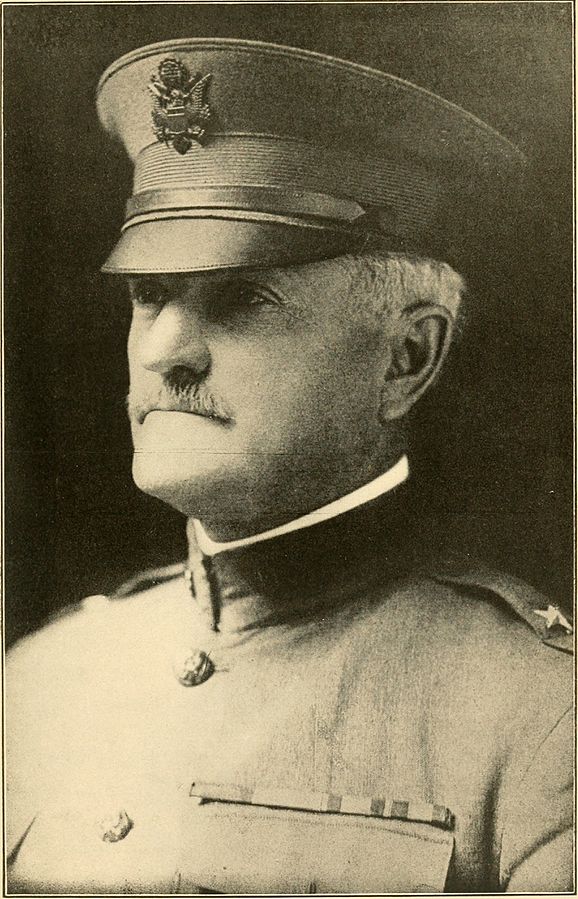
General John J. “Black Jack” Pershing, Commander-in-Chief of the American Expeditionary Forces in France during the First World War.
Image via Wikimedia Commons.
The basic tactical concept behind the square AEF divisions under which the two regiments holding the division’s front line could be relieved by two more regiments to their rear was seriously undermined. The two regiments that were supposed to be resting were the ones that had to man all the work details. When it came time for them to relieve the front-line regiments it was, as historian Allan Millett described it, often a question “of replacing exhausted troops who had suffered casualties with exhausted troops who had not”.
It had certainly not been intended that the infantry serve as labor troops. Such tasks were supposed to have been carried out by separate regiments of pioneers modeled on those used by the French. In the French Army, pioneer regiments were lightly armed infantry serving under corps and army headquarters. They tended to consist of older men and were not the elite assault troops that filled the pioneer platoons in the infantry regiments. Though they could fight when necessary, their main function was to furnish the bulk of the semi-skilled and unskilled labor in the forward areas.
In imitation of this system the War Department raised 37 AEF pioneer regiments. These were organized as AEF infantry regiments without machinegun companies or sapper-bomber, pioneer, or one-pounder gun platoons. Only two of the 29 pioneer regiments to reach France did so before the last three months of the war. One regiment was supposed to go to each army corps and several to each army. However, the AEF pioneers proved to be so badly trained and led (even by AEF standards) that after front line service involving a mere 241 battle casualties most of the pioneers were pulled out of combat to serve as unarmed laborers far to the rear.
It wasn’t just combat casualties that reduced US divisional effectiveness:
Early planning had called for one third of all divisions to serve as replacement depots or field-training units charged with keeping the remaining combat divisions filled with men. The system broke down, however, as heavy losses forced the intended depot divisions to be used as combat units instead. Only six of the 42 AEF divisions to reach France before the Armistice (three more arrived soon afterwards) actually served as replacement or training depots instead of the 14 that were needed.
As an emergency measure, five combat divisions, and later two of the depot divisions, were skeletonized to immediately create urgently needed replacements but, of course, this rendered them useless for either combat or depot duty. Another division had to be fragmented to provide men for rear area support duties and yet another was broken up to flesh out three French divisions. Even in February 1918, (before the AEF had seen serious combat) the four combat divisions in the AEF I Corps were 8,500 men short (mostly in their infantry regiments). The 41st Division, which was the corps’ depot division and charged with supplying those missing men was itself 4,500 men short. By early October 1918, AEF combat units needed 80,000 replacements but only 45,000 were expected before 1 November. At the end of October, the total shortfall had reached 119,690, including 95,303 infantrymen and 8,210 machine gunners. Only 66,490 replacement infantrymen and machine gunners would be available any time soon. For most of the war, AEF combat divisions were typically short by 4,000 men. After August 1918, even divisions fresh from the United States usually needed men. Too many divisions had been organized too quickly.
Of course, the root cause of the manpower problem was even more basic. Men were being used up faster than they could be replaced. The AEF suffered most of its battle casualties between 25 April and 11 November 1918, a period of less than seven months. These combat losses amounted to between 260,000 and 290,000 officers and men, of whom some 53,000 were killed in action or died of their wounds. The rest were wounded or gassed but 85% of these subsequently returned to duty. About 4,500 AEF prisoners of war were repatriated after the Armistice. Five thousand others became victims of “shell shock.” Accidental casualties, including those known to have been caused by “friendly fire” (total friendly fire losses must have been considerable, given the poor state of infantry-artillery coordination), or disease or self-inflicted wounds, far exceeded those sustained in battle.
Two thirds of the more than 125,000 Army and Marine Corps deaths between April 1917 and May 1919 occurred overseas and nearly half (57,000) were from disease. Pneumonia and influenza-pneumonia, which produced the infamous “swine flu” epidemic of 1918, were the chief killers but many victims who became ill before the Armistice did not actually die until after it. Between 14 September and 8 November 1918 some 370,000 cases were reported in the United States alone. Within less than two years between one quarter and one third of the men serving in the US Army had died or became temporarily or permanently disabled by battle, disease, accident, or misconduct. Had such losses continued, the United States might soon have begun to experience the same war weariness and manpower “burnout” that had been plaguing the British, French, and Germans.
With regard to the infantry, the woes of the AEF replacement and training system were much increased by the prevailing belief that because an infantryman needed few technical skills he had little to learn and could be quickly and easily trained from very average human material. Technical arms such as the engineers, signal corps, artillery, and, more significantly, the air corps got the pick of the AEF’s manpower.
The infantry soon became the repository for those deemed unfit for anything better. Many infantrymen saw themselves, and were seen, as cannon fodder. Morale and cohesion were further undermined by the practice of stripping new divisions of men (often before they had even left the United States) to fill older ones. The better men and officers avoided infantry duty to seek less demanding “technical” jobs. Of course, training suffered grievously.
As demands for replacements became more insistent, men who supposedly had received several months’ training were appearing in the front lines not knowing how to load their rifles. Others proved to be recent immigrants who could not speak English. Infantrymen of small physique who might have rendered useful service in non-infantry roles, soon collapsed under the physical burdens placed on them and became liabilities rather than assets. Losses among even good infantry were heavy enough but mediocre infantry melted away at an astonishing rate. Indiscipline, disorganization, and ignorance inevitably increased losses by what must have seemed like a couple of orders of magnitude. These losses were likely to be replaced, if at all, by men of even lower caliber.
Straggling was an especially pernicious problem, which the military police had only limited success in controlling. Even more than actual casualties, it caused some units to simply evaporate. During the Meuse-Argonne offensive, for example, one division reported that it was down to only 1,600 effective men. However, soon after it arrived at a rest area, it reported 8,400 men in its infantry regiments alone.
Comments Off on Manpower shortages in the American Expeditionary Forces (AEF) during WW1
March 25, 2023
Beria’s Reward for Ethnic Cleansing – War Against Humanity 100
World War Two
Published 23 Mar 2023Authoritarian regimes on both sides, in the Soviet Union, Nazi Germany, and Imperialist Japan the terror is once again escalating. The bombing war from both sides see continued death of civilians, while Harris of the RAF, Spaatz of the USAAF, and Supreme Allied Commander Eisenhower are getting into a fight about how the bombers should be used for the upcoming D-Day.
(more…)
Comments Off on Beria’s Reward for Ethnic Cleansing – War Against Humanity 100
March 24, 2023
Operation CARPETBAGGER: French Resistance No4 Enfield
Forgotten Weapons
Published 18 Nov 2022During 1944, the US and UK cooperatively ran a major effort to drop arms and equipment to French Resistance forces in preparation for the Allied landings in France. It began as Operation Carpetbagger with night drops from B24 Liberators in January 1944, and escalated into the summer. Eventually a number of massive daytime drops were made, totally more than 800 sorties and dropping 2.7 million pounds of equipment. The single most common firearm dropped was the MkII Sten, but containers also included Brens, handguns, M1 Carbines, bazookas, and No4 Enfields (along with ammunition).
After the country was liberated, the new government tried to collect up as many of the weapons as possible. They didn’t get them all (not by a long shot, actually), but many were put into government storage, including this No4 Lee Enfield. It was marked with a “PP” property mark and inventory number, and stashed away until being sold as surplus recently and imported by Navy Arms.
(more…)
Comments Off on Operation CARPETBAGGER: French Resistance No4 Enfield
March 16, 2023
History of the Royal Navy – Wooden Walls (1600-1805)
Ryan Doyle
Published 3 Mar 2013
(more…)
Comments Off on History of the Royal Navy – Wooden Walls (1600-1805)
March 13, 2023
1949: HMS Implacable‘s Last Voyage | BBC Television Newsreel | Retro Transport | BBC Archive
BBC Archive
Published 19 Nov 2022HMS Implacable, a 149 year-old ship of the line — which survived the Battle of Trafalgar — embarks on her final, solemn voyage.
The figurehead, deck and stern cabin of this captured French ship are to be kept at the National Maritime Museum in Greenwich, but her hulk is to be towed out from Portsmouth dockyard and scuttled.
Originally broadcast 5 December, 1949.
(more…)
Comments Off on 1949: HMS Implacable‘s Last Voyage | BBC Television Newsreel | Retro Transport | BBC Archive
March 10, 2023
QotD: Wine in French culture
Wine is obviously hugely central to French culture. In 1965 French adults consumed 160 litres per head a year, which perhaps explains their traditionally very high levels of cirrhosis. Despite this, they don’t have the sort of extreme oblivion-seeking alcoholism found in the British Isles. Anglo-Saxon binge drinking is considered uncouth, and the true man of panache and élan instead spends all day mildly sozzled until eventually turning into a grotesque Gérard Depardieu figure. (Although Depardieu’s 14 bottles of wine a day might be on the high side, even for French standards.)
When the French sought to reduce alcohol consumption in the 1950s, the government’s slogan was “No more than a litre of wine a day“, which must have seemed excessively nanny-statish at a time when primary school children were given cider for lunch. Wine consumption has quite drastically fallen in the decades since, by as much as two-thirds by some estimates.
Ed West, “The Frenchest things in the world … Part Deux”, Wrong Side of History, 2022-12-09.
Comments Off on QotD: Wine in French culture
March 7, 2023
“The First Soldier” – Albert Séverin Roche – Sabaton History 118
Sabaton History
Published 6 Mar 2023This song is the story of Albert Roche, who is very much forgotten today, but after the First World War was THE hero of France. He was hotheaded and tempestuous, but above all he was GOOD. His service — and his legend from that war — is just remarkable, and today we share the war stories of the First Soldier of France.
(more…)
Comments Off on “The First Soldier” – Albert Séverin Roche – Sabaton History 118
March 1, 2023
School Lunch from the Great Depression
Tasting History with Max Miller
Published 28 Feb 2023
(more…)
Comments Off on School Lunch from the Great Depression
February 25, 2023
Rise of Franco – The Spanish Rif War 1921-1926
The Great War
Published 24 Feb 2023The Rif War between Spain and the Rif Republic gave rise to a young Spanish officer named Francisco Franco — who later would become Spanish dictator. After Spain had almost lost the war against the Rifi people, they got help from France and WW1 hero Philippe Pétain.
(more…)
Comments Off on Rise of Franco – The Spanish Rif War 1921-1926
February 24, 2023
Up Close and Personal – Mountain Warfare in Italy – WW2 Special
World War Two
Published 23 Feb 2023Thanks to Curiosity Stream for sponsoring today’s video
Even as the Allied and Axis commanders focus on the sweeping warfare of the Eastern Front and the planning for the invasion of Europe, their men continue to fight a grinding war of attrition high in the Italian mountains. It’s a war of merciless terrain, brutal close-quarters combat, and vast quantities of artillery and bombs. They may be playing second fiddle, but the soldiers on the Italian front will never forget these battles.
(more…)
Comments Off on Up Close and Personal – Mountain Warfare in Italy – WW2 Special
February 22, 2023
Mosquito Bombers Bust Out French Resistance – War Against Humanity 098
World War Two
Published 21 Feb 2023Across Europe the anti-Nazi Resistance continues to rise as does the infighting. In France the RAF carry out Operation Jericho to break out captured resistance members held at the prison in Amiens.
(more…)
Comments Off on Mosquito Bombers Bust Out French Resistance – War Against Humanity 098
February 17, 2023
Spy ballooning has a remarkably long history (that’s clearly still ongoing)
In The Line, Scott Van Wynsberghe outlines the history of balloons in wartime and (as many are now aware from recent events) in peacetime:
China’s balloon spying is shocking on so many levels that you can take your pick. There is the ultra-flagrant violation of foreign sovereignty, the stunningly surreal air of denial exhibited by Beijing, and the fearful sense that something in the world order just lurched. There is also puzzlement: what, balloon spying is still a thing? Indeed it is, and its centuries-long history is instructive as to what China is now doing. It also makes clear that the U.S. is no innocent victim here but rather a past offender with a cleaned-up act.
Among the first major studies of aerial reconnaissance was a book brought out by military author Glenn B. Infield way back in 1970. In a way, Infield was charting unknown territory. When he addressed balloons in particular, he traced their use in spying to the many wars associated with the French Revolutionary and Napoleonic eras. In 1794, he related, the French military officer Jean-Marie-Joseph Countelle made an ascent at the city of Maubeuge in order to monitor enemy forces in the area. In the process, Countelle became the first balloon spy.
As technology improved, other firsts followed. By the 1850s, cameras were mounted on French military balloons. In the 1860s, during the American Civil War, Union forces battling the Confederacy used balloons trailing telegraphic wires, which transmitted immediate updates from the balloonists. Yet technology cut both ways. By the early 1900s, balloons had a nemesis in sight, in the form of winged and powered aircraft.
The inevitable showdown occurred in the First World War, and it was ugly. Large numbers of observation balloons were used by all sides in the conflict, and WWI historian Denis Winter claims the Germans alone deployed 170 of them in France by 1917. Typically, such balloons were tethered in place near the frontline, floating at several thousand feet, with telephone wires dangling to the ground. Although they seemed vulnerable, they were actually protected from below by anti-aircraft units, which blasted at any enemy plane that got too close. However, the reverse was also true, with balloons themselves being fired at from the ground. By 1915, says aviation writer Ralph Barker, the British were losing at least a dozen balloons a month from all forms of enemy action. Those balloonists who were not shot to pieces often had to bail out, putting their faith in parachutes that did not always work. (Horrified onlookers called them “balloonatics.”) The fighter pilots responsible for much of this mayhem — which they called “balloon-busting” — may not have had an easy time, but some of them scored heavily, with one Frenchman named Coiffard tallying 28 balloons. Although observation balloons managed to make it to the end of the war, it was a near-run thing. According to author Linda Hervieux, nobody after the war was talking about repeating that experience in any future fighting.
[…]
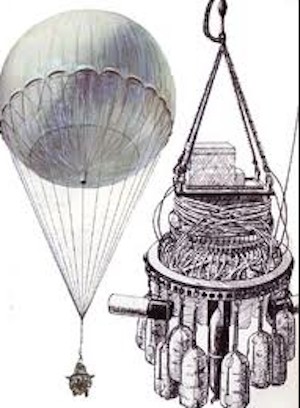
Once the Second World War was underway, some propaganda leafleting did occur, but secret balloon activity seemed to be at a low level. That was very misleading, because one of the tensest moments in ballooning history was playing out in the background, but it occurred amid so much security that the entire tale took years to emerge. In 1944, Japan launched the first of over 9,000 bomb-rigged balloons across the Pacific. Robert C. Mikesh, in a comprehensive 1973 monograph issued by the Smithsonian Institution, noted that almost a thousand of the balloons may have reached North America, but the true number is unknowable, because so many came down in remote wilderness. (One was found by forestry workers in British Columbia as late as 2014.) Mikesh tabulated 285 known incidents, ranging from Alaska all the way south to Baja California and as far inland as Manitoba. Both the U.S. and Canada clamped down hard on any news about the balloons, for fear of providing Tokyo valuable feedback about the results of the campaign. (In other words, balloon counterintelligence became a priority.) In general, the balloons did not cause a lot of harm, but one of them slaughtered six people in Oregon in 1945. By a strange fluke, one of the few groups in the U.S. that knew the full story of the balloons was an element of the Black community. The all-Black 555th Parachute Infantry Battalion was sent to the U.S. West to handle emergencies caused by the balloons.
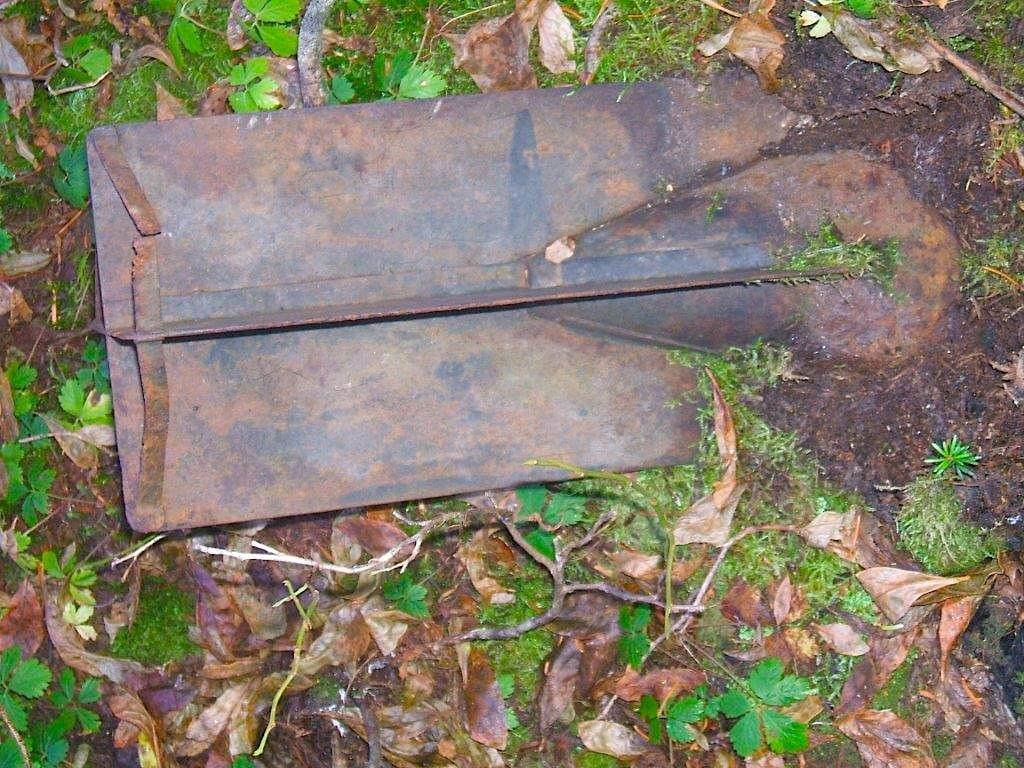
The remains of a Japanese balloon bomb found in the Monashee Mountains near Lumby, BC in 2014. It was detonated on-site by the bomb disposal unit of Maritime Forces Pacific of the Royal Canadian Navy.
There is a strong temptation to blame the Japanese balloon bombs for what happened next, because the U.S. unaccountably entered the Cold War as the most pugnacious exponent of clandestine ballooning up to that time. Whatever the explanation, the epic struggle between the United States and the Union of Soviet Socialist Republics plunged U.S. ballooning into a tangle of psychological warfare, shadowy science, under-the-table finances, and clandestine belligerence indistinguishable from military attacks. Plus, UFOs and breakfast foods were involved (seriously).
Comments Off on Spy ballooning has a remarkably long history (that’s clearly still ongoing)
February 12, 2023
German Desperation in Korsun Pocket – Week 233 – February 11, 1944
World War Two
Published 11 Feb 2023It is crisis mode in the Korsun Pocket this week for the Axis troops surrounded, but they are also losing ground all over the Eastern Front this week, including the big prize of Nikopol. In Italy, it is a different story as the Germans play offense at Anzio, though with only small gains.
(more…)
Comments Off on German Desperation in Korsun Pocket – Week 233 – February 11, 1944
February 11, 2023
Napoleon’s Downfall: Why He Lost the Battle of Nations
Real Time History
Published 10 Feb 2023After the brief summer 1813 cease fire, Napoleon’s campaign in Germany resumes. Surrounded by the Allies — which also manage to slowly turn the tide at Großbeeren, Dennewitz, Kulm, and Dresden — his only remaining option is the ultimate battle which takes place in October 1813 at Leipzig: The Battle of Nations.
(more…)
Comments Off on Napoleon’s Downfall: Why He Lost the Battle of Nations


