
World War Two
Published 21 May 2023Robert Capa has gone down in history as one the most groundbreaking war correspondents in all of journalism. His account of what happened on D-Day was something we wanted to share with all of you.
(more…)
May 22, 2023
What Happened Behind a Photographer’s Lens on D-Day
May 21, 2023
The Fall of Monte Cassino – WW2 – Week 247 – May 20, 1944
World War Two
Published 20 May 2023In Italy, the Allies finally overcome Monte Cassino and break through the Gustav Line; in Burma Merrill’s Marauders surprise the Japanese and take Myitkyina Airfield; in China, it’s the Japanese who are playing offense, as Operation Ichi Go and the siege of Luoyang continue. That’s the field action, but there’s big planning behind the scenes for major June offensives going on by both the Western Allies and the Soviets.
(more…)
Comments Off on The Fall of Monte Cassino – WW2 – Week 247 – May 20, 1944
May 17, 2023
QotD: How do you say “Catch-22” en français?
Jean-François has two hectares of vines in our valley in South-West France: his family have been making wine here on this hard limestone soil for more than half a century. And yet, he would like nothing more than to grub up his vineyards. If you ask him why, he looks skywards, and then, with hands as gnarled as his vines, pulls out the lining of his coat-pocket. Vide. Empty.
The nectar of the gods, French wines have a reputation for being cultivated in a sun-kissed vineyard surrounding a honey-stoned chateau, owned by a Hollywood star like Leonardo DiCaprio, or a Gallic aristo whose family escaped the guillotine. Jean-François is neither. And he is not the only vigneron who is struggling. Things are far from rosé for France’s small winemakers, as two hundred militants made clear outside the Prefecture in Bordeaux one Thursday last month. They follow the thousand who protested in the city last December, when vignerons hung a human effigy outside the doors of the Bordeaux Wine Council, to raise awareness for grape-growers at risk of suicide. “Every day there is a suicide in agriculture,” Didier Cousiney, president of the Viti 33 collective informed the crowd.
In the Bordeaux area alone, 500 vignerons are looking in the bottom of the glass and seeing financial ruin. And you can add to these the growers nearing retirement who cannot find buyers for their vineyards. Like Jean-François. In the Medoc, land prices are actually sinking.
Jean-François would like to simply abandon his vines. He cannot, because it is illegal. Abandoned vines are vectors for disease, which can spread to other vineyards. Vines must be either cultivated or grubbed up. But grubbing costs €2,000 per hectare, money Jean-François does not have.
Crisis in the French wine industry affects more than viticulteurs. In France, wine is not merely a drink: it’s a national symbol, the liquid affirmation of l’Art de vivre à la française. If you opened the arteries of Marianne, you would find them coursing with a Bordeaux Appellations d’Origine Contrôlée, the official certification for wine grown in the geographical region and made with requisite skill. Until 1981, French children were allowed to drink wine in school. So, when the wine industry turns sour, France’s identity suffers a hangover.
As does its income. Wine is France’s second biggest export after aircraft, worth about €15 billion a year according to the Fédération des Exportateurs de Vins et Spiritueux de France (FEVS).
What’s going wrong in the vineyards of La Belle France? Jean-François’s eloquent gestures indicate some of the causes. Doubtless French winegrowers have been complaining about the weather since the Gauls planted the first native vines in the fifth century BC. But in the last five years, the weather has lurched from one Biblical extreme to another. We’ve had drought, which did for my own few vines last year; we’ve had flooding; we’ve had hailstorms. A late frost in April 2021 affected 80% of the nation’s vineyards.
Such was the desperation of viticulteurs then that vineyards were heated overnight with candles and paraffin heaters, to keep the frost off the delicate buds of the fruit. The sight of the vineyards of Bordeaux, the sacred centre of the French wine industry, lit by geometrically exact lines of candlelight was magnificent, but the image ultimately came to symbolise the powerlessness of humans in the face of Mother Nature. After le gel historique, there were few climate change deniers in Bordeaux’s vineyards. According to the European Environmental Agency, France is suffering the biggest economic losses caused by climate change of any country in the world. The Hexagon took a hit of €4.2 billion in 2020 due to climate change.
John Lewis-Stempel, “The bourgeois war on French wine”, UnHerd, 2023-02-01.
Comments Off on QotD: How do you say “Catch-22” en français?
May 14, 2023
Victory at Sevastopol! – WW2 – Week 246 – May 13, 1944
World War Two
Published 13 May 2023The Soviets push the Axis out of the Crimea this week once and for all. In Italy, the Allies launch a major offensive, and the French make a breakthrough there by week’s end. In China, the Japanese are aiming at Luoyang, but in India at Kohima they’re slowly being pushed back.
(more…)
Comments Off on Victory at Sevastopol! – WW2 – Week 246 – May 13, 1944
Arming God’s Battalions: a Papal States Rolling Block
Forgotten Weapons
Published 13 Feb 2023The Remington Rolling Block was a very popular rifle in the 1860s and 1870s, and probably would have been a better choice than the Trapdoor Springfield for the US military. But among the nations that did adopt is were the Papal States. While Vatican City is a tiny sovereign enclave today in Rome, in the 1800s the Pope directly controlled a much larger area, roughly the size of Switzerland early in the 1800s.
Three different models of Rolling Block were adopted by the Papal States in the effort to rebuild their military after a serious defeat in 1860 — rifles, carbines, and musketoons — the latter being what we have today. All three were made by the Nagant Brothers in Liege and can be identified by the Papal crest (the crossed keys of St Peter) on the top of the barrel. Westley Richards in the UK also produced 5,000 rolling block rifles, but these had serious quality problems.
The Nagant Brothers rifles began to arrive in the fall of 1868. They saw service for only a few years, as the departure of French forces in the fall of 1870 (to take part in the Franco-Prussian War) allowed the Italian Army to seize Vatican City without much difficulty. A few survived in the hands of the Pope’s personal guard, but most of these rolling blocks were taken into Italian Army service. They would serve until being replaced by Vetterli rifles, and were eventually sent to Ethiopia as military aid to Emperor Menelik II in the 1880s.
(more…)
Comments Off on Arming God’s Battalions: a Papal States Rolling Block
May 7, 2023
Total Chaos on the Chinese Front! – WW2 – Week 245 – May 6, 1944
World War Two
Published 6 May 2023A command crisis in the Chinese Nationalist Army benefits the Japanese invaders, in Italy, Mark Clark spends his birthday planning new offensives, the Japanese are pushing for Imphal, and the Soviets for Sevastopol — another busy week of the war!
(more…)
Comments Off on Total Chaos on the Chinese Front! – WW2 – Week 245 – May 6, 1944
April 29, 2023
What Was the Deadliest Day of the First World War?
The Great War
Published 28 Apr 2023What was the deadliest day of any nation in WW1? There are multiple candidates for that, but why should we even care? Well, the answer to this question highlights a challenge with popular memory that is often focused on the biggest battles of the war like the Somme or Verdun.
(more…)
Comments Off on What Was the Deadliest Day of the First World War?
April 22, 2023
The action off Pula Aura, February 1804
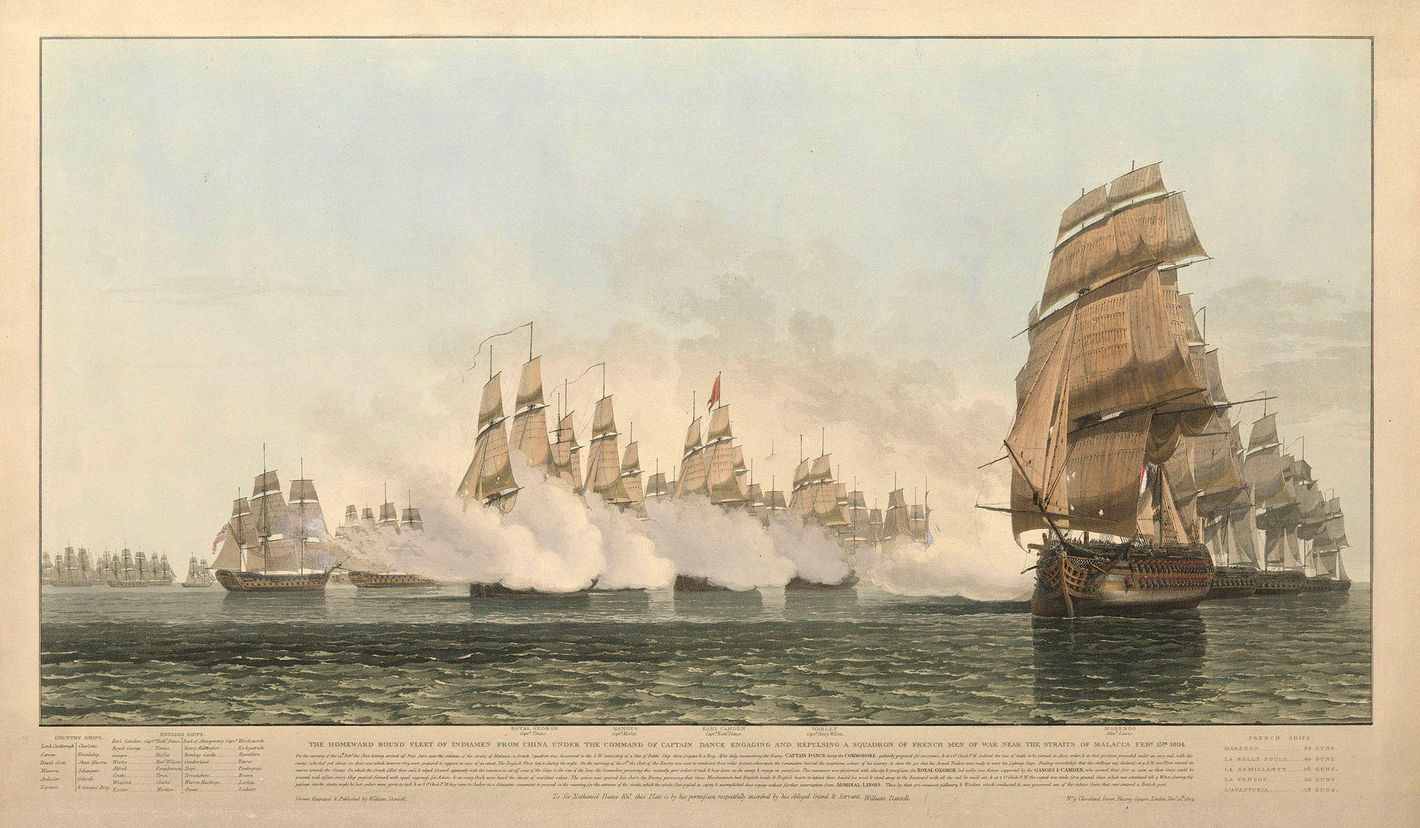
Ned Donovan recounts a very dangerous moment for the British East India Company — and the larger British economy — as a French naval squadron threatened the EIC’s China Fleet carrying a cargo that would be the rough equivalent of £750 million in today’s money:
It will not be surprising to any reader that the East India Company was arrogant. A company that, as William Dalrymple describes, had become “an empire within an empire”. It controlled much of India, had its own army, and its revenues kept Britain afloat. Its navy was also not to be sniffed at, made up of large, well-built ships (known as Indiamen) capable of being as armed as any British warship, but its commercial arrogance prevented this. Rather than fill these Indiamen with cannons and the hundreds of sailors needed to man them, it instead filled its gun ports with dummy cannons and its decks with luxurious cabins and storage for trade goods, maintaining crews only large enough to sail these ships and be stewards to its paying passengers.
Commodore Dance would have been pondering those dummy cannons as the ships he had sent to look at the four strange sail in the southwest reported back that it was four French warships, Linois’s squadron. He was practically defenceless. To protect his 30 ships and their precious cargo, he had one small armed brig named the Ganges with around a dozen guns. Up against him were the 186 guns of the French squadron, 74 in Marengo, 40 in Belle Poule, 36 in Semillante, 20 in Berceau and 16 in Aventurier. As Dance watched through his telescope, the French ships hoisted their colours, and the admiral’s flag of Linois broke out above Marengo. He needed a plan. Fast.
The lead East Indiamen challenge Admiral Linois
After a night of cat and mouse between the French and British, Dance ordered his convoy into a long single line and at the front put four of the largest Indiamen – the Royal George, Earl Camden, Warley, and Alfred. He then commanded that these four hoist blue ensigns, the sign of Royal Navy ships. This wasn’t the most absurd plan; the East India Company, in their arrogance, had a policy of painting their Indiamen to look like Royal Navy ships – as Dance records in his despatch: “We hoisted our colours and offered him battle.” But Linois and his ships continued to approach the convoy slowly, with Dance realising that the French intended to separate the convoy and take it apart piece by piece. It was now or never, and Dance took the initiative. At 1 pm, he ordered the Ganges, Royal George, Earl Camden, Warley and Alfred to turn and intercept the French. All the ships turned perfectly and crossed Linois, and at 1:15 pm, the French opened fire on the Royal George. In the preceding night, the convoy had put all the guns they had on these five ships and filled them with as many brave volunteers as they could. All five returned fire on the French warships, and one sailor on the Royal George was killed. I will let Dance take over here:
“But before any other ship could get into action, the enemy hauled their wind and stood away to the east under all the sail they could set. At 2 pm, I made the signal for a general chase and we pursued them until 4 pm.”
In around 40 minutes, Dance and his handful of real guns and dummy cannons had forced the French warships to withdraw under the belief it had engaged an elite squadron of Royal Navy ships. Not content with this victory, he then ordered his ships to chase the French down and stop them from returning. By the later afternoon, it was clear Linois had run, and Dance ordered his convoy to regroup and make for the safety of Malacca.
In the Straits of Malacca, Dance met the ships the Royal Navy had sent to escort him on the outbreak of war but would have been too late had the commodore not thought fast. The China Fleet passed the rest of its voyage without incident, returning to Britain in the summer of 1804.
To say the country was ecstatic would be an understatement. If the China Fleet and its £8 million had been taken, as Linois would have been perfectly able to do, it is evident that both the East India Company and Lloyds of London would have faced bankruptcy and collapse. Nathaniel Dance was knighted by George III and given a fantastic sword by Lloyds worth 100 guineas. With the sword came £5,000 (£403,000 today) from the Bombay Insurance Company and £500 a year (£40,000 today) from the East India Company, along with a share in the £50,000 given to all who sailed in convoy. Sir Nathaniel retired immediately and never took to the sea again, dying peacefully in 1827.
Poor Admiral Linois, on the other hand, never lived down the fracas, with Napoleon writing after the event, “[Linois] has shown want of courage of mind, that kind of courage which I consider the highest quality in a leader”. Despite that, Linois remained in the French navy … only to once again run into the fickleness of fate:
It is worth remarking that following the defeat at Pulo Aura, Linois had a similarly pathetic rest of the war that ended in a wonderfully ironic way. In 1806, the admiral was captured when he mistook a British squadron of warships for a merchant convoy.
Irony? That’s cosmic level stuff.
Comments Off on The action off Pula Aura, February 1804
April 21, 2023
Localism versus centralism
Theophilus Chilton offers some support to localism as an antidote to the centralization of powers we’ve seen in every western nation since the early “nation state” era at the end of the Middle Ages:
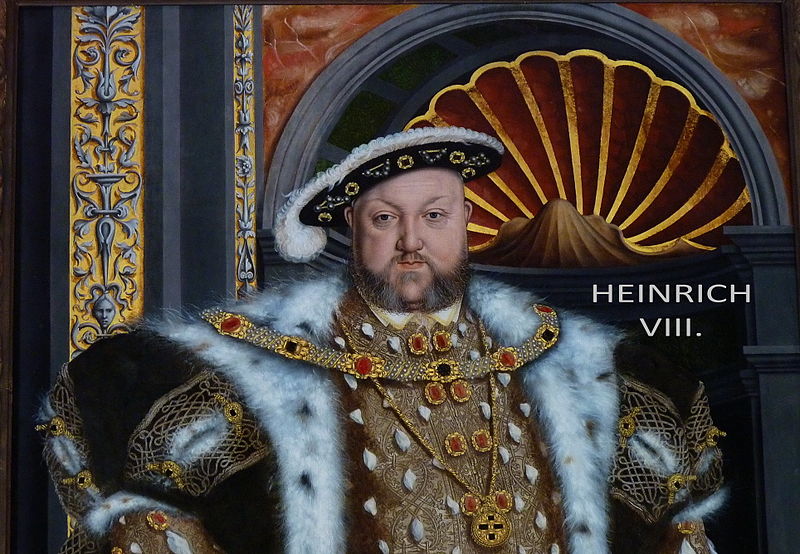
Cropped image of a Hans Holbein the Younger portrait of King Henry VIII at Petworth House.
Photo by Hans Bernhard via Wikimedia Commons.
The history of the West has, among other things, included a long, drawn-out conflict between two functional organizing principles – localism and centralization. The former involves the devolution of power to more narrowly defined provincial, parochial centers, while the later involves the concentration of power into the hands of an absolutist system. The tendency toward centralization began as far back as the high Middle Ages, during which the English and French monarchies began the reduction of aristocratic privileges and local divisions and the folding of this power into the rising bureaucratic state with a permanently established capital city and rapacious desire for provincial monies and personnel. The trend towards the development of absolute monarchy continued through the Baroque period, and the replacement of divinely-sanctioned kingship with popular forms of government (republicanism, democracy, communism) did not abate the process, but merely redirected power into different hands. The ultimate form of centralization, not yet come to pass, would be the sort of borderless one-world government desired by today’s globalists, whether they be neoconservatives or neoliberals, which would involve the ultimate consolidation of all power everywhere into one or a few hands in some place like Geneva or New York City.
[…]
The historical transition from localism to centralization in medieval Europe was seen in the decline of aristocratic rights and the institution of peer kingship, and their replacement with consolidated administrative control over a much larger and generally contiguous geographic area. This control was manifested in the person of the absolute monarch, and was exercised through an impersonal, disinterested bureaucratic apparatus which came to demand a greater and greater share of the national wealth to cover its expenses. This process, I believe, can ultimately be traced back to the strengthening of English and French royal power beginning in the 13th century, especially under Philip IV of France. Its fruition came (while monarchy still exercised effectual power in Europe) in the 17th-18th centuries before being undermined by Enlightenment and democratic dogmas which merely transferred the centralizing power to demagogues claiming to speak “for the people.”
Under the old aristocratic system, executive power formed a distributed system and rested on local nobility ruling over a local population with whom they were knowledgeable and on generally good terms. Despite the jaundiced modern view that feudalism was always “tyrannical” and “oppressive,” the fact is that most aristocrats in that era were genuinely devoted to the welfare of the commoners in their land, and it was the responsibility of the nobility to dispense justice and to right wrongs. The picture presented in Kipling’s poem “Norman and Saxon” most likely serves as a fair reflection of the relationship between lord and commoner. Kingship certainly existed, but the king was viewed as a “first among equals”, one who was the prime lord over his vassals, but who could also himself be a vassal of other kings of equal power and authority (as many of the earlier Plantagenet kings were to the Kings of France, by virtue of their holding fiefs as Dukes of Aquitaine).
False impressions about the role of the aristocracy generally correlate with false impressions about serfdom, the dominant labor relationship of the time. Contrary to popular notions, serfdom was generally not some cruel form of slavery that destroyed human dignity. Indeed, many serfs had liberties approach those of freemen, could transfer allegiances between nobles, enjoyed dozens of feast days (which were effectively vacation days to be devoted to family and community), and could even take themselves off to one of the many free cities which existed and be reasonably sure of not being compelled to return to their former master unless their case was especially egregious.
However, under centralization, the nobility was generally reduced to being ornaments of the royal court, their judicial and administrative functions removed and replaced by a bureaucracy personally loyal to the king. This, in effect, served to remove opportunities for serfs and other commoners to “get away” from the rule of a bad king. Whereas before, a serf could at least hope for the opportunity to flee a bad ruler and seek shelter with a good one, under the uniform rule of the absolute monarch, this was no longer an option unless the commoner wished to flee his entire nation and culture completely. Likewise, the ever-increasing regulation of his daily life by the bureaucracy followed him everywhere he went. By the end of the period, the centralization of power and the rise of crony capitalism led to the destruction of serfdom and the rise of wage capitalism, acting to reduce serfs and freemen alike to the status of cogs in profit-generating machines. The rise of absolute monarchy, part and parcel with the appearance of bureaucracy and the professionalization of military power, led directly to the rise of the modern managerial state.
Comments Off on Localism versus centralism
April 16, 2023
Raising the minimum retirement age may be necessary, but it will never be politically popular
As protests and riots continue against the French government’s attempt to raise the minimum retirement age from 62 to 64, Theodore Dalrymple explains why he finds sympathy with the working poor who will be most directly hurt by the change:
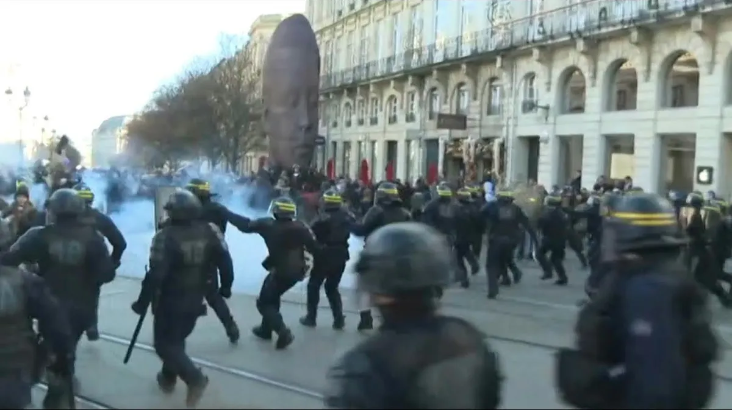
Riot police on the streets of Bordeaux as violent protests against French government plans to raise the retirement age continue.
YouTube screen capture from an AFP report.
As I hope to be able to work till my dying day, I am perhaps not the right person to animadvert on the present disturbances in France about the raising of the retirement age from 62 to 64. My work has always been pleasing to me, and it remains so; I even manage to delude myself sometimes that it is important.
I am forced to recognize, however, that not everyone is in the same happy position as I. I am sure that if I had been a dustman all my life, I should not hope to be emptying dustbins at my present age (73), let alone at the age of 85. While my work remains work, and in a certain sense occasionally even hard work, especially when I have to think, what I do is not physically demanding. No one ever got arthritis or fibrosis of the lung by writing a few articles.
The reform of the pension system in France, from my limited understanding of it, is rather unfair. It is true that some reform is necessary: There are ever fewer workers to fund the pensions of ever more pensioners (the system being entirely unfunded by investment). On the other hand, it is those who do the most unpleasant and unremunerative jobs who have to work the longest, and the reform only increases this unfairness. As the old cockney song has it, it’s the rich what gets the pleasure.
Nevertheless, the extreme opposition to the reform, which is hardly a radical one, strikes most foreigners as rather strange. In a way it is also sad, for it implies that a long retirement is the main aim of all that precedes it, which in turn implies that all the work done for several decades before retirement has been an unpleasant imposition rather than something of value in itself. That the quid pro quo for a longer life expectancy is a greater number of years spent working seems not to strike anyone with force.
The demonstrators probably think, no doubt correctly, that the reform is the thin end of a wedge: If it is allowed to pass without a fuss, there will be further such reforms until the retirement age will be 70, 80, or never, depending on life expectancy. As for the younger demonstrators, they do not seem to worry much that it is they who will be paying for the people older than themselves to retire early, the distant prospect of early retirement being more real to them than the far more proximate high rates of taxation.
Comments Off on Raising the minimum retirement age may be necessary, but it will never be politically popular
Do Foucault and Derrida deserve the blame for PoMo excesses?
In Spiked, Patrick West says that it’s a misunderstanding of Foucault and Derrida to blame them for the rise of wokeness:

Michel Foucault speaking at the Hospital das Clínicas of the State University of Guanabara in Brazil, 1974.
Public domain image from the Arquivo Nacional Collection via Wikimedia Commons.
It has become common to blame wokeness on its supposed philosophical parent: postmodernism. As the standard narrative goes, postmodernism is the ideology that entrenched itself in Anglophone universities in the 1980s and 1990s. It talked of relativism, of the absence of objective truth, of the spectre of a pervasive, invisible power, and it was generally anti-Western. A whole generation of professors, writers, journalists and a fair few activists have subsequently been raised on this diet of postmodern thinking. And the result is a cultural elite that is wedded to wokeness.
[…]
For these critics of woke, Foucault’s influence, in particular, is seemingly everywhere. According to [Douglas] Murray [in The War on The West], it’s through the “anti-colonial” philosophy popularised by the Foucault-inspired scholar, Edward Said, that Foucault and therefore postmodernism have filtered down into woke philosophy, which holds that Western society is uniquely racist and to blame for all of today’s ills. Equally, right-wing critics of wokeness will claim that the trans movement has sprung from the postmodern contention that sexuality and gender are entirely socially constructed and therefore plastic and malleable.
If Foucault is regarded as the father of wokeness then 19th-century philosopher Friedrich Nietzsche tends to be regarded as the grandfather. After all, Foucault was profoundly influenced by Nietzsche and even proudly declared himself to be “Nietzchean”. Nietzsche, like Foucault, also saw all human behaviour stemming from the desire for power. And he conceived of morality – good and evil, right and wrong – as the mere manifestation of the will to power. As he wrote of the “origin of knowledge”, in The Joyous Science (1883): “Gradually, the human brain became full of such judgements and convictions, and a ferment, a struggle, and lust for power developed in this tangle. Not only utility and delight but every kind of impulse took sides in this fight about ‘truths’.” One can see this Nietzschean sentiment at work in Foucault’s Discipline and Punish (1975): “Power produces knowledge … power and knowledge directly imply one another.”
So, according to this largely right-wing narrative, wokeness is the product of a 20th-century philosophical assault on truth, objectivity and the West. And it was inspired by Nietzsche and led by several “cultural Marxist” thinkers.
There are several problems with this rather neat story. The first error is to use the phrase “cultural Marxism” to talk of postmodernism or wokeness. This term doesn’t really make sense. Marx himself conceived of his work as a historical materialism. It was focussed on class and the means of production, not on culture. Yes, in the 1940s and 1950s, some Frankfurt School thinkers, who sometimes presented themselves as Marxist, did focus on culture rather than class. But as Joanna Williams writes in How Woke Won (2022), their thinking “represented less a continuation of Marxism and more a break with Marx”.
Moreover, postmodern thinkers were broadly opposed to Marxism. Many may have been signed-up Communists in their youth (the French Communist Party dominated left-wing politics at the time), but by the 1960s they had become highly critical of Marxist politics. They rejected the idea that history was progressing “dialectically” towards a communist future, or “telos”. And they were often hostile to the scientific objectivity and “Enlightenment” values so central to Marxism. Foucault wrote that history was not the story of progress; it was but a series of non-linear discontinuities and contingencies. And Jean-François Lyotard (1924-1998), in his highly-influential The Postmodern Condition (1979), announced and celebrated the end of “grand narratives”, and with it the end of the Marxist “grand narrative” of progress. Lyotard’s writings from the 1970s onwards were violently antithetical to Marxism, especially its claims to objective truth.
As for wokeness itself, it has nothing to do with Marxism. With their myopic focus on race and gender, woke activists are utterly blind to the material, class-structure of society. Today, bizarrely, it’s often conservatives who are more attuned to the plight of the working class than woke “radicals”. As Williams writes, “critics who insist that woke is simply Marxism in disguise are wide of the mark”.
Comments Off on Do Foucault and Derrida deserve the blame for PoMo excesses?
April 12, 2023
French Onion Soup from 1651
Tasting History with Max Miller
Published 11 Apr 2023
(more…)
Comments Off on French Onion Soup from 1651
April 11, 2023
LeMat Centerfire Pistol and Carbine
Forgotten Weapons
Published 27 Nov 2014Colonel LeMat is best known for his 9-shot muzzleloading .42 caliber revolver with its 20 gauge shot barrel acting as cylinder axis pin — several thousand of these revolvers were imported and used in the field by Confederate officers during the US Civil War (and modern reproductions are available as well). What are less well-known are the pinfire and centerfire versions of LeMat’s revolver, and the carbine variants as well.
In this video I’m taking a look at a centerfire LeMat revolver and a centerfire LeMat carbine, both extremely rare guns. They use the same basic principles as the early muzzleloading guns, but look quite different. In these guns, the shotgun remains 20 gauge but uses a self-contained shell loaded from the rear, and the 9 rifles shots are designed for an 11mm (.44 caliber) cartridge very similar to that used in the French 1873 service revolver.
(more…)
Comments Off on LeMat Centerfire Pistol and Carbine
April 10, 2023
The Crimean Naval War at Sea – Battleships, Bombardments and the Black Sea
Drachinifel
Published 5 Apr 2023Today we take a look at most of the naval theaters of the Crimean War on conjunction with the fine people @realtimehistory find their video here: Last Crusade or F…
(more…)
Comments Off on The Crimean Naval War at Sea – Battleships, Bombardments and the Black Sea
April 9, 2023
USMC units in the American Expeditionary Forces (AEF) in France
Another interesting excerpt from John Sayen’s Battalion: An Organizational Study of United States Infantry currently being serialized on Bruce Gudmundsson’s Tactical Notebook discusses the role of the US Marine Corps on the Western Front as part of Pershing’s AEF:
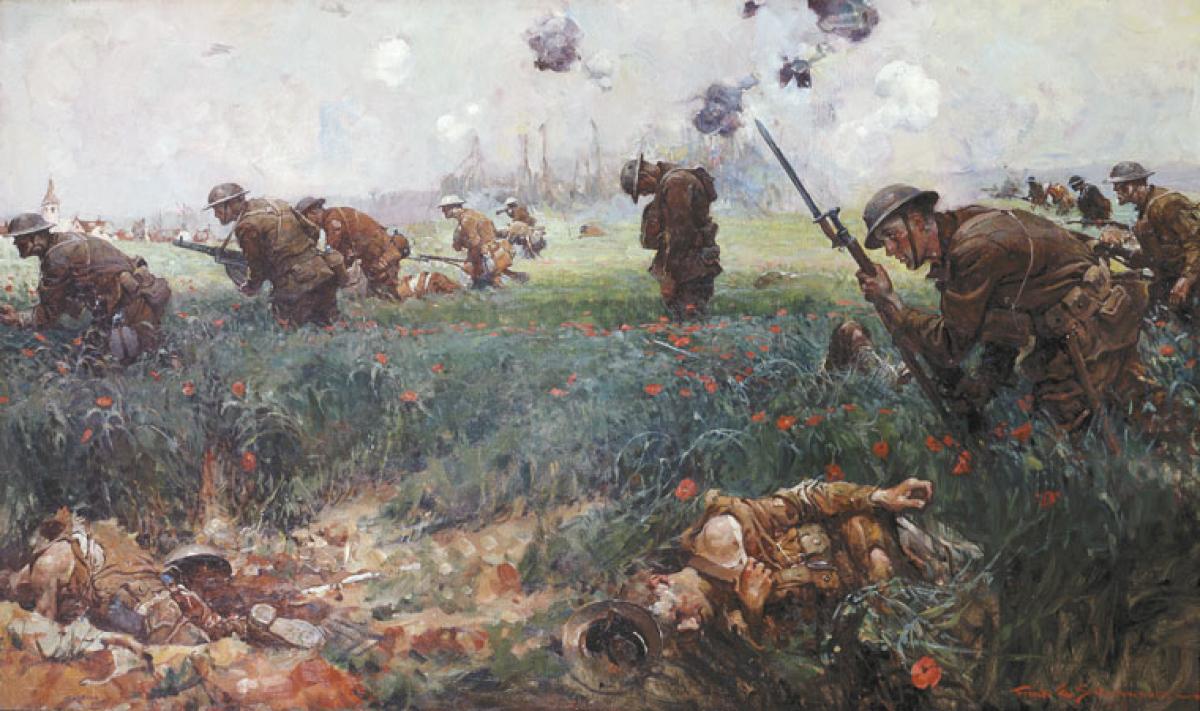
“How Twenty Marines Took Bouresches” by Frank E. Schoonover.
Originally published in the Ladies’ Home Journal Vol. 24 No. 1, via Wikimedia Commons
The Fifth Regiment arrived in France in July 1917. Being the fifth regiment of a four-regiment division, it soon found itself relegated to the sidelines and stuck with all the odd jobs such as providing military police details, couriers, and guards. Correctly reasoning that a larger unit would not be so easily pigeonholed, General Barnett [the Marine Corps Commandant] in October 1917 augmented the Fifth Regiment with the newly formed Sixth Regiment and Sixth Machinegun Battalion. The whole force constituted the AEF Fourth Brigade, or half the infantry of the AEF 2nd Division.*
Although the organization of the Fourth Brigade’s infantry regiments was supposed to be the same as that of all the other AEF infantry regiments, it did in fact differ in some details (see Appendix 2.6). Every Marine rifle and machinegun company had two additional sergeants to serve as gas NCOs and the Marines added gas officers to each battalion headquarters. Whether this helped reduce the number of gas casualties is unclear.
Marine enlisted men also tended to be given higher ranks than their Army counterparts. In a Marine regiment a platoon sergeant was not just the senior sergeant in a platoon, he was a gunnery sergeant, ranking as an Army sergeant first class (a rank that the Army awarded only to specialists) and well above a sergeant. Sergeants commanded all four sections in a Marine rifle platoon and this allowed an additional sergeant per half-platoon. The rifle section included two men trained equipped as snipers (enough for one sniper per half-platoon). Two more snipers were in company headquarters. Since 1887 when test results had exposed their poor marksmanship, the Marines had made rifle shooting into even more of a fetish than it had been in the Army. In contrast to the many soldiers sent into battle without even having fired their rifles, no Marine was even allowed overseas if he had not qualified as an expert rifleman or sharpshooter.
To give extra promotion, pay, and recognition (but not leadership responsibility) to the best shots the Marines introduced the rank of corporal (technical). The rank was also given to mechanics, horseshoers, saddlers, teamsters, and five senior operators in the telephone section of the regimental signal platoon to reward technical proficiency. However, despite their important but difficult and thankless duties, Marine cooks only ranked as privates.
[…]
The Marine AEF regiments differed from their Army counterparts in more than just structural details. They had a huge advantage in manpower quality. Except for about 7,100 draftees accepted during the war’s last weeks, the nearly 79,000 Marines who served in the war were all volunteers. About one sixth of these men had joined prior to the war. This was several times the Army’s percentage of pre-war men, even if those who had only National Guard service are included. Many Marine wartime volunteers were college men and included a lot of athletes.
The large number of officer-quality enlisted men persuaded General Barnett to direct on 4 June 1917 that, in future, all officers be appointed from the ranks. This move had the strong backing of Secretary Daniels who favored the practice of commissioning enlisted men. Such a system would be more in line with what the Germans and French were doing. Even the college men would have to have several months’ enlisted service before they could hope for a commission. By then their leadership potential could be properly evaluated. In addition, many pre-war enlisted men of greater age and experience but less education and growth potential could also become officers. Better still, the Marines were mostly infantry. Unlike the Army, they had few service or technical positions into which their best and brightest could be drained. Instead of getting the dregs, Marine infantry regiments got all the best officers and men. They were always kept at full strength with fully trained replacements, despite heavy casualties.**
The high quality men that the Marines were able to contribute to the AEF provoked a good deal of jealousy within the Army in general and from General Pershing in particular. The latter praised the Marines in private but refused to do so in public. Although Pershing had accepted the Fourth Marine Brigade into the AEF, he rebuffed every offer to send Marine artillery to France. The presence of both Marine infantry and artillery in France would have paved the way for the formation of a Marine AEF division. That would have given the Marines much more publicity at Army expense.
Late in the war Pershing relented enough to accept another Marine infantry brigade, the Fifth, which reached France in September 1918. However, although nearly all these Marines had qualified as expert marksmen, he employed them in menial jobs in the rear areas. At the same time, Pershing was rushing thousands of untrained Army recruits into front line combat where they were routinely and needlessly slaughtered.***
* Major David N. Buckner USMC, A Brief History of the Tenth Marines (Washington DC, Historical Div. HQMC; 1981) pp. 16-17.
** Heinl pp. 191-228; and J. Robert Moskin, The Story of the U.S. Marine Corps (New York, Paddington Press Ltd. 1979) pp. 138-139; LtGen William K. Jones USMC(Ret) A Brief History of the 6th Marines (Washington DC, History and Museum Div. HQMC 1987) p 1.
*** Heinl pp. 194-195 and 208-210; Allan R. Millett, Bullard op cit p. 321.
Comments Off on USMC units in the American Expeditionary Forces (AEF) in France


