
World War Two
Published 12 Jan 2023While the Soviet Union declared they will annex parts of Poland, the Western Allies fear that the broken French Resistance may ruin the plans for D-Day.
(more…)
January 13, 2023
Is the French Resistance Defeated by 1944? – War Against Humanity 095
Comments Off on Is the French Resistance Defeated by 1944? – War Against Humanity 095
January 11, 2023
Repurposing Obsolete Rifles: The Lebel R35 Carbine
Forgotten Weapons
Published 19 Dec 2017The French military had investigated the possibility of a Lebel carbine in the 1880s, but by the 1930s a different set of priorities was in place. In an effort to make some use of the vast stockpiles of obsolete Lebel rifles France had, a plan was put in place to shorten then into carbines for auxiliary troops like artillery crews and engineers. These men needed some sort of rifle or carbine, but they did not need the best and newest weapons. By giving them shortened Lebel carbines, it would free up more modern rifles like the M34 Berthiers in 7.5mm and the new MAS-36 rifles to go to the front line infantry who needed them most.
The R35 conversion was developed by the Tulle arsenal and adopted in January of 1936. The French government ordered 100,000 to be made, and deliveries began in April of 1937. Production would accelerate and continue right up to the spring of 1940, with a total of about 45,000 being actually delivered before the armistice with Germany. The conversions were all assembled at Tulle, but four other factories manufactured barrels for them: Chatellerault (MAC), St Etienne (MAS), Société Alsacienne de Constructions Mécaniques (SACM), and Manufacture d’Armes de Paris (MAP). These barrels were 450mm long (17.7 inches), and with the similarly shortened magazine tube, the R35 carbines held just 3 rounds. Production would not continue after the liberation of France in 1944.
(more…)
Comments Off on Repurposing Obsolete Rifles: The Lebel R35 Carbine
January 7, 2023
Converting the Lebel to 7.5mm: The M27 Lebel
Forgotten Weapons
Published 12 Dec 2017In the aftermath of World War One, the French military instituted a plan to introduce a completely new roster of small arms. This would begin with the development of a modern rimless rifle cartridge, which was adopted in 1924. With the new cartridge in hand, programs were begun to develop a light machine gun, bolt action rifle, and semiautomatic rifle using it. To supplement these new arms — especially during their development and production — plans were also made to convert existing 8mm rifles to the new cartridge.
The two rifles in large supply, of course, were the Lebel and the Berthier. The St Etienne arsenal was tasked with developing a Berthier conversion (this would become the M34 Berthier), and the Tulle arsenal was assigned to do the same with the Lebel. The first prototype was ready for testing in 1927. That first example was not satisfactory, and iterative development would continue into the early 1930s. Ultimately, the Lebel conversion was simply not as well liked by troops or as effective as the M34 Berthier, and so the Berthier was chosen for mass production. A total of about 1500 Lebel M27 conversions would be made by 1940, in a wide variety of configurations including different barrel lengths, rifling patterns, and optics mounting setups. While this did not result in a successful production rifle, it would inform the development of the MAS-36, and not go to waste. In addition, a number of M27 rifles would be converted into pressure testing guns to assist in ammunition development.
(more…)
Comments Off on Converting the Lebel to 7.5mm: The M27 Lebel
January 4, 2023
The First Modern Military Rifle: The Modele 1886 Lebel
Forgotten Weapons
Published 5 Dec 2017The Lebel was a truly groundbreaking development in military small arms, being the first rifle to use smokeless powder. This gave it — and in turn the French infantry — a massive advantage in range over everyone else in the world at the time. This advantage was short-lived, but the French did their best to exploit it.
French chemist Paul Vielle successfully developed his smokeless powder (“poudre B“) formula in 1884, and French ordnance spent 1885 experimenting with different calibers of small bore bullet to see what would work best. They also began looking at rifle actions to use, including specifically the Remington-Lee and the Mannlicher. However, a new Minister of War was appointed in January of 1886 and he demanded a completed prototype rifle and ammunition be completed by May 1886. This was a nearly impossibly short deadline to meet, and it meant that the Ordnance officers could not possibly develop a wholly new rifle, and instead would have to modify something already in the inventory.
The only suitable option was the Model 1884/5, a combination of the Gras bolt and Kropatschek tube magazine. The new smokeless cartridge was made by simply necking down the 11mm Gras round, and the 1884 rifle was given a new barrel in 8mm and a new dual-locking-lug bolt head to accommodate the high chamber pressure of the new powder. The result was the Lebel, and it was formally accepted in April 1887 after a relatively short period of testing. The weapon may not have been used the most advanced elements, but it was without any doubt the foremost military rifle in the world at the time, by a substantial margin.
The three main French state arsenals of St Etienne, Chatellerault, and Tulle would all tool up to produce the Lebel, and by the end of 1892 approximately 2.8 million had been produced, enough to equip the entire Army. The rifle would remain in service as France’s primary infantry rifle until World War One, would be declared obsolete in 1920, and remain in inventory and in use until the end of World War Two.
(more…)
Comments Off on The First Modern Military Rifle: The Modele 1886 Lebel
December 19, 2022
Napoleon’s Downfall: German Wars of Liberation 1813
Real Time History
Published 16 Dec 2022After Napoleon’s defeat in Russia in 1812, the situation on the European continent is rapidly shifting. Prussia and Austria are leaving their unhappy alliance with the French. Prussian general Yorck even pledges his support to the Russian Army which is on the move towards Berlin. At Lützen and Bautzen Napoleon still manages to beat the new coalition, but his losses from Russia put him on the backfoot.
(more…)
Comments Off on Napoleon’s Downfall: German Wars of Liberation 1813
December 18, 2022
Belgian GP-35: Pre-War Browning High Power Complete Rig
Forgotten Weapons
Published 17 Aug 2022The Browning High Power (“Grande Puissance“, aka GP-35) was developed by Fabrique National in Belgium, designed primarily by John Browning’s apprentice Dieudonné Saive. It began in the very early 1920s as a pistol designed for a new French Army requirement, but eventually split into two separate development tracks. By the early 1930s the French procurement process was still ongoing, but FN felt that the current iteration of their pistol (the Grand Rendement) was sufficiently mature to be a viable military sidearm. They began offering it for sale, and the Belgian Army quickly took an interest. One thousand were purchased for Belgian field trials in 1933, and with a few minor changes it was adopted by Belgium as the GP-35 in 1935.
The first guns are delivered in May of 1935, and the first troops to receive them were troops like machine gun crews, tank crews, messengers and other men who needed a weapon, but not a full-length rifle. By 1938 enough have been delivered that the specialty troops and NCOs have been fully equipped, and guns begin to go to officers, replacing things like the FN Model 1900. By the time of the German invasion in May 1940, some 30,000 — 35,000 High Powers had been delivered to the Belgian Army. In addition to this, several other military contracts were made by FN, selling the pistol to Estonia, Lithuania, Paraguay, China, and Finland. However, the Belgian orders account for the significant majority of all pre-war made High Powers.
Note that in the US, original pre-war High Powers with original stocks, 500-meter tangent sights, and serial numbers below 47,000 (no prefix) are exempted from the NFA, and are not legally considered short-barreled rifles.
(more…)
Comments Off on Belgian GP-35: Pre-War Browning High Power Complete Rig
December 14, 2022
The Polish Armed Forces in Exile
World War Two
Published 13 Dec 2022The Polish state was the first to fall in this war, yet across the globe Polish soldiers are fighting on land, air, and sea as part of the United Nations alliance. The story of the tens of thousands of men and women fighting for Polish liberation is equal parts hope and hardship as they battle the enemy and even sometimes their own allies.
(more…)
Comments Off on The Polish Armed Forces in Exile
December 12, 2022
Before the High Power was the FN Grand Rendement
Forgotten Weapons
Published 8 Aug 2022The Browning High Power story begins with a French 1921 request for a new military pistol. FN engineer Dieudonné Saive developed a double stack, single feed magazine and John Browning adapted a Browning 1903 pistol to use it, and this was sent to France for consideration. This pistol worked well enough, but the French trials board requested changes … and they would continue requesting changes and more trials for the next decade.
By 1931, FN felt that the current iteration of the pistol — while still not meeting all the French requirements — was good enough to stand on its own as a service pistol for the Belgian Army and other clients. They named it the “Grand Rendement” (High Efficiency) and began marketing it. The Belgian Army showed a definite interest, and bought 1,000 pistols for field trials, based on the prototype example we have in today’s video. These would become the Grande Puissance, aka the High Power.
For more details on this and other FN Browning pistols, I highly recommend Anthony Vanderlinden’s FN Browning Pistols, soon to be released in its third edition:
Comments Off on Before the High Power was the FN Grand Rendement
December 10, 2022
Ed West finds nice-ish things to say about the French
It’s actually part two, which I’m sure would astonish many a Brit:
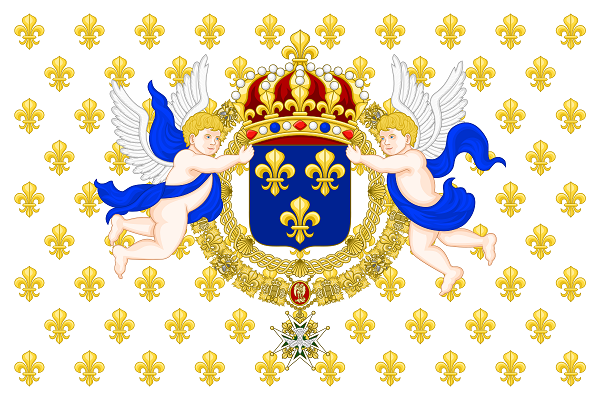
The Royal Standard of the King of France (and by default, the national flag), used between 1638 and 1790.
Wikimedia Commons.
“When, after their victory at Salamis, the generals of the various Greek states voted the prizes for distinguished individual merit, each assigned the first place of excellence to himself, but they all concurred in giving their second votes to Themistocles,” wrote the great 19th-century historian Edward Creasy. “This was looked on as a decisive proof that Themistocles ought to be ranked first of all. If we were to endeavour, by a similar test, to ascertain which European nation has contributed the most to the progress of European civilization, we should find Italy, Germany, England, and Spain, each claiming the first degree, but each also naming France as clearly next in merit. It is impossible to deny her paramount importance in history.”
France is central to the story of Europe, and indeed of Britain. It is almost impossible to understand England’s history without appreciating the relationship with its closest continental neighbour. It is a love-hate affair originating in a grand inferiority complex, a long rivalry that continues tomorrow [Saturday] when England meet France in the World Cup quarter-finals.
In a piece last year I cited some of the most endearing/maddening things about the French, all of which contributed to a sense of amused frustration on our part:
Only in France would football fans protest that a local restaurant had lost a Michelin Star, as happened in Lyon two years ago. Only in France would an expedition to the Himalayas — of huge national importance — fail because it was weighed down by eight tonnes of supplies, including 36 bottles of champagne and “countless” tins of foie gras. And only in France would you get actual wine terrorists, the Comité Régional d’Action Viticole, who have bombed shops, wineries and other things responsible for importing foreign produce. This is a country which only reluctantly in the 1950s stopped giving school children a nutritious drink for their health, by which the French meant not milk but cider.
This is a country where mistresses are so much part of life that they can legally inherit, and where murder doesn’t really count if it’s done for love. One of France’s most famous socialites, Henriette Caillaux, shot dead the editor of Le Figaro just before the First World War and received just four months in jail because it was a crime passionnel. So that’s all right then.
But there are so many other things to love about our strange neighbours …
The Anglo-French relationship is a difficult one, reflected in the troubled history of royal marriages. Charles I’s Catholic wife Henrietta Maria was a drag on his popularity among excitable Protestant radicals, and turned out to be the last French consort; in the 14th century Edward II’s wife Isabella overthrew him and, perhaps, conspired to have him killed, after a rocky marriage that began badly when he brought his lover to the coronation and acted inappropriately affectionate towards him. But then, as Edith Cresson pointed out, this is to be expected when you marry an Englishman.
In 1514 Louis XII married an English bride, Henry VIII’s sister Mary; she was 18, he was 53, and had syphilis, so she must have been delighted about the whole thing; however, within weeks she had “danced him to death”, the sex apparently proving too exciting for his nervous system. Francesco Vettori, Florence’s ambassador to Rome, wrote that King Louis had a lady “so young, so beautiful and so swift that she had ridden him right out of the world”.
***
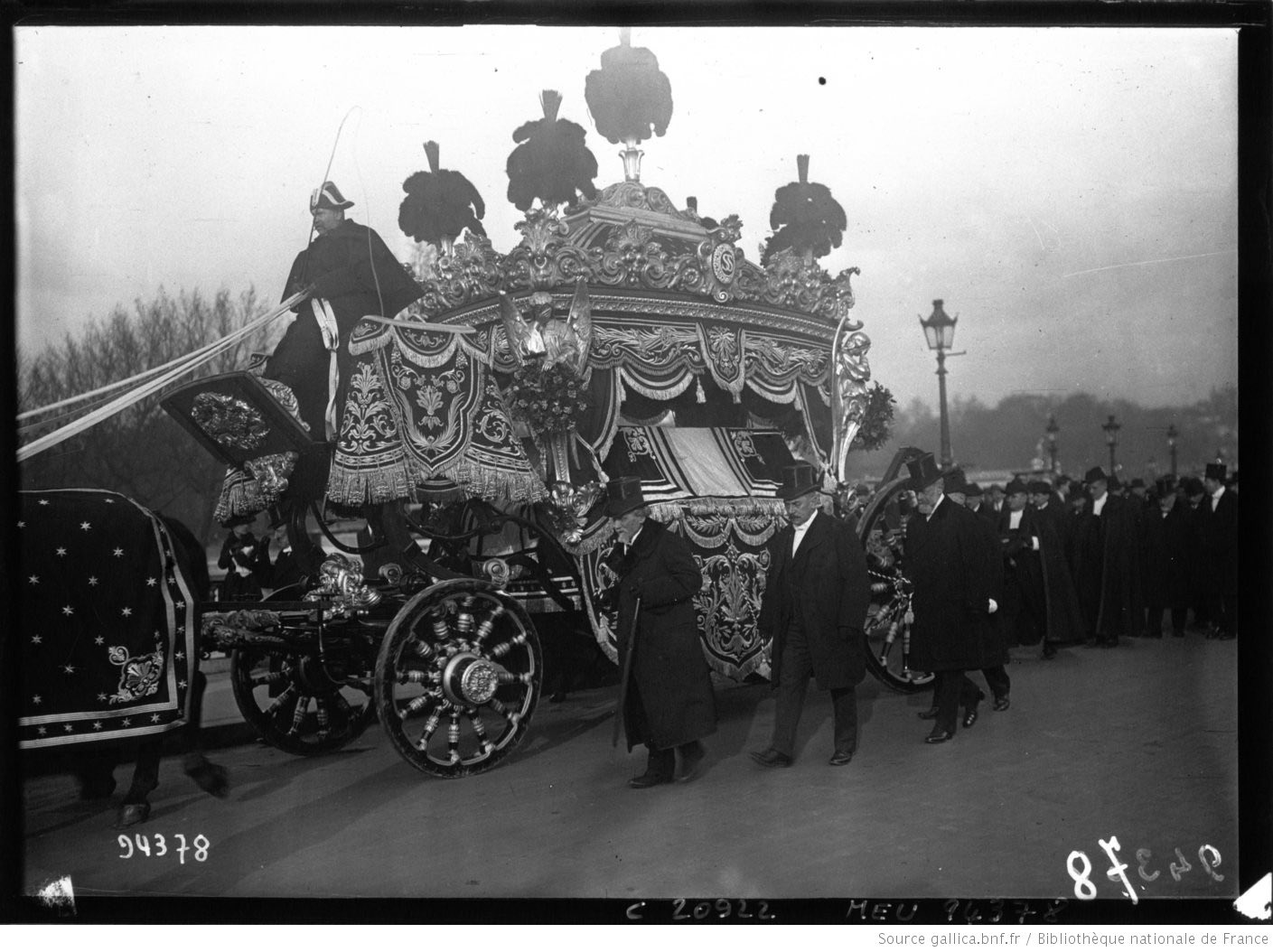
Perhaps not a terrible way for a Frenchman to go, and not the last French head of state to die in a similar manner. President Félix Faure expired in 1899 while with his mistress, after which his funeral featured this very understated carriage.
***
Numerous French presidents have had affairs, although Francois Mitterrand actually had a secret second family while in the Élysée Palace. Mitterrand’s last meal was also ultra-French: “He’d eaten oysters and foie gras and capon — all in copious quantities — the succulent, tender, sweet tastes flooding his parched mouth. And then there was the meal’s ultimate course: a small, yellow-throated songbird that was illegal to eat. Rare and seductive, the bird — ortolan — supposedly represented the French soul. And this old man, this ravenous president, had taken it whole — wings, feet, liver, heart. Swallowed it, bones and all. Consumed it beneath a white cloth so that God Himself couldn’t witness the barbaric act.”
***
The French are world outliers in their attitudes to adultery, the only country where a majority of people think it’s fine. Germany is number two in this index of permissiveness while the Americans, of course, are the most disapproving western nation.
Comments Off on Ed West finds nice-ish things to say about the French
December 7, 2022
The Marie Antoinette Diet
Tasting History with Max Miller
Published 6 Dec 2022
(more…)
Comments Off on The Marie Antoinette Diet
December 3, 2022
“The Valley of Death” – The Battles of Doiran – Sabaton History 115
Sabaton History
Published 1 Dec 2022The Bulgarian defenses in the Lake Doiran region were pretty much the best defenses any country had anywhere in the Great War, which the Entente forces discovered as they tried time and again and failed time and again — to break the front.
(more…)
Comments Off on “The Valley of Death” – The Battles of Doiran – Sabaton History 115
November 30, 2022
The St Etienne Mle 1907: France’s Domestic Heavy Machine Gun
Forgotten Weapons
Published 19 Oct 2017When the French first began testing machine guns in the late 1890s, they were one of the few countries that did not purchase quantities of Maxim guns. One of the reasons was that in France’s North African colonies, transporting water for guns was considered an unnecessary liability. Instead, France purchased a number of air-cooled Hotchkiss machine guns for its colonial forces. For the French Metropolitan Army, it wanted a gun designed and produced by its own arsenal system. And so, the Puteaux Arsenal developed the Modele 1905 gun.
This was a gas-trap style of action, pulling an operating rod forward with each shot. The gun was adopted and put into service, and as with every other military user of gas trap guns, the French quickly found the system to be seriously flawed. The St Etienne Arsenal set about improving it, and came up with the Modele 1907, which retained the forward-moving operating rod but used a gas piston instead of a gas trap. This would be the machine gun which France would enter World War One with, and more than 40,000 would be manufactured by 1917.
The Modele 1907 St Etienne gun is a magnificently Victorian machine gun, with a downright Swiss-like rack-and-pinion system running its action. It would have been truly at home on a Napoleonic battlefield — but not a World War One battlefield. The gun was not well-suited to the muddy hell of trench warfare, despite its beautiful machining and quality. Looking for both a lot more guns and also a more field-reliable system, the French began buying a great many Modele 1914 Hotchkiss machine guns, and they would replace the Modele 1907 by the end of the war.
One cannot fault the French for this change, and yet it still seems sad to see such a gorgeous piece of metal fabrication be sidelined — complete with its hydraulically adjustable rate of fire, its fine toothed feed spool, its sights with the spring and lever system to accommodate heat-induced change of aim and its magnificently extravagant flash hider.
(more…)
Comments Off on The St Etienne Mle 1907: France’s Domestic Heavy Machine Gun
November 29, 2022
In a dangerous and insecure world, the EU appears to feel that the greatest enemy is on the other side of the Atlantic
CDR Salamander on how the EU’s movers and shakers (i.e., mostly not democratically elected leaders) seem to have decided that their one true enemy is the United States:
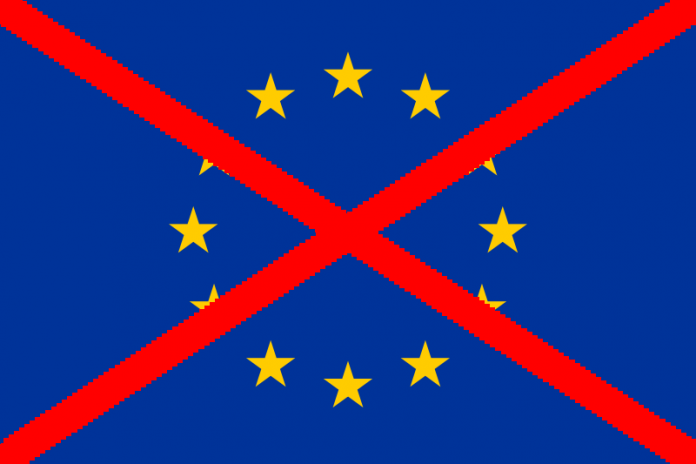
If you are an American who lived on the European Continent, specifically Western Europe, you’re very familiar with an exceptionally sharp strain of anti-Americanism that resides in a significant percentage of their ruling elite – an adult version of the middle school mean girls. Though present in all nations to one degree to another, it is especially acute in Germany and France for slightly different reasons but are all working towards the same goal; degrade American influence in Europe.
The best way for this political and corporate anti-Americanism to find a lever of power is through the the trans-national and anti-democratic modern iteration of the European Union – made even more problematic with the departure of Great Britain who once played a balancing role between the Continental powers as she has for centuries.
Why primarily France and Germany? To start with, this is part of the sibling rivalry between the children of Charlemagne for primacy in Europe that has churned Europe over the last thousand years. The Anglo-Saxons on both sides of the Atlantic kept getting in the way of their return to the struggle.
Their armies under various blood-soaked leaders moved across Iberia to Moscow and back for centuries in order to be THE driver of power in influence on the continent. The European Union, once the “trade association” nose was in the tent, is now seen – fairly – as a mechanism to centralize power so The Smartest People in the Room™ no longer have pesky minor powers and – Buddha forgive – voters getting in their way. Without checks, power only seeks more power for itself. The morphing of the EU is just the latest example.
Not unlike their American counterparts who would like the USA to extract itself from foreign entanglements (NB: as I have written through the years, I am sympathetic/supportive of these efforts), many of the strongest proponents of the EU just want the USA to go home.
The Europeans, while benefiting from the WWII/Cold War leftover presence of the USA, want it to end and the influence that comes with it. If any opportunity to push back against the USA appears, they have their talking points ready to dirty up the reputation and standing of the USA. If that can be done while blaming Eurocrat failures on the USA as well, even better.
You know the Americans, citizens of that mongrel nation whose gene pool is full of religious zealots, failed revolutionaries, slaves, economic refugees, grasping second sons, criminals, and their descendants – spoiled with a continent overflowing with food, water, minerals, forests and open land they don’t even appreciate.
Loud. Fat. Pushy. Americans.
The usual snarled insults cobbled together by smug people who get much of their opinions of the USA by reading The Washington Post or The New York Times. “I know America, I read your newspapers.” That is right after, “I’ve been to America. I spent a week in DC/NYC/Boston/Chicago. I studied a semester at Brown.”
[…]
The smaller European nations don’t trust France and Germany all that much, for good historical reasons. Most of the Europeans in the “new territories” in the east like the USA. They see the Americans as a more reliable guarantee of safety from hostile powers in the East, having a few centuries of experience of the Western European Frankish tribes carving them up for fun and profit – irrespective of local desires. Collectively these nations are not that large in GDP or population – not much more than Italy (for now), but that’s OK. They have the correct geography.
If we shape this relationship correctly, we don’t have to permanently garrison this part of Europe. Poland is already establishing a new paradigm of proper levels of security investment. Once NATO’s eastern front calms down a bit, we can rotate through forces for exercises and training. Perhaps even create some combined training and logistics bases ready to scale up in case of trouble in Mordor. A template we should have put in place in Western Europe decades ago.
Reward positive behavior and let the French and Germans continue their millennium-length struggle – peaceful this time – in the west; keep them frothing in Brussels and Strasbourg while the forward-looking nations try to set up the next thousand years of Western progress in a positive direction.
Perhaps.
Comments Off on In a dangerous and insecure world, the EU appears to feel that the greatest enemy is on the other side of the Atlantic
November 28, 2022
Mulberry Harbours – Rhinos, Whales, Beetles, Phoenixs and Spuds against the Axis
Drachinifel
Published 13 Jul 2022Today we take a look at the artificial harbours designed, built and then installed on the Normandy beaches in 1944.
Many thanks to @Think Defence for finding and collating so many images and letting me use them! Follow them on Twitter or on their website for more interesting articles!
(more…)
Comments Off on Mulberry Harbours – Rhinos, Whales, Beetles, Phoenixs and Spuds against the Axis


