
Overly Sarcastic Productions
Published 22 Jul 2022Colonial-era North America was a busy place, so let’s take a quick look through some of the major players from the perspective of the lands & cities they inhabited.
SOURCES & Further Reading: Lectures from The Great Courses: “1759 Quebec – Battle For North America” from The Decisive Battles of World History by Gregory Aldrete, “The American Revolution” from Foundations of Western Civilization II by Robert Bucholz, “North American Peoples and Tribes” from Big History of Civilizations by Craig Benjamin, “The Iroquois and Algonquians Before Contact” from Ancient Civilizations of North America by Edwin Barnhart, “Iroquoia and Wendake in the 1600s”, “Indian-European Encounters 1700-1750”, “The Seven Years War in Indian Country” and “The American Revolution Through Native Eyes” from Native Peoples of North America by Daniel M. Cobb, Britannica articles “New York” & “Boston” https://www.britannica.com/place/New-… & https://www.britannica.com/place/Bost…
(more…)
November 21, 2022
City Minutes: Colonial America
November 20, 2022
QotD: The Maginot Line worked
Frontier fortifications and army bases often make a degree of intuitive sense, either aimed at controlling crossings over an entire border or protecting a military force in the field. Point defenses like walled cities or castles (or defensive systems that don’t cover the entirety of a frontier) often make less sense to modern readers and students, invariably leading to the famous misquotation of George S. Patton that, “Fixed fortifications are a monument to the stupidity of man” – what he actually said was “This [the Maginot Line] is a first class case of man’s monument to stupidity“, a comment on a particular set of fortifications rather than a general statement about them and one, it must be noted, made in 1944, four years after those fortifications were taken so we also ought not credit Patton here with any great foresight.
As an aside, the purpose of the Maginot Line was to channel any attack at France through the Low Countries where it could be met head on with the flanks of the French defense anchored on the line to the right and the channel to the left. At this purpose, it succeeded; the failure was that the French army proceeded to lose the battle in the field. It was not the fixed fortifications, but the maneuvering field army which failed in its mission. One can argue that the French under-invested in that field army (though I’d argue the problem was as much doctrine than investment), but you can’t argue that the Maginot Line didn’t accomplish its goals – the problem is that those goals didn’t lead to victory.
Bret Devereaux, “Collections: Fortification, Part III: Castling”, A Collection of Unmitigated Pedantry, 2021-12-10.
November 15, 2022
Look at Life — Moving Day (1967)
PauliosVids
Published 20 Nov 2018How the headquarters of NATO was moved from France to Belgium.
November 14, 2022
Two Variants of the French RSC 1917 Semiauto WW1 Rifle
Forgotten Weapons
Published 2 Apr 2017The RSC 1917, aka FSA1917, has the distinction of being the only true semiautomatic service rifle to see significant frontline infantry use during World War One. It was introduced in 1917 as a long rifle, and about 75,000 were made in that configuration. An improved carbine model was developed in in 1918 right at the end of the war, with only a few thousand of those made. However, what we are looking at today are a pair of 1917 rifles which show a couple of differences.
One of these is a standard RSC 1917 as originally produced, and the other has been updated to a 1918 standard in two ways: the bolt handle/disassembly and the bolt holdopen mechanism. I do not know if these changes were actually implemented during the war, or in the years afterward, but they make the rifles substantially easier to field strip.
If you know of details relevant to these changes, please let me know in the comments!
(more…)
October 29, 2022
Your Thoughts on Our D-Day Coverage So Far – WW2 – Reading Comments
Updated with re-uploaded video, 3 Nov 2022. The original video was taken down within a few hours. This is the same video less one short rant that Indy reconsidered and has chosen to omit.
World War Two
Published 28 Oct 2022Indy and Sparty pick out some of the best, most interesting, and even controversial comments by you under our videos. Stay for the PJs.
(more…)
The Absinthe Murder
Tasting History with Max Miller
Published 28 Jun 2022
(more…)
October 24, 2022
QotD: When the “Grand Tour” gave way to the mere “tourists”
Smith’s most celebrated panorama relived his ascent of Mont Blanc in 1851 — which had been an astonishing physical feat for a clubbable bon viveur (though he had to be dragged to the summit barely conscious, he claimed to have celebrated by drinking a bottle of champagne and smoking a cigar). He pulled out all the stops to recreate Mont Blanc on the stage of the Egyptian Hall, Piccadilly in 1852, importing woodcarvers from Chamonix to recreate a Swiss chalet. St Bernards roamed the aisles and during the interval hot baked potatoes were dispensed for those in the audience feeling a glacial chill from the buckets of cold water placed around the hall. The stage was decked with alpine plants; there was a waterfall with real water, a mill wheel and a lily pond; the walls of the theatre were hung with chamois skins. “The Ascent of Mont Blanc” ran for six years and 2,000 performances, and on top of the fortune he made in ticket sales, Smith cannily expanded his repertoire by selling colouring books, fans, board games and miniature models of Mont Blanc.
Smith, an unrepentant populist (he liked to shock Thackeray by saying that Shakespeare was “all rot”), knocked the high culture out of the touristic experience. He made the adventure of foreign parts bite-sized and accessible — if not in reality, at least in dreams. He called it “the Alps in a box”. Figuratively speaking, Smith’s panoramas boxed up the great sights of the classical Grand Tour and sold them in miniature form, building them up with a dramatic flourish then cutting them down to size with a knowing dig in the ribs. Smith’s success runs parallel with the emergence of photography, the industrial manufacture of souvenirs, and the “I was here” frame of the postcard. After Smith, it became possible to think of “buying” the travel experience without actually going very far, framing it, and taking it home with you. Antiquarian high-culturists looked for quiddity and oddity when abroad but Smith encouraged a joyful appetite for mass-produced kitsch. His own apartment off Tottenham Court was a riot of knick-knackery from his travels. There was a figure of a Swiss peasant with a clock-face in his waistcoat, Venetian glasses, miniature Swiss chalets, soap from Vienna in the shape of fruit and a working model of a guillotine.
The tourist boom in Chamonix inspired by Smith was viewed with horror by those who thought the mountain were theirs to command. Ruskin found the “white leprosy of hotels” and souvenir shops that followed the visitors into the Alps was a blasphemy against “all the deep and sacred sensations of nature”. Everywhere the new tourists went, reported a journalist in 1856, they brought with them “Cockneyism, Albert Smithery, fun, frolic and vulgarity”. The rise in popular tourism to Europe, sparked most importantly by Thomas Cook, had highlighted a divide which has characterised British travelling ever since. In this paradigm, the tourist is the new bug and the traveller is the old soul. And even when they are gazing at the same view, the latter thinks the former is spoiling the view. The distaste is notable in how often crowds of tourists were, and still are, described in terms of mindless cattle or insects — they come in “herds” and “swarms” and “flocks”.
Lucy Lethbridge, “The snobbery of Brits abroad”, UnHerd, 2022-07-12.
October 21, 2022
Britain’s Royal Spy – WW2 – Spies & Ties 24
World War Two
Published 20 Oct 2022SOE agents come from all walks of life but very few can claim to be royalty. Few except Noor Inayat Khan. She’s been sent as a radio operator to France, arriving right in the middle of a German crackdown on the resistance. Now she is the sole link between London and Paris.
(more…)
October 20, 2022
French C6 Long-Recoil Prototype Semiauto Rifle
Forgotten Weapons
Published 18 Nov 2016France began working on developing military self-loading rifles virtually as soon as the 1886 Lebel was adopted, and they would pursue a pretty elaborate series of trials right up to World War I. One series was developed by Etienne Meunier at the Artillery Technical Section using gas operated mechanisms, and designated the A series. The B series was the work of M. Rossignol at the Musketry School, using mostly direct gas impingement systems. The C series was designed by Louis Chauchat and M. Sutter at the Puteaux Arsenal, and these were long-recoil actions. Trials commenced in 1911 and 1912 on the latest rifles from each series, and ultimately none was judged really ready for military service — although the A6 Meunier would be produced in small numbers (about a thousand) and issued in 1916.
This particular rifle is a C6, from Chauchat and Sutter. The C7 was in the formal testing, and this C6 is a very similar rifle. It uses a long recoil action, a unique locking system with two pivoting locking lugs somewhat similar to the Kjellman system, and a remarkably powerful 7mm rimless cartridge fed from 6-round Mannlicher-type clips. It was deemed too complicated at trial, not surprisingly.
(more…)
October 14, 2022
When Potatoes were Illegal
Tasting History with Max Miller
Published 7 Jun 2022
(more…)
October 11, 2022
QotD: The debt we owe to the Carolingian Renaissance
Bret Devereaux, “Collections: A Trip Through Dhuoda of Uzès (Carolingian Values)”, A Collection of Unmitigated Pedantry, 2020-03-27.
October 3, 2022
France in the Cold War: AA52 Replaces the Hotchkiss
Forgotten Weapons
Published 27 May 2022
(more…)
September 29, 2022
Nostradamus
In the latest post at Astral Codex Ten, Scott Alexander considers prophecy “From Nostradamus to Fukuyama”. Here’s the section on Nostradamus (because I don’t have a lot of time for Fukuyama, you’ll have to read the rest at ACX):
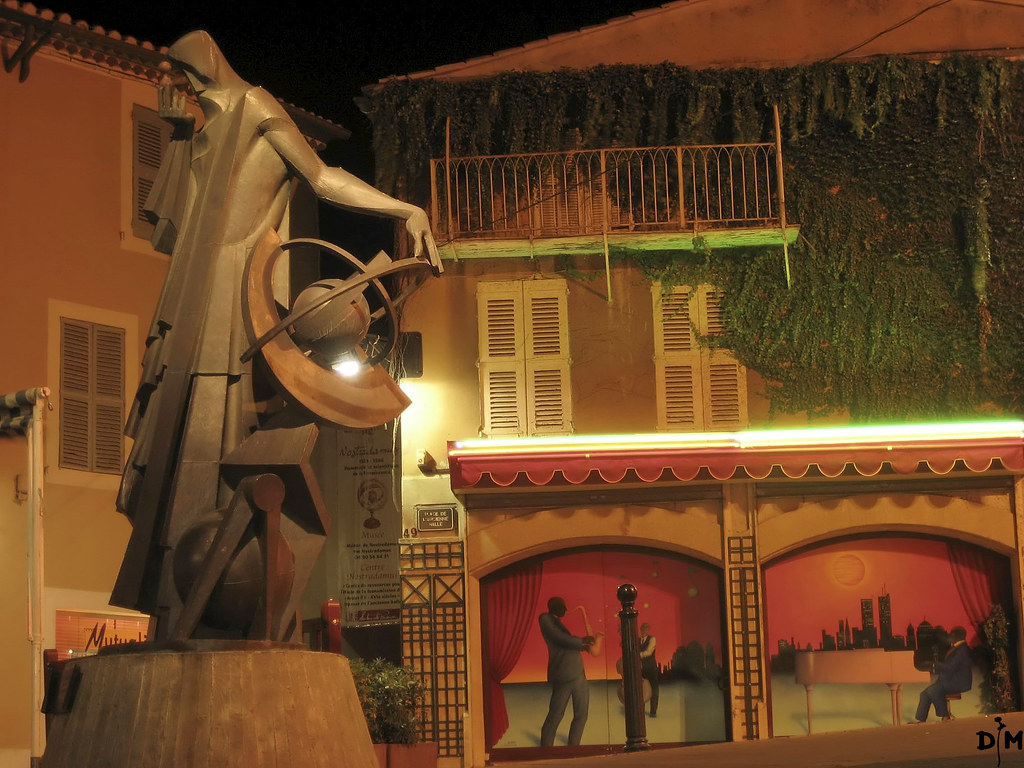
“House of Nostradamus in Salon, France. Now a museum.” by photographymontreal is marked with Public Domain Mark 1.0  .
.
Nostradamus was a 16th century French physician who claimed to be able to see the future.
(never trust doctors who dabble in futurology, that’s my advice)
His method was: read books of other people’s prophecies and calculate some astrological charts, until he felt like he had a pretty good idea what would happen in the future. Then write it down in the form of obscure allusions and multilingual semi-gibberish, to placate religious authorities (who apparently hated prophecies, but loved prophecies phrased as obscure allusions and multilingual semi-gibberish).
In 1559, he got his big break. During a jousting match, a count killed King Henry II of France with a lance through the visor of his helmet. Years earlier, Nostradamus had written:
The young lion will overcome the older one,
On the field of combat in a single battle;
He will pierce his eyes through a golden cage,
Two wounds made one, then he dies a cruel deathThe nobleman was a bit younger than the king, supposedly they both had lions on their shield (false), maybe King Henry was wearing a golden helmet (I can’t find evidence for this, but as a consolation prize please accept this picture of his amazing parade armor), and his slow agonizing death over ten days from his wounds was pretty cruel. Seems like a match, sort of. Anyway, for the next five hundred years lots of people were really into Nostradamus and spent goodness knows how many brain cycles trying to interpret his incomprehensible quatrains.
The basic Nostradamic method was:
Write 942 vague and incomprehensible quatrains, out of order and without any dates.
Whenever something happens, say “that sounds a lot like quatrain #143!” or “quatrain #558 predicted that”
Prophet
For example, prophecy 106:
Near the gates and within two cities
There will be two scourges the like of which was never seen,
Famine within plague, people put out by steel,
Crying to the great immortal God for reliefThis is an okay match for the atomic bombs, in the sense that there were two cities where something really bad happened. But read on to prophecy 107:
Amongst several transported to the isles,
One to be born with two teeth in his mouth
They will die of famine the trees stripped,
For them a new King issues a new edict.… and it starts to sound like he’s just kind of saying random stuff and some of it’s sticking by sheer luck.
A few prophecies sound more impressive than this, eg:
The lost thing is discovered, hidden for many centuries.
Pasteur will be celebrated almost as a god-like figure.
This is when the moon completes her great cycle,
but by other rumours he shall be dishonouredThis seems to name Pasteur, who was indeed a celebrated discoverer of things. And Nostradamus scholars note that a historian accused Pasteur of plagiarism in 1995, which is a kind of dishonorable rumor. But the work here is being done by the translator: Pasteur is just French for “pastor”, and an honest translation would have just said “the pastor will be celebrated …”, which is in tune with all his other vague allusions to things happening.
The blood of the just will be demanded of London
Burnt by fire in the year ’66
The ancient Lady will fall from her high place
And many of the same sect will be killed.Seems like a match for the London fire of 1666. But again checking the original French and the commentators, the second line is more properly “burnt by fire in 23 the 6”, which a fanciful translator rounded off to 20 * 3 + 6 = 66 and then assumed was a year. The experts say that this is really a coded reference to 23 Protestants being burned, in groups of six, during Nostradamus’ lifetime (many of his quatrains are references to past or present events, for some reason). This sounds more compatible with the “many of the same sect will be killed” ending.
I had a weird experience writing the end of this first part of the post. When I was a kid, reading through my parents’ old books, I came across an weird almanac from the 70s that had a section on Nostradamus. It listed some of his most famous prophecies, including the ones above, but also (reconstructing from memory and probably getting some things wrong, sorry):
The way of life according to Thomas More
Will give way to another more sweet and seductive
In the land of cold winds that first gave it birth
Without strife, without a war it will fall… and the 70s almanac interpreted this as meaning Soviet communism would fall peacefully. Reading this in 1995 or whenever it was I read it, a few years after Soviet communism did fall peacefully, I was really impressed: this is the only example I know where someone used a Nostradamus quatrain to predict something before it happened.
But I searched for the exact text so I could include the correct version in this essay, and I didn’t find it — this is none of Nostradamus’ 942 prophecies! The almanac authors must have made it up, or unwittingly copied it from someone else who did.
But I remember this very clearly — the almanac was from 1970-something. So how did the faker know Russian communism would collapse?
The moral of the story is: just because Nostradamus wasn’t a real prophet, doesn’t mean nobody else is.
September 26, 2022
Did D-Day win WW2? – a WW2 expert discussion
World War Two
Published 25 Sep 2022WW2 historians Indy Neidell, Spartacus Olsson, and Paul Woodadge moderated by Ryan Socash discuss the meaning and significance of D-Day from historical, current, and future perspectives. Recorded on the road while shooting in Normandy for TimeGhost’s 24-hour documentary on the events of June 6, 1944.
(more…)
September 22, 2022
Waking – or shaking – NATO’s freeloaders (like Canada)
CDR Salamander has a proposal to encourage cheapskate freeloaders like Justin Trudeau’s Canada (although it didn’t start with him … Canada has been freeloading militarily since the early 1970s) to take on more like a fair share of NATO’s needs:
President Vladimir Putin on Wednesday ordered Russia’s first mobilisation since World War Two and backed a plan to annex swathes of Ukraine, warning the West he was not bluffing when he said he’d be ready to use nuclear weapons to defend Russia.
In the biggest escalation of the Ukraine war since Moscow’s Feb. 24 invasion, Putin explicitly raised the spectre of a nuclear conflict, approved a plan to annex a chunk of Ukraine the size of Hungary, and called up 300,000 reservists.
This should not be a shock to anyone. If it is, perhaps you should consider investing your time in cat-blogging.
It should bring to the front that NATO can no longer allow unserious nations to play like they are anything but security free-riders. They need to contribute their fair share or pay some consequence. Alliances have benefits and responsibilities. You should not have one without the other.
While percentage of GDP is an imperfect measure of contribution, it is better than all the other ones. It is as simple benchmark of national effort.
As these are the best numbers we have, let’s look at 2021 and then forward.
It is amazing that after all Russia has shown Western Europe — both of its nature and the nature of modern warfare — that so many of our NATO allies continue to slow walk defense spending, doing the very minimum to be a full and fair partner in the alliance.
Russian victory — however they define it — or Russian defeat — however Ukraine defines it — will not change the geography or nature of Russia. She is not going anywhere.
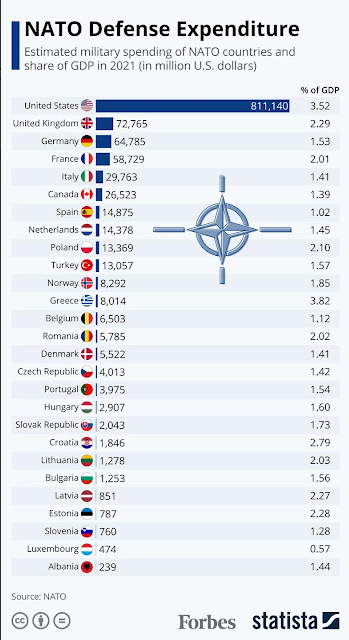
So, what’s to be done to encourage nations like Canada to put up or shut up? This might help:
“Out years” are where dragons live, so anyone not on guide-slope to 2%+ by the end of 2023 – when one way or another the Russo-Ukrainian War should be over – will find someway to not get there in a wave of excuses and bluffing.
We should call their bluff.
As such, and this is generous, we need to finally pursue PLAN SALAMANDER for NATO “Flags-to-Post” that I first proposed almost six years ago.
In NATO, General and Flag Officer billets are distributed amongst nations in a rather complicated way, but this formula is controlled by NATO – and as such – can be changed.
Entering argument: take the present formula for “fair distribution” and multiply by .75 any nation that spends 1.5% to 1.99% GDP on defense. Multiply by .5 any nation that spends between 1.25% to 1.499%. Multiply by .25 1.0% to 1.240%. If you fall below 1%, you get nothing and your OF5 (Col./Capt) billets are halved.
1.25x for 2.01%-2.25%. 1.5X for 2.26%-2.75%; 1.75x for 2.76% -3.0%. 2x for +3.01%.
The math gets funky when a lot of people get over 2%, but we can refine it later. Doesn’t cost a penny and will unquestionably get the attention of those nations. Trust me on this. By January 1st, 2024 no more excuses. A small and symbolic punishment, but a good start that may be all that is needed. This is not the second half of the 20th Century any more.


