Thomas Hobbes blamed the English Civil War on “ghostly authority”. Where the Bible is unclear, the crowd of simple believers will follow the most charismatic preacher. This means that religious wars are both inevitable, and impossible to end. Hobbes was born in 1588 — right in the middle of the Period of the Wars of Religion — and lived another 30 years after the Peace of Westphalia, so he knew what he was talking about.
There’s simply no possible compromise with an opponent who thinks you’re in league with the Devil, if not the literal Antichrist. Nothing Charles I could have done would’ve satisfied the Puritans sufficient for him to remain their king, because even if he did everything they demanded — divorced his Catholic wife, basically turned the Church of England into the Presbyterian Kirk, gave up all but his personal feudal revenues — the very act of doing these things would’ve made his “kingship” meaningless. No English king can turn over one of the fundamental duties of state to Scottish churchwardens and still remain King of England.
This was the basic problem confronting all the combatants in the various Wars of Religion, from the Peasants’ War to the Thirty Years’ War. No matter what the guy with the crown does, he’s illegitimate. It took an entirely new theory of state power, developed over more than 100 years, to finally end the Wars of Religion. In case your Early Modern history is a little rusty, that was the Peace of Westphalia (1648), and it established the modern(-ish) sovereign nation-state. The king is the king because he’s the king; matters of religious conscience are not a sufficient casus belli between states, or for rebellion within states. Cuius regio, eius religio, as the Peace of Augsburg put it — the prince’s religion is the official state religion — and if you don’t like it, move. But since the Peace of Westphalia also made heads of state responsible for the actions of their nationals abroad, the prince had a vested interest in keeping private consciences private.
I wrote “a new theory of state power”, and it’s true, the philosophy behind the Peace of Westphalia was new, but that’s not what ended the violence. What did, quite simply, was exhaustion. The Thirty Years’ War was as devastating to “Germany” as World War I, and all combatants in all nations took tremendous losses. Sweden’s king died in combat, France got huge swathes of its territory devastated (after entering the war on the Protestant side), Spain’s power was permanently broken, and the Holy Roman Empire all but ceased to exist. In short, it was one of the most devastating conflicts in human history. They didn’t stop fighting because they finally wised up; they stopped fighting because they were physically incapable of continuing.
The problem, though, is that the idea of cuius regio, eius religio was never repudiated. European powers didn’t fight each other over different strands of Christianity anymore, but they replaced it with an even more virulent religion, nationalism.
Severian, <--–>”Arguing with God”, Rotten Chestnuts, 2020-01-20.
September 14, 2022
QotD: The Wars of Religion and the (eventual) Peace of Westphalia
September 13, 2022
The Greatest Escapes of World War Two – WW2 Special
World War Two
Published 12 Sep 2022This is an intimate story inspired by real events (notably inspired by the story of a member of the Danish resistance and grandmother of Hans von Knut Skovfoged, Head of Development at PortaPlay. A story told not on the front line, but in the intimate setting of a small Danish village.
(more…)
September 11, 2022
MAS-36: The Backup Rifle is Called to Action
Forgotten Weapons
Published 25 Sep 2017There is a common assumption that the MAS-36 was a fool’s errand from the outset — why would a country develop a brand new bolt-action rifle in the mid 1930s, when obviously semiautomatic combat rifles were just on the cusp of widespread adoption? Well, the answer is a simple one — the French were developing a semiautomatic rifle at the same time, and the MAS-36 was only intended to go to rear echelon and reserve troops. It would serve as a measure of economy, reducing the number of the more complex and expensive self-loaders necessary, while still providing sufficient arms to equip the whole reserve in case of a mobilization.
Well, the plan didn’t quite work out that way, because Germany invaded France before the semiauto rifle was ready for production (it was, at that point, the MAS-40 and was in trials). Not until 1949 would the self-loader go into mass production with the MAS-49 (discounting the short-lived MAS-44). With this in mind, the MAS-36 suddenly makes much more sense. It is a simple, economical, and entirely adequate rifle without extraneous niceties. In a word, it is a Russian rifle rather than a Swiss one.
Production began in the fall of 1937, and by the time of the German invasion there were about 205,000 in French stockpiles. They saw extensive use in the Battle of France, along with M34 Berthiers in 7.5x54mm. Some would escape to serve the Free French forces worldwide through the war, and others would be captured and used by German garrisons in France and along the Atlantic Wall. Production resumed upon the liberation of St Etienne in 1944, and by 1957 about 1.1 million had been made. They basically fall into two varieties, with several pre-war milled components changed to more economical stamped designs after the war.
(more…)
September 3, 2022
Napoleon Defeats Russia: Friedland 1807
Epic History TV
Published 28 Sep 2018Napoleon brings his war against Russia and Prussia to an end with victory at Friedland, leading to the famous Tilsit conference, after which Napoleon stood at the peak of his power.
(more…)
September 2, 2022
Alliance For Peace (1951) North Atlantic Treaty Organization Promo Film
PeriscopeFilm
Published 14 May 202sProduced by NATO and the Signal Photographic Service of the U.S. Army, this black & white film is about the formation of NATO and its importance in the defense of the free world. Copyright 1951. The film features a score by William Alwyn. The film dates from the time when Gen. Dwight Eisenhower was supreme commander of NATO (1950-52), a post he left in order to run for President of the United States.
(more…)
September 1, 2022
QotD: The origins of the Bloody Mary
All the best bars serve Bloody Marys. But the best Bloody Mary is served in The Grenadier, the one-time officers’ mess of the Foot Guards and the long-time public house in Wilton Row, Belgravia. Pass beneath the low lintel of this tiny tavern, pick your way through the crowded tap room and press up against the burr mahogany bar to order the world’s premier pick-me-up.
[…]
The Grenadier is rightly proud of its reputation for restorative remedies and particularly this one. Into the glass go vodka, and a sizeable slug (preferably Stolichnaya), a stirrup of sherry (the secret weapon), tomato juice, then spices (Tabasco and Worcestershire sauce), citron (lemon or lime) and salt to personal taste. The addition of a celery stick is entirely superfluous but for those in search of their hair of the dog, a little light salad I suppose is a help — of sorts.
Yet this pub, though an historic watering hole, cannot claim to be the home of the Mary. That right is retained across the Channel in Paris by Harry’s New York Bar. There exactly a century ago in the City of Light, Fernand Petiot, perfected his “bucket of blood”. The name was soon changed to something a little less Madame la Guillotine and the Mary as we know it was born.
Christopher Pincher, “Hail Mary”, The Critic, 2022-05-30.
August 31, 2022
QotD: John Keegan’s The Face of Battle
Keegan’s first battle is Agincourt (1415). While famous for the place of the English longbow in it, at Agincourt the French advance (both mounted and dismounted) did reach the English lines; of this the sources for the battle are quite clear. And so the terror we are discussing is the terror of shock; not shock in the sense of a sudden shock or in the sense of a jolt of electricity, rather shock as the opposite of fire. Shock combat is the combat when two bodies of soldiers press into each other in mass hand-to-hand combat (which is, contrary to Hollywood, not so much a disorganized melee as a series of combats along the line of contact where the two formations meet). The advancing French had to will themselves forward into a terrifying shock encounter, while the English had to (like our hoplites above) hold themselves in place while watching the terrifying prospect of a shock engagement walk steadily towards them.
There is actually quite a bit of evidence that the terror of a shock engagement is something different from the other terrors of war (to be clear, not “better” or “worse”, merely different in important ways). There are numerous examples of units which could stand for extend periods under fire but which collapsed almost immediately at the potential of a shock engagement. To draw a much more recent example, at Bai Beche in 2001, a force of Taliban withstood two days of heavy bombing and had repulsed an infantry assault besides, but collapsed almost immediately when successfully surprised by a cavalry charge (yes, in 2001) in their rear (an incident noted in S. Biddle, “Afghanistan and the Future of Warfare”, Foreign Affairs 82.2 (2003)).
And so our sources for state-on-state pre-gunpowder warfare (which is where you tend to find more fully “shock” oriented combat systems) stress similar sequences of fear: the dread inspired by the sight of the enemy army drawing up before you (Greek literature is particularly replete with descriptions of teeth-chattering and trembling in those moments and it is not hard to imagine why), followed by the steady dread-anticipation as the armies advanced, each step bringing that moment of collision closer. Often in such engagements one side might break before contact as the fear not of what was happening, but what was about to happen built up. And only then the long anticipated not-so-sudden shock of the formations coming together – rarely for long given the overpowering human urge not to be near an enemy trying to stab you with a sharp stick. There is something, I think, quite fundamental in the human psyche that understands another human with a sharp point, or a huge horse rapidly closing on a deeper level than it understands bullets or arrows.
Which brings us to Keegan’s second battle, Waterloo (1815), defined in part by the ability of the British to manage to hold firm under extended fire from artillery and infantry. The French artillery in an 80-gun grand battery opened fire at 11:50am and kept it up for hours until the French cavalry advanced (hoping that the British troops were suitably “softened” by the guns to be dislodged) at 4pm. In contrast to Agincourt (or a hoplite battle) which may have ended in just a couple of hours and consisted mostly of grim anticipation, soldiers (on both sides) at Waterloo were forced to experience a rather different sort of terror: forced to stand in active harm for hours on end, as bullets and cannon shot whizzed overhead.
The difference of this is perhaps most clearly extreme if we move still forward to the Somme (1916) and bombardment. The British had prepared for their assault with a week long artillery barrage, in which British guns fired 1.5 million shells (that is about 148 shells fired a minute, every minute for a week). At the first sound of guns, soldiers (in this case, the Germans, but it had been the French’s turn just that February to be on the receiving end of a bombardment at Verdun) rushed into their dug-out bomb shelters at the base of their trench and then waited. Unlike the British at Waterloo, who might content themselves that, one way or another, the terror of fire would not last a day, the soldier of WWI had no way of knowing when the barrage would cease and the battle proper begin. Indeed, they could not see the battlefield at all, only sit under the ground as it shook around them and try to be ready, at any moment when the barrage stopped to rush back up to the lip of the trench to set up the machine guns – because if they were late to do it, they’d arrive to find British grenades and bayonets instead.
We will get into wounds, both physical and mental, next week, but it is striking to me that repeatedly there are reports after such barrages of soldiers so mentally broken by the strain of it that they wandered as if dazed or mindless, apparently driven mad by the bombardment. Reports of such immediate combat trauma are vanishingly rare in the pre-modern corpus (Hdt. 6.117 being the rare example). And it is not hard to see why the constant threat of sudden, unavoidable death hanging over you, day and night, for days or in some cases weeks on end produces a wholly different kind of terror.
And yet, to extend beyond Keegan’s three studies, in talking to contemporary veterans, it seems to me this terror of fire – being forced to stand (or hide) under long continuous fire – is not always quite the same as the terror of the modern battlefield. Of course I can only speak to this second hand (but what else can a historian generally do?), but there seems to be something different about a battlefield where everything might seem peaceful and fine and even a bit boring until suddenly the mortar siren sounds or a roadside IED goes off and the peril is immediate. The experience of such fear sometimes expresses itself in a sort of hypervigilance which seems entirely unknown to Greek or Roman writers (who in most cases could hardly have needed such vigilance; true surprise attacks were quite rare as it is extremely hard to sneak one entire army up on another) and doesn’t seem particularly prominent in the descriptions of “shell-shock” (which today we’d call PTSD) from the First World War, compared to the prominence of intense fatigue, the thousand-yard-stare and raw emotional exhaustion. I do wonder though if we might find something quite analogous looking into the trauma of having a village raided by surprise under the first system of war.
Bret Devereaux, “Collections: The Universal Warrior, Part IIa: The Many Faces of Battle”, A Collection of Unmitigated Pedantry, 2021-02-05.
August 28, 2022
Jersey – Millennia of Maritime Defence Preserved
Drachinifel
Published 4 May 2022Today we take a look at the island of Jersey, part of the Channel Islands off the coast of France, to examine the many generations of maritime defence that have been built and upgraded there.
It’s an excellent place to visit! https://www.jersey.com/
(more…)
August 25, 2022
Barbarian Europe: Part 8 – The Franks
seangabb
Published 1 Sep 2021In 400 AD, the Roman Empire covered roughly the same area as it had in 100 AD. By 500 AD, all the Western provinces of the Empire had been overrun by barbarians. Between April and July 2021, Sean Gabb explored this transformation with his students. Here is one of his lectures. All student contributions have been removed.
(more…)
August 20, 2022
How Turkey Fought a WW1 Peace Treaty – The Greek-Turkish War 1919-1923
The Great War
Published 19 Aug 2022The defeat of the Ottoman Empire in 1918 meant that it got its own peace treaty like the other three Central Powers. But the emerging Turkish National Movement under Mustafa Kemal resisted the Treaty of Sevres and occupation by various Entente Powers. Their successful resistance led to the creation of modern Turkey and the Treaty of Lausanne in 1923.
(more…)
August 19, 2022
Why Quebec rejected the American Revolution
Conrad Black outlines the journey of the French colony of New France through the British conquest to the (amazing to the Americans) decision to stay under British control rather than join the breakaway American colonies in 1776:

Civil rights were not a burning issue when Canada was primarily the French colony of New France. The purpose of New France was entirely commercial and essentially based upon the fur trade until Jean Talon created industries that made New France self-sufficient. And to raise the population he imported 1,000 nubile young French women, and today approximately seven million French Canadians and Franco-Americans are descended from them. Only at this point, about 75 years after it was founded, did New France develop a rudimentary legal and judicial framework.
Eighty years later, when the British captured Québec City and Montréal in the Seven Years’ War, a gentle form of British military rule ensued. A small English-speaking population arose, chiefly composed of commercial sharpers from the American colonies claiming to be performing a useful service but, in fact, exploiting the French Canadians. Colonel James Murray became the first English civil governor of Québec in 1764. A Royal proclamation had foreseen an assembly to govern Québec, but this was complicated by the fact that at the time British law excluded any Roman Catholic from voting for or being a member of any such assembly, and accordingly the approximately 500 English-speaking merchants in Québec demanded an assembly since they would be the sole members of it. Murray liked the French Canadians and despised the American interlopers as scoundrels. He wrote: “In general they are the most immoral collection of men I ever knew.” He described the French of Québec as: “a frugal, industrious, moral race of men who (greatly appreciate) the mild treatment they have received from the King’s officers”. Instead of facilitating creation of an assembly that would just be a group of émigré New England hustlers and plunderers, Murray created a governor’s council which functioned as a sort of legislature and packed it with his supporters, and sympathizers of the French Canadians.
The greedy American merchants of Montréal and Québec had enough influence with the board of trade in London, a cabinet office, to have Murray recalled in 1766 for his pro-French attitudes. He was a victim of his support for the civil rights of his subjects, but was replaced by a like-minded governor, the very talented Sir Guy Carleton, [later he became] Lord Dorchester. Murray and Carleton had both been close comrades of General Wolfe. […]
The British had doubled their national debt in the Seven Years’ War and the largest expenses were incurred in expelling the French from Canada at the urgent request of the principal American agent in London, Benjamin Franklin. As the Americans were the most prosperous of all British citizens, the British naturally thought it appropriate that the Americans should pay the Stamp Tax that their British cousins were already paying. The French Canadians had no objection to the Stamp Tax, even though it paid for the expulsion of France from Canada.
As Murray and Carleton foresaw, the British were not able to collect that tax from the Americans; British soldiers would be little motivated to fight their American kinfolk, and now that the Americans didn’t have a neighboring French presence to worry them, they could certainly be tempted to revolt and would be very hard to suppress. As Murray and Carleton also foresaw, the only chance the British would have of retaining Canada and preventing the French Canadians from rallying to the Americans would be if the British crown became symbolic in the mind of French Canada with the survival of the French language and culture and religion. Carleton concluded that to retain Québec’s loyalty, Britain would have to make itself the protector of the culture, the religion, and also the civil law of the French Canadians. From what little they had seen of it, the French Canadians much preferred the British to the French criminal law. In pre-revolutionary France there was no doctrine of habeas corpus and the authorities routinely tortured suspects.
In a historically very significant act, Carleton effectively wrote up the assurances that he thought would be necessary to retain the loyalty of the colony. He wanted to recruit French-speaking officials from among the colonists to give them as much self-government as possible while judiciously feeding the population a worrisome specter of assimilation at the hands of a tidal wave of American officials and commercial hustlers in the event of an American takeover of Canada.
After four years of lobbying non-stop in London, Carleton gained adoption of the Québec Act, which contained the guaranties he thought necessary to satisfy French Canada. He returned to a grateful Québec in 1774. The knotty issue of an assembly, which Québec had never had and was not clamoring for, was ducked, and authority was vested in a governor with an executive and legislative Council of 17 to 23 members chosen by the governor.
Conveniently, the liberality accorded the Roman Catholic Church was furiously attacked by the Americans who in their revolutionary Continental Congress reviled it as “a bloodthirsty, idolatrous, and hypocritical creed … a religion which flooded England with blood, and spread hypocrisy, murder, persecution, and revolt into all parts of the world”. The American revolutionaries produced a bombastic summary of what the French-Canadians ought to do and told them that Americans were grievously moved by their degradation, but warned them that if they did not rally to the American colours they would be henceforth regarded as “inveterate enemies”. This incendiary polemic was translated, printed, and posted throughout the former New France, by the Catholic Church and the British government, acting together. The clergy of the province almost unanimously condemned the American agitation as xenophobic and sectarian incitements to hate and needless bloodshed.
Carleton astounded the French-Canadians, who were accustomed to the graft and embezzlement of French governors, by not taking any payment for his service as governor. It was entirely because of the enlightened policy of Murray and Carleton and Carleton’s skill and persistence as a lobbyist in the corridors of Westminster, that the civil and cultural rights of the great majority of Canadians 250 years ago were conserved. The Americans when they did proclaim the revolution in 1775 and officially in the Declaration of Independence on July 4, 1776, made the British position in Canada somewhat easier by their virulent hostility to Catholicism, and to the French generally.
How Accurate is Saving Private Ryan? – WW2 D-Day Special
World War Two
Published 16 Aug 2022How accurate is that famous beach scene in Saving Private Ryan? Is it true to the history or just another Hollywood story? Seeing as we’re about to start the filming for our massive D-Day project, we figured we’d break it down, shot by shot.
(more…)
August 16, 2022
QotD: The first casualty of political campaigns
Walking in Paris just before the French election, I was handed some leaflets and stickers by partisans of Jean-Luc Mélenchon, the demagogic left-wing candidate. “The rich pollute,” said one of them, “the people pay.”
Am I one of the rich, I wonder? Or one of the people? What about the customers chatting over lunch in the nearby café? Are they rich or are they of the people? Mélanchon’s slogan is founded on the old lie, as Wilfred Owen calls Dulce et decorum, etc., that society is divided neatly into two distinct categories with interests diametrically opposed.
No lie appeals more to the dissatisfied than this, offering as it does the illusory hope of a confiscatory solution to life’s little problems. The best that can be said of it is that it permits the dissatisfied an access of hatred and moral outrage, which is always enjoyable and gratifying to experience.
Theodore Dalrymple, “Election bumf”, The Critic, 2022-04-29.
August 13, 2022
The lure of old wines
In The Critic, Henry Jeffreys admits his continuing love for mature wines, even past the point most people would consider them drinkable:
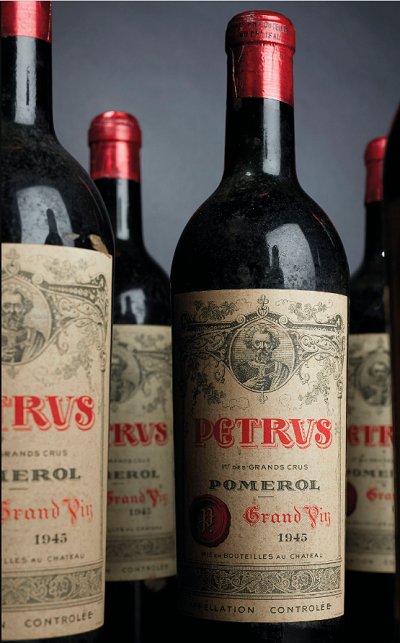
For some people wine appreciation is like big game hunting. It’s about ticking off the prizes: Latour, Petrus, Romanee Conti. Whereas for others it’s about chasing unicorns, looking for mythical wines so rare that they are almost impossible to obtain. I don’t have the money for either, but even if I did, I still think I would take the greatest pleasure in opening a strange old bottle and being surprised by how delicious it is.
I’m fortunate in having friends and relatives who think wine is more for keeping than for drinking. When my grandfather died, we inherited all kinds of strange things that he’d been saving including a half bottle of 1937 Army & Navy claret.
I’ve certainly never had the deep pockets to go after any of those tip-top wines, although I used to be able to go to LCBO wine tasting events where there’d occasionally be opportunities to try a few ultra-expensive wines (Petrus, Château Margaux, Nuits-Saint-Georges, Chassagne-Montrachet, Puligny-Montrachet, etc.). If I’m totally honest, in a few of those cases, the bouquet of the wine promised far more than the taste could deliver … I appreciate and enjoy better quality wines, but I don’t taste enough difference between a $50 bottle and a $500 bottle to justify paying the premium.
Oddly certain people get quite upset at lovers of very old wine. On Twitter recently a sommelier wrote “your taste sucks” to someone who expressed an enjoyment of such wines.
The French look at this peculiarly British habit as close to necrophilia. Americans, too, drink vintage port after a couple of years rather than waiting a generation as is customary.
There’s something magical about what decades can do to a wine. Quite austere clarets become heady and exotically-spiced while sweet wines begin to taste dry. I also relish the flavours that some might find less appealing: the tang of vinegar, the cooked taste of caramel and the whiff of sherry in wines that definitely are not sherry.
Maybe my taste sucks too but sometimes I prefer a wine to be old than to be particularly good. You adjust your palate, it’s like having a conversation with an elderly relative who’s a bit deaf but with great stories to tell.
August 10, 2022
“Every nation is divided, and thrives on division. But France illustrates the rule rather too well.”
Ed West on the historical divisions of the many regions in what we now know as “France”:
France is gigantic, like a continent in itself, and the most visited country on earth. It is four times the size of England and until the 17th century had a population four to five times as big (today it is 67 million v 56 million). Yet “France” until relatively recently extended not much further than Paris, in the area under the king’s direct control called the Île-de-France — beyond that, regional identity was distinctive and dialect pre-dominated.
As Robb writes, at the time of the Revolution just 11 per cent of the population, or 3 million people, spoke “French”; by 1880 still only one in five could communicate in the national language. Even with decades of centralisation, today there are still 55 distinct dialects in France; most are Romance, but the country is also home to Flemish, Alsatian, Breton and Basque-speaking communities. (Tintin has been translated into at least a dozen French dialects.) No regional identity in England, except the north-east, is as distinctive.
Many famous French historical figures wouldn’t have even understood “French”, among them St Bernadette, living in the then obscure village of Lourdes. She described the figure she saw as un petito damisela (or in French une petite demoiselle), the name for the local forest fairies in the Pyrenees. The Demoiselles dressed in white, lived in caves and grottos and were associated with water. They were also seen as being on the side of the poor, Robb points out, because here as is often the case there was a political underside to this folk belief. Indeed, a peasant conflict with the authorities from the 1830s to the 1870s had been called The War of the Demoiselles. But then conflict with the authorities — with Paris — almost defines French history.
[…]
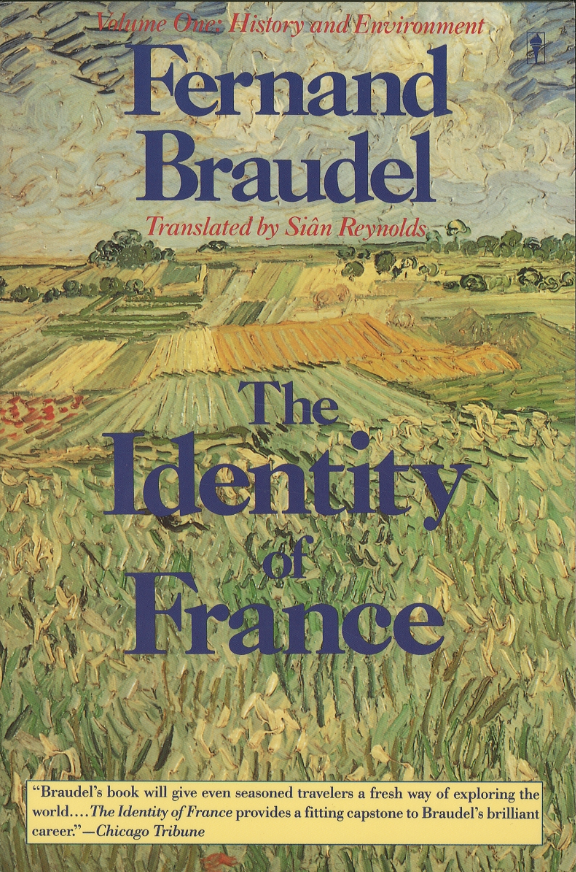
If you like Robb’s work, you’ll also enjoy Fernand Braudel’s The Identity of France, published in 1986 and supposed to be part one of a series by the great 20th century historian. Unfortunately, Braudel was already dead by the time part one was published, and so the series was never finished.
Braudel loved his country and believed in a deep and abiding Frenchness, yet he was also fascinated by its divisions, the various different pay — from Gallo-Roman pagus — which translates as land, although it can mean either country or region. Within this, dialects can be very varied: Gascon is “quite distinct” to Languedocien and Provencal, he wrote, but in Gascony “two completely different patois” were spoken. Near to Salins the language spoken in each village “varies to the point of being unrecognisable” and “what is more extraordinary” the town “being almost half a league in length, is divided by language and even customs, into two distinct halves”.
France’s regional identity is defined by language, food — the division between butter and olive, wine and cider — and even roof tiles. Braudel was essentially a geographic determinist and, citing Sartre’s line that France was “non-unifiable”, the author lamented that: “Every nation is divided, and thrives on division. But France illustrates the rule rather too well.”
To illustrate the rivalry, compare the words of two 19th-century historians: Jean-Bernard Mary-Lafon, who contrasted the “refined and freedom-loving” southerners with “brute barbarism” of “knights from across the Loire”, violent, fanatical and pillaging. And Ernest Renan, who wrote in 1872: “I may be mistaken, but there is a view derived from historical ethnography which seems more and more convincing to my mind. The similarity between England and northern France appears increasingly clear to me every day. Our foolishness comes from the south, and if France had not drawn Languedoc and Provence into her sphere of activity, we should be a serious, active, Protestant and parliamentary people.”
He was surely mistaken, for it’s the south which is more Protestant and the north more Catholic. Just like in England, where regional and religious identity are intertwined.
Yet it is true that France’s great bounty was also its curse; this western European isthmus forms a natural unit within which the most powerful warlord could dominate, and that man was bound to be based somewhere on the Seine or Loire, close to the continent’s richest wheat-growing area. Yet in the early modern era this unit was far too big to govern effectively — 22 days’ ride from north to south — compared to England or the Netherlands. The author quotes an essayist who suggested that: “France is not a synchronised country: it is like a horse whose four legs move in a different time.”