
World War Two
Published 8 Aug 2022The typical image of the French Resistance is of a man, beret at an angle, cigarette hanging from his bottom lip, captured MP40 across his chest. But one of the most successful resistance leaders is a woman – Marie-Madeline Fourcade. And right now, the Germans have her on the run!
(more…)
August 9, 2022
The Never Ending Failures in France – WW2 – Spies & Ties 21
Comments Off on The Never Ending Failures in France – WW2 – Spies & Ties 21
August 2, 2022
M34: The Berthier Converted to the 7.5mm Rimless Cartridge
Forgotten Weapons
Published 3 Aug 2017http://www.patreon.com/ForgottenWeapons
With the end of World War One, it was finally possible for the French military to replace the 8mm Lebel cartridge with a modern rimless cartridge, and they wasted no time in doing so. By 1924 a new round had been adopted, and along with it a new modern light machine gun. Next, the arsenals would start working on converting 8mm rifles to the new cartridge. The first candidate was the Lebel, and in 1927 a conversion was approved and a batch of a few hundred made — but this was a more expensive and time-consuming process than anyone wanted. After some brief trials, it was decided to work on adapting the Berthier instead, and in 1934 a conversion designed from St Etienne was approved as the 1907/15-M34.
This new design used a new 22.5″ barrel (570mm), a Mauser style internal 5-round double stack magazine, and new sights. The receivers and trigger parts were retained from the rifles being converted, along with the nosecaps and barrel bands, but not much else. Still, these conversions were put into production alongside the manufacture of new MAS-36 bolt action rifles. By the time of the German invasion about 63,000 M34 Berthiers had been converted, and were issued to frontline troops. They would fight in the Battle of France, and would also be used by German occupation forces as the Gewehr 241(f).
(more…)
Comments Off on M34: The Berthier Converted to the 7.5mm Rimless Cartridge
August 1, 2022
Hamburg’s Citizens Burnt Alive – WAH 071 – July 31, 1943
World War Two
Published 31 Jul 2022In Italy the Fascists fall from power in a peaceful coup, while in Germany the RAF and USAAF bring down a rain of fire of biblical proportions in Operation Gomorrah, launching the Firestorm of Hamburg.
(more…)
Comments Off on Hamburg’s Citizens Burnt Alive – WAH 071 – July 31, 1943
July 30, 2022
Alexis de Tocqueville
In The Critic, Paul Sagar reviews a new biography of Alexis de Tocqueville by Olivier Zunz:

Alexis de Tocqueville came perilously close to never existing at all. His parents, married in 1793, spent 10 of their first 18 months of matrimony in jail — arrested for the crime of being aristocrats during the height of the French revolutionary Terror. Tocqueville’s great-grandfather was guillotined in April 1794, after being forced to watch the beheadings of his daughter and grandchildren. His newlywed parents were in the queue, awaiting the same fate, but the fall of Robespierre in July meant they were spared.
Alexis, the third son of the family, would be born in 1805, and go on to write not one, but two, of the most influential works in the history of ideas. His two-volume Democracy in America (published in 1835 and 1840) has been hailed as, variously, the first work of political science, a founding text of sociological analysis, and a landmark in the history of political philosophy.
It remains a touchstone for those attempting to understand both democracy and the United States, as well as post-Revolutionary France (Tocqueville’s animating point of comparison). His later The Ancien Régime and the Revolution (1856) attempted to locate the long-term causes of the events of 1789, and inaugurated a school of French Revolution historiography that remains alive and influential to this day.
He also enjoyed a moderately successful career as a practising politician, directly involved in France’s tumultuous political upheavals from the 1830s to the early 1850s. Constitutionally frail, and wracked by tuberculosis for the final nine years of his life before dying at just 54, he nonetheless packed a lot in.
As a narrative biography, Olivier Zunz’s The Man Who Understood Democracy succeeds tremendously. The details of Tocqueville’s life — and the events he lived through — are rendered with engaging clarity. The detailed reconstruction of Tocqueville’s nine-month trip to America in 1831–32 is especially valuable, shedding a great deal of light on what Tocqueville saw and, crucially, who he spoke to and took his lead from. Zunz does not shy away from dissolving the myth to reveal the man. Sometimes treated as though he were a gimlet-eyed sage who saw through to the very soul of the fledgling United States, Zunz shows instead the extent to which Tocqueville tended to take too much at face value, especially regarding what he was told by less than impartial interlocutors, frequently failing to scratch below the surface on his whirlwind tour.
Thus, for example, he went on to write in Democracy in America that the liberty of the United States meant that secret societies were unknown there, entirely failing to recognise not only the extent of Masonic influence in local politics, but also how objections to Masonic influence were a core feature of contestation. A young man, dazzled by the hustle and bustle of the New World, he tended to see what he wanted to see — or what others hoped he would.
Comments Off on Alexis de Tocqueville
July 29, 2022
Why Ghost Division? What did Rommel do?
Military History Visualized
Published 5 Feb 2019Why was Rommel’s 7th Panzer Division called Gespensterdivsion – the “Ghost Division”? From all we know it earned this name during the Battle of France.
(more…)
Comments Off on Why Ghost Division? What did Rommel do?
July 25, 2022
QotD: Napoleon Bonaparte, the Great Man’s Great Man
The point is, a culture can survive an incompetent elite for quite a while; it can’t survive a self-loathing one. This is because the Great Man theory of History, like everything in history, always comes back around. History is full of men whose society doesn’t acknowledge them as elite, but who know themselves to be such. Napoleon, for instance, and isn’t it odd that as much as both sides, Left and Right, seem to be convinced that some kind of Revolution is coming, you can scour all their writings in vain for one single mention of Bonaparte?
That’s because Napoleon was a Great Man, possibly the Great Man — a singularly talented genius, preternaturally lucky, whose very particular set of skills so perfectly matched the needs of the moment. There’s no “social” explanation for Napoleon, and that’s why nobody mentions him — the French Revolution ends with the Concert of Europe, and in between was mumble mumble something War and Peace. The hour really did call forth the man, in large part, I argue, because the Directory was full of men who were philosophically opposed to the very idea of elitism, and couldn’t bear to face the fact that they themselves were the elite.
Since our elite can’t produce able leaders of itself, it will be replaced by one that can. When our hour comes — and it is coming, far faster than we realize — what kind of man will it call forth?
Severian, “The Man of the Hour”, Rotten Chestnuts, 2019-05-22.
Comments Off on QotD: Napoleon Bonaparte, the Great Man’s Great Man
July 23, 2022
Still living, still breathing, still walking around … but “legally dead”
I missed this from Alistair Dabbs last weekend, but it’s still just as concerning as it was then:
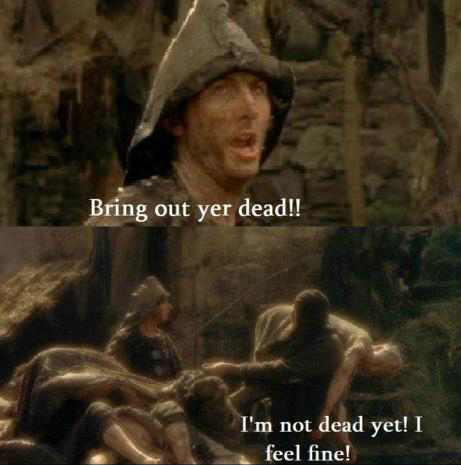
Zombies walk among us – until they need a nice sit-down, of course. It can be tiring to be undead. No wonder they drag their feet around and do all that moaning.
One such moaner is 58-year-old Michel from Montpellier. He has never stopped complaining since the postman delivered a letter one morning in June to offer him condolences on his recent death.
It was, as you might imagine, an administrative error: someone had probably clicked in the wrong checkbox or filed a request in the wrong folder. It was unlikely to be the result of a concerted Kafka-esque conspiracy to erase Michel from existence. Uncheck that box, drag the file out of the folder. It should be easy enough.
Evidently not. Once you’ve been declared dead, it sets in motion a sequence of automated digital-only procedures that sprint towards completion with alarming rapidity. You may have heard of France’s notoriety for officious paperwork and the snail-pace of its bureaucracy when you are living and breathing. But once you’re a stiff, it’s the fast lane electrons all the way.
Michel discovered that his bank accounts had already been frozen. His social security file had been closed immediately. His national health ID card was no longer valid and his top-up health insurance was cancelled.
He nipped over to his local social security office to see if they could put the brakes on the process but apparently it was too late: everything had already been done to kill him off, bar physically shoving him in a box and inviting friends and relatives around for beer and sandwiches.
Surely there’s a rollback option?
Ah now, it’s not that simple. The system architect that designed the automated process did not think of making [Alive] and [Dead] a pair of either-or radio buttons. They did not envisage a situation in which death, our ultimate existential destination, could be reversed by choosing Edit > Undo. There are no second- or third-life Power-Ups IRL. Instead, the system architect not unreasonably assumed that dying would be a one-way trip from which nobody is expected to return.
The system is not a complete disaster, though. The woman at the desk of the social security office was able to use it to find that a French national with exactly the same name and birthdate as Michel had died – albeit 4,500km (c 2,800 miles) away in Israel – and the two strangers’ records had probably been mixed up by a poorly trained official. So the error has been located. Good. Can it be corrected, please?
Yes, she said, before booking him in for a meeting to discuss it in two weeks’ time. No doubt he was also asked to bring documents that explicitly state when he didn’t die.
Comments Off on Still living, still breathing, still walking around … but “legally dead”
Tank Chat #152 | Swiss Centurion | The Tank Museum
The Tank Museum
Published 25 Mar 2022
(more…)
Comments Off on Tank Chat #152 | Swiss Centurion | The Tank Museum
July 22, 2022
Why Did The First World War Break Out? (July Crisis 1914)
[My 2014 series on “The Origins of World War I” can be read here. Although I’d read a fair bit of history on the period, once I began researching the period, even I was surprised at how many different contributing causes there were.]
The Great War
Published 15 Jul 2022The assassination of Archduke Franz Ferdinand and his wife in Sarajevo on the 28th of June 1914 kicked off a crisis among the European Powers. Tensions that built up in the decades before erupted and in early August 1914 the world was at war. But what happened in these fateful July weeks 1914?
(more…)
Comments Off on Why Did The First World War Break Out? (July Crisis 1914)
Winemaking in the Middle Ages | The Process, Taste, Storage and Use
Kobean History
Published 31 Aug 2020
(more…)
Comments Off on Winemaking in the Middle Ages | The Process, Taste, Storage and Use
July 17, 2022
The Berthier After World War One
Forgotten Weapons
Published 31 Jul 2017http://www.patreon.com/ForgottenWeapons
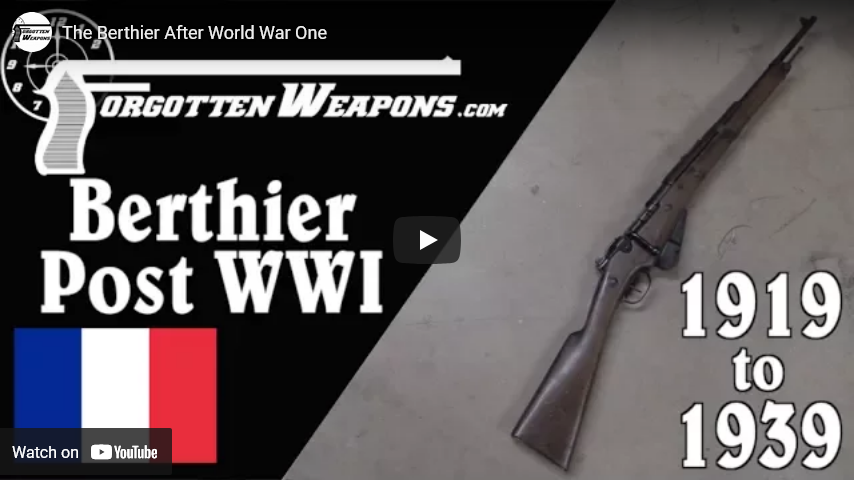
In the aftermath of World War One, France would face the need to replace virtually all of its small arms, because nearly everything it had been using was either a wartime stopgap (like the Ruby, Chauchat, and Berthier 07/15) or had been obsolete before the war began (like the Lebel and Mle 1892 revolver). The first focus of the rearming was a new light machine gun, which would be adopted in the form of the Chatellerault M24/29. Plans were made to develop a semiautomatic infantry rifle and bolt action support troops’ rifle (both in the new 7.5mm rimless cartridge), but these would not prove to be as quickly realized. As a result, the Berthier Mle 1916 carbines would remain in major frontline service right up to the outbreak of World War Two.
During the twenty years between the wars, the Berthiers would see a series of changes and upgrades including:
– Sling bars replacing swivels
– Revised handguard profile
– Raised sights
– Removal of the clearing rods
– Adoption of the 1932N cartridge and associated rechambering
– New metal finishesProduction of new carbines in fact continued all the way until 1939, with at least 160,000 made in 1919 and later. Many of the alterations made during this postwar period are evident on examples found today, and there is a collecting premium on guns that do not exhibit these peacetime modifications. So, let’s have a look, shall we?
If you enjoy Forgotten Weapons, check out its sister channel, InRangeTV! http://www.youtube.com/InRangeTVShow
Comments Off on The Berthier After World War One
QotD: When “the revolution” is in danger, resort to whatever will energize the masses
The problem with that, of course, is that Revolutionary France immediately found herself at war with the rest of Europe. Europe’s crowned heads have rarely been brainiacs, but again, anyone marginally saner than Robespierre saw immediately where the Declaration of the Rights of Man and Citizen was heading. They did the smart thing and invaded, which put the Enlightened in a real bind — war being the third most un-Enlightened thing ever. But they’d rather be hypocrites than dead, the Enlightened, so they had to knock together a new set of national symbols on the fly, ones men would fight and die for (absolutely no one was willing to bleed for “Reason”; whaddaya know).
To their credit, they did a hell of a job. La Marseillaise, Lady Liberty, La patrie en danger! … good stuff. It was part of Napoleon’s singular genius that he could turn these Roman Republic-inspired symbols into first his “consulship”, then his emperorship, but it didn’t have to go that way; Revolutionary France might’ve held out had the Littlest Corporal been killed in action. The important thing here is to note how effective such explicitly nationalist, indeed rabidly jingoist, symbols are, even when pushed by guys who not five minutes ago were proclaiming the Brotherhood of Man.
The Soviets did the same thing, and for the same reasons — look how fast “Workers of the world, unite!” became first the Molotov-Ribbentrop Pact, then the Great Patriotic War for the Fatherland – but they, too, went through an incredibly fecund period of inventing unifying symbols. Even though History has passed few clearer judgments than she has on Communism, you have to admit that as a symbol, the Soviet hammer-and-sickle is world class.
Severian, “Repost: National Symbols”, Founding Questions, 2021-10-27.
Comments Off on QotD: When “the revolution” is in danger, resort to whatever will energize the masses
July 12, 2022
Killing the Resistance, and Rockets of Death – War Against Humanity 068 – July 10, 1943
World War Two
Published 10 Jul 2022The Polish and French resistance find themselves weakened by the lots of their leaders. Hitler decided to give Werner von Braun hundreds of thousands of slaves to launch the German rocket program.
(more…)
Comments Off on Killing the Resistance, and Rockets of Death – War Against Humanity 068 – July 10, 1943
July 11, 2022
The Master Race of Asia? – WAH 067 – July 3 1943
World War Two
Published 8 Jul 2022
(more…)
Comments Off on The Master Race of Asia? – WAH 067 – July 3 1943
July 10, 2022
The Berthier Gets an Upgrade: The Model 1916
Forgotten Weapons
Published 26 Jul 2017http://www.patreon.com/ForgottenWeapons
The “Modifié 1916″ update to the Berthier system of rifles and carbines marked a major improvement in the gun’s combat effectiveness — really the first substantial overhaul to the design since it was developed in 1890. The two main elements of the upgrade were the addition of an upper handguard and an extension of the magazine from 3 rounds to 5, to match the capacity of the Mauser rifles used by Germany. In addition, several other improvements were made at the same time, including a redesign of the sights to favor quick target acquisition over long range precision and the addition of luminous radium elements to the sights. The upgrade package originally also included a dust cover over the bolt, but this was dropped for reasons I have not been able to determine.
This upgrade package was formally adopted in late 1916, and would go into production in 1917. However, it took a substantial time for the weapons to filter down to the front lines, and only a small number of M16 carbines and a very small number of M16 long rifles actually saw combat service before the Armistice. The M16 pattern (particularly the carbines) would form the standard armament for the French military right up to World War II, however, with Berthier carbine production continuing until 1939.
If you enjoy Forgotten Weapons, check out its sister channel, InRangeTV! http://www.youtube.com/InRangeTVShow

Comments Off on The Berthier Gets an Upgrade: The Model 1916


