
World War Two
Published 5 Jul 2022The Gestapo deals a devastating blow to French Resistance, and in Bengal, British India the famine is only getting worse.
(more…)
July 6, 2022
Decapitating the French Resistance – WAH 066 – June 26, 1943
Comments Off on Decapitating the French Resistance – WAH 066 – June 26, 1943
July 5, 2022
Dijon mustard … made from Canadian and Ukrainian mustard seeds
In the New English Review, Theodore Dalrymple explains why Europeans have been experiencing higher shelf prices and shortages for Dijon mustard recently, over and above the ordinary supply chain disruptions of the pandemic years we’ve all had to get used to:
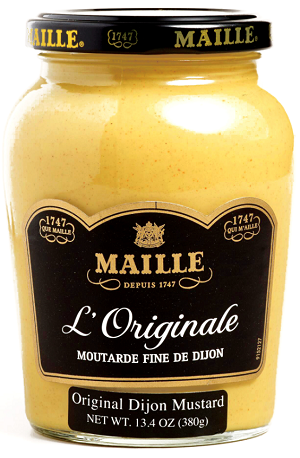
Among myriad smaller consequences of that war is an acute mustard shortage in France. Mustard has all but disappeared from supermarket shelves, having first increased in price dramatically. This has surprised everyone who lazily assumed that Dijon mustard came from Dijon. Why should a war waged in Ukraine lead to the disappearance of mustard throughout France? After all, the famous brands, familiar to everyone, proudly announce on their labels that they are Dijon mustard. Can there be anything more French than Dijon mustard?
Perhaps the mustard is elaborated in Dijon, but the mustard seed, it turns out to everyone’s surprise, is imported from Canada and Ukraine. Apparently, Canada has seen a disastrous harvest of mustard seed, while there is no need to explain the shortage in Ukraine. Dijon mustard is about as local to Dijon as a modern soccer team is local to the city in which it has its stadium.
What is striking about this mustard crisis, unimportant except to those trying to make a proper vinaigrette or lapin à la moutarde, is its revelation of a perennial aspect of social psychology: namely, a resort to conspiracy theory. For some say that there is not really any mustard shortage at all — that mustard has disappeared from supermarket shelves because the supermarket chains are hoarding it, that they have a plentiful supply in their warehouses and will release it little by little, thereby profiteering by the resultant high prices. The war in Ukraine is only a pretext.
This is an old, indeed medieval, trope in times of shortage. There may well have been times, of course, when people really did hoard for the purposes of profiteering, but people rarely hoard something that is in abundant supply.
Yet many people require no evidence or proof to believe in the hoarding story. Does it not, after all, stand to reason? Do not merchants try to maximize their profits, and is hoarding not an easy way to do so? Practically all the mustard in France is sold in supermarkets — themselves a cartel that could easily agree to remove the product from the shelves. Surely no further evidence is needed.
Comments Off on Dijon mustard … made from Canadian and Ukrainian mustard seeds
July 4, 2022
QotD: The French solution to trench warfare
That isn’t to say that battlefield tactics hadn’t improved. Quite to the contrary, 1918 saw both the Germans and the Allies deploy far more effective systems for assaulting trenches, though I would argue that it was actually the French who came closest to having the matter as figured out as one could have it with the equipment of 1918. The French method, termed la bataille conduite (“methodical battle”) has an understandably poor reputation because this method failed so badly against the technologies of 1940 but as we’ve seen that was quite a different technological environment than 1918.
On the defensive, the French had adopted many of the same principles of the German defense-in-depth we’ve already discussed. On the offense, they came to favor (particularly under the influence of Philippe Pétain and […] Ferdinand Foch) an offensive doctrine designed to maximize France’s position in an attritional contest: that is to limit losses and maximize enemy casualties while still taking and holding ground. The system favored limited “bite-and-hold” attacks, ideally limited such that the attack stopped before triggering the inevitable German counter-attack. Remember that it was when the attacker ran out of steam and the defender’s counter-attack came that the casualty ratios tended to shift to favor the defender. In French thinking, the solution was just to not reach that point.
Instead, the French came to favor – and the British and Americans picked up the same method by the end – elaborately prepared small offensives. The elaborate preparation meant planning out the attack carefully, using shorter but carefully planned hurricane barrages (all of this planning, of course took time) and then seizing the enemy’s forward positions and just their forward positions. Instead of then trying to push through – the old French notion of assault brutal et continu (“brutal and continuous” – a “keep up the pressure till they break” method) which Robert Nivelle had favored – methodical battle focused on “bite-and-hold”.
Once you hit your limited objectives in that first rush where enemy resistence is disoriented (from the short, hurricane barrage) and weaker – and thus where the casualty ratio favors you – you stop and begin fortifying your position. You dig those communications trenches, move up your artillery and brace for the counter-attack. By the time the enemy realizes you aren’t going to attack his second or third line positions (and trigger his devastating counter-attack), you are dug in and prepared for his attack (the hold part of “bite-and-hold”). To reestablish defense in depth, the defender now has to back up to establish new lines to the rear (or launch his own fresh offensive, but by late 1918, the Germans were too weak for this). A long series of such attacks – with significant intervals for fresh careful planning and stockpiling resources – could slowly but surely lever your opponent off of key positions, one by one. It would also preserve a favorable balance of casualties, ensuring that in the end, the enemy runs out of men and shells before you do (that is the “rupture” that Joffre had always hoped for, but which arrived but two years too late for his career).
Such a slow, expensive, bloody and unglamorous strategy was in some ways only politically possible once, by 1918, it had become apparent that all other options were exhausted. That said, to argue that this bite-and-hold operational doctrine broke the trench stalemate is probably not fair either. The progress of allied offensives in 1918 was extremely slow by even the standards of 1914. The German Spring Offensive was well and truly done in July and the Allied offensive picked up in August and ran through November as fast as it could (with Foch doing everything short of getting out and pushing the offensive to try to speed it up) and yet the final allied positions by November were not even in Germany. Even at its greatest distance in 100 days of unbroken victories by a force with materiel and numerical superiority, the front moved less than 100 miles and the overall casualty ratio was roughly even (around a million on both sides).
Bret Devereaux, “Collections: No Man’s Land, Part II: Breaking the Stalemate”, A Collection of Unmitigated Pedantry, 2021-09-24.
Comments Off on QotD: The French solution to trench warfare
July 3, 2022
Model 1907/15 Berthier: The WW1 Standard Infantry Rifle
Forgotten Weapons
Published 24 Jul 2017http://www.patreon.com/ForgottenWeapons
When World War One broke out in 1914, France mobilized millions of men into military service — and it became abundantly clear that a lot of new rifles would need to be manufactured. The 1886 Lebel was no longer in production and was a slow rifle to make in any case — but the 1907 Colonial Berthier was being produced already, and was a more efficient design as well. By late 1914, plans were underway to drastically increase Berthier rifle production.
A few changes were made to the 1907 pattern, mainly changing the front end to accept the standard 1886 Lebel bayonet (“Rosalie”). After the first 80,000 had been made, the bolt handle was also changed from the bent carbine style to a heavier duty straight type. With these changes made, the Modele 07/15 was ready for mass adoption by the infantry, where it would serve side by side with the Lebel.
The primary manufacturer of 07/15 rifles was the St. Etienne arsenal, which build between 1.0 and 1.2 million of them by the spring of 1917. The Chatellerault arsenal produced another 436,000, and the Delauney Belleville automobile factory retooled its workshops to make rifles, producing another 170,000 of them. The Remington company in the US also took a contract to make 250,000 Berthier rifles, but was unable to meet the terms of the contract. Remington had taken on more wartime production work than it could handle, and failed to meet French quality and scheduling requirements. In August of 1916 that contract was cancelled, with just 9,440 rifles sent to France for use. The remaining 5,000-10,000 that had been made by Remington were sold on the commercial market in the US.
By 1916, it was clear that the 3-round capacity of the Berthier was a very real disadvantage (both tactically and psychologically) to the German Mauser rifles, and an upgrade program was put underway. This would ultimately become the 1916 pattern and would go into production in 1917.
If you enjoy Forgotten Weapons, check out its sister channel, InRangeTV! http://www.youtube.com/InRangeTVShow

Comments Off on Model 1907/15 Berthier: The WW1 Standard Infantry Rifle
July 2, 2022
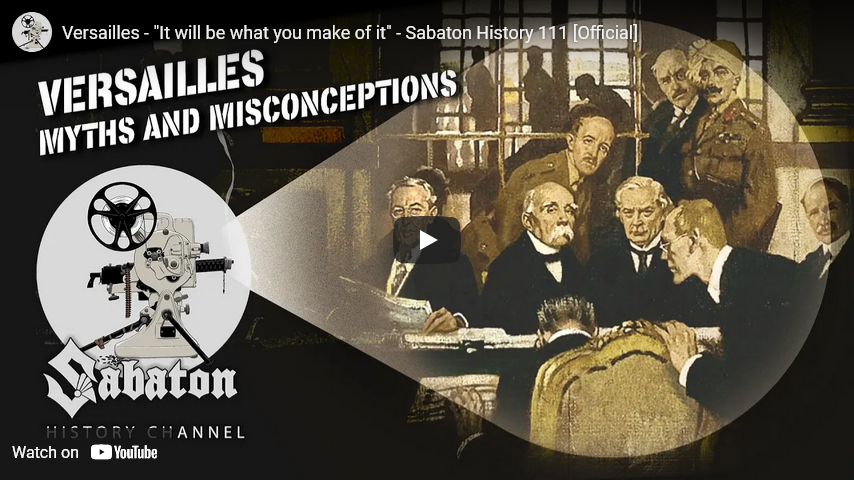
Versailles – “It will be what you make of it” – Sabaton History 111 [Official]
Sabaton History
Published 1 Jul 2022There are a great many myths and misconceptions about the Treaty of Versailles, and it has been used and even weaponized many times over the years. Today, Indy goes over the nuts and bolts of what it actually was and what it actually did.
Support Sabaton History on Patreon: https://www.patreon.com/sabatonhistory
Listen to “Versailles” on the album The War To End All Wars: https://music.sabaton.net/TheWarToEnd…
Listen to Sabaton on Spotify: http://smarturl.it/SabatonSpotify
Official Sabaton Merchandise Shop: http://bit.ly/SabatonOfficialShopHosted by: Indy Neidell
Written by: Markus Linke and Indy Neidell
Directed by: Rickard Erixon and Indy Neidell
Produced by: Pär Sundström, Astrid Deinhard and Spartacus Olsson
Creative Producer: Rickard Erixon, Indy Neidell
Set Design: Daniel Eriksson, Rickard Erixon,
Executive Producers: Pär Sundström, Joakim Brodén, Tomas Sunmo, Indy Neidell, Astrid Deinhard, and Spartacus Olsson
Post-Production Director: Marek Kamiński
Editor: Iryna Dulka
Sound Editor: Marek Kamiński
Archive: Reuters/Screenocean – https://www.screenocean.com
Colorizations by: Olga Shirnina, a.k.a. Klimbim – https://klimbim2014.wordpress.com/Sources:
IWM: 130-09+10, IWM 130-01
Auckland Libraries Heritage Collections 5-1276
Médiathèque de l’architecture et du patrimoine
hpebley3 from freesond.org
All music by: SabatonAn OnLion Entertainment GmbH and Stuffed Beaver LTD co-Production.
© Stuffed Beaver LTD, 2019 – all rights reserved.
Comments Off on Versailles – “It will be what you make of it” – Sabaton History 111 [Official]
June 25, 2022
Colonial Berthiers: 1902 Indochina and 1907 Senegalese
Forgotten Weapons
Published 21 Jul 2017http://www.patreon.com/ForgottenWeapons
The sharpshooters of the French colonial forces in Indochina (the Tirailleurs Indochinois) had never been issued Lebel rifles, and were still using single shot Gras rifles at the turn of the century. The Indochinese soldiers were rather short statured, and the Lebel was simply too long for them to use efficiently. The colonial government requested a special weapon for these men, and the result was the 1902 Berthier.
The Berthier carbine was much more compact than the Lebel, and it was also less expensive to manufacture and simpler to instruct troops with. So after some brief experimentation, a version was produced with a 25 inch (635mm) long barrel, which was a nice balance between the carbines and the Lebel rifle. In my opinion, the 1902 is the ideal size for a Berthier, and I think it handles best of all the different variations made.
An initial production run of 22,500 of these 1902 rifles was made by Chatellerault between 1902 and 1912. A second batch of about 25,000 more would be produced in the 1920s, but we will discuss these in a separate video, as they incorporated the 1916 upgrades.
With the successful implementation of the Berthier in the Indochinese colonial forces, it would stand out as an obvious solution for the need to upgrade the arms of France’s African colonial troops as well. These soldiers were not short, but also had outdated Gras rifles, and Lebel production was no longer active by 1907. As a result, a further lengthened Berthier was suggested for the Senegalese troops, with a barrel 31.5 inches (800mm) long; equal to that of the Lebel. This was accepted into service, and 25,000 were manufactured by Chatellerault between 1907 and the beginning of the Great War in 1914.
With the urgent need for more rifles because of World War One, the 1907 Berthier (renamed to the 1907 Colonial and issued to colonial troops besides just the Senegalese as of 1908) would attract the interest of the military because it was cheaper to manufacture than the Lebel, and still in active production. The result would be the 07/15 Berthier, which would become a dual standard infantry rifle alongside the 1886 Lebel in the war.
If you enjoy Forgotten Weapons, check out its sister channel, InRangeTV! http://www.youtube.com/InRangeTVShow

Comments Off on Colonial Berthiers: 1902 Indochina and 1907 Senegalese
June 20, 2022
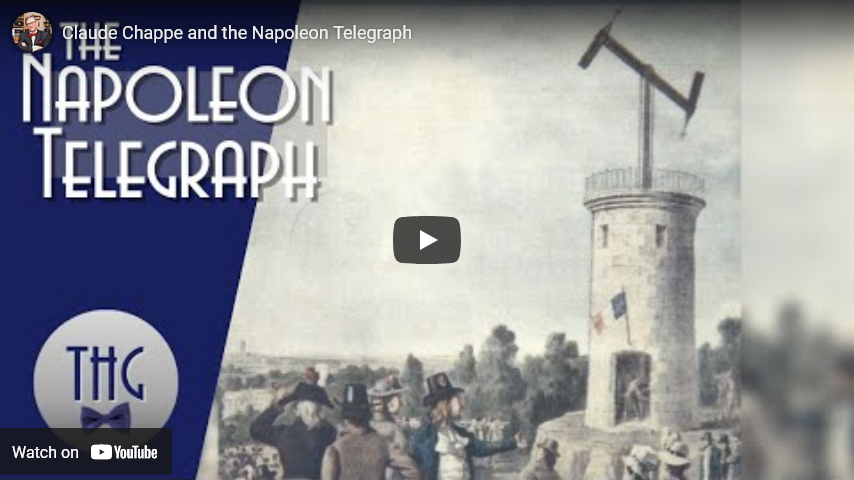
Claude Chappe and the Napoleon Telegraph
The History Guy: History Deserves to Be Remembered
Published 2 Mar 2022The development of technology for speedy long-distance communication dates back to antiquity, and reached its pre-electronic peak in the telegraph before Samuel Morse’s telegraph. Before wires crossed the world, Napoleonic France could send a message from Paris to Lille, a distance of some 250 kilometers, in ten minutes.
Check out our new community for fans and supporters! https://thehistoryguyguild.locals.com/
This is original content based on research by The History Guy. Images in the Public Domain are carefully selected and provide illustration. As very few images of the actual event are available in the Public Domain, images of similar objects and events are used for illustration.
You can purchase the bow tie worn in this episode at The Tie Bar:
https://www.thetiebar.com/?utm_campai…All events are portrayed in historical context and for educational purposes. No images or content are primarily intended to shock and disgust. Those who do not learn from history are doomed to repeat it. Non censuram.
Find The History Guy at:
New community!: https://thehistoryguyguild.locals.com/
Please send suggestions for future episodes: Suggestions@TheHistoryGuy.netThe History Guy: History Deserves to Be Remembered is the place to find short snippets of forgotten history from five to fifteen minutes long. If you like history too, this is the channel for you.
Awesome The History Guy merchandise is available at:
teespring.com/stores/the-history-guyScript by THG
#history #thehistoryguy #France
June 19, 2022
QotD: “Aristos à la Lanterne!“
Sgt. Mom, “Aristos a la Lanterne!”, Chicago Boyz, 2022-03-17.
Comments Off on QotD: “Aristos à la Lanterne!“
June 17, 2022
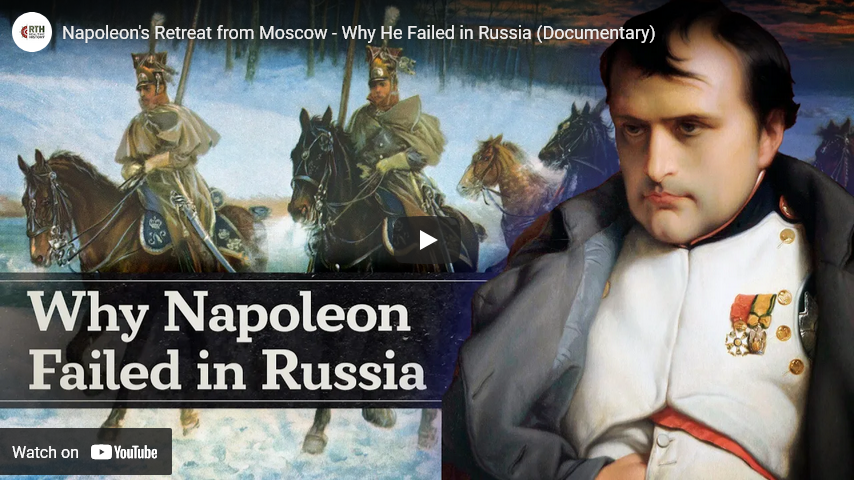
Napoleon’s Retreat from Moscow – Why He Failed in Russia
Real Time History
Published 16 Jun 2022Sign up for the CuriosityStream + Nebula Bundle: https://curiositystream.com/realtimeh…
Napoleon’s retreat from Moscow and from Russia as a whole is one of the most dramatic scenes in history. Starving and freezing, the French Grande Armée is desperately trying to reach the Berezina River. The revitalized Russian Army is on their heels and almost catches their prey in the 2nd Battle of Krasny. But it wasn’t just “General Winter” that defeated Napoleon in Russia.
» SUPPORT US ON PATREON
https://patreon.com/realtimehistory» THANK YOU TO OUR CO-PRODUCERS
John Ozment, James Darcangelo, Jacob Carter Landt, Thomas Brendan, Kurt Gillies, Scott Deederly, John Belland, Adam Smith, Taylor Allen, Rustem Sharipov, Christoph Wolf, Simen Røste, Marcus Bondura, Ramon Rijkhoek, Theodore Patrick Shannon, Philip Schoffman, Avi Woolf, Emile Bouffard, William Kincade, Daniel L Garza, Stefan Weiß, Matt Barnes, Chris Daley, Marco Kuhnert, Simdoom» SOURCES
Boudon, Jacques-Olivier. Napoléon et la campagne de Russie en 1812 (2021).
Chandler, David. The Campaigns of Napoleon, Volume 1 (New York 1966).
Lieven, Dominic. Russia Against Napoleon (2010).
Mikaberidze A. The Battle of the Berezina: Napoleon’s Great Escape (Pen&Sword Military, 2010)
Rey, Marie-Pierre. L’effroyable tragédie: une nouvelle histoire de la campagne de Russie. (2012).
Zamoyski, Adam. 1812: Napoleon’s Fatal March on Moscow. (2005).
Отечественная война 1812 года. Энциклопедия (Москва: РОССПЭН, 2004)
Безотосный В. М. Россия в наполеоновских войнах 1805–1815 гг. (Москва: Политическая энциклопедия, 2014)
Троицкий Н.А. 1812. Великий год России (Москва: Омега, 2007)
(Прибавление к «Санкт-Петербургским ведомостям» №87 от 29 октября 1812 / http://www.museum.ru/museum/1812/War/…)» OUR STORE
Website: https://realtimehistory.net»CREDITS
Presented by: Jesse Alexander
Written by: Jesse Alexander
Director: Toni Steller & Florian Wittig
Director of Photography: Toni Steller
Sound: Above Zero
Editing: Toni Steller
Motion Design: Toni Steller
Mixing, Mastering & Sound Design: http://above-zero.com
Digital Maps: Canadian Research and Mapping Association (CRMA)
Research by: Jesse Alexander, Sofia Shirogorova
Fact checking: Florian WittigChannel Design: Simon Buckmaster
Contains licensed material by getty images
Maps: MapTiler/OpenStreetMap Contributors & GEOlayers3
All rights reserved – Real Time History GmbH 2022
Comments Off on Napoleon’s Retreat from Moscow – Why He Failed in Russia
June 15, 2022
Model 1892 Berthier Artillery Musketoon
Forgotten Weapons
Published 19 Jul 2017http://www.patreon.com/ForgottenWeapons
The original 1890 Berthier carbine was designed for cavalry, but a slightly modified version was produced (in small numbers) with a bayonet lug, for use by the Gendarmerie. In 1892, the French military would adopt that same carbine for use by an assortment of troops who were better suited with a carbine than a full size Lebel rifle. These included primarily artillery crews, but also engineers, messengers, drivers, and others.
The Modele 1892 Mousqueton d’Artillerie was basically identical to the 1890 cavalry carbine, including the same 3-round Mannlicher-type clip. It was put into production at both the St Etienne and Chatellerault factories, and by August of 1914 384,000 were in French inventory. By the time the improved 1916 model was put into production, a total of 675,000 of these carbines would be built.
If you enjoy Forgotten Weapons, check out its sister channel, InRangeTV! http://www.youtube.com/InRangeTVShow

Comments Off on Model 1892 Berthier Artillery Musketoon
June 8, 2022
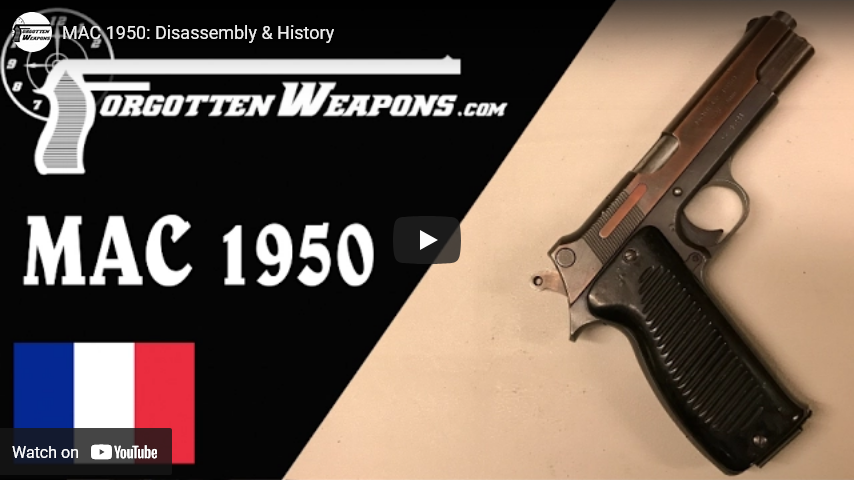
MAC 1950: Disassembly & History
Forgotten Weapons
Published 27 Feb 2017Shooting the MAC 1950: https://www.youtube.com/watch?v=sduZ4…
The PA MAC 1950 (Pistolet Automatique Modele 1950) was the result of a 1946 French effort to standardize on a single military pistol. By the end of WWII, the French military had accumulated a mess of different pistols of French, Spanish, American, and German origin; officially using the Luger, P38, Mauser HSc, 1911 (and A1), 1935A, 1935S, Star, Ruby, and Model 1892 revolver.
Trials were held in 1950, although the outcome was predetermined — this pistol, designed by St Etienne and largely derived from the Model 1935S, was to be the next French military sidearm. A design from the SACM company was also tested, as was a commercially purchased SIG SP47/8, but this was for comparison sake only. In fact, the SIG was the best performer in the testing, with the St Etienne design suffering from cracked parts and durability problems. It would be improved, however, and deemed suitable for adoption by early 1951.
Production began in 1953 at the Chatellerault arsenal (hence the “MAC” name used in the US). All of 221,900 were made by Chatellerault until it was shut down in 1963, when production transferred to St Etienne, where another 120,000 would be made by 1978.
Mechanically, the gun is largely taken form the Browning 1911, with a few improvements. The recoil spring is of a captive design, and the fire control group is all built into a single easily replaced unit (similar to the Tokarev and the 1935S). It is single action only, with hammer-block and magazine safeties and a 9-round magazine of standard 9x19mm ammunition. It is still in French service, having proven to be a reliable and dependable weapon, if outdated by today’s standards.
http://www.patreon.com/ForgottenWeapons
Cool Forgotten Weapons merch! http://shop.bbtv.com/collections/forg…
If you enjoy Forgotten Weapons, check out its sister channel, InRangeTV! http://www.youtube.com/InRangeTVShow
Comments Off on MAC 1950: Disassembly & History
June 7, 2022
D Day: The First Canadian Parachute Battalion and the Battle for the Village of Varaville
The History Guy: History Deserves to Be Remembered
Published 6 Jun 2022There are so many stories of heroism involved in the massive Operation Overlord, among them the extraordinary story of the little-known first Canadian Parachute Battalion. The lightly armed Canadians were among the first allied soldiers to hit the ground in France on D-Day.
Check out our new community for fans and supporters! https://thehistoryguyguild.locals.com/
This is original content based on research by The History Guy. Images in the Public Domain are carefully selected and provide illustration. As very few images of the actual event are available in the Public Domain, images of similar objects and events are used for illustration.
You can purchase the bow tie worn in this episode at The Tie Bar:
https://www.thetiebar.com/?utm_campai…All events are portrayed in historical context and for educational purposes. No images or content are primarily intended to shock and disgust. Those who do not learn from history are doomed to repeat it. Non censuram.
Find The History Guy at:
New community!: https://thehistoryguyguild.locals.com/
Please send suggestions for future episodes: Suggestions@TheHistoryGuy.netThe History Guy: History Deserves to Be Remembered is the place to find short snippets of forgotten history from five to fifteen minutes long. If you like history too, this is the channel for you.
Awesome The History Guy merchandise is available at:
teespring.com/stores/the-history-guyScript by THG
#history #thehistoryguy #DDay

Comments Off on D Day: The First Canadian Parachute Battalion and the Battle for the Village of Varaville
June 6, 2022
Dr. Mengele Takes Command – WAH 063 – June 5, 1943
World War Two
Published 5 Jun 2022Despair in Germany, more death in the Jewish ghettos, and Dr. Mengele tales command in Auschwitz-Birkenau.
(more…)
Comments Off on Dr. Mengele Takes Command – WAH 063 – June 5, 1943
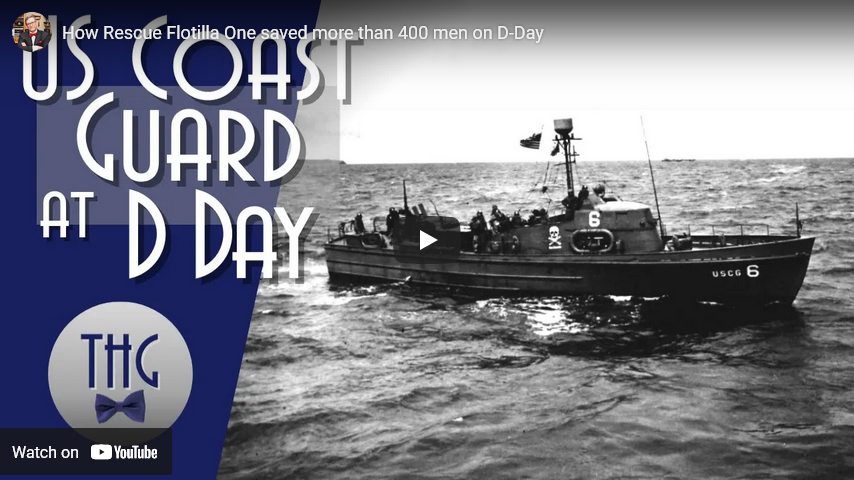
How Rescue Flotilla One saved more than 400 men on D-Day
The History Guy: History Deserves to Be Remembered
Published 2 Jun 2018The History Guy remembers the heroic service of Rescue Flotilla 1 of the United States Coast Guard during D-Day. It is history that deserves to be remembered.
The History Guy uses images that are in the Public Domain. As photos of actual events are sometimes not available, I will often use photographs of similar events and objects for illustration.
Patreon: https://www.patreon.com/TheHistoryGuy
The History Guy: Five Minutes of History is the place to find short snippets of forgotten history from five to fifteen minutes long. If you like history too, this is the channel for you.
Awesome The History Guy merchandise is available at:
teespring.com/stores/the-history-guyThe episode is intended for educational purposes. All events are presented in historical context.
#ushistory #militaryhistory #thehistoryguy
Comments Off on How Rescue Flotilla One saved more than 400 men on D-Day
June 1, 2022
The Battle of The Glorious First of June 1794
MaritimeGB
Published 17 Feb 20131794 — After the failed harvest, France organises for a desperately needed grain convoy to cross the Atlantic. British Admiral Lord Howe is sent to intercept the French and although the British win the fight, the tactical victory goes to France.
Comments Off on The Battle of The Glorious First of June 1794


