The Korean War by Indy Neidell
Published 3 Jun 2025The MacArthur Senate Hearings continue this week, with US Secretary of State Dean Acheson now in the hot seat. He takes a rather confusing barrage of questions, and yet manages to signal to the world at large, i.e. the Chinese, that the US is open to negotiations to end the war. The war still continues in the field, of course, with the UN forces’ Operation Piledriver in action, driving into the “Iron Triangle” and trying to trap as much of the enemy as possible.
Chapters
00:00 Intro
01:07 Recap
01:35 Acheson Speaks
05:44 Operation Piledriver
09:10 Attacks Begin
10:53 A Unifying JCS Directive
16:54 Summary
(more…)
June 4, 2025
The Korean War Week 50 – Trapped in the Triangle: Korea’s Killing Zone – June 3, 1951
Comments Off on The Korean War Week 50 – Trapped in the Triangle: Korea’s Killing Zone – June 3, 1951
Remarkable Victory – The Bomber War Episode 5 – Jan to June 1944
HardThrasher
Published 28 Feb 2024In which the USAAF and RAF finally start to Get Good at their jobs and tie up their respective campaigns for literally the first time.
00:00 – 04:01 – Introduction
04:06 – 08:12 – Forward Operating Base
08:15 – 11:30 – Changes in Command
11:32 – 16:16 – Doolittle’s Plan
16:20 – 22:25 – Big Week
22:34 – 29:32 – Aftermath
29:35 – 32:06 – Berlin
32:09 – 33:59 – Overlord
34:02 – Survivor’s Club
(more…)
Comments Off on Remarkable Victory – The Bomber War Episode 5 – Jan to June 1944
June 3, 2025
Exercise Tiger: The WW2 Cover-Up Before D Day
The History Chap
Published 23 May 2024Exercise Tiger 1944, was a large-scale dress rehearsal for the D-Day landings, off the Slapton Sands in England, that went horribly wrong. Over 700 US servicemen were killed, more than were killed on Utah beach on D-Day itself! With D-Day imminent, Allied Supreme Commander, General Dwight Eisenhower, ordered the disaster to be hushed up.
Following a friendly fire incident on Slapton Sands on the 27th April 1944, a convoy carrying US troops was attacked in the early hours of the 28th by German E-Boats. In what is called the Battle of Lyme Bay, two ships in the convoy were sunk resulting in the loss of over 700 US servicemen. Whilst rumours suggest that there were many casualties resulting from the friendly fire on Slapton Sands, the US Army has always remained tight-lipped. To this day, the mystery remains as to what extent the casualty figures were covered up.
In the 1980’s, a Sherman tank was raised from the seabed. It now stands at the end of Slapton Sands (near the village of Torcross) as a memorial to the young men who died 6 weeks before D-Day during Exercise Tiger.
Chapters
0:00 Intro
0:42 D-Day 1944
1:40 Slapton Sands
2:30 Civilian Evacuation
3:22 Military Build-up
4:58 Exercise Tiger
6:07 Live Fire Disaster
7:37 Convoy T-4
9:15 Spotted by Germans
10:03 E-boat attack
11:41 Battle of Lyme Bay
14:06 Casualty Figures
14:43 D-Day Compromised?
15:37 Cover-up?
17:00 D-Day Success
18:08 Exercise Tiger Remembered
(more…)
Comments Off on Exercise Tiger: The WW2 Cover-Up Before D Day
June 2, 2025
Fighting at Yenangyaung, 17-19 April 1942
Dr. Robert Lyman on the battle at Yenangyaung between 17-19 April 1942 early in the Burma campaign:
… the Yenangyaung battle is a fascinating one, with its own small degree of controversy, I decided to lay it out in this post. A mystery of the battle is the differing accounts of the Chinese attacks on the 19th April. In the British accounts (including Bill Slim’s in Defeat into Victory) the Chinese are blamed for failing to attack in the morning as they had promised, adding further jeopardy to the fate of the encircled 1st Burma Division. But was this true? The Japanese, Chinese and American accounts differ, so I thought I’d lay out the story to allow you, dear reader, to come to your own conclusion.
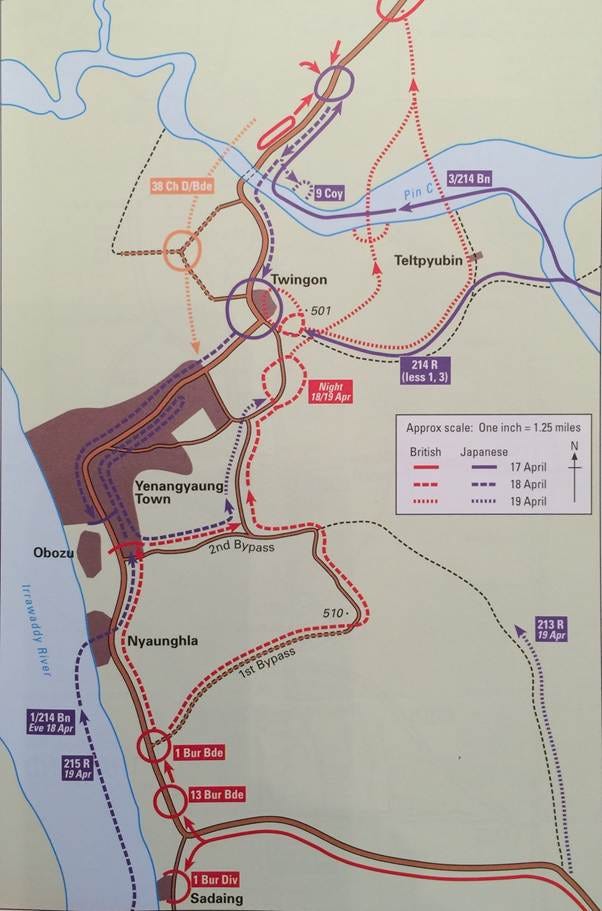
The fabulous map of Yenangyaung produced by the late Ian Lyall Grant.
The scrap at Yenangyaung was the final Corps-sized battle before the order to evacuate Burma Corps was given in early May. The Japanese had pushed out of Rangoon in mid-March, driving up the Irrawaddy on the left and against Toungoo on the right. Allied plans for the defence of Burma were inadequate, both Chinese (on the right) and Slim’s Burcorps (on the left) effectively fighting separate battles. Attempts by General Harold Alexander, the Army Commander, to control the battle and constrain the advancing Japanese ultimately came to naught. Alexander, Slim and Lieutenant General Joe Stilwell, nominally commanding the Chinese 5th Army, tried every trick in the tactical rule book to bring a halt to the relentless Japanese advance, and to destroy them in battle. After a month of fighting in which the Chinese were pushed out of Toungoo, the British lost control of Prome and an attempt to consolidate a defensive line across the country failed, the Japanese moved up the Irrawaddy in an attempt to turn the British flank, breaking in at the oilfield town of Yenangyaung on 17 April. At the time Slim’s Burma Corps was attempting to withdraw to the north from Allamyo. The Japanese infiltration into Yenangyaung cut the British in half. The 1st Burma Division was now cut off in Yenangyaung. The battle by the already weakened division (amounting to probably no more than 4,000 troops) into the Yenangyaung pocket over the period 17 and 19 April proved to be the severest trial yet faced by British troops in the short Burma campaign, the pressure applied by the Japanese exacerbated by the intense heat and the lack of water.
It was critical that Slim defeated this Japanese infiltration, rescue the 1st Burma Division from encirclement and retain the integrity of his Corps. If Yenangyaung were lost the Japanese would be free to sweep north to threaten Mandalay. It was crucial therefore that the divisional commander – Major General Bruce Scott – held on for as long as he could. But Slim had no reserve. The only hope of relief lay in assistance from the Chinese far to his right. He concluded that if he could engineer a attack into the pocket by the Chinese, across the Pin Chaung, combined with a breakout attack by 1st Burma Division, they might have a chance of escape. Nothing else looked likely to succeed.
When asked, Stilwell agreed to Alexander’s request for help to be provided to Slim, and gave him Lieutenant General Sun Lijen’s 38th Division – responsible for the defence of Mandalay – for the task. Chiang Kai-shek had given Sun responsibility for defending Mandalay. At midnight on 16 April Sun received an order from General Lo Cho-yin, “to dispatch his 113th Regiment to Kyaukpadaung, there to be commanded by the British General Slim …” Sun’s friend, Dr Ho Yungchi, recorded that by 3 a.m. he had arrived at Lo’s HQ at Pyawbe to discuss the order. Lo explained that the British were in serious trouble “in the oil town of Yenangyaung and had sent repeated requests for help”. By 6.30 a.m. it was agreed that Sun would personally take command of the 113th Regiment, while the two remaining regiments stayed to defend Mandalay. Sun and 1,121 men of 113th Regiment (commanded by Colonel Liu Fang-wu) arrived at Kyaukpadaung on the morning of 17 April.
Slim recalled: “The situation was not encouraging, and I was greatly relieved to hear that 113 Regiment of the Chinese 38th Division was just arriving at Kyaukpadaung. I dashed off in my jeep to meet their commander and give him his orders … this was the first time I had had Chinese troops under me … I got to like all, or almost all, my Chinese very much. They are a likeable people and as soldiers they have in a high degree the fighting man’s basic qualities – courage, endurance, cheerfulness, and an eye for country.”1
At Yenangyaung, Slim’s plan was for Sun’s 38th Division to attack from the north on the morning of 18th April while the 1st Burma Division, within the pocket, fought its way out. As Slim and Sun Lijen talked, discussing the details of the attack planned for the following morning Slim decided that he would place the Stuart tanks of the 7th Armoured Brigade directly under Sun’s command. It was only a move a man confident in the capabilities of his allies could make. Slim commented that “I was impressed by Sun and it was essential to gain his confidence. His division had no artillery or tanks of its own, and I was therefore arranging that all the artillery we had this side of the Pin Chaung and all available tanks should support his attack.” The commander of the British armoured brigade – Brigadier John Anstice – accepted this arrangement and according to Slim “he and Sun got on famously together”. What’s more, the soldiers worked well together too, Slim recording that the “gunners and tank crews, as is the way of British soldiers, soon got on good terms with their new comrades, and, in spite of language difficulties of an extreme kind, co-operation was, I was assured by both sides, not only close but mostly friendly.”2 Accordingly, at 6.15 a.m. on 18 April, Major Mark Rudkin of 2nd Royal Tank Regiment (2RTR) reported as instructed by Anstice to 38th Division HQ:
There was little activity except for the cooking of breakfast and it seemed most unlikely that the attack could start on time. I asked the British liaison officer with the Chinese what was happening and he informed me that as the Chinese realized that they would not be ready to attack at 0630 hours, they had put their watches back one hour, so that officially they were still attacking at 0630 though the time would in reality be 0730. They had, therefore, not lost “face” by being late.
The plan was that a troop of tanks would follow the leading troops of the leading Chinese battalion and give what support it could. Another troop was to follow the leading infantry battalion and assist the leading troop if required. The tanks would be almost entirely road bound owing to the going off the road.
At 0730 the assaulting Chinese moved forward off the ridge on a front of about four hundred yards, the leading troop keeping very close behind on the road. On foot near the tanks was a Chinese interpreter who carried out liaison between the tanks and infantry.
After advancing about half a mile the leading tank was hit by a Japanese 75-mm gun situated on the road just north of the Pin Chaung which was firing straight up 300 yards of road. The tank was disabled but there were no casualties.
The Chinese advance continued and by afternoon had almost reached the line of the ford on the Pin Chaung which was still held by the enemy. The Chinese had had heavy casualties, especially amongst officers, as it was the custom for Chinese officers to lead, whatever their rank. It was finally decided to hold positions about half a mile north of the crossing and continue the attack next day.3
With the first attack a failure, the Japanese retained their grip on both the ford and the village of Twingon. The situation for the surrounded remnants of the 1st Burma Division was desperate; the Japanese close to achieving a complete victory. Slim and Sun then worked through a plan for another attempt to be made the following morning, 19th April. This day also began badly, however. The Chinese attack was scheduled to begin at 7 a.m. British accounts subsequently recorded that a Chinese attack did not materialise at this time. Slim subsequently recorded in Defeat into Victory that the failure to attack must have been a function of the administrative difficulties faced by the Chinese. He wrote that with the Chinese “lack of signalling equipment, of means of evacuating wounded and of replenishing ammunition, and their paucity of trained junior leaders it was not surprising that to sort themselves out, reform, and start a fresh attack took time”.4 Slim was invariably impressed with what he saw of the Chinese soldier in action, but considered their support and command functions to be shockingly poor and a source of constant frustration to themselves, and to all who had occasion to operate with them.
Slim, and most other British published accounts, including the Indian and British Official Histories, record that the attack finally went in at 3 p.m., when Colonel Liu’s 113th Regiment successfully captured the ford and penetrated into Yenangyaung.5 “When the Chinese did attack they went in splendidly” wrote Slim in admiration. “They were thrilled at the tank and artillery support they were getting and showed real dash. They took Twingon, rescuing some two hundred of our prisoners and wounded. Next day, 20th April, the 38th Division attacked again and with tanks penetrated into Yenangyaung itself, repulsing a Japanese counter-attack. The fighting was severe and the Chinese acquitted themselves well, inflicting heavy losses, vouched for by our own officers.”
1. Slim, Defeat into Victory (1956), p. 63.
2. Ibid., p. 65.
3. Bryan Perrett, Tank Tracks to Rangoon: The Story of British Armour in Burma (London: Robert Hale, 1978)
4. Slim, op. cit., p. 70.
5. Bisheshwar Prasad (ed,) The Retreat from Burma 1941 – 42 (Calcutta, Combined Inter-Service Historical Section, 1954), p. 296.
Comments Off on Fighting at Yenangyaung, 17-19 April 1942
June 1, 2025
Panzers Attack! – Ten Days in Sedan
World War Two
Published 31 May 2025May 10, 1940. A new kind of warfare comes to the fore as a German Panzer Group rumbles through the Ardennes towards Sedan. Heinz Guderian has one goal in mind — Get to the Meuse! If he can manage that, then the Battle of France may be over before it even begins. Can the Allies hold back the armoured armada?
Chapters
01:05 German Forces
04:13 Blitzkrieg Theory, Applied
07:37 The Advance Begins
14:50 The Allied Plan
17:59 A Tight Schedule
20:57 Summary
21:16 Conclusion
(more…)
Comments Off on Panzers Attack! – Ten Days in Sedan
Ted Gioia on stopping AI cheating in academia
I’ve never been to Oxford, either as a student or as a tourist, but I believe Ted Gioia‘s description of his experiences there and how they can be used to disrupt the steady take-over of modern education by artificial intelligence cheats:

How would the Oxford system kill AI?
Once again, where do I begin?
There were so many oddities in Oxford education. Medical students complained to me that they were forced to draw every organ in the human body. I came here to be a doctor, not a bloody artist.
When they griped to their teachers, they were given the usual response: This is how we’ve always done things.
I knew a woman who wanted to study modern drama, but she was forced to decipher handwriting from 13th century manuscripts as preparatory training.
This is how we’ve always done things.
Americans who studied modern history were dismayed to learn that the modern world at Oxford begins in the year 284 A.D. But I guess that makes sense when you consider that Oxford was founded two centuries before the rise of the Aztec Empire.
My experience was less extreme. But every aspect of it was impervious to automation and digitization — let alone AI (which didn’t exist back then).
If implemented today, the Oxford system would totally elminate AI cheating — in these five ways:
(1) EVERYTHING WAS HANDWRITTEN — WE DIDN’T EVEN HAVE TYPEWRITERS.
All my high school term papers were typewritten — that was a requirement. And when I attended Stanford, I brought a Smith-Corona electric typewriter with me from home. I used it constantly. Even in those pre-computer days, we relied on machines at every stage of an American education.
When I returned from Oxford to attend Stanford Business School, computers were beginning to intrude on education. I was even forced (unwillingly) to learn computer programming as a requirement for entering the MBA program.
But during my time at Oxford, I never owned a typewriter. I never touched a typewriter. I never even saw a typewriter. Every paper, every exam answer, every text whatsoever was handwritten—and for exams, they were handwritten under the supervision of proctors.
When I got my exam results from the college, the grades were handwritten in ancient Greek characters. (I’m not making this up.)
Even if ChatGPT had existed back then, you couldn’t have relied on it in these settings.
(2) MY PROFESSORS TAUGHT ME AT TUTORIALS IN THEIR OFFICES. THEY WOULD GRILL ME VERBALLY — AND I WAS EXPECTED TO HAVE IMMEDIATE RESPONSES TO ALL THEIR QUESTIONS.
The Oxford education is based on the tutorial system. It’s a conversation in the don’s office. This was often one-on-one. Sometimes two students would share a tutorial with a single tutor. But I never had a tutorial with more than three people in the room.
I was expected to show up with a handwritten essay. But I wouldn’t hand it in for grading — I read it aloud in front of the scholar. He would constantly interrupt me with questions, and I was expected to have smart answers.
When I finished reading my paper, he would have more follow-up questions. The whole process resembled a police interrogation from a BBC crime show.
There’s no way to cheat in this setting. You either back up what you’re saying on the spot — or you look like a fool. Hey, that’s just like real life.
(3) ACADEMIC RESULTS WERE BASED ENTIRELY ON HANDWRITTEN AND ORAL EXAMS. YOU EITHER PASSED OR FAILED — AND MANY FAILED.
The Oxford system was brutal. Your future depended on your performance at grueling multi-day examinations. Everything was handwritten or oral, all done in a totally contained and supervised environment.
Cheating was impossible. And behind-the-scenes influence peddling was prevented — my exams were judged anonymously by professors who weren’t my tutors. They didn’t know anything about me, except what was written in the exam booklets.
I did well and thus got exempted from the dreaded viva voce — the intense oral exam that (for many students) serves as follow-up to the written exams.
That was a relief, because the viva voce is even less susceptible to bluffing or games-playing than tutorials. You are now defending yourself in front of a panel of esteemed scholars, and they love tightening the screws on poorly prepared students.
(4) THE SYSTEM WAS TOUGH AND UNFORGIVING — BUT THIS WAS INTENTIONAL. OTHERWISE THE CREDENTIAL GOT DEVALUED.
I was shocked at how many smart Oxford students left without earning a degree. This was a huge change from my experience in the US — where faculty and administration do a lot of hand-holding and forgiving in order to boost graduation rates.
There were no participation trophies at Oxford. You sank or swam — and it was easy to sink.
That’s why many well-known people — I won’t name names, but some are world famous — can tell you that they studied at Oxford, but they can’t claim that they got a degree at Oxford. Even elite Rhodes Scholars fail the exams, or fear them so much that they leave without taking them.
I feel sorry for my friends who didn’t fare well in this system. But in a world of rampant AI cheating, this kind of bullet-proof credentialing will return by necessity — or the credentials will get devalued.
(5) EVEN THE INFORMAL WAYS OF BUILDING YOUR REPUTATION WERE DONE FACE-TO-FACE — WITH NO TECHNOLOGY INVOLVED
Exams weren’t the only way to build a reputation at Oxford. I also saw people rise in stature because of their conversational or debating or politicking or interpersonal skills.
I’ve never been anywhere in my life where so much depended on your ability at informal speaking. You could actually gain renown by your witty and intelligent dinner conversation. Even better, if you had solid public speaking skills you could flourish at the Oxford Union — and maybe end up as Prime Minister some day.
All of this was done face-to-face. Even if a time traveler had given you a smartphone with a chatbot, you would never have been able to use it. You had to think on your feet, and deliver the goods with lots of people watching.
Maybe that’s not for everybody. But the people who survived and flourished in this environment were impressive individuals who, even at a young age, were already battle tested.
Comments Off on Ted Gioia on stopping AI cheating in academia
May 30, 2025
Was Germany Really Starved Into Surrender in WW1?
The Great War
Published 10 Jan 2025From 1914 to 1919, Allied warships in the Atlantic and Mediterranean controlled maritime trade to and from the Central Powers – stopping shipments of weapons and raw materials, but also food, from reaching their enemies. At the same time, hundreds of thousands of German civilians died of hunger-related causes. Often, these deaths and even the outcome of the war are attributed to the naval blockade – but did the British really starve Germany into surrender in WW1?
(more…)
Comments Off on Was Germany Really Starved Into Surrender in WW1?
May 29, 2025
Now that a Royal Marine general is head of the Royal Navy, is he the “First Land Lord”?
Sir Humphrey on the appointment of Royal Marine General Sir Gwyn Jenkins as the top flag officer of the Royal Navy — the first RM general officer to hold this position:
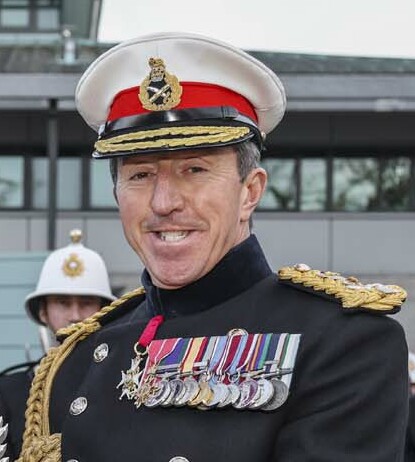
Vice Chief of the Defence Staff, General Sir Gwyn Jenkins in Lympstone, 2022.
Photo credit – LPhot Barry Swainsbury – https://www.royalnavy.mod.uk/-/media/royal-navy-responsive/images/news/new/221128-new-commandant-general-royal-marines-appointed/2.jpg, OGL 3, Link
General Sir Gwyn Jenkins has taken over as the professional head of the Royal Navy, the first Royal Marine to occupy the role of “First Sea Lord and Chief of the Naval Staff”. This is a move which is to be warmly welcomed, although the General will have many challenges ahead of him during his tenure.
While most have welcomed the move, there has been some mild hysteria on social media at the idea of a General heading the Royal Navy – what madness is this? The argument seems to be that apparently because Royal Marines haven’t commanded ships, they are somehow not able to lead the Royal Navy. Such an argument is fatuous nonsense.
The RN is a surprisingly tribal organisation of roughly 30,000 people, with its regular personnel broadly divided into four fighting arms – the Surface Fleet, the Submarine Service, the Fleet Air Arm and the Royal Marines. The surface fleet is the closest to being a “generalist” branch, although in its own way it is intensely tribal with different branches, organisations and structures. The Submariners and the FAA are unsurprisingly a bit of a closed shop, due to their missions, role and locations – it is not quite a “private navy”, but it would be rare for many personnel to serve at both Faslane supporting submarines and then to Culdrose or Yeovilton supporting aircraft. It is better to think of these fighting arms as smaller versions of the RN, each with its own culture, ethos and experience, and very different ways of bringing the fight to the enemy.
There have been First Sea Lords from the Surface Fleet, Submarine Service and FAA – no one has questioned the ability of an admiral who may have spent large parts of their career within a tribal part of the Service to lead all of it appropriately. Yet some seem to think that the General is somehow unable to do this due to his Royal Marines past. This makes very little sense – surely if this were true, how could any 1SL lead the Royal Marines effectively given they have, to the authors knowledge, never held a green beret?
The role of the 1st Sea Lord is not to stride the bridge in battle and fight wars against the enemy. He (and hopefully soon She) is the professional head of a complex organisation, employing tens of thousands of service personnel, reservists, civil servants and contractors on every continent. There are Royal Navy personnel based around the globe, from the Arctic to the Antarctic, and from the depths of the ocean to the skies far above. This role is about leadership, delivering the Government of the day’s desired defence policy outcomes, setting strategic direction for the Service and ensuring that it can deliver on its responsibilities.
The role of 1SL is part CEO, part diplomat, part public engagement and orator, and part politician. They need to be able to set a vision but accept their ability to deliver it is limited due to the time taken for naval procurement – while HMS VENTURER was rolled out of the yard today (27 May) some 10 years after the Type 31 was conceived, there have been no less than five permanent 1SL incumbents in this time. The post holder is also ultimately responsible for the delivery of operations, including the Deterrent, to the Prime Minister, and in providing advice to No10 on naval military matters.
Comments Off on Now that a Royal Marine general is head of the Royal Navy, is he the “First Land Lord”?
The King of Canada
In the National Post, Colby Cosh tweaks the berries of the tiny number of dedicated Canadian republicans:
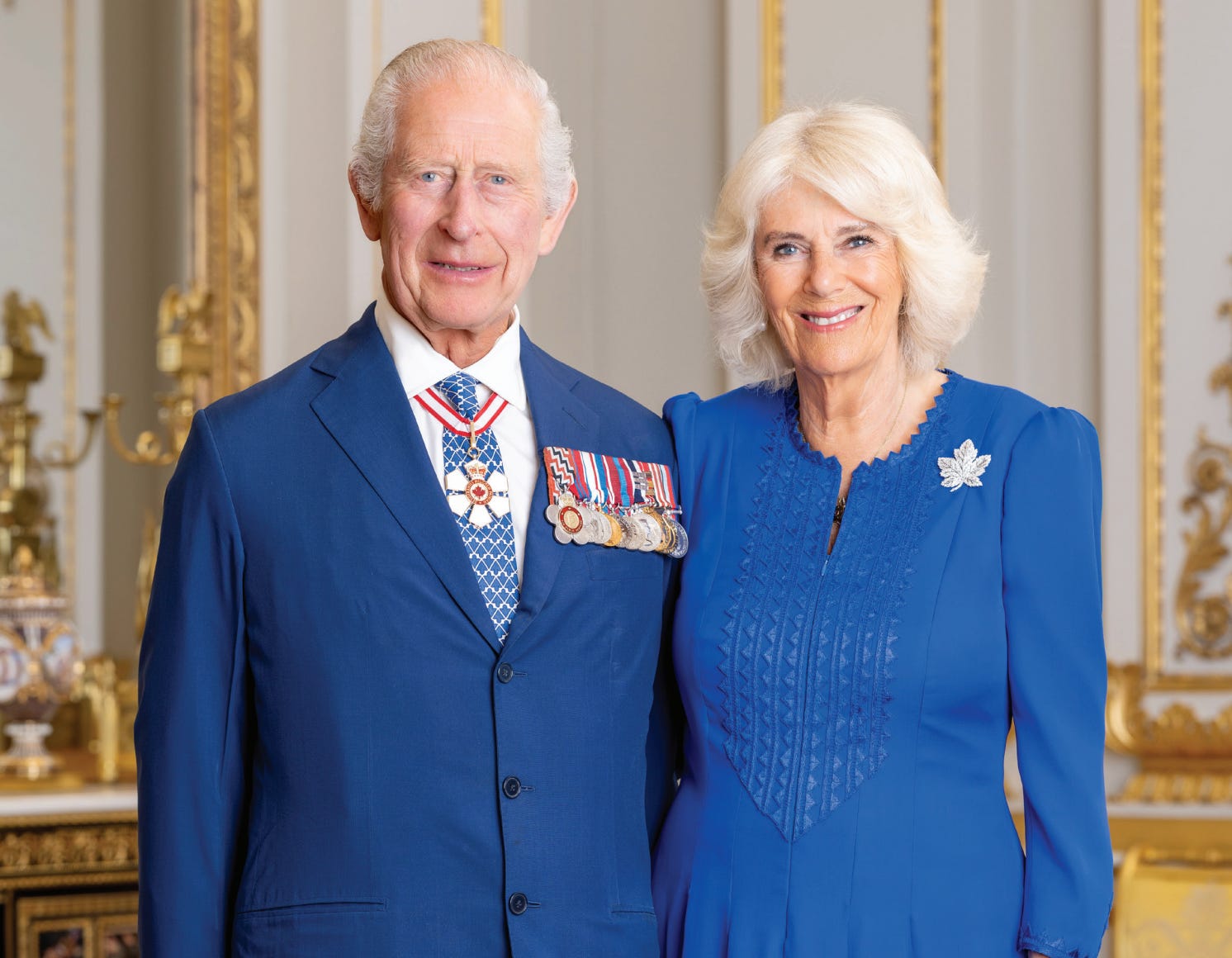
King Charles III and Queen Camilla, official portrait by Millie Pilkington.
The Post and other Canadian organs have been full of conscious praise for our unusual absentee monarchy lately, what with the King being in the capital to give the throne speech in person. But Canadian republicans must be hoping that our people will instinctively reject the spectacle, and at least see the genuine need for that blessing without which no sovereign state can hope to be taken seriously — a president.
There are rumblings about behind-the-scenes diplomatic tensions between Canada and the United Kingdom over the royal visit, rumblings which the Sunday Times (of London) put in print this weekend. The crux of the story is that Canada and the U.K. are not quite using the same playbook in dealing with the volatile and cutthroat Trump administration.
Sir Keir Starmer’s Labour government is applying lots of soft-soap, using Trump’s fondness for the British monarchy and its highly ornamented nature as a means of getting special treatment in trade negotiations. Meanwhile, Canada and its government hope to use the presence in Canada of Canada’s King as a subtle way of asserting independence, determination and strength as we bear the economic blows of Trumpian whim.
And — wait for it — the crazy part is, THOSE TWO KINGS ARE THE SAME EXACT DUDE. WHAAAT?
To a republican, this seems like a mystery concocted to obfuscate a logical weakness in the system. No doubt they see it just the same way an atheist looks at the centuries of early Christian debate over the Holy Trinity. It’s not exactly as though the U.K. and Canada are at war, or as though there is any overt disharmony between the two states. But the monarchists have to concede at least this much: when mutually sovereign countries have a shared head of state, you do in fact end up with the exotic possibility that George XIV of Canada might one day, in theory, have to issue a declaration of war on George XIV of Great Britain and Northern Ireland. This is baked into the improvised post-Imperial ontology of our government and of Britain’s.
This is why Canadian monarchists are so fussy about the independent constitutional footing on which the Canadian Crown rests. We do this, implicitly insisting that our system of government was reinvented in 1931, while at the same time arguing that the advantages of monarchy include antiquity, historical continuity and the preservation of a special bond between Commonwealth realms. Perhaps we are sneaky imperialist (or racist) hypocrites. Perhaps we just feel that those advantages are legitimate and important, and that the Statute of Westminster is an optimum compromise that preserves them while guaranteeing our sovereign freedom of action in the interplay of governments.
Comments Off on The King of Canada
Q&A: The Falklands War of 1982
Forgotten Weapons
Published 3 Jan 2025Since I spent a couple weeks hiking across the Falklands and then visiting battlefields (and penguins), it seems reasonable to do a Q&A video about the place and the 1982 war there between Argentina and the UK. All the questions were provided by Forgotten Weapons Patrons.
01:38 – How did the FAL perform, seeing as both sides used it?
03:43 – Effectiveness of light and heavy weapons in the war
08:49 – Would the British have been better off Yomping with AR15s, like the SAS used?
10:09 – Is there much local animosity to Argentina today?
12:21 – Local food and adult beverages
15:31 – What do people do for fun on the Falklands?
17:52 – Oldest small arm in service during the war?
20:18 – Military equipment wreckage on the islands
22:06 – Value of full powered rifle round in the FI terrain?
24:31 – Minefields
25:44 – Interaction of weapons with different effective ranges
28:46 – Did Exocet spur development of CIWS?
31:00 – What has been done to defend the islands against another invasion?
33:51 – Issues with an army designed to fight the USSR in Europe deploying to the South Atlantic?
35:30 – Weirdest weapon used in the conflict?
36:29 – Field modifications of small arms and unique kit
38:20 – Were British vehicle at risk of damage there?
39:40 – Engagement ranges
40:23 – Relevancy of bayonet fighting
41:28 – Unique equipment used by the Falkland Islands Defense Force
43:27 – American view of the Falklands War today
44:41 – Which Yomp route did we take?
45:01 – Did we visit Ajax Bay or the cemetery?
46:00 – Reality vs my expectations of the islands
46:57 – How would the war go if it happened today instead of in 1982?
48:25 – Did British soldiers use Argentine FALs?
(more…)
Comments Off on Q&A: The Falklands War of 1982
May 28, 2025
Masters of the Air – The Bomber War Episode 4 – 8th Air Force 1942-1943
HardThrasher
Published 6 Jan 2024If you’d like to be a cool kid, then become a Patreon or if you’d like to email me send a message to lordhardthrasher@gmail.com
0:00 Intro
4:30 We’re Going to North Africa 1st
8:36 But you’re not doing it properly
16:16 Play it Again Ira
22:30 Mid 1943 – The Crisis Begins
26:53 The Black Summer
28:03 Operation Tidal Wave
34:21 Into The Valley of Death – Schweinfurt
41:34 What Now?
48:37 Survivors Club
(more…)
Comments Off on Masters of the Air – The Bomber War Episode 4 – 8th Air Force 1942-1943
QotD: Communitarianism
Communitarianism is on the rise. The Left has its “Blue Labour” project, and writers like Giles Fraser and Paul Embery. The Right has its “One Nation Conservatism” project, and writers like Nick Timothy and Tim Montgomery. They differ in emphasis, but the commonalities outweigh the differences. It appeals to both right-wingers looking for an alternative to economic liberalism, and to left-wingers looking for an alternative to “woke” hyper-moralism.
What is communitarianism? Communitarians would probably define themselves as people who recognise the importance of community and social relations, but that is a bit like saying that environmentalists are people who care about the environment, or that feminists are people who believe in gender equality. Defining a political outlook in motherhood-and-apple-pie terms, so that you could not disagree with it without coming across like a complete psychopath, is not particularly useful. Apart from Britain’s four or five Randians, everybody recognises the importance of community and social relations. (And presumably, Britain’s four or five Randians tacitly recognise it too.)
In practice, communitarianism is little else but a knee-jerk anti-liberalism. Communitarians define themselves in opposition to an imaginary hyper-materialistic, hyper-individualistic liberal, who sees life as no more than a long string of financial transactions, and society as no more than a bunch of isolated individuals who happen to live side by side. Communitarians never identify any specific person who actually holds that view, which is not too surprising, because, apart from Britain’s aforementioned four or five Randians (who, on a bad day, might come a little bit close to that caricature), no such person exists.
Kristian Niemietz, “Communitarianism: the art of passing off trivial clichés as profound wisdoms”, Institute of Economic Affairs, 2020-02-14.
Comments Off on QotD: Communitarianism
May 27, 2025
QotD: Refuting the “state of nature” argument in Leviathan
Alas, Hobbes’s method is so seductively useful, and his “state of nature” so seemingly correct (if you don’t think about it too hard, which is easy to do, as Hobbes’s prose is entrancing), that in their haste to reject his conclusions, later thinkers like Locke didn’t stop to question whether or not the premises behind the method are actually true. It helped, too, that Locke (born 1632) came of age as the civil wars were winding down (his father was briefly a Parliamentary cavalry commander); he made his philosophical bones with the Restoration (1660). […]
It’s easy to get too far into the weeds with this stuff, but I trust everyone takes my point: Because Hobbes presented such a seductive vision, and because he took such sustained criticism by such high-level guys as Locke even as they were adopting his premises and methods, we — later generations of thinkers, almost without exception — behave as if Hobbes really had done what he said he did, which was to naturalize political philosophy. Political science, he would’ve said, and unlike the pretentious dweebs who staff those departments in modern universities, he wasn’t kidding — he really thought the arguments in Leviathan were as unassailable and compelling as geometry proofs.
But they weren’t, and even he knew it. Hobbes is a fascinating personality, but he’s a hard man to like, not least because he’s so irascible. I sympathize, Tommy, I really do, I’m no mean curmudgeon myself, but dude, you were wrong. Recall the fundamental premise of the “state of nature” thought experiment: All men are functionally equal.
That’s not just wrong, it’s arrant nonsense. It’s hard to think of a statement this side of Karl Marx that’s so backasswards as that one. Far from naturalizing political philosophy, Hobbes made it totally artificial, completely mechanical. His social contract requires a bunch of armed-to-the-teeth free agents, of sound mind and body, all ready and willing to defend themselves to the hilt at all times. Women have no place in Hobbes’s world. Nor do children, or the weak, or the halt, the sick, the old …
In short, although Hobbes is a brilliant observer of human nature, full of acute insight into man and his works, the most famous passage of Leviathan, the one to which all modern political philosophy is mere footnotes, has nothing at all of Man in it. It’s baloney, and therefore, everything derived from it is also, on some deep philosophical level, horseshit.
Severian, “Range Finding III: Natural Law”, Founding Questions, 2021-11-23.
Comments Off on QotD: Refuting the “state of nature” argument in Leviathan
May 25, 2025
Rommel’s Dark Secrets in North Africa – WW2 Fireside Chat
World War Two
Published 24 May 2025Indy and Sparty handle your questions on the German intervention in North Africa. Why did Rommel make such an impact so quickly? What was the war like for the local populations? How deeply involved was Rommel in the persecution of North African Jews?
(more…)
Comments Off on Rommel’s Dark Secrets in North Africa – WW2 Fireside Chat
May 24, 2025
History of Britain, II: Stonehenge; The Druids, Vates, and Celtic Religion
Thersites the Historian
Published 15 Jan 2025In this episode, I briefly examine the presence of prehistorical megaliths on the British Isles and talk about the religion of the Celts, which was ascendant at the time that Britain entered entered the historical record.
Comments Off on History of Britain, II: Stonehenge; The Druids, Vates, and Celtic Religion