
The infantry do not have a single capbadge, they are described as a single capbadge but they all have different badges, lots and lots of them. Due to amalgamations and drawing down they are merged and start using new ones. One day they will be merged into the Royal Corps of Infantry.
The infantry (note not “infanteers” as they really hate that) are the actual troops who stand toe-to-toe with the enemy and bayonet them in the face. Boots on the ground, their job is to be pointed at the bad guys and go wreck it. They may get delivered in various ways including aircraft, boat, ship or their own vehicles, but same job: “infantry go smash”. Can be identified by neck tattoos, traditions that the Victorians would think are dated, officers wear faded red trousers and soldiers fight each other on Friday nights.
Combat Boot, “So, ‘capbadges’, what’s that all about then?”, combatboot.co.uk, 2020-11-13.
February 20, 2021
QotD: The Infantry
February 19, 2021
QotD: The disillusionment of working in a bookshop
I got the interview by stating openly in my covering letter that I was 24, still living with my mum, and asking her for train-fare had become a bit undignified. This seemed encouraging. But then the panel (2 pax.) asked what I was reading currently, and I said Sam Harris’s The End of Faith, and there was awkward silence. This set the tone for almost every “literary” chat thereafter.
Call me an idiot, but I was genuinely stunned to find we weren’t allowed to read on the job. Instead, booksellers had to devote any time not spent actually dealing with customers (which on a rainy weekend, in the wrong bit of the shop, could be a lot) with often-fruitless searches for books which had been lost, mis-shelved, or maybe stolen, or because they had to be returned to publishers (another surprise), and at the publisher’s expense.
I also quickly realised that the layout of the shop was not an accident (even in the jury-rigged “commercial” buildings of many an English town centre), and that the unadvertised steering of a customer around a bookshop was near-identical to how the algorithms work in the online equivalents (or vice versa, probably). If you like Poetry, you’re more likely to also like Philosophy, (right here on the next set of shelves), or Music (by the window), or History books (just across the room there), than if you came in looking for the latest Jeffrey Archer novel (downstairs, on the pile-’em-high islands).
Most of the time, I was just moving “stock” about, taking maddening credit card orders over the phone, or walking people literally to alphabetised mass-market fiction. All of which required no interest in, let alone knowledge of, literature. To a middle-class nerd such as myself, discovering that working in a bookshop [cue poetic images of James Frain, or similar] was fundamentally no different from working in a Sports Direct or Tesco was about the most depressing thing imaginable. That, and waiting for the Sunday trains in winter.
A.S.H. Smyth, “Seven kinds of people you find in bookshops”, The Critic, 2020-11-14.
February 18, 2021
Tank Chats #95 | L1E3 Amphibious Tank | The Tank Museum
The Tank Museum
Published 21 Feb 2020Here David Fletcher examines the Vickers-Carden-Loyd L1E3 Amphibious Tank. Produced in the 1930s, the L1E3 was a pre-WW2 experimental tank which never entered service with the British Army.
Support the work of The Tank Museum on Patreon: ► https://www.patreon.com/tankmuseum
Visit The Tank Museum SHOP: ► tankmuseumshop.org
Twitter: ► https://twitter.com/TankMuseum
Instagram: ► https://www.instagram.com/tankmuseum/
Tiger Tank Blog: ► http://blog.tiger-tank.com/
Tank 100 First World War Centenary Blog: ► http://tank100.com/
#tankmuseum #tanks

February 14, 2021
German Army Surrounded: You Did Nazi That Coming! – WW2 – 129- February 13, 1942
World War Two
Published 13 Feb 2021The Soviet Red Army has managed to surround some 100,000 German soldiers in the Demyansk Pocket. The Allies are surrounded in Fortress Singapore and the Japanese spend the week breaking in. The Allies are also unable to supply Malta by ship because of continuous heavy Axis bombing of the island and its surroundings, which bodes ill for Allied operations in North Africa. The Germans also make a bold naval move this week — sending two capital ships right up the English Channel under British noses, making for German ports.
Join us on Patreon: https://www.patreon.com/TimeGhostHistory
Or join The TimeGhost Army directly at: https://timeghost.tvFollow WW2 day by day on Instagram @ww2_day_by_day – https://www.instagram.com/ww2_day_by_day
Between 2 Wars: https://www.youtube.com/playlist?list…
Source list: http://bit.ly/WW2sourcesWritten and Hosted by: Indy Neidell
Director: Astrid Deinhard
Producers: Astrid Deinhard and Spartacus Olsson
Executive Producers: Astrid Deinhard, Indy Neidell, Spartacus Olsson, Bodo Rittenauer
Creative Producer: Maria Kyhle
Post-Production Director: Wieke Kapteijns
Research by: Indy Neidell
Edited by: Iryna Dulka
Sound design: Marek Kamiński
Map animations: Eastory (https://www.youtube.com/c/eastory)Colorizations by:
– Mikołaj Uchman
– Carlos Ortega Pereira, BlauColorizations – https://www.instagram.com/blaucolorizations
– Norman Stewart – https://oldtimesincolor.blogspot.com/Sources:
– National Portrait Gallery
– IWM: FE 218, FE 312, A 9692, A 9694, HU 2765, A 9514, MH 4981, FE 222, FE 583Soundtracks from the Epidemic Sound:
– Rannar Sillard – “Easy Target”
– Jo Wandrini – “Dragon King”
– Andreas Jamsheree – “Guilty Shadows 4”
– Fabien Tell – “Break Free ”
– Fabien Tell – “Weapon of Choice”
– Wendel Scherer – “Growing Doubt”
– Johan Hynynen – “Dark Beginning”
– Gunnar Johnsen – “Not Safe Yet”
– Wendel Scherer – “Out the Window”
– Howard Harper-Barnes – “Underlying Truth”
– Philip Ayers – “Ominous”
– Johan Hynynen – “One More Thought”Archive by Screenocean/Reuters https://www.screenocean.com.
A TimeGhost chronological documentary produced by OnLion Entertainment GmbH.
February 13, 2021
QotD: Haynes guide to tools of the trade
ELECTRIC HAND DRILL: Normally used for spinning steel Pop rivets in their holes until you die of old age, but it also works great for drilling mounting holes just above the brake line that goes to the rear wheel.
PLIERS: Used to round off bolt heads.
HACKSAW: One of a family of cutting tools built on the Ouija board principle. It transforms human energy into a crooked, unpredictable motion, and the more you attempt to influence its course, the more dismal your future becomes.
MOLE-GRIPS/ADJUSTABLE spanner: Used to round off bolt heads. If nothing else is available, they can also be used to transfer intense welding heat to the palm of your hand.
OXYACETELENE TORCH: Used almost entirely for lighting various flammable objects in your garage on fire. Also handy for igniting the grease inside a brake-drum you’re trying to get the bearing race out of.
WHITWORTH SOCKETS: Once used for working on older cars and motorcycles, they are now used mainly for impersonating that 9/16″ or 1/2″ socket you’ve been searching for for the last 15 minutes.
DRILL PRESS: A tall upright machine useful for suddenly snatching flat metal bar stock out of your hands so that it smacks you in the chest and flings your beer across the room, splattering it against that freshly painted part you were drying.
WIRE WHEEL: Cleans rust off old bolts and then throws them somewhere under the workbench with the speed of light. Also removes fingerprint whorls in about the time it takes you to say, “F….”
Do it by the book — the real meaning of Haynes instructions.
February 12, 2021
Britain Chooses War Crimes – RAF Strategic Bombing – WAH 028 – February 1942, Pt. 1
World War Two
Published 11 Feb 2021As the winter of 1942 continues, many Soviet civilians suffer under the German Siege of Leningrad. Meanwhile, the British are shifting their bombing strategy from targeting factories to targeting homes.
Join us on Patreon: https://www.patreon.com/TimeGhostHistory
Or join The TimeGhost Army directly at: https://timeghost.tvFollow WW2 day by day on Instagram @ww2_day_by_day – https://www.instagram.com/ww2_day_by_day
Between 2 Wars: https://www.youtube.com/playlist?list…
Source list: http://bit.ly/WW2sourcesHosted by: Spartacus Olsson
Written by: Joram Appel and Spartacus Olsson
Director: Astrid Deinhard
Producers: Astrid Deinhard and Spartacus Olsson
Executive Producers: Astrid Deinhard, Indy Neidell, Spartacus Olsson, Bodo Rittenauer
Creative Producer: Maria Kyhle
Post-Production Director: Wieke Kapteijns
Research by: Joram Appel
Edited by: Miki Cackowski
Sound design: Marek Kamiński
Map animations: Eastory (https://www.youtube.com/c/eastory)Colorizations by:
Norman Stewart – https://oldtimesincolor.blogspot.com/
Daniel WeissSources:
USHMM
Bundesarchiv
Yad Vashem 2695/7, 5761/12
IWM MH 24747
RIA Novosti archive, image #762, #244
from the Noun Project:
Skull by Muhamad UlumSoundtracks from the Epidemic Sound:
Reynard Seidel – “Deflection”
Fabien Tell – “Last Point of Safe Return”
Farrell Wooten – “Blunt Object”
Jo Wandrini – “Dawn Of Civilization”
Wendel Scherer – “Defeated”
Jon Bjork – “Icicles”
Gunnar Johnsen – “Not Safe Yet”
Peter Sandberg – “Document This 1”Archive by Screenocean/Reuters https://www.screenocean.com.
A TimeGhost chronological documentary produced by OnLion Entertainment GmbH.
From the comments:
World War Two
4 hours ago
We are covering the RAF’s bombing campaigns in the War Against Humanity series because it concerns warfare against the civilian population. On previous occasions, we have been accused of relativizing Nazi’s war-crimes by covering Allied atrocities in the same space, but we argue that for a fact-based reporting on how WW2 impacted the civilian population we need to be complete and unbiased.The facts speak for themselves, and we document those facts that by providing an exhaustive record with equal coverage of all events and parties. Covering one event doesn’t relativize or justify the other and vice versa. We will not tolerate any whataboutism in the comments.
We will also not tolerate a justification of these crimes based on pragmatism, or equal proportionality — on an absolute moral level the goal never justifies the means. In this case we look at our comment section from a 21st century perspective and hold ourselves and anyone using our forums to the modern standards laid down in the laws of war. Explaining, analyzing and discussing war crimes and crimes against humanity is fine, even desired — celebrating, hailing, or justifying them is not.
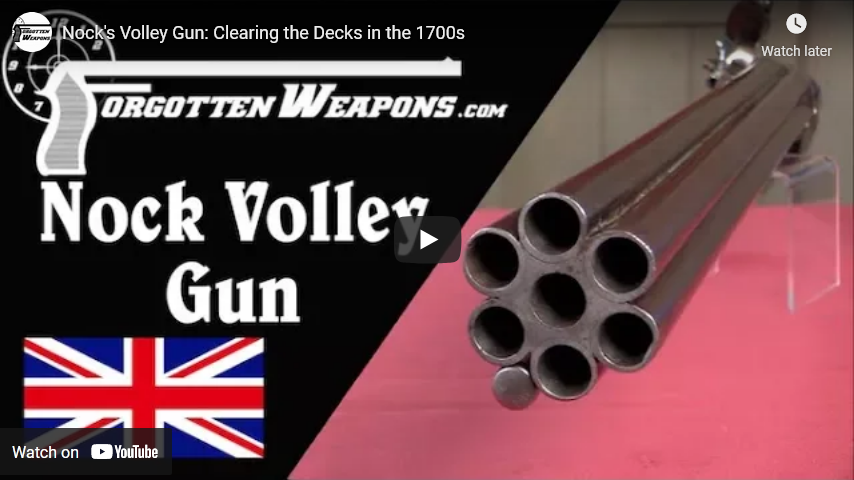
Nock’s Volley Gun: Clearing the Decks in the 1700s
Forgotten Weapons
Published 3 Mar 2018The Nock Volley Gun was actually invented by an Englishman named James Wilson in 1789, and presented to the British military as a potential infantry weapons. This was declined as impractical, but the Royal Navy found the concept interesting for shipboard use. In 1790 the Navy ordered two prototypes made by the British gunsmith Henry Nock, and finding them suitable, proceeded to oder a total of 500 of the guns (thus forever associating Nock’s name with the gun instead of Wilson’s). A further 100 or so were ordered in 1797, and the guns were in fact issued out to various ships — although accounts of their use in combat are difficult to find.
Unfortunately for Nock, the guns presented a couple of substantial problems in use. One was simply the recoil of firing. A single 32-bore (approximately .55 caliber) round ball over 40 grains of black powder is not a very impressive load, but seven of them firing simultaneously add up to a recoil comparable to 4- or 6-bore rifles, and in a volley gun weighing just 13 pounds (5.9kg). In addition, the guns did not always reliably fire all barrels, especially when dirty. This produced a conundrum: how to determine which barrels had fired and which had not? The practical result was double-loaded barrels, which could be liable to bulge or burst. For these reasons, the weapon was declared obsolete in 1805, and never appeared to play any significant military role.
The gun did receive a new wave of popular awareness in 1960, when the character of Jim Bowie was outfitted with one in the movie The Alamo (against all historical evidence). His easy handling of the weapon and the waves of men he was able to mow down with it brought the gun back into the popular consciousness.
http://www.patreon.com/ForgottenWeapons
Cool Forgotten Weapons merch! http://shop.bbtv.com/collections/forg…
If you enjoy Forgotten Weapons, check out its sister channel, InRangeTV! http://www.youtube.com/InRangeTVShow
Contact:
Forgotten Weapons
6281 N Oracle #36270
Tucson, AZ 85704
February 10, 2021
One Advantage of Swiss Neutrality: LSD! – WW2 – Reading Comments
World War Two
Published 9 Feb 2021Another edition of Across the Airwaves, where Indy and Sparty look at interesting and unique comments from our videos. In this episode, they look at gentlemanly declarations of war, Partisan memories, and LSD.
Join us on Patreon: https://www.patreon.com/TimeGhostHistory
Or join The TimeGhost Army directly at: https://timeghost.tvFollow WW2 day by day on Instagram @ww2_day_by_day – https://www.instagram.com/ww2_day_by_day
Between 2 Wars: https://www.youtube.com/playlist?list…
Source list: http://bit.ly/WW2sourcesHosted by: Indy Neidell & Spartacus Olsson
Director: Astrid Deinhard
Producers: Astrid Deinhard and Spartacus Olsson
Executive Producers: Astrid Deinhard, Indy Neidell, Spartacus Olsson, Bodo Rittenauer
Creative Producer: Maria Kyhle
Post-Production Director: Wieke Kapteijns
Edited by: Karolina Dołęga
Sound design: Marek Kamiński
Map animations: Eastory (https://www.youtube.com/c/eastory)Colorizations by:
– Daniel Weiss
– Mikołaj Uchman
– JHM Color
– Julius Jääskeläinen – https://www.facebook.com/JJcolorization/Sources:
– Imperial War Museums: MH 1324, CH 1533, HU111054, TR 1468, MGH 4464
– National Archives NARA
– United States Holocaust Memorial Museum
– Yad Vashem: 4360-99, 2725-5, 4788-73,
– Bundesarchiv
– Picture of Soviet Soldiers with DShK-38 gun courtesy of Leduytoan2003 from Wikimedia Commons
– Picture of 19th Army troops storming Mogile courtesy of Mil.ruSoundtracks from Epidemic Sound:
– “The Unexplored” – Philip Ayers
– “The Inspector 4” – Johannes Bornlöf
– “London” – Howard Harper-Barnes
– “Document This 1” – Peter Sandberg
– “Dark Beginning” – Johan Hynynen
– “Rubik’s Cube” – From Now On
– “Getaway Rock” – Elliot HolmesArchive by Screenocean/Reuters https://www.screenocean.com.
A TimeGhost chronological documentary produced by OnLion Entertainment GmbH.

Napoleonic Wars: Battle of Trafalgar 1805
Kings and Generals
Published 5 Nov 2017Napoleon Bonaparte fought all his battles on land, but no other battle influenced his military and political decisions as the battle of Trafalgar that was fought in 1805 off the coast of Spain between the allied Franco-Spanish fleet lead by the admirals Pierre-Charles Villeneuve and Federico Gravina and the Royal Navy of the United Kingdom commanded by the admirals Horatio Nelson and Cuthbert Collingwood. This is our first video on the War of the Third Coalition and second video in this series. We hope to have much more and cover all the Napoleonic Wars.
Support us on Patreon: http://www.patreon.com/KingsandGenerals or Paypal: http://paypal.me/kingsandgenerals
We are grateful to our patrons, who made this video possible: Koopinator, Daisho, Łukasz Maliszewski, Nicolas Quinones, William Fluit, Juan Camilo Rodriguez, Murray Dubs, Dimitris Valurdos, Félix Gagné-Dion, Fahri Dashwali, Kyle Hooton, Dan Mullen, Mohamed Thair, Pablo Aparicio Martínez, Iulian Margeloiu, Chet, Nick Nasad, Jeyares, Amir Eppel, Thomas Bloch, Uri Sternfeld, Juha Mäkelä, Georgi Kirilov, Moe Mia, Daniel Yifrach, Brian Crane, Muramasa, Gerald Tnay, Hassan Ali and Richie Thierry.
This video was narrated by good friend Officially Devin. Check out his channel for some kick-ass Let’s Plays. https://www.youtube.com/user/Official…
The Machinimas for this video are created by one more friend – ltflak. Check out his channel for some great Let’s Plays and Machinimas: https://www.youtube.com/user/ltflak
✔ Twitch ► https://www.twitch.tv/nurrrik_phoenix
✔ Twitter ► https://twitter.com/KingsGenerals
✔ Instagram ► https://www.instagram.com/nurrrrrik
✔ Steam ► http://steamcommunity.com/id/nurrrikInspired by: BazBattles, Invicta (THFE), Epic History TV, Historia Civilis and Time Commanders
Machinimas made on the Napoleon Total War
Production Music courtesy of Epidemic Sound and Total War Napoleon: http://www.epidemicsound.com
Songs used:Epidemicsound:
“Slaves” – Gunnar Johnsén
“At The Front” – Johan Hynynen
“Battle Ostinato 3” – Valdemar HansenTotal War Napoleon:
Richard Beddow – “Corsica, Humble Beginnings”
Ian Livingstone – “The Battle At Arcole”
Richard Beddow – “HMS Victory”
Richard Beddow – “The End”
February 8, 2021
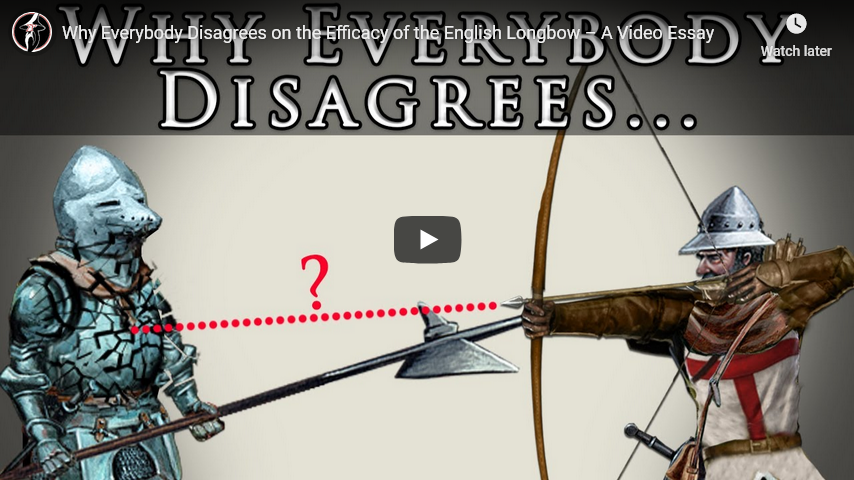
Why Everybody Disagrees on the Efficacy of the English Longbow – A Video Essay
SandRhoman History
Published 7 Feb 2021Everybody quarrels over the efficacy of the English longbow. Many historians, reenactors and history enthusiasts alike hold the view that arrows piercing armor is a myth. Some base this view on testing as was done for example by Tod from Tod’s workshop. Together with his team, he provided an invaluable data point for this debate. Others, such as traditionalist historians are often open to the possibility of arrows piercing armor, even though they are aware of actual testing of the longbow. In general, the efficacy of a weapon is much more complicated than its mere armor penetration value. So, in this video we’d like to shed light on the whole debate and explain why it is so hard to find common ground on this issue. This is why everybody disagrees on the efficacy of the English longbow.
Patreon: https://www.patreon.com/sandrhomanhis…
Twitter: https://twitter.com/Sandrhoman
Tod’s Video: ARROWS vs ARMOUR – Medieval Myth Busting https://youtu.be/DBxdTkddHaE
Tod’s playlist: MEDIEVAL MYTH BUSTING https://youtube.com/playlist?list=PLI…
Bibliography:
Rogers, C.J., The Efficacy of the English Longbow, 1998.
Devries, K., Medieval Military Technology, 1994.
Bane, M., “English Longbow Testing against various armor circa 1400”, 2006.
Soar, H., Gibbs, J., Jury, C., Stretton, M., Secrets of the English War Bow. Westholme, 2010, pp. 127–151.
Magier, Mariusz; Nowak, Adrian; et al., “Numerical Analysis of English Bows used in Battle of Crécy”. Problemy Techniki Uzbrojenia. 142 (2), 2017, 69–85.
February 7, 2021
Pearl Harbor Avenged! – WW2 – 128 – February 6, 1942
World War Two
Published 6 Feb 2021The Japanese advance in Burma and the Dutch East Indies, but they’ve reached the end of the Malayan Campaign- Singapore, which they have under siege. They now prepare for the final assault. The Allies are going on the offensive at sea, though, in the Marshalls-Gilberts Raids, while on land in the Soviet Union the Red Army launches another series of offensives against the Germans.
Join us on Patreon: https://www.patreon.com/TimeGhostHistory
Or join The TimeGhost Army directly at: https://timeghost.tvFollow WW2 day by day on Instagram @ww2_day_by_day – https://www.instagram.com/ww2_day_by_day
Between 2 Wars: https://www.youtube.com/playlist?list…
Source list: http://bit.ly/WW2sourcesWritten and Hosted by: Indy Neidell
Director: Astrid Deinhard
Producers: Astrid Deinhard and Spartacus Olsson
Executive Producers: Astrid Deinhard, Indy Neidell, Spartacus Olsson, Bodo Rittenauer
Creative Producer: Maria Kyhle
Post-Production Director: Wieke Kapteijns
Research by: Indy Neidell
Edited by: Iryna Dulka
Sound design: Marek Kamiński
Map animations: Eastory (https://www.youtube.com/c/eastory)Colorizations by:
– Mikołaj Uchman
– Julius Jääskeläinen – https://www.facebook.com/JJcolorization/
– Dememorabilia – https://www.instagram.com/dememorabilia/
– Norman Stewart – https://oldtimesincolor.blogspot.com/Sources:
– National Portrait Gallery
– Ministerie van Defensie
– Arrow by 4B Icons from the Noun Project
– Yad Vashem: 76BO2, 4331_21Soundtracks from the Epidemic Sound:
– Rannar Sillard – “Easy Target”
– Jo Wandrini – “Dragon King”
– Fabien Tell – “Last Point of Safe Return”
– Howard Harper-Barnes – “Sailing for Gold”
– Craft Case – “Secret Cargo”
– Rannar Sillard – “Split Decision”
– Flouw – “A Far Cry”
– Johannes Bornlöf – “The Inspector 4”
– Johan Hynynen – “Dark Beginning”
– Edward Karl Hanson – “Spellbound”
– Howard Harper-Barnes- “Underlying Truth”Archive by Screenocean/Reuters https://www.screenocean.com.
A TimeGhost chronological documentary produced by OnLion Entertainment GmbH.

February 6, 2021
From an improbable 1930s “death ray” to the radar network that helped defeat the Blitz
In a story from a few years back, Tim Harford outlines how a British Air Ministry prize for developing a “death ray” to use against enemy aircraft eventually helped kick off the discovery of radar:
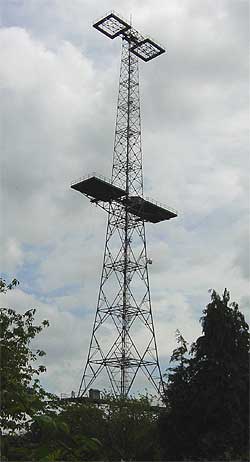
The Chain Home radar tower in Great Baddow Chelmsford.
Photo by Stuart166axe via Wikimedia Commons.
… sometimes inventions need other inventions to unlock their full potential.
For the aviation industry, that story starts with the invention of the death ray, or at least an attempt to design a death ray, back in 1935.
Officials in the British Air Ministry were worried about falling behind Nazi Germany in the technological arms race.
The death ray idea intrigued them: they had been offering a £1,000 prize for anyone who could zap a sheep at a hundred paces. So far, nobody had claimed it.
But should they fund more active research? Was a death ray even possible?
Unofficially, they sounded out Robert Watson Watt, of the Radio Research Station.
And he posed an abstract maths question to his colleague Skip Wilkins.
“Suppose, just suppose,” said Watson Watt to Wilkins, “that you had eight pints of water, 1km [3,000ft] above the ground.
“And suppose that water was at 98F [37C], and you wanted to heat it to 105F.
“How much radio frequency power would you require, from a distance of 5km?”
Skip Wilkins was no fool.
He knew that eight pints was the amount of blood in an adult human, 98F was normal body temperature and 105F was warm enough to kill you, or at least make you pass out, which — if you’re behind the controls of an aeroplane — amounts to much the same thing.
So Wilkins and Watson Watt understood each other, and they quickly agreed the death ray was hopeless: it would take too much power.
But they also saw an opportunity.
Clearly, the ministry had some cash to spend on research. Perhaps Watson Watt and Wilkins could propose some alternative way for them to spend it?
Wilkins pondered. It might be possible, he suggested, to transmit radio waves and detect — from the echoes — the location of oncoming aircraft long before they could be seen.
Watson Watt dashed off a memo to the Air Ministry’s newly formed Committee for the Scientific Survey of Air Defence. Would they be interested in pursuing such an idea? They would indeed.
What Skip Wilkins was describing became known as radar.
February 5, 2021
Tank Chats #93 Humber Hornet | The Tank Museum
The Tank Museum
Published 24 Jan 2020Here David Fletcher takes a look at the Humber Hornet, a specialised air-deployable Armoured Fighting Vehicle. It was designed to carry the Malkara, an anti-tank guided missile developed by Australia and the United Kingdom.
Support the work of The Tank Museum on Patreon: ► https://www.patreon.com/tankmuseum
Visit The Tank Museum SHOP: ►tankmuseumshop.org
Twitter: ► https://twitter.com/TankMuseum
Instagram: ► https://www.instagram.com/tankmuseum/
Tiger Tank Blog: ► http://blog.tiger-tank.com/
Tank 100 First World War Centenary Blog: ► http://tank100.com/

February 4, 2021
The New World: A Beautiful Mess
Atun-Shei Films
Published 3 Feb 2021A review of the Terrence Malick film The New World, a lavish and beautifully shot historical epic that nonetheless falls short in a few important ways.
Support Atun-Shei Films on Patreon ► https://www.patreon.com/atunsheifilms
Leave a Tip via Paypal ► https://www.paypal.me/atunsheifilms
Buy Merch ► teespring.com/stores/atun-shei-films
#TerrenceMalick #Jamestown #Pocahontas
Original Music by Dillon DeRosa ► http://dillonderosa.com/
Reddit ► https://www.reddit.com/r/atunsheifilms
Twitter ► https://twitter.com/atun_shei

February 3, 2021
Fatah demands that Britain return Big Ben to its original Jerusalem home
Daniel Greenfield unravels the historical misconceptions that informed the demand:
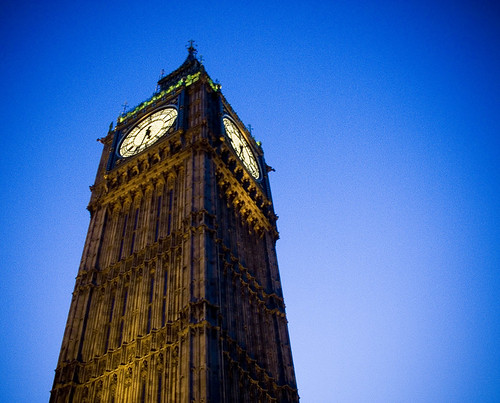
“Big Ben” by kev_zilla is licensed under CC BY-NC-ND 2.0


“The Jerusalem Clock is hidden in London today,” Fatah, the political movement behind the PLO and the Palestinian Authority, asserts in a post titled, “Jerusalem Stolen Clock”.
It goes on to claim that the British military ordered the clock tower dismantled. Then the “British moved the clock first to a new tower across from the municipality of Jerusalem, and transferred it to the British Museum in London, to become the famous British icon, ‘Big Ben’.”
How did Big Ben, which was built in 1859, become a Muslim clock tower from the 20th century?
There are some other slight differences between London’s Big Ben and the “stolen clock” such as the fact that Big Ben is 316 feet tall while the “Palestinian” clock tower was only 42 feet.
But the story of the “Palestinian clock” is also the story of the entire myth of “Palestine”.
When you believe that the Jerusalem of King David and King Solomon was originally yours, you can just as easily believe that London’s Big Ben was originally the property of “Palestine”.
The “Palestinian clock” is as real as “Palestine”. The myth of a “Palestinian” people propounded by Fatah which has spent decades killing over it is also the story of the “Palestinian clock”.
There’s no more of a “Palestinian” people who were dispossessed by the Jews than Big Ben is a “Palestinian” clock stolen and passed off as London’s Big Ben. Both are fake history built out of resentments and garbled stories whose context has been lost, but whose hatreds remain real.
There were never any Palestinians. When the clock was built the region had been part of the Ottoman Empire, the last Caliphate until ISIS. The caliphates had settled it with Arab Muslim clans who dominated Christian refugees fleeing Muslim persecution, along with groups of other minorities from escaped slaves to gypsies, along with the indigenous Jewish population.
The Ottomans had become obsessed with clock towers as a symbol of their empire. But the Ottomans hadn’t invented them, they had adopted them from Europe, and planted them in major cities of the empire to create a common sense of time and belonging for their subjects.
Sultan Abdul Hamid II, the last real sultan of the empire, obsessively erected clock towers to show off how modern the Ottoman Empire was. But by then the Empire was anything but modern and Hamid’s clock tower craze was powered by his German allies. Kaiser Wilhelm II gave Hamid a batch of clocks at the turn of the century which the Turks put into clock towers.
The Ottoman Empire erected some of its clock towers in Israel. These clock towers utilized the talents and funds of the indigenous Jewish and the Arab Muslim settler population. The clock tower projects in Israel began in 1901 which is also the date when Wilhelm sent Hamid a whole bunch of clocks. One of these clock towers was stuck on Jerusalem’s Jaffa Gate which Hamid had previously cut a hole in so that the Kaiser could enter Jerusalem in his tall plumed helmet.
H/T to Kate at SDA for the link.


