
While Heinlein (as far as I know) supplied no rationale for the advent and the recession of the craziness in the Crazy Years, A.E. van Vogt was freer with his speculations: insanity, either of individuals or of peoples, in van Vogt’s stories (and perhaps in the theories of Alfred Korzybski, who discovered or invented General Semantics) is caused by a fracture or disjunction between symbol and object. When your thoughts, and the thing about which you think, do not match up on a cognitive level, that is a falsehood, a false belief. When the emotions associated with the thought do not match to the thing about which you think, that is a false-to-facts association, which can range from merely a mistake to neurosis to psychosis, depending on the severity of the disjunction. You are crazy. If you hate your sister because she reminds you of your mother who beat you, that association is false-to-facts, neurotic. If you hate your sister because you have hallucinated that you are Cinderella, that association is falser-to-facts, more removed from reality, possibly psychotic.
The great and dire events of the early Twentieth Century no doubt confirmed Korzybski in the rightness of this theory. Nothing prevents a race of people from contracting and fomenting a false-to-facts belief: the fantasies of the Nazi Germans, pseudo-biology and pseudo-economics combined with the romance of neo-paganism, stirred the psyche of the German people for quite understandable reasons. From the point of view of General Semantics, the Germans had divorced their symbols from reality, they mistook metaphors for truth, and their emotions adapted to and reinforced the prevailing narrative. They told themselves stories about Wotan and the Blood, about being betrayed during the Great War, about needing room to live, about the wickedness of Jewish bankers and shopkeepers, about the origin of the wealth of nations — and they went crazy.
The Russians, earlier, and for equally psychological and psychopathic reasons told themselves a more coherent but more unreal story about history and destiny, taken from a Millenarian cultist named Marx, and they were, on an emotional level even if not on a cognitive level, convinced that shedding the blood of millions would bring about wealth as if from nowhere. And, because they used the word “scientific” to describe their brand of socialism, they actually thought their play-pretend neurotic story was a scientific theory that had been discovered by rigorous ratiocination — and they went crazy.
Berlin was bombed into submission during the Second World War, and the Berlin Wall collapsed along with the Soviet Empire at the end of the Cold War. But the modern methods of erecting false-to-facts dramas appealing to mass psychology, once discovered, did not fall when their practitioners fell: scientific socialism, naziism, fascism, communism, all have in common the subordination of word-association to political will. All these doctrines have a common ancestor, which is the social engineering theory of language: if you change the connotation of word, so the theory runs, you change the connotations of thoughts. General Semantics says that if an individual, or whole people en mass, adopt deliberately false beliefs, supported by deliberately manipulative word-uses, he or they will have increasingly unrealistic and maladaptive behaviors. Introduce Political Correctness, ignore factual correctness, and the people will go crazy.
The main sign of when madness has possessed a crowd, or a civilization, is when the people are fearful of imaginary or trivial dangers but nonchalant about real and deep dangers. When that happens, there is gradual deterioration of mores, orientation, and social institutions — the Crazy Years have arrived.
John C. Wright, “The Crazy Years and their Empty Moral Vocabulary”, John C. Wright, 2019-02-18.
January 1, 2022
QotD: Heinlein’s “Crazy Years”, Alfred Korzybski’s General Semantics, and modern times
December 29, 2021
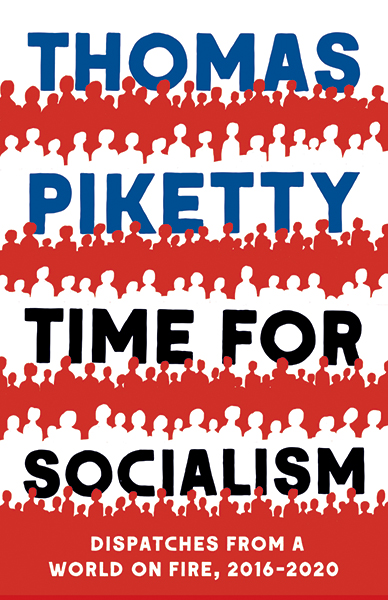
Theodore Dalrymple reviews the latest work from Thomas Piketty, Time for Socialism
Thomas Piketty has been a big name among progressives since his first book hit the bestseller lists, so the release of his latest work calls for some consideration from Theodore Dalrymple:
Piketty still writes clearly, though without much imaginative verve, and he has obviously consulted a lot of data. He is intelligent, knowledgeable, and decent, with a very firm grasp of unreality. He believes in a world in which economic levers act frictionlessly, or to borrow the description a doctor of my acquaintance has used with regard to his own medico-legal reports: “You turn the handle and the sausage comes out.”
There is no difference in his world between investment and expenditure. Thus, when he correctly ascribes low productivity in Britain to the low educational level of the general population (such that, in a predominantly service economy, much of it is unable even to answer the telephone properly or with reasonable courtesy), he ascribes it to lack of expenditure on education. If only this were the case! But lack of expenditure cannot possibly explain why about a fifth of children leave school barely literate. Incidentally, France seems to be progressing, if that is quite the word, in this direction.
We read that “Research in the social sciences, of which economics is an integral part, whatever some may think, is and always will be hesitant and imperfect. It is not designed to produce ready-made certainties … we have to examine patiently to endeavour to draw some provisional and uncertain lessons.” Amen to that! But modesty or tentativeness is not Professor Piketty’s main characteristic, nor does prudence once enter into his proposals.
There is no awareness that deterioration is possible as well as improvement, or of the fragility of things. Nothing counts for him but equality. He is to taxation policy what Le Corbusier was to architecture: he wants to prescribe (and proscribe) for the whole world. Above all, no variation! He would tell us how much we may possess, how much we may leave to our descendants or receive from our ancestors, how much we may earn in a year.
As an egalitarian and firm anti-nationalist, he does not explain why redistribution should stop at national borders. But try telling the average Frenchman that from now on he must forgo half his wealth in order to raise up Somalia or South Sudan! The book sometimes reads as if it were written by an electoral propagandist for Éric Zemmour, acting as an agent provocateur.
Uniformity is for him the price of unity (his countryman, Frédéric Bastiat, did not make the same mistake). He has little regard for, or even awareness of, the potential political consequences of some of his proposals. In his European Assembly, for example, which would have real power (unlike the current European Parliament), France, Spain, and Italy could and probably would outvote Germany with regard to economic policy. It does not occur to him that there could be few better ways of arousing dormant German nationalism than this. Nothing is certain, but much is possible; and while he mentions the internationalism of Jean-Luc Mélanchon, the left-wing French politician, he might also have mentioned that M. Mélenchon wrote a book about Germany and Germans that could easily have been written by a patriotic Frenchman in 1916.
Piketty is a strong believer in taxes as tools to make people more equal, and objects to the elimination of the wealth tax by the French government recently. Were he given the power, he would not only re-implement it, but vastly expand the taxes demanded of the wealthy.
[…] To all this, Professor Piketty has one sovereign remedy: tax the rich.
He thinks this is democratic because many, perhaps a majority, would vote for it. He has no problems with majoritarian democracy (provided the majority agrees with him): How can democracy be tyrannous? Thus, he sees no drawbacks in Senator Warren’s proposal to set a wealth tax and to provide — provide! — “an exit tax equal to 40% of total wealth for those who choose to leave the country and relinquish American citizenship.” Moreover, “the tax would apply to all assets, with no exemptions, with dissuasive sanctions for persons and governments who do not transmit appropriate information on assets held abroad.” Not only is this tyrannous with regard to individuals, but it is tyrannous with regard to international relations, providing a justification for American jurisdiction over the whole world. Needless to say, China, Russia, and India would never accept this, and might find allies. Conflict could become endless.
The answer to this little problem is obvious to Professor Piketty: a wealth tax worldwide, such that there would be nowhere for anyone to hide. There might be a few little teething problems with implementation — for example, who is to oversee it all — but think of the benefits: lie back and think of England! Professor Piketty has found the elixir of life, and it is taxation.
QotD: The pervasive infantilization of the “elites”
We’ll get there, fear not. But the appeal of Harry Potter absolutely eludes me. I’m sure it’s a charming enough story, but … it’s kid stuff, and they’re not reading it with their kids, because they don’t have kids. And it’s really creepy, y’all, how seriously they take this kids’ stuff. As Vizzini pointed out yesterday, the very mature deep thinkers in the Totally Legit Joe regime are whiling away their hours behind the razor wire by choosing spirit animals for themselves, based on their favorite Harry Potter characters. And while that is absolutely the kind of thing those imbeciles should be doing, instead of attempting to govern, not a one of them is under age 40 (Jen Psaki, for instance, is 43 — and also, according to anonymous White House sources, a “wild cat”; make of that information what you will).
Part of it is just the infantilization of American culture, of course, but it’s strange and disturbing how the more educated, professional classes seem to be not just more infantile than the hoi polloi, but much more passionate about it, too. I know a senior ER doc at a big hospital, for instance, who is waaaaay into Star Wars. And I don’t mean Star Wars collectibles, though of course he has a bunch of those, and as silly as that is in itself (guilty as charged; let me show you my baseball cards sometime).
I mean the dude is just really, really, really into Star Wars. He’s got Star Wars shit all over his house … his huge, grossly expensive, “befitting a senior trauma surgeon whose wife is also a big league university administrator” house, in the toniest part of town, to which he routinely invites other big league people, including — for professional purposes — politicians and powerful apparatchiks. And let me hasten to add, he’s not House MD, whose abrasive “quirks” are tolerated because of his preternatural genius. This guy is, himself, a slick political operator; he’s got plenty of social savvy. But … he’s also got a scale model Millennium Falcon hanging from the roof in the dining room.
I’m sure there’s an explanation for how nobody but me seems to find this really, deeply, disturbingly fucking odd … but there it is.
Severian, “The One Pop Culture Thing”, Rotten Chestnuts, 2021-09-16.
December 19, 2021
Remember the megabucks Andrew Cuomo received for his (ghostwritten) book? It’s going to New York State instead
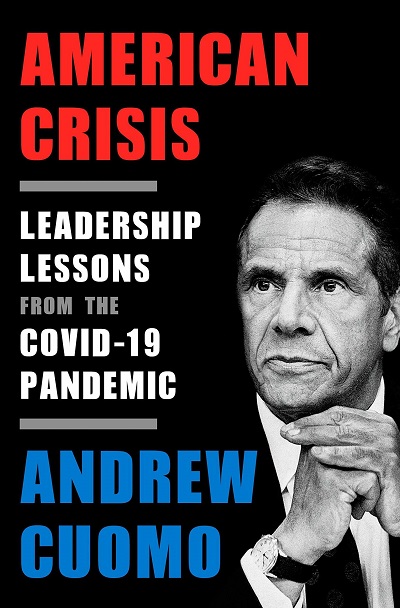
Back in November, Kenneth Whyte reported on the unlikely pay-off for Andrew Cuomo and his American Crisis. In this week’s SHuSH newsletter he’s delighted to report that the state government — which effectively funded the research and writing of the book — will be the eventual recipient of the whole advance:
Sorry to keep harkening back to previous SHuSHs but I can’t overlook the latest on the Andrew Cuomo shambles.
You’ll remember that now-disgraced former governor of New York, Andrew Cuomo, played dirty with his publisher and the public while landing a lucrative book contract. More specifically, he suppressed bad news about pandemic deaths in his state while coaxing a $5.1 million advance out of Penguin Random House for a book about his heroic activities as a COVID-19 fighter.
I mentioned that it was astonishing that the governor of America’s hardest-hit pandemic state could produce a fat manuscript in just three months, and that media reports suggested his staff and a ghostwriter authored the book for him. The same reports said he was in danger of violating state ethics prohibitions against the use of state resources or personnel in producing his book.
I also noted that weeks after the grandly titled American Crisis: Leadership Lessons from the COVID-19 Pandemic was released in October 2020, Cuomo was hit with the first in a long series of sexual harassment allegations. He was forced to resign his office in August 2021. By then, it had also emerged that Cuomo’s office had covered up roughly half of the fatalities among state nursing home residents during the pandemic.
Penguin Random House took a bath on the project. American Crisis has sold only about 50,000 copies, about a tenth of what the publisher needed to cover the advance it paid the author.
This week it was Cuomo’s turn in the tub. An ethics panel ruled that he had broken his promises not to use state resources or government staff to write his self-congratulatory book, and gave him thirty days to hand over to the State of New York the $5.1 million he earned with the book.
‘Tis the season to be jolly
Fa-la-la-la-la, la-la-la-la
QotD: Sun Tzu’s Art of War reworked for the 21st Century by General Mark Milley
“If you think you might attack an enemy, pick up the phone and give ’em a heads up. It’s only fair.”
“You have to be careful not to surprise your enemy. They really don’t like it.”
“Treason is not treason if it is the lesser of two treasons.”
“Know thy pronouns, and know thy enemy’s pronouns.”
“The supreme art of war is to surrender to your enemy without fighting.”
“All war is white rage.”
“If you surrender, you can never lose.”
“If thy commanding officer sends mean tweets, thou need not follow orders or the chain of command.”
“The enemy of my friend is my friend.”
“Keep your friends close and your enemies on speed dial.”
“You can not betray the one to which you were never loyal.”
“Ask not what your country can do for you, but what you can do for China.”
“When retreating, leave most of thy armaments behind so you know what you’ll be up against next time.”
“Chinese bros before American hoes.”
“He who turns on bad orange man gets big book deal.”
“General Milley Is Releasing A Revised Version Of The Art Of War — And We’ve Got Exclusive Excerpts”, BabylonBee, 2021-09-17.
December 15, 2021
QotD: Suppressing intellectual heresy
The young people at Middlebury who shouted down Charles Murray and assaulted a faculty member who had tried to engage him in civil debate were, in effect, suppressing the ideas of a heretic. After all, a heretic’s ideas are too dangerous to be heard.
Dangerous ideas are, of course, interesting ideas, especially to young people. When we fail to address dangerous ideas in our courses, we add to their mystique. When activists shout down or assault heretical speakers they send two messages. The first and intended message is a display of righteous disapproval. The other, unintended message, is that there is something so menacing about the idea being expressed that it cannot simply be laughed off or even argued with, rather it cannot be allowed to be spoken.
Consider how that looks to someone who is starting to question the premises of the liberal orthodoxy on race, gender, diversity and so on. Why, our alt-right curious person might wonder, are there some ideas that are so laughably false that one need not even mount a counter argument (a flat earth or the financial benefits of college athletics), some ideas that are considered contentious but still open to debate (supply-side economics), and some ideas that are so outré that they can only be met with back turning, shouting, or by punches to the face?
Might it be, our waverer must wonder, that these people don’t want me to hear this idea because they don’t have a good answer to it?
Erik Gilbert, “Liberal Orthodoxy and the New Heresy”, Quillette, 2019-02-04.
December 12, 2021
“Say what you will about Rand, nobody ever described her as a light read”
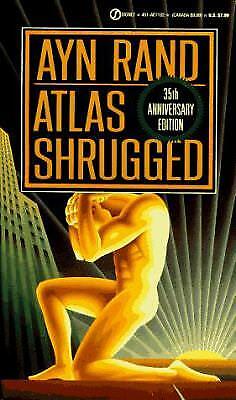
In Quillette, David Cohen notes that we’re coming up on the 40th anniversary of Ayn Rand’s death, which will almost certainly help expose her work to a renewed audience of disaffected teens and freshman university students:
More than a half-century ago the great — and, alas, irreplaceable — American scholar Allan Bloom became aware of the spell she could cast. He first started noticing it around the time he became aware of a decline in serious reading among his students. As the University of Chicago professor later recounted in The Closing of the American Mind, it became particularly evident whenever he asked his large introductory classes which authors and books really mattered to them. Most of the undergrads fell silent, he wrote, or else were puzzled by the question. There was generally no text to which they looked “for counsel, inspiration or joy,” he remarked. But one exception kept popping up.
There always seemed to be, he marvelled, a student who mentioned Atlas Shrugged, a work “although hardly literature, which, with its sub-Nietzschean assertiveness, excites somewhat eccentric youngsters to a new way of life.” And rather more of them than did Allan Bloom or, indeed, pretty much anyone else in the United States who has ever tried to hawk philosophy to the masses. Rand’s book sales overall stand at around 30 million, with hundreds of thousands more each year, and probably rather more this coming year.
Not only is she sought-after for her two best-known novels — the other being The Fountainhead — but also for her nonfiction. Her slim volumes of collected essays and old newspaper columns and other outtakes comprise an apparently fathomless vault from which the Ayn Rand Institute routinely cobbles together regular offerings for the lucky kids. One survey by the Library of Congress listed Atlas Shrugged as second only to the Bible in terms of campus popularity; an incredible accomplishment. All the more so in an era of Twitter, Facebook, and all the other intimations of the shortened attention-span. Say what you will about Rand, nobody ever described her as a light read.
A random internet search throws up an impressive litany of fans from the entertainment world, including Oliver Stone, Rob Lowe, Jim Carrey, and Sandra Bullock. Even the late professional wrestler James Hellwig, better known as The Ultimate Warrior, bellowed her praises, which might add some context to those rollickingly individualistic pre-fight interviews he used to do back in the WWE glory days. Oh, and let’s not forget Brad Pitt and Vince Vaughn. Which is particularly interesting, I think, since Jennifer Aniston (also a Rand fan) replaced the first with the second after Pitt ran off with Angelina Jolie, who’s also on record enthusing about Rand’s “very interesting” take on the good life.
In politics and economics, Rand had her youthful followers, too, and here again one sees the youth-appeal angle. Probably her best-known disciple is the former Federal Reserve chairman Alan Greenspan, who is rather ancient now. But back when dinosaurs still roamed the Earth, Greenspan declared that the high empress of the libertarian Right “taught me that capitalism is not only practical and efficient but also moral.” Like the young and philosophically restless undergrads in Allan Bloom’s classes, the British health secretary Sajid Javid also discovered her early on, and apparently still reads the courtroom scene in The Fountainhead every year. Or rather, as the cool libertarian kids in the black jeans might prefer to put it, it still reads him.
December 10, 2021
Shovel-ready infrastructure we’re already busy working on … the superhighway to serfdom
Jacob T. Levy considers the warning about authoritarian solutions to societal problems given by Friedrich A. Hayek in The Road to Serfdom and shows just how little we heeded his concerns:
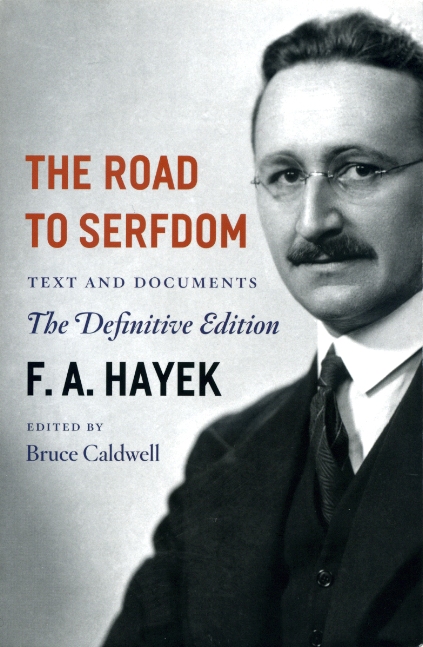
It is well-known that the classical liberal economist F.A. Hayek dedicated The Road to Serfdom to “socialists of all parties”, and wrote the book “as a warning to the socialist intelligentsia of England.” I suspect we now understate the importance of these facts. After decades of the Cold War and self-conscious conservative-libertarian “fusionism” in both the U.S. and Britain, what sticks in our memory of The Road to Serfdom is its defense of liberal open markets against economic planning and regulation of the sort advocated on the left. That is of course how it was wielded in the post-2008 surge in interest in it, in the wake of the financial crisis and the subsequent bailouts and stimulus packages: as a weapon of the right.
But if Hayek’s argument characterized socialist planning and regulation as a slippery slope, the slope did not only slope down toward the left. Fascist Italy and Germany figure even more prominently than the USSR in the book’s image of the despotism being risked:
It is necessary now to state the unpalatable truth that it is Germany whose fate we are now in some danger of repeating … students of the current of ideas can hardly fail to see that there is more than a superficial similarity between the trend of thought in Germany during and after [World War I] and the present current of ideas in the democracies … And at least nine out of every ten of the lessons which our most vociferous reformers are so anxious we should learn from this war are precisely lessons which the Germans did learn from the last war and which have done so much to produce the Nazi system … [A]t an interval of fifteen to twenty-five years we seem to follow the example of Germany.
In the face of resurgent right-wing populist and nationalist authoritarianism in the world, it is worth reconsidering the legacy of The Road to Serfdom and of Hayek’s work to bolster liberalism.
Hayek warned of centralizing and authoritarian urges of both the left and the right, but it’s in the “permanent” government — the civil servants who remain in office regardless of electoral outcomes — that much of the danger to individual liberty lies:
Throughout Hayek is concerned for constitutional parliamentary government and the rule of law, and their protection against arbitrary government. The idea that freedom requires clear and general rules of conduct anonymously applicable to all — that government run by ad hoc edict is oppressive — was to be the major theme of his subsequent works in political theory, The Constitution of Liberty and Law, Legislation, and Liberty; but it is central to the argument of Road to Serfdom as well.
In the preface to the 1956 edition, Hayek described the postwar Labour government as having created a bureaucratic “despotism exercised by a thoroughly conscientious and honest bureaucracy for what they sincerely believe is the good of the country. But it is nevertheless an arbitrary government, in practice free from parliamentary control; and its machinery would be as effective for any other than the beneficent purposes for which it is now used.”
Here one hears a predecessor of the widespread classical liberal “we told you so” after the election, blaming the Obama administration for increasing the presidential power that the Trump administration would now inherit. But it is worth emphasizing that Hayek still called the purposes pursued by the left-wing bureaucratic state “beneficent”.
The tone Hayek adopts here is not the schadenfreude of contemporary whataboutism. Now that “hot socialism is probably a thing of the past” (hardly what one would expect Hayek to say were he the determinist caricature sometimes embraced by fans as well as critics), the welfare state calls for “careful sorting out” in the pursuit of its “practical and laudable” aims. He calls for the welfare state and social insurance to be implemented through general rules and fiscal policy rather than administrative coercion, nationalization, and direct economic planning, because the latter instruments “are not compatible with the preservation of a free society.”
H/T to Tamara Keel for the link.
December 6, 2021
QotD: Modern “Canadian culture” is a vast vanity press operation funded with lots of government money
CanCon is a heavy lift at the best of times, being close neighbors to that hulking great monster south of us which is the most creative culture on earth. That is why we spend billions every year to prop up our creators, our artists, who we love.
Except we don’t.
Film salaries are funded up to 50%, books, 30%, news media 60%, and yet … no one is watching, reading, or listening. It is like a giant vanity project which various foreign appointees can brandish in foreign capitals.
Last month I traced the sales of this year’s Canadian literary award winners and I suppose “best-sellers”. Their sales on Amazon, hardcover, soft cover and digital ranged from 4 books to 33 books per month, incomes hovering in the three figures. (Amazon accounts for roughly 70% of sales.) This during summer reading months where Canadians are at their lake shacks from coast to coast reading one would hope about themselves, the world they live in, and well … just curiosity.
Equally looking at the viewer and listener stats for the CBC, our national behemoth, which eats up $1.5 billion annually, and which amounts to 50% of the media dollars spent, is equally disheartening. The state spends another $600 million supporting once-successful media because “internet”.
CBC television is watched by 3.9% of Canadians and only .8% watch CBC News. Again, half of all media dollars, half. Half is spent engaging less than 4% of Canadians.
CBC radio is considered reasonably good, and is listened to despite the almost vindictive calling out of anyone who disagrees with their hard socialist stance. Despite every conceivable advantage, advertising on the CBC dropped 20% during the pandemic.
In fact, they are so disliked that CBC is hiring “close protection security” for the next two years. They are so disliked, they have turned off commenting on their various programs. They are so disliked that there is a brand of coffee called “Defund the CBC”. This isn’t passive ignoring, this is active dislike to the point of needing bodyguards.
Why?
Because our media show us Canadians as racist, stupid, sexist, stupid, stupid and more stupid. And while they are at it, shallow and violent.
That is the real reason, and the only reason CanCon is dying. They hate us.
Elizabeth Nickson, “Canadian Culture on the Ropes”, Elizabeth Nickson, 2021-09-01.
December 5, 2021
Will publishers move back to actually printing their own books?
In the latest SHuSH newsletter, Kenneth Whyte explains some of the issues publishers face in getting their books printed, as most publishers outsourced the actual physical work of printing and binding many years back:

Offset printing.
Image from Wikimedia Commons.
I had a serious conversation with another publisher this week about the need for publishers to start printing their own books.
Those familiar with publishing history will know that from the fifteenth to the nineteenth century, most publishers printed their own books. Ownership of a press, as much as anything, was what made a publisher a publisher. In the course of the twentieth century, it was decided that publishing books and printing books were different businesses. Virtually all publishers outsourced their printing to high-volume printing specialists who were constantly upgrading their equipment, and who, theoretically, at least, were better, faster, and cheaper than in-house printing operations.
[…]
Apart from that handful of artisans, today’s book publisher can no more operate a printing press than a backhoe. He or she outsources printing to specialists on a project-by-project basis.
The options for large-scale quality printing are increasingly scarce, thanks to a lot of consolidation in the printing business. Smaller shops (like the artisans) only do paperbacks; hardcovers require a lot of expensive binding equipment. If a publisher wants a big run of a hardcover title, the most likely printers are the industry giants: R.R. Donnelley (above) or CJK Group in the US; Friesens and Marquis in Canada. These companies all use huge offset web presses that are big as gymnasiums and only economically efficient at higher quantities (i.e., in the thousands). The technology involves metal plates and rubber mats and massive rolls of paper (if you’re interested, read more here) and the quality is first rate.
I should have said that the only options for a big run of hardcovers in Canada are Friesens in Altona, Manitoba and Marquis in Montmagny, Quebec. There are no hardcover printing options in Ontario, where so many publishers are concentrated (although Marquis does have a plant in Toronto).
[…]
The reason publishers are now talking about doing their own printing is that it is increasingly difficult to get time on any kind of press. Friesens, when Sutherland House started a few years ago, could usually do a job for us in eight weeks. There were seasons — the dead of winter, the height of summer — when they could deliver even faster and we’d get a discount because their presses weren’t especially busy. COVID-19 changed all that.
People have been buying more books during the pandemic, and publishers have been printing more. Friesens is now fully booked six to eight months out; its fall 2022 schedule is already crowded. The US printers we use as alternatives to Friesens are similarly backed up.
It’s making the decision to print in hardcover hazardous. It used to be that if you printed a few thousand copies of a new book in hardcover and it was in danger of selling out, you could get back on press in six to eight weeks, maybe less, and continue to fill orders. Now, if that original press run is selling fast, you might have to wait six to eight months to print a second edition. You’ll be out-of-print for most of that time, and all momentum will be lost. Some publishers are thus moving immediately to digital paperback formats (none of the digital printers have hardcover binderies) for their second editions, even if it’s only weeks into a book’s life. There is more availability at digital printers, so resorting to the digital paperback format allows you to keep your momentum.
December 4, 2021
QotD: Still making dystopia
Curl’s critique of the theory and practice of modernism demolished the economical-ethical-political arguments put forward for decades that justified forcing people to live in inhuman environments. It was all a power-play, to drive humane architecture and its practitioners into the ground so that a new group of not very competent architects and academics could take over.
Alas, after three years, the situation is much the same as it was before 2018. Whoever practised humane architecture continues to do so today. Practitioners who have always applied Curl’s philosophy include Classical and Traditional architects, and followers of Christopher Alexander (who do not necessarily use a Classical style, but reject the modernist design straightjacket so as to create a more living structure). Those who produced image-based inhumane architecture have not changed tack or been influenced in any perceivable way.
Curl’s book covers human-scale developments that were allowed at the margins of the profession during several decades, as long as they didn’t threaten the core where the spotlight shines. Practitioners the world over, most often working in isolation, produce excellent and humane buildings. That work is hardly ever seen in the media, certainly never in the architecture journals. I’m sure that those architects now feel vindicated. It is possible that Curl’s book provides a rallying point for those who desire a new, humane architecture.
Nikos A. Salingaros, “Still making dystopia”, The Critic, 2021-08-30.
December 1, 2021
“To challenge individualism, we must suspend individual perceptions by exploring our collective racial identity, which is good because by disrupting individual identities, we challenge individualism”
Matt Taibbi reviews Robin DiAngelo’s Nice Racism: How Progressive White People Perpetuate Racial Harm.
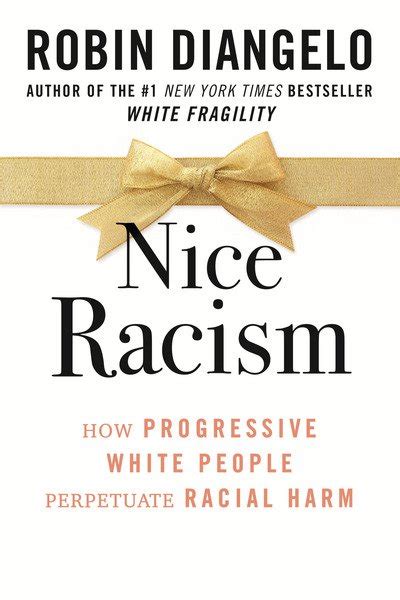
Nice Racism, the booklike product just released by the “Vanilla Ice of Antiracism“, Robin DiAngelo, begins with an anecdote from the author’s past. She’s in college, gone out to a dinner party with her partner, where she discovers the other couple is, gasp, black. “I was excited and felt an immediate need to let them know I was not racist,” she explains, adding: “I proceeded to spend the evening telling them how racist my family was. I shared every racist joke, story, and comment I could remember my family ever making …”
Predictably, her behavior makes the couple uncomfortable, but, “I obliviously plowed ahead, ignoring their signals. I was having a great time regaling them with these anecdotes — the proverbial life of the party!” She goes on:
My progressive credentials were impeccable: I was a minority myself — a woman in a committed relationship with another woman … I knew how to talk about patriarchy and heterosexism. I was a cool white progressive, not an ignorant racist. Of course, what I was actually demonstrating was how completely oblivious I was.
No kidding. Instead of trying to amp down her racial anxiety out of basic decency, this author fed hers steroids and protein shakes, growing it to brontosaurus size before dressing it in neon diapers and parading it across America for years in a juggernaut of cringe that’s already secured a place as one of the great carnival grifts of all time. Nice Racism, the rare book that’s unreadable and morally disgusting but somehow also important, is the latest stop on the tour.
DiAngelo is a unique writer, being dishonest, dangerous, and moronic in magnificent quantities, probably in that order. If you’re trying, which she clearly isn’t, a good trade rule is, “If you’ve already written a book once, don’t write it again.” Nice Racism is the same book as the 2018 bestseller White Fragility, and by “the same” I don’t mean generally, but word-for-word, line-by-line, chapter-by-chapter the same, a thunderous, admirably brazen exercise in self-plagiarism. Can you guess which of these passages is from Nice Racism, and which from White Fragility?
a) Individualism… allows white people to exempt ourselves personally from race-based advantage.
b) To challenge the ideologies of racism such as individualism and color blindness, we as white people must suspend our perception of ourselves as unique and/or outside race.
c) Exploring our collective racial identity interrupts a key privilege of dominance — the ability to see oneself only as an individual.
d) We need to discuss white people as a group — even if doing so jars us — in order to disrupt our unracialized identities … Talking about race and racism in general terms such as white people is constructive for whites because it interrupts individualism.
The first is from Nice Racism, the rest from White Fragility. The last three actually comprise a paragraph that moves in full circle: “To challenge individualism, we must suspend individual perceptions by exploring our collective racial identity, which is good because by disrupting individual identities, we challenge individualism.” A rhetorical palindrome! This isn’t writing, but vomiting up mounds of sentences that mean the same thing and mopping them on the page. Because this author only has two or three ideas — I was going to make a list but I think it stops after “denying racism is evidence of racism” — the effect is disorienting across one book, let alone two.
H/T to K.T. at Ace of Spades H.Q. for the link.
November 28, 2021
QotD: Hidden political pay-offs as “book advances”
True advances are, well, advances against expected future royalties. That’s why they’re called “advances”.
People expect that a J.K. Rowling book will produce at least $5 million in royalties, so you give her a $5 million advance on those royalties. You’re giving her a payment on her royalties in advance of actually seeing those sales.
But you do expect them.
You don’t pay her fresh royalties until the royalties she generates exceeds the initial advance on royalties you paid her.
When she makes $5 million and one hundred dollars, you send her a fresh check for one hundred dollars.
When these major media conglomerates, all left-leaning and most with business before the government, give millions to Hillary Clinton and Hunter Biden and Andrew Cuomo, there is no one at that company that expects the books will ever make that much in royalties.
They’re just payoffs. Or disguised political donations.
It’s not an “advance” if you cannot show a plausible stream of sales which will meet or exceed that “advance”.
Personally, I’d love to see some kind of law on this subject to force these large media corporations to prove that they have a genuine, rational belief that a Hunter Biden book will make $10 million in sales (which would justify a million dollar advance, assuming a royalty of 10%).
And I’d like to see their corporate officers sign certifications for the government that they’re not fudging the numbers. And that they understand that there might be prosecutions for perjury if they do lie about expected future royalties.
Much like people in the financial sector are constantly required to sign.
Why should media corporations be immune from such requirements?
And I’d love to see these disguised campaign donations treated and limited just like actual campaign donations.
Or, better yet: No “advances” for serving politicians, declared politicians who are running, or any politician ten years after his term of service ends. They can just take their royalty checks as royalties actually accrue.
If Hunter Biden really sells $10 million in books — LOL — then he’ll get that million dollars eventually in royalty payments. They’ll just come over the course of a year or two rather than all at once in an “advance” on future earnings.
If not — then not.
This isn’t stopping them from getting paid for books they sell — it’s to stop mega-media-corporations with business before the government, and a strong desire to pay off politicians they like, from giving “advances” to favored politicians that bear no relationship whatsoever to the actual expected royalties the books will generate.
Ace, “Ethics Agency Might Claw Back Cuomo’s $5 Million ‘Advance’ For His ‘Book'”, Ace of Spades H.Q., 2021-08-27.
November 27, 2021
How Andrew Cuomo got megabucks for his (ghostwritten) book on the pandemic
In the latest issue of the SHuSH newsletter, Kenneth Whyte details how former New York state Governor Andrew Cuomo managed to get a $5.1 million advance from Random Penguin for a book that was mostly written by Cuomo staff members and an outside ghostwriter:
Penguin Random House contacted Cuomo’s agent about writing a book on March 19, 2020, about three weeks after the first COVID-19 case landed in New York. Cuomo was a TV darling in the early days of the pandemic. On July 1, his agent got back to Penguin Random House to say he’d written 70,000 words and he was ready to make a deal. How did a governor of America’s hardest-hit pandemic state produce a fat manuscript in three months flat? It appears he had his staff and a ghostwriter author the book for him, in violation of state ethics prohibitions against the use of any state resources or personnel to produce the book.
Meanwhile, Cuomo’s office was churning out doctored statistics to make his pandemic policies, particularly around nursing homes, look better than they deserved.
July 8, Cuomo’s book went to auction. Penguin Random House kicked things off with a $750,000 offer and wound up winning with a bid of $5.1-million. It was a triumph for Cuomo, and not his first in the publishing world: about seven years ago, he took HarperCollins for a $700,000 advance on what the New Republic called an “overlong … cliché-ridden, and hopelessly dull” memoir, All Things Possible. That one sold 4,000 copies in hardcover, a number that would warrant an advance of maybe $10,000.
Several weeks after the auction, Cuomo was asked by the media if he got a lot of money to write the book. “Well,” he replied. “Only if I sell a lot of copies.” Which is not how it works. Advances are non-returnable, and he’d banked $3.1 of the $5.1 before publication. The rest of Cuomo’s advance was spread out over two more years, presumably for tax purposes.
Weeks after the grandly titled American Crisis: Leadership Lessons from the COVID-19 Pandemic was released in October 2020, Cuomo was hit with the first of a long series of sexual harassment allegations. He was forced to resign in August 2021. By then, it had also emerged that Cuomo’s office had covered up roughly half of the fatalities among state nursing home residents during the pandemic.
American Crisis managed to sell at least ten times more copies than Cuomo’s previous book, which is progress, I suppose, but still a nightmare for his publisher. A sale of 50,000 copies might warrant a solid six-figure advance. But $5.1 million? Disastrous.
November 25, 2021
Are there any actual First Nations people on government commissions, or are they all Pretendians?
There are few enough opportunities for First Nations people in Canada to be heard and for their efforts to matter on issues of concern to all First Nations people … so why do so many of those positions seem to be held by people who lie about their First Nations ancestry? (The original CBC story is from back in September, but I only found out about it today, with my usual great sense of timing.)



Suzy Kies, the co-chair of the Indigenous peoples’ commission of the Liberal Party, has resigned from the position after her claim to Indigenous ancestry was called into question.
Radio-Canada reported on Wednesday that it could not confirm Kies’s claims to Indigenous ancestry. Kies told Radio-Canada in an interview that her father is of European descent and her mother is of Indigenous descent.
“My mother’s family is from several communities,” she told Radio-Canada in an interview in French. “On my grandfather’s side, it’s the Maliseet, from St. Mary’s, New Brunswick, there are also the Laporte who are Innu. And my grandmother was Abenaki from Odanak.”
In Radio-Canada’s reporting, they consulted civil status records and the Abenaki Council of Odanak, who did not find Kies on the band list.
The story came following controversy over a book-burning project at a francophone Ontario school board in which Kies was involved. The event, which was carried out by the Conseil scolaire catholique Providence in 2019, has resurfaced during the election campaign and has attracted condemnation by federal leaders.
The event was meant to promote reconciliation by burning and disposing of books the school board deemed to contain outdated and inappropriate depictions of Indigenous people. The books included novels, comic books and encyclopedias, according to a documentary obtained by Radio-Canada. Nearly 5,000 books were disposed of, but only around 30 were burned.
H/T to halls of macadamia for the link.
Update: A disturbing number of white American college applicants are lying about their racial ancestry to (significantly) improve their chances of being accepted, so I guess Canadian Pretendians are just slightly ahead of the curve:
The survey of 1,250 white college applicants ages 16 and older found that the most popular racial claim was Native American. Out of the 34 percent of white college applicants who lied about their race, 77 percent were accepted.
“It’s the easiest lie to tell because you can’t get caught in it,” said Vijay Jojo Chokal-Ingam, an admissions consultant at SOSAdmissions.com and author of Almost Black: The True Story of How I Got Into Medical School By Pretending to Be Black.
“A lot of people, based on very flimsy reasons, claim to be either African-American, Hispanic or Native American because they know it’s going to improve their chances,” Chokal-Ingam said in an interview with The College Fix.
Though lying on college applications is frowned upon, universities typically do not push back on students about their race. Instead, they accept it regardless of what they look like, he said.
“It’s become a joke,” Chokal-Ingam said.
He cited Senator Elizabeth Warren, who famously “lied about her race to get a faculty position at Harvard.”
“If there was a degree to which people felt guilt about doing that, it died with Warren because the Boston Globe, the New York Times, the Washington Post — they all ran to her defense,” he said. “This prompted an ‘if she can do it, I can do it too’ ideology.”
“When President Trump called Senator Elizabeth Warren ‘Pocahontas’, [the media] called him a racist. They said it was a racist thing. On the contrary, I think that he was bringing to attention a very important issue in the field of racial-race relations,” Chokal-Ingam said. “He was making people aware of the fact that people routinely, on a massive scale, lie about their race.”
H/T to Glenn “Instapundit” Reynolds, who pointed out, “If white supremacy were actually a thing, this wouldn’t be happening”.


