
World War Two
Published 20 Apr 2024The Soviet drive on Berlin continues, but it is now very much a race between the forces of Georgy Zhukov and those of Ivan Konev. In the west, over 300,000 Germans surrender to the Allies as the Ruhr Pocket is eliminated, though there are advances by all Allied armies this week on the whole Western Front. There is even an Allied breakthrough in Italy, though on Okinawa American attacks get nowhere. The Japanese are advancing in China, and in Burma the Allied drive for Rangoon continues.
(more…)
April 21, 2024
300,000 Germans Surrender in the Ruhr – WW2 – Week 295 – April 20, 1945
Comments Off on 300,000 Germans Surrender in the Ruhr – WW2 – Week 295 – April 20, 1945
April 20, 2024
Cape Esperance and the Japanese Evacuation of Guadalcanal
Forgotten Weapons
Published Jan 12, 2024Today we return to Guadalcanal, to the site of the last actions of the campaign. For the Japanese, the defeat at Edson’s Ridge (aka Bloody Ridge) forced a disastrous and uncoordinated retreat into the jungle. With their supply lines destroyed, Japanese troops largely moved west on the island, away from American positions and in search of food. This would eventually bring them to Cape Esperance, where a rearguard force was landed, and some 10,652 Japanese soldiers were successfully evacuated on fast-moving destroyers over the course of several nights in early February, 1943.
On the American side, Army troops landed to relieve the Marines. In January and into early February they ran what was considered a mopping-up campaign west, including landings on the far west end of the island beyond Esperance. The intention was to encircle the remaining Japanese forces, under the assumption that the destroyer activity was landing fresh troops. Instead, when the American forces joined up at Cape Esperance it was an anticlimactic end to the fighting, as all they found were remnants of equipment that had been left on the beaches.
(more…)
Comments Off on Cape Esperance and the Japanese Evacuation of Guadalcanal
April 14, 2024
Soviets Take Vienna and Königsberg – WW2 – Week 294 – April 13, 1945
World War Two
Published 13 Apr 2024The prizes of Vienna and Königsberg fall to the Soviets as they continue what seems an inexorable advance. In the West the Allies advance to the Elbe River, but there they are stopped by command. The big news in their national papers this week is the death of American President Franklin Roosevelt, which provokes rejoicing in Hitler’s bunker. The Allied fighting dash for Rangoon continues in Burma, as does the American advance on Okinawa, although Japanese resistance is stiffening and they are beginning counterattacks.
Chapters
00:32 Recap
01:05 Operation Grapeshot
01:57 Roosevelt Dies
06:01 Soviet Attack Plans for Berlin
12:45 Stalin’s Suspicions
14:31 The fall of Königsberg
17:02 The fall of Vienna
18:38 Japanese Resistance on Okinawa
20:34 The War in China
21:09 Burma and the Philippines
22:38 Summary
22:57 Conclusion
25:05 Memorial
(more…)
Comments Off on Soviets Take Vienna and Königsberg – WW2 – Week 294 – April 13, 1945
April 8, 2024
The Battle of Okinawa Begins – WW2 – Week 293 – April 6, 1945
World War Two
Published Apr 6, 2024It’s the next step toward invading Japan’s Home Islands — invading Okinawa, and it begins April 1st. Advances are easy by land, but at sea the kamikaze menace is in full swing. In Burma, plans are made to liberate Rangoon; in the west hundreds of thousands of Germans are surrounded in the Ruhr; and in the east, the Soviets begin assaults on Königsberg and Vienna.
(more…)
Comments Off on The Battle of Okinawa Begins – WW2 – Week 293 – April 6, 1945
April 6, 2024
Italian Communists, the French in Indochina, and the fate of Italy’s army – WW2 – OOTF 34
World War Two
Published 5 Apr 2024What happened to Italian soldiers overseas after the fall of Mussolini? What about the French soldiers left over in Indochina after the Japanese “occupation by invitation”? And, what did the Allies think of the Italian Communist movement and its partisan forces?
(more…)
Comments Off on Italian Communists, the French in Indochina, and the fate of Italy’s army – WW2 – OOTF 34
April 4, 2024
QotD: What we mean by the term “indigenous”
Well, if by indigenous we mean “the minimally admixed descendants of the first humans to live in a place”, we can be pretty confident about the Polynesians, the Icelanders, and the British in Bermuda. Beyond that, probably also those Amazonian populations with substantial Population Y ancestry and some of the speakers of non-Pama–Nyungan languages in northern Australia? The African pygmies and Khoisan speakers of click languages who escaped the Bantu expansion have a decent claim, but given the wealth of hominin fossils in Africa it seems pretty likely that most of their ancestors displaced someone. Certainly many North American groups did; the “skraelings” whom the Norse encountered in Newfoundland were probably the Dorset, who within a few hundred years were completely replaced by the Thule culture, ancestors of the modern Inuit. (Ironically, the people who drove the Norse out of Vinland might have been better off if they’d stayed; they could hardly have done worse.)
But of course this is pedantic nitpicking (my speciality), because legally “indigenous” means “descended from the people who were there before European colonialism”: the Inuit are “indigenous” because they were in Newfoundland and Greenland when Martin Frobisher showed up, regardless of the fact that they had only arrived from western Alaska about five hundred years earlier. Indigineity in practice is not a factual claim, it’s a political one, based on the idea that the movements, mixtures, and wholesale destructions of populations since 1500 are qualitatively different from earlier ones. But the only real difference I see, aside from them being more recent, is that they were often less thorough — in large part because they were more recent. In many parts of the world, the Europeans were encountering dense populations of agriculturalists who had already moved into the area, killed or displaced the hunter-gatherers who lived there, and settled down. For instance, there’s a lot of French and English spoken in sub-Saharan Africa, but it hasn’t displaced the Bantu languages like they displaced the click languages. Spanish has made greater inroads in Central and South America, but there’s still a lot more pre-colonial ancestry among people there than there is pre-Bantu ancestry in Africa. I think these analogies work, because as far as I can tell the colonization of North America and Australia look a lot like the Early European Farmer and Bantu expansions (technologically advanced agriculturalists show up and replace pretty much everyone, genetically and culturally), while the colonization of Central and South America looks more like the Yamnaya expansion into Europe (a bunch of men show up, introduce exciting new disease that destabilizes an agricultural civilization,1 replace the language and heavily influence the culture, but mix with rather than replacing the population).
Some people argue that it makes sense to talk about European colonialism differently than other population expansions because it’s had a unique role in shaping the modern world, but I think that’s historically myopic: the spread of agriculture did far more to change people’s lives, the Yamnaya expansion also had a tremendous impact on the world, and I could go on. And of course the way it’s deployed is pretty disingenuous, because the trendier land acknowledgements become, the more the people being acknowledged start saying, “Well, are you going to give it back?” (Of course they’re not going to give it back.) It comes off as a sort of woke white man’s burden: of course they showed up and killed the people who were already here and took their stuff, but we’re civilized and ought to know better, so only we are blameworthy.
More reasonable, I think, is the idea that (some of) the direct descendants of the winners and losers in this episode of the Way Of The World are still around and still in positions of advantage or disadvantage based on its outcome, so it’s more salient than previous episodes. Even if, a thousand years ago, your ancestors rolled in and destroyed someone else’s culture, it still sucks when some third group shows up and destroys yours. It’s just, you know, a little embarrassing when you’ve spent a few decades couching your post-colonial objections in terms of how mean and unfair it is to do that, and then the aDNA reveals your own population’s past …
Reich gets into this a bit in his chapter on India, where it’s pretty clear that the archaeological and genetic evidence all point to a bunch of Indo-Iranian bros with steppe ancestry and chariots rolling down into the Indus Valley and replacing basically all the Y chromosomes, but his Indian coauthors (who had provided the DNA samples) didn’t want to imply that substantial Indian ancestry came from outside India. (In the end, the paper got written without speculating on the origins of the Ancestral North Indians and merely describing their similarity to other groups with steppe ancestry.) Being autochthonous is clearly very important to many peoples’ identities, in a way that’s hard to wrap your head around as an American or northern European: Americans because blah blah nation of immigrants blah, obviously, but a lot of northern European stories about ethnogenesis (particularly from the French, Germans, and English) draw heavily on historical Germanic tribal migrations and the notion of descent (at least in part) from invading conquerors.
One underlying theme in the book — a theme Reich doesn’t explicitly draw out but which really intrigued me — is the tension between theory and data in our attempts to understand the world. You wrote above about those two paradigms to explain the spread of prehistoric cultures, which the lingo terms “migrationism” (people moved into their neighbors’ territory and took their pots with them) and “diffusionism”2 (people had cool pots and their neighbors copied them), and which archaeologists tended to adopt for reasons that had as much to do with politics and ideology as with the actual facts on (in!) the ground. And you’re right that in most cases where we now have aDNA evidence, the migrationists were correct — in the case of the Yamnaya, most modern migrationists didn’t go nearly far enough — but it’s worth pointing out that all those 19th century Germans who got so excited about looking for the Proto-Indo-European Urheimat were just as driven by ideology as the 21st century Germans who resigned as Reich’s coauthors on a 2015 article where they thought the conclusions were too close to the work of Gustaf Kossinna (d. 1931), whose ideas had been popular under the Nazis. (They didn’t think the conclusions were incorrect, mind you, they just didn’t want to be associated with them.) But on the other hand, you need a theory to tell you where and how to look; you can’t just be a phenomenological petri dish waiting for some datum to hit you. This is sort of the Popperian story of How Science Works, but it’s more complex because there are all kinds of extra-scientific implications to the theories we construct around our data.
The migrationist/diffusionist debate is mostly settled, but it turns out there’s another issue looming where data and theory collide: the more we know about the structure and history of various populations, the more we realize that we should expect to find what Reich calls “substantial average biological differences” between them. A lot of these differences aren’t going to be along axes we think have moral implications — “people with Northern European ancestry are more likely to be tall” or “people with Tibetan ancestry tend to be better at functioning at high altitudes” isn’t a fraught claim. (Plus, it’s not clear that all the differences we’ve observed so far are because one population is uniformly better: many could be explained by greater variation within one population. Are people with West African ancestry overrepresented among sprinters because they’re 0.8 SD better at sprinting, or because the 33% higher genetic diversity among West Africans compared to people without recent African ancestry means you get more really good sprinters and more really bad ones?) But there are a lot of behavioral and cognitive traits where genes obviously play some role, but which we also feel are morally weighty — intelligence is the most obvious example, but impulsivity and the ability to delay gratification are also heritable, and there are probably lots of others. Reich is adorably optimistic about all this, especially for a book written in 2018, and suggests that it shouldn’t be a problem to simultaneously (1) recognize that members of Population A are statistically likely to be better at some thing than members of Population B, and (2) treat members of all populations as individuals and give them opportunities to succeed in all walks of life to the best of their personal abilities, whether the result of genetic predisposition or hard work. And I agree that this is a laudable goal! But for inspiration on how our society can both recognize average differences and enable individual achievement, Reich suggests we turn to our successes in doing this for … sex differences! Womp womp.
Jane Psmith and John Psmith, “JOINT REVIEW: Who We Are and How We Got Here, by David Reich”, Mr. and Mrs. Psmith’s Bookshelf, 2023-05-29.
1. aDNA works for microbes too, and it looks like Y. pestis, the plague, came from the steppe with the Yamnaya. It didn’t yet have the mutation that causes buboes, but the pneumonic version of the disease is plenty deadly, especially to the Early European Farmers who didn’t have any protection against it. In fact, as far as we can tell, in all of human history there have only been four unique introductions of plague from its natural reservoirs in the Central Asian steppe: the one that came with or slightly preceded the Yamnaya expansion around 5kya, the Plague of Justinian, the Black Death, and an outbreak that began in Yunnan in 1855. The waves of plague that wracked Europe throughout the medieval and early modern periods were just new pulses of the strain that had caused Black Death. Johannes Krause gets into this a bit in his A Short History of Humanity, which I didn’t actually care for because his treatment of historic pandemics and migrations is so heavily inflected with Current Year concerns, but I haven’t found a better treatment in a book so it’s worth checking it out from the library if you’re interested.
2. I cheated with that “pots not people” line in my earlier email; it usually gets (got?) trotted out not as a bit of epistemological modesty about what the archaeological record is capable of showing, but as a claim that the only movements involved were those of pots, not of people.
Comments Off on QotD: What we mean by the term “indigenous”
March 31, 2024
Allies Charge Forward from the Rhine! – WW2 – Week 292 – March 30, 1945
World War Two
Published 30 Mar 2024All along the Western Front the Allies break out in force, invading German territory and receiving German surrenders by the thousands. In the east, the Soviets take Danzig and Gdynia, and rout the Germans in Hungary. There’s a new Japanese offensive in China, though the fight on Iwo Jima ends with a Japanese defeat.
Chapters
00:45 Recap
01:08 Big Advances all over the West
05:48 Soviets take Gdynia and Danzig
07:09 Zhukov’s forces take Kustrin
10:39 The War in China
12:21 Iwo Jima Ends
14:30 Preliminaries for Okinawa
18:46 More Landings in the Philippines
19:23 Slim focuses on Rangoon
20:12 Notes to end the week
20:48 Summary
21:28 Conclusion
24:47 Call To Action
(more…)
Comments Off on Allies Charge Forward from the Rhine! – WW2 – Week 292 – March 30, 1945
August, 1945 – The Soviets enter the war in China
Big Serge outlines the Soviet invasion of Manchuria in August 1945 and its devastating impact on the Japanese Kwantung Army, finally shattering any remaining illusions that the Soviets would broker a peace between Japan and the western allies:
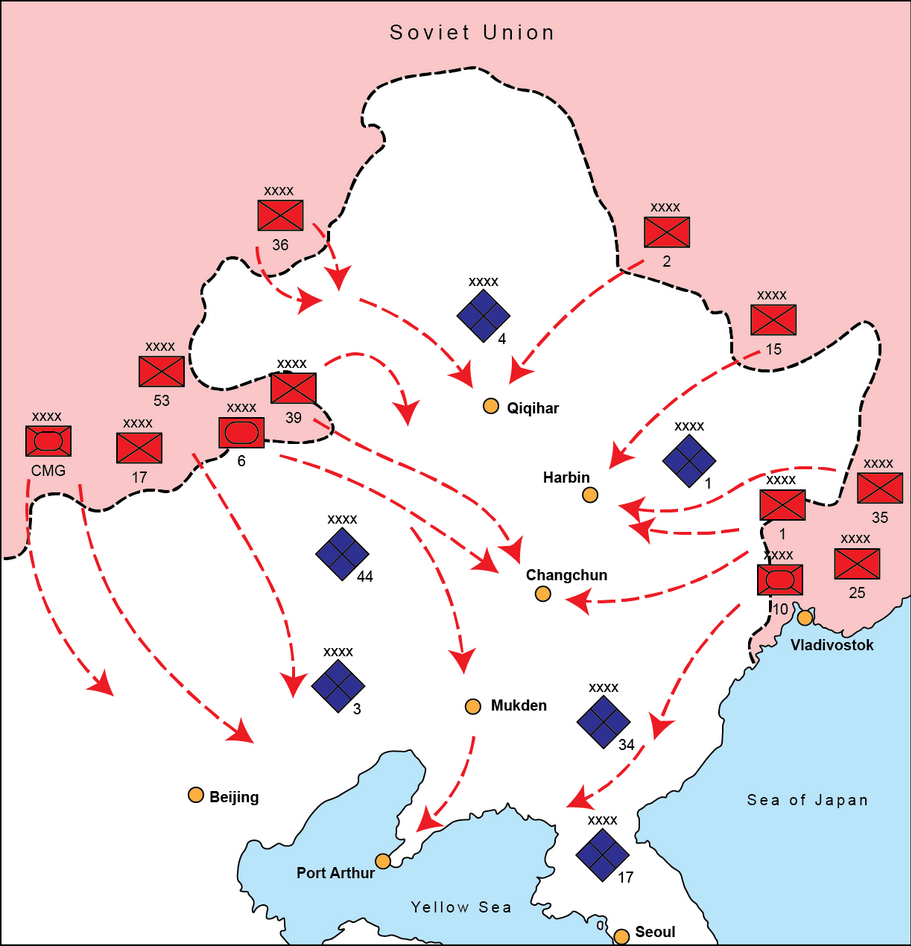
August Storm: The Soviet Invasion of Manchuria (August 9-20, 1945)
The Second World War had a strange sort of symmetry to it, in that it ended much the way it began: namely, with a well-drilled, technically advanced and operationally ambitious army slicing apart an overmatched foe. The beginning of the war, of course, was Germany’s rapid annihilation of Poland, which rewrote the book on mechanized operations. The end of the war — or at least, the last major land campaign of the war — was the Soviet Union’s equally totalizing and rapid conquest of Manchuria in August 1945.
Manchuria was one of the many forgotten fronts of the war, despite being among the oldest. The Japanese had been kicking around in Manchuria since 1931, consolidating a pseudo-colony and puppet state ostensibly called Manchukuo, which served as a launching pad for more than a decade of Japanese incursions and operations in China. For a brief period, the Asian land front had been a major pivot of world affairs, with the Japanese and the Red Army fighting a series of skirmishes along the Siberian-Manchurian border, and Japan’s enormously violent 1937 invasion of China serving as the harbinger of global war. But events had pulled attention and resources in other directions, and in particular the events of 1941, with the outbreak of the cataclysmic Nazi-Soviet War and the Great Pacific War. After a few years as a major geopolitical pivot, Manchuria was relegated to the background and became a lonely, forgotten front of the Japanese Empire.
Until 1945, that is. Among the many topics discussed at the Yalta Conference in the February of that year was the Soviet Union’s long-delayed entry into the war against Japan, opening an overland front against Japan’s mainland colonies. Although it seems relatively obvious that Japanese defeat was inevitable, given the relentless American advance through the Pacific and the onset of regular strategic bombing of the Japanese home islands, there were concrete reasons why Soviet entry into the war was necessary to hasten Japanese surrender.
More specifically, the Japanese continued to harbor hopes late into the war that the Soviet Union would choose to act as a mediator between Japan and the United States, negotiating a conditional end to war that fell short of total Japanese surrender. Soviet entry into the war against Japan would dash these hopes, and overrunning Japanese colonies in Asia would emphasize to Tokyo that they had nothing left to fight for. Against this backdrop, the Soviet Union spent the summer of 1945 preparing for one final operation, to smash the Japanese in Manchuria.
The Soviet maneuver scheme was tightly choreographed and well conceived — representing in many ways a sort of encore, perfected demonstration of the operational art that had been developed and practiced at such a high cost in Europe. Taking advantage of the fact that Manchuria already represented a sort of salient — bulging as it did into the Soviet Union’s borders — the plan of attack called for a series of rapid, motorized thrusts towards a series of rail and transportation hubs in the Japanese rear (from north to south, these were Qiqihar, Harbin, Changchun, and Mukden).
By rapidly bypassing the main Japanese field armies and converging on transit hubs in the rear, the Red Army would effectively isolate all the Japanese armies both from each other and from their lines of communication to the rear, effectively slicing Manchuria into a host of separated pockets.
There were, of course, a host of reasons why the Japanese had no hope of resisting this onslaught. In material terms, the overmatch was laughable. The Soviet force was lavishly equipped and bursting with manpower and equipment — three fronts totaling more than 1.5 million men, 5,000 armored vehicles, and tens of thousands of artillery pieces and rocket launchers.
The Japanese (including Manchurian proxy forces) had a paper strength of perhaps 900,000 men, but the vast majority of this force was unfit for combat. Virtually all of the Japanese army’s veteran units and equipment had been steadily transferred to the Pacific in a cannibalizing trickle — a vain attempt to slow the American onslaught. Accordingly, by 1945 the Japanese Kwantung Army had been reduced to a lightly armed and poorly trained conscript force that was suitable only for police actions and counterinsurgency against Chinese partisans.
Really, there was nothing for the Japanese to do. The Kwantung Army had far less of a fighting chance in 1945 than the Wehrmacht had in the spring of that year, and everyone knows how that turned out. Unsurprisingly, then, the Soviets broke through everywhere at will when they began the assault on August 9. Soviet armored forces found it trivially easy to overrun Japanese positions (armed primarily with archaic, low caliber antitank weaponry that could not penetrate Soviet armor even at point blank range), and by the end of the first day the Soviet pincers were driving far into the rear.
It is easy, in hindsight, to write off the Manchuria campaign as something of a farce: a highly experienced, richly equipped Red Army overrunning and abusing an overmatched and threadbare Japanese force. In many ways, this is an accurate assessment. However, what the offensive demonstrated was the Red Army’s extreme proficiency at organizing enormous operations and moving at high speeds. By August 20 (after only 11 days), the Red Army had reached the Korean border and captured all their objectives in the Japanese rear, in effect completely overrunning a theater that was even larger than France. Many of the Soviet spearheads had driven more than three hundred miles in a little over a week.
To be sure, the combat aspects of the operation were farcical, given the totalizing level of Soviet overmatch. Red Army losses were something like 10,000 men — a trivial number for an operation of this scale. What was genuinely impressive — and terrifying to alert observers — was the Red Army’s clear demonstration of its capacity to organize operations that were colossal in scale, both in the size of the forces and the distances covered.
More to the point, the Japanese had no prospect of stopping this colossal steel tidal wave, but who did? All the great armies of the world had been bankrupted and shattered by the great filter of the World Wars — the French, the Germans, the British, the Japanese, all gone, all dying. Only the US Army had any prospect of resisting this great red tidal wave, and that force was on the verge of a rapid demobilization following the surrender of Japan. The enormous scale and operational proclivities of the Red Army thus presented the world with an entirely new sort of geostrategic threat.
Comments Off on August, 1945 – The Soviets enter the war in China
March 30, 2024
Extra Firepower for Vietnam: the Aussie “B!tch”
Forgotten Weapons
Published Dec 18, 2023Many of the special forces groups that operated during the Vietnam War found their standard issue weapons a bit unwieldy for use in confined jungle environments. They also found a need for something that could deliver an immediate large volume of fire to break contact during an ambush (or deliver an ambush of their own). The Australians were no exception, and with the typical Special Forces attitude towards customization a few guys made some improvements to what they were issued …
What we have today is a recreation (by Mark Graham of ARS, build on a DSA semiauto receiver) of an Australian L1A1 with its flash hider cut down and a second pistol grip mounted to the barrel. The real examples of these often had rather shorter barrels, and ones that began life as semiauto L1A1 rifles were typically converted to fully automatic (some began as L2A1 automatic rifles and did not require this extra step). Fitted with a large LMG magazine, they could deliver a lot of firepower in a very short time; just the ticket for a small jungle patrol.
(more…)
Comments Off on Extra Firepower for Vietnam: the Aussie “B!tch”
March 28, 2024
The History of Fish Sauce – Garum and Beyond!
Tasting History with Max Miller
Published Dec 26, 2023Sweet frittata-like patina of pears with classic ancient Roman flavors and sprinkled with long pepper
City/Region: Rome
Time Period: 1st CenturyThis patina de piris is one of over a dozen recipes for similar dishes in Apicius’ De re coquinaria, a staple for ancient Roman recipes. It would have probably been part of mensa secunda, or second meal. Not a second breakfast, it was the final course in a larger meal and usually consisted of sweets, pastries, nuts, and egg dishes, kind of like a modern dessert course.
I finally made my own true ancient Roman garum in the summer of 2023, from chopped up fish pieces and salt to clear amber umami-laden liquid. There’s no fishiness in this surprisingly sweet dish, just a saltiness and savory umami notes that complements the other very ancient Roman flavors.
As with all ancient recipes, this is my interpretation and you can change things up how you like. I separated my eggs before beating them, but you could just whisk them up whole and add them like that.
(more…)
Comments Off on The History of Fish Sauce – Garum and Beyond!
March 26, 2024
QotD: Cavalry logistics for Steppe raiders
Each steppe warrior rode to battle with not one horse, but several: typically five to eight. For reasons that will rapidly become obvious, they preferred mares for this purpose. The Steppe warrior could ride the lead horse and keep the rest of them following along by connecting them via a string (thus “horse-string logistics”), such that each steppe warrior was his own little equine procession. These horses are, you will recall, fairly small and while they are hardy, they are not necessarily prodigiously strong, so the warrior is going to shift between them as he rides, sparing his best mount for the actual fight. Of course we are not looking at just one warrior on the move – that would be very dangerous – but a group on the move, so we have to imagine a large group (perhaps dozens or hundreds or even thousands) of warriors moving, with something like 5-8 times that many horses.
[Edit: It is worth noting that a horse-string war party might well also bring some number of sheep with them as an additional food supply, herding them along as the army rode. So even here, sheep maintain their importance as a core part of the subsistence system.]
Now of course the warriors are going to bring rations with them from the camp, including milk (both liquid in leather containers and dried to qurut-paste) as well as dried meat. But the great advantage of moving on mares is that they when they are lactating, mares are already a system for turning the grass of the steppe into emergency rations. As Timothy May (op. cit.) notes, a mare produces around 2.25-2.5 quarts of milk in excess of the needs of her foal per day during her normal five-month lactation period, equal to about 1,500kcal/day, half of the daily requirement for a human. So long as at least two of the horses in the horse-string were lactating, a steppe warrior need not fear shortfall. This was more difficult in the winter when less grass was available and thus mare’s milk became scarce, which could impose some seasonality on a campaign, but a disciplined band of steppe warriors could move massive distances (the Mongols could make 60 miles a day on the move unencumbered, which is a lot) like this in just a few months.
In adverse conditions (or where time permitted because meat is tasty), steppe warriors on the move could also supplement their diet by hunting, preserving the meat as saddle-jerky. In regions where water became scarce, we are frequently told that the Mongols could keep going by opening a vein on their horse and drinking the blood for both nourishment and hydration; May (op. cit.) notes that a horse can donate around 14 pints of blood without serious health risk, which is both hydrating, but also around 2,184kcal, about two-thirds of the daily requirement. This will have negative impacts on the horses long term if one keeps doing it, so it was an emergency measure.
The major advantage of this kind of horse-string logistics was that a steppe warrior party could move long distances unencumbered by being essentially self-sufficient. It has a second major advantage that I want to note because we’ll come back to it, they light no fires. For most armies, camp fires are essential because food preparation – particularly grains – essentially requires it. But a steppe warrior can move vast distances – hundreds of miles – without lighting a fire. That’s crucial for raiding (and becomes a key advantage even when steppe warriors transition to taking and holding territory in moments of strength, e.g. the Mongols) because sight-lines on the steppe are long and campfires are visible a long way off. Fireless logistics allow steppe warriors to seemingly appear from the steppe with no warning and then vanish just as quickly.
That said, these racing columns of steppe warriors, while they could move very fast and be effectively independent in the short term, don’t seem generally to have been logistically independent of the camp and its herds of sheep in the long term. Not only, of course, would there be need for things like hides and textiles produced in the camp, but also the winter snows would drastically reduce the mares milk the horses produced, making it more difficult to survive purely on horse-string logistics. Instead, the camp formed the logistical base (and store of resources, since a lot of this military activity is about raiding to get captives, sheep and horses which would be kept in the camp) for the long range cavalry raids to strike out from. To the settled peoples on the receiving end of a Mongol raid, it might seem like the Mongols subsisted solely on their horses, but the Mongols themselves knew better (as would anyone who stayed with them for any real length of time).
Bret Devereaux, “That Dothraki Horde, Part II: Subsistence on the Hoof”, A Collection of Unmitigated Pedantry, 2020-12-11.
Comments Off on QotD: Cavalry logistics for Steppe raiders
March 24, 2024
Chiang versus Mountbatten – WW2 – Week 291 – March 23, 1945
World War Two
Published 23 Mar 2024Chiang Kai-Shek is demanding his Chinese troops back from Burma, but this doesn’t fit well with Mountbatten’s plans for the region. In Burma, Bill Slim’s forces liberate Mandalay this week and make plans to head south for Rangoon. There’s also friction elsewhere in Allied command — between the Soviets and the Western Allies — over Italy. In the field in Europe, the Soviets advance all along the eastern front, and in the west, the Allies secure another Rhine crossing, and they also launch a double operation to send even more men across the river in force.
0:00 Intro
0:53 Recap
1:20 Iwo Jima
2:15 Plans for Okinawa
3:53 Mandalay liberated and plans for Burma
08:19 Allied Machinations about Italy
10:25 Soviet advances all along the Eastern Front
16:55 Plans for Operation Grapeshot
17:45 Four Allied Operations in the west
23:25 Summary + Conclusion
(more…)
Comments Off on Chiang versus Mountbatten – WW2 – Week 291 – March 23, 1945
Gahendra: the Nepalese Not-A-Martini
Forgotten Weapons
Published Jul 8, 2018(This video has been updated from its original form to fix translation issues and to clarify that Nepal was not, in fact, a British colony. Originally published January 10, 2017.)
Long a mysterious unknown member of the Martini family, the Nepalese Gahendra rifles finally became available in the US and Europe after IMA purchased Nepal’s cache of historic arms. The Gahendra is a uniquely Nepalese design built to sidestep British reluctance to supply military arms to the country. Developed by a General Gahendra (who is also responsible for the Bira copy of the Gardner Gun), the rifle is not actually a Martini at all. Instead, it shares its mechanical features mostly with the earlier Peabody falling block rifles, using a hammer and flat mainspring (the Martini improvement replaces there with a striker and coil spring).
Gahendras are chambered for the standard British .577/.450 Martini cartridge, although their bore diameters vary substantially, and one should absolutely slug a specific rifle before loading ammunition for it. In fact, unless you are capable of proficiently assessing the safety of the Gahendra, it is wiser not to shoot them at all. These rifles were individually handmade well over a hundred years ago using steels of questionable metallurgy and hardening.
That said, the guns were actually much better made than most people assume, considering their non-interchangeable parts. Craftsmen built each rifle part by part, giving the factory an output of just four rifles per day. Production began in the 1880s, and according to the Nepalese government ended prior to 1899. Dates on the rifles, however, are commonly found as late as 1911. These dates are generally assumed to be inventory or refurbishment dates.
(more…)
Comments Off on Gahendra: the Nepalese Not-A-Martini
March 23, 2024
Bhutan
Ned Donovan recounts his recent trip to Bhutan, situated in the Himalaya mountains between India and China:
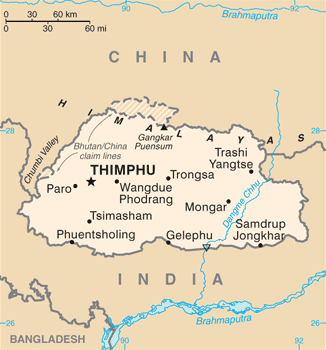
Bhutan map from the CIA World Factbook, 2010. Chinese-disputed border areas are marked with dashed lines and darker shading.
Wikimedia Commons.
Bhutan has long been a place I had wanted to visit, but it isn’t as simple as booking a ticket.
It would be remiss not to quickly situate Bhutan and its history for those unaware. It is a small kingdom east of Nepal and nestled between India and China. It has a population of around 750,000, almost all of whom are devout Buddhists. It was once a land of feuding Tibetan chieftans who were united in the 1630s by a remarkable warrior and Buddhist lama called Ngawang Namgyal. Namgyal died in 1651, but his death was kept a secret from the country for more than 50 years, with officials simply saying that the king was “on an extended retreat” and continued to keep Bhutan together by issuing decrees in his name.
While Namgyal was seen as the spiritual leader, he also established a temporal monarchy which in a slightly modified form still exists today under the leadership of the Wangchuk dynasty. The King of Bhutan’s title is the Druk Gyalpo, which literally translates to Dragon King. Over time Bhutan, being small but strategically located, faded in and out of the spheres of influence of the day from the Mughals to the British Raj. It would have been subsumed into the latter like other princely states, but in the 19th Century a British civil servant placed some files relating to Bhutan into a folder marked “External” instead of “Internal”, a small decision that ensured it remains an independent country today, albeit one “guided” on matters of defence and foreign affairs by a treaty with India.
The country only opened its borders to foreigners in 1974, to mark the coronation of the Fourth King, Jigme Singye Wangchuck. His Majesty saw the opportunity to take advantage of his accession to showcase Bhutan and its unique culture and traditions to the world, but was also aware that unrestricted tourism would put those at risk. Over time, this developed into a vision known as “High Quality, Low Volume” tourism. All visitors must have a guide and driver and also pay a daily fee — currently $100. In 1974, 287 foreigners visited Bhutan, and in 2019 more than 70,000 fee paying tourists came.
As a result of this policy, the trips are largely cultural. You take hikes in unimaginable scenery, watch local festivals where masked creatures tell villagers morality tales, and sit with locals to eat dishes made up mostly of chilis. For fun people relax with the national sport of archery, singing deliciously rude songs to put off their friends while they take shots. Tourists get to have a go but the target is brought closer and you get to use the same kind of bow young children do. Civil servants go to work in traditional dress and robe-clad monks pepper society. In the five days I spent there, much was spent talking to our compulsory guide who was a lovely man named Yarab, who had once been on the Bhutan national football team. One story Yarab told me was that of Bhutan’s transition to democracy.
The previously mentioned Fourth King oversaw Bhutan’s transition into the modern world – but with a catch. Bhutan’s development could not come at the cost of its people’s happiness. Thousands of kilometres of roads were built, free at point of use clinics quickly filled the country, and electricity and telephone hookups turned King Jigme Singye’s isolated kingdom where almost no one had access to healthcare or education into a remarkably healthy and literate little state in the space of just a few decades. Much of the money to make this possible came from selling hydroelectricity generated by dams that are powered by Himalayan glaciers. The Fourth King explained that: “water is to us what oil is to the Arabs”.
Comments Off on Bhutan
March 17, 2024
Smiling Albert Takes Command – WW2 – Week 290 – March 16, 1945
World War Two
Published 16 Mar 2024After the Allies took a Rhine Bridge last week, Adolf Hitler has again shuffled his commanders, moving Kesselring to the west. Meanwhile, the German offensive in Hungary comes to its end — and it does not end well for the Germans. The Japanese are nearly defeated on Iwo Jima, are feeling a bit of desperation in Burma, but are far, far from defeated on Luzon.
01:02 Recap
01:33 Remagen Bridge and the Western Front
06:44 Army Group Courland and 3rd Belorussian Front
10:23 Konev’s new attacks
11:29 Operation Spring Awakening ends
15:00 A German surrender in Italy?
17:01 Japanese being ground down on Iwo Jima
18:12 The war in the Philippines
20:48 The war in Burma
23:07 Summary
23:36 Conclusion
(more…)
Comments Off on Smiling Albert Takes Command – WW2 – Week 290 – March 16, 1945


