
Though both the Germans and the Japanese had every intention of starting major wars, as everyone knows they seemingly put zero thought into what they’d do once they won. I know, I know, [Himmler] had his sweaty wet dreams about Wehrbauern on the vast Russian steppes, but all but the most rudimentary post-victory planning seems to have been beyond the Third Reich’s capacity — the Reich Resettlement Office, for instance, was tiny even when the war looked like it would be over by Christmas. The Japanese were, if anything, even dumber — they honestly seemed to believe they could run China, all of it, and even India Manchukuo-style.
The Russians, meanwhile, never stopped playing the long game. While Goebbels made a few token gestures at rapprochement with “the West” (yeah, they called it that), and to sell Nazism to ditto, his heart wasn’t in it, any more than the Japanese’s heart was in their “Greater East Asia Co-Prosperity Sphere” hooey. Stalin, by contrast, was always pimping Communism to the West — even in the deepest, darkest days of the war, when it looked like the Wehrmacht was about to march into Moscow, the propaganda directed at the West continued full blast.
Like the German and Japanese aircraft industries, the German propaganda industry was ideologically locked into its core mission: To sell Nazism to Germans. And they were aces at it, no doubt … but then the mission changed. The smart thing for the Germans (and Japanese) to have done with their conquered territories was, in the context of the war, to ease up on the Nazi shit for the duration. The Nazis could’ve had zillions of Ukrainians fighting for them in 1941 just as the Japanese probably could’ve waltzed into India in 1941 had they not been so … well, so Japanese, in the rest of the Pacific rim. Stalin would’ve done it in a heartbeat, had the situation been reversed, and to hell with “authentic” Marxism-Leninism. Win the war first; square the ideology later.
As this is running way long, one example should suffice. Goebbels approached the task of selling Nazism to Germans in the most German way possible: He created the Reich Culture Chamber, which controlled all newspapers, radio broadcasts, film distribution, etc. And it worked, as far as it went — Goebbels deserves his “evil genius” rep — but as we’ve seen, that locked the leadership into an ideological straightjacket. Telling the Wehrmacht to ignore the Commissar Order and buddy up with the Ukrainians would’ve been the smart thing to do, militarily, but it was culturally impossible. Goebbels did his job too well … and then the mission changed.
The Soviets had a similar problem inside the USSR, but — here’s Stalin’s evil genius — they had free reign in propagandizing the West. Goebbels hardly bothered, but the Soviets poured massive resources into it. Forget, as far as you can, everything you think you know about “Nazism” […]. Even if you look at it as objectively as possible, it still seems ridiculous, and there’s a simple explanation for that — it’s not for you. Unless you were a pure blooded Aryan, actually living in Germany (or within Germany’s potential military reach), [they] couldn’t care less about you. Which made being a “Nazi” in, say, America uniquely pointless — you just look like a bigot at best, a traitorous bigot at worst.
Being a “Communist”, though? That was universal. Indeed, that made you a Smart person, a very very smart person, and morally superior to boot. Why? Because you care so much that you’ve mastered this large body of deliberately esoteric doctrine, comrade … all straight out of the NKVD playbook. And if actual life as it was lived in the Soviet Union didn’t quite measure up to the promises, well, that’s because they didn’t have the right people — people like YOU — running things. It’s fucking brilliant — a totally ideologically closed, indeed brutal, system at home, presented as the most open-minded, enlightened, tolerant one possible abroad.
Which is why Joey G. needed a huge Reich Culture Chamber that never came close to justifying its budget, and Stalin needed, effectively, nothing. Being so very, very Smart, wannabe “elites” in the West were happy to spread Commie propaganda for free. The NKVD, let alone the Gestapo, ain’t got shit on the Junior Volunteer Thought Police of Twitter and Facebook …
… which forces us to confront the question: Which model of propaganda are our rulers using? Has the one morphed into the other? Is it real, or is it just “German efficiency”?
Severian, “The Myth of German Efficiency”, Rotten Chestnuts, 2021-05-26.
March 17, 2024
QotD: Imperial Japan and Nazi Germany never had a “long game” … but Stalin did
March 16, 2024
The “TikTok ban” isn’t really about banning TikTok
Matt Taibbi explains why the movement to ban TikTok is so dangerous to Americans’ civil liberties:

As discussed on the new America This Week, passage of the TikTok ban represents a perfect storm of unpleasant political developments, putting congress back fully in line with the national security establishment on speech. After years of public championing of the First Amendment, congressional Republicans have suddenly and dramatically been brought back into the fold. Meanwhile Democrats, who stand to lose a lot from the bill politically — it’s opposed by 73% of TikTok users, precisely the young voters whose defections since October put Joe Biden’s campaign into a tailspin — are spinning passage of the legislation to its base by suggesting it’s not really happening.
“This is not an attempt to ban TikTok, it’s an attempt to make TikTok better,” is how Nancy Pelosi put it. Congress, the theory goes, will force TikTok to divest, some kindly Wall Street consortium will gobble it up (“It’s a great business and I’m going to put together a group to buy TikTok,” Steve Mnuchin told CNBC), and life will go on. All good, right?
Not exactly. The bill passed in the House that’s likely to win the Senate and be swiftly signed into law by the White House’s dynamic Biden hologram is at best tangentially about TikTok.
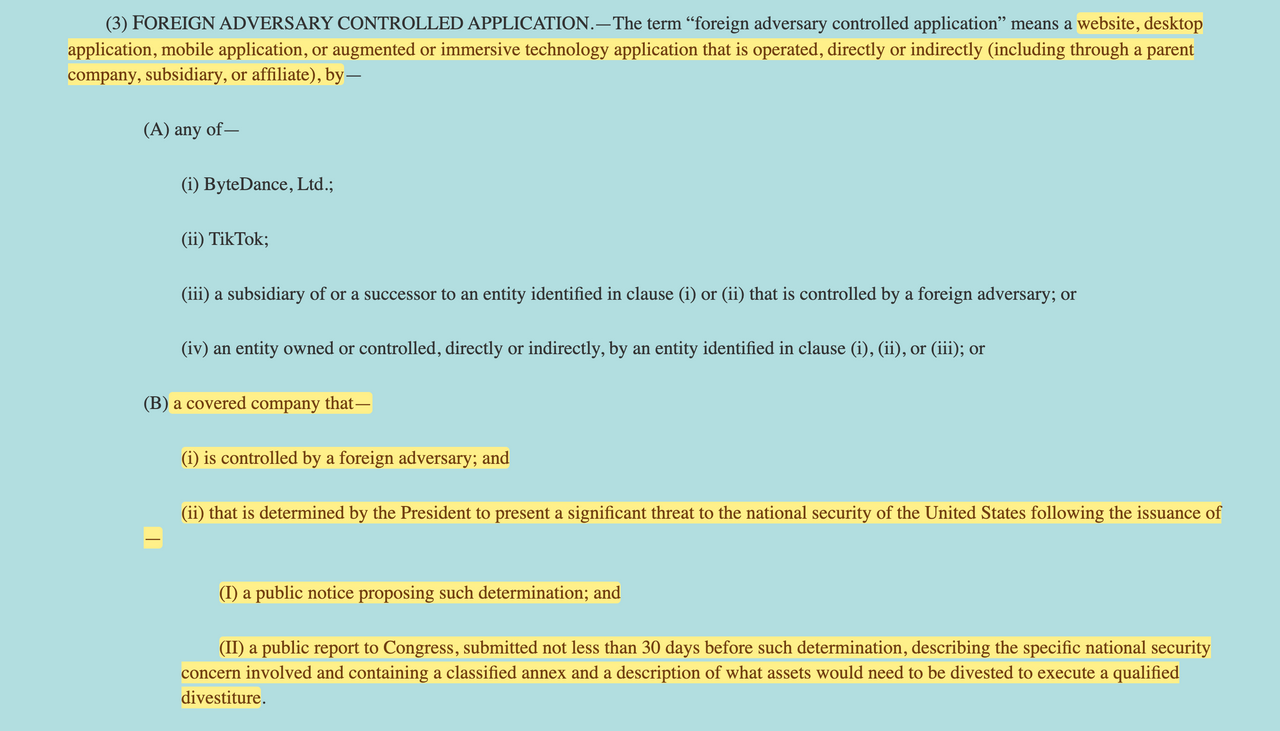
You’ll find the real issue in the fine print. There, the “technical assistance” the drafters of the bill reportedly received from the White House shines through, Look particularly at the first highlighted portion, and sections (i) and (ii) of (3)B:
As written, any “website, desktop application, mobile application, or augmented or immersive technology application” that is “determined by the President to present a significant threat to the National Security of the United States” is covered.
[…]
As Newsweek reported, the bill was fast-tracked after a secret “intelligence community briefing” of Congress led by the FBI, Department of Justice, and the Office of the Director of National Intelligence (ODNI). The magazine noted that if everything goes as planned, the bill will give Biden the authority to shut down an app used by 150 million Americans just in time for the November elections.
Say you’re a Democrat, however, and that scenario doesn’t worry you. As America This Week co-host Walter Kirn notes, the bill would give a potential future President Donald Trump “unprecedented powers to censor and control the internet“. If that still doesn’t bother you, you’re either not worried about the election, or you’ve been overstating your fear of “dictatorial” Trump.
We have two decades of data showing how national security measures in the 9-11 era evolve. In 2004 the George W. Bush administration defined “enemy combatant” as “an individual who was part of or supporting Taliban or al Qaeda forces, or associated forces that are engaged in hostilities against the United States”. Yet in oral arguments of Rosul et al v Bush later that year, the government conceded an enemy combatant could be a “little old lady in Switzerland” who “wrote a check” to what she thought was an orphanage.
QotD: “Surface democracies” and “surface monarchies” — how the deep state pretends to be something else
Surface democracies are wildly, raucously competitive. Two or more parties wage an all-out cinematic slugfest over hot-button issues with big, beautiful ratings. There may be a kaleidoscopic cast of quixotic minor parties with unusual obsessions filling the role of comic relief, usually only lasting for a season or two of the hit show Democracy. The spectacle is gripping, everybody is awed by how high the stakes are and agonizes over how to cast their precious vote. Meanwhile, in a bland gray building far away from the action, all of the real decisions are being made by some entirely separate organ of government that rolls onwards largely unaffected by the show.
Losers and haters are perpetually accusing the United States of being a surface democracy. Enemies of the state ranging from Ralph Nader to Vladimir Putin are constantly banging on about it, but this is a Patriotic Substack and we would obviously never countenance such insinuations about our noble republic. So there’s absolutely no chance it’s even the slightest bit true of the US, but … what about Japan?
Well, awkwardly enough, it turns out that the central drama of preindustrial Japanese history was the growing power of unofficial rulers (the shoguns) who ran the country in reality while the official rulers (the emperors) gradually devolved into puppets and figureheads. A “surface monarchy”, if you will. Of course that all ended with the Meiji Restoration of 1868 (c’mon, it says “restoration” right there in the name) which returned the emperor to being fully in charge … which is why when the Japanese declared war on America in 1941, neither the Emperor Hirohito nor the parliament was even consulted. Hang on a minute!
In fact, yes, prewar Japan may have been reigned over by a monarch, but it was ruled by the deep state — especially the career military general staff and the economic planning bureaucracies. I know it’s hard to believe that drab agencies regulating coal and steel production were able to go toe-to-toe with General Tojo, but just imagine that they were all being staffed by fanatical clans of demobilized samurai or something crazy like that. When MacArthur rolled in with the occupation forces, he had a goal of creating total discontinuity with Japan’s past and utterly bulldozing the government. But a guy needs to pick his battles, and so he obviously focused on getting rid of all those nasty generals and admirals he’d just spent years fighting. The harmless paper-pushers, on the other hand, how much trouble could they be? Maybe they could even help organize the place.
The chapter about the post-war occupation is one of the deadpan funniest in Johnson’s book. The American occupiers are genuinely trying to create a liberal democracy out of the ashes, but have no idea that the friendly, helpful bureaucrats they’ve enlisted in this quest were the secret rulers of the regime they’d just conquered. The stats bear this out — of all the officials who controlled Japan’s wartime industry, only a few dozen were ever purged by the Americans. The most striking example of continuity has to be Nobusuke Kishi,1 but there were countless others like him. These were the men charged with translating the occupiers’ desires into policy, reconstructing Japanese society, and finally drafting a new constitution. Then eventually the Americans sailed off, and the bureaucrats smiled and waved, and went back to ruling as they’d done for hundreds of years, behind the scenes.
John Psmith, “REVIEW: MITI and the Japanese Miracle by Chalmers Johnson”, Mr. and Mrs. Psmith’s Bookshelf, 2023-04-03.
1 Briefly: Kishi was a descendant of samurai (of course) who became an economic planning bureaucrat (of course) and then the dictator of the Japanese puppet state in Manchuria in the 1930s. During his reign he tried out a lot of the industrial policy ideas that would later fuel the Japanese postwar boom … and also brutalized the population to such an extent that even other Imperial Japanese colonial administrators thought he was excessive. Later he signed the declaration of war against the United States (he was an economic planning bureaucrat, after all), and was briefly imprisoned as a war criminal after the Japanese surrender. Within a few years, however, he was back out, and running the country as prime minister. His brother was also prime minister. Oh … and his grandson was a guy you might have heard of, a guy named “Shinzo Abe”.
March 10, 2024
German Blunder Hands Allies a Rhine Crossing – WW2 – Week 289 – March 9, 1945
World War Two
Published 9 Mar 2024The Allies manage to take an intact bridge over the mighty Rhine at Remagen, a major piece of luck; the Germans launch a new offensive in Hungary, and the Allies end one in Italy. Over in Burma, Meiktila falls, sabotaging the entire Japanese supply system for the country, and on Iwo Jima the fight continues, bloodier than ever for both sides.
00:59 Recap
01:35 The Fall of Meiktila
03:46 The fight on Iwo Jima
05:27 Advances on the Western Front
07:44 The Rhine River
10:05 Remagen Bridge
16:20 Operation Encore
17:10 Rokossovsky and Zhukov attack
18:09 Operation Spring Awakening
21:57 Notes to end the week
23:42 Conclusion
(more…)
March 5, 2024
The National Microbiology Laboratory scandal in brief
Tristin Hopper rounds up some of the eye-opening details of the security breach at Winnipeg’s National Microbiology Lab which certainly looks like a factor in the Wuhan Coronavirus pandemic story:

Whether or not COVID-19 started as an accidental lab leak, the pandemic just so happens to have originated in the same neighbourhood as the Wuhan Institute of Virology, home to a coronavirus laboratory with a known history of lax security protocols.
For that reason alone it’s a major scandal that Canada’s own high-security biolab was employing two scientists – married couple Xiangguo Qiu and Keding Cheng – who according to CSIS exhibited a reckless disregard of lab security and the protection of confidential information. Now, tack on the fact that both Cheng and Qiu are suspected of prolonged unauthorized contact with the Chinese government.
This week, Health Canada bowed to opposition pressure and published an illuminating package of more than 600 official documents detailing CSIS’s evidence against the couple, as well as internal emails from the Winnipeg-based National Microbiology Laboratory where they worked. The highlights are below.
The lab is surprisingly casual about shipping planet-altering pathogens
One of the main accusations against Qiu is that she sent lab samples to China, the U.S. and the U.K. without proper authorization. Around this same time, she also sent highly virulent Ebola samples to the Wuhan Institute of Virology.
[…]
Cheng was accused of breaking virtually every cyber-security law in the book
If Qiu’s signature offence was sending out lab materials without proper authorization, Cheng’s was that he routinely ignored even the most basic protocols about computer security.
[…]
Throughout, both were in constant (unauthorized) touch with China
The CSIS reports don’t necessarily frame Qiu and Cheng as traitors.
[…]
The pair kept changing their story after being presented with smoking gun evidence, according to CSIS
Some of the documents’ more cinematic passages are when CSIS agents describe lengthy interrogations in which the pair were confronted about their alleged breaches of Canadian national security.
March 4, 2024
Japan’s Meiji Restoration, 1868-1912
Lawrence W. Reed outlines the end of Japan’s Shogunate Period and the start of the reign of Emperor Mutsuhito, known as the Meiji Period:
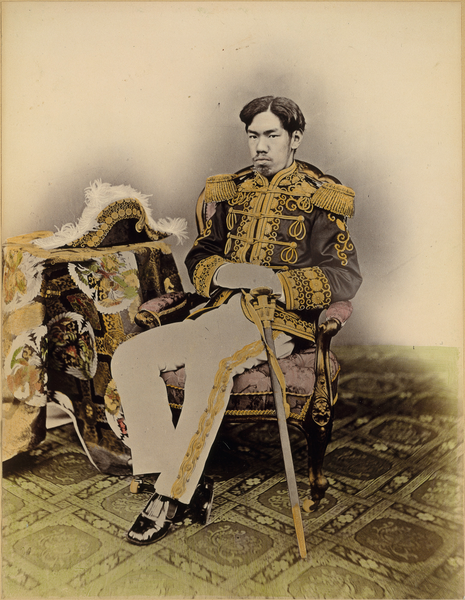
The Imperial Household Agency chose Uchida Kuichi, one of the most renowned photographers in Japan at the time, as the only artist permitted to photograph the Meiji Emperor in 1872 and again in 1873. Up to this point, no emperor had ever been photographed. Uchida established his reputation making portraits of samurai loyal to the ruling Tokugawa shogunate.
Wikimedia Commons.
In the 15 years that followed [American Commodore Matthew] Perry’s venture, the grip of the military dictatorship in Tokyo declined. Civil war erupted. When the smoke cleared in the first few days of January 1868, the shogunate was gone and a coup d’etat ushered in a new era of dramatic change. We call it the Reform Period, or the era of the Meiji Restoration.
That seminal event brought 14-year-old Mutsuhito to the throne, known as Emperor Meiji (a term meaning “enlightened rule”). He reigned for the next 44 years. His tenure proved to be perhaps the most consequential of Japan’s 122 emperors to that time. The country transformed itself from feudal isolation to a freer economy: engaged with the world and more tolerant at home.
In 1867, Japan was a closed country with both feet firmly planted in the past. A half-century later, it was a major world power. This remarkable transition begins with the Meiji Restoration. Let’s look at its reforms that remade the nation.
For centuries, Japan’s emperor possessed little power. His was a largely ceremonial post, with real authority resting in the hands of a shogun or, before that, multiple warlords. The immediate effect of the Meiji Restoration was to put the emperor back on the throne as the nation’s supreme governor.
In April 1868, the new regime issued the “Charter Oath,” outlining the ways Japan’s political and economic life would be reformed. It called for representative assemblies, an end to “evil” practices of the past such as class discrimination and restrictions on choice of employment, and an openness to foreign cultures and technologies.
After mopping up the rebellious remnants of the old shogunate, Emperor Meiji settled into his role as supreme spiritual leader of the Japanese, leaving his ministers to govern the country in his name. One of them, Mori Arinori, played a key role in liberalizing Japan. I regard Arinori as “the Tocqueville of Japan” for his extensive travels and keen observations about America.
The Meiji administration inherited the immediate challenge of a raging price inflation brought on by the previous government’s debasement of coinage. The oval-shaped koban, once almost pure gold, was so debauched that merchants preferred to use old counterfeits of it instead of the newer, debased issues. In 1871, the New Currency Act was passed which introduced the yen as the country’s medium of exchange and tied it firmly to gold. Silver served as subsidiary coinage.
A sounder currency brought stability to the monetary system and helped build the foundation for remarkable economic progress. Other important reforms also boosted growth and confidence in a new Japan. Bureaucratic barriers to commerce were streamlined, and an independent judiciary established. Citizens were granted freedom of movement within the country.
The new openness to the world resulted in Japanese studying abroad and foreigners investing in Japan. British capital, for instance, helped the Japanese build important railway lines between Tokyo and Kyoto and from those cities to major ports in the 1870s. The new environment encouraged the Japanese people themselves to save and invest as well.
For centuries, the warrior class (the samurai) were renowned for their skill, discipline, and courage in battle. They could also be brutal and loyal to powerful, local landowners. Numbering nearly two million by the late 1860s, the samurai represented competing power centers to the Meiji government. To ensure that the country wouldn’t disintegrate into chaos or military rule, the emperor took the extraordinary step of abolishing the samurai by edict. Some were incorporated into the new national army, while others found employment in business and various professions. Carrying a samurai sword was officially banned in 1876.
In 1889, the Meiji Constitution took effect. It created a legislature called the Imperial Diet, consisting of a House of Representatives and a House of Peers (similar to Britain’s House of Lords). Political parties emerged, though the ultimate supremacy of the emperor, at least on paper, was not seriously questioned. This nonetheless was Japan’s first experience with popularly elected representatives. The Constitution lasted until 1947, when American occupation led to a new one devised under the supervision of General Douglas MacArthur.
March 3, 2024
Allied Deception Surrounds Japanese in Burma – WW2 – Week 288 – March 2, 1945
World War Two
Published 2 Mar 2024Bill Slim’s master plan is near fruition and the Japanese are surrounded at Meiktila in Burma. The Allies have also nearly cleared Manila on Luzon, but the fighting on Iwo Jima is just growing in intensity. In Europe, the Soviets are still on the move in Poland, though attacking now to the north, but in Hungary it’s the Germans who are making plans for a new offensive. The big news on the Western Front is the Allies reaching the Rhine, though how they’ll cross that mighty river is anyone’s guess.
(more…)
March 2, 2024
Crossing the Irrawaddy
Dr. Robert Lyman is on a visit to the site of a very significant event in the battle for Burma in 1945:
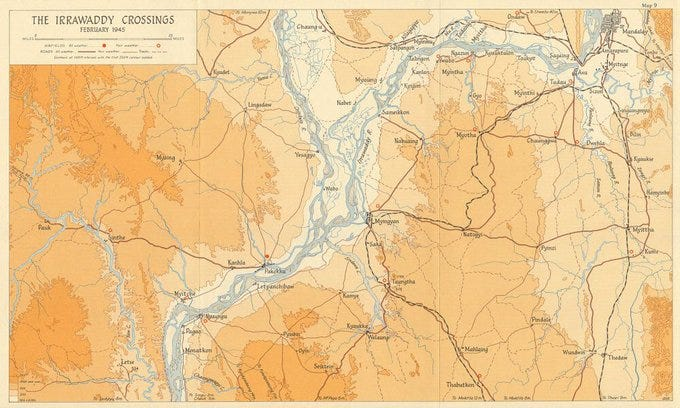
On 13-14 February 1945, 79-years ago this month the 7th Indian Division commanded by Major General Geoffrey Evans secured crossings over the Irrawaddy at Pakkoku and Nyaung-U/Bagan. The northern crossing (Pakkoku) was designed to allow Punch Cowan’s 17th Indian Division, and the Sherman tanks of 255 Indian Tank Brigade, to race across country to seize Meiktila. The southern ones, at Nyaung-U and Bagan (a few miles to the south still), were designed to prevent the enemy from interfering with the operations against Meiktila, and to make him believe that securing the Irrawaddy as a route to Rangoon — and not Meiktila — was Slim’s primary objective. In 2005, for the 60th anniversary of the Irrawaddy crossings, I was privileged to walk the battlefield with three veterans of these crossings, John Chiles (Probyn’s Horse), Manny Curtis (South Lancashire Regiment) and Bert Wilkins (RA, in support of the South Lancs). During that trip we travelled along the Irrawaddy from Bagan, anxiously scouring the maps in the South Lancs’ War Diary searching for B4 beach, where on the early morning of 14 February 1945 two hundred men of 2nd Battalion South Lancashire Regiment had rowed silently across the river to form the vanguard of the 7th Indian Division beachhead. I remember vividly the excitement as we found B4 — it was much easier than I had thought — disembarked from the boat and climbed to the top of the cliffs to find old trenches from the battle. It was an emotional event for the veterans as they recalled the battle and found trenches left by the defenders decades before.
At Nyaung-U the first wave of a company of the 2nd Bn South Lancs (including Manny Curtis) managed to seize the high ground above B4 in the early morning of 14 February. It was the longest opposed river crossing in any theatre of the Second World War. The beaches had been recced by a Sea Reconnaissance Unit and a Special Boat Section. However, subsequent waves of troops from the remainder of the South Lancs, the 4th Battalion 14th Punjab Regiment and the 4th Battalion 1st Gurkha Rifles were mauled by enemy machine gun fire as the leaky canvas boats and temperamental outboard motors failed to cope with the distance they had to cover and the strength of the river’s flow. The enemy? Pagan and Nyaungu were defended not by the Japanese but by three battalions of the Indian National Army’s 4th Guerrilla Regiment, some 2,000 men in well-sited positions overlooking the Irrawaddy. This was the only major engagement of the war when troops of the Indian Army fought in direct combat against the INA. To subdue the enemy positions causing casualties on the water, Sherman tanks of the Gordon Highlanders sniped the enemy positions, and an artillery bombardment by 25-pdrs and a Hurribomber strike pummelled the east bank of the river. Together these actions succeeded in forcing the INA to surrender. Further to the west, at Pagan, the INA’s 9th Battalion took a heavy toll of the assaulting 1/11th Sikh Regiment, before they withdrew to Mount Popa to the rear. River crossing are dangerous, especially for troops with little training in boatmanship, across one of the world’s greatest rivers. But this time the 7th Indian Division succeeded with little training or preparation. By the end of the day the east bank was in its hands. Amazingly, a cinematographic unit were available to film some of the crossings at Nyaung-U. An 8-minute reel of the landings can be seen in the IWM on JFU35.
Today I was able to revisit B4. Not much had changed in nearly 20-years. The size of the Irrawaddy even in the dry season is astonishing, the task given to the men of 33 Brigade enormous. In 2005 we climbed the cliffs that Manny and his friends had raced up in 1945. Looking at them again today, I realised just how Gallipoli-like was the terrain. In the hands of of better trained enemy, 33 Brigade should never have managed to get off the beachhead. Rippling rows of gullies flow behind the initial landing site: if these had all been defended, a position of great depth and near impregnability could have been achieved. These photos look down on B4 and across to the position up which the men of 2nd South Lancs scrambled.
February 25, 2024
Iwo Jima! – WW2 – Week 287 – February 24, 1945
World War Two
Published 24 Feb 2024This week the Battle of Iwo Jima begins and American forces raise the Stars and Stripes on Mount Suribachi. Elsewhere, the Allies fight the stiff Japanese defences in Manila. The Red Army continues fighting through East Prussia and Pomerania as Stalin plans the next stage of the advance on the Reich. There are Allied advances in Western Europe and Italy too.
00:01 Intro
00:54 Recap
01:16 Iwo Jima Begins
06:32 The war in the Philippines
07:56 The Battle of Manila
11:12 Fighting in Burma
12:14 Operation Grenade
13:46 Operation Encore
14:38 Soviet plans for new offensives
21:28 Moscow Commission Meets
(more…)
Battleships – Ruling the Waves Across the 7 Seas – Sabaton History 124 [Official]
Sabaton History
Published Nov 16, 2023They were as much symbols of national pride as they were mighty weapons of war, but they were indeed MIGHTY. Dreadnoughts, battleships, super battleships — Sabaton has covered them in songs more than once, and today we dive into the battleship craze of the early 20th century: the Age of the Battleship!
(more…)
February 22, 2024
The Malayan Emergency – Britain’s Jungle War v Communists
The History Chap
Published Nov 16, 2023Britain’s Victorious Jungle War Against the Communists
Get My FREE Weekly Newsletter
https://www.thehistorychap.com
February 18, 2024
German Counterattack in Pomerania – WW2 – Week 286 – February 17, 1945
World War Two
Published 17 Feb 2024The Germans finally launch a counterattack into the Soviet flanks, but it does not go as well as was as hoped. The Siege of Budapest comes to an end, also not well for the Germans. The Soviets have now also surrounded Breslau. In Burma, the Allies cross the Irrawaddy River, in the Philippines the fight for Manila continues, and in the Pacific preparations are underway for an American invasion of Iwo Jima Island.
01:50 The fight for East Prussia
04:08 German counterattack in Poland
07:00 Breslau Surrounded
07:57 The Siege of Budapest
09:14 Operation 4th Term in Italy
10:07 Operation Veritable Continues
11:36 Allies cross the Irrawaddy
14:43 The Fight in the Philippines
17:52 Preparations for Iwo Jima
(more…)
February 17, 2024
Apparently Confucius “had a based libertarian streak”
N.S. Lyons points out some very helpful advice from Confucius that pretty much every western government would benefit from heeding:
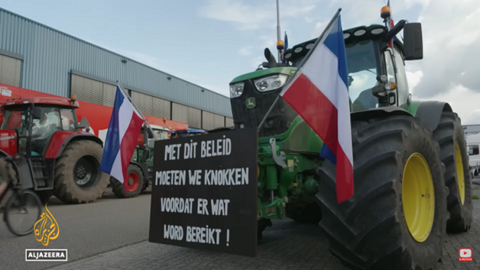
I was watching a bit of recent footage of some peasants in revolt, as they are at the moment basically everywhere across the West, and was suddenly struck by the recollection that I’d definitely read a wise saying about the general situation somewhere on a fortune cookie. No, wait, I realized, this time it must actually have been from Master Confucius himself! So I went digging through my copy of the Analects …
Lo and behold, right there in Book 12, Chapter 7, is this straightforward lesson:
A disciple asks Confucius what, fundamentally, it takes to govern a state without it collapsing.
Confucius says: “Simply make sure there is enough armaments, enough food, and that you have the trust of the common people.” (足食,足兵,民信之矣.)
“If sacrificing one of these three things becomes unavoidable, which would you give up first?” the disciple asks. (必不得已而去,於斯三者何先?)
“The weapons,” Confucius replies. (去兵.)
“If two things?” the disciple asks. (必不得已而去,於斯二者何先?)
“The food,” Confucius says, because while even death is a part of life “without the trust of the people, a state cannot stand.” (去食. 自古皆有死,民無信不立.)
What is most notable to me from this little dialogue from almost 2,500 years ago is how much, in comparison, our political leaders, in their hubris and absorption in grand projects (and graft), seem to have forgotten the very basics.
Indeed it strikes me that they already failed on maintaining enough armaments (at least in Europe, though even America now seems to be struggling to produce the most basic munitions). More broadly speaking, they can no long provide security for citizens or defend their own borders.
And now they’ve suddenly got the wise idea of going after the food too, which is a plan that will surely work out great.
February 16, 2024
Regional Power: North Korea
Army University Press
Published Feb 13, 2024This film examines the current political and military situation in North Korea. Subject matter experts discuss Korean history, DPRK current affairs, and KPA military doctrine. Topics include the rise of the Kim family to political leadership of the DPRK, its influence in the region, and how the U.S. works in partnership with the Republic of Korea.
February 15, 2024
Artillery! A WW2 Special
World War Two
Published 14 Feb 2024The modern artillery of the Great War was responsible for the vast majority of military deaths in that conflict, but how has artillery developed from that war to this one? Today we take a look at some of the artillery of WW2.
(more…)


