
From trunk to tail, elephants are a logistics nightmare.
And that begins almost literally at birth. For areas where elephants are native, nature (combined, typically, with the local human terrain) create a local “supply”. In India this meant the elephant forests of North/North-Eastern India; the range of the North African elephant (Loxodonta africana pharaohensis, the most likely source of Ptolemaic and Carthaginian war elephants) is not known. Thus for many elephant-wielding powers, trade was going to always be a key source for the animals – either trade with far away kingdoms (the Seleucids traded with the Mauyran Indian kingdom for their superior Asian elephants) or with thinly ruled peripheral peoples who lived in the forests the elephants were native to.
(We’re about to get into some of the specifics of elephant biology. If you are curious on this topic, I am relying heavily on R. Sukumar, The Asian Elephant: Ecology and Management (1989). I’ve found that information on Asian elephants (Elephas maximus) much easier to come by than information on African elephants (Loxodonta africana and Loxodonta cyclotis).)
In that light, creating a breeding program – as was done with horses – seems like a great idea. Except there is one major problem: a horse requires about four years to reach maturity, a mare gestates a foal in eleven months and can go into heat almost immediately thereafter. By contrast, elephants reach adulthood after seventeen years, take 18-22 months to gestate and female elephants do not typically mate until their calf is weaned, four to five years after its birth. A ruler looking to build a stable of cavalry horses thus may start small and grow rapidly; a ruler looking to build a corps of war elephants is looking at a very slow process. This is compounded by the fact that elephants are notoriously difficult to breed in captivity. There is some speculation that the Seleucids nonetheless attempted this at Apamea, where they based their elephants – in any event, they seem to have remained dependent on imported Indian elephants to maintain the elephant corps. If a self-sustaining elephant breeding program for war elephants was ever created, we do not know about it.
To make matters worse, elephants require massive amounts of food and water. In video-games, this is often represented through a high elephant “upkeep” cost – but this often falls well short of the reality of keeping these animals for war. Let’s take Total War: Rome II as an example: a unit of Roman (auxiliary) African elephants (12 animals), costs 180 upkeep, compared to 90 to 110 upkeep for 80 horses of auxiliary cavalry (there are quite a few types) – so one elephant (with a mahout) costs 15 upkeep against around 1.25 for a horse and rider (a 12:1 ratio). Paradox’s Imperator does something similar, with a single unit of war elephants requiring 1.08 upkeep, compared to just 0.32 for light cavalry; along with this, elephants have a heavy “supply weight” – twice that of an equivalent number of cavalry (so something like a 2:1 or 3:1 ratio of cost).
Believe it or not, this understates just how hungry – and expensive – elephants are. The standard barley ration for a Roman horse was 7kg of barley per day (7 Attic medimnoi per month; Plb. 6.39.12); this would be supplemented by grazing. Estimates for the food requirements of elephants vary widely (in part, it is hard to measure the dietary needs of grazing animals), but elephants require in excess of 1.5% of their body-weight in food per day. Estimates for the dietary requirements of the Asian elephant can range from 135 to 300kg per day in a mix of grazing and fodder – and remember, the preference in war elephants is for large, mature adult males, meaning that most war elephants will be towards the top of this range. Accounting for some grazing (probably significantly less than half of dietary needs) a large adult male elephant is thus likely to need something like 15 to 30 times the food to sustain itself as a stable-fed horse.
In peacetime, these elephants have to be fed and maintained, but on campaign the difficulty of supplying these elephants on the march is layered on top of that. We’ve discussed elsewhere the difficulty in supplying an army with food, but large groups of elephants magnify this problem immensely. The 54 elephants the Seleucids brought to Magnesia might have consumed as much food as 1,000 cavalrymen (that’s a rider, a horse and a servant to tend that horse and its rider).
But that still understates the cost intensity of elephants. Bringing a horse to battle in the ancient world required the horse, a rider and typically a servant (this is neatly implied by the more generous rations to cavalrymen, who would be expected to have a servant to be the horse’s groom, unlike the poorer infantry, see Plb. above). But getting a war elephant to battle was a team effort. Trautmann (2015) notes that elephant stables required riders, drivers, guards, trainers, cooks, feeders, guards, attendants, doctors and specialist foot-chainers (along with specialist hunters to capture the elephants in the first place!). Many of these men were highly trained specialists and thus had to be quite well paid.
Now – and this is important – pre-modern states are not building their militaries from the ground up. What they have is a package of legacy systems. In Rome’s case, the defeat of Carthage in the Second Punic War resulted in Rome having North African allies who already had elephants. Rome could accept those elephant allied troops, or say “no” and probably get nothing to replace them. In that case – if the choice is between “elephants or nothing” – then you take the elephants. What is telling is that – as Rome was able to exert more control over how these regions were exploited – the elephants vanished, presumably as the Romans dismantled or neglected the systems for capturing and training them (which they now controlled directly).
That resolves part of our puzzle: why did the Romans use elephants in the second and early first centuries B.C.? Because they had allies whose own military systems involved elephants. But that leaves the second part of the puzzle – Rome doesn’t simply fail to build an elephant program. Rome absorbs an elephant program and then lets it die. Why?
For states with scarce resources – and all states have scarce resources – using elephants meant not directing those resources (food, money, personnel, time and administrative capacity) for something else. If the elephant had no other value (we’ll look at one other use next week), then developing elephants becomes a simple, if difficult, calculation: are the elephants more likely to win the battle for me than the equivalent resources spent on something else, like cavalry. As we’ve seen above, that boils down to comparisons between having just dozens of elephants or potentially hundreds or thousands of cavalry.
The Romans obviously made the bet that investing in cavalry or infantry was a better use of time, money and resources than investing in elephants, because they thought elephants were unlikely to win battles. Given Rome’s subsequent spectacular battlefield success, it is hard to avoid the conclusion they were right, at least in the Mediterranean context.
Bret Devereaux, “Collections: War Elephants, Part II: Elephants against Wolves”, A Collection of Unmitigated Pedantry, 2019-08-02.
February 13, 2024
QotD: War elephant logistics
February 12, 2024
Yalta, When Stalin Split the World – a WW2 Special
World War Two
Published 11 February 2024Indy and Sparty take you through the negotiations at Yalta as The Big Three thrash out the shape of the postwar world. As the splits between East and West continue to deepen, who will come out on top?
(more…)
February 11, 2024
The Battle of Manila Begins – WW2 – Week 285 – February 10, 1945
World War Two
Published 10 Feb 2024The American advance on Luzon has reached the Philippine capital, and it looks like they have a real fight on their hands with the Japanese there. There are supposed to be two new Allied operations starting in Western Europe, but one is delayed by flooding. The Allies do manage to eliminate the Colmar Pocket in the west, though. On the Eastern Front, there are new Soviet attacks in Pomerania and East Prussia, as well as out of the Steinau Bridgehead to the south, and in Budapest, it looks like the Soviet siege might soon end in victory.
(more…)
QotD: Learning and re-learning the bloody art of war
The Athenian commanders before Salamis, it is reported, talked of art and of the Acropolis, in sight of the Persian fleet. Beside their own campfires, the Greek hoplites chewed garlic and joked about girls.
Without its tough spearmen, Hellenic culture would have had nothing to give the world. It would not have lasted long enough. When Greek culture became so sophisticated that its common men would no longer fight to the death, as at Thermopylae, but became devious and clever, a horde of Roman farm boys overran them.
The time came when the descendants of Macedonians who had slaughtered Asians till they could no longer lift their arms went pale and sick at the sight of the havoc wrought by the Roman gladius Hispanicus as it carved its way toward Hellas.
The Eighth Army, put to the fire and blooded, rose from its own ashes in a killing mood. They went north, and as they went they destroyed Chinese and what was left of the towns and cities of Korea. They did not grow sick at the sight of blood.
By 7 March they stood on the Han. They went through Seoul, and reduced it block by block. When they were finished, the massive railway station had no roof, and thousands of buildings were pocked by tank fire. Of Seoul’s original more than a million souls, less than two hundred thousand still lived in the ruins. In many of the lesser cities of Korea, built of wood and wattle, only the foundation, and the vault, of the old Japanese bank remained.
The people of Chosun, not Americans or Chinese, continued to lose the war.
At the end of March the Eighth Army was across the parallel.
General Ridgway wrote, “The American flag never flew over a prouder, tougher, more spirited and more competent fighting force than was Eighth Army as it drove north …”
Ridgway had no great interest in real estate. He did not strike for cities and towns, but to kill Chinese. The Eighth Army killed them, by the thousands, as its infantry drove them from the hills and as its air caught them fleeing in the valleys.
By April 1951, the Eighth Army had again proved Erwin Rommel’s assertion that American troops knew less but learned faster than any fighting men he had opposed. The Chinese seemed not to learn at all, as they repeated Chipyong-ni again and again.
Americans had learned, and learned well. The tragedy of American arms, however, is that having an imperfect sense of history Americans sometimes forget as quickly as they learn.
T.R. Fehrenbach, This Kind of War: A Study in Unpreparedness, 1963.
February 10, 2024
The War Goals to End WW2 in 1945 – a WW2 Special
World War Two
Published Feb 8, 2024While World War Two looks like it is about to end, the belligerent powers have vastly different goals for that end. Differences that may or may not prolong the war, will decide the survival of tens of millions of people, and the future fate of all of Humanity.
(more…)
QotD: When Manchuria became Manchukuo
Further unpleasantness ensued in the wake of World War I, when both Imperial Russia and Republican China collapsed. The Japanese had a big railroad project of their own going in the Kwantung Leased Territory, which was threatened by the chaos. Moreover, the big Japanese railroad project had grown — as Japanese industrial concerns tend to do — into a ginormous, all-encompassing combine known as Mantetsu.
So far, so recondite, I suppose, but stop me if this part sounds familiar: Mantetsu was so big, and so shady, that it was all but impossible to tell where “the guys running Mantetsu” ended and “the Japanese government” began. And it gets better: Thanks to the Japanese Empire’s distinctive (to put it mildly, and kindly) administrative structure, it was equally hard to tell where “the Japanese government” ended and “the Japanese military” began. Even better — by which I mean much, much worse, but again feel free to stop me when this sounds familiar — “the Japanese military” was itself composed of several wildly different, mutually hostile chains of command, all competing with each other for political power, economic access, and glory. Best of all — by which, again, I mean worst — since Mantetsu was so big, and so wired-in to every level of the Japanese government, it basically got its own army, which was effectively separate even from the Army High Command back in Tokyo.
Here again, the granular details are insanely complex, and I’m not qualified to walk you through them, but the upshot is: Thanks to all of the above, plus the active enmity of the rapidly-rearming Soviet Union and the rapidly-accelerating chaos of the Warlord Period in China, Japan’s foreign policy ended up being dictated by the Kwantung Army, with almost no reference to even the High Command, let alone the civilian politicians, back in Tokyo. A particular warlord giving the Mantetsu Board of Directors — or, you know, whoever — grief? No problem — boom! Oh, that didn’t solve the problem, and now the politicians are dragging their feet? Might as well blow up a different part of your own railway, seize a whole bunch of territory on that flimsy pretext, and set up a puppet government to give you cover …
I don’t expect y’all to follow all the links right away, so trust me on this: Nobody involved in any of that stuff ranked higher than colonel. Indeed, the guy most “responsible” — if that’s really the word — for all of this stuff was a staff pogue, also a colonel, named Kanji Ishiwara. He and another staff pogue, Seishiro Itagaki, who was head of the Kwantung Army’s intelligence section, orchestrated the Japanese invasion of China, and while it’s oversimplifying things a bit too much to say those two clowns started World War II in the Pacific, I’m not stopping you from saying it.
From there, events took on a logic of their own. The rest of the Army was soon committed to the war in North China, which rapidly became the war in all the rest of China. The Navy, not wanting to let the Army hog all the glory, had gotten in on the war a few years prior to the Marco Polo Bridge, and soon enough they were causing all kinds of international grief on their own account. Put simply, but not unfairly, you had the Navy chasing the Army, and the Army chasing itself, all across China, with the civilian politicians lagging way behind in the rear, desperately trying to catch up, or even just figure out what the hell was going on …
Severian, “Lessons from Manchuria”, Rotten Chestnuts, 2021-04-21.
February 7, 2024
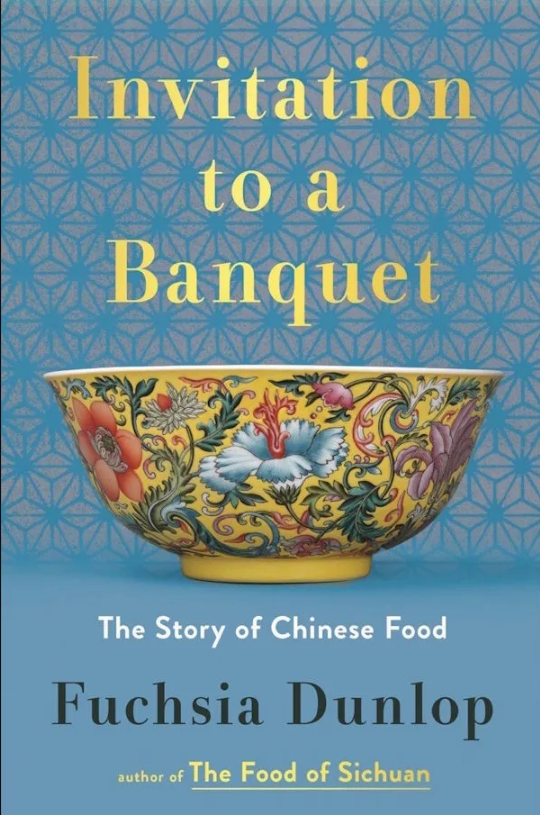
“China is a food-obsessed society”
If your initial reaction to the headline is to assume this is because of the amazingly unsettled history of mainland China over the last several hundred years and the totally understandable fear of famines, I’m with you, but we’d both be wrong, as John Psmith explains:
One sunny December morning years ago, Jane and I were on holiday in the South of China. Far from the city, a little temple had been hewn out of a seaside grotto so that it partially flooded when the tide came in. We stood inside and gazed up at a statue of 觀音, “Guan Yin”, the lady to whom the temple was dedicated. Her legend originated in India, where she was known as the bodhisattva Avalokitasvara, but she’d been absorbed and appropriated by Chinese folk religion many centuries ago, and in this statue there was no trace to be found of her South Asian origins. A minute or two into our reverie, a local came over to us and, seeing that we looked out of place, helpfully explained in unaccented English, “This is one of the most important Christian goddesses.”
The Chinese are almost as bad as the Romans were about pilfering the deities of their neighbors, so you really can’t blame them when they occasionally get confused about who they stole them from. As with goddesses, so with food: earlier that day a different helpful local had steered us towards a restaurant specializing in “Western cuisine”. The menu listed steaks “French style”, “German style”, and “Barbecue style”. Soup options included minestrone and borscht, both of them with the surprise addition of prawns. Their pride and joy, however, was their breakfast menu which included roughly seventy different varieties of toast. The chef told me that there were restaurants in Europe and America that did not have so many kinds of toast, and beamed with pride when I nodded gravely. One of the diners, delighted to see real living and breathing Westerners in her local Western restaurant, told me: “The thing I love about this place is that it’s so authentic.”
This “Western” restaurant may sound ridiculous to you, but it’s only as ridiculous as most of the “Chinese” restaurants you’ve encountered in the West. First of all, there’s no such thing as “Chinese” food. China is a country, but it’s the size of a continent, and it boasts a culinary diversity which exceeds that of many actual continents. Second, the dishes you encounter in the average Chinese restaurant over here bear about as much resemblance to real Chinese food as the seventy varieties of toast and the barbecue steaks do to French cuisine. “American Chinese food” is an interesting topic in its own right, and there are some good books about it, but now that I’m through the mandatory throat-clearing you have to do when writing about Chinese cuisine for a Western audience, I’m never going to mention it again.
China is a food-obsessed society. People are always talking about their next meal. People talk about it incessantly. The Chinese equivalent of talking about the weather, a way of making polite chitchat with strangers, is to mention a restaurant that you like, or a meal that you’re looking forward to. A standard way of saying “hello” in Mandarin is “你吃饭了吗?” In Cantonese it’s “你食咗飯未呀?” Both of them literally translate as something like “have you eaten yet?” and produce a natural conversational opening to begin immediately discussing food. Perhaps most uncanny to foreigners, Chinese people will sometimes discuss their next meal while they are in the middle of eating a fancy dinner. Dozens of gorgeous little dishes spread around them, chomping or slurping away at exquisite cuisine, and happily chattering about what they plan to eat tomorrow.
None of this is remotely new. If anything, between the Revolution and the famines, Chinese food culture is actually tamer than it used to be.1 We know this from literary and historical accounts, from archeological evidence (China had fancy restaurants about a thousand years before France did), and from the structure of the language itself. They say the Eskimos have an improbable number of words for snow,2 but the Chinese actually do have a zillion words for obscure cooking techniques. What’s more, many of the words are completely different from region to region, which is hardly surprising since the food itself is bewilderingly different from one side of the country to the other.
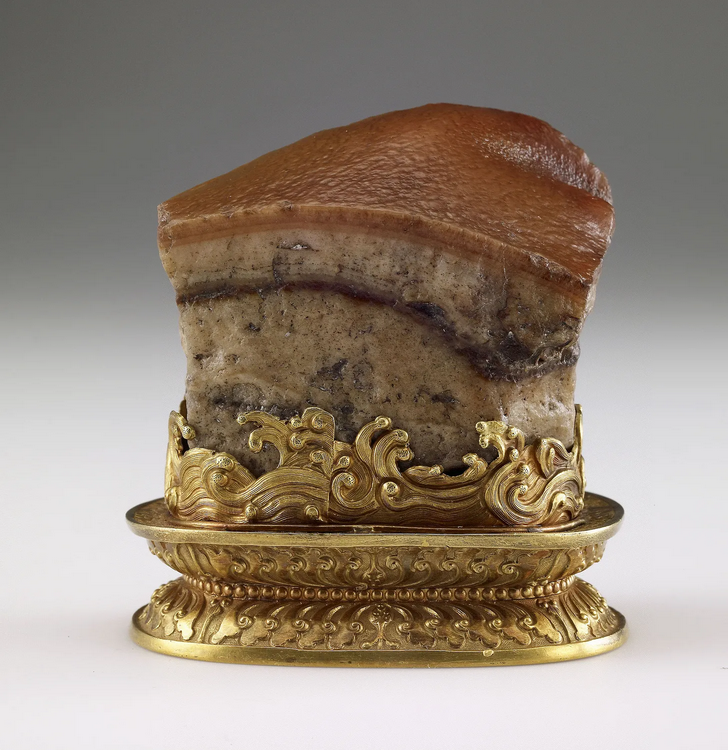
How food-obsessed are the Chinese? One of the most priceless artifacts belonging to the imperial family, the one thing the fleeing Nationalists made sure to grab as communist artillery leveled Beijing, now the most highly-valued object in the National Palace Museum in Taipei is … The Meat-Shaped Stone.3 A single piece of jasper carved into a lifelike hunk of luscious pork belly, complete with crispy skin and layers of subcutaneous fat and meat. Feast your eyes upon it.
1. Ferran Adrià, the legendary chef of El Bulli, once said that Mao was the most consequential figure in the history of cooking because: “[Spain, France, Italy and California] are only competing for the top spot because Mao destroyed the pre-eminence of Chinese cooking by sending China’s chefs to work in the fields and factories. If he hadn’t done this, all the other countries and all the other chefs, myself included, would still be chasing the Chinese dragon.”
2. I once tried searching Google to find out whether Eskimos really have a lot of words for snow. The top results were all places like BuzzFeed and the Atlantic denouncing this as an outmoded racist stereotype … followed by a Wikipedia article patiently explaining that no it’s actually true.
3. The Meat-Shaped Stone is not some weird aberration. The runner-up most valuable items in the museum are a piece of jadeite carved to look like a cabbage and a very fancy cooking vessel.
February 4, 2024
Is the Red Army too fast for its own good? – WW2 – Week 284 – February 3, 1945
World War Two
Published 3 Feb 2024Soviet forces have reached the old German border in force, however, logistical issues and a strong enemy presence possibly threatening their flanks means that a drive on Berlin may not be doable just now. Heinrich Himmler is in charge of the new Army Group to defend the Reich, and he has a host of problems. On the Western Front, the Allies finally eliminated the Colmar Pocket, and in the Philippines, the American advance reaches Manila, and the battle for the city is about to begin.
(more…)
February 1, 2024
The Kohima Epitaph: Britain’s Forgotten Battle That Changed WW2
The History Chap
Published 9 Nov 2023What is the Kohima Epitaph and what has it got to do with Britain’s forgotten battle that changed the Second World War? Well, those of you living in the UK and who attend Remembrance Sunday services will probably know the words even if you don’t know the story behind them:
“When you go home, tell them of us and say,
For your tomorrow, We gave our today.”The memorial which bears those powerful words, stands in a cemetery containing the graves over over 1,400 British servicemen and memorials to over 900 Indian troops who died alongside them. They died in one of the bloodiest, toughest, grimmest battles of the Second World War. A battle sometimes called the “Stalingrad of the East.”
Outnumbered 6:1 and half of whom were from non-combat units, the multi-national British garrison stood their ground in bloody hand-to-hand fighting, refusing to retreat or surrender for two weeks until relieved. And even then the battle continued for another vicious month. That stand stopped the Japanese invasion of India in its tracks and turned the tide of the war in South East Asia. Both for its ferocity and its turning point in the war, it has been called: “Britain’s greatest battle”.
The Japanese lost 53,000 men from their army of 85,000.
The British (14th Army) lost 4,000 men killed and wounded.This forgotten victory was made possible by General William (Bill) Slim commanding the 14th Army. Rather like the battle and the 14th Army, General Slim has not received the recognition that he is due. And yet, it is almost completely forgotten. Rather like the army that fought against the Japanese in Burma.
So, as we near Remembrance Sunday, I think it is time to reveal the story of the Battle of Kohima in 1944.
(more…)
January 28, 2024
Himmler Takes Command – WW2 – Week 283 – January 27, 1945
World War Two
Published 27 Jan 2024A new German Army Group has been formed, tasked with protecting the Reich from the east and commanded by none other than Heinrich Himmler, who has never held such a command. The Soviets are really on the move in the east and have even begun reaching the prewar German border. In the west the Allies have cleared the Roer Triangle and are also working hard to eliminate the Colmar Pocket. In the Far East the Americans are advancing on Luzon, and in Burma the Allies have success on the Arakan and the Shwebo Plain, and finally manage to re open the Burma Road with China.
01:27 Soviet advances in East Prussia
09:23 Hungary and the fight for Buda
11:19 Operations Nordwind, Cheerful, and Blackcock
14:23 Block 5
16:14 American advances on Luzon
18:55 Allied successes in Burma
22:06 Summary
22:26 Conclusion
(more…)
January 25, 2024
Finnish Jews, Polish Special Forces, and MREs – WW2 – OOTF 32
World War Two
Published 24 Jan 2024How did Finland treat its Jews, and what did Finnish people know about the Holocaust? Who were the mysterious Polish Silent Unseen? And, what sort of rations did soldiers carry? Find out in this episode of Out of the Foxholes.
(more…)
January 23, 2024
The battle of Sangshak, 1944
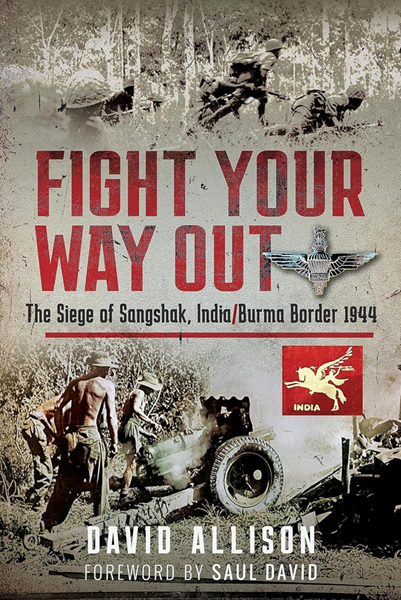
Dr. Robert Lyman discusses a new book by David Allison that covers one of the many small battles that made up the large Imphal-Kohima campaign:
When Wavell, by then Viceroy of India, visited Imphal after the battle in October, to bestow knighthoods on the four victors — Lieutenant Generals Bill Slim (14 Army), Montagu Stopford (33 Corps), Geoffrey Scoones (4 Corps) and Philip Christison (15 Corps) — he admitted to Slim that he found the battle hard to follow, as it seemed to have been fought in “penny-packets”. In professing his ignorance of Slim’s great triumph, Wavell nevertheless hit the nail on the head. Sangshak was one of those penny-packet fights which cumulatively determined the outcome of Japan’s audacious invasion of India.
Like many battles in insufficiently examined wars, Sangshak has suffered over the years from a paucity of rigorous examination. Louis Allen’s magisterial The Longest War gave it short treatment in 1984, and very little else. Until now. I’m delighted to say that a Hong Kong-based Australian lawyer with a military background — David Allison — has produced a new account of this crucial battle, and it is absolutely outstanding. It can be purchased here. I recommend it very strongly. It’s not long: at 159-pages of text you can make your way through this in a couple of days, but it is diligently researched, well written and judiciously argued. For those who know something of the battle, the big arguments in the past about the state training of the 50 Indian Parachute Brigade, the temporary breakdown of its commander, Hope-Thomson and the supposed loss of the captured Japanese map and orders by HQ 23 Indian Division, are calmly and satisfyingly explained.
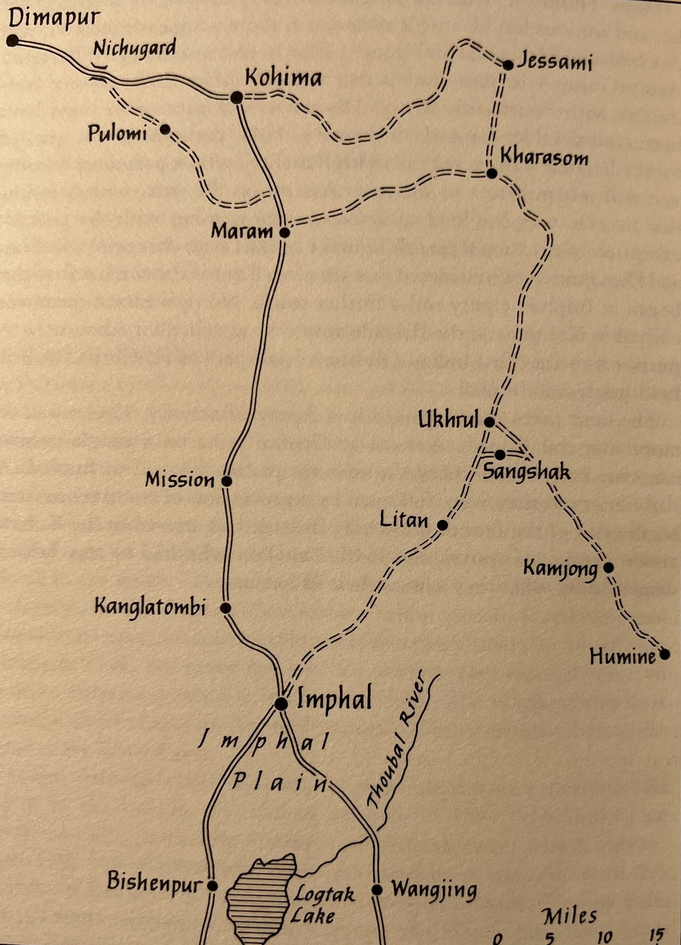
The story can be briefly told. The territory to the north-east of Imphal (centring on the Naga village of Ukhrul) had only the lightest of garrisons and no real defences. Until 16 March it was home to 49 Brigade, which was then despatched to the Tiddim Road to deal with the advance in the south of Lieutenant General Yanagida’s 33 Division. The brigade had considered itself to be in a rear area, and, extraordinarily, no dug-in and wired defensive positions had been prepared. It was one of the most serious British planning failures of the campaign. The entire north-eastern portion of Imphal lay effectively undefended. The gap left by the brigade’s departure had been filled in part by the arrival of the first of the two battalions of the newly raised 50 Indian Parachute Brigade (comprising the Gurkha 152 Battalion and the Indian 153 Battalion), whose young and professional commander, 31-year-old Brigadier M.R.J. (“Tim”) Hope-Thomson, had persuaded New Delhi to allow him to complete the training of his brigade in territory close to the enemy. The area north-east of Imphal was regarded as suitable merely for support troops and training. At the start of March, the brigade HQ and one battalion had arrived in Imphal and began the leisurely process of shaking itself out in the safety of the hills north-east of the town. To the brigade was added 4/5 Mahrattas under Lieutenant Colonel Trim, left behind when 49 Brigade was sent down to the Tiddim Road. To Scoones and his HQ, the area to which Hope-Thomson and his men were sent represented the lowest of all combat priorities. Sent into the jungle almost to fend for themselves, it was not expected that they would have to fight, let alone be on the receiving end of an entire Japanese divisional attack. They had little equipment, no barbed wire, and little or no experience or knowledge of the territory. No one considered it worthwhile to keep them briefed on the developing situation. To all intents and purposes, 50 Indian Parachute Brigade was an irrelevant appendage, attached to Major General Ouvry Roberts’ 23 Indian Division for administrative purposes but otherwise left to its own devices.
Before long, information began to reach Imphal that Japanese troops were advancing in force on Ukhrul and Sangshak. Inexplicably, however, this information appeared not to ring any warning bells in HQ IV Corps in Imphal, which was preoccupied with the developing threat in the Tamu area where the main Japanese thrust was confidently predicted. On the night of 16 March, the single battalion of 50 Parachute Brigade took over responsibility for the Ukhrul area from 49 Brigade, which was hastily departing for the Tiddim Road. They had no idea that an entire Japanese division of 20,000 men was crossing the Chindwin in strength opposite Homalin. On 19 March, large columns of Japanese infantry were reported advancing through the hills.
No one had expected them to be where they were. But the first shock came to the Japanese 3/58 battalion (Major Shimanoe), part of Lieutenant General Sato’s 31 Division – troops whose objective was Kohima, and not Imphal – who were bloodily rebuffed by the determined opposition of the young Gurkha soldiers at an unprepared position forward of Sheldon’s Corner. The 170 Gurkha recruits refused to allow the 900 men of 3/58 to roll over them and inflicted 160 casualties on the advancing Japanese. In the swirling confusion of the next 36 hours, Hope Thomson and his staff kept their heads, attempting to concentrate what remained of the dispersed companies of 152 Battalion and 4/5 Mahrattas back to a common position at the village of Sangshak, which dominated the tracks southwest to Imphal.
It was at this now-deserted Naga village that Hope-Thomson, on 21 March, decided to group his brigade for its last stand, his staff desperately attempting to alert HQ 4 Corps in Imphal to the enormity of what was happening to the north-east. The Japanese columns infiltrated quickly around and through the British positions, heading in the direction of Litan. The Japanese now began days of repeated assaults on the position in a battle of intense bravery and sacrifice for both sides. Hope Thomson’s men could only dig shallow trenches, which provided no protection from Japanese artillery.
The Korean War: The First Year
Army University Press
Published Jan 22, 2024Created for the Department of Command and Leadership and the Department of Military History at the US Army Command and General Staff College, The Korean War: The First Year is a short documentary focused on the major events of the Forgotten War. Designed to address the complex strategic and operational actions from June 1950 – June 1951, the film answers seven key questions that can be found in the timestamps below. Major events such as the initial North Korean invasion, the defense of the Pusan Perimeter, the Inchon landing, and the Chinese intervention are discussed.
Timestamps:
1. Why are there Two Koreas? – 00:25
2. Why did North Korea Attack South Korea? – 02:39
3. How did the UN stop the Communist invasion? – 06:30
4. Why did MacArthur attack at Inchon? – 10:24
5. Why did the UN attack into North Korea? – 14:27
6. Why did China enter the Korean War? – 18:51
7. How did the UN stop the Communist invasion … again? – 21:44
January 22, 2024
“He lied. That was what he had to say at the time.”
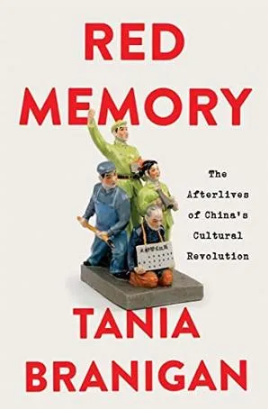
At First Things, Robert Carle reviews Tania Brannigan’s Red Memory: The Afterlives of China’s Cultural Revolution:
At a 1979 White House dinner, actress Shirley MacLaine told Deng Xiaoping, China’s new leader and the guest of honor that evening, about a Chinese scientist she had met. He said that he’d been happier and more productive when he worked on a Chinese farm. Deng cut her short: “He lied. That was what he had to say at the time.” Deng spent three years working in a tractor factory during the Cultural Revolution, and he refused to romanticize it. The memoirs of Cultural Revolution survivors written in the 1980s echo Deng’s view that it was a brutal and pointless experiment.
Today, there is widespread nostalgia in China for the Cultural Revolution. President Xi Jinping has reflected positively on the time he spent exiled in the remote town of Liangjiahe in Shaanxi province, living in a cave, hauling coal carts, carrying manure, building dikes, enduring bitter winters, flea bites, and hunger. This experience, Xi claims, bonded him with China’s common people and prepared him to be an empathetic ruler. Liangjiahe is now a “red tourist” attraction where students can visit Xi’s old home and admire the well he built.
Xi’s glamorization of the Cultural Revolution is reflected in Beijing’s chic dining scene. In Red Classics Restaurant, for example, waitresses in Red Guard uniforms serve meat and vegetables in plain style to invoke an era of stark living. You can have a fully themed wedding in this restaurant, posing for photos in matching Mao suits on a tractor parked in one corner.
In her new book, Red Memory, Tania Branigan describes the clashing memories of the Cultural Revolution. Those who suffered under the brutality of the Red Guard describe an infernal decade when Mao turned his murderous paranoia on his own people, leading them to tear each other to pieces. Children denounced their parents, and students murdered their teachers. In Mao’s campaign against the four “olds” (Old Ideas, Old Culture, Old Customs, and Old Habits), traditional Chinese culture and morality became targets for destruction.
But Branigan also tells stories of people who are nostalgic for a time when life was more austere and when people lived for a cause other than individualism and materialism. Some former Red Guards have set up a bookstore and website called Utopia. Others organize trips to North Korea to admire society as it should be, or set up rural communes for students. One Utopia co-founder, a professor, made headlines for slapping an eighty-year-old “traitor” who had dared to criticize Mao.
Red Memory is full of chilling stories of brutality and betrayal. Fang Zhongmou witnessed the torture and beating of her husband by adolescent Red Guards. She endured years of interrogations at her workplace because her father had been a landowner. One night in 1970, while doing laundry at home, she launched into a tirade against Mao. Her son told her, “If you go against my dear Chairman Mao, I will smash your dog head in”. He reported her to officials. After two months of violent “struggle sessions”, Fang was executed. The son grew up to be a guilt-ridden adult who agonizes over his mother’s gravesite.
Song Binbin was eighteen when she viciously denounced her school’s deputy principal, Bian Zhongyun. Bian had told the students that they should run out of the building in the event of an earthquake. Because she did not instruct the students to take Mao portraits with them, Red Guards hunted her down and beat her to death with nailed clubs. As the Cultural Revolution swept China, beatings and executions became increasingly baroque. Students poured boiling water over teachers’ heads and made them swallow excrement, crawl over embers, drink ink and glue, and beat one another.
QotD: Mao’s theory of “protracted war” as adapted to Vietnamese conditions by Võ Nguyên Giáp
Giáp was facing a different set of challenges in Vietnam facing either France or the United States which required the framework of protracted war to be modified. First, it must have been immediately apparent that it would never be possible for a Vietnamese-based army to match the conventional military capability of its enemies, pound-for-pound. Mao could imagine that at some point the Red Army would be able to win an all-out, head-on-head fight with the Nationalists, but the gap between French and American capabilities and Vietnamese Communist capabilities was so much wider.
At the same time, trading space for time wasn’t going to be much of an option either. China, of course, is a very large country, with many regions that are both vast, difficult to move in, and sparsely populated. It was thus possible for Mao to have his bases in places where Nationalist armies literally could not reach. That was never going to be possible in Vietnam, a country in which almost the entire landmass is within 200 miles of the coast (most of it is far, far less than that) and which is about 4% the size of China.
So the theory is going to have to be adjusted, but the basic groundwork – protract the war, focus on will rather than firepower, grind your enemy down slowly and proceed in phases – remains.
I’m going to need to simplify here, but Giáp makes several key alterations to Mao’s model of protracted war. First, even more than Mao, the political element in the struggle was emphasized as part of the strategy, raised to equality as a concern with the military side and fused with the military operation; together they were termed dau tranh, roughly “the struggle”. Those political activities were divided into three main components. Action among one’s own people consisted of propaganda and motivation designed to reinforce the will of the populace that supported the effort and to gain recruits. Then, action among the enemy people – here meaning Vietnamese who were under the control of the French colonial government or South Vietnam and not yet recruited into the struggle – a mix of propaganda and violent action to gain converts and create dissension. Finally, action against the enemy military, which consisted of what we might define as terroristic violence used as message-sending to negatively impact enemy morale and to encourage Vietnamese who supported the opposition to stop doing so for their own safety.
Part of the reason the political element of this strategy was so important was that Giáp knew that casualty ratios, especially among guerrilla forces – on which, as we’ll see, Giáp would have to rely more heavily – would be very unfavorable. Thus effective recruitment and strong support among the populace was essential not merely to conceal guerrilla forces but also to replace the expected severe losses that came with fighting at such a dramatic disadvantage in industrial firepower.
That concern in turn shaped force-structure. Giáp theorized an essentially three-tier system of force structure. At the bottom were the “popular troops”, essentially politically agitated peasants. Lightly armed, minimally trained but with a lot of local knowledge about enemy dispositions, who exactly supports the enemy and the local terrain, these troops could both accomplish a lot of the political objectives and provide information as well as functioning as local guerrillas in their own villages. Casualties among popular troops were expected to be high as they were likely to “absorb” reprisals from the enemy for guerrilla actions. Experienced veterans of these popular troops could then be recruited up into the “regional troops”, trained men who could now be deployed away from their home villages as full-time guerrillas, and in larger groups. While popular troops were expected to take heavy casualties, regional troops were carefully husbanded for important operations or used to organize new units of popular troops. Collectively these two groups are what are often known in the United States as the Viet Cong, though historians tend to prefer their own name for themselves, the National Liberation Front (Mặt trận Dân tộc Giải phóng miền Nam Việt Nam, “National Liberation Front for South Vietnam”) or NLF. Finally, once the French were forced to leave and Giáp had a territorial base he could operate from in North Vietnam, there were conventional forces, the regular army – the People’s Army of Vietnam (PAVN) – which would build up and wait for that third-phase transition to conventional warfare.
The greater focus on the structure of courses operating in enemy territory reflected Giáp’s adjustment of how the first phase of the protracted war would be fought. Since he had no mountain bases to fall back to, the first phase relied much more on political operations in territory controlled by the enemy and guerrilla operations, once again using the local supportive population as the cover to allow guerrillas and political agitators (generally the same folks, cadres drawn from the regional troops to organize more popular troops) to move undetected. Guerrilla operations would compel the less-casualty-tolerant enemy to concentrate their forces out of a desire for force preservation, creating the second phase strategic stalemate and also clearing territory in which larger mobile forces could be brought together to engage in mobile warfare, eventually culminating in a shift in the third phase to conventional warfare using the regional and regular troops.
Finally, unlike Mao, who could envision (and achieve) a situation where he pushed the Nationalists out of the territories they used to recruit and supply their armies, the Vietnamese Communists had no hope (or desire) to directly attack France or the United States. Indeed, doing so would have been wildly counter-productive as it likely would have fortified French or American will to continue the conflict.
That limitation would, however, demand substantial flexibility in how the Vietnamese Communists moved through the three phases of protracted war. This was not something realized ahead of time, but something learned through painful lessons. Leadership in the Democratic Republic of Vietnam (DRV = North Vietnam) was a lot more split than among Mao’s post-Long-March Chinese Communist Party; another important figure, Lê Duẩn, who became general secretary in 1960, advocated for a strategy of “general offensive” paired with a “general uprising” – essentially jumping straight to the third phase. The effort to implement that strategy in 1964 nearly overran the South, with ARVN (Army of the Republic of Vietnam – the army of South Vietnam) being defeated by PAVN and NLF forces at the Battles of Bình Giã and Đồng Xoài (Dec. 1964 and June 1965, respectively), but this served to bring the United States more fully into the war – a tactical and operational victory that produced a massive strategic setback.
Lê Duẩn did it again in 1968 with the Tet Offensive, attempting a general uprising which, in an operational sense, mostly served to reveal NLF and PAVN formations, exposing them to US and ARVN firepower and thus to severe casualties, though politically and thus strategically the offensive ended up being a success because it undermined American will to continue the fight. American leaders had told the American public that the DRV and the NLF were largely defeated, broken forces – the sudden show of strength exposed those statements as lies, degrading support at home. Nevertheless, in the immediate term, the Tet Offensive’s failure on the ground nearly destroyed the NLF and forced the DRV to back down the phase-ladder to recover. Lê Duẩn actually did it again in 1972 with the Eastern Offensive when American ground troops were effectively gone, exposing his forces to American airpower and getting smashed up for his troubles.
It is difficult to see Lê Duẩn’s strategic impatience as much more than a series of blunders – but crucially Giáp’s framework allowed for recovery from these sorts of defeats. In each case, the NLF and PAVN forces were compelled to do something Mao’s model hadn’t really envisaged, which was to transition back down the phase system, dropping back to phase II or even phase I in response to failed transitions to phase III. By moving more flexibly between the phases (while retaining a focus on the conditions of eventual strategic victory), the DRV could recover from such blunders. I think Wayne Lee actually puts it quite well that whereas Mao’s plan relied on “many small victories” adding up to a large victory (without the quick decision of a single large victory), Giáp’s more flexible framework could survive many small defeats on the road to an eventual strategic victory when the will of the enemy to continue the conflict was exhausted.
Bret Devereaux, “Collections: How the Weak Can Win – A Primer on Protracted War”, A Collection of Unmitigated Pedantry, 2022-03-03.


