
World War Two
Published 20 Jan 2024The huge new Soviet offensives charge ahead this week, taking Warsaw and Krakow; in the west the Battle of the Bulge is officially called over … though there is still fighting there. On Luzon, the Americans push out of their beachhead, though there is heavy fighting to secure their flank.
(more…)
January 21, 2024
The Red Army Overruns Poland! – WW2 – Week 282 – January 20, 1945
Comments Off on The Red Army Overruns Poland! – WW2 – Week 282 – January 20, 1945
January 20, 2024
The British Empire would have failed a proper cost-benefit analysis
At the Institute of Economic Affairs, Kristian Niemietz is working on a paper on the economics of empire that, as he shows in this article, indicates that the empire was never a winning economic proposition for Britain as a whole, no matter how well certain well-connected individuals and companies benefitted:
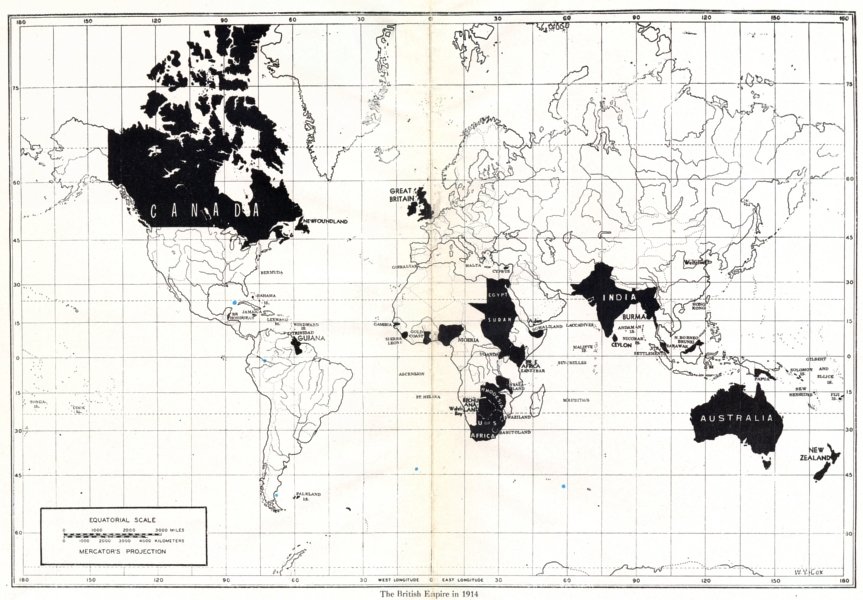
The British Empire in 1914 (via antiquaprintgallery.com)
But is it actually true that imperialism makes countries richer? Does imperialism make economic sense?
This question was already hotly debated at the heyday of imperialism. Adam Smith believed that the British Empire would not pass a cost-benefit test:
The pretended purpose of it was to encourage the manufactures, and to increase the commerce of Great Britain. But its real effect has been to raise the rate of mercantile profit, and to enable our merchants to turn into a branch of trade, of which the returns are more slow and distant than those of the greater part of other trades, a greater proportion of their capital than they otherwise would have done […]
Great Britain derives nothing but loss from the dominion which she assumes over her colonies.
He believed that Britain would be better off if it dissolved its Empire:
Great Britain would not only be immediately freed from the whole annual expense of the peace establishment of the colonies, but might settle with them such a treaty of commerce as would effectually secure to her a free trade, more advantageous to the great body of the people, though less so to the merchants, than the monopoly which she at present enjoys.
The liberal free-trade campaigner Richard Cobden agreed:
[O]ur naval force, on the West India station […], amounted to 29 vessels, carrying 474 guns, to protect a commerce just exceeding two millions per annum. This is not all. A considerable military force is kept up in those islands […]
Add to which, our civil expenditure, and the charges at the Colonial Office […]; and we find […] that our whole expenditure, in governing and protecting the trade of those islands, exceeds, considerably, the total amount of their imports of our produce and manufactures.
If imperialism was a loss-making activity – why did Britain and other European colonial empires engage in it for so long?
Smith and Cobden explained it in terms of clientele politics (or Public Choice Economics, as we would say today). Somebody obviously benefited, even if the nation as a whole did not. And the beneficiaries were politically better organised than those who footed the bill.
This proto-Public Choice case against imperialism was not limited to political liberals. Otto von Bismarck, the Minister President of Prussia and future Chancellor of the German Empire, hated liberals in the Smith-Cobden tradition, but he rejected colonialism in terms that almost make him sound like one of them:
The supposed benefits of colonies for the trade and industry of the mother country are, for the most part, illusory. The costs involved in founding, supporting and especially maintaining colonies […] very often exceed the benefits that the mother country derives from them, quite apart from the fact that it is difficult to justify imposing a considerable tax burden on the whole nation for the benefit of individual branches of trade and industry [translation mine].
In his writing about the economics of imperialism, even Michael Parenti, a Marxist-Leninist political scientist (who is, for obvious reasons, popular among Twitter hipsters), sounds almost like a Public Choice economist:
[E]mpires are not losing propositions for everyone. […] [T]he people who reap the benefits are not the same ones who foot the bill. […]
The transnationals monopolize the private returns of empire while carrying little, if any, of the public cost. The expenditures needed […] are paid […] by the taxpayers.
So it was with the British empire in India, the costs of which […] far exceeded what came back into the British treasury. […]
[T]here is nothing irrational about spending three dollars of public money to protect one dollar of private investment – at least not from the perspective of the investors.”
This leads us to a curious situation. Today’s woke progressives disagree with their comrade Parenti on the economics of empire, but they do agree with Britain’s old imperialists, who argued that the Empire was vital for Britain’s prosperity.
January 14, 2024
Soviet and American Massive Attacks – Week 281 – January 13, 1945
World War Two
Published 13 Jan 2024In the East, the Soviets launch a massive series of new offensives. In the West, Monty holds an ill-judged press conference about the Battle of the Bulge. Operation Nordwind, the German offensive in Alsace, continues. In Hungary, there’s house to house fighting as the Red Army besieges Budapest. In Asia, the Allies wrestle with the Kamikazes, begin their landings on Luzon, and advance in Burma.
00:54 Intro
01:12 Recap
01:22 Montgomery’s Press Conference
05:53 Operation Nordwind
07:07 The battle for Hungary
09:38 The huge Soviet offensive begins!
12:22 American landings on Luzon
15:29 Anti-Kamikaze tactics
18:11 Slim’s advance in Burma
21:11 Conclusion
(more…)
Comments Off on Soviet and American Massive Attacks – Week 281 – January 13, 1945
January 13, 2024
QotD: Brahmins and Mandarins
Traditional Hindu society knew hundreds of hereditary castes and subcastes, but all broadly fit into four major “varna” (“colors”, strata):
- Brahmins (scholars, clerisy)
- Kshatriya (warriors, rulers)
- Vaishya (traders, skilled artisans)
- Shudras (farmers)
- The un-counted fifth varna are the Dalit (“untouchables”, outcasts in both senses of the word)
Historical edge cases aside, membership in the Brahmin stratum was hereditary, even more so than in the nobility of feudal Europe. At least there, kings might raise a commoner to a knighthood or even the peerage for merit or political expedience: one need not wait for reincarnation into a higher caste.
The Sui dynasty in China, however, took a different route. Seeking both to curb the power of the hereditary nobles and to broaden the available talent pool for administrators, they instituted a system of civil service examinations. With interruptions (e.g. under the Mongol emperor Kublai Khan) and modifications, that system remained in place for thirteen centuries until finally abolished in 1904. Westerners refer to laureates of the Imperial Examinations (from the entry-level shengyuan to the top-level jinshi) by the collective term Mandarins. Ironically, this term comes not from any Chinese dialect but (via Malay and Portuguese) from the Sanskrit word mantri (counselor, minister) — cf. the Latin mandatum (command) and its English cognate “mandate”.
Initially, the exams were limited to the scholar and yeoman farmer classes: with time, they were at least in theory opened up to all commoners in the “four occupations” (scholars, farmers, artisans, merchants), with jianmin (those in “base occupations”) still excluded. The process also was ostensibly fair: exams were written, administered at purpose-built examination halls with individual three-walled examination cubicles to eliminate cribbing. Moreover, exam copies were identified by number rather than by name. […]
In practice, the years of study and the costs of hiring tutors for the exam limited this career path to the wealthy. Furthermore, the success rate was very low (between 0.03% and 1%, depending on the source) so one had better have a fallback trade or independent wealth. In some cases, rich families who for some reason were barred from the exams would sponsor a bright student from a poor family. Once the student became a government official, he would owe favors to the sponsor.
Moreover, the subject matter of the exam soon became ossified and tested more for conformity of thought, and ability to memorize text and compose poetry in approved forms, than for any skill actually relevant to practical governance. (Hmm, artists or scholars in a narrow abstruse discipline being touted as authorities on economic or foreign policy: verily, there is nothing new under the sun.)
Nitay Arbel, “Brahmandarins”, According to Hoyt, 2019-10-08.
Comments Off on QotD: Brahmins and Mandarins
January 11, 2024
Pushing back against the Colonialism Narrative
At Samizdata, Brendan Westbridge praises Nigel Biggar’s 2023 book Colonialism: A Moral Reckoning:
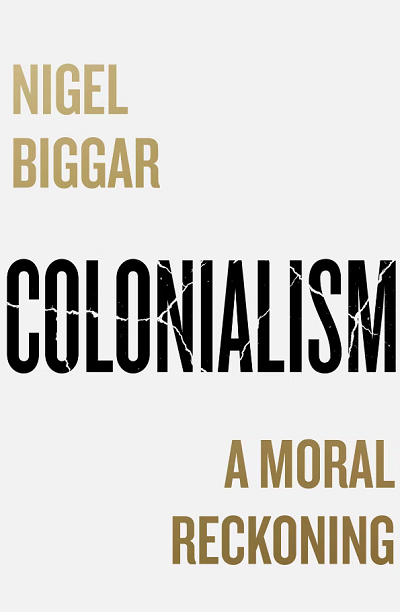
He examines the various claims that the “de-colonisers” make: Amritsar, slavery, Benin, Boer War, Irish famine. In all cases he finds that their claims are either entirely ungrounded or lack vital information that would cast events in a very different light. Amritsar? Dyer was dealing with political violence that had led to murder. Some victims had been set alight. Anyway, he was condemned for his actions by the British authorities and, indeed, his own standing orders. Slavery? Everyone had it and Britain was the first to get rid of it. Benin? They had killed unarmed ambassadors. Irish famine? They tried to relieve it but they were quite unequal to the size of the task. In the case of Benin he comes very close to accusing the leading de-coloniser of knowingly lying. The only one of these where I don’t think he is so convincing is the Boer War. He claims that Britain was concerned about the future of the Cape and especially the Simonstown naval base and also black rights. I think it was the pursuit of gold even if it does mean agreeing with the communist Eric Hobsbawm.
He is far too polite about the “de-colonisers”. They are desperate to hammer the square peg of reality into their round-hole of a theory. To this end they claim knowledge they don’t have, gloss over inconvenient facts, erect theories that don’t bear scrutiny and when all else fails: lie. Biggar tackles all of these offences against objectivity with a calmness and a politeness that you can bet his detractors would never return.
The communists – because they are obsessed with such things and are past masters at projection – like to claim that there was an “ideology” of Empire. Biggar thinks this is nonsense. As he says:
There was no essential motive or set of motives that drove the British Empire. The reasons why the British built an empire were many and various. They differed between trader, migrant, soldier, missionary, entrepreneur, financier, government official and statesman. They sometimes differed between London, Cairo, Cape Town and Calcutta. And all of the motives I have unearthed in this chapter were, in themselves, innocent: the aversion to poverty and persecution, the yearning for a better life, the desire to make one’s way in the world, the duty to satisfy shareholders, the lure of adventure, cultural curiosity, the need to make peace and keep it, the concomitant need to maintain martial prestige, the imperative of gaining military or political advantage over enemies and rivals, and the vocation to lift oppression and establish stable self-government. There is nothing morally wrong with any of these. Indeed, the last one is morally admirable.
One of the benefits of the British Empire is that it tended to put a stop to local wars. How many people lived because of that? But that leads us on to another aspect. Almost no one ever considers what went on before the Empire arrived. Was it better or worse than went before it? Given that places like Benin indulged in human sacrifice, I would say that in many cases the British Empire was an improvement. And if we are going to talk about what went before what about afterwards? He has little to say about what newly-independent countries have done with their independence. The United States, the “white” (for want of a better term) Commonwealth and Singapore have done reasonably well. Ireland is sub-par but OK. Africa, the Caribbean and the Indian sub-continent have very little to show for themselves. This may explain why Britain needed very few people to maintain the Empire. At one point he points out that at the height of the Raj the ratio of Briton to native was 1 to 1000. That implies a lot of consent. Tyrannies need a lot more people.
The truth of the matter is that talk of reparations is rooted in the failure of de-colonisation. If Jamaica were a nicer place to live than the UK, if Jamaica had a small boats crisis rather than the UK then no one would be breathing a word about reparations or colonial guilt. All this talk is pure deflection from the failure of local despots to make the lives of their subjects better.
Biggar has nothing to say about what came after the empire and he also has little to say about how it came about in the first place – so I’ll fill in that gap. Britain acquired an empire because it could. Britain was able to acquire an Empire because it mastered the technologies needed to do it to a higher level and on a greater scale than anyone else. Britain mastered technology because it made it possible to prosper by creating wealth. That in itself was a moral achievement.
Comments Off on Pushing back against the Colonialism Narrative
January 8, 2024
QotD: Nomadic cultures’ territorial needs
The chief thing that nomads, both Great Plains Native Americans and Eurasian Steppe Nomads used violence to secure control of is the one thing the Dothraki never do: territory. To agrarian elites (who write most of our sources) and modern viewers, the vast expanses of grassland that nomads live on often look “empty” and “unused” (and thus not requiring protection), but that’s not correct at all. Those “empty” grasslands are very much in use; the nomads know this and are abundantly willing to defend those expanses of grass with lethal force to keep out interlopers. Remember: the knife’s edge of subsistence for nomads is very thin indeed, so it takes only a small disruption of the subsistence system to push the community into privation.
For the Eurasian Steppe nomad, the grass that isn’t near their encampment is in the process of regrowth for the season or year when it will be near their encampment and need to support their herds. Allowing some rival nomadic group to move their sheep and their horses over your grassland – eating the essential grass along the way – means that grass won’t be there for your sheep and your horses when you need it; and when the sheep starve, so will you. So if you are stronger than the foreign interloper, you will gather up all of your warriors and confront them directly. If you are weaker, you will gather your warriors and raid the interloper, trying to catch members of their group when they’re alone, to steal horses and sheep (we’ll come back to that); you are trying to inflict a cost for being on your territory so that they will go away and not come back.
The calculus for nomadic hunters like the Great Plains Native Americans is actually fairly similar. Land supports bison, bison support tribal groupings, so tribal groups defend access to land with violent reprisals against groups that stray into their territory or hunt “their” bison. And of course the reverse is true – these groups aren’t merely looking to hold on to their own territory, but to expand their subsistence base by taking new territory. Remember: the large tribe is the safe tribe; becoming the large tribe means having a larger subsistence base. And on either the plains or the steppe, the subsistence base is fundamentally measured in grass and the animals – be they herded sheep or wild bison – that grass supports. Both Secoy and McGinnis (op. cit.) are full of wars of these sorts on the Great Plains, where one group, gaining a momentary advantage, violently pushes others to gain greater territory (and thus food) for itself. For instance, Secoy (op. cit., 6-32) discusses how access to horses allowed the Plains Apache to rapidly violently expand over the southern Plains in the late 17th century, before being swept off of them by the fully nomadic Ute and Comanche in the first third of the 18th. As McGinnis notes (op. cit., 16ff), on the Northern Plains, prior to 1800 it initially was the Shoshone who were dominant and expanding, but around 1800 began to be pushed out by the Blackfoot, who in turn would, decades later, be pushed by the expanding Sioux.
This kind of warfare is different from the way that settled, agrarian armies take territory. Generally, the armies of agrarian states seek to seize (farm-) land with its population of farmers mostly intact and exert control both over the land and the people subsequently in order to extract the agricultural surplus. But generally (obviously there are notable exceptions) nomads both lack the administrative structures to exert that kind of control and are also very able to effectively resist that sort of control themselves (it is hard for even nomads to tax nomads), making “empire building” along agrarian lines difficult or undesirable (unless you are the Mongols). So instead, polities are trying to inflict losses (typically more through raiding and ambush than battle). Since rivals will tend to avoid areas that become unsafe due to frequent raiding, the successful tribe can essentially push back an opposing tribe with frequent raids. In extreme circumstances, a group may feel threatened enough to get up and move entirely – which of course creates conflict wherever they go, since their plan is to disposess the next group along the way of their territory.
Within that security context, larger scale groupings – alliances, confederations, and super-tribal “nations” – are common. On the Eurasian Steppe, such alliances tended to be personal, although there was a broad expectation that a given ethnic grouping would work together against other ethnic groupings (an expectation that Chinggis actually worked very hard, once he became the Great Khan of a multi-ethnic “Mongol” army, to break up through the decimal organization system; this reorganization is part of what made the Mongol Empire so much more successful than previous Steppe confederations). Likewise, even a cursory look at the Native Americans of the Great Plains produces both a set of standard enmities (the Sioux and the Crow, for instance) but also webs of peace agreements, treaties, alliances, confederations and so on. The presence of British, French, Spanish and American forces (both traders and military forces) fit naturally into that system; the Plains Apache allied with the Spanish against the Comanche, the Crow with the United States against the Sioux and so on. Such allies might not only help out in a conflict, but also deter war and raiding because their strength and friendship made lethal retaliation likely (don’t attack someone allied to Chinggis Khan and expect to survive the experience …).
Exactly none of that complexity appears with the Dothraki, who have no alliances, no peace agreements, no confederations and no territory to attack or defend. Instead, the Dothraki simply sail around the grass sea, fighting whenever they should chance to meet.
Bret Devereaux, “Collections: That Dothraki Horde, Part IV: Screamers and Howlers”, A Collection of Unmitigated Pedantry, 2021-01-08.
Comments Off on QotD: Nomadic cultures’ territorial needs
January 7, 2024
1945 Begins! – WW2 – Week 280 – January 6, 1945
World War Two
Published 6 Jan 2024The Germans launch a new offensive, Operation Nordwind, in Alsace, even as their offensive in the Ardennes is stalled. The Allies in the west don’t just have to fight these, they are also having serious issues amongst themselves in High Command that threaten their unity. The siege of Budapest is in full swing and is a hard, fought, bloody battle, and the Soviets and the Americans have big plans for new offensives soon to kick off in Eastern Europe and the Philippines (respectively).
00:00 INTRO
01:20 The Siege of Budapest
04:51 German defense plans in the East
06:38 Montgomery versus Eisenhower
08:32 Eisenhower versus the French
10:35 New German Offensive in Alsace
13:49 Monty’s plans for the press
15:04 The Battle of the Bulge
17:45 Preparations for the Luzon Landings
20:56 Notes to end the week
21:51 Summary and conclusion
(more…)
Comments Off on 1945 Begins! – WW2 – Week 280 – January 6, 1945
QotD: The US Army between 1945 and 1950
The trouble is, different men live by different myths.
There are men who would have a society pointed wholly to fighting and resistance to Communism, and this would be a very different society from the one Americans now enjoy. It might succeed on the battlefield, but its other failures can be predicted.
But the infantry battlefield also cannot be remade to the order of the prevailing midcentury opinion of American sociologists.
The recommendations of the so-called Doolittle Board of 1945-1946, which destroyed so much of the will — if not the actual power — of the military traditionalists, and left them bitter, and confused as to how to act, was based on experience in World War II. In that war, as in all others, millions of civilians were fitted arbitrarily into a military pattern already centuries old. It had once fitted Western society; it now coincided with American customs and thinking no longer.
What the Doolittle Board tried to do, in small measure, was to bring the professional Army back into the new society. What it could not do, in 1946, was to gauge the future.
By 1947 the United States Army had returned, in large measure, to the pattern it had known prior to 1939. The new teen-agers who now joined it were much the same stripe of men who had joined in the old days. They were not intellectuals, they were not completely fired with patriotism, or motivated by the draft; nor was an aroused public, eager to win a war, breathing down their necks.
A great many of them signed up for three squares and a sack.
Over several thousand years of history, man has found a way to make soldiers out of this kind of man, as he comes, basically unformed, to the colors. It is a way with great stresses and great strains. It cannot be said it is wholly good. Regimentation is not good, completely, for any man.
But no successful army has been able to avoid it. It is an unpleasant necessity, seemingly likely to go on forever, as long as men fight in fields and mud.
One thing should be made clear.
The Army could have fought World War III, just as it could have fought World War II, under the new rules. During 1941-1945 the average age of the United States soldier was in the late twenties, and the ranks were seasoned with maturity from every rank of life, as well as intelligence.
In World War III, or any war with national emotional support, this would have again been true. Soldiers would have brought their motivation with them, firmed by understanding and maturity.
The Army could have fought World War III in 1950, but it could not fight Korea.
T.R. Fehrenbach, This Kind of War: A Study in Unpreparedness, 1963.
Comments Off on QotD: The US Army between 1945 and 1950
January 5, 2024
QotD: Hong Kong and the “league table” of world economic freedom
The same countries typically appear at the top from year to year, and are separated mostly by microscopic, irrelevant differences. For 2017, whence the data in the new report come, Canada sat in eighth place just a hair above Australia and a hair below the U.K. Ascending to the top, we meet other siblings of the English-speaking world, Ireland and the U.S.; the Swiss Republic stands in its typical fourth; the relatively wild child of the Commonwealth, New Zealand, remains third; and then, in the top two places, you have the twin beacons of radical economic freedom, Singapore and Hong Kong.
Ah, yes, Hong Kong. The Special Administrative Region seems, for now, to have won a short-term victory in its struggle to preserve the conditions of its reunion with mainland China. This has not, ostensively, been a struggle over economic freedom per se, but it is not a coincidence that the rioting ultimately originated in a conflict over bookstores. It is mighty hard to draw a line where “economic” freedom stops and purely personal or civil freedoms begin, and the design of the index reflects this. It has a large basic rule-of-law component, includes mobility rights under the free trade factor, and takes points away for imposing military conscription. (This is surely a tiny tribute to the shade of Milton Friedman, who was one of the originators of the index.)
Even if Hong Kong’s immediate quarrel with China has been resolved for now, it is only a manifestation of what is likely to be a longer game. Clever columnists always like exoticizing talk about how the Chinese think in generations, but when it comes to Hong Kong, the cliché has weight. The 2019 riots, in showing how attached young HKers are to their distinct identity and to the English-speaking world, have revealed a nightmarish, even delegitimizing failure by the Chinese Communists. Mainland influence on Hong Kong education and politics has been used with the intention of prolonging and deepening the spirit of ’97; China, so often deemed the super-country of the future by admiring or fearful intellectuals, has tested the results of this effort in the eyes of the world and been made a laughingstock.
Colby Cosh, “Hong Kong’s still king in economic freedom rankings … for now”, National Post, 2019-09-17.
Comments Off on QotD: Hong Kong and the “league table” of world economic freedom
January 1, 2024
Michael Palin’s Great-Uncle Harry
In The Critic, Peter Caddick-Adams reviews Michael Palin’s Great-Uncle Harry:
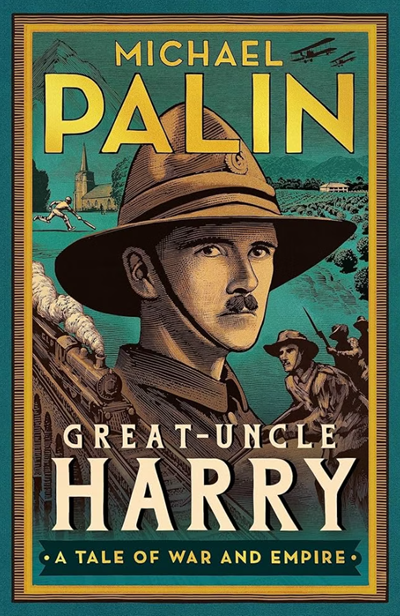
The first of last week’s volumes nestling on my desk, with its immediately identifiable Ripping Yarns cover illustration, was Sir Michael Palin’s story of his forebear, Great Uncle Harry, who travelled the world but disappeared on the Somme. Here, I felt an immediate connection, not least because Michael, I and his Great Uncle Harry Palin had hauled ourselves through the same academy of learning, Shrewsbury School, though at different times. There are plenty of 1914-18 memoirs and tributes around, but this is one of the best. The further the Great War (as it used to be called) recedes, the more we seem to need to torture ourselves with the staggering sacrifices it involved. I read my copy over Remembrance weekend, which made it doubly poignant.
In Great Uncle Harry, Palin’s gift is to give us the hinterland of his ancestor. Many First World War authors, here I could mention the great Lyn Macdonald, Richard Holmes and Martin Middlebrook, all of whom I place on pedestals, provide us with erudite studies, laced with gripping eyewitness accounts. I find myself doing the same with 1939-45, but of necessity there is no room to give the brave and the damned a back story. They are parachuted into the text. They fight and live or die and exit stage left. It is refreshing, therefore, to hold the hand of a first war warrior from birth unto death. Palin was lucky his Great Uncle Harry kept a series of notebooks and diaries of his time in khaki, and was able to research his globe-trotting years before battle. Our man was brought up in Herefordshire, and after school drifted out to British India. He had two stints, first working as a railway manager and latterly as overseer on tea plantations. The reader is fortunate that Palin the documentary-maker filmed in both environments and is able to look over his forebear’s shoulder and summon up the Edwardian social standards of the day, with its solar topees and chota pegs (sunset whiskeys), its heat and its dust. Palin the younger’s many diaries and written travelogues, of which I find New Europe (2007) the best, are equally good.
But Great Uncle Harry Palin was restless. The youngest and most headstrong of seven, he flounced out of each of his two jobs serving the Raj, and ended up trying his hand at farming in New Zealand. There he seemed more settled, but not quite. The Palin under the microscope, notes his great nephew, was one of the first to volunteer for war service with the 12th (Nelson) Regiment, a South Island infantry outfit, in August 1914 and sailed with them overseas, initially to Egypt. There they were absorbed into the Canterbury Battalion, and deployed to Gallipoli, from which Great Uncle Harry emerged without a scratch.
Gallipoli is a conjurer’s name. Now known by the Turks as their Gelibolu Peninsula, overlooking the ancient Hellespont (today’s Dardanelles Strait), its southern tip lies 200 miles from what was then Turkey’s capital, Constantinople, officially Istanbul after 1930. Only since the 1990s has this strategically significant sliver of land, across the Dardanelles from ancient Troy, and guarding entry to the Bosphorus and Black Sea, been opened up for tourists. The 1915 operation was dreamt up by Winston Churchill to break the stalemate of the Western Front. He advocated a naval advance on Constantinople, as a way of knocking the Austro-German alliance out of the war. Such a stratagem would then have offered Paris and London the ability to supply the troops of Tsar Nicholas the Last with modern arms and munitions to prevail against the Central Powers.
Instead of breaking the Western Front, Gallipoli broke Churchill. It was a campaign endlessly refought in the inter-war years, which generally concluded that amphibious warfare had no future, though Lieutenant Colonel George S. Patton in his 1936 General Staff study, The Defense of Gallipoli, found it fascinating. It was one reason why the allies had no maritime landing capability in 1939-40, to Britain’s detriment at Dunkirk, and later Germany’s disadvantage when planning a seaborne assault against southern England. Valuable lessons of what to do, and not to do, had to be relearned before D-Day in 1944 could be a success. My own assessment is right idea, wrong commanders. Gallipoli might have offered the success Churchill desired, but was executed poorly.
The original plan had been to overwhelm Constantinople with battleships, and there is evidence that the Turks were preparing to surrender. However, the Franco-British war fleet encountered German-supplied Krupp cannon along both shores of the Dardanelles and a minefield in the middle, and suffered catastrophic losses. A land campaign was then initiated to clear the Turkish land-based defences. This should have been foreseen and a simultaneous, rather than sequential, maritime-land attack might well have delivered the goods.
Instead, the few Turkish defenders on Gallipoli could see a landing was imminent, called in reinforcements and dug trenches ferociously. On the peninsula, amidst scrub, trench and memorials lie scattered British, Commonwealth, Ottoman and French (yes, they were there too) cemeteries, hinting at stirring tales of derring-do. Last time I was there, I encountered not only rifle cartridges, pieces of pottery rum jars, and shell cases, but human bones. My guide observed, “Probably wild pigs dislodging the topsoil. It happens all the time.” An indication of the 300,000 Allied and 255,000 Turkish killed, wounded and missing in a campaign where illness often took as many as combat wounds. Along the western coast, amidst shards of amphorae from pre-history, lie many wrecks associated with the 1915 campaign in crystal-clear water. It remains high on my recommended battlefields to visit.
Comments Off on Michael Palin’s Great-Uncle Harry
December 31, 2023
Budapest Under Siege – WW2 – Week 279 – December 30, 1944
World War Two
Published 30 Dec 2023In the west, the Allies break the siege of Bastogne, but the fight for the Ardennes continues. and British commander Bernard Montgomery is maneuvering to take command of the Western Front ground forces. In Hungary Budapest is cut off by the Soviets and under siege, with hundreds of thousands of civilians still in the city. The fight in Italy is winding down for the winter, but the fight in the Philippines continues. In fact, American landings on Luzon are planned to go off soon.
00:00 INTRO
01:22 The Siege of Bastogne
03:10 The failure of 5th and 6th Panzer Armies
06:11 Montgomery wants command
09:27 Guderian appeals to Hitler, “stop the Ardennes Offensive!”
12:11 Budapest surrounded and under siege
17:04 Wrapping up the Gothic Line Campaign
19:29 Churchill in Athens
20:30 The fight in the Philippines
23:07 SUMMARY
(more…)
Comments Off on Budapest Under Siege – WW2 – Week 279 – December 30, 1944
December 26, 2023
The awe-inducing power of volcanoes
Ed West considers just how much human history has been shaped by vulcanology, including one near-extinction event for the human race:
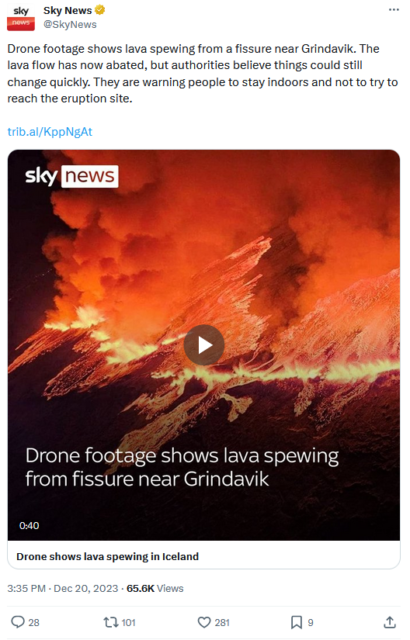
A huge volcano has erupted in Iceland and it looks fairly awesome, both in the traditional and American teenager senses of the word.
Many will remember their holidays being ruined 13 years ago by the explosion of another Icelandic volcano with the epic Norse name Eyjafjallajökull. While this one will apparently not be so disruptive, volcano eruptions are an under-appreciated factor in human history and their indirect consequences are often huge.
Around 75,000 years ago an eruption on Toba was so catastrophic as to reduce the global human population to just 4,000, with 500 women of childbearing age, according to Niall Ferguson. Kyle Harper put the number at 10,000, following an event that brought a “millennium of winter” and a bottleneck in the human population.
In his brilliant but rather depressing The Fate of Rome, Harper looked at the role of volcanoes in hastening the end of antiquity, reflecting that “With good reason, the ancients revered the fearsome goddess Fortuna, out of a sense that the sovereign powers of this world were ultimately capricious”.
Rome’s peak coincided with a period of especially clement climatic conditions in the Mediterranean, in part because of the lack of volcanic activity. Of the 20 largest volcanic eruptions of the last 2,500 years, “none fall between the death of Julius Caesar and the year AD 169”, although the most famous, the eruption of Vesuvius in AD 79, did. (Even today it continues to reveal knowledge about the ancient world, including a potential treasure of information.)
However, the later years of Antiquity were marked by “a spasm” of eruptions and as Harper wrote, “The AD 530s and 540s stand out against the entire late Holocene as a moment of unparalleled volcanic violence”.
In the Chinese chronicle Nan Shi (“The History of the Southern Dynasties”) it was reported in February 535 that “there twice was the sound of thunder” heard. Most likely this was a gigantic volcanic explosion in the faraway South Pacific, an event which had an immense impact around the world.
Vast numbers died following the volcanic winter that followed, with the year 536 the coldest of the last two millennia. Average summer temperature in Europe fell by 2.5 degrees, and the decade that followed was intensely cold, with the period of frigid weather lasting until the 680s.
The Byzantine historian Procopius wrote how “during the whole year the sun gave forth its light without brightness … It seemed exceedingly like the sun in eclipse, for the beams it shed were not clear”. Statesman Flavius Cassiodorus wrote how: “We marvel to see now shadow on our bodies at noon, to feel the mighty vigour of the sun’s heat wasted into feebleness”.
A second great volcanic eruption followed in 540 and (perhaps) a third in 547. This led to famine in Europe and China, the possible destruction of a city in Central America, and the migration of Mongolian tribes west. Then, just to top off what was already turning out to be a bad decade, the bubonic plague arrived, hitting Constantinople in 542, spreading west and reaching Britain by 544.
Combined with the Justinian Plague, the long winter hugely weakened the eastern Roman Empire, the combination of climatic disaster and plague leading to a spiritual and demographic crisis that paved the way for the rise of Islam. In the west the results were catastrophic, and urban centres vanished across the once heavily settled region of southern Gaul. Like in the Near East, the fall of civilisation opened the way for former barbarians to build anew, and “in the Frankish north, the seeds of a medieval order germinated. It was here that a new civilization started to grow, one not haunted by the incubus of plague”.
Comments Off on The awe-inducing power of volcanoes
December 24, 2023
The Siege of Bastogne Begins – WW2 – Week 278 – December 23, 1944
World War Two
Published 23 Dec 2023The German Ardennes Offensive, called by the Allies the Battle of the Bulge, is in full swing in Luxembourg and Belgium this week, and the Germans have the key junction town of Bastogne under siege. On the Allied side there comes a large American surrender, plans for counterattacks, and tension growing between British and American Commands. The fight in both Italy and the Philippines continues, and in Hungary the Soviets have nearly surrounded Budapest.
00:26 Intro
01:06 The Battle of the Bulge
03:54 The Malmedy Massacre
06:25 Bastogne
10:00 American Surrender on Schnee Eifel
12:06 Patton plans a counterattack
15:44 Bernard Montgomery and Omar Bradley
18:12 The Red Army advances around Budapest
21:39 Fighting in Italy and Greece
22:45 Leyte and Mindoro
25:07 Conclusion
(more…)
Comments Off on The Siege of Bastogne Begins – WW2 – Week 278 – December 23, 1944
December 22, 2023
Camouflage
World War Two
Published Dec 19, 2023Camouflage comes in many forms, shapes, disguises, and even processes, for there are indeed many ways to hide your soldiers, guns, tanks, and even ships at sea. Today we take a wee look at camouflage during the war.
(more…)
Comments Off on Camouflage
December 17, 2023
The Battle of the Bulge Begins – WW2 – Week 277 – December 16, 1944
World War Two
Published 16 Dec 2023Adolf Hitler’s Ardennes counteroffensive finally goes off this week, and it does indeed catch the Allies by surprise, and they suspend other offensive operations in the west. They are still attacking in Italy, and the Soviets are still advancing in Hungary, trying to cut off Budapest. In the Far East, there are Allied landings on Mindoro, and they are also on the march in Burma, hoping to pin down the enemy.
0:00 Intro
0:55 Recap
1:22 Street fighting in Athens
04:07 Operation Queen ends
06:33 Autumn Mist Offensive plans
09:51 Allied intelligence failures
12:26 The Ardennes Offensive Begins
16:57 Allied attacks in Italy and Soviet plans to surround Budapest
20:07 The Allied offensive in Burma
22:10 Mindoro Landings
24:33 Summary
25:14 Conclusion
(more…)
Comments Off on The Battle of the Bulge Begins – WW2 – Week 277 – December 16, 1944


