Quotulatiousness

December 21, 2017

The bloody 20th century and the leaders who helped make it so

Filed under: China, Germany, History, Military, Russia, WW1, WW2 — Tags: , , , , — Nicholas @ 05:00

Walter Williams on the terrible death toll of the 20th century, both in formal war between nations and in internal conflict and repression:

The 20th century was mankind’s most brutal century. Roughly 16 million people lost their lives during World War I; about 60 million died during World War II. Wars during the 20th century cost an estimated 71 million to 116 million lives.

The number of war dead pales in comparison with the number of people who lost their lives at the hands of their own governments. The late professor Rudolph J. Rummel of the University of Hawaii documented this tragedy in his book Death by Government: Genocide and Mass Murder Since 1900. Some of the statistics found in the book have been updated here.

The People’s Republic of China tops the list, with 76 million lives lost at the hands of the government from 1949 to 1987. The Soviet Union follows, with 62 million lives lost from 1917 to 1987. Adolf Hitler’s Nazi German government killed 21 million people between 1933 and 1945. Then there are lesser murdering regimes, such as Nationalist China, Japan, Turkey, Vietnam and Mexico. According to Rummel’s research, the 20th century saw 262 million people’s lives lost at the hands of their own governments.

Hitler’s atrocities are widely recognized, publicized and condemned. World War II’s conquering nations’ condemnation included denazification and bringing Holocaust perpetrators to trial and punishing them through lengthy sentences and execution. Similar measures were taken to punish Japan’s murderers.

But what about the greatest murderers in mankind’s history — the Soviet Union’s Josef Stalin and China’s Mao Zedong? Some leftists saw these communists as heroes. W.E.B. Du Bois, writing in the National Guardian in 1953, said, “Stalin was a great man; few other men of the 20th century approach his stature. … The highest proof of his greatness (was that) he knew the common man, felt his problems, followed his fate.” Walter Duranty called Stalin “the greatest living statesman” and “a quiet, unobtrusive man.” There was even leftist admiration for Hitler and fellow fascist Benito Mussolini. When Hitler came to power in January 1933, George Bernard Shaw described him as “a very remarkable man, a very able man.” President Franklin Roosevelt called the fascist Mussolini “admirable,” and he was “deeply impressed by what he (had) accomplished.”

December 9, 2017

The Trudeau sideshow in China

Filed under: Cancon, China, Economics, Politics — Tags: , , , — Nicholas @ 05:00

Colby Cosh on figuring out why Justin Trudeau’s trip to China didn’t end in the glory he and his handlers were clearly anticipating:

My favourite part of the fair has always been the sideshow. And when it comes to Justin Trudeau’s official visit to China, the sideshow definitely turned out to be the most interesting part of the proceedings. Interpreting the outcome of the visit involves a certain amount of old-fashioned Kremlinology, applied to both sides, but it seems fairly clear that Trudeau was gulled into providing Chinese leadership with some celebrity glamour in exchange for a big pile of nothing on Chinese-Canadian trade.

He came to China with hopes for progress on a future trade deal that would involve China accepting new labour, gender, and environment standards. But he collided with the newly aggressive Xi Jinping doctrine — a change in the official Chinese mood that insists on the country’s superpower status. China-watchers know that over the past year, in a process that culminated at the 19th Chinese Communist Party Congress in October, China has become more explicit, and more chauvinist, in claiming to pursue an independent, indigenous alternative model of economic and social progress.

[…]

Western commentators on China have, for a long time, had an implicit vision of a re-emerging bipolar world, with China in the old place of Russia as an ideological challenger to Western democracies. Xi is taking them at their word. China’s aspirations are no longer to follow or imitate the West, but to out-compete it on its own terms, without any of the untidy, politically dis-unifying elements of Western life — independent universities, newspapers that aren’t trash, multiple political parties, and the like.

Given this background, Trudeau arguably arrived in China at exactly the wrong moment. Formal talks on a China-Canada free trade agreement would have been the first ever between China and a G7 country. It turned out that there was more value for Xi in slapping the hand of friendship. The Global Times, an organ of the party’s People’s Daily newspaper network, published a cranky English-language editorial in the midst of Trudeau’s visit.

The editorial attacked the “superiority and narcissism” of Canadian newspapers, as an alternative to jabbing the prime ministerial guest in the eye personally. But it is easy enough to read between the lines. “Trade between China and Canada is mutually beneficial, more significant than the ideology upon which the latter’s media has been focusing,” wrote the tabloid’s editor, Hu Xijin. “When Canada imports a pair of shoes from China, will Canada ask how much democracy and human rights are reflected in those shoes?”

If Trudeau had been hoping to wipe away memories of his embarrassing stunt at the TPP negotiations by a Pierre-Trudeau-like Chinese breakthrough, the Chinese government clearly saw him coming a few thousand miles away and ensured that no such PR coup would be allowed.

November 27, 2017

China discovers that there’s a (very) limited appetite for shared bikes

Filed under: Business, China, Economics — Tags: , , , — Nicholas @ 04:00

In the Guardian, Benjamin Haas reports on what at first might seem to be a vast modern art display:

At first glance the photos vaguely resemble a painting. On closer inspection it might be a giant sculpture or some other art project. But in reality it is a mangled pile of bicycles covering an area roughly the size of a football pitch, and so high that cranes are need to reach the top; cast-offs from the boom and bust of China’s bike sharing industry.

Just two days after China’s number three bike sharing company went bankrupt, a photographer in the south-eastern city of Xiamen captured a bicycle graveyard where thousands have been laid to rest. The pile clearly contains thousands of bikes from each of the top three companies, Mobike, Ofo and the now-defunct Bluegogo.

Tim Worstall draws the correct conclusion from the provided evidence:

We want, irrespective of anything else about the economy, a method of testing ideas to see if they work. Does the application of these scarce resources meet some human need or desire? Does it do so more than an alternative use, is it even adding value at all?

Bike shares, are they a good idea or not? The underlying problem being that expressed and revealed preferences aren’t the same. There’s only so far market research can take you, at some point someone, somewhere, has to go out and do it and see.

Excellent, the Commie Chinese have done so. Vast amounts of capital thrown into this, competing bike share companies, hire costs pennies. And no fucker seems very interested. That is, no, large scale bike share schemes don’t meet any discernible human need or desire, they don’t add value, spending the money on something else will increase human joy and happiness better.

And this is excellent, we’ve tried the idea and it don’t work. Now we can abandon it and go off and do something else therefore.

Which is the great joy of market based systems. They’re the best method we’ve got of finding out which ideas are fuck ups.

Long live markets.

November 4, 2017

The death toll of a century of Communism

Filed under: China, History, Politics, Russia — Tags: , , , — Nicholas @ 05:00

Yuri Maltsev on the human cost of the Russian Revolution and its follow-on upheavals worldwide:

The horrors of twentieth-century socialism — of Lenin, Stalin, Hitler, Mussolini, Mao, and Pol Pot — were the offspring of 1917. Seventy years earlier, Marx and Engels predicted the overthrow of bourgeois rule would require violence and “a dictatorship of the proletariat … to weed out remaining capitalist elements.” Lenin conducted this “weeding out” using indiscriminate terror, as Russian socialists before him had done and others would continue to do after his death.

The late Rudolph Rummel, the demographer of government mass murder, estimated the human toll of twentieth-century socialism to be about 61 million in the Soviet Union, 78 million in China, and roughly 200 million worldwide. These victims perished during state-organized famines, collectivization, cultural revolutions, purges, campaigns against “unearned” income, and other devilish experiments in social engineering.

In its monstrosity, this terror is unrivaled in the course of human history.

Lenin’s coup on November 7, 1917, the day Kerensky’s provisional government fell to Bolshevik forces, opened a new stage in human history: a regime of public slavery. Collectivist economic planning led to coercion, violence, and mass murder. Marx and Engels had defined socialism as “the abolition of private property.” The most fundamental component of private property, self-ownership, was abolished first.

[…]

The Marxists’ biggest targets have always been the family, religion, and civil society — institutional obstacles to the imposition of the omnipotent state. With the Bolsheviks in power, Lenin set out to destroy them.

Murder of children became a norm after he ordered the extermination of Czar Nicholas II, his wife Alexandra, and their five children. Millions of families were rounded up and forcibly relocated to remote and uninhabited regions in Siberia and Kazakhstan. Hundreds of thousands of children died of starvation or disease during their journey into exile and were buried in mass unmarked graves.

In 1935, Stalin introduced Article 12 of the USSR Criminal Code, which permitted that children age twelve and older be sentenced to death or imprisonment as adults. This “law” was directed at the orphans of victims of the regime, based on the belief that an apple never falls far from the tree. Many of these kids, whose parents had been jailed or executed, were commonly known as bezprizorni, street children. They found themselves living in bare, dirty cells in a savagely violent gulag, where they were mixed with dangerous criminals and were brutalized and raped by guards and common criminals.

On a lighter note, here’s a review of The Death of Stalin from Samizdata:

The Death of Stalin opened recently across the UK. It is an excellent black comedy, 5 stars. The film opens with a musical performance for Radio Moscow, Stalin likes it, and asks for the recording. There is none, so, in true Soviet style, the recording is ‘faked’ by the terrified producer, who resorts to desperate measures. The backdrop to this is nightly NKVD raids, roaming through apartment blocks with the citizenry knowing what to expect, Beria adds his own touches to the minutiae of the raids. We see Stalin’s inner circle, all desperately keeping track of what they have said, and striving to please their master.

Then Stalin collapses, with a little sub-plot device thrown in. Beria is the first to find him, and gets his head start on the race for power. The others in the Praesidium arrive, and the plotting begins. Efforts to get a doctor for Stalin are complicated by the consequences of the Doctors’ Plot, with the NKVD rounding up whoever they can find instead. But it becomes clear that Stalin is in a terminal condition and he then dies.

It should be noted that the film is by the writers of The Thick of It, something, not having a TV, I have never seen, but it has the flavour of a much coarser version of an Ealing Comedy. Beria’s raping and torturing is a major theme, and anyone who sits through the first 15 minutes should by then be under no illusion about the nature of the Soviet Union and socialism. Another excellent aspect of the film is the use of various accents, Stalin is a cockney (perhaps he should have been Welsh, an outsider, emphasising his Georgian origins). Zhukov a bluff Lancastrian (or Northerner), Malenkov and Khrushchev have American accents.

June 4, 2017

Intro to the Solow Model of Economic Growth

Filed under: China, Economics, Germany, Japan — Tags: , , — Nicholas @ 02:00

Published on 28 Mar 2016

Here’s a quick growth conundrum, to get you thinking.

Consider two countries at the close of World War II — Germany and Japan. At that point, they’ve both suffered heavy population losses. Both countries have had their infrastructure devastated. So logically, the losing countries should’ve been in a post-war economic quagmire.

So why wasn’t that the case at all?

Following WWII, Germany and Japan were growing twice, sometimes three times, the rate of the winning countries, such as the United States.

Similarly, think of this quandary: in past videos, we explained to you that one of the keys to economic growth is a country’s institutions. With that in mind, think of China’s growth rate. China’s been growing at a breakneck pace — reported at 7 to 10% per year.

On the other hand, countries like the United States, Canada, and France have been growing at about 2% per year. Aside from their advantages in physical and human capital, there’s no question that the institutions in these countries are better than those in China.

So, just as we said about Germany and Japan — why the growth?

To answer that, we turn to today’s video on the Solow model of economic growth.

The Solow model was named after Robert Solow, the 1987 winner of the Nobel Prize in Economics. Among other things, the Solow model helps us understand the nuances and dynamics of growth. The model also lets us distinguish between two types of growth: catching up growth and cutting edge growth. As you’ll soon see, a country can grow much faster when it’s catching up, as opposed to when it’s already growing at the cutting edge.

That said, this video will allow you to see a simplified version of the model. It’ll describe growth as a function of a few specific variables: labor, education, physical capital, and ideas.

So watch this new installment, get your feet wet with the Solow model, and next time, we’ll drill down into one of its variables: physical capital.

Helpful links:
Puzzle of Growth: http://bit.ly/1T5yq18
Importance of Institutions: http://bit.ly/25kbzne
Rise and Fall of the Chinese Economy: http://bit.ly/1SfRpDL

May 26, 2017

Puzzle of Growth: Rich Countries and Poor Countries

Filed under: China, Economics — Tags: , , , , — Nicholas @ 02:00

Published on 16 Feb 2016

Throughout this section of the course, we’ve been trying to solve a complicated economic puzzle — why are some countries rich and others poor?

There are various factors at play, interacting in a dynamic, and changing environment. And the final answer to the puzzle differs depending on the perspective you’re looking from. In this video, you’ll examine different pieces of the wealth puzzle, and learn about how they fit.

The first piece of the puzzle, is about productivity.

You’ll learn how physical capital, human capital, technological knowledge, and entrepreneurs all fit together to spur higher productivity in a population. From this perspective, you’ll see economic growth as a function of a country’s factors of production. You’ll also learn what investments can be made to improve and increase these production factors.

Still, even that is too simplistic to explain everything.

So we’ll also introduce you to another piece of the puzzle: incentives.

In previous videos, you learned about the incentives presented by different economic, cultural, and political models. In this video, we’ll stay on that track, showing how different incentives produce different results.

As an example, you’ll learn why something as simple as agriculture isn’t nearly so simple at all. We’ll put you in the shoes of a hypothetical farmer, for a bit. In those shoes, you’ll see how incentives can mean the difference between getting to keep a whole bag of potatoes from your farm, or just a hundredth of a bag from a collective farm.

(Trust us, the potatoes explain a lot.)

Potatoes aside, you’re also going to see how different incentives shaped China’s economic landscape during the “Great Leap Forward” of the 1950s and 60s. With incentives as a lens, you’ll see why China’s supposed leap forward ended in starvation for tens of millions.

Hold on — incentives still aren’t the end of it. After all, incentives have to come from somewhere.

That “somewhere” is institutions.

As we showed you before, institutions dictate incentives. Things like property rights, cultural norms, honest governments, dependable laws, and political stability, all create incentives of different kinds. Remember our hypothetical farmer? Through that farmer, you’ll learn how different institutions affect all of us. You’ll see how institutions help dictate how hard a person works, and how likely he or she is to invest in the economy, beyond that work.

Then, once you understand the full effect of institutions, you’ll go beyond that, to the final piece of the wealth puzzle. And it’s the most mysterious piece, too.

Why?

Because the final piece of the puzzle is the amorphous combination of a country’s history, ideas, culture, geography, and even a little luck. These things aren’t as direct as the previous pieces, but they matter all the same.

You’ll see why the US constitution is the way it is, and you’ll learn about people like Adam Smith and John Locke, whose ideas helped inform it.

And if all this talk of pieces makes you think that the wealth puzzle is a complex one, you’d be right.

Because the truth is, the question of “what creates wealth?” really is complex. Even the puzzle pieces you’ll learn about don’t constitute every variable at play. And as we mentioned earlier, not only are the factors complex, but they’re also constantly changing as they bump against each other.

Luckily, while the quest to finish the wealth puzzle isn’t over, at least we have some of the pieces in hand.

So take the time to dive in and listen to this video and let us know if you have questions along the way. After that, we’ll soon head into a new section of the course: we’ll tackle the factors of production so we can further explore what leads to economic growth.

May 23, 2017

The Ally From The Far East – Japan in World War 1 I THE GREAT WAR Special

Filed under: Asia, China, History, Japan, Military, Pacific, WW1 — Tags: , , , — Nicholas @ 05:00

Published on 22 May 2017

Japan’s participation in World War 1 is an often overlooked part of their history – even in Japan itself. Their service as one of the members of the Entente marked the climax of a development that started with the Meiji Restoration, a way out of isolation and into the global alliance system. This brought Japan more power and was also very lucrative. And after fighting in the Pacific Theatre of World War 1, the Siege of Tsingtao and contributing the Japanese Navy to the war effort, Japan had a seat at the table of the Versailles peace negotiations.

April 6, 2017

American “isolationism” between the wars

Filed under: Americas, China, Europe, History, USA, WW2 — Tags: , , , — Nicholas @ 05:00

Reason‘s Jesse Walker linked to this article by Andrew Bacevich which helps to debunk the routine description of US foreign policy between the first and second world wars as “isolationism”:

… McCain is worried about the direction of world events, with Russian provocations offering but one concern among many. Patterson shares McCain’s apprehensions, compounded by what he sees as a revival of “the isolationism in Europe and America that precipitated World War II.”

Now as an explanation for the origins of the war of 1939-1945, American “isolationism” is as familiar as the sweet-and-sour pork featured at your local Chinese takeout joint. Its authenticity is equally dubious. Yet Patterson’s assertion has this virtue: It captures in less than a sentence a prime obstacle to instituting a realistic, fact-based approach to foreign policy.

In truth, isolationism is to history what fake news is to journalism. The oft-repeated claim that in the 1920s and 1930s the United States raised the drawbridges, stuck its head in the sand, and turned its back on the world is not only misleading, but also unhelpful. Citing a penchant for isolationism as a defect afflicting the American character is like suggesting that members of Congress suffer from a lack of self-esteem. The charge just doesn’t square with the facts, no matter how often repeated.

Here, by way of illustrating some of those relevant facts, is a partial list of places beyond the boundaries of North America, where the United States stationed military forces during the interval between the two world wars: China, the Philippines, Guam, Hawaii, Panama, Cuba, and Puerto Rico. That’s not counting the U.S. Marine occupations of Nicaragua, Haiti, and the Dominican Republic during a portion of this period. Choose whatever term you like to describe the U.S military posture during this era — incoherent comes to mind — but isolationism doesn’t fill the bill.

As for Patterson’s suggestion that the behavior of the United States “precipitated” World War II, the claim is simply laughable. World War I precipitated World War II, or more specifically the European malaise resulting from the bloodletting of 1914-1918, compounded by the Bolshevik Revolution and the spread of fascism, and further exacerbated by profoundly shortsighted policies pursued by Great Britain and France. Throw into the mix the Great Depression, Japanese imperial ambitions, and the diabolical plotting of Adolf Hitler and his henchmen, and you have the makings of a catastrophe. Some few observers foresaw that catastrophe, but preventing it lay well beyond the ability of the United States, even if U.S. leaders had been clairvoyant.

March 30, 2017

Another Japanese “destroyer” joins the fleet

Filed under: China, History, Japan, Military — Tags: , — Nicholas @ 03:00

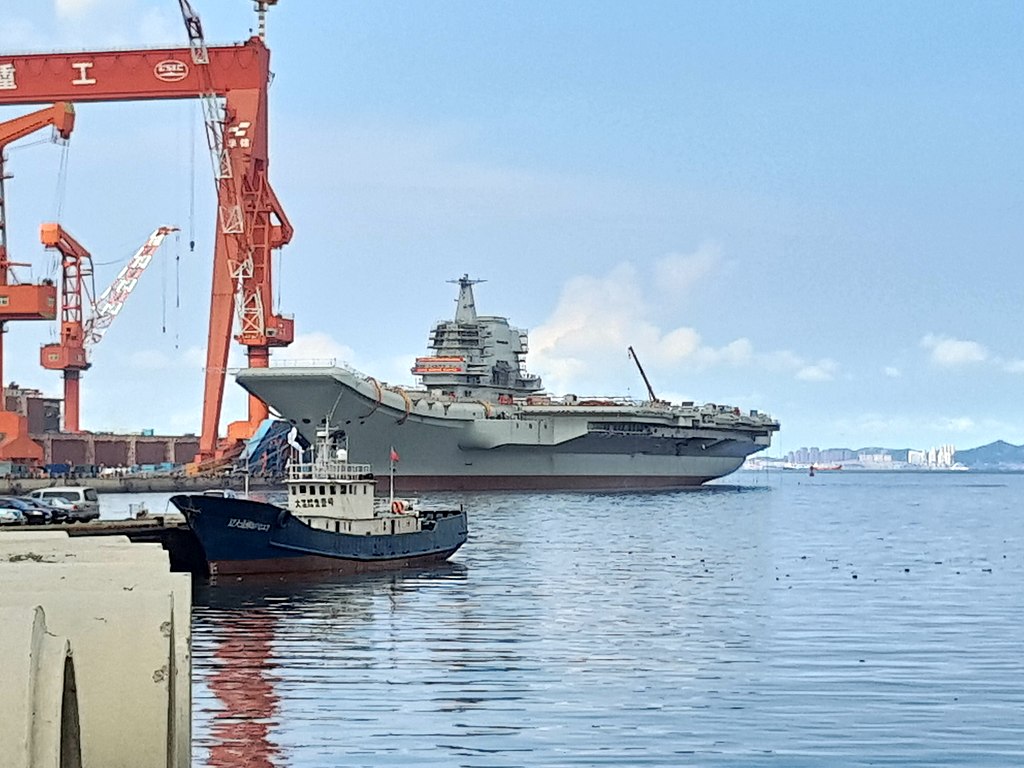
Due to a long-standing aversion to calling certain kinds of vessels by their most appropriate name, the Japanese Maritime Self-Defence Force (because Japan’s constitution prohibits the country having a “navy”, post-1945) commissioned their latest “destroyer” last week:

JS Izumo DDH-183, sister-ship of the just-commisioned JS Kaga DDH-184, both helicopter-equipped destroyers, officially.

I know what you’re thinking … “That doesn’t look like a destroyer to me” … but that’s what Japan officially designates ships like this to be, so that’s what they’re called. Strategy Page has more:

On March 22nd Japan put into service a second 27,000 ton “destroyer” (the Kaga, DDH 184) that looks exactly like an aircraft carrier. Actually it looks like an LPH (Landing Platform Helicopter) an amphibious ship type that first appeared in the 1950s. This was noted when Izumo, the first Japanese LPH was launched in 2012 (it entered service in 2015). The Izumos can carry up to 28 aircraft and are armed only with two 20mm Phalanx anti-missile cannon and launcher with sixteen ESSM missiles for anti-missile defense.

LPHs had no (or relatively few) landing craft but did carry a thousand or more troops who were moved ashore using the dozen or more helicopters carried. The first American LPH (the USS Iwo Jima) was an 18,400 ton ship that entered service in 1961, and carried 2,000 troops and twenty-five helicopters. Until Izumo showed up, several nations operated LPHs, and Britain and South Korea still do. The U.S. retired its last LPHs in the 1990s, but still have a dozen similar ships that include landing craft (and a well deck in the rear to float them out of) as well as helicopters. A few other nations have small carriers that mostly operate helicopters but carry few, if any troops.

The Izumos are the largest LPHs to ever to enter service. It differs from previous LPHs in not having accommodations for lots of troops and having more powerful engines (capable of destroyer-like speeds of over fifty-four kilometers an hour). Izumo does have considerable cargo capacity, which is intended for moving disaster relief supplies quickly to where they are needed. Apparently some of these cargo spaces can be converted to berthing spaces for troops, disaster relief personnel, or people rescued from disasters. There are also more medical facilities than one would expect for a ship of this size. More worrisome (to the Chinese) is the fact that the Izumo could carry and operate the vertical take-off F-35B stealth fighter, although Japan has made no mention of buying that aircraft or modifying the LPH flight decks to handle the very high temperatures generated by the F-35B when taking off or landing vertically. The Chinese are also upset with the name of this new destroyer. Izumo was the name of a Japanese cruiser that was a third the size of the new “destroyer” and led the naval portion of a 1937 operation against Shanghai that left over two-hundred-thousand Chinese dead. The Chinese remember all this, especially the war with Japan that began unofficially in 1931 and officially in 1937.

IJNS Izumo at anchor 1932 (Colourized), via Wikimedia

How Germany’s Victories weakened the Japanese in World War 2

Filed under: China, Europe, Germany, History, Japan, Military, WW2 — Tags: , , — Nicholas @ 02:00

Published on 24 Mar 2017

This video gives you a short glimpse on how the war in Europe had a detrimental effect on the Japanese Economy.

Military History Visualized provides a series of short narrative and visual presentations like documentaries based on academic literature or sometimes primary sources. Videos are intended as introduction to military history, but also contain a lot of details for history buffs. Since the aim is to keep the episodes short and comprehensive some details are often cut.

March 16, 2017

Origins of the Silk Road

Filed under: Asia, China, Europe, History, Middle East — Tags: , , — Nicholas @ 03:00

I’ve been quietly fascinated by the ancient Silk Road trading route spanning from the Middle East to China since I first heard about it as a kid. (The most recent book I read on the topic, Foreign Devils on the Silk Road, blended bits of the history of the route with the activities of European spies in the area preceding the start of the First World War.) At Ars Technica, Annalee Newitz summarizes some recent work in Nature that pushes back the origins of the Silk Road more than two millennia:

The Silk Road was a series of ancient trading routes that spanned Asia, reaching as far as the Middle East and Europe. Self-organizing and vast, it fell under the control of various empires — but never for long. The polyglot civilizations of traders who lived along its routes are the subject of legends, and more recently the Silk Road lent its name to an infamous darknet market. Historians usually date the Silk Road from roughly the 200s to the 1400s. But a new study in Nature suggests the trade routes may be 2,500 years older than previously believed and its origins much humbler than the rich cities it spawned.

Historical accounts of the Silk Road begin in China in the 100s, when the Han Dynasty used its many routes to trade with the peoples of Central and South Asia. Han soldiers protected the roads and maintained regular outposts on them, allowing wealth and knowledge to flow across the continent. Monks wandering the Silk Road brought Buddhism from India to China, while merchants brought spices, gems, textiles, books, horses, and other valuables from one part of the continent to the other. Great Silk Road cities such as Chang’an (today called Xi’an) and Samarkand grew fat on wealth from the routes that passed outside their walls.

But Washington University in St. Louis anthropologist Michael Frachetti and his colleagues wondered how people traversed the many difficult stretches of the Silk Road that switchbacked through the mountains of Central Asia. Even though these routes weren’t urban or under the protection of soldiers, people used them all the time to pass between Asia and the Middle East. We can see where these travelers camped at over 600 archaeological sites in the mountains. Writing in Nature, Frachetti and his colleagues describe how they had to devise a new approach to track the routes people took between these camps.

The problem was that previous scholars assumed people took routes that resembled what a “least cost” algorithm would draw — essentially the easiest path. This is “largely effective in lowland zones where economic networks and mobility between urban centers are consistent with ease of travel,” the researchers write in their paper. But those algorithms won’t work in the mountains, on uneven terrain that was often barren.

NHK and CCTV did a 12-part documentary on the Silk Road, with beautiful theme music by Kitaro:

Published on 18 Sep 2013

Camels plodding across the desert, and a sense of timelessness evoked by Kitaro’s theme music… NHK devoted 17 years to the planning, shooting and production of The Silk Road, which unearthed trade routes linking long-lost civilizations of East and West. A landmark in broadcasting history, this series told the story of the rise and fall of ancient civilizations.
The NHK Tokushu and China’s CCTV documentary series The Silk Road began on April 7, 1980. The program started with the memorable scene of a camel caravan crossing the desert against the setting sun, with Kitaro’s music and a sense of timelessness. It was the start of an epic televisual poem.

The first journey described in the series began in Chang’an (now Xi’an), at the eastern end of the ancient route. On 450,000 feet of film, the NHK crew recorded the path westward to the Pamir Heights at the Pakistan border and this material was edited to make 12 monthly broadcasts. In response to viewers’ requests that the series be extended to cover the Silk Road all the way to Rome, sequels were made over the next 10 years. Seventeen years after the program was conceived, the project was completed.

1) The Glories of Ancient Chang-An
Chang-An – China’s old center. The journey begins from Chang-An, current Xi-an that was more than 1,000 years a capital in China, and the melting pot of international influences.

March 1, 2017

The different “flavours” of propaganda

Filed under: China, Media, Politics, Russia, USA — Tags: , , , , — Nicholas @ 03:00

Cory Doctorow on the various types of propaganda in use around the world:

Jonathan Stray summarizes three different strains of propaganda, analyzing why they work, and suggesting counter-tactics: in Russia, it’s about flooding the channel with a mix of lies and truth, crowding out other stories; in China, it’s about suffocating arguments with happy-talk distractions, and for trolls like Milo Yiannopoulos, it’s weaponizing hate, outraging people so they spread your message to the small, diffused minority of broken people who welcome your message and would otherwise be uneconomical to reach.

Stray cites some of the same sources I’ve written about here: Tucker Max’s analysis of Yiannopoulos’s weaponized hate and The Harvard Institute for Quantitative Science team’s first-of-its kind analysis of leaked messages directing the activities of the “50-cent army, which overwhelms online Chinese conversation with upbeat cheerleading (think of Animal Farm‘s sheep-bleating, or Nineteen Eighty-Four‘s quackspeak).

But I’d never encountered the work he references on Russian propaganda, by RAND scholar Christopher Paul, who calls Russian disinformation a “firehose of falsehood.” This tactic involves having huge numbers of channels at your disposal: fake and real social media accounts, tactical leaks to journalists, state media channels like RT, which are able to convey narrative at higher volume than the counternarrative, which becomes compelling just by dint of being everywhere (“quantity does indeed have a quality all its own”).

Mixing outright lies with a large dollop of truth is key to this tactic, as it surrounds the lies with a penumbra of truthfulness. This is a time-honored tactic, of course: think of the Christian Science Monitor‘s history of outstanding international coverage, accompanied by editorials about God’s ability to heal through prayer; or Voice of America‘s mixture of excellent reporting on (again) international politics and glaring silence on US crises (see also: Al Jazeera as a reliable source on everything except corruption in the UAE; the BBC World Service‘s top-notch journalism on everything except UK complicity in disasters like the Gulf War, etc).

In addition to this excellent taxonomy of propaganda, Stray proposes countermeasures for each strain: for Russia-style “firehoses of falsehood,” you have to reach the audience first with an alternative narrative; once the firehose is on, it’s too late. For Chinese quackspeak floods, you need “organized, visible resistance” in the streets. For pathetic attention-whores like Yiannopoulos, Stray says Tucker Max is right: you have to ignore him.

January 1, 2017

QotD: Currency Manipulation

Filed under: China, Economics, Politics, Quotations — Tags: , , , , — Nicholas @ 01:00

One of the critiques of any trade deal of late is that there should be penalties for countries guilty of “currency manipulation.” The concern is that countries will devalue their currency in an effort to make their own exports cheaper to other nations while making it harder for other countries to export back to them. As an example, if the Chinese were to do something that cuts the value of the Yuan in half vs. the dollar, their products look very cheap to American consumers while American-produced goods suddenly look a lot more expensive to Chinese consumers.

I have two brief responses to this:

  1. I find it hilarious that anyone in the United States government, which has a Federal Reserve that has added nearly $2 trillion to its balance sheet in the service of cramming down the value of the dollar, can with a straight face accuse other nations of currency manipulation. In practice in today’s QEconomy, currency manipulation means another country is doing exactly what we are doing, but just doing it faster.
  2. As an American consumer, to such currency manipulation by other countries I say, Bring it On! If China wants to hammer its own citizens with higher prices and lower purchasing power just to subsidize lower prices for me, I am happy to let them do it. Yes, a few specific politically-connected export businesses lose revenues, but trying to prop them up is pure cronyism. Which is one reason I think Elizabeth Warren is a total hypocrite. The constituency of the poor and lower middle class she presumes to speak for are the exact folks who shop at Walmart and need very price break on everyday goods they can get. Senator Warren’s preferences for protectionist trade policies and a weak dollar will hurt these folks the most.

Warren Meyer, “Currency Manipulation”, Coyote Blog, 2015-05-26.

October 31, 2016

The History of Paper Money – II: Not Just Noodles – Extra History

Filed under: China, Economics, Europe, History, Italy — Tags: , , — Nicholas @ 03:00

Published on Oct 8, 2016

How does paper money get introduced? Who has to lose their head to do so? And what does Marco Polo have to do with anything???

October 9, 2016

The Chinese Labour Corps in Russia During World War 1 I OUT OF THE ETHER

Filed under: China, Europe, History, Military, Russia, WW1 — Tags: , , — Nicholas @ 02:00

Published on 8 Oct 2016

In another exiting episode of Out Of The Ether, Indy reads a great comment by a Russian fan about the situation of Chinese workers in Russia.

« Newer PostsOlder Posts »

Powered by WordPress