Quotulatiousness

July 29, 2019

South African R2 and its Special Furniture

Filed under: Africa, History, Military, Technology, Weapons — Tags: , , , — Nicholas @ 02:00

Forgotten Weapons
Published on 5 Jun 2019

http://www.patreon.com/ForgottenWeapons

Cool Forgotten Weapons merch! http://shop.bbtv.com/collections/forg…

In South African military service, the R1 was the FN FAL and was the preferred infantry combat rifle until the adoption of the Galil as the R4 rifle. So what were the guns in between? Well, the R2 was a South African adaptation of the G3. A large number of rifles were needed as a reserve, and also to equip second echelon units like the Air Force, Cape Corps, and South West Africa Territorial Force. To reduce the expense of this, South Africa purchased something like 100,000 G3 rifles from Portugal and designated them R2.

The Portuguese hand guards and buttstocks were found to be unsatisfactory, however. In the heat and harsh ultraviolet radiation of South West Africa (now Namibia) in particular, the plastic would shrink and lose its fit, leading to the guns being called “rattlers” by the SADF troops. The fix this, the American firm of Choate Machine & Tool was contracted to make new hand guards based on the H&K export pattern — wider and longer and with fittings for a bipod. New stocks were also made, duplicating the shape of the R1/FAL stock.

Contact:
Forgotten Weapons
PO Box 87647
Tucson, AZ 85754

July 7, 2019

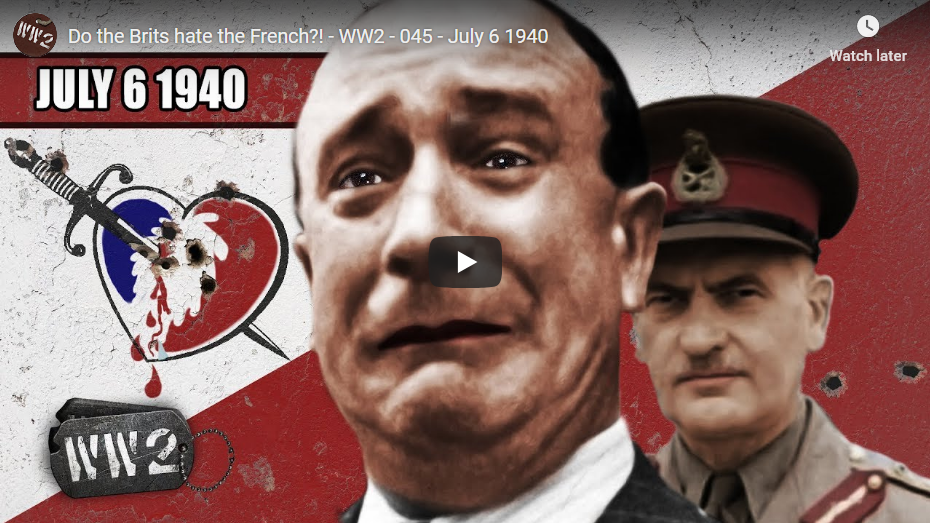
Do the Brits hate the French?! – WW2 – 045 – July 6 1940

Filed under: Africa, Britain, France, Germany, History, Japan, Military, WW2 — Tags: , , , , — Nicholas @ 04:00

World War Two
Published on 6 Jul 2019

The repercussions of the fall of France are not yet seen in full. But this week Britain makes it clear it isn’t about to give up, even if it will mean some really hard decisions.

Join us on Patreon: https://www.patreon.com/TimeGhostHistory
Or join The TimeGhost Army directly at: https://timeghost.tv

Follow WW2 day by day on Instagram @World_war_two_realtime https://www.instagram.com/world_war_t…
Join our Discord Server: https://discord.gg/D6D2aYN.
Between 2 Wars: https://www.youtube.com/playlist?list…
Source list: http://bit.ly/WW2sources

Written and Hosted by: Indy Neidell
Produced and Directed by: Spartacus Olsson and Astrid Deinhard
Executive Producers: Bodo Rittenauer, Astrid Deinhard, Indy Neidell, Spartacus Olsson
Creative Producer: Joram Appel
Research by: Indy Neidell
Post production director: Wieke Kapteijns
Edited by: Iryna Dulka
Map animations: Eastory

Colorisations by Daniel Weiss, Norman Stewart and Julius Jääskeläinen https://www.facebook.com/JJcolorization/

Eastory’s channel: https://www.youtube.com/channel/UCEly…
Archive by Screenocean/Reuters https://www.screenocean.com.

Sources:
WM: H 4610, A 3589
Narodowe Archiwum Cyfrowe
Jacques Mulard
Colorization of Göring by Klimbim
Romanian National Archives

A TimeGhost chronological documentary produced by OnLion Entertainment GmbH.

June 29, 2019

Determining who the “original” inhabitants were

Filed under: Africa, Americas, Australia, Europe, History, Pacific, Science — Tags: , , , — Nicholas @ 03:00

It’s become quite common in some countries to pay formal lip service to the “original” peoples who inhabited the land before being dispossessed of that territory by various Europeans. Actually determining who were the first human inhabitants, however, is much more fraught … you can’t exactly expiate some residual guilt of your culture by acknowledging the previous culture if the previous culture in their turn dispossessed an even earlier group, can you? How far down the rabbit hole do you need to go? Tim Worstall explains:

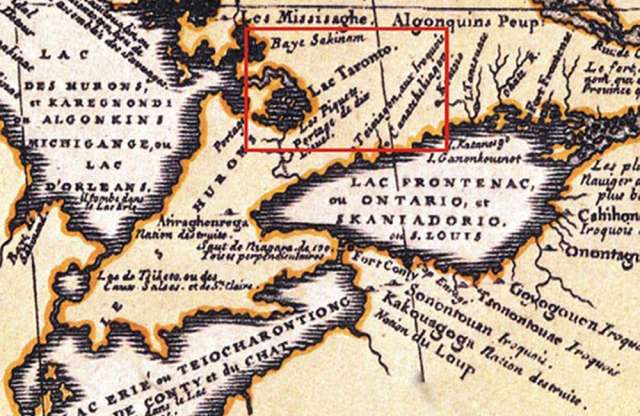
Detail from a 1688 map of western New France by Vincenzo Coronelli that locates “Lac Taronto” at Lake Simcoe.
City of Toronto Culture Division/Library and Archives Canada via the National Post

… within all that the accurate answer to “Whose land are we on?” is the land of the latest bunch of murderous bastards who killed all the previous inhabitants. Perhaps moderated to say the peeps who killed all the previous men then dated the remaining womenfolk. Because once we’ve got past that nullius stage that’s the way it has been. The Moriori are in short supply these days on the Chatham Islands given that the Maori decided to eat them.

The original inhabitants of the British Isles, the Beaker Folk, were entirely replaced by the next lot, the Iron Age Celts and similar. The Angles displaced to the west the Romano Celts in their turn, detailed DNA studies showing rather more of the female side of the R-C’s bred into the new population than the male. The Franks weren’t indigenous to France, the Allemani to Germany, the Turks to Turkey.

In fact, we’ve between little and no proof that the varied Amerinds were the original inhabitants of the lands where the White Europeans found then from 1492 onwards. In the case of both the Incas and Aztecs as political powers, proof they weren’t. And horses and Plains Indians simply weren’t a thing until the Eurasian horse was introduced post 1492.

Basically, this is indeed true. Anywhere is the possession of simply the last group of people to have slaughtered, or outbred, the previous group.

An interesting observation – if we apply the oft stated Americas example elsewhere, that Whitey stole it all and should give it back, then the Bantu should be back in Nigeria and Central Africa returned to the Pygmies, Southern to the Khoi San. We don’t say that and for the life of me I can’t work out why.

June 22, 2019

The African Continental Free Trade Area (AfCFTA)

Filed under: Africa, Business, Economics, Government, USA — Tags: , , , — Nicholas @ 05:00

Alexander Hammond explains why a free trade deal among many African nations is good news for the United States and other non-African nations:

2018 map showing the African countries involved in the African Continental Free Trade Agreement.
Dark green indicates ratification, medium green are countries that signed in March 2018, and light green are countries that signed in July 2018 but did not ratify the agreement immediately.
Map by Themightyquill at Wikimedia Commons.

The poorest continent in the world is about to lend a hand to the United States. Last week, Africa implemented the world’s largest free-trade area, and that’s great news for American foreign policy. Back in December, U.S. National Security Advisor John Bolton unveiled a plan for the Trump administration’s titled the “Africa Strategy.”

The plan is simple — the United States will give less aid to Africa, instead prioritizing enhancing America’s “economic ties with the region.” Now that many African nations have unified under a single market, trading with the continent will become far easier — and a trade deal between the United States and Africa would help out everyone involved.

Streamlining Trade

The African Continental Free Trade Area (AfCFTA) trade deal officially came into force on May 30, a month after it reached the twenty-two-nation threshold needed to do so. Now, tariffs on 90 percent of the goods traded among AfCFTA member states will be removed — a move that, according to the UN, will boost intra-African trade by 52 percent in only a few years.

Given the United States’ new plans for the continent, the AfCFTA’s member states aren’t the only economies that will reap the benefits of an African single market.

A key component of the Trump administration’s Africa Strategy is to advance “U.S. trade and commercial ties” with Africa by creating “modern comprehensive trade agreements.” A single African market will be a far simpler trade partner for America. Now, only one set of trade deals will need to be negotiated with the AfCFTA — as opposed to fifty-five intricately-crafted trade deals with each small African economy. The U.S. Trade Representative has even released a report noting how time-consuming and costly it is to negotiate trade deals with each African nation. Because trade deals are long and expensive processes, creating a solitary trade deal with the AfCFTA will keep more money in the U.S. government’s purse.

June 5, 2019

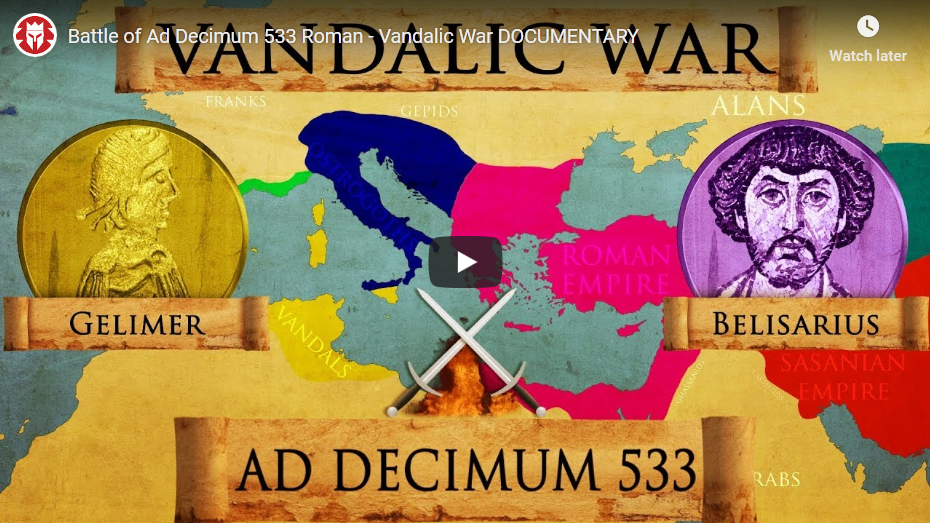
Battle of Ad Decimum 533 Roman – Vandalic War Documentary

Filed under: Africa, History, Military — Tags: , , , — Nicholas @ 04:00

Kings and Generals
Published on 12 Nov 2017

Although Belisarius, the best general of the Roman Emperor Justinian, had earned a significant victory over the Sassanids at the battle of Dara in 530, the restoration of the empire was just starting. The empire’s western lands were under Vandalic control and Justinian was eager to get them back. He sent Belisarius to Africa to deal with the Vandals. Two battles – Ad Decimum and Tricamarum – were central in this campaign.

Previous video within this series – Battle of Dara 530: https://www.youtube.com/watch?v=9GR_V…

Support us on Patreon: http://www.patreon.com/KingsandGenerals or Paypal: http://paypal.me/kingsandgenerals

We are grateful to our patrons, who made this video possible: Koopinator, Daisho, Łukasz Maliszewski, Nicolas Quinones, William Fluit, Juan Camilo Rodriguez, Murray Dubs, Dimitris Valurdos, Félix Gagné-Dion, Fahri Dashwali, Kyle Hooton, Dan Mullen, Mohamed Thair, Pablo Aparicio Martínez, Iulian Margeloiu, Chet, Nick Nasad, Jeyares, Amir Eppel, Thomas Bloch, Uri Sternfeld, Juha Mäkelä, Georgi Kirilov, Moe Mia, Daniel Yifrach, Brian Crane, Muramasa, Gerald Tnay, Hassan Ali, Richie Thierry, David O’Hare, Christopher Commins, Chris Glantzis and Mike.

The script was developed by our friend DismountedCentaur. His help with the research was essential for this documentary.

This video was narrated by good friend Officially Devin. Check out his channel for some kick-ass Let’s Plays. https://www.youtube.com/user/Official…

The Machinimas for this video are created by one more friend – Malay Archer. Check out his channel, he has some of the best Total War machinimas ever created: https://www.youtube.com/user/Mathemed…

May 23, 2019

The early days of the S.A.S.

Filed under: Africa, Britain, History, Middle East, Military, WW2 — Tags: , , — Nicholas @ 04:00

Lindybeige
Published on 31 Oct 2017

One of the world’s most famous regiments was nearly disbanded after one disastrous mission.
Support me on Patreon: https://www.patreon.com/Lindybeige

I forgot to say that David Stirling was twenty-five years old when recovering from his injury and dreaming up the future SAS. Within two years, all the major airfields within 300 miles of the front had been raided by the SAS, some of them up to four times.

The camouflage used on the vehicles of the LRDG, and later the SAS, was rose pink and olive green, and by all accounts it worked very well.

Main sources: SAS Rogue Heroes by Ben Macintyre, Eastern Approaches by Fitzroy Maclean.

Lindybeige: a channel of archaeology, ancient and medieval warfare, rants, swing dance, travelogues, evolution, and whatever else occurs to me to make.

▼ Follow me…

Twitter: https://twitter.com/Lindybeige I may have some drivel to contribute to the Twittersphere, plus you get notice of uploads.

website: http://www.LloydianAspects.co.uk

May 19, 2019

Siege of Vienna & Queen Nzinga – Lies – Extra History

Filed under: Africa, Europe, History, Religion — Tags: , , , , , , — Nicholas @ 06:00

Extra Credits
Published on 18 May 2019

Writer Rob Rath talks about all the cool stories and facts we didn’t get to cover in our two special short series on the Siege of Vienna, and the life of Queen Nzinga.
Join us on Patreon! http://bit.ly/EHPatreon

From the comments:

Extra Credits
Timestamps:
2:00 – Demonetization sucks. THANK YOU PATRONS!
7:15 – Istanbul was Constantinople now it’s Istanbul not Constantinople been a long time gone oh Constantinople
11:07 – the arrival of the Winged Hussars wasn’t exactly the same as Rohan answering Gondor’s call for aid
16:20 – Nzinga’s controversial role in slavery
19:25 – what’s next on Extra History?
21:02 – SIX DEGREES OF WALPOLE

Recommended reading:
The Enemy at the Gate: Habsburgs, Ottomans, and the Battle for Europe by Andrew Wheatcroft
The Siege of Vienna: The Last Great Trial Between Cross & Crescent by John Stoye
Hispanics and the Civil War: From Battlefield to Homefront by the National Park Service

Music videos:
Queen Nzinga: https://www.youtube.com/watch?v=N94H6F0WObc

Siege of Vienna: https://www.youtube.com/watch?v=jQ_HV57cgbg

May 17, 2019

The EU’s trade distortions harm African farmers in many ways

Filed under: Africa, Economics, Europe — Tags: , , , — Nicholas @ 05:00

One of the unifying themes of the European Union is its dedication to farm subsidies, which are very popular among some European farmers. EU farming subsidies and trade policies also do significant measurable harm to African farmers:

spiked: How does the EU harm African economies?

Sam Akaki: Thanks to the EU’s Common Agricultural Policy, which heavily subsidises EU farmers, Africa’s markets are flooded with their cheap excess produce. If you go to any African market, you can buy all kinds of European produce sold at very, very cheap prices. This is driving African farmers out of the market. At the same time, the EU imposes strict limitations on what African countries can export to the European market. In particular, African farmers cannot export value-added goods. So if a farmer in Ghana is producing cocoa, or a farmer in Kenya is producing coffee, they can perhaps get less than a dollar for their product as they have to export it raw. Only a fraction of the money you pay for a jar of coffee goes to an African farmer. The value-added goods, such as processed coffee, are then produced in Europe. Germany, especially, has been doing a lot of harm.

EU lobby groups and NGOs are not working in the interests of Africa and are opposed to African attempts to get themselves out of poverty. For instance, many African farmers work with genetically modified (GM) crops. One of the big issues about GM food is that Western companies sell GM seeds that don’t produce new seeds for the next season. Farmers have to go back to companies like Monsanto every year. In Uganda, at the Kawanda Agricultural Research Institute, scientists have been working on their own way of producing local GM seeds that will be reusable each year. Europe is against this and tries to stop it.

[…]

spiked: How have EU sanctions affected Africa?

Akaki: The clearest examples are Zimbabwe and Eritrea. Of course, these countries have human-rights issues. But human rights are a question of development. Countries go through developmental stages. There would have been enormous human-rights abuses in Europe 100 years ago. The UK and the EU use their influence selectively to impose economic and diplomatic sanctions on African countries. We should follow a consistent policy. We impose sanctions on African countries but we are happy to trade with other human-rights abusers like Saudi Arabia. One danger is that these sanctions are driving African countries closer and closer into the arms of the Chinese. This is a real own goal.

Sanctions are a blunt instrument. The leaders responsible for human-rights abuses are protected. They still have access to the best lifestyles money can buy. Their money is stashed away in British and other foreign banks. Sanctions don’t touch them at all. Instead, they hit the poorest hardest. Sanctions are directly contributing to poverty and mass migration. We should promote human rights, certainly, but we shouldn’t use human rights to punish the very poorest.

May 13, 2019

“[T]he most famous Zulu word on the planet was invented by a New York socialist in 1951”

Filed under: Africa, History, Media, USA — Tags: , , , — Nicholas @ 05:00

I had no idea there was so much back-story to the song “The Lion Sleeps Tonight” aka “Wimoweh” aka “Mbube”, which had managed to be a hit for groups as diverse as Tight Fit, Robert John, the Tokens, the Weavers, Ilonka David-Biluska, Henri Salvador, and others:

Those words about “the jungle, the mighty jungle” sit so perfectly and indivisibly on those notes they sound like they’ve belonged to each other for all time. We know the lyric is George Weiss’, but where did the tune come from?

Well, it’s obvious, isn’t it? It was a “Zulu chant” — ie, “traditional – ie, “anonymous” — ie, out of copyright. Which meant someone else could put it back in copyright. In the Fifties and early Sixties, public demand for “authentic” “traditional” music created a huge windfall for savvy Tin Pan Alleymen. You take some half-forgotten folk dirge, tweak it here and there, and then copyright your version as a full-blown composition in its own right. Everyone was doing it: in the Fifties, “Frankie And Johnny”, “Auld Lang Syne”, “Greensleeves” and a bunch of other things that had been around forever were being copyrighted as brand new songs. Huge and Luge had done it with “Can’t Help Falling In Love”, né “Plaisir d’Amour“. So the first thing they wondered, when the Tokens showed up and began doing their Zulu impressions, was where did this “Wimoweh” thing come from anyway? They looked at the song credits: “Paul Campbell” and “Albert Stanton”.

Bingo! There was no such “Paul” and no such “Albert”. Mr “Campbell” was the name Pete Seeger and the Weavers would put on the sheet music when they’d recorded a folk tune and decided they’d like to cut themselves a piece of the songwriting action. And Mr “Stanton” was the name Al Brackman at the Richmond publishing house put on the music when he wanted to do the same for his bank account. Messrs “Campbell” and “Stanton” thus became successful mid-20th century songwriters who apparently hadn’t written anything since the mid-19th century. So the minute Huge and Luge saw those names on “Wimoweh” they knew it was a plum just ripe for a second picking. If it ever came to court, Huge, Luge and George Weiss’ defense would be yes, they’d plagiarized it not from Campbell & Stanton but from the same 19th century Zulu natives Campbell & Stanton had plagiarized it from. And, because Pete Seeger, the Weavers and the Richmond organization well understood that, they never did bring it to court. So there are two entirely separate mid-20th century pop songs by two entirely separate writing teams, one called “The Lion Sleeps Tonight”, the other called “Wimoweh“.

[…]

In South Africa, it was huge. “Mbube” became not just the name of a hit record but of an entire vocal style — a high-voiced lead over four-part bass-heavy harmony. That, in turn, evolved into “isicathamiya“, a smoother vocal style that descended to Ladysmith Black Mambazo and others, taking its cue from the injunction “Cothoza, bafana” — or “tread carefully, boys”. That’s to say, Zulu stomping is fine in the bush, but when you’re singing in dancehalls and restaurants in you’ve got to be a little more choreographically restrained, if only for the sake of the floorboards.

“Tread carefully, boys” is good advice for anyone in the music business. A few years after Solomon Linda and the Evening Birds made their hit record, it came to the notice of Pete Seeger, on the prowl for yet more “authentic” “traditional” “vernacular” “folk music” for the Weavers to make a killing with. He misheard “Mbube” and transcribed it as “Wimoweh“. That’s a great insight into the “authenticity” of the folk boom: the most famous Zulu word on the planet was invented by a New York socialist in 1951

May 6, 2019

Queen Nzinga – The Double Queen – Extra History – #2

Filed under: Africa, History, Military, Religion — Tags: , , , — Nicholas @ 06:00

Extra Credits
Published on 4 May 2019

Nzinga was briefly, temporarily supplanted by Ngola Hari who had been installed by the Portuguese, but she was determined to let nothing get in the way of keeping West Africa safe from colonial powers. To achieve this end, she would go on to form — and break, as she pleased — alliances with the Dutch, the Imbangala, and even the Catholic Church!

Thanks again to Cassandra Khaw for guest-writing this mini-series!

Join us on Patreon! http://bit.ly/EHPatreon

From the comments:

Extra Credits
Queen Nzinga is a woman who, despite being one of the best-documented rulers in early modern Africa, still presents a puzzle. Her record, from ambitious noble, to guerrilla fighter, to consummate diplomat and religious reformer is still haunted by myths conjured up by her enemies — and a few constructed by Nzinga herself.

Catch our Lies episode next week for behind-the-scenes on our research for the Siege of Vienna and Queen Nzinga series!

May 3, 2019

Musgrave 9mm: A Gun for the Black Market

Filed under: Africa, History, Law, Technology, Weapons — Tags: , , , , — Nicholas @ 02:00

Forgotten Weapons
Published on 27 Mar 2019

http://www.patreon.com/ForgottenWeapons

Cool Forgotten Weapons merch! http://shop.bbtv.com/collections/forg…

In the brief couple of years between the election of a new black-majority government in South Africa in 1994 and the dissolution of the Musgrave company, it attempted to produce a new 9mm pistol to sell to the burgeoning market of black South African citizens buying handguns. Ownership of pistols by black citizens had been legal under apartheid, but was (not surprisingly) quite uncommon – this began to change in 1994. The most popular pistol at the time was the Norinco 213 Tokarev in 9x19mm, which was available in large numbers and at very low cost.

To compete against this, Musgrave designed a simple blowback, polymer framed pistol chambered for 9x19mm using Beretta 92 magazines (which Musgrave had a large supply of, being the licensed Beretta distributor in the country). The gun was extremely simple, held together with a handful of screws and using a single-action-only hammer-fired mechanism. It was a commercial flop, however — unable to match the quality and price combination of the Tokarev and only about 500 were made in 1995 and 1996.

Contact:
Forgotten Weapons
PO Box 87647
Tucson, AZ 85754

April 29, 2019

Queen Nzinga – Rise of a Legend – Extra History – #1

Filed under: Africa, Europe, History, Military — Tags: , , , — Nicholas @ 06:00

Extra Credits
Published on 27 Apr 2019

Nzinga didn’t start out as a queen — but when she saw how incompetently her brother was running affairs in Ndongo (what would become Angola), she took advantage of his decision to send her to negotiate with the Portuguese — much to his grief later. Nzinga established herself against colonial forces and did not budge.

Queen Nzinga of the Ndongo and Matamba Kingdoms, a scion of the Mbundu people, will spend forty years standing between the Portuguese and their ambitions, using everything at her command — her cunning, her ruthless intellect, her military acumen, even the bodies of her people — whatever it takes to succeed.

Thanks again to Cassandra Khaw for guest-writing this mini-series!

Join us on Patreon! http://bit.ly/EHPatreon

April 13, 2019

“UN peacekeeping is a bad joke”

Filed under: Africa, Cancon, Military — Tags: , , , — Nicholas @ 03:00

Ted Campbell discusses a recent report that takes Canada to task for Canadian peacekeeping efforts that don’t match those of poorer nations, especially in Africa:

I’m sorry to burst Mr. Oliphant’s bubble, but most UN peacekeeping, especially that done by Africans in Africa, is a farce. There are HUGE Afro-Asian forces deployed under the UN’s banner because, mainly, the UN pays a nation $(US)1,400+ per month for each soldier wearing a blue beret, but, the BBC reports that “Countries are paid to provide personnel to UN missions and the top countries providing troops are unrepresentatively poor. The amount countries are paid for providing those troops is considerably higher than the average wage in most of the countries sending large numbers of troops.”

In other words many (I would say most) African countries and some Asian countries send lots of poorly paid, ill-trained, unprofessional, second or third rate troops to the UN to serve as peacekeepers in what is essentially a profitable commercial transaction. Let’s use Rwanda, a country about which Mr. Oliphant knows and cares, as an example: some sources say that a Rwandan worker, on average, earns about $(CA)295.00 per month, some estimates are lower, only about $(CA)120.00 per month. Let’s guess that a typical Rwandan soldier, not one of the colonels or generals … is paid something in between those two numbers, say, at a guess, $(CA)205.00 ($(US)154.00) per month. That means that every month the Rwandan government pockets almost $(US)1,275.00 ($(US)1,428.00 – $(US)154.00) for each soldier it deploys, and, in early 2019, Rwanda has over 6,000 soldiers on UN peacekeeping duties, that means it gets over $(US)90 Million ($(CA)120+ Million) every year. In 2016/17 Canada sent about $(CA)25 Million to Rwanda in direct aid, so, for Rwanda, sending soldiers to UN peacekeeping missions garners almost five times as much money as Canada sends in aid.

Rwanda is not the biggest provider of cannon fodder peacekeepers to the UN. Ethiopia sends over 8,000 soldiers, India sends almost 7,500 (who are well trained, very well led, professionals) and Pakistan sends over 7,000 (also quite well trained) while Bangladesh (6,700+) and Rwanda (6,100+) round out the top 5 troop providing nations.

Back in the 18th century, a small and poor European nation earned significant amounts of foreign money by renting out units of its army. Americans may remember the Hessians, although I suspect few of them knew anything more about them than that they were working for the British crown and most of them didn’t speak much (if any) English. The UN has managed to re-create the same conditions of the 1700s in the modern world. Nice going, UN. What’s next? Plagues? (Oh, wait … they’ve already done that one.)

April 2, 2019

The not-so-ancient extinction of Madagascar’s megafauna

Filed under: Africa, Environment, History, Science — Tags: , , , , — Nicholas @ 03:00

At The Conversation, Nick Scroxton, Laurie Godfrey, and Stephen Burns discuss their new theory on the megafauna extinction in Madagascar just over a thousand years ago:

Giant 10-foot-tall elephant birds, with eggs eight times larger than an ostrich’s. Sloth lemurs bigger than a panda, weighing in at 350 pounds. A puma-like predator called the giant fosa.

They sound like characters in a child’s fantasy book, but along with dozens of other species, they once really roamed the landscape of Madagascar. Then, after millions of years of evolution in the middle of the Indian Ocean, the populations crashed in just a couple of centuries.

Scientists know that over the past 40,000 years, most of Earth’s megafauna – that is, animals human-size or larger – have gone extinct. Woolly mammoths, sabre tooth tigers and countless others no longer roam the planet.

What’s remarkable about the megafaunal crash in Madagascar is that it occurred not tens of thousands of years ago but just over 1,000 years ago, between A.D. 700 and 1000. And while some small populations survived a while longer, the damage was done in a relatively short amount of time. Why?

Over the last three years, new investigations into climate and land use patterns, human genetic diversity on the island and the dating of hundreds of fossils have fundamentally changed scientists’ understanding of the human and natural history of Madagascar. As two paleoclimatologists and a paleontologist, we brought together this research with new evidence of megafaunal butchery. In doing so we’ve created a new theory of how, why and when these Malagasy megafauna went extinct.

Many of the forests that originally existed on Madagascar are now replaced by more open, human-modified landscapes, like this palm savanna at Anjohibe.
Laurie Godfrey, CC BY-ND

March 25, 2019

Battle of Ecnomus (256 BC) – Largest Naval Battle in History

Filed under: Africa, Europe, History, Military — Tags: , , , , , , — Nicholas @ 02:00

Invicta
Published on 12 Sep 2016

The Battle of Ecnomus in 256 BC is arguably the largest naval battle in history with 680 warships and an estimated 290,000 rowers and marines participating! This monumental clash was fought during the First Punic War between Rome and Carthage along the coast of Sicily.

Fleet Anatomy: https://www.youtube.com/watch?v=7PhRp…
Fleet Operation: https://www.youtube.com/watch?v=397-i…
Fleet Tactics: https://www.youtube.com/watch?v=VOc8m…

More Classical Antiquity Documentaries: https://www.youtube.com/playlist?list…

Literary Sources:
Uniforms of the Roman World by Kevin Kiley
Republican Roman Warships by Osprey Publishing
The Fall of Carthage by Adrian Goldsworthy
Augustus by Anthony Everitt

Game Engine:
Total War: Rome II

Game Mods:
Devide et Impera
Realistic Ship Colors
Ave_Gigas.pak

From the comments:

Invicta
2 years ago
It has been a real pleasure to research and produce the documentary series on the Roman Navy. This video is a culmination of that exploration into the little-covered world of ancient naval combat which I hope has been equally enlightening and entertaining. It is also worth mentioning that the battle maps I created for this video individually show the 680 vessels from both sides. Though this was painstaking to do, it was worth it to convey the insane scale of this encounter at sea.

I’d also like to point out that I tried using new effects in this video. I will continue to try new styles and adapt my presentations in the future and greatly appreciate any and all feedback. Thank you all for your support and help thus far. Its a true joy to have an audience for this passion of mine : )

« Newer PostsOlder Posts »

Powered by WordPress