
I don’t think it’s a stretch to say that Mark Carney wouldn’t be Prime Minister without the active connivance of Donald Trump. Using the Bad Orange Man to whip up the thoroughly propagandized Boomer Elbozos has been Carney’s most successful play since arriving in Ottawa. With the enthusaistic support of the presstitutes of the Canadian relic media, all Carney needs to do to deflect any bad news is to mention the name and the elbows start flapping in unison:
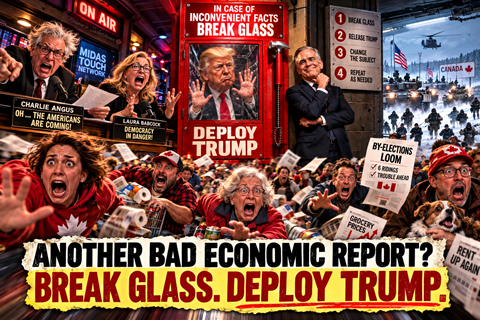
AI-generated image from Melanie in Saskatchewan
Dear Prime Minister Carney,
Enough the crap already. Just stop it and tell your caucus MPs to knock it off too. Canadians deserve better. I, along with most Canadians I talk to, are genuinely disgusted by what Canadian politics has become.
Let me start with something that apparently now requires a disclaimer before common sense is permitted into the room: yes, the Canadian government should prepare for catastrophes, whether that’s war, cyberattacks, pandemics, natural disasters, terrorism, economic shocks, asteroids and comets or, hell, even an alien invasion. Governments are supposed to think about things the rest of us would reasonably file under “probably never going to happen”, including scenarios so unlikely that everybody involved hopes the planning exercise ends up gathering dust forever. That is called governing.
But there is an enormous difference between quietly preparing for an extreme possibility and irresponsibly putting that possibility in front of Canadians until people start wondering whether they should be watching the southern horizon for tanks.
And apparently we are doing the latter now.
You called the possibility of American military action against Canada an “extreme tail risk”. In other words, something considered extraordinarily unlikely but potentially catastrophic.
Fine, plan for it then. War-game it if you like. Put it in a binder thick enough to stop a bullet and lock it in whatever filing cabinet governments use for scenarios involving asteroid strikes, alien invasions and somebody successfully explaining the federal tax code.
But why are ordinary Canadians being invited into this particular nightmare? Especially now?
Because while everybody is staring south waiting for Donald Trump’s army to parachute into Canada, something considerably less hypothetical is happening right here.
The Canadian economy isn’t exactly bounding through the meadow with a ribbon in its hair like you touted, now, is it And guess what’s actually more interesting?
On June 3, you stood in the House of Commons defending Canada’s economic performance and told Pierre Poilievre that if he wanted an answer, he could “ask the OECD”, which was forecasting Canada to have the second-strongest G7 economy that year and the next.
Finance Minister François-Philippe Champagne invoked the OECD forecasts too. The OECD had become something of an international report card pinned proudly to the Liberal refrigerator. You touted it as proof “the plan is working!”
Then September arrived.
I’ve been saying for quite some time that Carney genuinely doesn’t want and wouldn’t accept a trade deal with the Trump administration, no matter how much it will cost Canadians (and since his family and personal wealth is more than 90% in the United States, it’ll cost him nothing at all personally). Even so, this seems to be a position from which there is no eventual “victory”, no chance to recoup the lost economic opportunities, there is nothing to “win” here. So, aside from theorized anti-Trump animus, why has Carney chosen this path? In a long essay, Upper Canadian Cavalier suggests some fascinating yet unsettling reasons that aren’t at all tied to Canadian interests:
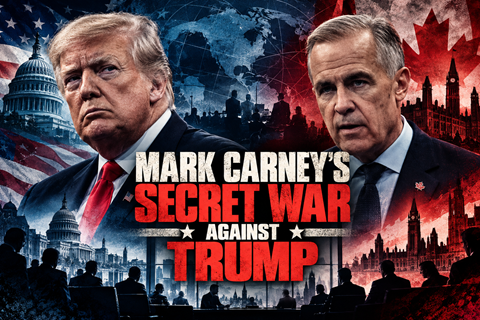
AI-generated image from Upper Canadian Cavalier
To ask who Mark Carney is working for, you first have to be willing to look at the real nature of the Canada-US relationship, the one that no one in a position of power above would dare articulate.
Set aside the picture of the United States as the friendly giant next door, the trading partner, the ally with the shared border and the shared anthem at the hockey game. That picture is a courtesy. What sits below us is an empire, in the oldest and most exact sense of the word, and it does not rule the way the older empires ruled. Rome ruled through legions, garrisons, roads, and the physical occupation of ground. The American empire rules through the things that move without an army. It is an empire of covert softpower most of whose subjects are blissfully unaware of their subordinate position. That empire maintains control through the currency the world prices its oil in. The payment rails every bank on earth must touch. The studios and platforms that manufacture what a hundred nations find funny and frightening and true. The defence umbrella that quietly turns an independent foreign policy into a luxury most of its members decline. The foundations and the NGOs that decide which causes are respectable and which are fringe. The universities whose faculties set the terms of every argument before a single voter ever hears it. It lets its provinces keep their flags. It lets them keep their anthems and their parliaments and their little ceremonies of self-government, because none of that costs the metropole a thing, and a province that believes it is a country is far easier to manage than one that knows it is a province.
On that map, Canada is not a neighbour. Canada is the richest province in the entire system. Wealthier than nearly all of them, wired more directly into the centre than any of them, sharing the longest border, the deepest supply chains, and the most complete cultural merger of any territory the empire holds. Most provinces of an empire sit at a distance from it. We are plugged straight into the board. Southern Ontario is closer to the beating heart of that system than West Virginia is, and it has been for fifty years.
I recall hearing the term “branch plant economy” from when I first started paying attention to the news: it was a standard refrain in any discussion of Canadian industry from at least the 1960s and probably going back much further than that … because a lot of US companies did set up small manufacturing operations in Canada to avoid paying duty and taxes for shipping products across the US-Canadian border.
But the same was at least as true about cultural issues:
Once you see the country this way, something that has nagged at you for years finally has a name. You have noticed, surely, that our politics feels like a rerun. That the arguments arrive already formed, six months late, dubbed into Canadian. The slogans on the placards, the list of what counts as controversial, the shape of every fight, all of it seems to come pre-packaged from somewhere south of here, keyed to institutions and a history that are not ours. The Canadian left takes its vocabulary and its enemies from the American left. The Canadian right does the same in the other direction. To argue about any of it from outside the imported frame, to counter-signal the entire American script, is treated in this country as something close to blasphemy. That is what it is to be a province. The metropole ships the politics, and the province stages the show.
One of the claimed advantages of the negotiations leading up to the first general free-trade agreement between Canada and the United States was to eliminate as much as possible of the cross-border friction in trade: those duties and taxes that initially encouraged branch plant expansion. Free trade meant, at least in theory, that companies could produce their output where it made the most economic sense and serve the entire North American market more efficiently. Some of the old branch plants disappeared, while others expanded and grew to become much larger facilities. Later, as emphasis on manufacturing shifted from domestic to (cheaper) international sources, the jobs and the money moved steadily away from making things and toward providing services. This seemed to make sense in the economic calculations, but it wasn’t all sweetness and light and following Adam Smith’s philosophy:
Over forty years the American economy (and Canada’s) was reorganized so that the money flowed away from the people who make things and toward the people who arrange things. Factories went abroad. Finance stopped being a utility that funded industry and became the industry. A whole class came up in the gap between those two facts: the asset managers, the consultancies, the compliance shops, the climate-finance desks, the private equity partners. Men whose income arrives not from building anything but from standing between someone’s labour and someone’s capital and charging a toll on the traffic.
Intermediation, in the polite register. Skimming, if you want the shorter word.
It is very good money. It also has requirements. Open borders for goods and capital. A regulatory thicket dense enough that only the largest players can afford the guides through it. And a political class that treats all of it as weather rather than policy.
Then 2016, and worse, 2024.
Trump is a realignment. Tariffs, reshoring, open contempt for the managerial professions and the international bodies, a stated preference for the man who pours concrete over the man who writes the memo about pouring concrete. Say what you like about how he does it. The direction is unmistakable. He is dragging the American state back toward the people who work with their hands, and away from the people who take the percentage.
So that is the larger economic and political picture. Here at home, Canada has had a decade of Justin Trudeau’s clown prince act and has finally grown tired of it:
January 2025. The Liberal brand is radioactive. Ten years of Trudeau have curdled, the party is twenty-odd points down, the cycle is running hard against it and every professional in Ottawa can read the polling. A liberal man who wants a political career in Canadian politics would wait. He would let someone else absorb the defeat, sits out a term, and comes back clean in 2029 as the saviour of a rebuilt party. That is the obvious play and any political operator in town knows it.
Carney jumped in anyway.
When somebody takes a deal that looks bad, don’t ask him what it cost. Ask him what he is buying instead. Because Carney was not making a shrewd pivot towards a political career. On the arithmetic available in January 2025 he was buying a short ugly premiership, taking a run at Kim Campbell’s record and he went for it anyway.
What the office did offer, immediately and uniquely, was a seat at the table opposite Donald Trump. Not commentary. Not a column in the Financial Times. A state. Tariff authority, a negotiating team, a G7 chair, standing with Brussels, and control of one of the few economies wired deep enough into the American one to actually hurt it.
[…]
[Carney] is not governing this country. He is occupying it.
When Caesar took Rome, Pompey and the Senate did not surrender. They crossed to Greece, and there they raised what he could and kept the war going from the provinces, because their faction lost the capital but did not want to stop fighting and submit to reforms that would permanently alter the lucrativeness of their rent seeking ways. So they relocated their base of operations to continue the war abroad instead.
They lost Washington. So they reorganized the resistance in the most valuable province they had, the one already theirs, and they garrisoned it with a man of their own class who needed no persuading at all. Nobody had to recruit him. He was already one of them, and the province came with the office.
Pompey’s people in Greece were not a band of exiles, and this is the part worth understanding. They were the Senate. The lawful government of Rome, in their own account, operating in exile with its own command and its own coinage, entirely convinced that they were Rome and that the man sitting in the city was a usurper. They were also, by any honest reading, a rich and deeply corrupt class defending its own holdings, and they could hold both of those things in their heads at once without difficulty.
That is the mind of Carney’s class exactly. They are not insurgents. They think of themselves as the rightful order who have temporarily been displaced by a vulgar interloper, waiting it out in the provinces and administering what is still theirs in the meantime.
The parallel runs the other way too, and it is not flattering to the Senate. Caesar’s support was real and it was popular. The opposition to him was a wealthy class protecting its rents and calling that protection a defence of the republic. There was no cabal in that Senate either. There were hundreds of men, each convinced of his own righteousness, each guarding his own standing, arriving at the same posture without a single meeting required. Which is why it could never be exposed, only defeated.
They also treated him as a mortal threat to the constitution before he had become one, went all in on the civil war framing, and the measures they took to stop him are what forced his hand. Prophecies of that kind have a way of fulfilling themselves.
Long time readers will know that I couldn’t possibly pass up a reference to the parallels to the late Roman Republican struggle between Caesar and Pompey.


