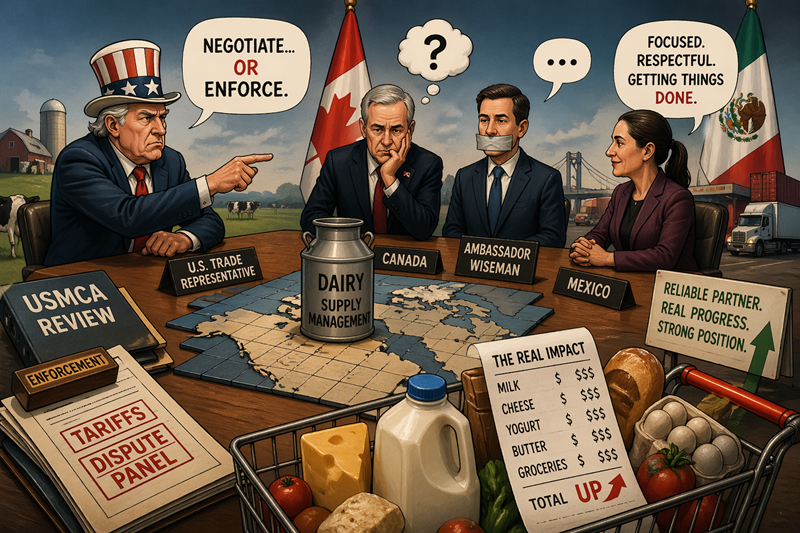
Dr. Sylvain Charlebois on the strong hints the US government has been dropping that Canada’s stance on our restrictive dairy cartel — euphemistically referred to as “supply management” — is going to be a key negotiating point in the upcoming USMCA trade negotiations:
The warning came quietly, but it was unmistakable. According to a Reuters report carried by The Western Producer, U.S. Trade Representative Jamieson Greer made it clear: Canada’s dairy dispute will be resolved one of two ways, through negotiation or through enforcement.
That is not diplomatic nuance. That is a choice.
And it comes at a delicate moment, as the review of USMCA approaches. Dairy is once again at the center of the storm. It always is. Canada’s supply management system, long defended domestically, continues to frustrate U.S. officials over limited market access. As reported by Reuters, tensions remain high around how Canada administers its tariff-rate quotas.
None of this is new. What is new is the tone.
Recent commentary out of the United States, including sharp criticisms aimed at Mark Carney, reflects a growing impatience. Some of it is political theatre. But some of it signals something more consequential, a willingness to move from negotiation to enforcement if progress stalls.
In food trade, that shift matters.
Canada’s agri-food economy is deeply integrated with the United States. This is not a casual trading relationship. It is structural. Supply chains cross the border multiple times before products reach consumers. Roughly three-quarters of Canadian agri-food exports still head south. You do not casually antagonize the market that anchors your value chain.
The critique coming from voices like Brian Switzer, however undiplomatic, boils down to a familiar expectation. Canada should act like a predictable partner. Not subordinate, but steady. When that perception erodes, the consequences are rarely immediate. They emerge later, in tighter border controls, procurement shifts, or dispute panels.
And eventually, in prices.