
The Korean War by Indy Neidell
Published 24 Feb 2026The tensions at Koje-do POW camp explode this week, ending in heavy bloodshed as UN forces desperately try to wrestle control of the situation. Changes will need to be made to counter the growing threat of disorder, and fast. Elsewhere, the Communist forces are on the attack this week, both in the field and through diplomatic channels, as a naval invasion of Yang-do launches and accusations of biological weapons ramp up.
00:00 Intro
00:44 Recap
01:13 Compound 62
04:44 Yang-do Island
07:45 Biological Warfare
09:55 Supervisory Committee
12:22 Notes
13:16 Summary
13:27 Conclusion
14:13 Call to Action
(more…)
February 25, 2026
The Korean War Week 88: Riot or Revolution? – February 24, 1952
Comments Off on The Korean War Week 88: Riot or Revolution? – February 24, 1952
“Allyness” in the British military
I suspect anyone who has spent time in uniform out in the field (peacetime or wartime) would recognize these traits, but so far as I know only the British army and Royal Marines have a specific term for it:
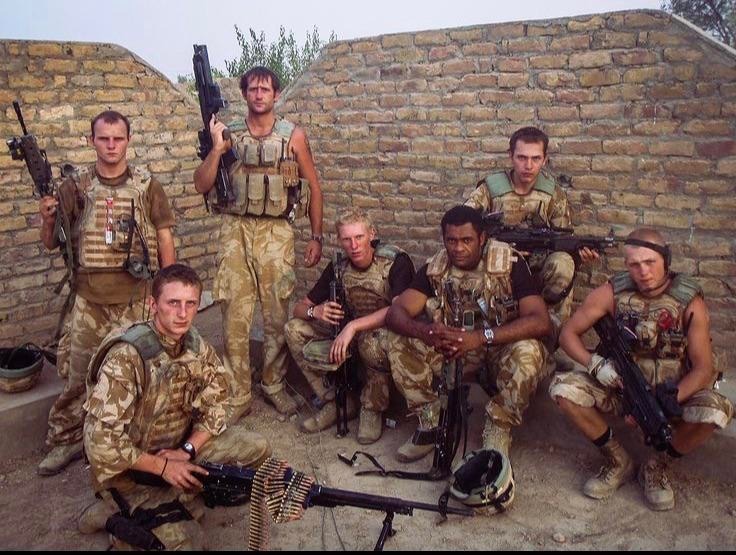
(British troops in Afghanistan, 2008, looking very ‘ally’)
Photo and caption from Combat Threads
Professor Andrew Groves is one of the few true academic experts on menswear. In fact, it was his work as the Director of the Westminster Menswear Archive that inspired me to pursue my Costume Studies MA. Recently, he has started a weekly Substack that is well worth checking out. Last week, he wrote an essay on “Ally“, a British military slang term. What exactly “Ally” is can be hard to nail down, as it has no comparable terms in the US military or civilian cultures. Broadly, it can be described as a language of visual signifiers that denote a soldier as “having been there”, or at the very least, wanting to come across that way, usually by modifying pieces of kit, or wearing it in a particular fashion.
As Groves puts it, “The quiet discipline of looking ready. It is a system that emerges precisely when regulation lags and consequences move faster than command … Allyness was awarded horizontally, not issued from above. It was recognition from peers who knew what to look for.” Groves continues:
That recognition lived in detail, but it was never a checklist. Allyness was built through small, cumulative acts, field-smart adjustments passed down through units, not rulebooks: cutting down webbing to reduce snagging, taping over buckles to kill shine, shaping berets tight to the temple, sewing in map pockets, blacking out brass, marking kit discreetly. None of this was required. All of it mattered, because it signalled experience rather than purchase.
While the origins of “ally” definitely had roots in field-wise functionality and competence (the widespread adoption of Bundeswehr boots by British Paras or the “norgi” baselayer adopted by RM Commandos come to mind), by the time the GWOT generation were forming their own sense of “allyness”, much had devolved to style. I am going to quote from Simon Akam’s wonderful book The Changing of the Guard: The British Army Since 9/11, on the evolution of “ally” in the 21st Century:
“Ally” is rifle magazines taped together — it draws inspiration from films as well as finding exhibition through the same medium. Ally is beards. Ally is non-regulation scarves and shemagh cloths. Ally is belts of 7.62mm link machine-gun ammunition draped over shirtless muscled torsos. Ally is liberal use of sniper tape on bits of kit, scrim netting pulled taut over the issued helmet, or “hero sleeves” — sleeves rolled only halfway up the forearm. A strong influence, ironically given the outcome of that conflict, is Vietnam … Of course, the two quantities of violence and ally are entwined. Fighting is ally. It seeps into Iraq, too: Major Stuart Nicholson, a Fusiliers officer serving on an exchange post with the Anglians in Basra in 2006, sees one sub-unit who keep one set of totemic combats [field uniform] to wear every time they go out on patrol, regardless of how dirty and disgusting they become. Nicholson catches one of this crew deliberately driving a Warrior armoured vehicle over a helmet cover to make it look already battered.
Later in the book, Akam recounts the “ally” origins of the British Army’s adoption of a Crye designed variant MultiCam (named Operation Peacock). The need for a new camouflage pattern was practical: British troops in Afghanistan found their DPM uniforms coming up short, and it was also based on seeing American SOF using MultiCam. I think that best illustrates the push and pull of what makes something “ally”. Some “allyness” traits can be seen as battlewise modifications to equipment, like taping down loose straps or added helmet scrim to help break up the silhouette, while others can be affectations that soldiers think look cool. And often, a bit of both.
Like anything to do with the infantry, of course, it can be taken too far and rather than improving effectiveness in the field, it can lead in very unwelcome directions:
These kinds of regulation-flouting practices can be interpreted as signs of a breakdown in unit discipline, which, in turn, can lead to more serious issues. It isn’t exactly “broken windows” theory for military units, but it also kind of is. It’s why, when Akam tells a story of an American officer who visited a British base in Afghanistan in 2006 and remarked that the British soldiers “look like our army at the end of Vietnam”, It was not meant as a compliment. Elsewhere, the desire to be “ally” led to armored vehicles flying English flags (despite its local connotations to the Crusades being an issue) and SS decals on other vehicles. “Allyness” can be a sign of the unit culture going rogue.
The result was a crackdown on the excesses of “allyness”. As Akam writes, “the ally clampdown is also a knee-jerk response to a realisation that something had got out of control. Some elements of ally survive, in particular the Paras’ interest in taping up bits of their gear. That is harder to stamp down on.”
Comments Off on “Allyness” in the British military
Bommarito: America’s First Toggle-Locked Battle Rifle
Forgotten Weapons
Published 1 Oct 2025Designed by Giuseppe Bommarito, this was one of the many independent rifle designs submitted to the US War Department in the 1910s hoping for military adoption. It is a short recoil operated, toggle-locked system chambered for .30-06 and using detachable 20-round magazines. It was tested (without much success) at Springfield and remained in development until 1918.
See a more complete article including original disassembly photos here:
https://www.forgottenweapons.com/m1-g…Thanks to the Springfield Armory National Historic Site for giving me access to this truly unique specimen from their reference collection to film for you! Don’t miss the chance to visit the museum there if you have a day free in Springfield, Massachusetts:
https://www.nps.gov/spar/index.htm
(more…)
Comments Off on Bommarito: America’s First Toggle-Locked Battle Rifle
QotD: The notion of “history”
“History” is itself a fairly recent phenomenon, historically speaking. As far as we can tell, all the preliterate civilizations, and a lot of the literate ones, lived in what amounted to an endless now. I find [Julian] Jaynes’s ideas [in his book The Origins of Consciousness in the Breakdown of the Bicameral Mind] very helpful in this regard, but we don’t need him for this, because whatever the explanation, it’s an obvious fact of historiography (“the history of History”; the study of the writing of History). Herodotus and Thucydides were more or less contemporaries, but what a difference in their work! Herodotus’s “history” was a collection of anecdotes; Thucydides focused on people and their motivations; but both of them wrote in the 400s BC — that is, 2500 years ago.
We are closer in time to them than they were to the men who built the Pyramids — by a long shot — and think about that for a second. That’s the vast scope of merely literate human history. Human settlement itself goes back at least another 6,000 years before that, and probably a lot longer.
So far as we can tell, well into historical time men had no real conception of “the past”. Even those men who had recently died weren’t really gone, and again I find Jaynes useful here, but he’s not necessary; it’s obvious by funeral customs alone. They had a basic notion of change, but it was by definition cyclical — the sun rises and sets, the moon goes through its phases, the stars move, the seasons change, but always in an ordered procession. What once was will always return; what is will pass away, but always to return again.
Linear time — the sense of time as a stream, rather than a cycle; the idea that the “past” forecloses possibilities that will never return — only shows up comparatively late in literate history. Hesiod wrote somewhere between 750 and 650 BC; his was the first work to describe a Golden Age as something that might’ve actually existed (as opposed to the Flood narratives of the ancient Middle East).
Note that this is not yet History — that would have to wait another 300 years or so. Whereas a Thucydides could say, with every freshman that has ever taken a history class, that “We study the past so that we don’t make the same mistakes”, that would’ve been meaningless to Hesiod — we can’t imitate the men of the Golden Age, because they were a different species of man.
Note also that Thucydides could say “Don’t make the mistakes of the past” because “the past” he was describing was “the past” of currently living men — he was himself a participant in the events he was describing “historically”.
The notion that the Golden Age could return, or a new era begin, within the lifetime of a living man is newer still. That’s the eschaton proper, and for our purposes it’s explicitly Christian — that is, it’s at most 2000 years old. Christ explicitly promised that some of the men in the crowd at his execution would live to see the end of the world (hence the fun medieval tradition of the Wandering Jew). And since that didn’t happen, you get the old-school, capital-G Gnostics, who interpreted that failure to mean that it was up to us to bring about our own salvation via secret knowledge …
… or, in Europe starting about 1000 AD, you get the notion that it’s up to us to somehow force Jesus to return by killing off all the sinners. I can’t recommend enough Norman Cohn’s classic study The Pursuit of the Millennium if you want the gory details. Cohn served with the American forces denazifying Europe, so he has some interesting speculations along Vogelin’s lines, but for our purposes it doesn’t matter. All we need to do is note that this was in many ways The Last Idea.
Severian, “The Ghosts”, Founding Questions, 2022-05-17.
Comments Off on QotD: The notion of “history”
February 24, 2026
The political spectrum in Canadian media runs from the far left all the way to the left-of-centre
The federal government isn’t noted for being good with money. Yes, I know, understatement of the century … But they did make one investment that has been fantastically beneficial. For the Liberal Party, if not for Canadians in general. That investment was buying the support of almost all of the surviving mainstream media outlets by directly subsidizing their payrolls. Most media folks lean left anyway, but once their paycheque literally depended on keeping the Liberals happy, they joyfully co-operated in ways that 1930s German newspapers would blush at. On her Substack, Melanie In Saskatchewan explains just how far away from representative the media political spectrum has drifted (leftwards, of course, always leftwards):
If you were to draw a Venn diagram of the real Canadian political landscape and the pundit ecosystem on legacy networks, you’d find they barely overlap.
Rosemary Barton is the undisputed matriarch of the CBC’s political brand. As host of At Issue and Rosemary Barton Live, she shapes the entire panel tone for CBC political discourse and anchors the network’s election coverage. She has been at the helm of federal election panels since 2016, interviewing party leaders and moderating debates from coast to coast.
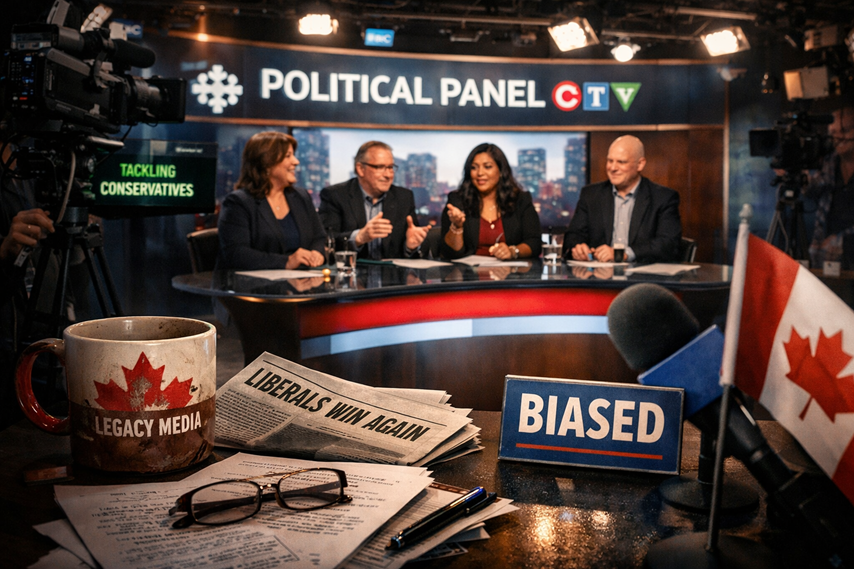
Canada’s mainstream media as Liberal Party propagandists.
Image from Melanie In SaskatchewanNow ask yourself this: if half the population consistently feels unheard by these panels, is that a coincidence, or the predictable result of decades of the same ideological herd wandering through the same studios?
Here is the rub. The At Issue panel rarely rotates through voices that actually represent today’s conservative electorate. Instead, it routinely features professional journalists and political insiders who debate among themselves, talking about conservatives far more often than they engage with conservatives whose voters make up a massive share of the country. That is not centrism. It is an echo chamber assembled by committee.
Then there is Andrew Coyne. He is often presented as the token ideological counterweight on At Issue, the panel’s supposed nod to conservatism. After all, he has spent decades as a columnist and editorial thinker, comfortably critiquing governments from a well upholstered perch.
But let us be clear. Coyne is not remotely representative of today’s conservative electorate. He is not a reflection of the current Conservative Party base. He is not channeling the instincts of voters outside the Ottawa and Toronto corridor.
Positioning him as the conservative voice on a national panel is not balance. It is branding. It allows producers to claim ideological diversity without ever inviting someone who actually carries the convictions, tone, or priorities of the modern conservative movement. Coyne is not a grassroots conservative. He is a professional pundit whose worldview fits tidily within the Ottawa insider class. That is not ideological contrast. It is controlled opposition dressed up as pluralism.
Meanwhile, audiences have been increasingly vocal online about the sense that these panels sound like academic seminars, not reflections of the lived experience of Canadians who didn’t spend their twenties in Ottawa press galleries.
Don’t call German Chancellor Friedrich Merz anything disrespectful … or else
German law provides far more protection for the reputations of politicians than any rational country should ever do … because free citizens should always have the right to criticize their political leaders under any circumstance short of threats and physical violence. And by “disrespectful”, they mean anything as trivial as referring to the Chancellor as “Pinocchio”:
In the latest retarded case of political repression to afflict the Federal Republic of Germany, police are investigating a pensioner for the crime of associating the German Chancellor with an iconic children’s book character.
From the Heilbronner Stimme:
When … Friedrich Merz and Baden-Württemberg Minister President Winfried Kretschmann came to Heilbronn last October for the opening ceremony of the Innovation Park Artificial Intelligence (IPAI), the celebrity visit occasioned discussion discussion on social media.
A post appeared on the Heilbronn Police Facebook page informing locals about a temporary flight ban enacted for security during the visit. A resident of Heilbronn responded by writing that “Pinocchio is coming to [Heilbronn].” He included a long-nosed emoji.
Three months later, at the end of January, the man could hardly believe his eyes as he received a letter from the criminal police informing him that he is now under investigation for his comment. He is suspected of committing the crime of insult as prohibited by Section 188 of the Criminal Code.
StGB §188 is the notorious “lèse-majesté” statute, which the Bundestag expanded substantially in 2021 when politicians grew tired of being criticised for suspending most of our democratic freedoms in a mad drive to exterminate a respiratory virus. As currently formulated, StGB §188 enhances penalties for “insult, malicious gossip and defamation” when the rabble direct these at “persons in political life”, and also makes these transgressions easier to prosecute. In this case, the pinched schoolmarms on the “social media team” who run the Heilbronn Police Facebook page filed a complaint with prosecutors as soon as they noticed our pensioner’s comment. Apparently it is their policy to monitor comments and cry to teacher whenever they see anything they don’t like.

Update, 25 February: Welcome, Instapundit readers! Have a look around at some of my other posts you may find of interest. I send out a daily summary of posts here through my Substack – https://substack.com/@nicholasrusson that you can subscribe to if you’d like to be informed of new posts in the future.
Canada’s climate follies, a brief update
On Substack, John Robson looks at the Canadian federal government’s lofty climate goals and their pathetic strategies to achieve those goals and the vast chasm between the two:

Chinese electric vehicles are likely coming to Canadian roads, like these BYD models.
Forgive us for being fixated on Canada’s climate follies just because we live here. But they are revealing, including the U-turn on EVs that we mentioned last week where the government yanked the steering wheel so hard they did a 360 from banning gasoline vehicles by law to banning them by regulation. Raising the question whether they actually know what they’re doing and, if so, whether they regard themselves as commendably devious or just way smarter than everyone else. We hope not the latter because the policy is going to fail big-time. As Randall Denley just warned in the National Post, “To summarize, the Carney plan relies on electric vehicles (EVs) that Ontario plants don’t produce, a sudden and dramatic new appetite for buying EVs and an imagined export market that doesn’t exist. To top it off, the federal government will provide $2.3 billion in EV rebates that will encourage Canadians to buy cars made elsewhere.” Apart from that, a stroke of genius of the sort that, through decades of diligent effort, has made the nation tragically poorer without hitting any of our targets including the one where they get more humble.
As a Globe & Mail news story blurted out:
A new study published Friday by the Canadian Climate Institute says Canada is not on track to meet any of its climate targets – not the 2026 interim emissions reduction target, the 2030 Paris Agreement commitment, or even the long-term goal of reaching net-zero emissions by 2050.
Oh. Pretty hard to make that one sound like an achievement, isn’t it? Or to sound as if the people who pulled it off should be trusted with the next one.
Now as we’ve complained before, the “Canadian Climate Institute” bills itself as some sort of dispassionate neutral observer when in fact it’s a creature of the state. And, worse, one of those lavishly-funded outfits (we deniers may have all the money, but they got $30 million from the Canadian government and we did not … uh no, that was just one grant, the total’s higher) that exists to push the government to do things it wants to do anyway but needs the appearance of “civil society” support to pull off.
Thus, the Globe sonorously informs us, the problem isn’t that the targets were impractical or the politicians and bureaucrats inept. Heck no. As usual with Thomas Sowell’s “unconstrained vision” of public policy, all you need is love:
The report suggests Canada has moved away from its climate goals thanks to “a slackening of policy effort over the past year, marked by the removal or weakening of climate policies across the country”.
Which gives the impression they had been on track to meet their goals up until some recent backsliding, whereas in reality they have never shown any sign of meeting them. After all, what policies have actually changed since Carney took over as Prime Minister in ways that could possibly affect long-term trends? And how close was Canada to meeting “its climate goals” before this disastrous swerve into the camp of the deniers?
It’s not even true that “Canada” as a collective has collective “climate goals”. The government has climate goals, and they come bundled with a host of other policies at election time, especially since even our “Conservative” party is terrified of challenging climate orthodoxy. Public support for those goals is weak, sporadic and prone to vanish when real costs hove into view. But ignoring that piece of typical collectivist prose, Mark Carney has spent most of his prime ministership flying around virtue-signaling in the presence of others doing the same. (No, really. It’s been less than a year and he’s taken almost three dozen flights.) He hasn’t been in the office shredding this and demolishing that.
Comments Off on Canada’s climate follies, a brief update
What did Prisoners eat at Folsom in 1925? – Lamb Curry & Beans
Tasting History with Max Miller
Published 26 Aug 2025Lamb curry with onions and carrots served with white bread and plain pinto beans
City/Region: Folsom, California
Time Period: 1916-1933Folsom Prison is infamous, but the food doesn’t sound like it was all that bad, though there was plenty of watery gruel made from the water salt pork had been soaked in, and if you were in solitary confinement, you got a diet of bread and water with beans every third day. Meals weren’t all terrible, though. A 1925 menu show foods like Hamburger Steak with Brown Gravy, Split Pea Soup, and Lamb Curry & Rice, which is what we’re making here.
In the 1920s, a lot of the cooks were using military manuals, so that is where the base of this recipe comes from, along with a list of ingredients from a commissary report from 1933.
It’s actually quite good, though I would add as much as double the amount of curry powder as was specified in the historical recipe. The beans are a little plain, but that’s to be expected.
382. Beef, curry (for 60 men).
Ingredients used:
20 pounds beef.
1 1/2 ounces curry powder.
Cut the beef into 1-inch cubes and place in a bake pan; cover with beef stock or water; season with salt, pepper, and curry powder. When nearly done, thicken slightly with a flour batter. Serve hot.— Manual for Army Cooks, 1916
LAMB CURRIE and RICE
1160 pounds Mutton
830 ” Rice
300 ” Onions
400 ” Carrots
1 bottle Curry
— Commissary report from Folsom Prison, February 1, 1933
Comments Off on What did Prisoners eat at Folsom in 1925? – Lamb Curry & Beans
QotD: The! Exclamation! Mark!
To the grammatically sane, reading the exclamation mark in its proper mode, the modern world appears increasingly deranged, authored seemingly by caffeinated twelve-year-olds. The delirium jumps at you in emails, on billboards, from the end of every other sentence.
The exclamation mark — the name a dead giveaway — means to exclaim. To cry out or speak suddenly or excitedly, as from surprise, delight, horror, etc. That line and dot seize your attention. Help! Now, it seizes your last nerve. Stop! If everything is exclamatory, then nothing is.
To the cynic, the exclamation mark is a hypodermic needle spiking foreign joy into the bloodstream of language. With each excitable email, I wonder, is this person in need of urgent medical attention? Or have they overdosed on Adderall?
Christopher Gage, “Against Enthusiasm”, Oxford Sour, 2025-11-21.
Comments Off on QotD: The! Exclamation! Mark!
February 23, 2026
“Public intellectuals”
Ted Gioia charts the rise of what we now struggle to avoid … the “public intellectual”:
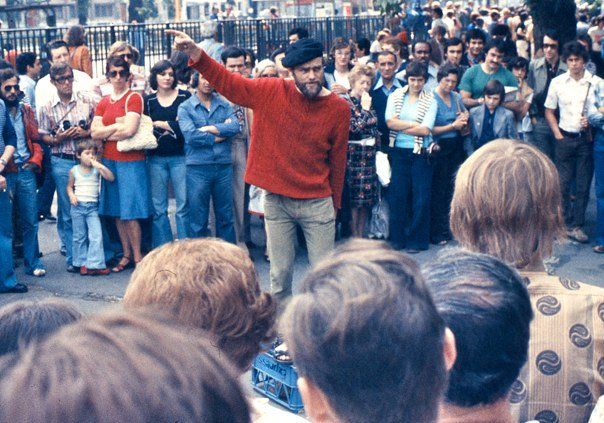
“Orator at Speakers’ Corner, London, with crowd, 1974” by GeorgeLouis is licensed under CC BY-SA 3.0 

 .
.
I see this term “public intellectual” everywhere nowadays — and it has a nice ring about it. It summons up images of speakers standing on soapboxes proclaiming the truth to passers-by.
That’s actually happened in places like London’s Hyde Park and 125th Street in Harlem. It sounds so very fair and democratic. Not every intellectual teaches at Harvard and Yale. Sometimes they really do exist out in the wild. We ought to nurture and support them.
Not long ago, these same people were often called “working class intellectuals”. I had two uncles who could be described that way — they lacked prestigious degrees and institutional affiliations. They grew up poor, but were smart and well-read and could speak articulately on almost any subject.
A few colleges specialized in educating these working class intellectuals. Consider the case of City College of New York, where the finest minds of the proletariat got book learning on the cheap. (You can find a list of CCNY alums and profs here — it includes an impressive number of Nobel laureates and Pulitzer Prize winners.)
But those days are long gone. Working-class intellectuals have vanished in recent years. Instead we have witnessed the rise of millionaire — or billionaire — intellectuals.
There have always been super-rich people, but in the past they kept a low profile. In my youth, the wealthiest person in the world was Howard Hughes, and he stayed in hiding for the last two decades of his life — you couldn’t even find a current photograph of the man.
He was doing us a favor. Hughes was rumored to have abandoned all the niceties of personal hygiene.
During the last fifteen years of his life, Hughes was described as a tall gaunt skeleton of a man with long, unwashed matted hair, a scraggly beard, and fingernails and toenails of such length that curled in upon themselves. He dressed only in a pair of dirty undershorts or went nude.
Believe it or not, Martin Scorsese cast Leonardo DiCaprio to play Hughes in the biopic. You gotta love Hollywood.
Hughes briefly emerged from seclusion on just one occasion. On January 7, 1972, he made a brief phone call from the Bahamas to seven journalists assembled in a room in a Hollywood hotel. This was necessary because a scamming author had published a fake autobiography attributed to Hughes, and the world’s richest man wanted to denounce it as a fraud.
He spoke on the phone for a few minutes, then signed off. That was the last time the media had any contact with Howard Hughes.
After Hughes’s death, the richest person in the world was Daniel Ludwig. You have probably never heard his name. But that’s no surprise — Ludwig was even more reclusive than Hughes. He lived for 95 years, and only gave one interview during that time.
Fast forward to today. Elon Musk is now the wealthiest person in the world — and he’s making proclamations every day. He even bought his own social media platform, and posts his opinions constantly. He’s the reverse of Howard Hughes. You can’t escape him. And unless he flies off to Mars, you never will.
It’s not just Musk. There are dozens of billionaires who aspire to public intellectual status. Bill Gates serves up book reviews. Peter Thiel gives a lecture series. Tom Steyer makes speeches and offers himself as a candidate for President.
We have come a long, long way from the working class intellectuals and soapbox pundits of yore. Everything now is pay-to-play.
How did this happen? When did the status of public intellectual become something you can buy, like merchandise on the shelf at a Rodeo Drive boutique?
Comments Off on “Public intellectuals”
“The aim always being to shoot the kulaks and who cares about the reasoning?”
It’s funny how the latest crisis always seems to have the same recommendations from the great and the good of the land – give us more money and more power. Pollution? More money and more power, please. Global poverty? More money and more power, please. Climate change? More money and more power, please. So it’s not really surprising that when the great and the good decide that global wealth inequality is a huge and growing problem, well, we all know what they’re going to recommend, don’t we?
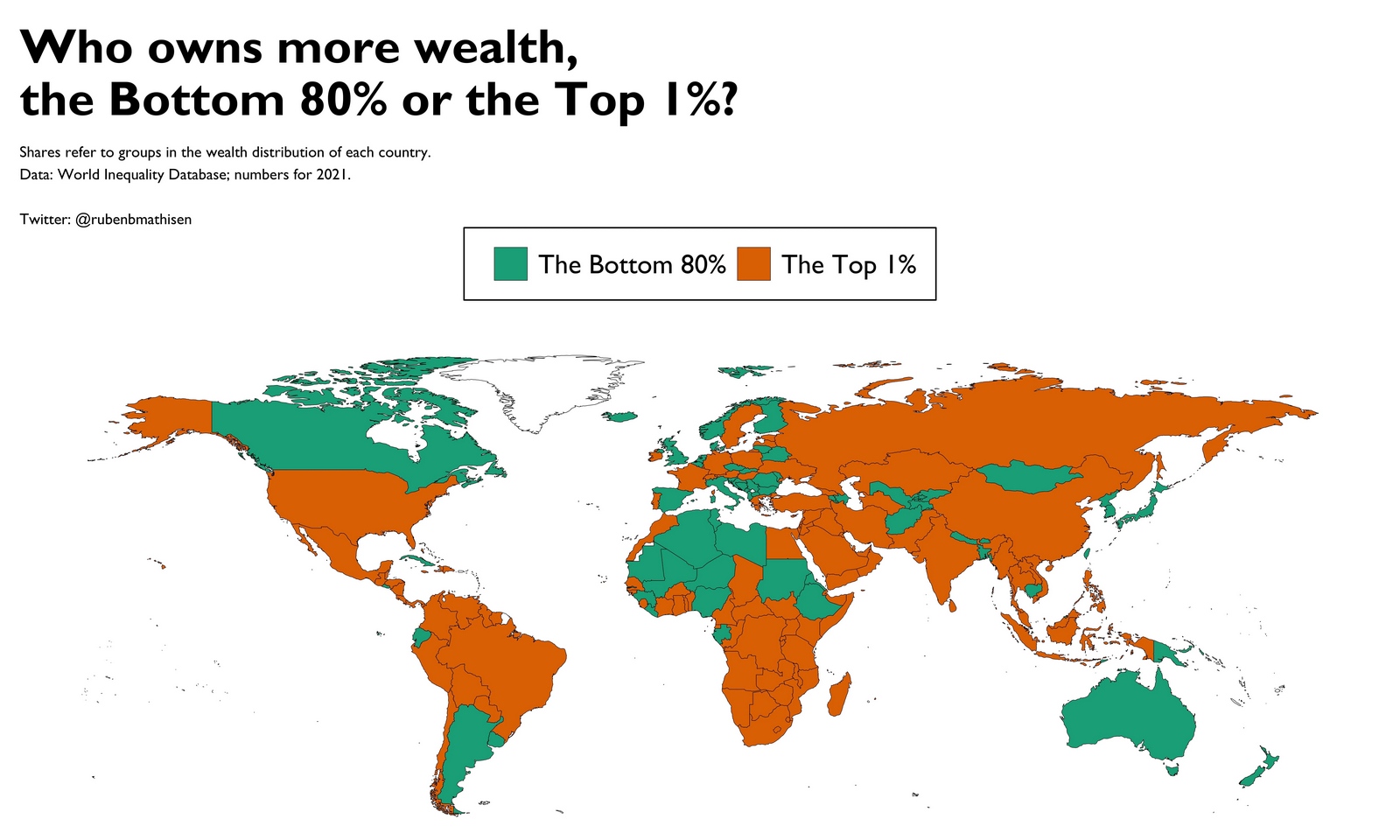
As we all know, because we’re all told it so often, global wealth inequality is rising. Therefore something must be done! Punitive taxation and the bureaucrats get to spend everything, obviously.
The one little problem with this is that the aim, intention, is always punitive taxation and the bureaucrats get to spend everything and damn the actual evidence used to support the proposal. It’s all sub-Marxoid ever increasing concentrations of summat and therefore the kulaks need to be shot. The aim always being to shoot the kulaks and who cares about the reasoning?
30 years back — and yes, I am old enough to recall this — it was all about how income was becoming more unequal in its distribution. Therefore punitive taxes, the bureaucrats get to allocate everything and hey, look, we can shoot the kulaks! This all rather fell apart when it was pointed out that the actual effect of global neoliberalism was that income inequality was declining. For which we can thank the work of Branko Milanovic. Who did prove that income inequality was declining under global neoliberalism.
Thus, to my mind, the move to squeeing about wealth inequality. For we need that reason to shoot the kulaks and damn the intellectual perversions required to find it.
And, well, Branko and his numbers again, eh?
New paper on the capitalization of the world with @BrankoMilan just out!
Capital income remains very unequally distributed worldwide, but inequality has slightly declined.
Oh. Global neoliberalism is reducing the inequality of capital income, is it? Why yes yes it is:
Global capital income inequality has declined in the 21st century, with the Gini coefficient falling from 97% to 94%. Over the same period, the share of the world population with annual capital income above $100 increased from 12% to 27%. This implies more than a doubling of the number of individuals earning positive income from interest, dividends, rents, and privately-funded pensions.
That’s alarmingly high, yes. We’d all like it to be lower too. I certainly would. I’d like us all to be living in that bourgeois American upper middle class in fact. $100k a year family incomes, $500k (later in life, obviously) in the 401(k) and all that. You know, bring it on.
We even have a mapped out plan about how we get from here to there. It’s in the SRES, which is the foundation of all that IPCC work about climate change. If we have globalised neoliberalism for the rest of this century then we’ll all be approaching that — in current $ — American upper middle class income. If we power that by going fracking, developing out solar and so on then climate change won’t be a problem either. If we power it by not going fracking and turn back to the use of coal then Bangladesh gets it. But the base idea that all will rise up into those bourgeois pleasures of three squares, a warm crib and choices in life really is in there. And, yes, it’s globalised neoliberalism that will take us there.
So, while it is alarmingly high, that inequality, we’re already solving it as we did income inequality — global neoliberalism. Pity no one gets to shoot the kulaks but there we are, reality doesn’t always accord with desires.
Comments Off on “The aim always being to shoot the kulaks and who cares about the reasoning?”
Grand Strategy of the Roman Empire PART TWO
Adrian Goldsworthy. Historian and Novelist
Published 27 Aug 2025This should have posted earlier this morning, but for some reason did not.
This is the follow up to last week’s discussion of grand strategy, looking at the reactions and criticisms of Luttwak’s ideas, followed by some of my own thoughts.
Comments Off on Grand Strategy of the Roman Empire PART TWO
QotD: Faith, Hope, and Charity defended Malta
France has collapsed, Hitler is eating Europe alive, and Mussolini doesn’t want to miss out. He wants birthday cake without bringing a present.
Poor show
So he looks at a map and asks the Italian Air Force:
“Who can we bomb that’s really close?”
Answer: Malta, 49 miles away.
The Italians begin their great wartime contribution by flying at 14,000 feet and dropping bombs with the accuracy of a man throwing darts after fourteen pints. Half land in the sea, a few hit fields.
But accuracy wasn’t the point. They just wanted to show Berlin they were “in the war”.
For the Maltese, who had never seen modern bombing, even bad Italian bombing was terrifying.
And unfortunately for them, this was only the warm-up act.
Maynard’s Defence: Faith, Hope and Charity
Air Commodore Foster Maynard is given the job of defending Malta with basically nothing.
He had been promised four fighter squadrons.
Zero have arrived. Typical early war British brilliance.
His only aircraft were some slow, ancient Fairey Swordfish.
Great for torpedoing ships, hopeless for intercepting bombers.
These were the famous “Stringbags”. We will hear from them later on.
Then like an archaeologist opening a cursed tomb the British discover 18 Gloster Gladiators in crates on the island. They were meant for HMS Glorious and HMS Eagle.
What followed was peak British wartime admin:
- Maynard asks the Navy to release some Gladiators.
- He gets permission.
- The ground crew assemble several.
- THEN the Navy says “No actually, stop, pack them back up.”
- THEN the decision gets reversed again.
- So they unpack them, reassemble them … again.
After all this faffing, three Gladiators emerge ready to fight.
Next problem: no fighter pilots.
Big problem I feel, anyway …
Maynard asks for volunteers. Eight bomber men step forward, either heroic or mildly insane.
Problem solved.
A journalist on the island, Harry Kirk, watching these three lonely biplanes scramble day after day, nicknames them Faith, Hope and Charity after his mother’s brooch.
The names stick. The legend begins.
On 21 June 1940 Pilot Officer George Burges shoots down a Savoia-Marchetti bomber over Valletta, the island’s first air victory.
The Maltese take it as a sign from God.
(It wasn’t, but let them have the moment.)
“MALTA: PART 1, Foreboding”, WWII Matters, 2025-11-17.
Comments Off on QotD: Faith, Hope, and Charity defended Malta
February 22, 2026
“[T]he trans cult … attracted many mentally ill people [offering] instant visibility, attention, and status”
In the visible-to-cheapskates portion of his Weekly Dish post, Andrew Sullivan tries to point out how the Democrats can salvage something from their decade-long, all-in approach to all things trans (warning, contains Andrew Sullivan):
I had dinner this week with a young gay man who was castrated and had his endocrine system permanently wrecked as a result of “gender-affirming care” for minors. He was super girly as a kid and had an undiagnosed testosterone deficiency which delayed his male development. He liked playing with girls, seemed to act like one, and when he socially transitioned as a teen, he passed easily. Suddenly all the sneers of “faggot” he’d endured as a boy went away. In today’s “gender-affirming care” environment, that was enough.
“Compassion” and “science” took a gay boy, flooded his young male body with estrogen, and removed his genitals — because the docs and the shrinks determined he was too effeminate to be a “real man”. Only when he personally figured this out as an adult and got himself off estrogen and onto testosterone did everything change. He felt energy and mental clarity for the first time. And his life as a man could finally begin — although his body will never be fully repaired.
Readers keep telling me to shut up about this topic (I can hear your groans now). I’m obsessed, you say, and this is a trivial (boring) matter. I’ve lost some good friends who feel very much that way, and my social life has shrunk. But then I meet someone like Mike (a pseudonym) — and I’ve met many others, gay and lesbian — and realize not a single gay group or resource is on his side. In fact, the “LGBTQIA+” lobby all but denies he exists, or dismisses him as transphobic — a dreaded “detransitioner”.
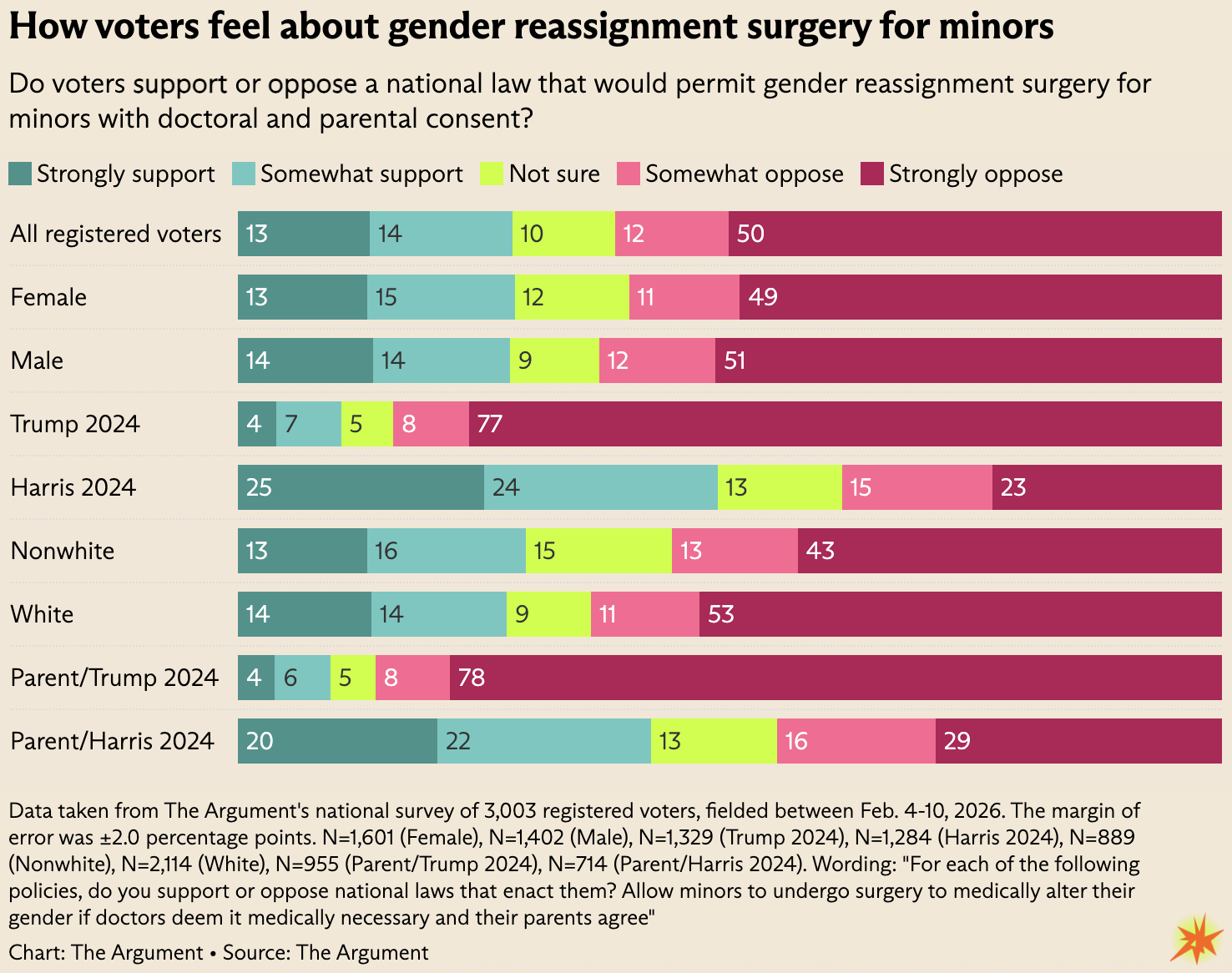
I was thinking about Mike as I read the latest polling — out this week in a liberal online mag, The Argument. The poll shows what we well know: 63 percent of Americans want to protect trans people from discrimination. This isn’t a transphobic country. But, equally, 62 percent oppose transing minors (50 percent strongly), 60 percent support banning transwomen competing against women in sports, and 53 percent want to ban gender ideology in elementary schools. These numbers have gone up the more the debate has raged. The backlash is so intense it has even reversed the public’s previous opposition to bathroom bills.
Now check out the liberal response. Bluesky erupted in fury that the poll was published at all. “Please help us,” one X member tweeted with direct appeals to Tim Cook and McKenzie Scott, who have bankrolled this campaign. Jill Filipovic complained that the “Dems … should have focused on things like ending discrimination in housing and employment”, rather than sports and kids, unaware that the Bostock decision already did that with employment. Most liberals have literally no idea that trans people already have civil rights. Off-message.
In this air-tight ideological bubble, where Bostock is unknown, the Dems flounder. “This isn’t happening” was the first gambit. Good try. Then: “this has all been ginned up by the far right, and Dems did nothing”. Did they miss the Obama and Biden Title IX diktats, Admiral Levine’s removal of lower age limits for transing kids, Biden’s “nonbinary” official Sam Brinton stealing dresses, or other embarrassments like the White House invite to Dylan Mulvaney? Then they say it’s a tiny issue. But it helped Trump massively in 2024. And if it’s tiny, why not compromise? After that, it’s just MLK-envy all the way down, the desire to be the next Rosa Parks. But it’s odd to campaign for “civil rights” when you already have them.
After trying to debate, you come to realize it’s pointless. The woke mind is not really a mind; it’s more like a bunch of synapses. Presented with an actual argument, they snap shut. This is part of what Eric Kaufmann calls the “sacralization” of minorities. For the woke, the “oppressed” are sacred. And in the social justice hierarchy, no minority is as oppressed and thereby as sacred as trans.
And so what sacred trans people say they want — or rather, what a tiny group of trans activists say they want — is all that matters. Anything else is illegitimate or “hate”. And any opponent is a bigot. Try arguing your way out of that dogmatic thicket. It’s like trying to disprove the Holy Trinity. I’ve given up.
But the real world keeps intervening. We just saw a ground-breaking lawsuit that won a $2 million judgment for a double mastectomy at 15. And this month saw two awful mass shootings by mentally unwell men caught up in the trans craze. Between Tumbler Ridge, Canada, and a Rhode Island hockey match, 12 people are now dead, including 6 children. And this is no longer a shock. Ask yourself what the 2023 Nashville Covenant School shooting, the 2025 Annunciation Catholic Church shooting, and even the 2024 attempted assassination of Trump, have in common.
Yes, it’s categorically wrong to link trans people to mass killings. That’s false and dangerous. But you’d be dumb not to worry that the trans cult of the last decade may have attracted many mentally ill people into a space where they have instant visibility, attention, and status. We have set up an open-ended subjective category — anyone who says they’re trans is trans, period — almost designed to attract delusional narcissists, and, with every safeguard thrown away, there’s no way to distinguish the nutters from the genuinely in need.
Comments Off on “[T]he trans cult … attracted many mentally ill people [offering] instant visibility, attention, and status”
How to Use a Tariff War to Disrupt the World – Death of Democracy 04 – Q4 1933
World War Two and Spartacus Olsson
Published 21 Feb 2026In Q4 1933 Hitler pivots Nazi Germany from internal takeover to outward defiance. The London Economic Conference collapses and the tariff truce unravels, Hitler withdraws from the Disarmament Conference and the League of Nations — then stages the November 12 plebiscite and one‑party Reichstag election to claim the nation stands behind him. As Goebbels tightens propaganda and press control through the Editors’ Law (Schriftleitergesetz) and daily directives, the Winter Relief campaign turns “charity” into social pressure and Volksgemeinschaft theater. In December, Reichsbank president Hjalmar Schacht hardens the transfer moratorium to conserve foreign currency for raw materials and rearmament. Using contemporary voices, this episode shows how isolation, manipulation, and “unity” accelerate Europe toward a pre‑war era.
(more…)
Comments Off on How to Use a Tariff War to Disrupt the World – Death of Democracy 04 – Q4 1933


