
John: … When did this change? I am tempted to blame it, like everything else, on the rise of meritocracy.
Jane: But Napoleon was a meritocrat, in the strictest and most literal sense. He made himself emperor through sheer excellence, and the men he elevated were the same. I mean, let’s look at his first set of marshals: Augereau is the son of a fruit-seller, Ney’s father was a cooper, Masséna’s father was a shopkeeper, and Bessières’ was a doctor (in an era when that was a lot less prestigious than it is today). Bernadotte starts out the son of a provincial prosecutor and ends up king of Sweden. Only Davout had an aristocratic background. Obviously this was sort of inevitable, because the previous elite had been literally decapitated and a new one had to come from somewhere. Maybe it’s just what happens when you have a particularly profound disruption: people end up in power because they’re better than anyone else at making war to get the power in the first place. Just like you can’t follow the lineage of any European aristocrat back farther than the Germanic conquerors of the early Middle Ages. (The Psmiths, as is well attested, trace descent from the Viking Psmiðr who came to Normandy with Rollo in the 8th century.) But I think it’s more than that. Napoleon set up all kinds of meritocratic institutions outside the military: he had his competitive examination lycées, he was constantly promoting the talented young auditeurs he ran across in the Conseil … (Can you tell I liked the civil administration chapters better than the battle chapters? #thetwogenders)
So what is the difference between Napoleonic meritocracy and our present sort? I think the real difference is that in his case there was someone doing the choosing. This is important for a couple of reasons: first, because it takes a certain amount of talent to recognize excellence. You can get away with being a Salieri, but you need to have something. I think we’ve all seen institutions whose HR departments were so packed with drones that they couldn’t have recognized a genius if one fell into their laps, let alone wanted to work for them. And it’s way, way harder to keep around an institution full of competent intelligent people with correctly aligned incentives than it is to just … be good at identifying talent, personally. Second, a person exercising judgment can take a way more holistic view than any standardized metric. This is what college admissions claims to be trying to do when they’re not just using it as an excuse to keep out Asians. But a well-functioning meritocracy — or an emperor picking his men — should be searching for excellence. Studying hard and doing well on a test not only fails to reliably indicate excellence, it actually encourages and cultivates habits of mind that undermine excellence.
But the biggest reason this is important, I think, brings us back to Napoleon again, and might be the key to what you described as the strange inconsistency between his loving concern for his men and his willingness to send them to a hideous death. Because I don’t actually think it’s an inconsistency at all! And it has to do with mission. What’s the deal with our current meritocratic system? “We want to have the smartest people in power”. Okay but why? “So they can be effective”. Effective at what?
No one ever had to ask Napoleon “effective at what”.
He was willing to throw himself, and his closest friends, and the meanest infantryman whose boots he nevertheless obsessed over, into some of the most hellish experiences yet devised by men1 in service of something greater. And you can be snide and say the something greater was “Napoleon”, and that’s sort of true, but to him and to France “Napoleon” had come to stand for law and knowledge and liberty and order and greatness itself. Napoleon’s meritocracy worked because it had a telos. Our meritocracy is the idiot fluting of a blind inhuman blob.
Jane and John Psmith, “JOINT REVIEW: Napoleon the Great, by Andrew Roberts”, Mr. and Mrs. Psmith’s Bookshelf, 2023-01-21.
1. Another book recommendation! The Face of Battle.
June 12, 2025
QotD: Napoleon Bonaparte, arch-meritocrat
June 11, 2025
The Korean War Week 51 – China: Acheson’s Cold Calculus – June 10 , 1951
The Korean War by Indy Neidell
Published 10 Jun 2025The UN forces Operation Piledriver gets bogged down by the weather and the terrain. 8th Army Commander Jim Van Fleet says that though the enemy has been hurt, he still has another big offensive left in him by summer’s end, but there are murmurs and hints that some of the forces fighting this war are ready to talk about an armistice. And in the Senate, Dean Acheson spends five solid days talking about the US position on China.
Chapters
00:00 Hook
01:00 Recap
01:28 Operation Piledriver
04:04 ROK 6th Division
07:18 Van Fleet’s Appraisal
08:18 Armistice Overtures?
17:00 Summary
17:15 Conclusion
(more…)
The coming “Dissolution of the Universities”
At Postcards from Barsoom, John Carter provides a useful summary of the situation in England at the time of the Reformation which brought King Henry VIII to seize the wealth and property of the monasteries and other Christian establishments and why he was probably right to do so. Then he shows just how the modern western universities now find themselves in a remarkably similar position today:

The well-preserved ruins of Fountains Abbey, a Cistercian monastery near Ripon in North Yorkshire. Founded in 1132 until dissolved by order of King Henry VIII in 1539. It is now owned by the National Trust as part of the Studley Royal Park, a UNESCO World Heritage Site.
Photo by Admiralgary via Wikimedia Commons.
Our own university system is on the cusp of a similar collapse. This may seem outrageous, given the size, wealth, and massive cultural importance of universities, but at the dawn of the 16th century, the suggestion that monasteries would be dismantled across Europe within a generation would have struck everyone – even their opponents – as absurd.
The Class of 2026
The rot in academia is already proverbial. Scholarly careerism, declining curricular standards, the replication crisis, a demented ideological monoculture, administrative bloat … a steady accumulation of chronic cultural entropy has built up inside the organizational tissue of the academy, rendering universities less effective, less trustworthy, less affordable, and less useful than ever before in history. We see a parallel here with the moral laxity of 16th century monastic life, where religious vows were more theoretical than daily realities for many monks. Does anyone truly think that Harvard professors take Veritas at all seriously?
At the same time, universities have become engorged on tuition fees, research grants, and endowments, providing an easy and luxurious life for armies of well-paid and under-worked administrators, as well as for those professors who are able to play the social games necessary to climb the greased pole of academic promotion. Everyone knows that academia is in a bubble, and as with any bubble, correction is inevitable, and the longer correction is postponed by the thicket of interlocking entrenched interests that have dug themselves into the system, the uglier that correction was always going to be.
Just as the printing press rendered the monastic scriptoria entirely redundant, the Internet has placed universities under increasing threat of obsolescence. Libraries and academic publishing have already been rendered useless by preprint servers. It is no longer, strictly speaking, necessary to attend a university to learn things: the Internet has every tool an autodidact could desire, and insofar as it doesn’t – for instance, university presses and private journals charging outrageous fees for their books and papers – this is due to the academy jealously guarding its treasures with intellectual property law rather than any limitation of the technology. One can easily make the argument that academia has become an obstacle, rather than an organ, of information dissemination.
Still, universities have so far managed to hold on to their relevance due to their lock on credentialization: no one really cares how many How-To videos you watched at YouTube U, because – in theory – a university degree means that there was some level of human verification that you actually mastered the material you studied.
Large Language Models, however, are delivering the killing blow. Just as the printing press collapsed the cost of reproducing text, AI has collapsed the cost of producing texts. This is actually worse news for universities than Gutenberg was the monasteries: movable type made scriptoria unnecessary, but LLMs haven’t only made universities obsolete, they’ve made it impossible for universities to fulfil their function.
Universities rely on undergraduate tuition fees for a major part of their income. Large research schools derive a significant fraction from research grants, and the more prestigious institutions often receive substantial private donations, but for the majority of schools it is the fee-paying undergraduate that pays the bills. This is already a problem, because enrolment is already declining, partly for demographic reasons (the birth rate is low), and partly because academia has been increasingly coded as women’s work, leading to young men staying away.
In theory, undergraduate students are paying for an “education”. They are gaining essential professional skills that will make them employable in well-remunerated white collar professions, or they are broadening their minds with a liberal arts education that provides them with the soft skills – critical thinking, the ability to compose and parse complex texts, a depth of historical and philosophical understanding of intricate social and political issues – that prepare them for careers in elite socioeconomic strata.
Everyone, however, has long since understood that this narrative of “education” is a barely-plausible polite fiction, like those little scraps of fabric exotic dancers wear on their nipples so everyone can pretend they aren’t showing their boobs. Students know it’s a lie, professors know it’s a lie, administrators know it’s a lie, and employers certainly know it’s a lie. What students are actually paying for is not an education, but a credential: they could not possibly care less about the “education” they’re receiving, so long as they receive a piece of paper at the end of their four years which they can take to an employer as evidence that they are not cognitively handicapped, and are therefore in possession of the minimal level of self-discipline and intelligence required to handle routine tasks at the entry-level end of the org chart. Thus the venerable proverb among students that “C’s and D’s get degrees”. It doesn’t matter if you did well: employers don’t generally care about your GPA. All that matters is that you do the minimal possible level of work to squeak through. As a general rule, your time as a student is better spent grinding away in the library as little as possible while enjoying yourself to the maximum extent that you can in order to develop social networks you can draw upon later.
Until recently, graduate school ensured that there was still some vestigial motivation for genuine intellectual engagement. Corporate America might not care about your transcript, but if you wanted an advanced degree, graduate schools most certainly did. Those students with greater academic ambitions than a Bachelor’s degree could therefore generally be relied on to actually apply themselves, thereby making the professoriate’s efforts delivering lectures, preparing homework assignments, and grading exams somewhat less of a pantomime. DEI, however, was already eating its way through even this. As graduate school admission became more about protected identities and less about intellectual mastery, and as graduate programs were themselves rendered easier in order to improve retention of underqualified diversity admits, it started to become less important to study hard even if one wanted to enter grad school.
To the point. In 2022, ChatGPT became available. Almost overnight undergraduate students began using it to write their essays for them. Its abuse has now become essentially ubiquitous, and not only for essays: ChatGPT can write code or solve mathematical problems just as easily as it can generate reams of plausible-sounding text. It might not yet do these things well, but it doesn’t have to: remember, C’s and D’s get degrees.
These Romans are crazy – in praise of Asterix the Gaul
Adrian Goldsworthy. Historian and Novelist
Published 30 Dec 2024Today we look at the Asterix comic books — fun tales of indomitable Gauls and their fights with Julius Caesar’s Romans.
QotD: “Pike and Shot” in the early gunpowder era
Instead, pike and shot were combined into a single unit. The “standard” form of this was the tercio, the Spanish organizational form of pike and shot and one which was imitated by many others. In the early 16th century, the standard organization of a tercio – at least notionally, as these units were almost never at full strength – was 2,400 pikemen and 600 arquebusiers. In battle, the tercio itself was the maneuver unit, moving as a single formation (albeit with changing shape); they were often deployed in threes (thus the name “tercio” meaning “a third”) with two positioned forward and the third behind and between, allowing them to support each other. The normal arrangement for a tercio was a “bastioned square” with a “sleeve of shot”: the pikes formed a square at the center, which was surrounded by a thin “sleeve” of muskets, then at each corner of the sleeve there was an additional, smaller square of shot. Placing those secondary squares (the “bastions” – named after the fortification element) on the corner allowed each one a wide potential range of fire and would mean that any enemy approaching the square would be under fire at minimum from one side of the sleeve and two of the bastions.
That said, if drilled properly, the formation could respond dynamically to changing conditions. Shot might be thrown forward to provide volley-fire if there was no imminent threat of an enemy advance, or it might be moved back to shelter behind the square if there was. If cavalry approached, the square might be hollowed and the shot brought inside to protect it from being overrun by cavalry. In the 1600s, against other pike-and-shot formations, it became more common to arrange the formation linearly, with the pike square in the center with a thin sleeve of shot while most of the shot was deployed in two large blocks to its right and left, firing in “countermarch” (each man firing and moving to the rear to reload) in order to bring the full potential firepower of the formation to bear.
Indeed it is worth expanding on that point: volley fire. The great limitation for firearms (and to a lesser extent crossbows) was the combination of frontage and reloading time: the limited frontage of a unit restricted how many men could shoot at once (but too wide a unit was vulnerable and hard to control) and long reload times meant long gaps between shots. The solution was synchronized volley fire allowing part of a unit to be reloading while another part fired. In China, this seems to have been first used with crossbows, but in Europe it really only catches on with muskets – we see early experiments with volley fire in the late 1500s, with the version that “catches on” being proposed by William Louis of Nassau-Dillenburg (1560-1620) to Maurice of Nassau (1567-1625) in 1594; the “countermarch” as it came to be known ends up associated with Maurice. Initially, the formation was six ranks deep but as reloading speed and drill improved, it could be made thinner without a break in firing, eventually leading to 18th century fire-by-rank drills with three ranks (though by this time these were opposed by drills where the first three ranks – the front kneeling, the back slightly offset – would all fire at once but with different sections of the line firing at different times (“fire-by-platoon”)).
Coming back to Total War, the irony is that while the basic components of pike-and-shot warfare exist in both Empire: Total War and for the Empire faction in Total War: Warhammer, in both games it isn’t really possible to actually do pike-and-shot warfare. Even if an army combines pikes and muskets, the unit sizes make the kind of fine maneuvers required of a pike-and-shot formation impossible and while it is possible to have missile units automatically retreat from contact, it is not possible to have them pointedly retreat into a pike unit (even though in Empire, it was possible to form hollow squares, a formation developed for this very purpose).
Indeed if anything the Total War series has been moving away from the gameplay elements which would be necessary to make representing this kind of synchronized discipline and careful formation fighting possible. While earlier Total War games experimented with synchronized discipline in the form of volley-fire drills (e.g. fire by rank), that feature was essentially abandoned after Total War: Shogun 2‘s Fall of the Samurai DLC in 2012. Instead of firing by rank, musket units in Total War: Warhammer are just permitted to fire through other members of their unit to allow all of the soldiers in a formation – regardless of depth or width – to fire (they cannot fire through other friendly units, however). That’s actually a striking and frustrating simplification: volley fire drills and indeed everything about subsequent linear firearm warfare was focused on efficient ways to allow more men to be actively firing at once; that complexity is simply abandoned in the current generation of Total War games.
Bret Devereaux, “Collection: Total War‘s Missing Infantry-Type”, A Collection of Unmitigated Pedantry, 2022-04-01.
June 10, 2025
Mark Carney’s big defence spending announcement
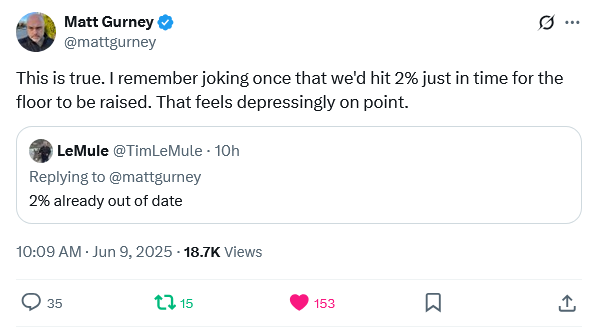
On Monday Morning, Prime Minister Mark Carney was in Toronto to make a major announcement on Canada’s military spending. After being one of the worst freeloaders in the western alliance, Canada was spending far less on the Canadian Armed Forces than the 2% of GDP we’d promised our NATO partners several years ago. Of course, at the same time that Canada seems to be finally getting serious about defence priorities, the rest of our allies are talking seriously about raising the agreed-upon target to 5%:
Chris Lambie in the National Post says it’s a C$9 billion bump in direct military spending in this (unbudgeted) year:
Canada’s plan to add more than $9 billion to defence spending this year was praised by military watchers Monday, but they cautioned that the country is shooting at a moving target.
Prime Minister Mark Carney announced the country would meet its commitment in this fiscal year of hitting the two per cent of gross domestic product mark that was agreed upon by NATO countries more than a decade back.
“It’s very encouraging that the prime minister has come out this early in his mandate and made such a strong commitment to defence,” said Vincent Rigby, a former top intelligence adviser to former prime minister Justin Trudeau, who spent 14 years with Canada’s Department of National Defence.
“You’ve gone from the former prime minister talking about the two per cent as a crass mathematical calculation to the current prime minister saying, no, this is actually a serious commitment. We committed to it 10 years ago and even before that. And we have to do it because we owe it to our allies. But we also owe it to the Canadian people. He made it quite clear this is about protecting Canada, protecting our national interests and protecting our values.”
New spending could do a lot to improve crumbling military infrastructure, said Michel Maisonneuve, a retired Canadian Army lieutenant-general who has served as assistant deputy chief of defence staff, and chief of staff of NATO’s Allied Command.
“The housing on bases is horrible,” Maisonneuve said.
He’s keen on Carney’s plan to participate in the $234-billion ReArm Europe program.
“This will bolster our ability to produce stuff for ourselves” while also helping the Europeans to do the same, Maisonneuve said.
“All the tree huggers are going to hate that, but that’s where we are today in the world.”
Carney’s cash injection includes $2.6 billion to recruit and retain military personnel. The military is short about 13,000 people. It aims to boost the regular force to 71,500 and the reserves to 30,000 by the end of this decade.
“There is no way we can protect Canada and Canadians with the strength that we have now,” Maisonneuve said.
Later in the day, Matt Gurney made some preliminary comments on the social media site formerly known as Twitter (I imagine he’ll have more to say in an upcoming Line post):
I’ve had a chance to actually look at some of the details of what was announced today for Canada’s defence. Overall, I am very supportive of everything that’s been announced.
There are some caveats. Or at least notes.
1. The new spending is mostly aimed at flushing out existing capabilities, not adding new ones.
That’s fine! We need to do that, definitely. I just don’t know if the public understands how much money we could sink into the military without actually adding any new capabilities. All we would do is backfill capabilities that we currently claim to have that don’t really exist.
2. Billions of additional dollars are going toward very basic things. More money to retain existing personnel. Apparently more money to build out recruitment. Spending more money to bring equipment and facilities up to state of proper repair.
Same as above. All good! Needed. Smart.
3. Some of what’s being announced today is entirely a matter of how we’re budgeting stuff. Certain existing expenditures are being redesignated as defence expenditures.
That’s okay! Some of our allies count things toward their defence total that we don’t. Everybody cooks the books a little bit, and I have no objection to this.
4. Everything being announced today should have been done years ago.
The only note I really have to add here is how the longer [Mark Carney] is Prime Minister, the harder it gets to explain away some of the shocking inactivity of his immediate predecessor.
5. None of this is going to be enough.
Remember, all we’re doing here is building out existing capabilities so that they are actually real things, not just things that exist on paper. That’s good. But the actual work of recapitalizing, expanding and adapting the military for 21st-century conflict hasn’t really begun yet. Everything announced today is a necessary start to getting that done. But the hard work is still to come.
And so are the really eye-watering numbers.
Of course, there are definite downsides to just opening up the spending taps the way things currently are set up:
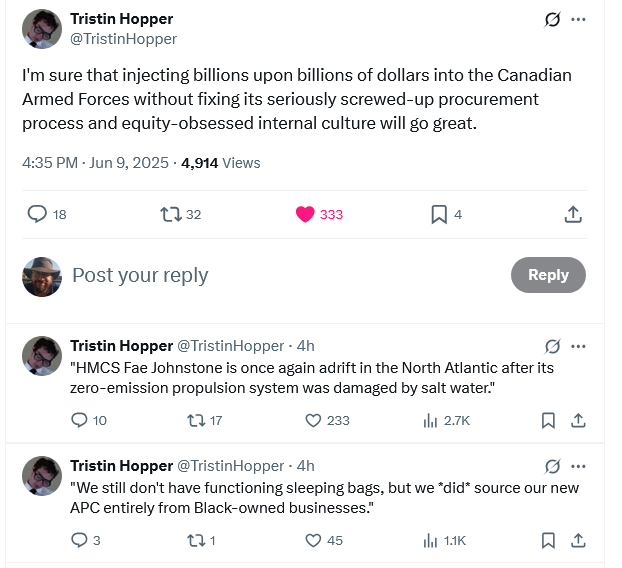
He’s not wrong.
How Moscow Got the Atomic Bomb – W2W 31
TimeGhost History
Published 8 Jun 2025In 1949, the Soviet Union detonates its first atomic bomb — years ahead of Western expectations. This episode dives into how the USSR mobilized former Nazi scientists, forced Soviet physicists into secret cities, and relied on intelligence from spies like Klaus Fuchs. While Stalin pushes for rapid progress, Beria enforces brutal discipline, and Soviet scientists race to meet an impossible deadline. The nuclear balance of power is about to shift — forever.
(more…)
The limits of female empathy
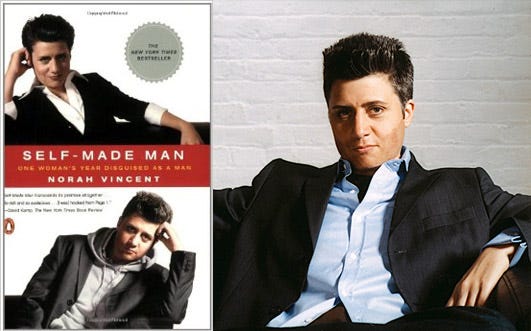
Janice Fiamengo discusses the 2006 book Self-Made Man: One Woman’s Year Disguised As A Man by journalist Norah Vincent. Intended as a kind of exposé of male privilege, her investigations turned into something rather different than she originally intended:
Many men are lonely. Many don’t like the work they do. Many are unhappily married. They struggle with an at-times overwhelming sex drive. Their encounters with women, romantic or otherwise, often involve rejection and contradictory tests of their masculinity. They are the objects of blame and bigotry in their societies, yet are expected to remain stoic and put women’s needs first.
It’s a strange world in which the above observations — by a woman — are seen as outstanding insights, but it’s the one we’re in.
In 2006, American journalist Norah Vincent published Self-Made Man: One Woman’s Year Disguised As A Man, an under-cover adventure in which the author, a mannish lesbian with big feet, spent close to 18 months periodically disguised as a man named Ned, notching up about 150 episodes in drag.
With breasts flattened, fake stubble on her chin, and a stuffed jock strap in her pants, having hired a tutor to teach her how to pitch her voice low and move like a man, she set out to “infiltrate exclusive all-male environments and if possible learn their secrets” (p. 18). She joined a bowling league, went on dates, did sales calls, spent some weeks at a monastery, and attended a Robert Bly-influenced men’s wilderness retreat.
Expecting to learn something about male power, she found instead “the hidden pain of masculinity and my own sex’s symbiotic role in it” (p. 254). The planned exposé became a feminist mea culpa.
The book got a lot of attention when it was published, and many men expressed gratitude and appreciation for the empathy and insight in Vincent’s work.
Reading the many accolades, I felt sadness, tenderness, and amazement. Wasn’t this a bit much? Was it really so remarkable that a woman could develop sympathy for the opposite sex?
Most men are so unaccustomed to any empathy from a woman, even when it’s mixed with patronizing descriptions and questionable conclusions, that they respond as if to heroism. The woman who cares, even within circumscribed limits, is catapulted into the company of the saints.
Imagine the reaction if a man had masqueraded as a woman for a year or more, and then pretended to understand women (even sympathetically) using a shop-worn ideological framework? Imagine a white person putting on blackface in order to become an expert, even a well-intentioned one, on the need for black self-improvement? There would be howls of outrage and indignant rebuttals, especially by members of the impersonated group.
Not in Vincent’s case. So rare is a woman’s attempt to understand male experiences that she doesn’t need to be consistently sympathetic or accurate.
Even when someone goes beyond temporary male drag, there is a palpable surprise that mens’ lives are not a well-watered garden of male privilege:
Today, of course, there is still always a reason to look away from men’s pain. Feminist-inclined men and women routinely “bathe in male tears“. They claim that discussing men’s issues is misogynistic, and ask “Can White Men Finally Stop Complaining?” No wonder it seems that the only time men can be heard is when women speak for them.
Notably, women who “transition” to male through hormone treatments and surgery are often shocked by the indifference and unkindness they encounter in public, where men are not eager to help and women expect deference. Zander Keig wrote as a trans man in “Crossing the Divide” of a pronounced sense of aloneness: “No one, outside of family and close friends, is paying any attention to my well-being”.
They Live SG-1: Conquest and Paternalism
Feral Historian
Published 26 Jan 2024Stargate and SG-1 generally don’t go together, but they’re based on the same underlying premise. Our leaders are lying to us, denying us knowledge of fundamental truths about our world. Truths that can be the difference between freedom and slavery for all of humanity.
Sidenote, this is the first time I’ve shot one of these videos indoors instead of in the mountains. It’s -24 out on the day of recording.
00:00 Intro
01:05 Stargate
03:11 Ruling Class
04:18 Secrets
06:02 Illusions
06:48 Conclusion
QotD: From Witan to Magna Carta
After a few hundred years of trial and error, and given a king who really was wicked and stupid, too, they, the barons as they were then known, went to war with their king and bent him to their will by forcing him to agree to a great charter of their rights. There was a bit of ringing language about no free man being taken except after a trial by a jury of his peers, but, basically, in very typically English fashion, the rights about which the great charter was most concerned were property rights because the barons had learned, over the centuries that only by controlling the pursestrings could they really control the king.
A few hundred years later, one of liberalism’s and democracy’s greatest voices told us that we have three absolutely fundamental, natural rights: to life, to liberty and to property. These rights were not and still are not unlimited. There were and are ways to lawfully and properly deprive a person of his property and his liberty and, in some countries, even his life.
A few centuries after John Locke another philosopher wanted to do away with the right to property: “From each according to his ability, to each according to his need”, Karl Marx wrote, and many, far too many, believed. The only real problem with Marx’s notion is that it requires that humans are perfect … and most of us know how rare that is. Here in Canada, especially since the early years of the 20th century, we have had far too much Marx and far too little Locke.
Ted Campbell, “Democracy is in peril”, Ted Campbell’s Point of View, 2020-06-12.
June 9, 2025
Parenting style choice – “small people who do not yet know very much or … pets who can talk”
I always felt that my son was a person, and did my best to treat him that way while still being his father. I think that was the correct choice, although clearly a lot of other parents choose the other option for their children:

“Happy family cyanotype 2” by simpleinsomnia is licensed under CC BY 2.0 
 .
.
There are two views of children — that they are small people who do not yet know very much or that they are pets who can talk. I prefer the former. One implication is that children and parents are, in a fundamental sense, peers. Obviously they are not equal in what they know or what they can do or how strong they are. But they are not different sorts of people in a way that goes beyond that. Children should usually believe their parents about things the parents know much more about but parents should believe children when that asymmetry is reversed, as it sometimes is. The mere fact that one is parent and the other child does not determine which is right and which wrong when they disagree; that is determined, as between adults, by which has better arguments, more evidence.
One implication of treating children as people not pets is that you have to keep promises to them, as to other people. Another is that if you assert something to them you have the same obligation you would have if you said it to an adult to defend it or, if you find you cannot, admit that you can’t.
I once heard an elderly man tell a child who disagreed with him on something that he should never contradict his elders. The statement struck me as not merely wrong but blasphemous. The elder was probably correct on what they disagreed about but the appropriate response is to demonstrate that, at worst decline to argue it, not to imply either that truth is determined by seniority or that it is discourteous to point out errors to a status superior. I am reasonably sure that neither of my parents ever told me to believe something just because they said so or refused to entertain arguments against their views. The son of my first marriage, who spent summers with me and my wife when he was growing up, told a friend that his project for that summer was to get my wife to say “because I told you so.” I doubt that he succeeded.
Treating your children as your peers is easier if you sometimes interact with them in contexts where they demonstrably are at least your equal. I was the first member of our family to play World of Warcraft, so when my wife and our children, then eleven and fourteen, joined the game I was more skilled, had a higher level character, more in-game resources. They improved over time and there was a long period, during which we sometimes played separately, sometimes as a family team, were all on about the same level. By the time I eventually quit the game some years later we all had top level characters and all three of them had become more skilled at the game than I was.
Going back to my childhood, the nearest equivalent that occurs to me is ping-pong. We had a table in the basement on which my father and I played. We equalized the contest with a sliding handicap, a number of points I started each game with. Every time he won the handicap went up, every time I won it went down. Over a period of years, as I got better, the handicap went down, eventually to zero, I think occasionally below zero. The family also played bridge together, there being conveniently four of us.
I spent a lot of time arguing with my father on a wide range of subjects. Someone who met us skiing on Colorado when I was in high school told a friend of mine that we spent all our time arguing and I won half the arguments. I don’t think the latter was true, but if my father won a majority of the arguments he won them fair.
The Mighty Meteor – The World’s First Operational Jet Fighter
HardThrasher
Published 8 Jun 2025References
1. https://tinyurl.com/yc74kmed
2. Britain’s Jet Age, Guy Ellis, 2016, Amberley Publishing
3. Genius Of The Jet | The Invention Of The J… – Frank Whittle and Powerjets documentary, originally aired on the BBC
4. Meteor, Gloster’s First Jet Fighter, Steven Bond, Midland, 1985, Chpt 1
5. The British Aircraft Specifications File, Meekcombs and Morgan, 1994, p.298
6. https://en.wikipedia.org/wiki/Klimov_…
7. Most Secret Place, Johnson & Hefferman, Janes, 1983
8. https://mikesresearch.com/2020/12/25/…
9. Bond, op cit. p18
10. Bond, op cit.p34
11. QUEEN OF THE SKY: Meteor Night Fighters, U…
12. https://hushkit.net/2020/05/12/my-fav…
13. https://asn.flightsafety.org/wikibase… and https://asn.flightsafety.org/wikibase…
(more…)
The federal Minister of Public Safety admits he knows literally nothing about Canadian gun laws
Prime Minister Mark Carney’s cabinet may actually be worse than any line-up of ministers under Justin Trudeau, with the Minister of Public Safety as a poster child for ignorance and apathy:
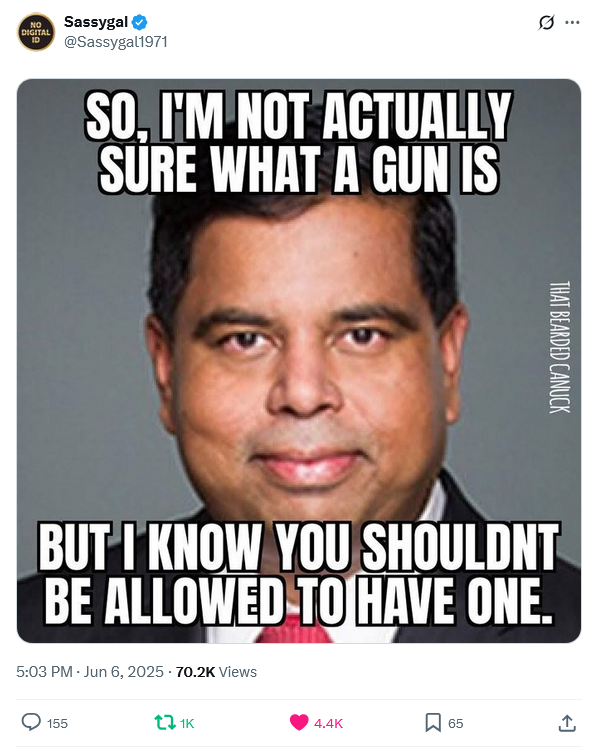
[…] Then we have the Minister of Public Safety, Gary Anandasangaree — a Trudeau–Carney loyalist freshly installed under the new Liberal minority regime — who made headlines not for bold leadership, but for a shocking display of ignorance on the very file he’s been assigned to oversee: firearms policy.
During a session of debate on the current spending bill, Conservative MP Andrew Lawton posed a basic question:
“Do you know what an RPAL is?”
An RPAL, or Restricted Possession and Acquisition Licence, is a standard certification required by law for any Canadian who wants to own restricted firearms, such as handguns or certain rifles. It’s a core element of Canada’s legal firearms framework.
The Minister’s response?
“I do not.”
Lawton followed up with another foundational question:
“Do you know what the CFSC is?”
The CFSC, or Canadian Firearms Safety Course, is a mandatory course required for all individuals seeking to obtain a firearms license in Canada — including the RPAL. It’s the very first step every legal gun owner in the country must complete. This is basic civics for anyone involved in firearms policy.
Anandasangaree replied again:
“I do not know.”
This wasn’t a “gotcha” moment. It was a revealing moment. The Minister of Public Safety, the individual charged with implementing gun bans, overseeing buyback programs, and crafting firearms legislation, has no familiarity with the fundamental licensing and safety processes every Canadian gun owner must follow.
In any other profession, this level of unpreparedness would be disqualifying. If a surgeon couldn’t name a scalpel, he’d be pulled from the operating room. But in Ottawa? It qualifies you to oversee a multi-hundred-million-dollar national gun seizure operation.
And that brings us to the next moment of absurdity.
Lawton asked the minister how much money had already been spent on the federal firearms buyback program, the centerpiece of the Liberal government’s Bill C-21, which targets legally acquired firearms now deemed prohibited.
Anandasangaree’s answer?
“About $20 million.”
But that doesn’t match the government’s own published data. In a report tabled by Public Safety Canada in September 2023, it was disclosed that $67.2 million had already been spent on the buyback as of that date. The majority of that spending was attributed to “program design and administration” — before a single firearm had even been collected.
So what happened? Did the government refund tens of millions of dollars? Were contracts cancelled? Of course not.
They just reframed the accounting — separating so-called “preparatory costs” and implying they don’t count as part of the buyback, even though they exist entirely to implement it.
It’s not transparency. It’s political bookkeeping — a deliberate attempt to make a costly, unpopular program appear manageable.
And it didn’t end there. When Lawton asked for the number of firearms that had actually been collected under the buyback, the response was yet another dodge. The Minister and his department couldn’t provide a number.
That’s right: after spending over $67 million, the federal government can’t even say how many guns have been retrieved. Yet they’re moving full steam ahead, with the support of a minister who doesn’t understand the system he’s responsible for.
This isn’t policymaking. It’s blind ideology strapped to a blank cheque. And the people paying the price are law-abiding citizens — not criminals, not gangs, and not smugglers.
At this rate, I can’t imagine how he’ll still be in cabinet by the end of summer.
Q&A: British Small Arms of World War Two
Forgotten Weapons
Published 24 Jan 2025Today’s Q&A is brought to you by the fine folks at Patreon, and by Penguin Brutality: https://www.varusteleka.com/en/search…
01:11 – Was the Vickers .50 any good, and why did the British use four different heavy cartridges instead of consolidating?
07:35 – The Sten and its single-feed magazine design
10:27 – Owen versus Sten, and German use of the Owen.
14:38 – British wartime work on an “assault rifle” sort of weapon?
15:44 – Why no British semiauto rifle during WW2? – Jonathan Ferguson on British semiauto rifle trials: Q&A 43 (feat. Jonathan Ferguson): Mil…
18:04 – EM2’s automatic bolt closure system
20:46 – Did the British use other allied weapons besides American ones?
23:15 – Is the PIAT a Destrucitve Device under US law and why?
26:07 – Bren vs Degtyarev
27:50 – Why not make the Sten in .45 to use Thompson ammo?
29:37 – Did the British get M3 Grease Guns?
31:01 – British SMG in .455?
32:03 – Sten vs Lanchester
33:26 – Was there an LSW version of the EM1/EM2 planned? EM1 Korsac: The Korsac EM1 – a British/Polish Bul…
34:25 – Why wasn’t the BESA in .303?
36:34 – Biggest British missed opportunity during the interwar period?
38:40 – British naval service small arms
41:45 – Did .280 cartridge development begin during the war?
43:24 – Impact of MP44 on British post-war small arms development?
44:25 – Gallilean sights on the Enfield
46:25 – Why is there a semiauto selector on the Sten?
49:17 – Did American soldiers use British small arms?
50:29 – Why did the British choose the Lee action over the Mauser action?
51:16 – Which was better, Sten or Grease Gun?
52:34 – Why did the whole Commonwealth not switch to the No4 Enfield?
(more…)
QotD: “Defending” democracy with totalitarian methods
These people don’t see that if you encourage totalitarian methods, the time may come when they will be used against you instead of for you. Make a habit of imprisoning Fascists without trial, and perhaps the process won’t stop at Fascists. Soon after the suppressed Daily Worker had been reinstated, I was lecturing to a working men’s college in South London. The audience were working‐class and lower‐middle‐class intellectuals — the same sort of audience that one used to meet at Left Book Club branches. The lecture had touched on the freedom of the press, and at the end, to my astonishment, several questioners stood up and asked me: Did I not think that the lifting of the ban on the Daily Worker was a great mistake? When asked why, they said that it was a paper of doubtful loyalty and ought not to he tolerated in war time. I found myself defending the Daily Worker, which has gone out of its way to libel me more than once. But where had these people learned this essentially totalitarian outlook? Pretty certainly they had learned it from the Communists themselves!
Tolerance and decency are deeply rooted in England, but they are not indestructible, and they have to be kept alive partly by conscious effort. The result of preaching totalitarian doctrines is to weaken the instinct by means of which free peoples know what is or is not dangerous. The case of Mosley illustrates this. In 1940, it was perfectly right to intern Mosley, whether or not he had committed any technical crime. We were fighting for our lives and could not allow a possible Quisling to go free. To keep him shut up, without trial, in 1943 was an outrage. The general failure to see this was a bad symptom, though it is true that the agitation against Mosley’s release was partly factitious and partly a rationalization of other discontents. But how much of the present slide to ward Fascist ways of thought is traceable to the “anti‐Fascism” of the past ten years, and the unscrupulousness it has entailed?
George Orwell, “The Freedom of the Press“, 1945 (written as the introduction to Animal Farm, but not published in Orwell’s lifetime).


