Quotulatiousness

August 9, 2020

Tanks, but no Tanks – Hitler Hinders the Blitzkrieg – WW2 – 102 – August 8, 1941

Filed under: China, Germany, History, Japan, Military, Russia, WW2 — Tags: , , , , , , — Nicholas @ 04:00

World War Two
Published 8 Aug 2020

In Japan those in power are divided as to what to do as war with the Western powers looks more and more likely. Meanwhile in the USSR the war gets deadlier and deadlier, but also more and more confusing with leadership conflicts on both sides of the front.

Join us on Patreon: https://www.patreon.com/TimeGhostHistory
Or join The TimeGhost Army directly at: https://timeghost.tv
Check out our TimeGhost History YouTube Channel: https://www.youtube.com/c/timeghost?s…

Follow WW2 day by day on Instagram @World_war_two_realtime https://www.instagram.com/world_war_two_realtime
Between 2 Wars: https://www.youtube.com/playlist?list…
Source list: http://bit.ly/WW2sources

Written and Hosted by: Indy Neidell
Director: Astrid Deinhard
Producers: Astrid Deinhard and Spartacus Olsson
Executive Producers: Astrid Deinhard, Indy Neidell, Spartacus Olsson, Bodo Rittenauer
Creative Producer: Joram Appel
Post-Production Director: Wieke Kapteijns
Research by: Indy Neidell
Edited by: Iryna Dulka
Sound design: Marek Kamiński
Map animations: Eastory (https://www.youtube.com/c/eastory)

Colorizations by:
– Olga Shirnina, a.k.a. Klimbim – https://klimbim2014.wordpress.com/
– Carlos Ortega Pereira, BlauColorizations – https://www.instagram.com/blaucoloriz…
– Norman Stewart – https://oldtimesincolor.blogspot.com/
– Julius Jääskeläinen – https://www.facebook.com/JJcolorization/
– Jaris Almazani (Artistic Man) – https://instagram.com/artistic.man?ig…

Sources:
– Mil.ru
– Narodowe Archiwum Cyfrowe
– FDR Presidential Library & Museum
– rgakfd.ru
– Yad Vashem: 10470_17, 5138_98
– Bundesarchiv, CC-BY-SA 3.0: Bild_101III-AhrensA-020-31A, Bild_101I-138-1091-07A
– papers icon by Pauline from the Noun Project

Archive by Screenocean/Reuters https://www.screenocean.com.

A TimeGhost chronological documentary produced by OnLion Entertainment GmbH.

From the comments:

World War Two
2 days ago
This war is getting bigger and bigger, and bloodier and bloodier. When we started out on this mega project we already anticipated this, and immediately started to cover the war on multiple fronts to provide the fullest coverage possible,

As Indy says in the episode we publish an essential event of the war every day on our Instagram WW2 Day by Day feed. Often these are events that Indy might not have place to cover here in the weekly videos.

Likewise we cover the humanitarian crisis created deliberately, and by collateral effects that the war has on the world population in our War Against Humanity series that is now coming out every second week to keep up with the increasing pace of terror. So, to get the full experience of the chronological developments, follow those formats too:

WW2 Day by Day on Instagram: https://www.instagram.com/world_war_two_realtime/
War Against Humanity playlist: https://www.youtube.com/playlist?list=PLsIk0qF0R1j4cwI-ZuDoBLxVEV3egWKoM

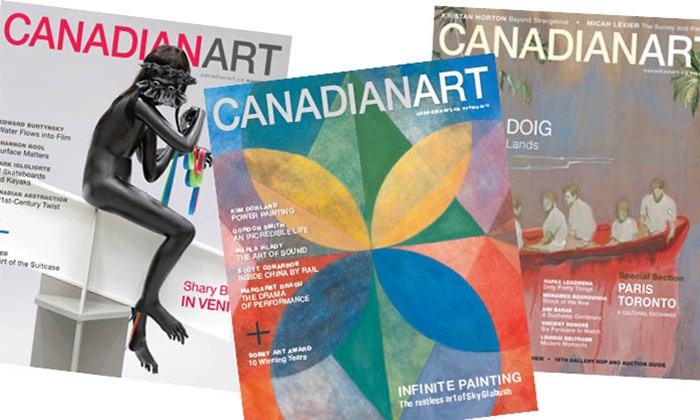
Canadian Art magazine’s “woke suicide pact”

As a cultural barbarian and all-around Neanderthal, it will come as little surprise to both my readers that I’d never even heard of Canadian Art magazine. As a result, the recent decision to cease publication due to the unresolved (and almost certainly unresolvable) issues of needing to be funded by rich white people:

These evils were explained in a long article published by Canadian Art‘s former editor-in-chief, David Balzer (self-describedgay, fag, queer. Ambivalent Libra“), in which he complains that the progressive agenda of the magazine he edited was forever being undercut by the need to solicit funds from wealthy white donors. Or, as he describes it, the pursuit of: “white, liberal money — the champagne socialists.”

Shockingly, these donors are not especially fond an incessant slew of articles with titles such as Drop the Charges and Defund the Police, Says New Artists’ Letter for Black Lives, Give Us Permanence — Ending Anti-Black Racism in Canada’s Art Institutions, and A Crisis of Whiteness in Canada’s Art Museums.

Balzer’s analysis of the growing tension between establishment donor and do-good editor is spot on:

    Most boards, which are also majority white, are [interested] in going to where they believe the money is. So the argument goes: It takes a certain talent, panache, to be president, director, or CEO, to open those pocketbooks, and without these skills, culture cannot run. This argument implies that culture cannot run if its backrooms are not white … Many corporate partners make possible the lavish, yearly fundraising galas that cultural organizations host: ostentatious displays of whiteness and wealth that are the public-facing versions of the aforementioned work done by white presidents, directors and CEOs.

It’s a problem that every charity, art outlet, and activist organization in Canada will face. Supporting the arts is rarely an act of pure altruism. It has always been a status flex by the well-connected barons and baronesses of privilege. At its most cynical, arts funding is a high-class game of reputation laundering.

MGB 81, the Spitfire of the Seas | World War II gunboat review | Motor Boat & Yachting

Filed under: Britain, History, Military, Weapons, WW2 — Tags: , — Nicholas @ 02:00

Motor Boat & Yachting
Published 16 Jan 2019

We have the immense privilege of getting behind the wheel (and guns) of MGB 81, the Spitfire of the seas.

Filmed by Paul Wyeth: http://www.pwpictures.com/

► For the latest reviews, new gear launches and tour news, visit our website here – http://www.mby.com

►Follow us on Twitter here – https://twitter.com/mbytimeinc

QotD: The economic concept of “revealed preferences”

Filed under: Britain, Economics, Government, Media, Quotations — Tags: , , — Nicholas @ 01:00

Economists have a handy term called “revealed preferences”. In colloquial English it means “look at what people do, not what they say, and certainly never take notice of what they say others should do”.

Now, you can’t help but notice that there is a disparity between those who say that taxes should be higher and those who act as if they should be. Clearly, an individual who really believes that the Government is more effective at spending his money would voluntarily offer up more than the legal minimum of taxation. That we have fewer people acting in this manner than are to be found writing columns and making speeches calling for higher taxation shows a certain gap, does it not, between public utterances and private actions? Why, we could make such donations a litmus test for those believers in higher taxation and state spending who want to compel all of us to pay more. Only those who show their commitment by sending a cheque to the Treasury should be treated seriously.

Cheques, by the way, should be made out to “The Accountant, HM Treasury”, and sent to 1 Horse Guards Road, London SW1A 2HQ. A 2nd-class stamp is sufficient and you are encouraged to add a covering note so that your donation is spent in the way you like.

Tim Worstall, “Show us your cheques”, Times of London, quoted in Continental Telegraph, 2020-05-07.

August 8, 2020

Andrew Sullivan – “[T]he Kendi test: does the staff reflect the demographics of New York City as a whole?”

Filed under: Business, Media, Politics, USA — Tags: , , , , — Nicholas @ 05:00

In his latest Weekly Dish, Andrew Sullivan looks at an earnest diversity initiative of The Newspaper Guild of New York:

I’m naming this after Ibram X. Kendi because his core contribution to the current debate on race is the notion that “any measure that produces or sustains racial inequity between racial groups” is racist. Intent is irrelevant. I don’t think many sane people believe A.G. Sulzberger or Dean Baquet are closet bigots. But systemic racism, according to Kendi, exists in any institution if there is simply any outcome that isn’t directly reflective of the relevant racial demographics of the surrounding area.

The appeal of this argument is its simplicity. You can tell if a place is enabling systemic racism merely by counting the people of color in it; and you can tell if a place isn’t by the same rubric. The drawback, of course, is that the world isn’t nearly as simple. Take the actual demographics of New York City. On some measures, the NYT is already a mirror of NYC. Its staff is basically 50 – 50 on sex (with women a slight majority of all staff on the business side, and slight minority in editorial). And it’s 15 percent Asian on the business side, 10 percent in editorial, compared with 13.9 percent of NYC’s population.

But its black percentage of staff — 10 percent in business, 9 percent in editorial — needs more than doubling to reflect demographics. Its Hispanic/Latino staff amount to only 8 percent in business and 5 percent in editorial, compared with 29 percent of New York City’s demographics, the worst discrepancy for any group. NYT’s Newsroom Fellowship, bringing in the very next generation, is 80 percent female, 60 percent people of color (including Asians), and, so far as I can tell, one lone white man. And it’s why NYT‘s new hires are 43 percent people of color, a definition that includes Asian-Americans.

But notice how this new goal obviously doesn’t reflect New York City’s demographics in many other ways. It draws overwhelmingly from the college educated, who account for only 37 percent of New Yorkers, leaving more than 60 percent of the city completed unreflected in the staffing. It cannot include the nearly 19 percent of New Yorkers in poverty, because a NYT salary would end that. It would also have to restrict itself to the literate, and, according to Literacy New York, 25 percent of people in Manhattan “lack basic prose literary skills” along with 37 percent in Brooklyn and 41 percent in the Bronx. And obviously, it cannot reflect the 14 percent of New Yorkers who are of retirement age, or the 21 percent who have yet to reach 18. For that matter, I have no idea what the median age of a NYT employee is — but I bet it isn’t the same as all of New York City.

Around 10 percent of staffers would have to be Republicans (and if the paper of record nationally were to reflect the country as a whole, and not just NYC, around 40 percent would have to be). Some 6 percent of the newsroom would also have to be Haredi or Orthodox Jews — a community you rarely hear about in diversity debates, but one horribly hit by a hate crime surge. 48 percent of NYT employees would have to agree that religion is “very important” in their lives; and 33 percent would be Catholic. And the logic of these demographic quotas is that if a group begins to exceed its quota — say Jews, 13 percent — a Jewish journalist would have to retire for any new one to be hired. Taking this proposal seriously, then, really does require explicit use of race in hiring, which is illegal, which is why the News Guild tweet and memo might end up causing some trouble if the policy is enforced.

And all this leaves the category of “white” completely without nuance. We have no idea whether “white” people are Irish or Italian or Russian or Polish or Canadians in origin. Similarly, we do not know if “black” means African immigrants, or native black New Yorkers, or people from the Caribbean. 37 percent of New Yorkers are foreign-born. How does the Guild propose to mirror that? Ditto where staffers live in NYC. How many are from Staten Island, for example, or the Bronx, two places of extremely different ethnic populations? These categories, in other words, are incredibly crude if the goal really is to reflect the actual demographics of New York City. But it isn’t, of course.

My point is that any attempt to make a specific institution entirely representative of the demographics of its location will founder on the sheer complexity of America’s demographic story and the nature of the institution itself. Journalism, for example, is not a profession sought by most people; it’s self-selecting for curious, trouble-making, querulous assholes who enjoy engaging with others and tracking down the truth (at least it used to be). There’s no reason this skillset or attitude will be spread evenly across populations. It seems, for example, that disproportionate numbers of Jews are drawn to it, from a culture of high literacy, intellectualism, and social activism. So why on earth shouldn’t they be over-represented?

And that’s true of other institutions too: are we to police Broadway to make sure that gays constitute only 4 percent of the employees? Or, say, nursing, to ensure that the sex balance is 50-50? Or a construction company for gender parity? Or a bike messenger company’s staff to be reflective of the age demographics of the city? Just take publishing — an industry not far off what the New York Times does. 74 percent of its employees are women. Should there be a hiring freeze until the men catch up?

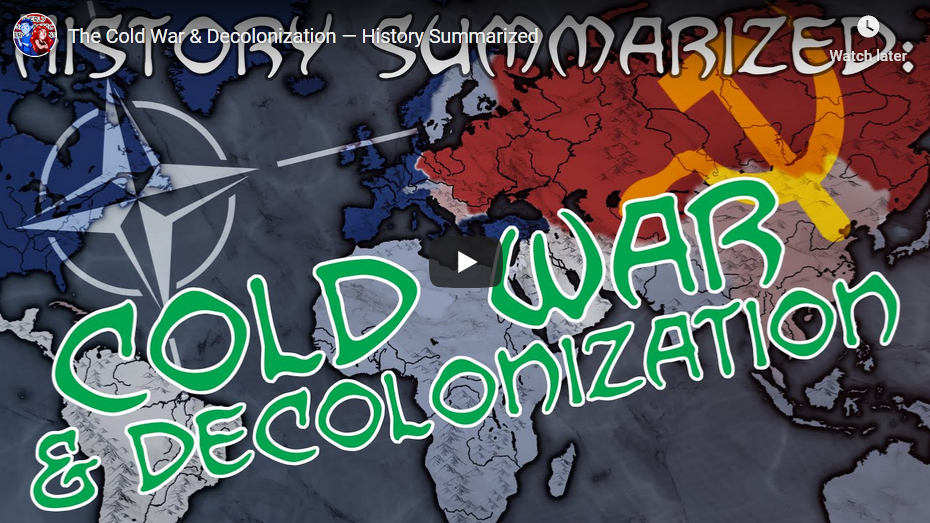
The Cold War & Decolonization — History Summarized

Overly Sarcastic Productions
Published 7 Aug 2020

Keep safe and stylish with a Red-And-Blue facemask from Volante Design, or DONATE to help students in public schools receive high-quality masks for free — https://bit.ly/2DwE9O7

August of 2020 marks the 75th anniversary of the end of the Second World War. So I wanted to make a video about that. That was a bad idea…

What do you get when a Classically-Minded historian ventures about 2,000 years outside of their comfort zone? A mess. A well-intentioned mess is what you get. BUT a mess that we can learn from! So join me as we dig into the aftermath of the Second World War to analyze the origins of the Cold War and the decolonization of European Empires.

SOURCES & Further Reading: The Cold War by Gaddis, The Wars of French Decolonization by Clayton, British decolonization, 1946-1997 by McIntyre, The Cold War’s Killing Fields by Chamberlin, The Cold War: A Very Short Introduction by McMahon, and “Crash Course European History [Parts 42-47]” by Green.

This video was edited by Sophia Ricciardi AKA “Indigo”. https://www.sophiakricci.com/
Our content is intended for teenage audiences and up.

DISCORD: https://discord.gg/kguuvvq

PATREON: https://www.Patreon.com/OSP

MERCH LINKS: https://www.redbubble.com/people/OSPY…

OUR WEBSITE: https://www.OverlySarcasticProductions.com
Find us on Twitter https://www.Twitter.com/OSPYouTube
Find us on Reddit https://www.Reddit.com/r/OSP/

From the comments:

Overly Sarcastic Productions
1 hour ago (edited)
Some clarifications:
North Africa did of course see conflict, the Pacific did get occupied — even the places that didn’t (eg: India) still paid for the war. Damn double-negatives.

That weird Romania-Hungary-Russia border is a holdover from WWII. The border lasted until 1946 and was changed in 1947. Later in the video you’ll see the more familiar borders.

Indonesia declared Independence in 1945 (Like Vietnam), but the Netherlands didn’t withdraw until 1949, hence my mention of ’49.

“The show exploits the most extreme disaster LARPers, but their visions of the apocalypse are typical”

Filed under: Media, USA — Tags: , , — Nicholas @ 03:00

Jen Gerson does a bit of disaster-watching, or rather not so much watching disasters as watching people prepping for disasters:

If you spend a few hours devoted to consuming episodes of the reality TV show Doomsday Preppers, it becomes impossible to avoid this obvious conclusion: doomsday preppers are probably the least prepared of any of us to survive the apocalypse.

Take Season 2, Episode 14, for example, in which a 44-year-old man in Hawaii believes that he will use his intuition and limited backcountry skills to survive a tsunami — his first such intuition is to get into a boat.

More typically, the television show documents Middle American families who believe they can buy their way out of society’s collapse by burying bunkers and stockpiling food, weapons and tactical gear.

Most of them seem paranoid. A few come off as genuinely disturbed. All of them seem sad.

Ask them what they’re so afraid of and they will list their apocalypse of choice: electromagnetic pulse, financial collapse, famine, drought, coup, a population-devastating plague.

The show exploits the most extreme disaster LARPers, but their visions of the apocalypse are typical. We were all prepared for zombies, and aliens — the surround-sound end-of-the world in which we would take up arms against invading forces and ferry our children to the bug-out Eden in the mountains.

Nobody pictured the apocalypse would like this; stuck at home for months at a time, pounding Oreos and beer at 11 a.m. and watching Doomsday Preppers on Netflix while faking a work day on the couch. For most, heroism has been an act of idleness.

Tank Chats #77 Jagdtiger | The Tank Museum

Filed under: Germany, History, Military, Weapons, WW2 — Tags: , , , — Nicholas @ 02:00

The Tank Museum
Published 14 Jun 2019

David Willey, Curator at The Tank Museum, presents a Tank Chat on the mighty WW2 German Jagdtiger.

Support the work of The Tank Museum on Patreon: ► https://www.patreon.com/tankmuseum

Visit The Tank Museum SHOP: ► https://tankmuseumshop.org/

Twitter: ► https://twitter.com/TankMuseum
Instagram: ► https://www.instagram.com/tankmuseum/
Tiger Tank Blog: ► http://blog.tiger-tank.com/
Tank 100 First World War Centenary Blog: ► http://tank100.com/ #tankmuseum #tanks #tankchats

QotD: The British Empire

Filed under: Britain, Economics, History, Quotations — Tags: , — Nicholas @ 01:00

Security empires come and go. While they serve a purpose, their citizens are willing to pay the cost. When they become too expensive to maintain, they simply fold, or get ground under. They work to purpose, or stop.

Conquest empires rarely outlive their founders, or only last a few generations. Alexander’s generals, or Charlemagne’s children and grandchildren, dividing and subdividing into smaller and smaller units, is the norm for such empires. (If not straight collapse when the dictator holding it all together vanishes.)

The only “conquest” empires that have held up are those that send settlers into the lands of hunter-gatherers or nomads. The United States, Russia and Australia being good examples. (But the only reason they can hold up is if the captured territory can be converted into a functional part of the state and society … something the US and Australia have largely managed … Russia’s attempts to enforce this unity by repression of its more developed conquered peoples have not been so successful over the last few centuries, and it is unlikely that China will do much better long-term no matter how much repression it introduces into its recent conquests of established societies like Tibet and the Uyghurs.)

Which leaves only trade empires as potentially successful long term options. And only because their success is not measured by sustaining the political unity of the “empire”, but by sustaining its economic goals.

The most successful empire in world history is the British empire, which could delightedly declare itself obsolete in the 1920s, and again (after having to work mostly co-operatively to fight World War Two) in the 1950s. Both times it encouraged the member states to go look after themselves (some successfully and some less so), and yet it still managed to leave an almost completely secure legacy for its existence … relatively safe international free trade routes. (The almost complete elimination of both piracy and slavery worldwide just being minor side benefits of the British Empire.)

For an empire developed “in a fit of absent mindedness”, and as a byproduct of trying to develop free trade around the world: the measure of success has to be the Commonwealth of Nations – comprising 54 nations with about 1/3 of the world’s population, getting together to play cricket every year and hold a Commonwealth Games every 4 years.

This is not an empire that copllapsed, or was destroyed. This is an empire that over a century or so (from granting independent Dominion status to Canada in 1886 [Canadians stoutly maintain it was 1867], Australia 1901, New Zealand and South Africa pre-Great War, Ireland and Egypt interwar, India and Pakistan post war, large parts of Asia and Africa in the 60s and 70s etc.); nonetheless developed and secured the international free trade system that the world has embraced. (Including a re-integration by an early exit-er from the empire … the 13 out of 35 British north American colonies that became the United States … and who finally inherited the title of world policeman when the rest of the Commonwealth nations had got sick of the whole thing.)

Nigel Davies, “Types of Empires: Security, Conquest, and Trade”, rethinking history, 2020-05-02.

August 7, 2020

A Career Anti-Fascist – George Orwell – WW2 Biography Special

World War Two
Published 6 Aug 2020

George Orwell is one of the most famous English writers in the modern age. But how did he become the man who would coin so many of the words we still use in our political debates?

Join us on Patreon: https://www.patreon.com/TimeGhostHistory
Or join The TimeGhost Army directly at: https://timeghost.tv

Follow WW2 day by day on Instagram @World_war_two_realtime https://www.instagram.com/world_war_two_realtime
Between 2 Wars: https://www.youtube.com/playlist?list…
Source list: http://bit.ly/WW2sources

Hosted by: Indy Neidell
Written by: Rune Væver Hartvig
Director: Astrid Deinhard
Producers: Astrid Deinhard and Spartacus Olsson
Executive Producers: Astrid Deinhard, Indy Neidell, Spartacus Olsson, Bodo Rittenauer
Creative Producer: Joram Appel
Post-Production Director: Wieke Kapteijns
Research by: Rune Væver Hartvig
Edited by: Mikołaj Cackowski
Sound design: Marek Kamiński
Map animations: Eastory (https://www.youtube.com/c/eastory)

Colorizations by:
Cassowary https://www.flickr.com/photos/cassowa…
Klimbim https://www.flickr.com/photos/2215569…

Sources:
Wellcome Images V0014461
Bundesarchiv
Narodowe Archiwum Cyfrowe
From the Noun Project: Pig by supalerk laipawat, Horse by supalerk laipawat, Goat by Laymik, Sheep by Laymik, Cow by supalerk laipawat, Chicken by supalerk laipawat, Farmer by Symbolon, Podium by Focus Lab

Soundtracks from the Epidemic Sound:
Howard Harper-Barnes – “London”
Johannes Bornlof – “Deviation In Time”
Johannes Bornlof – “The Inspector 4”
Skrya – “First Responders”
Jo Wandrini – “Puzzle Of Complexity”

Archive by Screenocean/Reuters https://www.screenocean.com.

A TimeGhost chronological documentary produced by OnLion Entertainment GmbH.

From Medieval Letters Patent to our modern patents, by way of Venice

Filed under: Britain, Europe, History, Law, Technology — Tags: , , , , , — Nicholas @ 05:00

In the latest Age of Invention newsletter, Anton Howes traces the lines of descent from the Letters patent of the Middle Ages, through Venetian legal innovations, to what began to resemble our modern patent system:

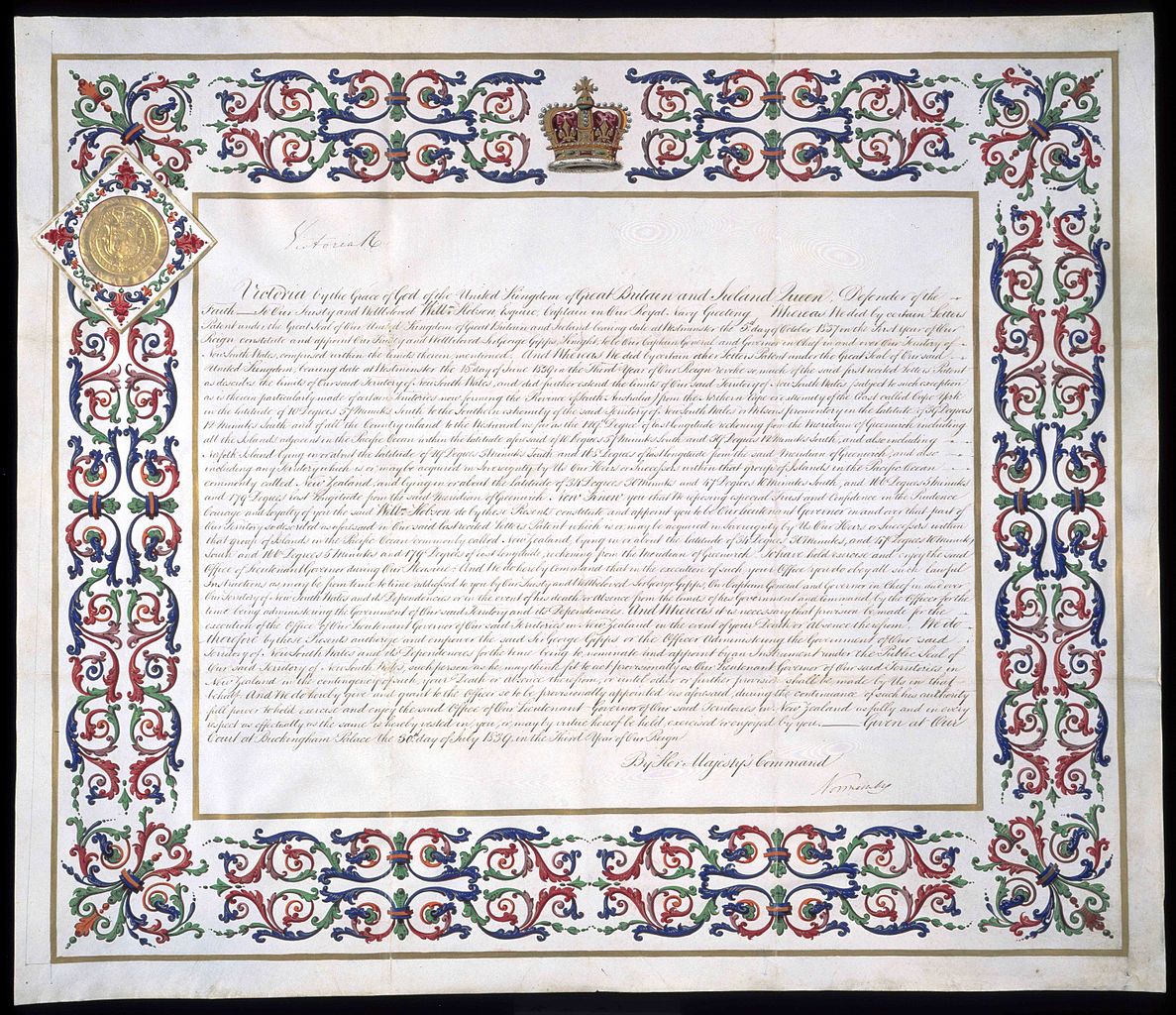
Letters Patent Issued by Queen Victoria, 1839
On 15 June 1839 Captain William Hobson was officially appointed by Queen Victoria to be Lieutenant Governor General of New Zealand. Hobson (1792 – 1842) was thus the first Governor of New Zealand. This position was renamed in 1907 as “Governor General”. Hobson arrived in New Zealand in late January 1840, and oversaw the signing of te Tiriti o Waitangi only a few days later. By the end of 1840, New Zealand became a colony in its own right and Hobson moved the capital of the colony from the Bay of Islands to Auckland. He served as Governor until his death in 1842 after he suffered a stroke at the age of 49.
Constitutional Records group of Archives NZ via Wikimedia Commons.

Patents for invention — temporary monopolies on the use of new technologies — are frequently cited as a key contributor to the British Industrial Revolution. But where did they come from? We typically talk about them as formal institutions, imposed from above by supposedly wise rulers. But their origins, or at least their introduction to England, tell a very different story.

England’s monarchs had long used their prerogative powers to grant special dispensations by letters patent — that is, orders from the monarch that were open for all the public to see (think of the word patently, from the same root, which means openly or clearly). For the most part, such public proclamations had been used to grant titles of nobility, or to appoint people to positions in various official hierarchies — legal, religious, and governmental. And, of course, letters patent could be used to promote the introduction of new technologies.

[…]

Monopolies in general, of course, over particular trades or industries had been granted for centuries, by rulers all across Europe. They granted such privileges to groups of merchants, artisans, and city-dwellers, giving them rights to organise and regulate their own activities as guilds or as city corporations. Inherent to all such charters was the ability of the in-group to restrict competition from outsiders, at least within the confines of their city. And the ruler, in exchange for granting such privileges, typically received a share of the guild’s or corporation’s revenues. But such monopolies were very rarely given to individuals. When they were, it was often so unpopular as to be almost immediately overturned. And they were rarely used to encourage innovation.

With one exception: Italy. Throughout the fifteenth century, some Italian city guilds had begun to forbid their members from copying newly-invented patterns for silk and woollen cloth, effectively granting a monopoly over those patterns to the individual inventors. In Venice, a 50-year monopoly was granted in 1416 to one Franciscus Petri, of Rhodes, to introduce superior fulling mills. In Florence, the famous architect and engineer Filippo Brunelleschi was granted a monopoly in 1421 for a vessel he designed for transporting heavy loads of marble, in exchange for revealing the secrets of his design. The printing press was also introduced to Venice using such a privilege, with a 5-year monopoly granted in 1469 to Johannes of Speyer, though he died only a few months after receiving it. And these ad hoc grants were made with increasing frequency, such that in 1474 Venice legislated to make them more systematic, declaring that 10-year monopolies could be obtained for all new technologies, either invented or imported (though it continued to also grant ad hoc patents, with the terms and durations decided on a case-by-case basis as before). Under the 1474 law, Venice was soon granting patent monopolies to the introducers of various mills, pumps, dredges, textile machines, printing techniques, and even special kinds of lasagna. It granted over a hundred patents in the first half of the sixteenth century, with many more thereafter.

From Venice, the use of patent monopolies as an instrument of policy spread abroad, with the initiative coming from the would-be introducers of novelties themselves. In the mid-fifteenth century, for example, a French inventor who had acquired patents in Venice was also successfully lobbying for similar privileges from the archbishop of Salzburg, the duke of Ferrara, and the Hapsburg Holy Roman Emperor. The use of patent monopolies thus soon diffused to the rest of Italy, to Germany, and to the various dominions of the Spanish emperor — including Spain itself, its American colonies, and the Low Countries.

And, eventually, to England. But not in the way we might expect. In 1496, the Venetian explorer Zuan Chabotto (aka John Cabot) acquired a patent monopoly from Henry VII over the trade and products of any lands he was to discover — a legal procedure unlike anything that earlier English explorers had attempted (they had merely been granted licenses). Cabot’s grant even differed from the agreements made by Christopher Columbus with the Spanish crown, or by earlier explorers for the Portuguese. Columbus, for example, was effectively granted a patent of nobility — the hereditary titles of viceroy, admiral, and governor. He and the Portuguese explorers were direct agents of the crown, with military and justice-dispensing responsibilities over any newly conquered lands — a model derived from the Christian conquests of Muslim Iberia. Columbus effectively became a marcher lord, a custodian and defender of Spain’s new borderlands.

“40:1” Pt. 2 – Another Polish Last Stand – Sabaton History 079 [Official]

Filed under: Europe, Germany, History, Media, Military, Russia, WW2 — Tags: , , , — Nicholas @ 04:00

Sabaton History
Published 6 Aug 2020

At the end of September 1939, Poland was burning. Trapped in an ever shrinking corridor between the Wehrmacht and the Red Army, the last remaining Polish forces were still holding out. Isolated, short of ammunition and supplies, and without hope for relief. The last Polish Army, the SGO Polesie, was making its way towards the Vistula, as it was cut off by German motorcycle troops. Determined to sell their lives dearly, the SGO Polesie dug in and prepared for a last stand.

Support Sabaton History on Patreon: https://www.patreon.com/sabatonhistory

Listen to “40:1” from the album The Art Of War:
https://music.sabaton.net/TheArtOfWar

Watch the Official Music Video of “40:1” here:
https://www.youtube.com/watch?v=epeQw…

Listen to Sabaton on Spotify: http://smarturl.it/SabatonSpotify
Official Sabaton Merchandise Shop: http://bit.ly/SabatonOfficialShop

Hosted by: Indy Neidell
Written by: Markus Linke and Indy Neidell
Directed by: Astrid Deinhard and Wieke Kapteijns
Produced by: Pär Sundström, Astrid Deinhard and Spartacus Olsson
Creative Producer: Joram Appel
Community Manager: Maria Kyhle
Executive Producers: Pär Sundström, Joakim Broden, Tomas Sunmo, Indy Neidell, Astrid Deinhard, and Spartacus Olsson
Post-Production Director: Wieke Kapteijns
Edited by: Karolina Dołęga
Sound Editing by: Marek Kaminski
Maps by: Eastory – https://www.youtube.com/c/eastory
Archive by: Reuters/Screenocean https://www.screenocean.com
Music by Sabaton.

Sources:
Paul Otto courtesy Glenn Jewison
University of Wisconsin-Milwaukee Libraries
Bundesarchiv
Imperial War Museums: HU106375
Museum of Warsaw
Narodowe Archiwum Cyfrowe
Centralne Archiwum Wojskowe

An OnLion Entertainment GmbH and Raging Beaver Publishing AB co-Production.

© Raging Beaver Publishing AB, 2019 – all rights reserved.

From the comments:

Sabaton History
2 days ago (edited)
Once again the time has come for the Polish people to show what they’re made of.

This time they’re facing a gargantuan two-headed monster of an enemy and are outnumbered many many times over.

They may not win, they may not even live to see another day — but The Polish will not give up without giving their all.

Spirit of Spartans
Death and glory
Soldiers of Poland
Second to none

So come, bring on all that you’ve got
Come hell, come high water — never stop!

With the help of Indy and the TimeGhost team you can learn more about the Soviet invasion of Poland and the last days of The Polish Defensive War in these two episodes of the “World War Two In Real Time” series:

“The Russians are Coming! – The Soviet Invasion of Poland” – WW2 – 004 – September 22, 1939
https://youtu.be/8vjBp-qyNVE

“Poland is Crushed” – WW2 – 005 – 29 September, 1939
https://youtu.be/OOPiUaakSXM

Aftermath of the Beirut explosion

Filed under: Middle East — Tags: , , , — Nicholas @ 03:00

Kareem Shaheen, who lived and worked in Beirut for some years, reports on the devastation and the ongoing debate over causes and responsibility:

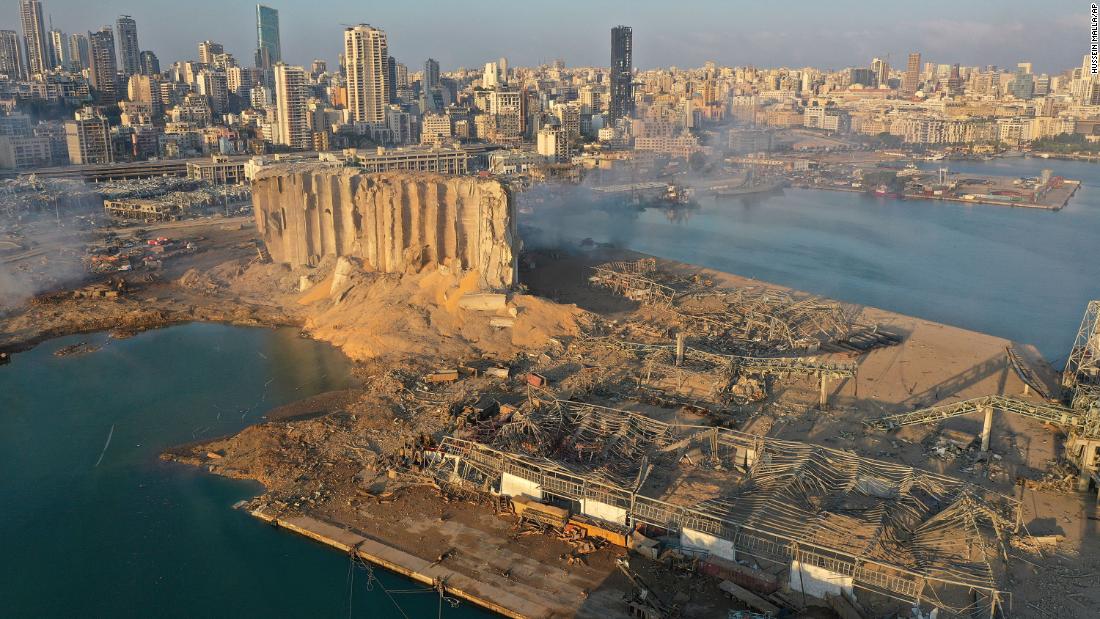
Part of a photo gallery posted by CNN shows the site of the explosion in Beirut harbour. Note the massive grain elevator structure has been partly demolished, but the buildings on the other side almost certainly suffered far less damage for being in the blast shadow of such a massive concrete shield.
Photo gallery – https://www.cnn.com/2020/08/05/world/satellite-images-beirut-explosion-before-after-trnd/index.html

The Lebanese prime minister and security officials said the explosion was likely caused by a 2,700 tons of highly explosive ammonium nitrate that had been abandoned in the port. By comparison, the Oklahoma City bombing was about 2.2 tons of the same substance.

Reports indicate that the ammonium nitrate had been seized years ago, and knowing Lebanon, it was left there either out of negligence, or because the self-interested ruling classes of the country — a mafia in its own right — could not agree on how to divvy up the profits from the stuff.

Naturally, America’s arsonist and conspiracy theorist in chief, Donald Trump, speculated in a press conference that the explosion looked like a bomb. His generals told journalists, anonymously, that they had no idea what he was talking about.

But in a country already on the verge of collapse, the damage of this speculation was done. Conspiracy theories are now rampant.

Donald Trump’s comment may have been ill-informed, but the conspiracy theorists — along with anyone who thinks they know anything about explosives — were busy spinning pet theories regardless of what he said.

One that made the rounds seized on a tweet by Israeli Prime Minister Benjamin Netanyahu about a raid on pro-Iranian targets in Syria, and linked it to the Beirut explosion. The terrible size of the explosion prompted fears that it was a tactical nuclear strike. Independent Arabia — which licenses the British Independent newspaper brand and is owned by a Saudi Arabian publisher — reported, falsely, that the Canadian embassy said that the explosion’s fallout contained depleted uranium. Another media organization linked to the Lebanese president’s party claimed the explosive material was bound for terrorist groups in Syria.

The explosion could not have come at a worse time. Even before the blast, Lebanon was a failed state. Over most of the past year, it has suffered hyperinflation akin to the crisis in Venezuela.

Lebanon endured a 15-year civil war that ended in 1990 with an accord that divided power equally among its various religions and sects, while ensuring no accountability for the warlords who reigned over militias that carried out atrocities.

Many of these warlords, or their sons, are still in charge, and have built corrupt patronage networks to enrich themselves and their loyalists. Most are beholden to outside powers like Iran and Saudi Arabia, who have turned Lebanon into a proxy battleground for their own geopolitical interests. The most powerful military force in the country is Hezbollah, Iran’s favoured proxy militia, which was instrumental in keeping Syria’s dictator, Bashar Al-Assad, in power. The war drove a million Syrians to seek refuge in Lebanon, which had a pre-war population of just four million.

Myth and Reality of the Ross MkIII Rifle

Filed under: Cancon, History, Military, Weapons, WW1 — Tags: , , , , — Nicholas @ 02:00

Forgotten Weapons
Published 16 Jun 2013

There is a long-standing urban legend about the Canadian Ross rifle, a straight-pull bolt action that was used in lieu of the SMLE by Canadian troops early in World War One. The story is that the Ross would sometimes malfunction and blow the bolt back into its shooter’s face, with pretty horrible results. Well, I wanted to learn “the rest of the story” — could this actually happen? What caused it? How could it be prevented? In short, what would a Ross shooter need to know to remain safe? And if I could get some cool footage of a bolt blowing out of a Ross in the process, all the better.

Well, reader Andy very generously provided a sporterized Ross for the experiments, and I started reading into what the issue really was. Turns out that the legend was quite true — you can put a Ross MkIII bolt together the wrong way, and it will allow you to fire without the locking lugs engaged, thus throwing the bolt back out of the gun at high velocity. However, the issue was recognized fairly quickly, and the vast majority of Ross rifles were modified with a safety rivet to prevent this from happening. It is also quite easy to determine if a Ross is assembled correctly, once you know what to look for.

http://www.forgottenweapons.com

QotD: Celibacy and chastity

Filed under: History, Quotations, Religion — Tags: , , , , — Nicholas @ 01:00

Despite the common misunderstanding of the word, “celibate” does not refer to someone who abstains from sex. “Celibate” refers to someone who forgoes marriage — the part about not having sex is implied, at least in the Christian world, give or take an Alexander VI or two. “Chaste,” at the same time, doesn’t quite mean what people think it does: It refers principally to the abstention from extramarital sex, which in the case of the celibate means abstention from sex categorically. But chastity is part of marriage, too, describing a reverent attitude toward sex. In the Christian view (which is to say, in the view of Western civilization until ten minutes ago), the procreative act is the means by which men and women in union with one another participate in God’s creative work. “Chastity” means a lot more than mere abstinence. Chastity isn’t some kind of genital veganism.

There has been some pretty elevated stuff written on that subject, and if you want to take that particular high road, then Professor Robert George of Princeton is your guy. But consider the low road, too. There’s another conclusion, maybe a little bit cynical, that could be drawn from this: If you are a sexually frustrated young man, the smart play would be to join a church.

Kevin D. Williamson, “Advice for Incels”, National Review, 2018-05-10.

« Newer PostsOlder Posts »

Powered by WordPress