An ad in the Nashville Craigslist:

It may not be a huge market, but there’s definitely a demand for these kind of services, especially at Thanksgiving, Christmas, and family birthday parties.
H/T to Marina Stover for the link.

An ad in the Nashville Craigslist:
It may not be a huge market, but there’s definitely a demand for these kind of services, especially at Thanksgiving, Christmas, and family birthday parties.
H/T to Marina Stover for the link.
Ashe Schow thinks we need to get serious about addressing this issue, and here is her proposal on how to accomplish this worthy end:
For example, if men want to go into gender studies, let them — that way, they’ll make less money and it will help close the gender gap. But women need to be kept away from such majors. Colleges and universities should in fact create separate lists of majors to give to men and women. If possible, women should not be told about any course of study that will yield lower-paying career choices in the future.
Among others, social science majors feed the gender gap. When women ask about those subjects or departments, colleges should tell them they don’t exist, or that all classes are full, except maybe the ones in economics. Even better, colleges should tell women that engineering, mathematics and finance are actually social sciences. Class rosters must then be watched carefully. If a woman somehow manages to sign up for a sociology class, she should instead be given the classroom number for a course in mechanical engineering.
When women express a desire to pursue teaching or social work jobs, they should be discouraged. In fact, college counselors should be instructed to tell them there are no such jobs available, along with some sort of plausible explanation, like: “There are no teaching jobs available anymore, because Republicans cut the budget and the government is closing all of the schools. How about a nice career in accounting?”
Women who ask too many questions should be promptly steered into a nearby organic chemistry class, because no one can remain mentally alert for too long.
Feminists who might disapprove of this proposal should first ask themselves if they would be making more money had someone forced them to become an engineer rather than an activist. Would they have avoided the misfortunes and oppression they now suffer and condemn had they pursued a more useful course of studies and ended up with a higher-paying job?
So what do you do about women who freely make choices that perpetuate structural inequalities? Do you stop them from making the choices? Neither Harvard, nor Kantor, seems to have a good answer. But that is the core dilemma. Maybe women drop out because they have a deeper biological connection to their kids. Maybe they do so because they’re raised to be nurturers, or maybe because they don’t feel the same personal anguish that a man does when he gives up on the dream of a top-flight career. Maybe if men felt they had the option to stay home, more would. And maybe women find the role of breadwinner more stressful than men do — all the women I know who are the primary earners are neurotic about it in a way that the men I know don’t seem to be. I’m not talking about the fear that your partner will resent your success; these are women married to admirably feminist men. I’m just talking about a near-constant fear that you will not be able to provide, and your family will end up horribly destitute. I’m not saying that men don’t experience that worry, but they don’t seem tormented by it the way the women I talk to are.
Or maybe it’s that women just don’t want it badly enough. In my experience, one of the reasons that women drop out of finance, and 80-hour-a-week fields more generally, is that they just don’t want it as badly as the men. In their 20s, they’re happy to work those kinds of hours, even at tasks they find boring. They do well at them, too. But a lot of these jobs aren’t actually that rewarding as work: The investment banking associates I observed seemed to spend most of their time on basically clerical tasks, tabulating data and proofreading PowerPoints. And eventually most of the women seem to say “You know, I just care more about relationships than I do about success.” There are always exceptions on both sides: women who will sacrifice anything for the career they feel called to and men who would rather be home. But on average, the women I talk to just aren’t nearly as willing to sacrifice close friendships, and family relationships, for the sake of their jobs.
We can say that they shouldn’t have to, of course, but the sad fact is that there are trade-offs in this world. In your 20s you can finesse them — work super hard and also have a roaring social life — because you have boundless energy and no one depending on you. This is the age at which young women write furious articles and Facebook posts denouncing anyone who suggests that women opt-out of high pressure jobs for any reason other than the rankest sexism.
As you age, your body refuses to cooperate with your plan to work from 7 a.m. to 11 p.m. and then hang out with friends. Your parents start to need you more, if only to lift heavy things. And of course, there are kids. You start having to make direct trade-offs, and then suddenly you look up and you haven’t seen your friends for two years and your mother is complaining that you never call. This is the age at which women write furious articles defending their decision to step back from a high-pressure job and/or demanding subsidized childcare, generous paid maternity leave and “family friendly policies,” a vague term that ultimately seems to mean that people who leave at five to pick up the kids should be entitled to the same opportunities and compensation as people who stay until 9 to finish the client presentation. These pleas usually end (or begin) by pointing to the family-friendly utopia of Northern Europe, except that women in Europe do less well at moving into high-test management positions. Whatever the government says, someone who takes several years off work is in fact less valuable to their company than someone who doesn’t.
Megan McArdle, “Harvard’s Gender Bender”, Bloomberg View, 2013-09-10
To sum up: the qualities that arouse the protective instinct are the opposite of those that attract a sex partner.
Protector and protégé are outwardly alike; sex partners are complimentary opposites. Protégés are physically and mentally inferior to their protectors; sex partners are physically and mentally equals. These three sets of qualities, opposite and mutually exclusive, of protégés and sex partners, determine the basic attitudes towards each, also opposite and mutually exclusive. And yet we call these profoundly different emotions by the same name: love. Love has become of necessity, then, the most dangerously misleading word in the language.
Esther Vilar, The Polygamous Sex, 1976.
Polar opposition in the sex-specific areas, then, is combined with resemblance in all other respects. The man will usually be physically stronger than the women, a sex-specific difference that makes them attractive to one another. But as soon as this difference becomes too great — as soon as the woman is so weak, or pretends to be so weak, that the physical difference can no longer be regarded as sex-specific — the stronger partner’s protective instinct may seriously interfere with his sex instinct. He may refrain from sex in order not to hurt his partner. If, in addition to being physically inferior, she is also mentally inferior, the weaker partner tends to become increasingly the object of his protection. The sex act — normally a kind of combat at close quarters — under such conditions involves considerable self-restraint, and loses something essential in the process. Equality on the intellectual level, combined with polarity on the physical, is therefore a condition sine qua non of full-scale love between a man and a woman.
A good guarantee for the necessary resemblance of the partners in the nonsexual realm is their belonging to the same generation. By a generation we mean the time span between the birth of an individual and the birth of its first offspring — about twenty to twenty five years. Sexuality is in any case for adults, but if one partner is more than twenty five years older than the other, and thereby belongs to the generation of the other’s grandparents, the chances for a mutually satisfactory sexual relationship are relatively poor. There are of course cases in which a particular person’s special dynamism can bridge this biological gap for a time, but such exceptions only confirm the rule. The frequent alliances between young women and men who are their seniors by more than a generation are no proof to the contrary; they always depend on the same factor: the wealth or social status of the much older man. If it were a biological mechanism that drove attractive young females into the arms of old men, a poor old pensioner might occasionally have a chance of marrying a rich young girl.
Esther Vilar, The Polygamous Sex, 1976.
In Forbes, Tim Worstall looks at how the World Economic Forum came up with their scary conclusions that the pay gap between men and women won’t disappear until 2095:
And that’s it: no, really, that is what they’re basing, in its entirety, their estimations of the gender pay gap upon. They asked a few people whether they thought that men and women got roughly the same pay for roughly the same sort of job or not and that’s it. This isn’t cutting edge data science to put it very kindly indeed.
For when we go off and look at the messy details of the gender pay gap we find that we’ve not really got one, not in the industrialised countries. Once we correct for the obvious things like hours at work, years in the workforce, educational background and so on we find that the mythical gender pay gap (that “women earn 77 cents to every $ men do”) simply disappears. There might be a small residual, a few percent, left in there but not enough that we can really notice. And quite apart from anything else it’s actually illegal to pay men and women different amounts for doing the same job (if on the basis that the different pay is purely as a result of their being men or women that is).
So, no, we shouldn’t be taking this report or finding seriously. And there’s more than just the fact that they’re using a survey to measure that gap. For of course the printing of this report will lead to, as the other incorrect claims about the gender pay gap do, a certain circularity of reasoning.
Ask someone: “Are men and women paid equally?” And they’ll start thinking about whoever it was that said that 77 cents line, recall that last year the WEF said that gender pay inequality was very bad indeed. So, now we come to asking them the same question for the next WEF survey and their answer will be influenced by the cacophony of voices that have been telling them how bad the gender pay disparity is. Including, obviously, last year’s WEF report that said so. It’s entirely circular and self-reinforcing.
Really, we shouldn’t be taking this stuff seriously.
In a post from earlier this year, Scott Alexander discusses a common example of what has been described as a “motte-and-bailey” argument:
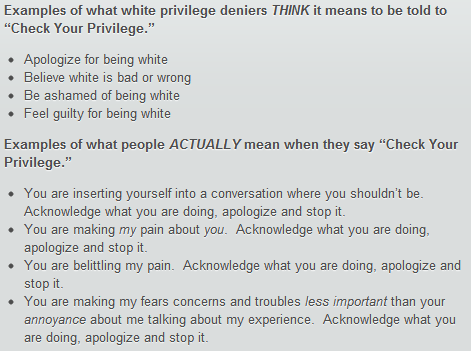
I recently learned there is a term for the thing social justice does. But first, a png from racism school dot tumblr dot com.
So, it turns out that privilege gets used perfectly reasonably. All it means is that you’re interjecting yourself into other people’s conversations and demanding their pain be about you. I think I speak for all straight white men when I say that sounds really bad and if I was doing it I’m sorry and will try to avoid ever doing it again. Problem solved, right? Can’t believe that took us however many centuries to sort out.
A sinking feeling tells me it probably isn’t that easy.
In the comments section of the last disaster of a social justice post on my blog, someone started talking about how much they hated the term “mansplaining”, and someone else popped in to — ironically — explain what “mansplaining” was and why it was a valuable concept that couldn’t be dismissed so easily. Their explanation was lucid and reasonable. At this point I jumped in and commented:
I feel like every single term in social justice terminology has a totally unobjectionable and obviously important meaning — and then is actually used a completely different way.
The closest analogy I can think of is those religious people who say “God is just another word for the order and beauty in the Universe” — and then later pray to God to smite their enemies. And if you criticize them for doing the latter, they say “But God just means there is order and beauty in the universe, surely you’re not objecting to that?”
The result is that people can accuse people of “privilege” or “mansplaining” no matter what they do, and then when people criticize the concept of “privilege” they retreat back to “but ‘privilege’ just means you’re interrupting women in a women-only safe space. Surely no one can object to criticizing people who do that?”
…even though I get accused of “privilege” for writing things on my blog, even though there’s no possible way that could be “interrupting” or “in a women only safe space”.
When you bring this up, people just deny they’re doing it and call you paranoid.
When you record examples of yourself and others getting accused of privilege or mansplaining, and show people the list, and point out that exactly zero percent of them are anything remotely related to “interrupting women in a women-only safe space” and one hundred percent are “making a correct argument that somebody wants to shut down”, then your interlocutor can just say “You’re deliberately only engaging with straw-man feminists who don’t represent the strongest part of the movement, you can’t hold me responsible for what they do” and continue to insist that anyone who is upset by the uses of the word “privilege” just doesn’t understand that it’s wrong to interrupt women in safe spaces.
I have yet to find a good way around this tactic.
My suspicion about the gif from racism school dot tumblr dot com is that the statements on the top show the ways the majority of people will encounter “privilege” actually being used, and the statements on the bottom show the uncontroversial truisms that people will defensively claim “privilege” means if anyone calls them on it or challenges them. As such it should be taken as a sort of weird Rosetta Stone of social justicing, and I can only hope that similarly illustrative explanations are made of other equally charged terms.
H/T to Sam Bowman for the link.
The Popehat grand poobah suspects that if you’re passionate about #gamergate, you’re probably wrong … or at least, wrong-headed about your passions:
GamerGate is label-heavy, and labels are lazy, obfuscating bullshit.
Labels are supposed to be shorthand for collections of ideas. I might say “I am libertarian-ish” because it’s not practical to go around announcing the whole array of views I hold about demolishing public roads and privatizing the air force and so forth. This, up to a point, is useful.
It stops being useful when we argue over labels instead of over ideas. Take, for instance, “feminist.” A person who describes themselves as “feminist” might associate that term with their grandmother being the first woman in the family to go to college and their mother defying a sexist boss in a male-dominated job and the development of laws saying women can’t be relentlessly harassed in the workplace or fired for being women.1 Someone who routinely criticizes “feminism” might be thinking of Andrea Dworkin saying all heterosexual sex is coercive, or that time a woman snapped at him when he held a door open, or the time someone embarrassed his friend by saying his joke was sexist. When these two people use the term “feminist” in an argument, they are talking past each other and engaging with strawmen rather than ideas. The feminist is engaging the anti-feminist as if he opposes women in the workplace or supports gender-based hiring, which he doesn’t necessarily. The anti-feminist is engaging the feminist as if she thinks all marital sex is rape and as if she thinks jokes should get him fired, which she doesn’t necessarily. Neither is really engaging in the particular issue at hand — because why would you engage with a person who holds such extreme views? Why would it matter if the person you are arguing with has an arguable point on a specific issue, if they also necessarily (based on labels) stand for everything you hate?
Oh, and reacting before thinking (or instead of it)?
People are going to say things about your favorite parts of the culture. Some of these things will be stupid or wrong. It is swell to use more speech to disagree with, criticize, or ridicule the criticism. But when you become completely and tragicomically unbalanced by the existence of cultural criticism, or let it send you into a buffoonish spiral of resentful defensiveness, people may not take you seriously. Rule of thumb: a reasoned rebuttal of wrong-headed cultural criticism mostly likely won’t require you to use the word “cunt.”
There are ten points Ken covers in the original post. I really do recommend that you read it all. By my count, he gores everyone’s ox by the time he’s at point four (and by point five, he’s blaming Canada in the footnotes).
Andrew Sullivan carefully dips his toes into the #gamergate war:

Many readers have warned me not to dip a toe into the gamergate debate, which, so far, we’ve been covering through aggregation and reader-input. And I’m not going to dive headlong into an extremely complex series of events, which have generated huge amounts of intense emotion on all sides, in a gamer culture which Dish readers know far, far better than I. But part of my job is to write and think about burning current web discussions – and add maybe two cents, even as an outsider.
So let me make a few limited points. The tactics of harassment, threats of violence, foul misogyny, and stalking have absolutely no legitimate place in any discourse. Having read about what has happened to several women, who have merely dared to exercise their First Amendment rights, I can only say it’s been one of those rare stories that still has the capacity to shock me. I know it isn’t fair to tarnish an entire tendency with this kind of extremism, but the fact that this tactic seemed to be the first thing that some gamergate advocates deployed should send off some red flashing lights as to the culture it is defending.
Second, there’s a missing piece of logic, so far as I have managed to discern, in the gamergate campaign. The argument seems to be that some feminists are attempting to police or control a hyper-male culture of violence, speed, competition and boobage. And in so far as that might be the case, my sympathies do indeed lie with the gamers. The creeping misandry in a lot of current debates – see “Affirmative Consent” and “Check Your Privilege” – and the easy prejudices that define white and male and young as suspect identities (because sexism!) rightly offend many men (and women).
There’s an atmosphere in which it has somehow become problematic to have a classic white, straight male identity, and a lot that goes with it. I’m not really a part of that general culture – indifferent to boobage, as I am, and bored by violence. But I don’t see why it cannot have a place in the world. I believe in the flourishing of all sorts of cultures and subcultures and have long been repulsed by the nannies and busybodies who want to police them – whether from the social right or the feminist left.
But – and here’s where the logic escapes me – if the core gamers really do dominate the market for these games, why do they think the market will stop catering to them? The great (and not-so-great) thing about markets is that they are indifferent to content as such. If “hardcore gamers” skew 7 -1 male, and if corporations want to make lots of money, then this strain of the culture is hardly under threat. It may be supplemented by lots of other, newer varieties, but it won’t die. Will it be diluted? Almost certainly. Does that feel like an assault for a group of people whose identity is deeply bound up in this culture? Absolutely. Is it something anyone should really do anything about? Nah. Let a thousand variety of nerds and post-nerds bloom. And leave Kenny McCormick alone. This doesn’t have to be zero-sum.
Our sexual differences can be more or less general, or more or less individual i.e. they may be typical for the whole sex or for only an individual member of that sex. Men with a vigorous growth of beard, hairy chests broad shoulders narrow hips, big penises, for example, are generally more in demand as are, conversely, women with delicate skin, big breasts, wide hips. The more individual polarity exists in any given case, the more ideal the sexual relationship is likely to become. We all do what we can to emphasize our sexual differentiation from the opposite sex — or with respect to a specific member of the opposite sex — as skillfully as possible. Whoever is not strikingly male or female will do everything possible to seem so by, for example, developing his biceps through gymnastics, pad her bra, style the hairdo, etc.
The same motivation also underlies the so-called ‘typically masculine’ and ‘typically feminine’ kinds of behavior: it is always a conscious or unconscious parading of sex-specific characteristics. To smile rarely or often, talk much or little, swing the hips or not in walking, makes people ‘more manly’ or ‘more womanly.’ This kind of behavior is simulated, as shown by the fact that it is subject to fashion and can be dropped at will. The ‘womanly’ mannerisms of the stars in the old movies are markedly different from those we see in films by Truffault or Godard. To behave like a movie vamp of the twenties today is to appear not womanly but ridiculous.
Esther Vilar, The Polygamous Sex, 1976.
For one thing, the average online gamer is female*:
The confusing, nasty muck of the Gamergate scandal, in which anonymous attackers have harassed and sent death threats to women linked to the video-game industry, has morphed into a bitter culture war over the world’s $100 billion gaming empire.
But the fight has also highlighted the minefield facing an industry still learning how best to attract — and protect — a new generation of American gamer. The danger, analysts said: The fight could scare away the growing market of women the gaming industry wants.
The stereotype of a “gamer” — mostly young, mostly nerdy and most definitely male — has never been further from the truth. In the United States, twice as many adult women play video games as do boys, according to the Entertainment Software Association, the industry’s top trade group. Male gamers between ages 10 and 25 represent a sliver of the market, only 15 percent, according to Newzoo, a games research firm.
Yet America’s 190 million gamers, 48 percent of whom are women, still play in a harsh frontier. About 70 percent of female gamers said they played as male characters online in hopes of sidestepping sexual harassment, according to a study cited by “Hate Crimes in Cyberspace” author and law professor Danielle Keats Citron.
“It’s just like playing outside when you’re a teenager. It’s still a jungle out there,” said Peter Warman, the chief executive of Newzoo. Of the women who played as men, he said, “they wanted to be treated equal on the virtual battlefield.”
* Actually, the Washington Post headline mis-represents the data slightly, so this isn’t an accurate statement either.
Human beings also operate on this principle of similarity. Identification with her young is of course easiest for the mother: she has felt it inside her for months, she has known it come out of her own body, it is ‘flesh of her flesh’ i.e. herself. The father, by comparison, depends on hearsay; he is therefore likely to be rather indifferent at first. Despite the repeated assurances from everyone around him that the newborn is his ‘spitting image’ it is not easy for him to see this. It is only some time later that he begins to accept the resemblance and to love the child.
A woman’s predisposition to identify with the infant at once, to a degree impossible for the male, has won her the reputation of being the more selfless parent. Since she instantly accepts the newborn as her charge and actively devotes herself to its care and feeding, a mother’s love is held to be stronger than that of a father. Actually it is only a matter of time lapse between two equally powerful emotional attachments, based entirely upon biological causes.
That fathers are capable of loving their children just as much as mothers, and that the male nurturing instinct is in no way less developed than that of the female, is amply attested by the exchange of parental roles in various primitive cultures, as well as by the experimental knowledge of modern sociology.
Esther Vilar, The Polygamous Sex, 1976.
In Time, Camille Paglia says that universities are unable to understand the real risks to young women on campus:
The gender ideology dominating academe denies that sex differences are rooted in biology and sees them instead as malleable fictions that can be revised at will. The assumption is that complaints and protests, enforced by sympathetic campus bureaucrats and government regulators, can and will fundamentally alter all men.
But extreme sex crimes like rape-murder emanate from a primitive level that even practical psychology no longer has a language for. Psychopathology, as in Richard von Krafft-Ebing’s grisly Psychopathia Sexualis (1886), was a central field in early psychoanalysis. But today’s therapy has morphed into happy talk, attitude adjustments, and pharmaceutical shortcuts.
There is a ritualistic symbolism at work in sex crime that most women do not grasp and therefore cannot arm themselves against. It is well-established that the visual faculties play a bigger role in male sexuality, which accounts for the greater male interest in pornography. The sexual stalker, who is often an alienated loser consumed with his own failures, is motivated by an atavistic hunting reflex. He is called a predator precisely because he turns his victims into prey.
Sex crime springs from fantasy, hallucination, delusion, and obsession. A random young woman becomes the scapegoat for a regressive rage against female sexual power: “You made me do this.” Academic clichés about the “commodification” of women under capitalism make little sense here: It is women’s superior biological status as magical life-creator that is profaned and annihilated by the barbarism of sex crime.
You have to admire the courage of Captain Lauren F. Serrano for publishing this opinion article in the Marine Corps Gazette. She clearly states why women do not belong in the infantry, and explains the few exceptions (Israel and the Kurds have female infantry troops). This may mark the moment at which she stopped progressing toward her next promotion, however, as what she says will be incredibly unpopular politically:
While reading the February issue of the Marine Corps Gazette, I skimmed past the “Be Bold” advertisement calling for readers to submit articles that challenge a Marine Corps policy or way of doing business. Immediately a current “hot topic” came to mind, but as usual I quickly discarded it because I have purposely avoided publicly disagreeing with the passionate opinions of many of my female peers and friends. After weeks of contemplation and debate, I am “being bold” and coming clean: I am a female Marine officer and I do not believe women should serve in the infantry. I recognize that this is a strong statement that will be vehemently challenged by many. I have not come to this opinion lightly and I do not take joy in taking a stance that does not support equal opportunity for all. I have spent countless hours discussing this topic with many civilians and Marines and have discovered that a large number of people agree with the arguments in this article but do not wish to get involved in the public discussion. Interestingly, most of the people who want to incorporate women into infantry are civilians or young, inexperienced Marines. Most of the more seasoned Marines with whom I have spoken tend to oppose the idea of women in infantry—perhaps this is failure to adapt or perhaps it is experienced-based reasoning. National Public Radio’s recent segment, “Looking for a Few Good (Combat-Ready) Women,” stated, “Col Weinberg admits there’s anecdotal evidence that female Marines, who make up 7 percent of the force, aren’t rushing to serve in ground combat.” If the infantry had opened to women while I was still a midshipman or second lieutenant I probably would have jumped at the opportunity because of the novelty, excitement, and challenge; but, to my own disappointment, my views have drastically changed with experience and knowledge. Acknowledging that women are different (not just physically) than men is a hard truth that plays an enormous role in this discussion. This article addresses many issues regarding incorporating women into the infantry that have yet to be discussed in much of the current discourse that has focused primarily on the physical standards.
Before you disagree, remember that war is not a fair business. Adversaries attempt to gain an advantage over their enemies by any means possible. Enemies do not necessarily abide by their adversary’s moral standards or rules of engagement. Although in today’s world many gory, violent war tactics are considered immoral, archaic, and banned by international law or the Geneva Conventions, adversaries still must give themselves the greatest advantage possible in order to ensure success. For the Marine Corps, this means ensuring that the infantry grunt (03XX) units are the strongest, most powerful, best trained, and most prepared physically and mentally to fight and win. Although perhaps advantageous to individuals and the national movement for complete gender equality, incorporating women into infantry units is not in the best interest of the Marine Corps or U.S. national security.
Update: Forgot to H/T The Armorer for the link.
I haven’t watched the latest video of Ray Rice being an embarrassment to humankind, nor do I intend to. I think the NFL has made major errors in how they’ve handled the whole situation, and I don’t think it’s over yet, even with Rice out of football (because Rice is certainly not the only offender … he’s just the one we know the most about right now). Katie Nolan offers her insight into why the NFL still doesn’t understand how seriously they’ve fumbled this issue:
Update: USA Today‘s Christine Brennan reports on why the NFL did not act more strongly to the first video.
NFL Commissioner Roger Goodell said he never saw the elevator video of Ray Rice striking his then-fiancee until Monday morning, but when he did, he found it “sickening,” he told USA TODAY Sports in a telephone interview Tuesday evening.
He also said that Rice and his representatives told him a different story about what happened in the Atlantic City elevator than what he saw on the video. While he would not reveal those details, he called them “ambiguous.”
“There was no ambiguity when you saw that tape (Monday),” he said. “It was sickening. It was appalling. It was clear that it was not consistent with what they presented to us in the hearing and we needed to take the right step which is to indefinitely suspend him.”
Goodell said he and his staff saw the first video in February, the one in which Rice is seen dragging Janay Palmer’s listless body out of the elevator. They “suspected” there was another, and tried to obtain it.
“We asked for it on multiple occasions,” Goodell said. “We asked law enforcement and they were not willing to provide it. I think they were under some legal requirements not to provide it, as I understand it.”
A spokesman for the New Jersey state attorney general addressed on Tuesday the issue of why the video was not released to the NFL.
“It’s grand jury material. It would have been improper — in fact, illegal — for the Atlantic County Prosecutor’s Office to provide it to an outside/private/non law-enforcement entity,” Paul Loriquet said, according to ABC News.



Powered by WordPress