Forgotten Weapons
Published 5 Aug 2021Try out World of Tanks with a special bonus tank using this link!
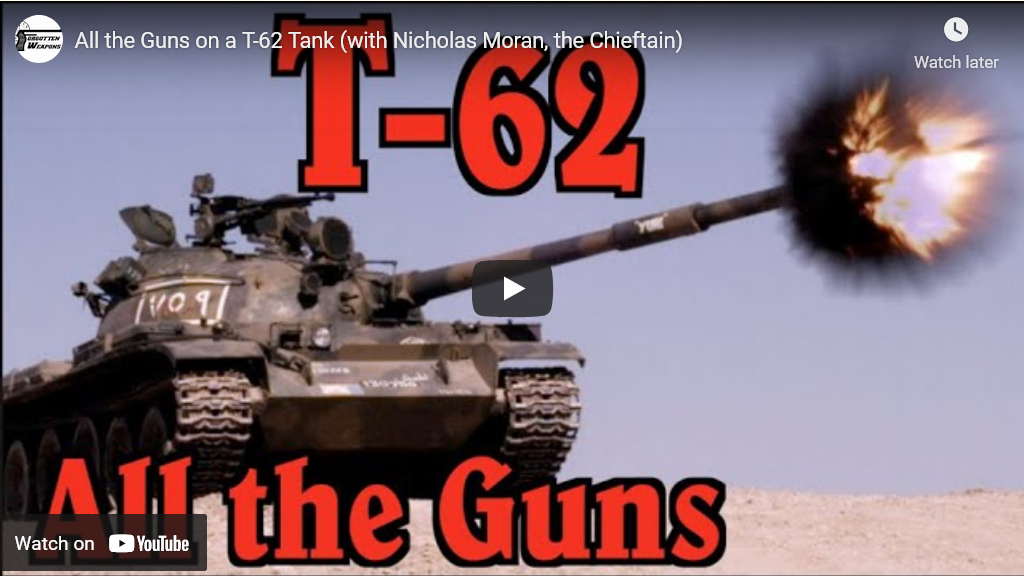
Today Nicholas Moran (the Chieftain) and I are at Battlefield Vegas courtesy of Wargaming.net, to show you around a Soviet T-62 and all its various armaments. This particular T-62 was built in 1971 or 1972 and initially sold to Syria. It saw combat in the Valley of Tears in 1973, but survived as was eventually transferred to Lebanese ownership. From there is was captured by Israel and eventually imported into the United States via the UK. The T-62 was the last of the “simple” WW2-style Soviet tanks, and equipped with an extremely effective 115mm smoothbore main gun. In addition to that cannon, we will discuss and shoot the coaxial PKT machine gun and the loader’s antiaircraft DShKM heavy machine gun.
If you enjoy this video, check out World of Tanks – and maybe they will send Nicholas and I back again to do the same thing yet again on a third tank!
For videos on the detail of tanks like this one, check out The Chieftain:
https://www.youtube.com/user/WorldOfT…
https://www.youtube.com/channel/UCp4j…0:00:00 – Introduction
0:06:02 – Coaxial PKT
0:13:12 – Antiaircraft DShKM
0:20:25 – 115mm Main Gun
0:28:43 – Firing the main gunContact:
Forgotten Weapons
6281 N. Oracle 36270
Tucson, AZ 85740
November 18, 2021
All the Guns on a T-62 Tank (with Nicholas Moran, the Chieftain)
August 12, 2021
July 28, 2021
QotD: Lawrence and the Hejaz railway
Lawrence had used Aqaba as a base for repeated attacks on the Hejaz railway until the winter, when there was a lull in the fighting. Allenby’s progress towards Damascus was delayed, too, as two of his divisions (around 25,000 men) were redeployed to the Western Front. In the spring, when the drive to Damascus finally began, the policy towards the railway changed. It was imperative to cut off the line up from the Hejaz so that the Turks could not use it to bring reinforcements from Madinah against Allenby’s forces. Consequently, Lawrence’s group attacked the railway in various places, having developed a more sophisticated type of mine inappropriately called “tulip”. This was a much smaller charge, a mere 2lb of dynamite compared with the 40lb or 50lb ones used previously, and involved placing the charge underneath the sleepers, which would blow the metal upwards “into a tulip-like shape without breaking; by doing so it distored the two rails to which its ends were attached”, which was impossible to repair and consequently forced the Turks to replace the whole section of track. In early April 1918, the last train between Madinah and Damascus made it through but after that the line was blocked by successive attacks which left more Turkish troops stuck in the Hejaz protecting a line that was now of no strategic use than were facing Allenby in Palestine. In the decisvie attack at Tel Shahm, led by General Dawnay, Lawrence showed his regard for the railway by claiming the station bell, a fine piece of Damascus brass work: “the next man took the ticket punch and the third the office stamp, while the bewildered Turks stared at us with a growing indignation that their importance should be merely secondary”. The Turks had clearly never met any British trainspotters with their obsession for railway memorabilia.
Christian Wolmar, Engines of War: How Wars Were Won & Lost on the Railways, 2010.
May 26, 2021
The not-so-hidden subtext of One Thousand And One Nights
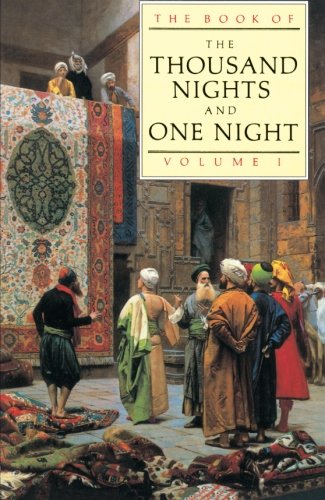
At least, that’s how Scott Alexander at Astral Codex Ten opens this review of (an abridged version) of One Thousand And One Nights:

One of many different covers of various editions of this book, but almost certainly not the edition reviewed here.
One Thousand And One Nights is a book about love, wonder, magic, and morality. About genies, ape-people, and rhinoceroses who run around with elephants impaled on their horns. About how to use indexical uncertainty to hack the simulation running the universe to return the outcome you want. But most of all, it’s a book about how your wife is cheating on you with a black man.
Nights stretches from Morocco to China, across at least four centuries — and throughout that whole panoply of times and places, your wife is always cheating on you with a black man (if you’re black, don’t worry; she is cheating on you with a different black man). It’s a weird constant. Maybe it’s the author’s fetish. I realize that Nights includes folktales written over centuries by dozens of different people — from legends passed along in caravanserais, to stories getting collected and written down, to manuscripts brought to Europe, to Richard Burton writing the classic English translation, to the abridged and updated version of Burton I read. But somewhere in that process, probably multiple places, someone had a fetish about their wife cheating on them with a black man, and boy did they insert it into the story.
Our tale begins in Samarkand. One day the king, Shah Zaman, comes home unexpectedly and sees his wife cheating on him with a black man. He kills her in a rage, then falls sick with grief, and is taken to the palace of his brother, King Shahryar of Persia. While there, he sees King Shahryar’s wife cheat on him with a black man. He tells King Shahryar, who kills his wife in a rage too, then also falls sick with grief. The two grief-stricken kings decide to wander the world, expecting that maybe this will help in some way.
They come across a mighty king of the genies, and the brothers hide lest he see them and kill them. The genie falls asleep, and the genie’s wife finds them and demands they have sex with her or she’ll kill them. They have sex, and all the while, the genie’s wife is boasting about how even the king of the genies can’t prevent his wife from cheating. The two kings find this experience salutary — apparently the problem isn’t specific to them, it’s just an issue with the female sex in general. So they go back to the palace and everyone lives happily ever … no, actually, King Shahryar vows that he will bed a new woman every night, then kill her the following morning, thus ensuring nobody can ever cheat on him again.
So for however many years, King Shahryar beds a new woman every night, then kills her in the morning. After a while the kingdom begins to run dangerously low on women. The vizier frets over this, and his daughter Scheherazade hears him fretting. She develops a plan, and volunteers to be the king’s victim that night. After having sex, she tells the king a story. At the end, she says it’s too bad she’s going to die the next morning, because she knows other stories which are even better. Perhaps if the king spared her life for one night she could tell some of those too.
(I’d always heard that she leaves him at a cliff-hanger and makes him spare her to find out how it ends, which I think makes a better story, but this isn’t how the real Arabian Nights works).
Scheherazade’s stories are set in an idealized Middle East. The sultans are always wise and just, the princes are always strong and handsome, and almost a full half of viziers are non-evil. Named characters are always so beautiful and skilled and virtuous that it sometimes gets used it as a plot device — a character is separated from his family member or lover, so he wanders into a caravanserai and asks for news of someone who is excessively beautiful and skilled and virtuous. “Oh yes,” says one of the merchants, “I talked to a traveler from Cairo who said he encountered the most beautiful and skilled and virtuous person he’d ever seen in a garden there, he couldn’t shut up about them for days” — and now you know your long-lost brother must be in Cairo. In one case, a woman went searching for her long-lost son, tasted some pomegranate jam in Damascus, and immediately (and correctly!) concluded that only her son could make pomegranate jam that good. She demanded to know where the merchant had gotten the jam, and the trail led to a happy reunion.
The most common jobs in Idealized Middle East are sultan, merchant, poor-but-pious tailor, fisherman, merchant, evil vizier, sorcerer, merchant, thief, person who gets hired to assist a sorcerer because they have the exact right astrological chart to perform some otherwise-impossible ritual, and merchant. Of these, merchant is number one. Whatever else you’re doing — sailing, stealing, using your perfect astrological chart to enter a giant glowing door in the desert mysteriously invisible to everyone else — you’re probably also dealing goods on the side. The only exceptions are Moroccans (who are all sorcerers), Zoroastrians (who are all demonic cannibals), and Jews (who are all super-double merchants scamming everyone else). Also maybe the 5 – 10% of the Middle Eastern population who witches have turned into animals at any given time.

May 7, 2021
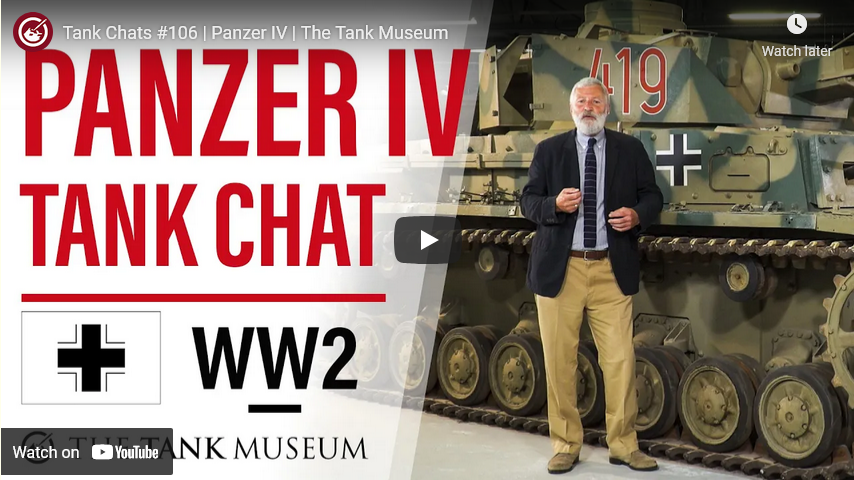
Tank Chats #106 | Panzer IV | The Tank Museum
The Tank Museum
Published 11 Sep 2020Join The Tank Museum’s Curator David Willey as he discusses the Sd.Kfz 161, better known as Panzer IV: the most numerously produced tank by Germany during the Second World War.
Support the work of The Tank Museum on Patreon: ► https://www.patreon.com/tankmuseum
Visit The Tank Museum SHOP & become a Friend: ► tankmuseumshop.orgTwitter: ► https://twitter.com/TankMuseum
Instagram: ► https://www.instagram.com/tankmuseum/
#tankmuseum #tanks
January 3, 2021
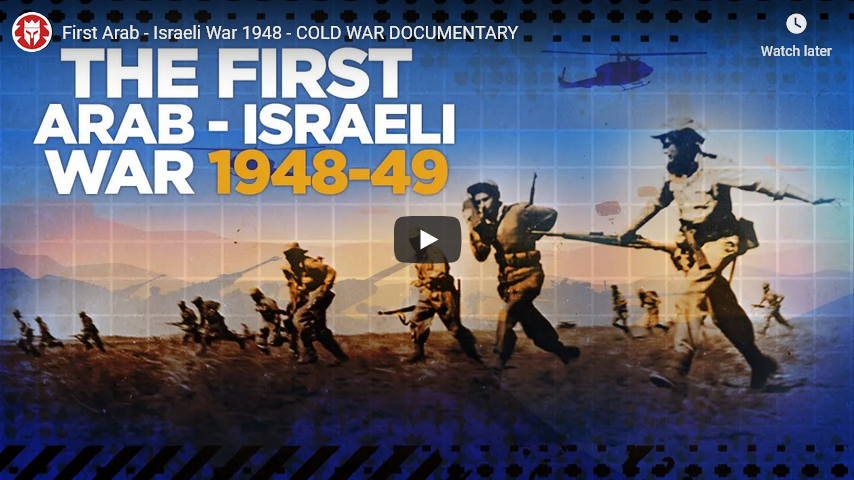
First Arab – Israeli War 1948
Kings and Generals
Published 31 Aug 2019Support our channel and install the free-to-play PC game World of Tanks to get the in-game gifts: http://patron.me/KingsAndGeneralsWoT
Previously in our animated historical documentary series on modern warfare we have covered the Six-Day War of 1967, also known as the Third Arab-Israeli War http://bit.ly/30NfTOy This new 3d documentary will explain the events of the First Arab-Israeli War, which was fought in 1948-1949.
Creation of Israel: http://bit.ly/2ZApWFi
Arab countries after the World War II: http://bit.ly/2ZBW0bX
First Arab – Israeli War of 1948 – Political episode: http://bit.ly/2zyjAvsSupport us on Patreon: http://www.patreon.com/KingsandGenerals or Paypal: http://paypal.me/kingsandgenerals
We are grateful to our patrons and sponsors, who made this video possible: https://drive.google.com/open?id=1Jlq…
The video was made by our friend Leif Sick, while the script was written by Matt Hollis.
This video was narrated by Officially Devin (https://www.youtube.com/user/Official…)
✔ Merch store ► teespring.com/stores/kingsandgenerals
✔ Podcast ► Google Play: http://bit.ly/2QDF7y0 iTunes: https://apple.co/2QTuMNG
✔ Twitter ► https://twitter.com/KingsGenerals
✔ Instagram ► http://www.instagram.com/Kings_GeneralsSources:
Efraim Karsh – The Arab-Israeli Conflict: The Palestine War 1948
Benny Morris – A History of the First Arab-Israeli War 1948
Ahron Bregman – Israel’s Wars: A History Since 1947Production Music courtesy of Epidemic Sound: http://www.epidemicsound.com
#Documentary #ArabIsraeliWar #ColdWar
September 27, 2020
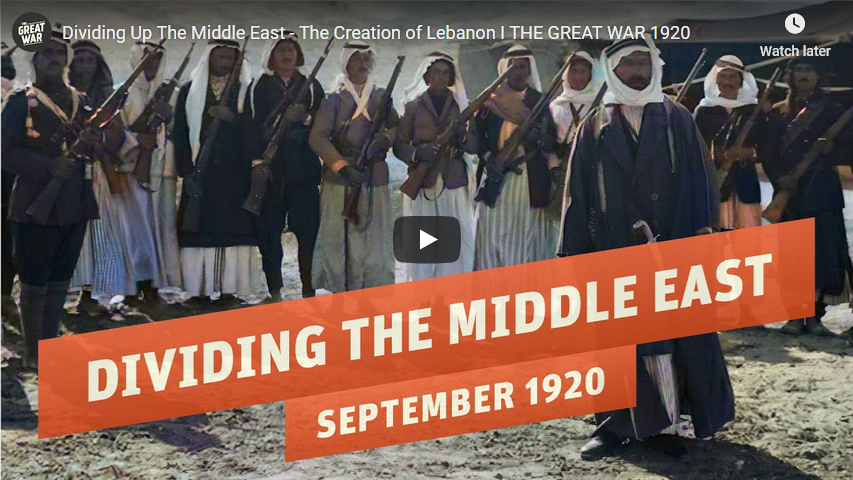
Dividing Up The Middle East – The Creation of Lebanon I THE GREAT WAR 1920
The Great War
Published 26 Sep 2020Sign up for Curiosity Stream and get Nebula bundled in: https://curiositystream.com/thegreatwar
In the summer of 1920 it became clear that the many different voices and local opinions on the future of the former Ottoman provinces were going to be mostly ignored. France and Britain had their own ideas for the new mandate states in the region.
» SUPPORT THE CHANNEL
Patreon: https://www.patreon.com/thegreatwar» OUR PODCAST
https://realtimehistory.net/podcast – interviews with World War 1 historians and background info for the show.» BUY OUR SOURCES IN OUR AMAZON STORES
https://realtimehistory.net/amazon *
*Buying via this link supports The Great War (Affiliate-Link)» SOURCES
Sicker, Martin. The Middle East in the Twentieth Century (Greenwood Publishing, 2001)Gontaut-Biron, Roger. Comment la France s’est installée en Syrie (Paris: Plon, 1922). https://archive.org/details/commentla…
Cornwallis, K. Notes on the Middle-East No.4. 1920. File 756/1917 Pt 2-3 “ARAB BULLETIN Nos 66-114” [374r] (756/834), British Library: India Office Records and Private Papers, IOR/L/PS/10/658.
Miller, David Hunter. My Diary. At the Conference of Paris. Vol 4. (New York, 1924). https://archive.org/details/MyDiaryAt…
D’Andurain, J. “Gouraud, Henri” in: 1914-1918-online. International Encyclopedia of the First World War, ed. by Ute Daniel, Peter Gatrell, Oliver Janz, Heather Jones, Jennifer Keene, Alan Kramer, and Bill Nasson, issued by Freie Universität Berlin, Berlin 2014-10-08. DOI: 10.15463/ie1418.10303. https://encyclopedia.1914-1918-online…
Naamany, B. “A hundred years since Sykes-Picot, maps’ reading”. General Secretariat of the Arab League. Tunis. Tunisia. 2018. http://nna-leb.gov.lb/en/show-news/98…
Meouchy, N. “Les temps et les territoires de la révolte du Nord (1919-1921).” In: Alep et ses territoires: Fabrique et politique d’une ville (1868-2011). (Beyrouth – Damas: Presses de l’Ifpo, 2014).
Raymond, André. “III – La Syrie, du Royaume arabe à l’indépendance (1914-1946)”. In La Syrie d’aujourd’hui. Aix-en-Provence: Institut de recherches et d’études sur les mondes arabes et musulmans, 1980. (pp. 55-85)
Kouyoumdjian, O. “Le Liban à la veille et au début de la Grande Guerre: Mémoires d’un gouverneur, 1913-1915″. Revue D’histoire Arménienne Contemporaine. Paris: Centre d’histoire arménienne contemporaine. 2003.
Government of New Zealand, Ministry for Culture and Heritage. “Anzac troops take revenge on Arab civilians at Surafend” https://nzhistory.govt.nz/page/anzac-….
Ministère de la Guerre. Etat-major des armées. Service historique. Les armées françaises dans la Grande guerre. Tome IX. 9, 1, ANNEXES. Imprimerie Nationale. Paris. France. 1935.
Australian Imperial Force unit war diaries. 1914-1918 War. Light Horse. Item number: 10/3/47. Title : 3rd Australian Light Horse Brigade. December 1918. AWM4 Class 10 – Light Horse. https://www.awm.gov.au/collection/C13…
» MORE THE GREAT WAR
Website: https://realtimehistory.net
Instagram: https://instagram.com/the_great_war
Twitter: https://twitter.com/WW1_Series
Reddit: https://reddit.com/r/TheGreatWarChannel»CREDITS
Presented by: Jesse Alexander
Written by: Jesse Alexander
Director: Toni Steller & Florian Wittig
Director of Photography: Toni Steller
Sound: Toni Steller
Editing: Toni Steller
Motion Design: Philipp Appelt
Mixing, Mastering & Sound Design: http://above-zero.com
Maps: Daniel Kogosov (https://www.patreon.com/Zalezsky)
Research by: Jesse Alexander
Fact checking: Florian WittigChannel Design: Alexander Clark
Original Logo: David van StepholdContains licensed material by getty images
All rights reserved – Real Time History GmbH 2020
September 20, 2020
Our World 100 Years Ago – September 1920 I THE GREAT WAR
The Great War
Published 19 Sep 2020Let’s take a look at our world 100 years ago, in September 1920.
» SUPPORT THE CHANNEL
Patreon: https://www.patreon.com/thegreatwar» OUR PODCAST
https://realtimehistory.net/podcast – interviews with World War 1 historians and background info for the show.» BUY OUR SOURCES IN OUR AMAZON STORES
https://realtimehistory.net/amazon *
*Buying via this link supports The Great War (Affiliate-Link)» SOURCES
» MORE THE GREAT WAR
Website: https://realtimehistory.net
Instagram: https://instagram.com/the_great_war
Twitter: https://twitter.com/WW1_Series
Reddit: https://reddit.com/r/TheGreatWarChannel»CREDITS
Presented by: Jesse Alexander
Written by: Jesse Alexander
Director: Toni Steller & Florian Wittig
Director of Photography: Toni Steller
Sound: Toni Steller
Editing: Toni Steller
Motion Design: Philipp Appelt
Mixing, Mastering & Sound Design: http://above-zero.com
Maps: Daniel Kogosov (https://www.patreon.com/Zalezsky)
Research by: Jesse Alexander
Fact checking: Florian WittigChannel Design: Alexander Clark
Original Logo: David van StepholdContains licensed material by getty images
All rights reserved – Real Time History GmbH 2020
July 26, 2020
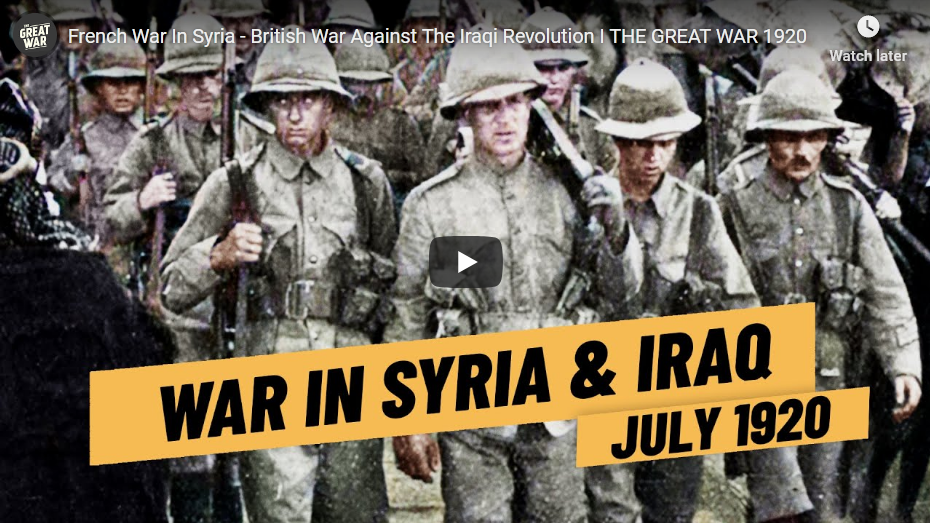
French War In Syria – British War Against The Iraqi Revolution I THE GREAT WAR 1920
The Great War
Published 25 Jul 2020Sign up for Curiosity Stream and get Nebula bundled in: https://curiositystream.com/thegreatwar
The French and British colonial powers had their own plans on how to rule the Middle East after the costly campaigns of World War 1. National self-determination for the different groups in Syria, Iraq, Palestine and Arabia were not part of these plans. And so in the summer of 1920 the situation in Iraq and Syria escalated and the French-Syrian War and the Iraqi Revolt broke out.
» SUPPORT THE CHANNEL
Patreon: https://www.patreon.com/thegreatwar» OUR PODCAST
https://realtimehistory.net/podcast – interviews with World War 1 historians and background info for the show.» BUY OUR SOURCES IN OUR AMAZON STORES
https://realtimehistory.net/amazon *
*Buying via this link supports The Great War (Affiliate-Link)» SOURCES
Kadhim, Abbas. Reclaiming Iraq: the 1920 revolution and the founding of the modern state (U of Texas Press, 2012).
Allawi, Ali. Faisal I of Iraq (Yale University Press, 2014).
Fromkin, David. A Peace to End All Peace (Macmillan, 2009 [1989]).
Naaman, Abdullah. Le Liban: histoire d’une nation inachevée.
Karsh, Efraim & Karsh, Inari. Empires of the Sand: The Struggle for Mastery in the Middle East 1789-1923, (Cambridge, MA : Harvard University Press, 1999)» MORE THE GREAT WAR
Website: https://realtimehistory.net
Instagram: https://instagram.com/the_great_war
Twitter: https://twitter.com/WW1_Series
Reddit: https://reddit.com/r/TheGreatWarChannel»CREDITS
Presented by: Jesse Alexander
Written by: Jesse Alexander
Director: Toni Steller & Florian Wittig
Director of Photography: Toni Steller
Sound: Toni Steller
Editing: Toni Steller
Motion Design: Philipp Appelt
Mixing, Mastering & Sound Design: http://above-zero.com
Maps: Daniel Kogosov (https://www.patreon.com/Zalezsky)
Research by: Jesse Alexander
Fact checking: Florian WittigChannel Design: Alexander Clark
Original Logo: David van StepholdContains licensed material by getty images
All rights reserved – Real Time History GmbH 2020