
World War Two
Published 12 Jan 2022Even the best sniper needed a reliable and accurate rifle. During the Second World War, all warring nations fielded designated sniper and marksman rifles, but different manufacturers had different ideas, from optical sights to breech-loading mechanisms, to gas-piston systems. Some preferred traditional bolt-action, others favored the new semi-automatic approach.
(more…)
January 13, 2022
Sniper Rifles of 1942 – WW2 Special
Comments Off on Sniper Rifles of 1942 – WW2 Special
January 12, 2022
Sniper Warrior – Vasily Zaitsev – WW2 Biography Special
World War Two
Published 11 Jan 2022From the woods of the Urals to the burning city of Stalingrad, Vasily Zaitsev went out to hunt his prey. As a sniper, he learned his trade in the grim reality of Stalingrad street fighting. Deep in the ruins of the factories, he stalked his enemies with a team of battle-hardened snipers. For days on end, they would lay in wait for valuable targets to show up. With a finger on the trigger, they would decimate the German ranks within a few deadly moments.
(more…)
Comments Off on Sniper Warrior – Vasily Zaitsev – WW2 Biography Special
December 20, 2021
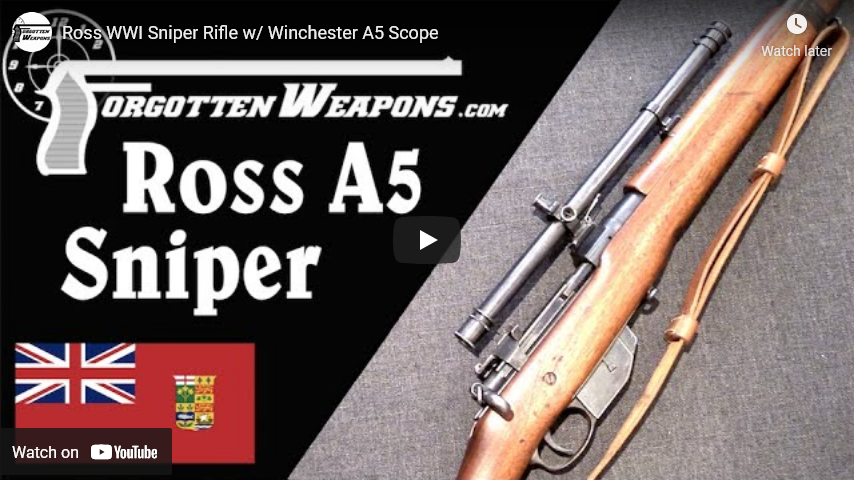
Ross WWI Sniper Rifle w/ Winchester A5 Scope
Forgotten Weapons
Published 23 Aug 2021http://www.patreon.com/ForgottenWeapons
https://www.floatplane.com/channel/Fo…
Cool Forgotten Weapons merch! http://shop.forgottenweapons.com
The standard Canadian sniper’s rifle of World War One was the MkIII Ross fitted with a Warner & Swasey “musket sight” purchased from the United States. However, armorers in the field did create sniping rifles using other scopes — in particular the Winchester A5. The A5 was a popular commercial rifle scope at the time, and it found its way onto military rifles for many nations — I have seen examples on Lebel and SMLE rifles as well as of course American Springfields and this Ross.
The A5 was a 5x magnification scope with external adjustments. We don’t know when this example was built into sniper configuration, but it’s provenance is solid (this sort of thing would be relatively easy to counterfeit). Personally, I would much prefer a Winchester A5 over the Warner & Swasey pattern…
Contact:
Forgotten Weapons
6281 N. Oracle 36270
Tucson, AZ 85740
From the comments:
Cole Harris
1 hour ago
The famed Francis Pegahmagabow used a Ross during his service with the Canadian Expeditionary Force during WWI. While the Ross was considered a pretty terrible service rifle because of reliability/durability concerns, on the range it was a superb rifle that he used to great effect. I don’t know if he used irons or not, but he built quite a reputation for marksmanship with the Ross.
If you’d like more information about Francis Pegahmagabow, The Great War channel did a bio special about him and more recently Sabaton wrote a song called “A Ghost in the Trenches” about his military service.
Comments Off on Ross WWI Sniper Rifle w/ Winchester A5 Scope
December 11, 2021
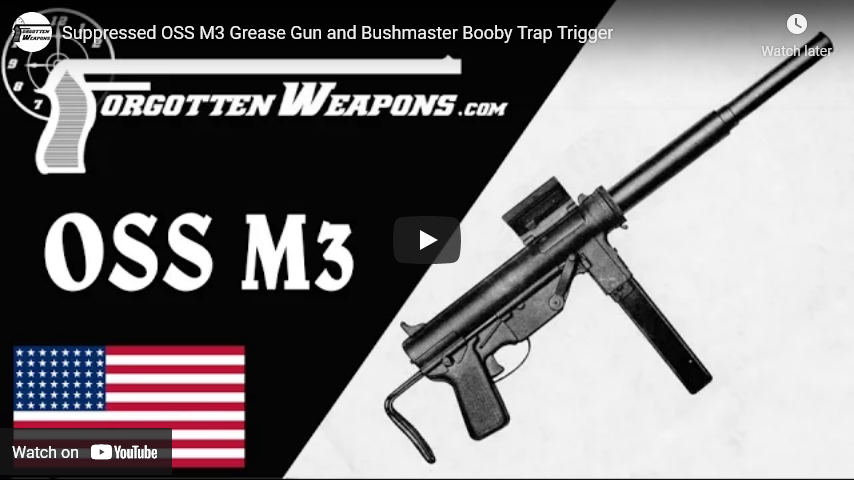
Suppressed OSS M3 Grease Gun and Bushmaster Booby Trap Trigger
Forgotten Weapons
Published 9 May 2017Today, we have a chance to take a look at a suppressed M3 “Grease Gun”, as purchased and issued by the Office of Strategic Services (the OSS; predecessor to the CIA). Thanks to its readily removable barrel, the M3 (and M3A1) submachine gun was an easy gun to adapt to use with a suppressor (or as it was called at the time, a silencer). During World War 2, such a unit was developed for clandestine use by OSS and British SOE agents in occupied Europe, and they would see use for many decades in all manner of conflicts.
The suppressor itself is quite different than modern designs, being a two-part device using tight wire mesh instead of baffles. The barrel itself is heavily perforated, and extends only through the large diameter section of the suppressor. Around it is wrapped a large roll of wire mesh, which acts as an expansion chamber to slow down the exit of gas from the muzzle. The smaller front section of the unit is filled with small discs of the same wire mesh, similar to wipes but made of mesh.
Allegedly, the suppressor was effective enough to reduce the noise of the gunshots below the level of the action cycling, which is all that one can reasonable want from a suppressor. This particular example has an excellent provenance, having been provided by OSS to a European resistance fighter for a specific mission right at the end of WW2.
In addition, we also have a piece of the OSS sneaky tricks catalog to see. Specifically, a “Bushmaster” remote trigger mechanism to allow the M3 (silenced or otherwise) to be made into an autonomous booby trap in conjunction with a time delay, tripwire, or other triggering device.
Many thanks to the anonymous collector who let me take a look at this piece and bring you a video on it!
Cool Forgotten Weapons merchandise! http://shop.bbtv.com/collections/forg…
http://www.patreon.com/ForgottenWeapons
If you enjoy Forgotten Weapons, check out its sister channel, InRangeTV! http://www.youtube.com/InRangeTVShow
Comments Off on Suppressed OSS M3 Grease Gun and Bushmaster Booby Trap Trigger
November 1, 2021
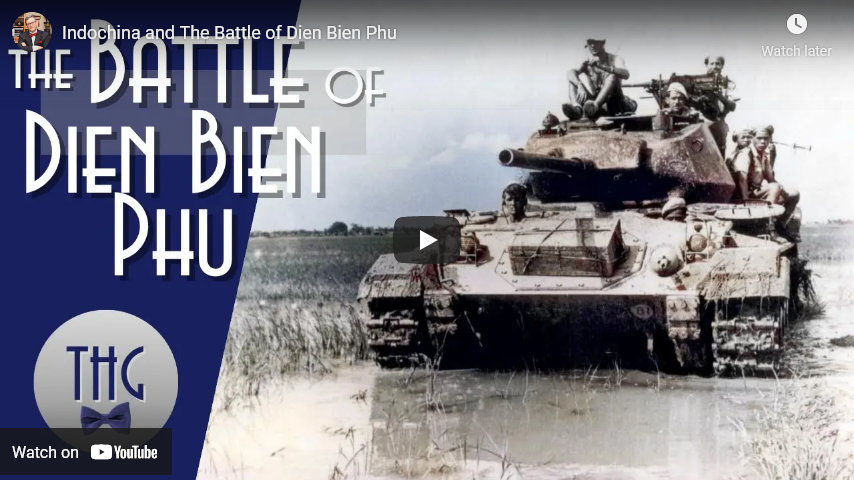
Indochina and The Battle of Dien Bien Phu
The History Guy: History Deserves to Be Remembered
Published 29 Sep 2017The History Guy remembers how decolonization led to proxy war and the Battle of Dien Bien Phu in what is now known as Vietnam.
The episode discusses and presents historical photographs and film footage depicting events during a period of war, which some viewers may find disturbing. All events are described for educational purposes and are presented in historical context.
The History Guy uses images that are in the Public Domain. As photographs of actual events are often not available, I will sometimes use photographs of similar events or objects for illustration.
Patreon: https://www.patreon.com/TheHistoryGuy
The History Guy: Five Minutes of History is the place to find short snippets of forgotten history from five to fifteen minutes long. If you like history too, this is the channel for you.
Awesome The History Guy merchandise is available at:
https://teespring.com/stores/the-hist…The episode is intended for educational purposes. All events are presented in historical context.
#DienBienPhu #militaryhistory #thehistoryguy
Comments Off on Indochina and The Battle of Dien Bien Phu
September 7, 2021
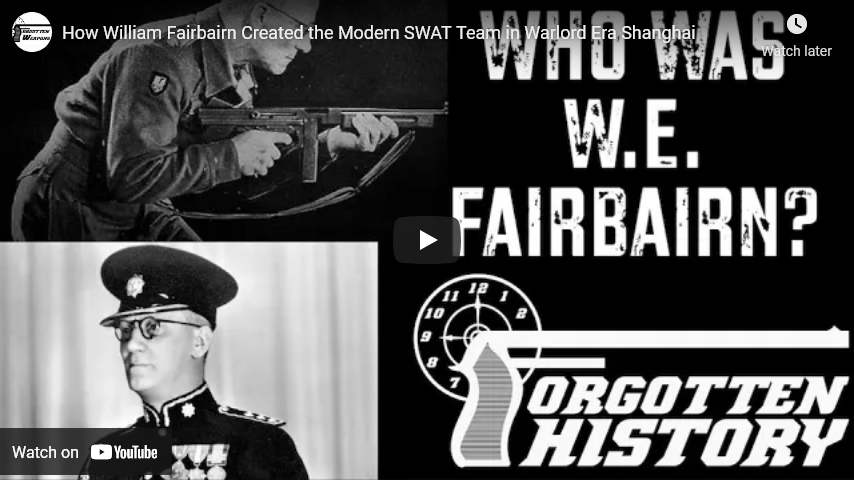
How William Fairbairn Created the Modern SWAT Team in Warlord Era Shanghai
Forgotten Weapons
Published 1 Jun 2021William E. Fairbairn is best known for his work with Eric Sykes and their “Commando” knife design during World War Two. However, Fairbairn spent some 33 years in the Shanghai Municipal Police, working his way up from a beat constable to Assistant Commissioner. There he was responsible for the SMPD adopting truly forward-thinking fighting methods, and he essentially invented the modern SWAT team (the “Reserve Unit”, which Fairbairn led for 10 years). He combined expertise in formal marksmanship, instinctive practical shooting, and hand-to-hand combat schools (including jiu-jitsu and judo) into a comprehensive training program like no other on earth at the time.
Book references:
The World’s First SWAT Team, by Leroy Thompson:
https://amzn.to/2TrYiNvGentleman & Warrior, by Peter Robins:
https://amzn.to/3vuODn9http://www.patreon.com/ForgottenWeapons
https://www.floatplane.com/channel/Fo…
Cool Forgotten Weapons merch! http://shop.forgottenweapons.com
Contact:
Forgotten Weapons
6281 N. Oracle 36270
Tucson, AZ 85740
Comments Off on How William Fairbairn Created the Modern SWAT Team in Warlord Era Shanghai
August 21, 2021
In this matter Canada apes the US rather than following the great example provided by France
In The Line, Kevin Newman highlights the stark difference between what France has been doing to rescue their own citizens and Afghani civilians with ties to France with the utterly feckless Canadian government’s “effort”:
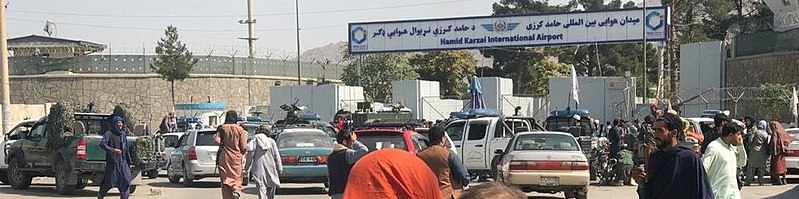
On the second day of the Taliban’s rule in Kabul, the front of Hamid Karzai International Airport was crowded with people trying to travel abroad, but were stopped by Taliban militants, 17 August, 2021.
Public domain image from VOA via Wikimedia Commons.
Ten buses screamed out of France’s embassy in Kabul early this week, past every Taliban checkpoint along the way, and according to eyewitnesses, zipped confidently through a back-entrance gate and straight onto the chaotic tarmac at Hamid Karzai International Airport. Five hundred exhausted and terrified passengers were then loaded onto a French military aircraft which quickly took off.
And then it happened again on Thursday, four buses this time, under the guard of French special forces. As with the first convoy, Paris newspapers reported the buses carried French nationals stranded in Kabul, and hundreds of Afghans and their families the French embassy had given shelter to since before the Taliban roared into and re-occupied the city. Two ballsy airlifts took them to safety at a French military base in the United Arab Emirates, where hundreds of desperate people were given a hot meal, questioned about their identities and had their documents confirmed. Most were then sent on to Paris, where they received physical and mental-health support as well as cash, clothing, and places to stay as they begin their new lives.
On those same days in Kabul, another country tried to rescue its citizens and hundreds of Afghan interpreters and their families hiding throughout the city. I’ve pieced together what happened to them from texts and video Canadian veterans have been receiving every hour from people they know in Kabul, and I am sharing them with permission. I have verified each of these facts (from the peace of Canada) with multiple sources on the ground.
There were no buses, soldiers or escorts for these terrified people. Thursday they received a short text from Immigration, Refugees and Citizenship Canada (IRCC). They were instructed (in English only) to urgently head to the airport on their own, try to find a way through multiple Taliban checkpoints searching for them, and then if they survived that kilometres-long trip, figure out a way through thousands of desperate Afghans trying to flee. They were told by IRCC to carry documents to identify themselves to a gate agent, but because those same documents would be used to identify them by the Taliban, it was up to them to decide whether to carry them. With that, IRCC wiped its hands of responsibility. No direction on where to avoid Taliban checkpoints, no specific gates to head to (there are eight), and no Canadians on site to help. In fact there hadn’t been any Canadian officials in Kabul for a week, and when a few arrived hours after that text blast, reporters said they had travelled on an American military flight because their Canadian C-17 needed servicing somewhere else.
Needless to say, no one got through the airport, so they returned to their safe houses — wondering if their last flight to freedom had left without them.
It hadn’t. It never existed. Later that night another set of blasts went out again telling Afghans to move on their own to the airport. This time they were told to shout “Canada” and hope a soldier would hear them and help them through the airport gates. Taliban guards could hear them as well there, which would ensure that the target on their backs they had been trying to hide came completely into focus.
Comments Off on In this matter Canada apes the US rather than following the great example provided by France
August 20, 2021
“They were there to debate Afghanistan, a far-away country of which it turns out that we know even less than we thought”
The British government recalls Parliament to debate the situation in Afghanistan (not that there’s much to be done at this late stage, but formalities are at least being observed in a perfunctory manner):
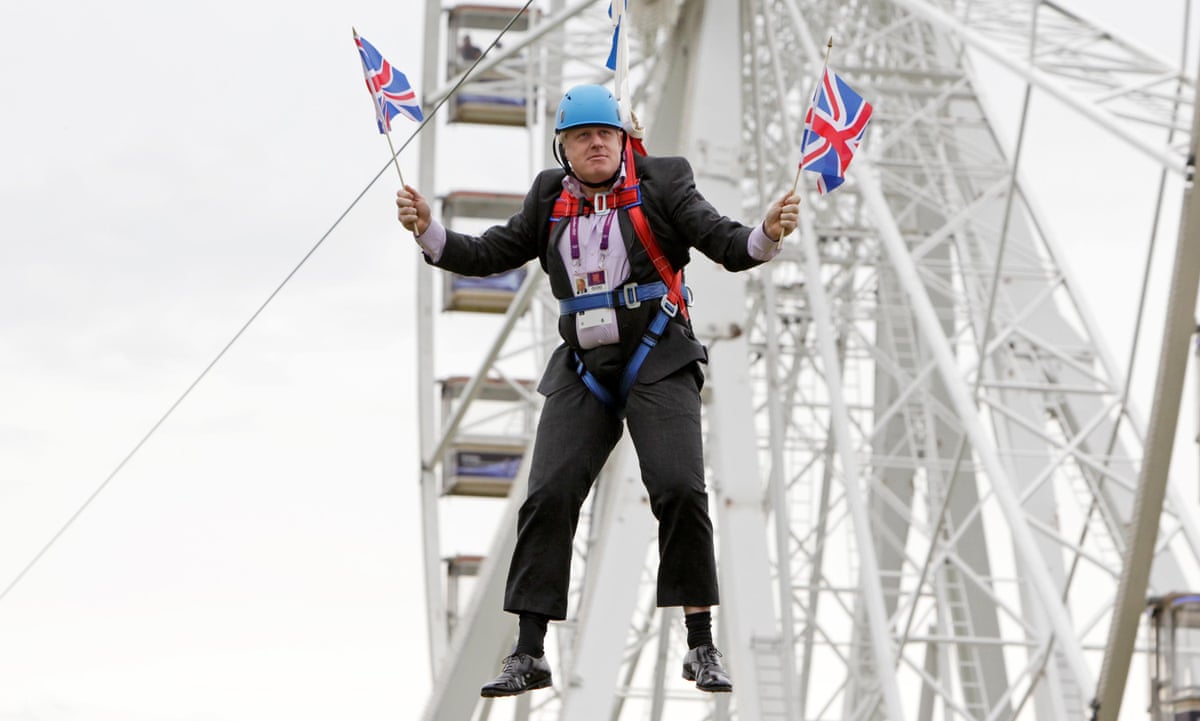
The House of Commons was full, for the first time since last March. Members of Parliament had been brought back from their holidays, from West Country campsites and from Greek resorts, in a repatriation operation that puts the Foreign Office to shame.
They were there to debate Afghanistan, a far-away country of which it turns out that we know even less than we thought. It was only last month that Boris Johnson was assuring MPs that “there is no military path to victory for the Taliban”, although we now know that path was straight along the road to Kabul, as fast as their trucks could carry them.
Now Johnson was back to explain that things had turned out to be a bit more complicated than he thought. Or perhaps a bit simpler: we’ve gone, they’re back. Parliament was getting eight hours to discuss this, although it was too late to do very much about it. It wasn’t so much shutting the stable door after the horse had bolted as holding a long discussion about the history of equine care as the stallion in question disappeared over the horizon.
Still, the atmosphere was jolly. Many of these MPs haven’t seen each other in over a year. There was a first-day-of-term feel to things. With Parliament’s Covid restrictions lapsed, the Conservatives were wedged in together in the small, windowless chamber, barely a facemask in sight. The government’s instructions are still to wear masks in crowded places, but the Conservatives view Covid as some sort of socialist conspiracy that will go away if they ignore it. Or maybe they just feel that rules are for the little people.
Labour MPs had at least nodded to social distancing, sitting about 18 inches apart from each other. This is, admittedly, easier when there aren’t very many of you. The opposition benches were a sea of masks. Only the Democratic Unionists, who like the Tories see illness as a sign of moral failure, were a lone island of uncovered faces.
Johnson’s statement was, as ever, a masterpiece of bare adequacy. It eloquently just about dealt with the matter in question, magisterially pretty much covering the bases. The speechwriters, one sensed, must have been working on the words late into the previous afternoon. They had gone through as many as one draft as they tried to come up with something that, if it didn’t deal with every complex nuance of the Afghan tragedy, at least asked the question that Johnson lives by: “Will this do?”
The situation in Afghanistan was a “concern”, the prime minister explained, with what might, in another context, have been a brilliantly comic understatement. Over the past 20 years, the British had worked for a better future for the people of Afghanistan. “Some of this progress,” the prime minister said, “is fragile”, which is certainly one way of putting it.
What had gone wrong with our intelligence services, several people asked, that they had so comprehensively failed to see this coming? Be fair, replied Johnson, even the Taliban had been surprised by the speed of their own advance.
On the US Naval Institute Blog, CDRSalamander notes the only speech in the House of Commons during that debate that grabbed and held the attention of the entire body:
Let’s back away from the problem at hand a bit … and then back up further. I mentioned it earlier, but let’s bring it up again; national humiliation. There are different aspects of this growing humiliation that are already manifesting itself, the first of which is how others look at us.
Let’s start with our closest friend and take a moment to listen to a speech earlier today in the British House of Commons by Tom Tugendhat, MP.
The mission in Afghanistan wasn’t a British mission, it was a Nato mission. … And so it is with great sadness that I now criticise one of them. … To see their commander-in-chief call into question the courage of men I fought with — to claim that they ran. It is shameful. … this is a harsh lesson for all of us and if we are not careful it could be a very, very difficult lesson for our allies. … to make sure we are not dependent on a single ally, on the decision of a single leader, but that we can work together with Japan and Australia, with France and Germany, with partners large and small, and make sure we hold the line together.
That is our closest friend outlining a loss of confidence. That is just one datapoint from a friend, but it is safe to say that it is probably somewhere in the center of opinion.
What are those nations who are not our friends thinking? I don’t think I need to spend all that much time on discussing how emboldened they are. It is self-evident to anyone who reads USNIBlog.
On the ground, troops of 2nd Battalion, The Parachute Regiment are actively involved in escorting British and Afghani civilians from safe houses to Kabul airport for evacuation:
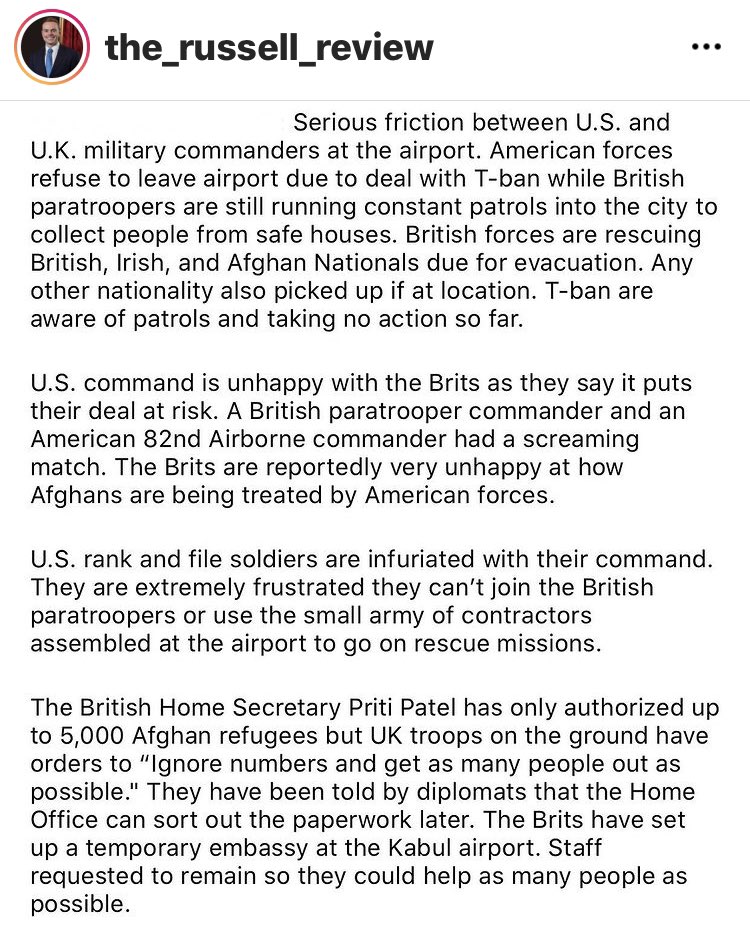
At least one NATO country hasn’t forgotten the civilians who have been left behind during the precipitate withdrawal by US troops.
Comments Off on “They were there to debate Afghanistan, a far-away country of which it turns out that we know even less than we thought”
August 13, 2021
Spycraft and the Special Operations Executive – WW2 – Spies & Ties 07
World War Two
Published 12 Aug 2021Astrid talks about spying all the time, but what was it actually like for people on the ground? We look through the lens of the British Special Operations Executive (SOE) to find out!
(more…)
Comments Off on Spycraft and the Special Operations Executive – WW2 – Spies & Ties 07
June 16, 2021
By Sea, By Land – A Global History of the Marines – WW2 Special
World War Two
Published 15 Jun 2021Naval infantrymen have long been a feature of warfare. In the build-up to 1939, they took on new functions and tactics. The Royal Marines, the US Marine Corps, Black Death, Kaiheidan, and more are ready for all-out amphibious warfare in the Pacific Theatre and beyond.
(more…)
Comments Off on By Sea, By Land – A Global History of the Marines – WW2 Special
May 28, 2021
The Plot to Kill Hitler’s Hangman – Operation Anthropoid – WAH 035 – May 1942, Pt. 2
World War Two
Published 27 May 2021Arthur Harris and his RAF Bombers carry out a massive bombing raid on Cologne. Meanwhile, one of the architects of the Holocaust, Reinhard Heydrich is the target of a spectacular assassination attempt.
(more…)
Comments Off on The Plot to Kill Hitler’s Hangman – Operation Anthropoid – WAH 035 – May 1942, Pt. 2
April 4, 2021
The Carpet Bombing of Germany begins – WW2 – 136 – April 3, 1942
World War Two
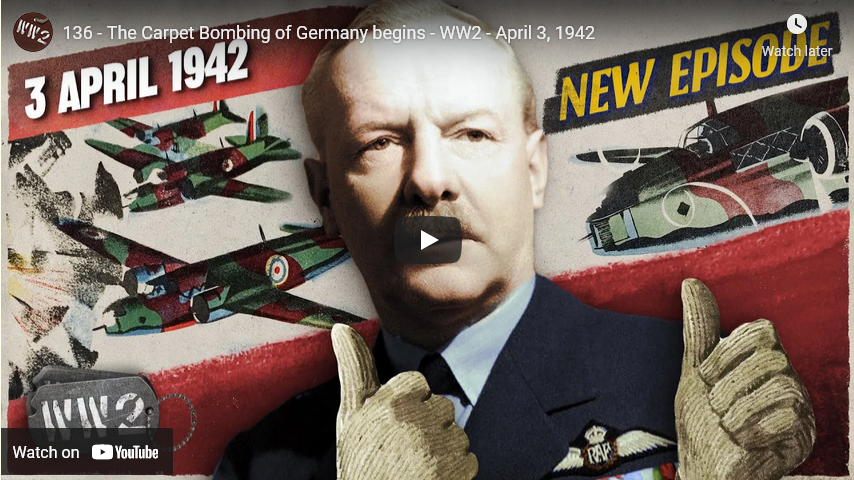
Published 3 Apr 2021Britain’s campaign to firebomb the old towns of Germany where civilians reside begins in earnest this week. The British also destroy the port at St. Nazaire in commando action. In the Indian Ocean, however, they are avoiding contact with the Japanese, even while on land the Japanese advance in both Burma and New Guinea.
Check out Indy’s Tie Barn to get your own tie right here: https://www.youtube.com/c/IndysTieBar…
Join us on Patreon: https://www.patreon.com/TimeGhostHistory
Or join The TimeGhost Army directly at: https://timeghost.tvFollow WW2 day by day on Instagram @ww2_day_by_day – https://www.instagram.com/ww2_day_by_day
Between 2 Wars: https://www.youtube.com/playlist?list…
Source list: http://bit.ly/WW2sourcesWritten and Hosted by: Indy Neidell
Director: Astrid Deinhard
Producers: Astrid Deinhard and Spartacus Olsson
Executive Producers: Astrid Deinhard, Indy Neidell, Spartacus Olsson, Bodo Rittenauer
Creative Producer: Maria Kyhle
Post-Production Director: Wieke Kapteijns
Research by: Indy Neidell
Edited by: Iryna Dulka
Sound design: Marek Kamiński
Map animations: Eastory (https://www.youtube.com/c/eastory)Colorizations by:
– Daniel Weiss
– Carlos Ortega Pereira, BlauColorizations – https://www.instagram.com/blaucolorizations
– Election1960 from Wiki CommonsSources:
– Bundesarchiv – 101II-MW-3722-03
– IWM C 2351, A 11787, H_018753_1, R 1827Soundtracks from the Epidemic Sound:
– Rannar Sillard – “Easy Target”
– Edward Karl Hanson – “Spellbound”
– Phoenix Tail – “At the Front”
– Jo Wandrini – “Dragon King”
– Phoenix Tail – “Last Minute Reaction”
– Craft Case – “Secret Cargo”
– Fabien Tell – “Last Point of Safe Return”
– Howard Harper-Barnes – “Underlying Truth”
– Flouw – “A Far Cry”
– Fabien Tell – “Break Free”
– Wendel Scherer – “Time to Face Them”Archive by Screenocean/Reuters https://www.screenocean.com.
A TimeGhost chronological documentary produced by OnLion Entertainment GmbH.
Comments Off on The Carpet Bombing of Germany begins – WW2 – 136 – April 3, 1942
March 31, 2021
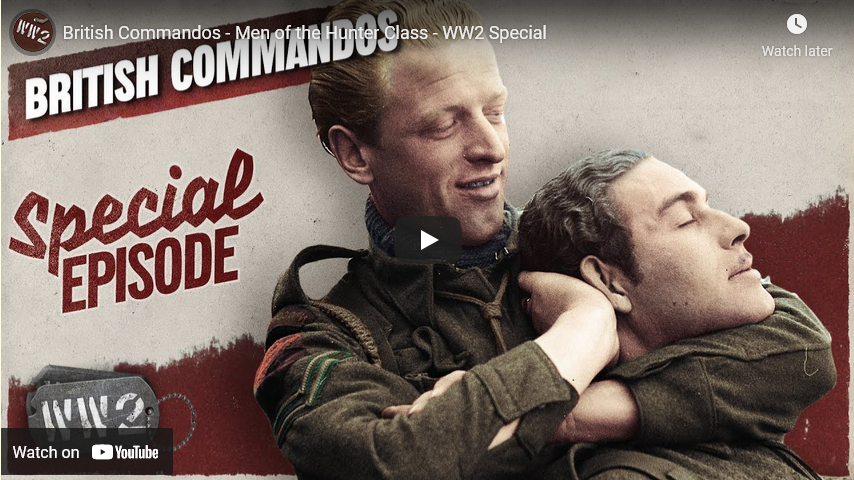
British Commandos – Men of the Hunter Class – WW2 Special
World War Two
Published 30 Mar 2021After the German take over continental Europe, the British invent the commando, a new soldier type to raid and harass German installations in occupied Europe.
Join us on Patreon: https://www.patreon.com/TimeGhostHistory
Or join The TimeGhost Army directly at: https://timeghost.tvFollow WW2 day by day on Instagram @ww2_day_by_day – https://www.instagram.com/ww2_day_by_day
Between 2 Wars: https://www.youtube.com/playlist?list…
Source list: http://bit.ly/WW2sourcesHosted by: Indy Neidell
Written by: Joram Appel
Director: Astrid Deinhard
Producers: Astrid Deinhard and Spartacus Olsson
Executive Producers: Astrid Deinhard, Indy Neidell, Spartacus Olsson, Bodo Rittenauer
Creative Producer: Maria Kyhle
Post-Production Director: Wieke Kapteijns
Research by: Joram Appel
Edited by: Karolina Dołęga
Sound design: Marek Kamiński
Map animations: Eastory (https://www.youtube.com/c/eastory)Colorizations by:
– Daniel WeissSources:
– Imperial War Museums: N 3, HU41240, A 26238, H17472, B 5203, H 19272, CH 10705, H 17489, D 8893, H 39031, A 17763, H 17502, TR1425, E 6390,E 6404, H 31439, TR1230, ADM 5072, H39029, H 17485, H 17347, H 022592, H 17511,H 22588, H 019284, H19269, NA 12466, N 530, NA12469, H18957, H 22604, A 27469, NA 379 A,N397 1941, C2352,H 17364, 023574,H 039033
– Bundesarchiv
– National Archives NARA
– National Military Museum
– Icons from the Noun Project: barge by Seb Chmiel, soldier by Wonmo Kang,
– Crickets sound courtesy of damonmensch
– Slide projector courtesy of hpebley3Soundtracks from the EpidemicSound:
– “London” – Howard Harper-Barnes
– “March Of The Brave 10” – Rannar Sillard
– “Rememberance” – Fabien Tell
– “The Inspector 4” – Johannes BornlöfArchive by Screenocean/Reuters https://www.screenocean.com.
A TimeGhost chronological documentary produced by OnLion Entertainment GmbH.
Comments Off on British Commandos – Men of the Hunter Class – WW2 Special
March 17, 2021
Heavy But Effective: Britain’s No4 MkI (T) Sniper Rifle
Forgotten Weapons
Published 29 Aug 2018http://www.patreon.com/ForgottenWeapons
Cool Forgotten Weapons merch! http://shop.bbtv.com/collections/forg…
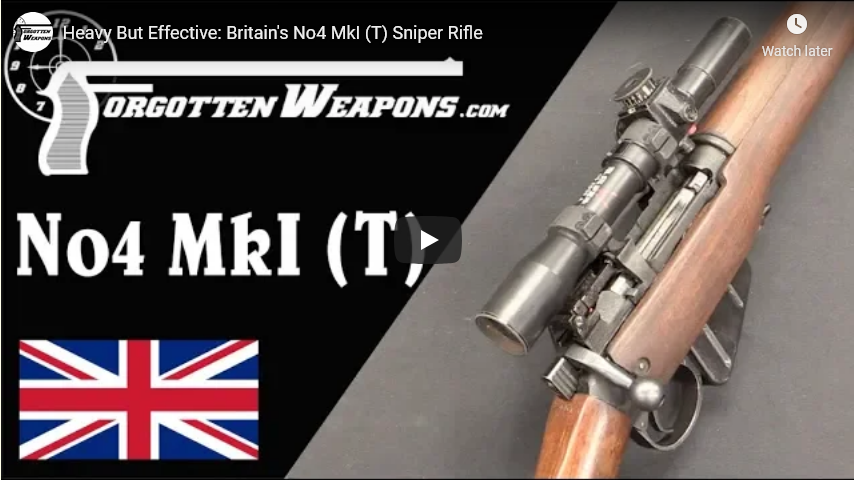
The main British sniper rifle of World War Two, and arguably one of the best looking military sniper rifles of all time, the No4 MkI (T) was something the British military knew they would want even before the No4 MkI rifle had gone into real production. The first No4 snipers were built on leftover trials rifles from Enfield, and the pattern was formally introduced in February of 1942. First use was in North Africa, but the fighting there was not really suited to sniper rifles, and the weapon’s practical combat debut was in Italy in 1943.
The No4 MkI (T) was a conversion of a standard No4 MkI rifle, using examples chosen for particular good accuracy. They were sent to Holland & Holland to have scope mount bases added and No32 telescopic sights fitted (along with cheek risers on the stocks and having the battle sight aperture ground off to allow room for the scope bell). Between 23,000 and 26,000 were made during the war, and they would continue to be used in the British military for decades, including later conversion into 7.62mm NATO L42A1 rifles [which Ian discusses here].
Contact:
Forgotten Weapons
6281 N Oracle #36270
Tucson, AZ 85704
Comments Off on Heavy But Effective: Britain’s No4 MkI (T) Sniper Rifle
March 14, 2021
China Lake 40mm Pump Action Grenade Launcher
Forgotten Weapons
Published 11 Dec 2020http://www.patreon.com/ForgottenWeapons
https://www.floatplane.com/channel/Fo…
Cool Forgotten Weapons merch! http://shop.bbtv.com/collections/forg…
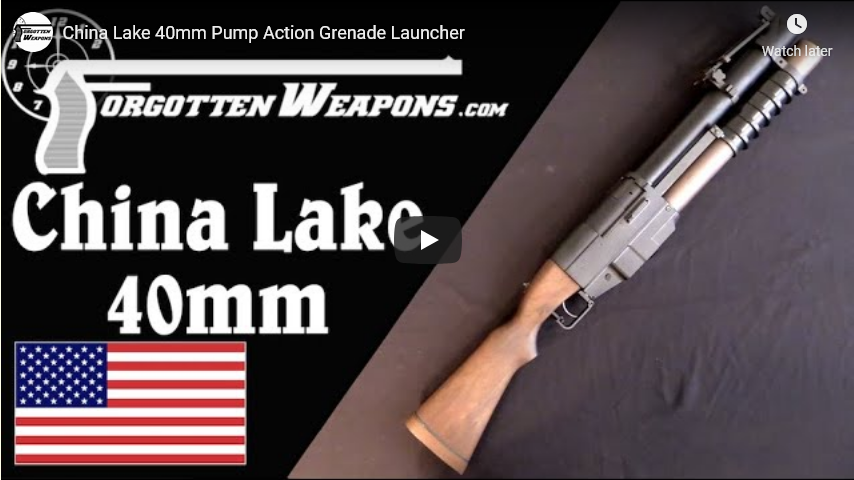
Possibly the coolest small arm used by the United States in the Vietnam War was the China Lake 40mm pump action grenade launcher. Only 24 of these were made, each fitted by hand. Of those, 2 went to MACVSOG, 2 to Army Force Recon, and the remaining 20 the the Navy SEALS. They were used as an ambush initiation weapon, with 4 rounds of rapid-fire 40mm HE grenades available.
Only five original examples survive today; four in US museums and military institutions and one in a museum in Saigon. An effort was made in 2004 to build reproductions, it is one of those used in this video. This project was not ultimately successful, but did lead to a very interesting series of events with the Airtronic company and the US Marine Corps, which will be detailed in a following video. Special thanks to Dutch Hillenburg and Kevin Dockery for making this video possible!
Contact:
Forgotten Weapons
6281 N. Oracle #36270
Tucson, AZ 85740
Comments Off on China Lake 40mm Pump Action Grenade Launcher


