Forgotten Weapons
Published 21 Jan 2022http://www.patreon.com/ForgottenWeapons
https://www.floatplane.com/channel/Fo…
Cool Forgotten Weapons merch! http://shop.forgottenweapons.com
—
UPDATE: One correction to make; this rifle has the A2 charging handle. The original A1 version was essentially identical to the standard conventional charging handle. Sorry!
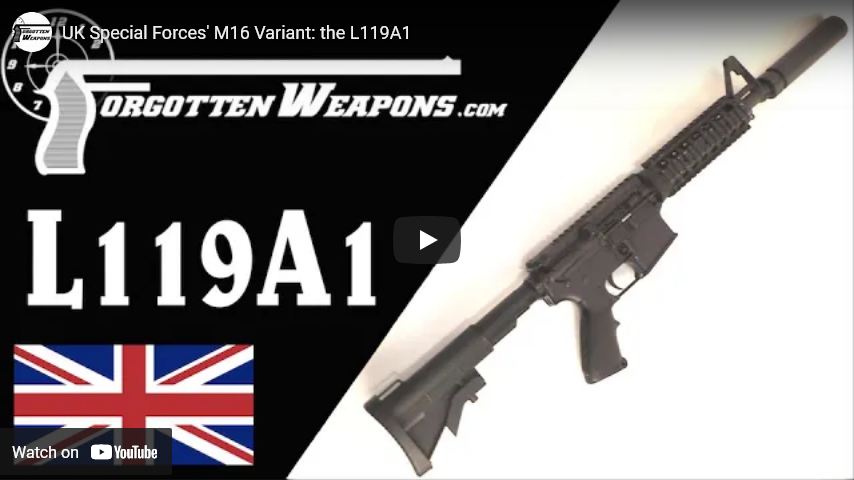
—In 1999, the UK Ministry of Defense put out a tender for a new rifle for UK Special Forces (UKSOF). The elite units of the British military were definitely not going to be using the L85! There was some competition (including the SIG 550 series), but it was pretty much known going in that the contract would be going to Diemaco (later Colt Canada) for a version of their C8 SFW (“Special Forces Weapon”). That was the case, but only after very extensive trials, which actually cost more than the procurement contract itself. The rifles were tested in all environmental extremes, including Alaska, Kuwait, and Brunei.
The rifle ultimately adopted had a number of unique features. It was at heart a Diemaco C8, with Diemaco’s early flat top upper (which predates Picatinny adoption, and is actually a bit closer to Weaver — but still compatible with modern accessories). Two barrel lengths were purchased, 10.0 inch and 15.7 inch. Other details include:
Stepped buffer tube
Textured telescoping stock
Permanently attached rubber buttplate
Lone Star grip
Knight’s RAS with locking clamps on both top and bottom rails
Strengthened gas block (usually but not always)
SureFire 216-A flash hider
Unique castle nut details
Ambidextrous charging handleThe barrel profile chosen for the L119A1 is quite heavy, and the 10 inch barreled version is substantially overgassed. The guns were heavy, but very reliable, and have since been adopted as the standard service rifle of the Royal Marines. The SOF opted to seek out a replacement around 2013-2016, and that would result in the L119A2 (a significantly different rifle).
Contact:
Forgotten Weapons
6281 N. Oracle 36270
Tucson, AZ 85740
May 14, 2022
UK Special Forces’ M16 Variant: the L119A1
May 11, 2022
M1944E1/M1945 Johnson Light Machine Gun
Forgotten Weapons
Published 27 Aug 2016http://www.patreon.com/ForgottenWeapons
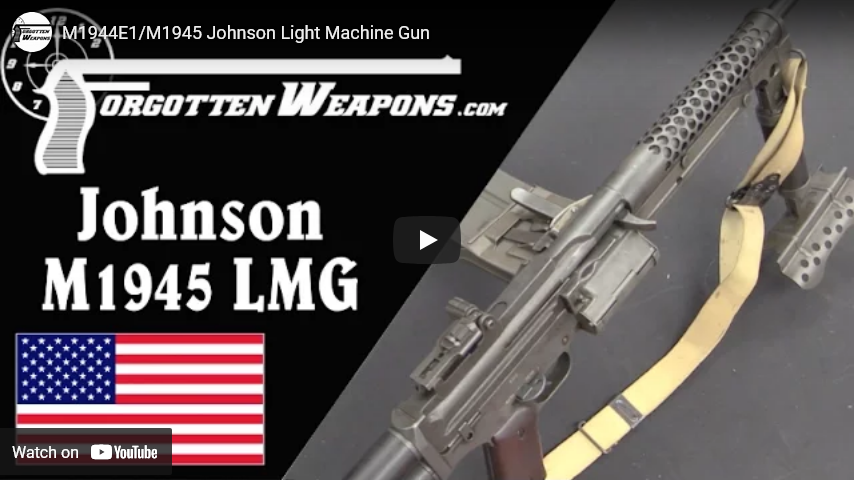
After getting his Model 1941 machine gun purchased in small numbers by the US military, Melvin Johnson continued to press for more sales and a general adoption. Following testing results and recommendations from soldiers in the field, he made a number of modifications to the gun and developed the M1944, which was quickly tweaked to become the M1944E1, also called the M1945. This new version included several improvements including:
* Replacing the bipod with a monopod less prone to interfering with barrel removal
* Improved stronger bolt anti-bounce latch
* Metal dual-tube buttstock in place of wood
* and most significantly, a gas-boosted hybrid recoil operating systemThis new model of the Johnson was in testing at the end of WWII, and weapons development budget cuts at the conclusion of the war prevented it from replacing the BAR as Johnson and many in the Marine Corps had hoped.
This particular M1945 Johnson is fully transferrable, as came out of the Winchester Museum Collection (now the Cody Firearms Museum) back many years ago when curators would occasionally sell items from the collection to raise money.
May 4, 2022
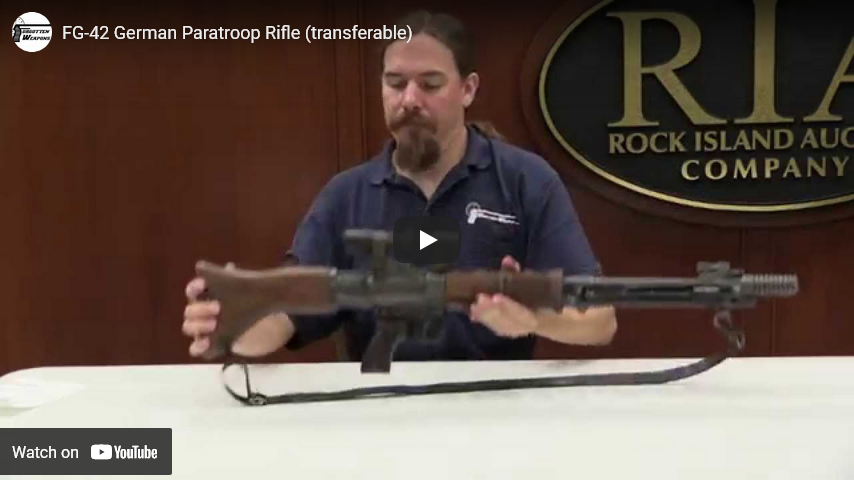
FG-42 German Paratroop Rifle
Forgotten Weapons
Published 24 Aug 2014Cool Forgotten Weapons Merch! http://shop.bbtv.com/collections/forg…
Only a few dozen of these are in private hands in the US, and they are an extremely advanced design for WWII.
Theme music by Dylan Benson – http://dbproductioncompany.webs.com
April 28, 2022
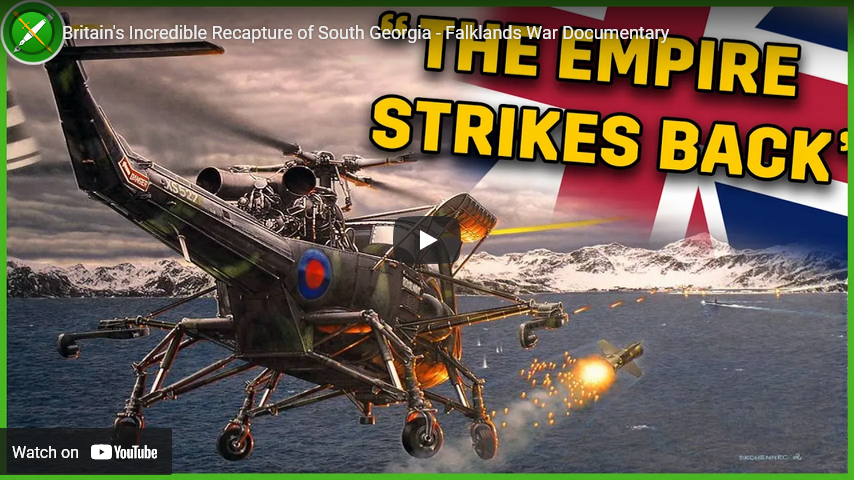
Britain’s Incredible Recapture of South Georgia – Falklands War Documentary
Historigraph
Published 27 Apr 2022Go to https://squarespace.com/historigraph to get a free trial and 10% off your first purchase of
a website or domain.In just three weeks after the Argentinian invasion of the Falkland islands, Britain threw together a task force out of thin air, sailed it 8000 miles around the world and started taking its territory back. This is how it happened.
Made with thanks to the Fleet Air Arm Musuem in Yeovilton, Somerset. https://www.fleetairarm.com/
To help support the creation of the rest of the Falklands series, consider supporting on Patreon:
https://www.patreon.com/historigraph#Falklands40 #Historigraph
Come join the historigraph discord: https://discord.gg/ygypfs3BEB
Buy Historigraph Posters here! historigraph.creator-spring.com
► Twitch: https://www.twitch.tv/historigraph
► Second Channel: https://www.youtube.com/channel/UCpIj…
► Twitter: https://twitter.com/historigraph
► Instagram: https://www.instagram.com/historigraph
Thumbnail credit Daniel Behennec: https://www.naval-history.net/FxDBMis…Sources for the Falklands War Series (so far):
Max Hastings & Simon Jenkins, Battle for the Falklands
https://archive.org/details/battlefor…
Martin Middlebrook, Operation Corporate
Martin Middlebrook, Battle for the Malvinas
Mike Norman, The Falklands War There and Back Again: The Story of Naval Party 8901
Kenneth Privratsky, Logistics in the Falklands War
Sandy Woodward, One Hundred Days
Paul Brown, Abandon Ship
Julian Thompson, No Picnic
John Shields, Air Power in the Falklands Conflict
Edward Hampshire, The Falklands Naval Campaign 1982
Hugh McManners, Forgotten Voices of the Falklands
Cedric Delves, Across an Angry Sea: The SAS in the Falklands War
Rowland White, Vulcan 607
Vernon Bogdanor, “The Falklands War, 1982” lecture https://www.youtube.com/watch?v=a9bWw…
Arthur Gavshon, “The sinking of the Belgrano” https://archive.org/details/sinkingof…
Gordon Smith, Battle Atlas of the Falklands War 1982 by Land, Sea and Air
http://www.naval-history.net/NAVAL198…
Hansard- https://api.parliament.uk/historic-ha…
Recording of Thatcher’s statement to the Commons is from https://www.youtube.com/watch?v=HvbhV…Music Credits:
“Rynos Theme” Kevin MacLeod (incompetech.com)
Licensed under Creative Commons: By Attribution 4.0 License
http://creativecommons.org/licenses/b…“Crypto” Kevin MacLeod (incompetech.com)
Licensed under Creative Commons: By Attribution 4.0 License
http://creativecommons.org/licenses/b…“Stay the Course” Kevin MacLeod (incompetech.com)
Licensed under Creative Commons: By Attribution 4.0 License
http://creativecommons.org/licenses/b…Other music and SFX from Epidemic Sound
March 9, 2022
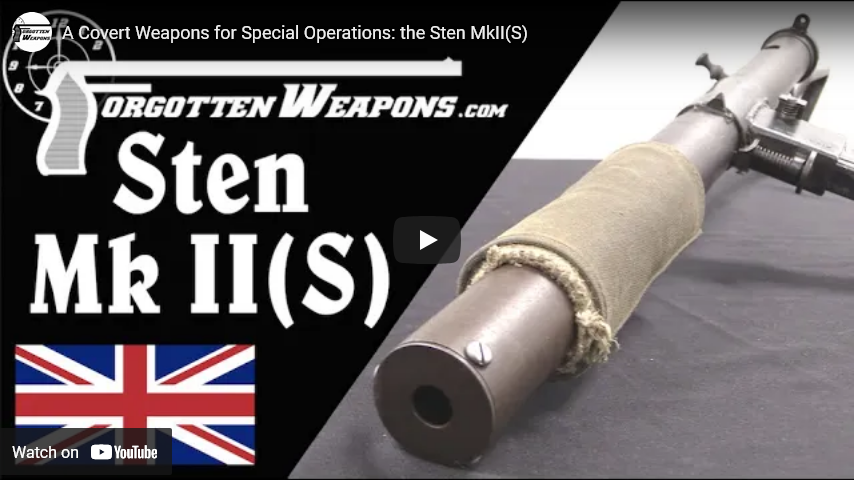
A Covert Weapons for Special Operations: the Sten MkII(S)
Forgotten Weapons
Published 5 Nov 2021http://www.patreon.com/ForgottenWeapons
https://www.floatplane.com/channel/Fo…
Cool Forgotten Weapons merch! http://shop.forgottenweapons.com
There are a fairly wide variety of silenced Sten guns that were made during World War Two, because many were needed for small Special Operations Executive missions. However, the British Army did also formally develop and adopt such a weapon. It was initially requested in 1942, with the first trials in November of that year. After two years of tinkering and deliberating, a pattern was finally put into production in February 1944. This was a Sten MkII with an integrally suppressed barrel. The barrel was just 3.75 inches long, with six vent holes drilled just in front of the chamber to reduce muzzle velocity below the speed of sound. The silencer itself was about 12 inches long, with an initial expansion chamber and 18 baffles.
Since the vented barrel reduced recoil energy of the cartridge, the bolt was reduced in weight by about 15% and the recoil spring shortened just slightly as well, to ensure proper cycling. The result was formally designated the Sten MkII(S). It retained the selective fire capability of the Sten, but was not to be used in automatic mode, as doing so could compress the baffles together and damage them. In total, 5,776 of these silent submachine guns were made. The design was followed by a more sophisticated Sten Mk6 (essentially a silenced Mk5), but remained in active use with the British military into the early 1970s.
Finding completely original and intact examples of the MkII(S) is extremely difficult today, and this one is a rare privilege to examine!
Contact:
Forgotten Weapons
6281 N. Oracle 36270
Tucson, AZ 85740
March 5, 2022
No Nazi Atomic Bomb – Operation Gunnerside – WW2 Special
World War Two
Published 3 Mar 2022By 1943 the German “Uranium-Club” was hoping to harvest the energy of the atoms. One of the things they still needed for their experiments was the moderator “heavy water”, which was produced for them in the hydro-plant “Vemork” in occupied Norway. British High Command authorized a top-secret mission to prevent it from ever reaching Germany. A group of highly trained commandos was to parachute in and destroy the heavy water facility by any means necessary.
(more…)
March 3, 2022
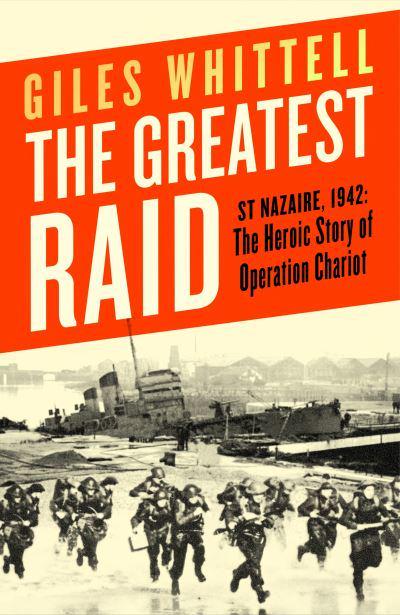
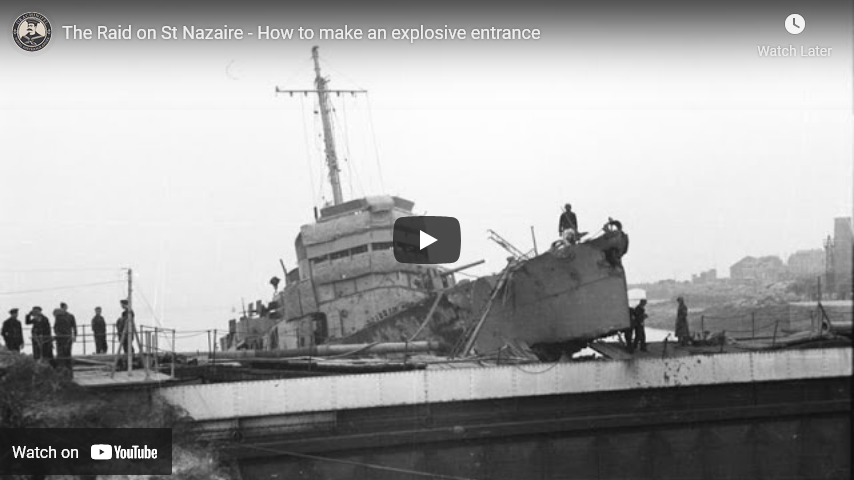
The Raid on St Nazaire – How to make an explosive entrance
Drachinifel
Published 23 Feb 2022Today we take a look at the famous raid to destroy the Normandie Drydock. With apologies for starting off with the right pronunciation of St Nazaire and slipping back into my old incorrect way later on!
Sources:
www.amazon.co.uk/Storming-St-Nazaire-James-G-Dorrian/dp/0850528070
www.amazon.co.uk/St-Nazaire-1942-Commando-Campaign/dp/1841762318
www.amazon.co.uk/Operation-Chariot-Nazaire-Forces-Operations/dp/1844151166
www.amazon.co.uk/Into-Jaws-Death-Legendary-Saint-Nazaire/dp/1782064478Free naval photos and more – www.drachinifel.co.uk
Want to support the channel? – https://www.patreon.com/Drachinifel
Want a shirt/mug/hoodie – https://shop.spreadshirt.com/drachini…
Want a poster? – https://www.etsy.com/uk/shop/Drachinifel
Want to talk about ships? https://discord.gg/TYu88mt
Want to get some books? www.amazon.co.uk/shop/drachinifelDrydock
February 21, 2022
OSS Flying Dragon: A Silent Poisoned Dart Gun
Forgotten Weapons
Published 7 Apr 2018The OSS experimented with a lot of … unorthodox weapons during World War Two, and one of their overarching goals was a weapon with a 100 yard lethal range but without flash or noise. To this end they experimented with a number of suppressed firearms as well as weird stuff like various crossbow designs, silenced dart gun pistol conversions, and in this case a CO2 powered dart gun. It was code-named the Flying Dragon, and first mentioned in documents in 1943. In the summer of 1945, 15 were manufactured, and 12 of these remained in OSS stocks at the end of the war.
In July 1945 testing, the Flying Dragon was found the be the second-quietest option (the William Tell crossbow was quieter, at 66 decibels to the Dragon’s 69 decibels). However, the testing board noted that a simple suppressed .22 pistol was pretty much just as good, and quite a lot cheaper (and more reliable, I would expect). The problem with a dart gun like this one is that if it is not reliably lethal, the whole point of it being silenced is lost. Anyone shot by that big dart and not killed by it (which would require a pretty significant muzzle velocity) will immediately start making a heck of a lot of noise. OSS investigated options for poison on the darts to give the weapon the necessary lethality, but was unable to find a suitable solution. This led to discussion of using a small hypodermic syringe as a projectile, an even less practical idea — but this was the freewheeling OSS, where such things were not uncommon to consider.
http://www.patreon.com/ForgottenWeapons
Cool Forgotten Weapons merch! http://shop.bbtv.com/collections/forg…
If you enjoy Forgotten Weapons, check out its sister channel, InRangeTV! http://www.youtube.com/InRangeTVShow
Contact:
Forgotten Weapons
6281 N Oracle #36270
Tucson, AZ 85704
February 4, 2022
The Origins of the SAS – WW2 Special Episode
World War Two
Published 3 Feb 2022“Who dares, wins”. Nowadays the British SAS — Special Air Service — is considered one of the best special forces in the world. Yet its wartime origins are shrouded in mysteries and legends. From the first ideas of top-secret “special raiding squadrons”, to the first raids in North Africa accompanying the Long Range Desert Group, the SAS’s beginnings resemble one big experiment. An experiment from which a truly legendary special service would emerge.
(more…)
February 2, 2022
QotD: Breaking the trench stalemate with Stormtroopers (Stoßtruppen)
One way to respond to a novel tactical problem is with novel tactics. And the impetus for this kind of thinking is fairly clear: if your own artillery is the problem digging you into a hole, then find a way to use less of it.
The mature form of this tactical framework is often called “Hutier” tactics, after German general Oskar Emil von Hitier, though he was hardly the sole or even chief inventor of the method. In its mature form, the technique went thusly: instead of attacking with large waves of infantry which cleared each objective in sequential order, attacks ought to be proceeded by smaller units, carefully trained with the layout of the enemy positions. Those units, rather than having a very rigid plan of attack, would be given those general objectives and left to figure for themselves how to accomplish them (“mission tactics” or Auftragstaktik), giving them more freedom to make decisions based on local conditions and the ground.
These elite spearhead units, called Stoßtruppen or “Stormtroopers” were well equipped (in particular with a higher amount of automatic firearms and hand grenades, along with flamethrowers). Importantly, they were directed to bypass enemy strong-points and keep moving forward to meet their objectives. The idea here was that the follow-up waves of normal infantry could do the slow work of clearing out points where enemy resistance was strong, but the stormtroopers should aim to push as deeply as possible as rapidly as possible to disorient the defenders and rapidly envelop what defenses remained.
These sets of infantry tactics were in turn combined with the hurricane barrage, a style of artillery use which focused on much shorter but more intense artillery barrages, particularly associated with Colonel Georg “Breakthrough” Bruchmüller. Rather than attempting to pulverize defenses out of existence, the hurricane barrage was designed merely to force enemies into their dugouts and disorient the defenders; much of the fire was directed at longer ranges to disrupt roads and artillery in the enemy rear. The short barrage left the ground relatively more intact. Meanwhile, those elite infiltration units could be trained to follow the creeping barrage very closely (being instructed, for instance, to run into the shell explosions, since as the barrage advantages, no gun should ever strike the same spot twice; a fresh shell-hole was, in theory, safe). Attentive readers will recognize the basic foundations of the “move fast, disorient the enemy” methods of the “modern system” here.
So did infiltration tactics break the trench stalemate? No.
First, it is necessary to note that while infiltration tactics were perhaps most fully developed by the Germans, they were not unique to them. The French were experimenting with many of the same ideas at the same time. For instance, basic principles of infiltration were being published by the French General Headquarters as early as April, 1915. André Laffargue, a French infantry captain, actually published a pamphlet, which was fairly widely distributed in both the French and British armies by the end of 1915 and in the American army in 1916, on exactly this sort of method. In many cases, like at the Second Battle of Artois, these French tactics bore significant fruit with big advances, but ran into the problem that the gains were almost invariably lost in the face of German counter-attacks. The Russians, particularly under Aleksei Brusilov, also started using some of these techniques, although Brusilov was as much making a virtue of necessity as the Russians just didn’t have that much artillery or shells and had to make due with less and Russian commanders (including Brusilov!) seem to have only unevenly taken the lessons of his successes.
The problem here is speed: infiltration tactics could absolutely more efficiently overrun the front enemy lines and even potentially defeat multiple layers of a defense-in-depth. But after that was done and the shock of the initial push wore off, you were still facing the same calculus: the attacker’s reinforcements, shells, artillery and supplies had to cross broken ground to reach the new front lines, while the defender’s counter-attack could ride railways, move over undamaged roads and then through prepared communications trenches. In the race between leg infantry and trains, the trains always won. On the Eastern Front or against the Italians fighting under the Worst General In History at Caporetto (1917), the already badly weakened enemy might simply collapse, producing massive gains (but even at Caporetto, no breakthrough – shoving the enemy is not a breakthrough, to qualify as a breakthrough, you need to get to the “green fields beyond” that is open ground undefended by the enemy), but against a determined foe, as with the 1918 Spring Offensives, these tactics, absent any other factor, simply knocked big salients in the line. Salients which were, in the event, harder to defend and brought the Germans no closer to victory. Eventually – often quite rapidly – the front stabilized again and the deadlock reasserted itself. Restoring maneuver, the actual end-goal of these tactics, remained out of reach.
Bret Devereaux, “Collections: No Man’s Land, Part II: Breaking the Stalemate”, A Collection of Unmitigated Pedantry, 2021-09-24.

January 26, 2022
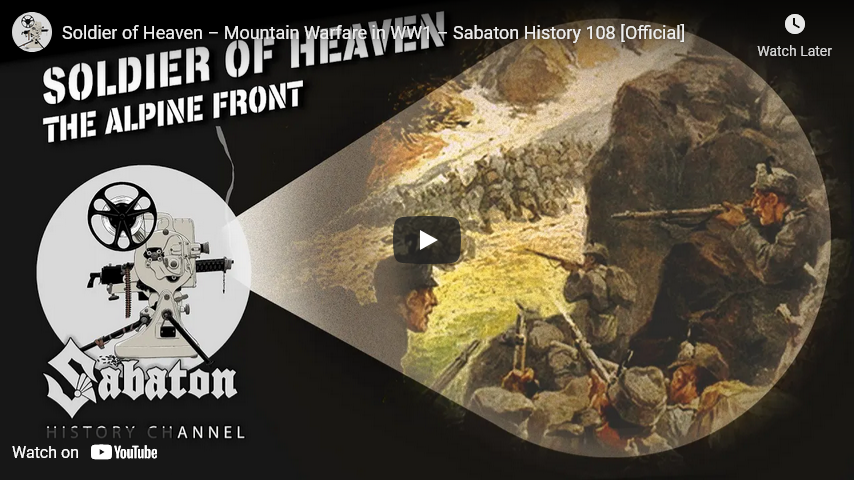
“Soldier of Heaven” – Mountain Warfare in WW1 – Sabaton History 108 [Official]
Sabaton History
Published 25 Jan 2022The war in the Alps between the Italians and the Austro-Hungarians added new dimensions to the fighting in the Great War since mountain warfare has its own unique set of challenges and dangers. What sort of men were doing the fighting here? And how did they cope with it? How did the survivors survive? Let’s take a look.
Support Sabaton History on Patreon: https://www.patreon.com/sabatonhistory
Listen to “Soldier of Heaven”: https://music.sabaton.net/SoldierOfHe…
Watch the Official Music Video of “Soldier of Heaven” here: https://www.youtube.com/watch?v=LYI3e…
Listen to Sabaton on Spotify: http://smarturl.it/SabatonSpotify
Official Sabaton Merchandise Shop: http://bit.ly/SabatonOfficialShopHosted by: Indy Neidell
Written by: Markus Linke and Indy Neidell
Directed by: Astrid Deinhard and Wieke Kapteijns
Produced by: Pär Sundström, Astrid Deinhard and Spartacus Olsson
Creative Producer: Maria Kyhle
Executive Producers: Pär Sundström, Joakim Brodén, Tomas Sunmo, Indy Neidell, Astrid Deinhard, and Spartacus Olsson
Post-Production Director: Wieke Kapteijns
Editor: Iryna Dulka
Sound Editor: Marek Kaminski
Archive: Reuters/Screenocean – https://www.screenocean.com
Sources:
– IWM Q 65115, IWM Q 65299, IWM Q 65062, IWM Q 65324, IWM Q 65102, IWM 1034-4, IWM 1062-14, IWM 459, IWM Q 114805б IWM Q 65104, IWM Q 65053, IWM Q 54778, IWM Q 65114, IWM Q 65130, IWM Q 65158
– esercito.difesa.it
– Médiathèque de l’architecture et du patrimoineS
– Business vector created by macrovector, Background vector created by freepik – www.freepik.com
All music by: SabatonAn OnLion Entertainment GmbH and Raging Beaver Publishing AB co-Production.
© Raging Beaver Publishing AB, 2019 – all rights reserved.
January 13, 2022
Sniper Rifles of 1942 – WW2 Special
World War Two
Published 12 Jan 2022Even the best sniper needed a reliable and accurate rifle. During the Second World War, all warring nations fielded designated sniper and marksman rifles, but different manufacturers had different ideas, from optical sights to breech-loading mechanisms, to gas-piston systems. Some preferred traditional bolt-action, others favored the new semi-automatic approach.
(more…)
January 12, 2022
Sniper Warrior – Vasily Zaitsev – WW2 Biography Special
World War Two
Published 11 Jan 2022From the woods of the Urals to the burning city of Stalingrad, Vasily Zaitsev went out to hunt his prey. As a sniper, he learned his trade in the grim reality of Stalingrad street fighting. Deep in the ruins of the factories, he stalked his enemies with a team of battle-hardened snipers. For days on end, they would lay in wait for valuable targets to show up. With a finger on the trigger, they would decimate the German ranks within a few deadly moments.
(more…)
December 20, 2021
Ross WWI Sniper Rifle w/ Winchester A5 Scope
Forgotten Weapons
Published 23 Aug 2021http://www.patreon.com/ForgottenWeapons
https://www.floatplane.com/channel/Fo…
Cool Forgotten Weapons merch! http://shop.forgottenweapons.com
The standard Canadian sniper’s rifle of World War One was the MkIII Ross fitted with a Warner & Swasey “musket sight” purchased from the United States. However, armorers in the field did create sniping rifles using other scopes — in particular the Winchester A5. The A5 was a popular commercial rifle scope at the time, and it found its way onto military rifles for many nations — I have seen examples on Lebel and SMLE rifles as well as of course American Springfields and this Ross.
The A5 was a 5x magnification scope with external adjustments. We don’t know when this example was built into sniper configuration, but it’s provenance is solid (this sort of thing would be relatively easy to counterfeit). Personally, I would much prefer a Winchester A5 over the Warner & Swasey pattern…
Contact:
Forgotten Weapons
6281 N. Oracle 36270
Tucson, AZ 85740
From the comments:
Cole Harris
1 hour ago
The famed Francis Pegahmagabow used a Ross during his service with the Canadian Expeditionary Force during WWI. While the Ross was considered a pretty terrible service rifle because of reliability/durability concerns, on the range it was a superb rifle that he used to great effect. I don’t know if he used irons or not, but he built quite a reputation for marksmanship with the Ross.
If you’d like more information about Francis Pegahmagabow, The Great War channel did a bio special about him and more recently Sabaton wrote a song called “A Ghost in the Trenches” about his military service.
December 11, 2021
Suppressed OSS M3 Grease Gun and Bushmaster Booby Trap Trigger
Forgotten Weapons
Published 9 May 2017Today, we have a chance to take a look at a suppressed M3 “Grease Gun”, as purchased and issued by the Office of Strategic Services (the OSS; predecessor to the CIA). Thanks to its readily removable barrel, the M3 (and M3A1) submachine gun was an easy gun to adapt to use with a suppressor (or as it was called at the time, a silencer). During World War 2, such a unit was developed for clandestine use by OSS and British SOE agents in occupied Europe, and they would see use for many decades in all manner of conflicts.
The suppressor itself is quite different than modern designs, being a two-part device using tight wire mesh instead of baffles. The barrel itself is heavily perforated, and extends only through the large diameter section of the suppressor. Around it is wrapped a large roll of wire mesh, which acts as an expansion chamber to slow down the exit of gas from the muzzle. The smaller front section of the unit is filled with small discs of the same wire mesh, similar to wipes but made of mesh.
Allegedly, the suppressor was effective enough to reduce the noise of the gunshots below the level of the action cycling, which is all that one can reasonable want from a suppressor. This particular example has an excellent provenance, having been provided by OSS to a European resistance fighter for a specific mission right at the end of WW2.
In addition, we also have a piece of the OSS sneaky tricks catalog to see. Specifically, a “Bushmaster” remote trigger mechanism to allow the M3 (silenced or otherwise) to be made into an autonomous booby trap in conjunction with a time delay, tripwire, or other triggering device.
Many thanks to the anonymous collector who let me take a look at this piece and bring you a video on it!
Cool Forgotten Weapons merchandise! http://shop.bbtv.com/collections/forg…
http://www.patreon.com/ForgottenWeapons
If you enjoy Forgotten Weapons, check out its sister channel, InRangeTV! http://www.youtube.com/InRangeTVShow