
Real Time History
Published 21 Oct 2022Sign up for Nebula and watch Rhineland 45: https://nebula.tv/realtimehistory
The Battle of the Bulge was one of the last German offensives during the Second World War. It caught the US Army off guard in the Ardennes sector but ultimately the Allies prevailed. But did Unternehmen Wacht am Rhein (“Operation Watch on the Rhine”) ever have a chance to succeed and reach Antwerp?
(more…)
October 22, 2022
Battle of the Bulge 1944: Could the German Plan Work?
Comments Off on Battle of the Bulge 1944: Could the German Plan Work?
October 19, 2022
South Atlantic D-Day: Battle of San Carlos – Falklands War
Historigraph
Published 15 Oct 2022On May 21st 1982, the United Kingdom landed thousands of troops at San Carlos Water in the Falkland Islands, to begin their recapture from Argentina. But only hours after arriving, British forces were under intense attack, as the Argentine air force attempted to push the troops clambering ashore back into the sea. This was the Battle of San Carlos.
0:00 – Intro
0:37 – Britain’s Invasion Plans
2:59 – Bespoke Post
4:16 – The Argentine Onslaught
8:46 – Attack on Coventry and Conveyer
(more…)
Comments Off on South Atlantic D-Day: Battle of San Carlos – Falklands War
October 9, 2022
QotD: The Paras in peacetime … the “Millwall of the British Army”
Part of the mythos surrounding the Parachute Regiment is its near legendary “bad behaviour” – it is not seen as a gentlemanly and affable club, it is, arguably, the Millwall of the British Army infantry units. Their role is simple – to leap from the air, and land in the most difficult and demanding of circumstances, probably at night, probably amid confusion, disarray and destruction, and then fight until relieved. It calls for a uniquely aggressive and determined mindset, and a willingness to go on long after others would have stopped.
The Regimental history is littered with gallantry awards and tales of valour that are both inspirational and humbling to read. There is no doubt that within their world, the airborne infantryman can, when deployed on operations, be a ferocious foe, who few would wish to tangle with. The problem is that this aggression and drive is not something that is commonly needed outside of military operations, and the chances of these occurring are in ever shorter supply.
After a period when there were opportunities for deployments and kinetic action in Afghanistan and Iraq, the call for missions for Paratroopers is, currently, slim. Designed as a force intended to be ready to go when called, their leadership have to balance off maintaining an aggressive “ready for anything” mentality, coupled with trying to keep the behaviour of their people under manageable control.
Sir Humphrey, “Values, Standards, and Leadership in the Internet Age”, Thin Pinstriped Line, 2022-06-18.
Comments Off on QotD: The Paras in peacetime … the “Millwall of the British Army”
September 30, 2022
M1C Sniper Garand
Forgotten Weapons
Published 18 Sep 2016The M1C was an M1 Garand with a telescopic sight, using a mounting system developed by the Griffin & Howe company of New York. It utilized a rail pinned and screwed to the left side of the receiver, coupled with a quick-release scope on top. The rails had to be installed prior to heat treating the receivers, which had the unfortunately consequence of preventing rifles form being chosen for sniper conversion based on their mechanical accuracy. Instead, accuracy would be tested only after rifles were complete, leading to a 60% rejection rate.
The scope was offset to the left of the receiver so as not to interfere with the Garand’s clip loading, and issued with a leather cheek pad to give the shooter’s cheek weld a matching offset to the left. The scope used with the M1C was the M73B1, later replaced with the M81 and M82 scopes — all military versions of the 2.5x Lyman Alaskan hunting scope (which was a very good piece of equipment despite its low magnification)
The M1C was adopted in 1944, but production and quality control delays would prevent it from seeing any action in WWII. It was in use during the Korean War, however, before being replaced by the M1D.
(more…)
Comments Off on M1C Sniper Garand
September 18, 2022
Jailbreak! Mussolini on the Loose Again! – WW2 – 212 – September 17, 1943
World War Two
Published 17 Sep 2022
(more…)
Comments Off on Jailbreak! Mussolini on the Loose Again! – WW2 – 212 – September 17, 1943
September 2, 2022
The Paras Last Drop – Gamil Airfield 1956
Mark Felton Productions
Published 18 Apr 2020The last time the Parachute Regiment dropped into combat was during the 1956 Suez Crisis when 3 PARA landed on El Gamil Airfield outside Port Said, Egypt.
(more…)
Comments Off on The Paras Last Drop – Gamil Airfield 1956
September 1, 2022
The Royal Marines at War: Commando – The Story of the Green Beret (1945)
Royal Marines
Published 31 Aug 2012Commando, made for the Admiralty in 1945, is a drama-documentary covering Commando training in Wrexham, Anchnacarry and St. Ives. Fascinating archive footage shows wartime Commando units on amphibious assault exercises, perfecting cliff-top assaults and practicing both armed and unarmed combat techniques.
Comments Off on The Royal Marines at War: Commando – The Story of the Green Beret (1945)
August 19, 2022
How Accurate is Saving Private Ryan? – WW2 D-Day Special
World War Two
Published 16 Aug 2022How accurate is that famous beach scene in Saving Private Ryan? Is it true to the history or just another Hollywood story? Seeing as we’re about to start the filming for our massive D-Day project, we figured we’d break it down, shot by shot.
(more…)
Comments Off on How Accurate is Saving Private Ryan? – WW2 D-Day Special
August 5, 2022
ARNHEM – A Bridge Too Far – THE TRUE STORY (2001)
British Army Documentaries
Published 25 Jun 2022Please help us to keep bringing you great content! We are able to bring you these interesting documentaries, which would otherwise be held in a vault, or away from public view because we purchase commercial licenses often at considerable expense. Unfortunately, YouTube’s re-use policy now means we can’t monetise it. This means we can’t invest in new licenses for new documentaries. Please help us by subscribing to our Patreon page from just £2/month so we can keep bringing you great content, otherwise, this channel may need to close forever. Thank You
https://www.patreon.com/BritishArmyDocs
——————————————————————————————————————————
At 3:00 a.m., the commanders of the 2nd South Staffordshire battalion and the 1st and 11th Parachute battalions met to plan their attack. At 4:30 a.m., before dawn, the 1st Parachute Brigade began its attack towards Arnhem bridge, with the 1st Battalion leading supported by remnants of the 3rd Battalion, with the 2nd South Staffordshires on the 1st Battalion’s left flank and the 11th Battalion following. As soon as it became light the 1st Battalion was spotted and halted by fire from the main German defensive line. Trapped in open ground and under heavy fire from three sides, the 1st Battalion disintegrated and what remained of the 3rd Battalion fell back. The 2nd South Staffordshires were similarly cut off and, save for about 150 men, overcome by midday. The 11th Battalion, (which had stayed out of much of the fighting) was then overwhelmed in exposed positions while attempting to capture high ground to the north. With no hope of breaking through, the 500 remaining men of these four battalions withdrew westwards in the direction of the main force, 5 km (3.1 mi) away in Oosterbeek.
The 2nd Battalion and attached units (approximately 600 men) were still in control of the northern approach ramp to the Arnhem bridge. They had been ceaselessly bombarded by enemy tanks and artillery from two battle groups led by SS-Sturmbannführer [Major] Brinkmann and one commanded by Major Hans-Peter Knaust. The Germans recognized that they would not be moved by infantry attacks such as those that had been bloodily repulsed on the previous day so instead, they heavily shelled the short British perimeter with mortars, artillery, and tanks; systematically demolishing each house to enable their infantry to exploit gaps and dislodge the defenders. Although in the battle against enormous odds, the British clung to their positions, and much of the perimeter was held.
(more…)
Comments Off on ARNHEM – A Bridge Too Far – THE TRUE STORY (2001)
August 2, 2022
The Last Battle in the West – How The Allies Crossed The Rhine 1945
Real Time History
Published 30 Jul 2022Get CuriosityStream + Watch Rhineland 45 on Nebula: https://curiositystream.com/realtimeh…
The Rhine river was the last major natural obstacle on the Western Front of WW2 in early 1945. The Allied armies needed to cross the symbolic river to enter the heart of Nazi Germany. While General Patton’s 1st Army crossed the river at Remagen first, the actual set-piece battle of the Rhine took place further north and involved the biggest airborne operation in a single day in the entire war.
(more…)
Comments Off on The Last Battle in the West – How The Allies Crossed The Rhine 1945
July 27, 2022
When the founder of the SAS was captured by Italian troops in 1943
In The Critic, Saul David describes what happened when Lieutenant Colonel David Stirling was captured during his “most hare-brained scheme” to link up the troops of Britain’s First and Eighth armies in Tunisia:

In January 1943 Lieutenant Colonel David Stirling, founder of the SAS, was flown to Rome for interrogation. He had been captured by the Italians on his “most hare-brained scheme yet” — leading a small raiding party deep into enemy territory in Tunisia to attack lines of communication, reconnoitre the terrain and become the first Eighth Army unit to link up with the First Army advancing from the west.
Cautious when speaking to the Italians, he was “vain and voluble” in conversation with a fellow “captive”, Captain John Richards. Unbeknown to Stirling, Richards was an Anglo-Swiss stool pigeon, Theodore Schurch, who had deserted from the British army and was working for fascist intelligence.
Prior to Schurch’s court-martial for treachery in late 1945, Stirling denied he had revealed any sensitive information. If he had, it was inaccurate and “designed to deceive”. This was a lie, told to protect Stirling’s reputation. In fact, as the British authorities knew all too well from intercepted signals, Stirling had told Richards vital details about current SAS operations, including the location of patrols and their orders. He had even given them the name of his probable replacement as SAS commander: Paddy Mayne.
The story of Stirling’s unfortunate encounter with Schurch has been told before, notably by Ben Macintyre in his bestselling SAS: Rogue Heroes. But Macintyre underplays Stirling’s indiscretion and fails to link it to the many other examples of the SAS commander’s recklessness and poor judgement of character. For Gavin Mortimer, on the other hand, both the capture and loose talk were typical of a man who was “imaginative, immature, immoderate and ill-disciplined”. Small wonder that even his own brother Bill thought he would be better off in a prisoner-of-war camp.
The subtitle of Mortimer’s book — a carefully researched and impeccably sourced take-down of the legendary special forces pioneer — is a corrective to the flattering but inaccurate nickname that was first coined for Stirling by British tabloids during the Second World War. “When word reached Cairo of the Phantom Major moniker,” writes Mortimer, “it must have sparked a mix of hilarity and indignation. All the falsehoods and fabrications would have been harmless enough had Stirling not stolen the valour of his comrades.”
Thread by thread, Mortimer unpicks the myth of Stirling’s life and war service that the subject and his fawning admirers had so carefully constructed, both during and after the war. Stirling was not training in North America for an attempt on Mount Everest’s summit when war broke out in 1939, as he later claimed, but rather working as a ranch hand because his exasperated family hoped it might give the feckless youth some focus and direction.
Comments Off on When the founder of the SAS was captured by Italian troops in 1943
July 24, 2022
Stoner 63A Automatic Rifle – The Original Modular Weapon
Forgotten Weapons
Published 17 Mar 2018The Stoner 63 was a remarkably advanced and clever modular firearm designed by Eugene Stoner (along with Bob Fremont and Jim Sullivan) after he left Armalite. This was tested by DARPA and the US Marine Corps in 1963, and showed significant potential — enough that the US Navy SEALs adopted it and kept it in service into the 1980s. It was a fantastic balance of weight and controllability, offering a belt-fed 5.56mm platform at less than half the weight of the M60. The other fundamental characteristic of the Stoner 63 was modularity. It was built around a single universal receiver component which could be configured into a multitude of different configurations, from carbine to medium machine gun. Today we have one of the rarer configurations, an Automatic Rifle type. In addition, today’s rifle is actually a Stoner 63A, the improved version introduced in 1966 to resolve some of the problems that had been found in the original.
Ultimately, the Stoner system was able to achieve its remarkably light weight by sacrificing durability. The weapon was engineered extremely well and was not a danger to itself (like, for example, the FG-42), but it was prone to damage when mishandled by the average grunt. This would limit its application to elite units like the SEALs, who were willing to devote the necessary care to the maintenance and operation of the guns in exchange for the excellent handling characteristics it offered.
(more…)
Comments Off on Stoner 63A Automatic Rifle – The Original Modular Weapon
July 18, 2022
Russian Invasion of Finland – The Winter War 1939-40
Mark Felton Productions
Published 24 Mar 2022Find out why Russia invaded neutral Finland in late 1939, and how the outnumbered and outgunned Finns managed to defend their country for 3 months until making peace with Stalin.
(more…)
Comments Off on Russian Invasion of Finland – The Winter War 1939-40
July 17, 2022
Who Let the Dogs Out?! – The Invasion of Sicily – WW2 – 203 – July 16, 1943
World War Two
Published 16 Jul 2022The Allies have begun their fight to take back Western Europe with Operation Husky. That’s not the only news though. They are also trying to extend their foothold in the Solomons, and Germany and the USSR continue smashing into one another at Kursk.
(more…)
Comments Off on Who Let the Dogs Out?! – The Invasion of Sicily – WW2 – 203 – July 16, 1943
June 29, 2022
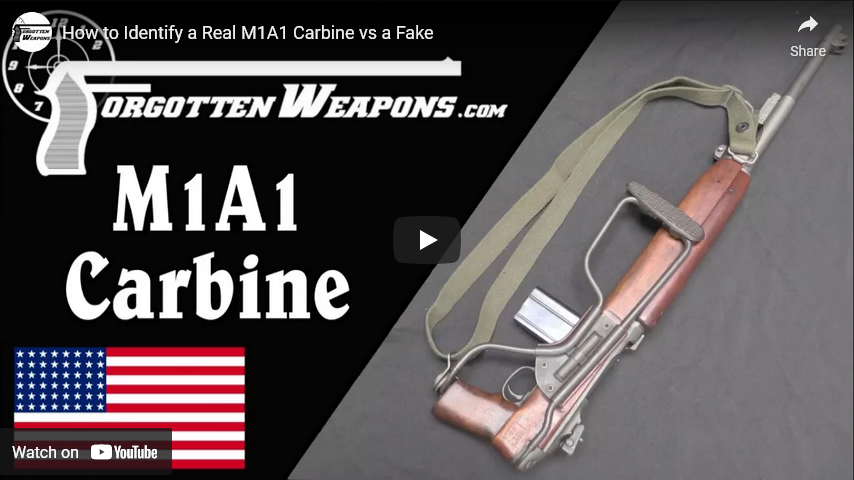
How to Identify a Real M1A1 Carbine vs a Fake
Forgotten Weapons
Published 10 Feb 2018Looking for a light and compact weapon to equip its new Airborne units, the US military adopted the M1A1 Carbine in May of 1942. This was mechanically identical to the existing M1 Carbine but with a wire-frame side-folding stock in place of the standard wooden stock. This allowed the M1A1 to fit into a very handy leg bag for paratroops.
Deliveries began in October 1942, with all of the guns being manufactured by the Inland company. A total of 140,591 were made in two batches (71,000 between October 1942 and October 1943 and another 69,000 between April and December 1944). This is a very small fraction of the more than 6 million M1 Carbines made during the war, and the M1A1 has become quite notable and desirable for its association with elite Airborne units. As a result, reproduction and fake stocks abound, and are quite difficult to tell from original ones.
Today we are going to look at some of the specific features that can help you authenticate an M1A1 stock.
http://www.patreon.com/ForgottenWeapons
Cool Forgotten Weapons merch! http://shop.bbtv.com/collections/forg…
If you enjoy Forgotten Weapons, check out its sister channel, InRangeTV! http://www.youtube.com/InRangeTVShow
Contact:
Forgotten Weapons
6281 N Oracle #36270
Tucson, AZ 85704
Comments Off on How to Identify a Real M1A1 Carbine vs a Fake


