
World War Two
Published 4 Jul 2022Glyndwr Michael, the dead secret agent, has deposited his deceptive letters in Spain. Now the next phase of Operation Mincemeat begins. If Charles Cholmondely of MI5 and Ewen Montagu of Naval Intelligence have done their job right, the letters should make their way into Hitler’s hands.
(more…)
July 5, 2022
How to Fool a Führer – Operation Mincemeat – WW2 – Spies & Ties 19
Comments Off on How to Fool a Führer – Operation Mincemeat – WW2 – Spies & Ties 19
June 16, 2022
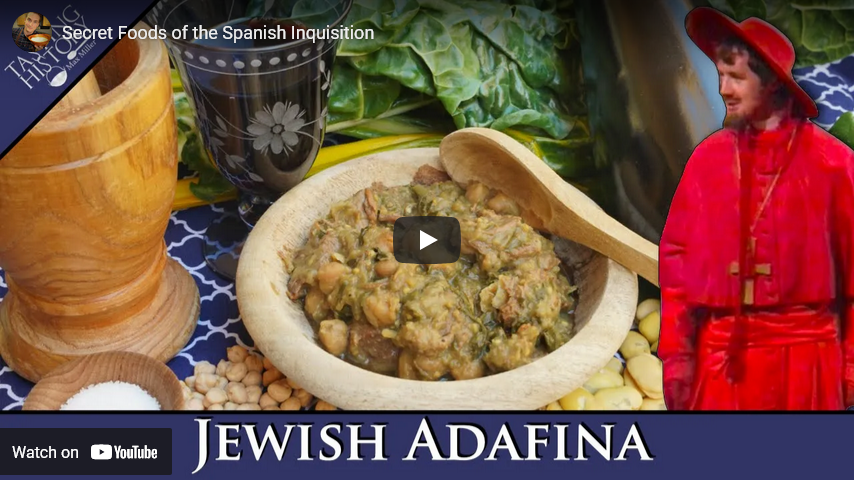
Secret Foods of the Spanish Inquisition
Tasting History with Max Miller
Published 15 Feb 2022Support the Channel with Patreon ► https://www.patreon.com/tastinghistory
Merch ► crowdmade.com/collections/tastinghistory
Instagram ► https://www.instagram.com/tastinghist…
Twitter ► https://twitter.com/TastingHistory1
Tiktok ► TastingHistory
Reddit ► r/TastingHistory
Discord ► https://discord.gg/d7nbEpy
Amazon Wish List ► https://amzn.to/3i0mwGt
Send mail to:
Tasting History
PO Box 766
Burbank, CA 91503LINKS TO SOURCES**
A Drizzle of Honey by David M. Gitlitz and Linda Kay Davidson: https://amzn.to/3gyf0CY
The Spanish Inquisition by Henry Kamen: https://amzn.to/3B9EbVXRECIPE
1 cup (160g) dried fava beans
1 cup (180g) dried chickpeas
2 1/2 lbs or 1kg beef
¼ cup (60ml) Olive oil
1 tablespoon salt
1 large onion diced
1 quart (1L) beef broth or water
2 teaspoon ground coriander
1 1/2 tsp ground cumin
2 teaspoon ground caraway
2 teaspoon fresh ground pepper
2 Eggplant, peeled and chopped
A large handful of chard leaves1. Coat the eggplant in salt, cover, and set aside for several hours.
2. Boil the fava beans and chickpeas in a large pot for 2 minutes, then drain and set aside. In the same pot, heat half of the olive oil over medium heat then, add the onions and half of the salt and cook until lightly brown, about 8 minutes. Remove the onions and add the beef to the empty pot with the rest of the oil and salt. Cook until lightly brown, about 5 minutes. Add the onions back in as well as the beef broth/water. Bring to a simmer and cover, letting the stew simmer for 1 hour.
3. Drain and rinse the eggplant, then add it into the pot along with the fava bean, chickpeas, and spices. Cover and let cook for another 2 hours.
4. Chop the chard, then pound it flat with a rolling pin, and add it into the pot. Set the pot into the oven at 200°F and cook overnight (or at least 6 hours). Alternately, you can transfer the adafina to a slow cooker overnight. Serve alone or over rice.**Some of the links and other products that appear on this video are from companies which Tasting History will earn an affiliate commission or referral bonus. Each purchase made from these links will help to support this channel with no additional cost to you. The content in this video is accurate as of the posting date. Some of the offers mentioned may no longer be available.
Subtitles: Jose Mendoza | IG @ worldagainstjose
#tastinghistory #jewishcooking #spanishinquisition
Comments Off on Secret Foods of the Spanish Inquisition
June 11, 2022
Spanish Canada: The Nootka Crisis
The History Guy: History Deserves to Be Remembered
Published 10 Jun 2022In 1789, the Spanish empire prepared to enforce their territorial claims far to the North of what they nominally controlled, and instigated a crisis that threatened to bring the great European powers to war.
Check out our new community for fans and supporters! https://thehistoryguyguild.locals.com/
This is original content based on research by The History Guy. Images in the Public Domain are carefully selected and provide illustration. As very few images of the actual event are available in the Public Domain, images of similar objects and events are used for illustration.
You can purchase the bow tie worn in this episode at The Tie Bar:
https://www.thetiebar.com/?utm_campai…All events are portrayed in historical context and for educational purposes. No images or content are primarily intended to shock and disgust. Those who do not learn from history are doomed to repeat it. Non censuram.
Find The History Guy at:
New community: https://thehistoryguyguild.locals.com/
Please send suggestions for future episodes: Suggestions@TheHistoryGuy.netThe History Guy: History Deserves to Be Remembered is the place to find short snippets of forgotten history from five to fifteen minutes long. If you like history too, this is the channel for you.
Awesome The History Guy merchandise is available at:
teespring.com/stores/the-history-guyScript by JCG
#history #thehistoryguy #Canada

Comments Off on Spanish Canada: The Nootka Crisis
May 31, 2022
The Crusades: Part 9 – The Other Crusades
seangabb
Published 18 Mar 2021The Crusades are the defining event of the Middle Ages. They brought the very different civilisations of Western Europe, Byzantium and Islam into an extended period of both conflict and peaceful co-existence. Between January and March 2021, Sean Gabb explored this long encounter with his students. Here is one of his lectures. All student contributions have been removed.
(more…)
Comments Off on The Crusades: Part 9 – The Other Crusades
May 17, 2022
QotD: Slavery
There is no doubt, if you read history, that people in the past treated other people very badly. We still do, too, but I guess it’s much more awful when society is not quite so affluent and when being on the bottom can mean starving to death. It is impossible to read history, particularly primary sources, and not to be horrified.
But part of that is that we’re imposing our values on the past. Look, history is looked at backwards, while we live forward. Take slavery (I don’t want it.) Yes, it was a horrible institution. It was also pervasive in human history, and as far as we can tell pre-history, world without end. Hell, still is as well, considerably less of the world than it was, but in Africa it’s pretty much still a thing, and not just in Arab countries.
Romans had complex rules to deal with it, and lived in fear of slave revolts.
It required mental gymnastics, because it was obvious to anyone that slaves were as human as their masters, and so a complex set of rules and philosophical separations were instituted and once any idea of the equality of man (or that man ought to be equal before the law (and G-d) the whole thing was doomed, sooner or later.
Americans tend to have a bizarre idea that slavery was always by race. I blame public school. I don’t know if it’s deliberately obscured, to emphasize the specialness of racial victimhood, or just because race and slavery are so associated in American history that it overshadows everything else. (Yes, again, is it malice or stupidity? Perhaps we should formulate an axiom that sufficiently advanced stupidity is indistinguishable from malice.)
Men and women of all colors were enslaved throughout history. Heck, in the peninsula, in the long centuries in which it was a frontier between Christian and Moor, the slaving went on both ways. […]
Roman slaves were often blond, and the citizens often of African origin. But even there, it wasn’t tied to race. (Though celts were apparently in general fairly cheap, from what I can figure.)
So. All of us have slave ancestors. ALL OF US. All of us have slave owners in our ancestry.
Even in the US — though rare — there were black slave owners. And if you’re going to parse quadroons and octaroons who might very well be slaves, you’re going to assume race is one-drop but only for non-white races.
Sarah Hoyt, “I Am Myself Alone”, According to Hoyt, 2019-02-25.
Comments Off on QotD: Slavery
May 11, 2022
Operation Mincemeat – The True Story – WW2 – Spies & Ties 16
World War Two
Published 10 May 2022We’ve encountered plenty of different secret agents. Men, women, Allied, Axis, Partisans. They all fight for different reasons: patriotism, vengeance, or cold hard cash. But they’ve all had one thing in common. They’ve been alive. We’ve never had a dead secret agent. Yet …
(more…)
Comments Off on Operation Mincemeat – The True Story – WW2 – Spies & Ties 16
April 17, 2022
Operation Mincemeat, 1943
Once an obscure bit of espionage and military disinformation, the events of Operation Mincemeat are being brought to the big screen (boy, does that term seem dated) in a feature film starring Colin Firth. Michael Curtis provides a look at the actual deception mission that inspired the film:
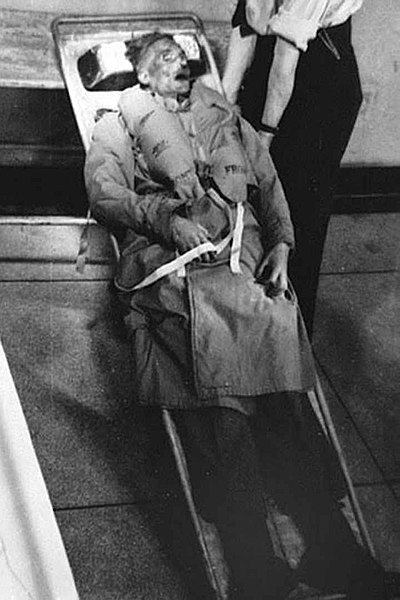
The corpse of Glyndwr Michael, dressed in a Royal Marine uniform with false documents and a fake ID, used in Operation Mincemeat, 1943.
Public domain image from The National Archives.
The story of the British deception, a fascinating story of Allied subterfuge, is now told in the film Operation Mincemeat. It is a remarkable and seemingly highly improbable story of a plan of Allied intelligence to deceive Hitler and misdirect German intelligence. Indeed, it is one of the best examples in history of military deception.
The concept of a plan starts with the Trout Memo, officially written in 1939 by Admiral John Godfrey, director of Naval Intelligence, but almost certainly written by his subordinate Lieutenant Commander Ian Fleming, not yet dreaming of 007, about the deception of an army in war time by fly fishing. Many ideas were suggested, including sending out tins of explosives disguised as food so that hungry sailors would pick them up. One idea, number 28 on the list, almost certainly the thought of Fleming who thought of elaborate deception options, was to use a dead body dressed as an airman dropped from a parachute that had failed and carrying false papers, and drop it where the Germans would find it and be deceived by it.
The deception was planned by a group, the Twenty Committee, XX, headed by Lieutenant Commander RNVR, Ewen Montagu, Cambridge, Harvard, a naval intelligence officer and prominent Jewish lawyer, who later became a judge, together with an RAF officer Squadron Leader Charles Cholmondeley. Montagu later wrote an account of the affair in a book, The Man who Never Was, 1953. The memory of the event is also simply commemorated in a mortuary in Hackney in East London where the body that was used in the plot is buried. In a rather unkind but truthful remark Montagu said of the man who was used, “The only worthwhile thing he ever did, he did after his death.”
The main deception in the plot was a personal letter purported to be from General Sir Archibald Nye to General Sir Harold Alexander, starting, “My dear Alex.” Nye’s letter contained details of sensitive topics, and of a new commander of the Guards brigade, and U.S. service medal awards. He also referred to Operation Husky, an imminent Allied invasion of Greece, that the Germans had been reinforcing and strengthening their defenses in Greece and Crete, and therefore the chief of the Imperial General Staff felt that the Allied troops planned for the assault were insufficient. Thus, it was agreed by the chiefs of staff that the 5th division should be reinforced by one brigade group for the assault on the beach south of Cape Araxos and that similar reinforcement should be made for the 56th division at Kalamata. The letter was a clever double bluff. Nye wrote that “we stand a very good chance of making the Germans think we will go for Sicily, it is an obvious objective and one about which they must be nervous.” To confuse Hitler, he therefore suggested the Allies would invade Sicily.
It is interesting but not surprising that a key figure in the deception appears to have been Ian Fleming, Mr. James Bond, who had written of methods to confuse the enemy, and was crucial to the Trout Memo.
The plot developed. After some difficulty a suitable body was found by a London coroner and kept on ice for few months. It was Glyndwr Michael, 34, homeless Welsh laborer, penniless, with mental health problems, who had died after ingesting rat poison in a London warehouse. He was transformed into Major William Martin, of the Royal Marines whose body contained love letters from a non-existent fiancé named Pam, a jewelry bill for an engagement ring, ticket stubs, religious medal, a copy of a letter marked “personal and most secret”, and above all the false Nye letter. The body had to look as if it had died in an air crash, but floated ashore and he had died at sea. Major Martin, his body wrapped in a life jacket, and with a black attaché case chained to his wrist, was found on April 30, 1943, by a Spanish fisherman off the coast of Huelva.
Even more unlikely than the plan itself was the impact the “secret” document had on Axis planning, summarized in the Wikipedia article:
On 14 May 1943 Grand Admiral Karl Dönitz met Hitler to discuss Dönitz’s recent visit to Italy, his meeting with the Italian leader Benito Mussolini and the progress of the war. The Admiral, referring to the Mincemeat documents as the “Anglo-Saxon order”, recorded
The Führer does not agree with … [Mussolini] that the most likely invasion point is Sicily. Furthermore, he believes that the discovered Anglo-Saxon order confirms the assumption that the planned attacks will be directed mainly against Sardinia and the Peloponnesus.
Hitler informed Mussolini that Greece, Sardinia and Corsica must be defended “at all costs”, and that German troops would be best placed to do the job. He ordered that the experienced 1st Panzer Division be transferred from France to Salonika, Greece. The order was intercepted by GC&CS on 21 May. By the end of June, German troop strength on Sardinia had been doubled to 10,000, with fighter aircraft also based there as support. German torpedo boats were moved from Sicily to the Greek islands in preparation. Seven German divisions transferred to Greece, raising the number present to eight, and ten were posted to the Balkans, raising the number present to 18.
On 9 July the Allies invaded Sicily in Operation Husky. German signals intercepted by GC&CS showed that even four hours after the invasion of Sicily began, twenty-one aircraft left Sicily to reinforce Sardinia. For a considerable time after the initial invasion, Hitler was still convinced that an attack on the Balkans was imminent, and in late July he sent General Erwin Rommel to Salonika to prepare the defence of the region. By the time the German high command realised the mistake, it was too late to make a difference.
April 4, 2022
The Congress of Vienna (Part 2) (1814 to 1815)
Historia Civilis
Published 2 Apr 2022Patreon | http://historiacivilis.com/patreon
Donate | http://historiacivilis.com/donate
Merch | historiacivilis.com/merch
Mailing List | http://historiacivilis.com/mailinglist
Twitter | http://historiacivilis.com/twitter
Website | http://historiacivilis.comSources:
Eric Hobsbawm, The Age of Revolution, 1789-1848
Adam Zamoyski, Rites of Peace: The Fall of Napoleon and the Congress of Vienna
Richard J. Evans, The Pursuit of Power: Europe 1815-1914
Wolfram Siemann, Metternich: Strategist and Visionary
A. Wess Mitchell, The Grand Strategy of the Habsburg Empire
Robert K. Massie, Dreadnought: Britain, Germany, and the Coming of the Great War
Adam Hochschild, Bury the Chains: Prophets and Rebels in the Fight to Free an Empire’s Slaves
Harry Dickinson, Public Opinion and the Abolition of the Slave Trade | https://bit.ly/2XRMLJC
The History of Parliament: The 5th Parliament of the United Kingdom | https://www.historyofparliamentonline…Music:
“Past,” by Nctrnm
“While She Sleeps (Morning Edit),” by The Lights Galaxia
“Mell’s Parade,” by Broke For Free
“Day Bird,” by Broke For Free
“Thomas Neutrality,” by Enrique Molano
“Infados,” by Kevin MacLeod
“The House Glows (With Almost No Help),” by Chris Zabriskie
“Hallon,” by Christian Bjoerklund
Comments Off on The Congress of Vienna (Part 2) (1814 to 1815)
March 7, 2022
Wargaming the Spanish Civil War
Of all the wars of the 20th century, the Spanish Civil War has to have been one of the most confusing to outsiders at the time and virtually unreadable to moderns who didn’t live through that tumultuous era. I’ve read and enjoyed Orwell’s Homage to Catalonia, but it’s not a history of the whole war: Orwell was an enlisted volunteer who served on a “quiet” sector until he was seriously wounded by a Nationalist sniper. He discusses the situations he encountered personally and avoids, for the most part, editorializing the larger strategic conflict (the TimeGhost team did a pretty helpful video on how the war was triggered that may be informative). As a result of the lack of clarity and the confused narratives, the Spanish Civil War hasn’t been covered in wargames to any great degree, but Jonathan Kay found a scenario for Advanced Squad Leader on part of the conflict that he clearly found intriguing:
The Spanish Civil War was, in human terms, an epic clash of arms: Almost 300,000 combatants are thought to have been killed, as well as more than 150,000 civilians. The conflict also looms large in the history of the 20th century, having been memorably described by U.S. ambassador to Spain Claude Bowers as the “dress rehearsal” for World War II.
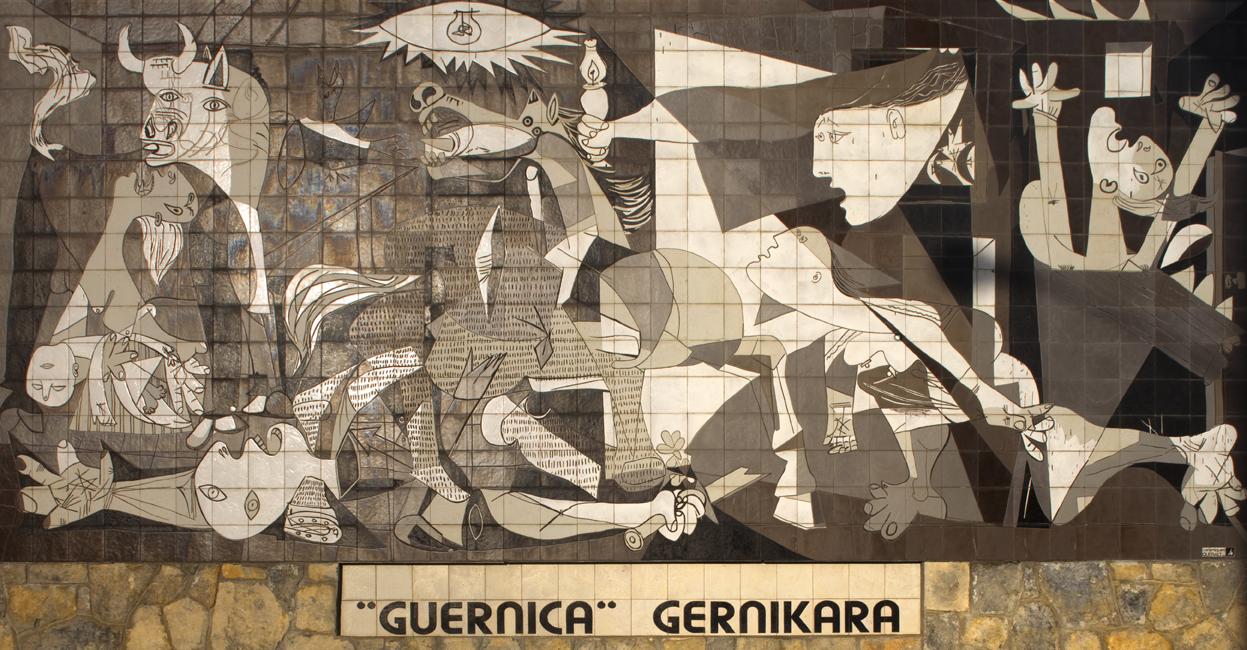
Among the idealistic combatants who travelled to Spain to join the fight against fascism were Ernest Hemingway and George Orwell, whose war experiences served to inform, respectively, For Whom the Bell Tolls and Homage to Catalonia. The war also inspired Pablo Picasso’s unsettling surrealist masterpiece Guernica, which depicted the bombing of the Basque town of the same name on April 26, 1937.
Picasso’s Guernica in mural form in the town of Guernica.
Photo by Papamanila via Wikimedia Commons.All in all, something like 50,000 foreigners assisted the Republican side through the International Brigades — whose Brigada Abraham Lincoln included a Washington Battalion made up of Americans, and a Mackenzie-Papineau Battalion made up of Canadians. At least a quarter of these international volunteers died in combat, but most of the rest went home with frightening stories to tell. Even before the Nazis invaded Poland, the world’s understanding of fascism’s existential threat to humanity was shaped by General Francisco Franco’s successful campaign to topple the Second Spanish Republic.
And yet one thing that the Spanish Civil War has not yielded is a wide array of popular boardgames. This may be partly due to the fact that the conflict was so greatly overshadowed in scale and importance by World War II. But it may also be due to the fact that neither side emerged as sympathetic. As Orwell described in Homage to Catalonia (and as Adam Hochschild described, from a U.S. perspective, in his 2016 book, Spain in Our Hearts: Americans in the Spanish Civil War, 1936–1939), the Republican war effort turned out to be incompetent, fractured, and cynical, with the dominant pro-Stalinist faction eventually turning murderously upon its Trotskyist and anarchist allies. And as late as early March, 1939, just weeks before Franco conquered Madrid and ended the war, Republican forces inside the capital city were engaged in a deadly power struggle within their own ranks. All in all, the many regional and political subplots make the war difficult to model in any kind of conventional wargame (though, of course, this hasn’t stopped numerous game designers from trying).
However, The Beleaguered Capital, HazMo scenario 11, presents a reminder that when Republican and Nationalist forces fought each other in pitched battles, the mode of combat really did offer a preview of World War II, including the use of air power and tanks. (While the only tanks that existed in Spain when the war broke out were a handful of tiny, World War I-era Renault FTs, the Russians sent T-26s to the Republicans while Germany dispatched Pz Is to the Nationalists. In both cases, these vehicles arrived in Spain during the Fall of 1936, just a few months before the December 16 dateline on The Beleaguered Capital.)
Comments Off on Wargaming the Spanish Civil War
February 7, 2022
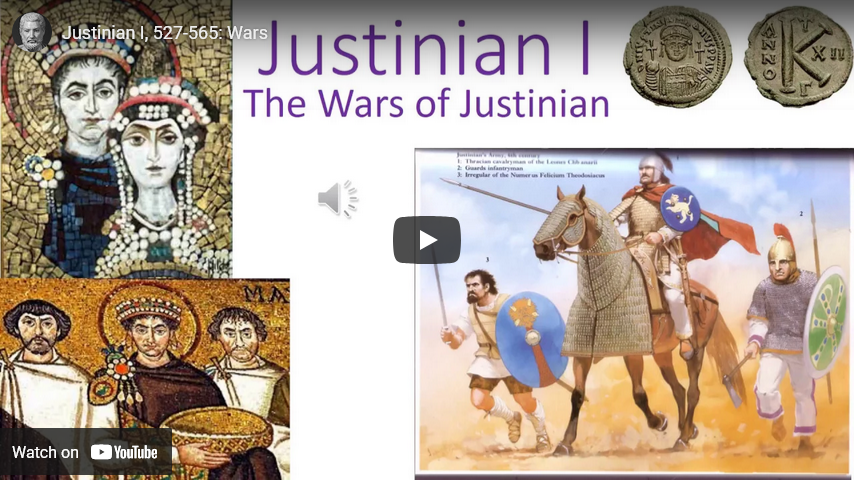
Justinian I, 527-565: Wars
Thersites the Historian
Published 21 Sep 2017In this video, I look at the wars of conquest waged by the Emperor Justinian and explore whether or not these conflicts advanced the long-term interests of the Byzantine state.
Comments Off on Justinian I, 527-565: Wars
January 27, 2022
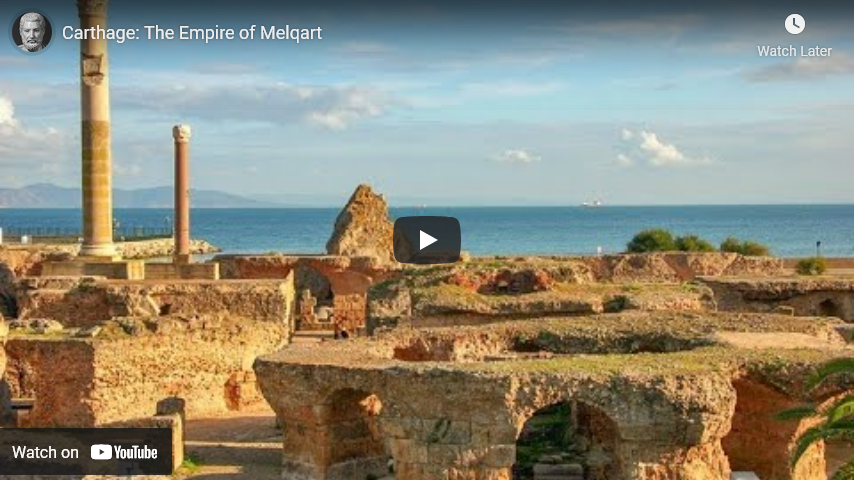
Carthage: The Empire of Melqart
Thersites the Historian
Published 11 Nov 2021In this lecture, we look at why it is so hard to find Punic material remains and where one can search for what little there is left to find.
Patreon link: https://www.patreon.com/thersites
PayPal link: paypal.me/thersites
Discord: https://discord.gg/QCaXXFr
Brave Browser: https://brave.com/noa557
Twitter link: https://twitter.com/ThersitesAthens
Minds.com link: https://www.minds.com/ThersitestheHis…
Steemit/dtube link: https://steemit.com/@thersites/feed
BitChute: https://www.bitchute.com/channel/jbyg…
Comments Off on Carthage: The Empire of Melqart
January 17, 2022
QotD: The British ruling class reaction to fascism and communism
The British ruling class were not altogether wrong in thinking that Fascism was on their side. It is a fact that any rich man, unless he is a Jew, has less to fear from Fascism than from either Communism or democratic Socialism. One ought never to forget this, for nearly the whole of German and Italian propaganda is designed to cover it up. The natural instinct of men like Simon, Hoare, Chamberlain, etc. was to come to an agreement with Hitler. But – and here the peculiar feature of English life that I have spoken of, the deep sense of national solidarity, comes in – they could only do so by breaking up the Empire and selling their own people into semi-slavery. A truly corrupt class would have done this without hesitation, as in France. But things had not gone that distance in England. Politicians who would make cringing speeches about “the duty of loyalty to our conquerors” are hardly to be found in English public life. Tossed to and fro between their incomes and their principles, it was impossible that men like Chamberlain should do anything but make the worst of both worlds.
One thing that has always shown that the English ruling class are morally fairly sound, is that in time of war they are ready enough to get themselves killed. Several dukes, earls and what-not were killed in the recent campaign in Flanders. That could not happen if these people were the cynical scoundrels that they are sometimes declared to be. It is important not to misunderstand their motives, or one cannot predict their actions. What is to be expected of them is not treachery or physical cowardice, but stupidity, unconscious sabotage, an infallible instinct for doing the wrong thing. They are not wicked, or not altogether wicked; they are merely unteachable. Only when their money and power are gone will the younger among them begin to grasp what century they are living in.
George Orwell, “The Lion And The Unicorn: Socialism and the English Genius”, 1941-02-19.
Comments Off on QotD: The British ruling class reaction to fascism and communism
January 4, 2022
Peninsular War: Why were British infantry so successful?
Redcoat: British military history
Published 16 Dec 2021Why were the British redcoats so successful in the Peninsular war? There were many reasons, but amongst them was the way regiments were organised and the tactics they employed.
If you are interested in the Zulu War, then please sign up for my mailing list to receive my free book on the subject: www.redcoathistory.com
If you are very generous, you can also buy me a coffee and help support the channel via https://ko-fi.com/redcoathistory
Comments Off on Peninsular War: Why were British infantry so successful?
November 19, 2021
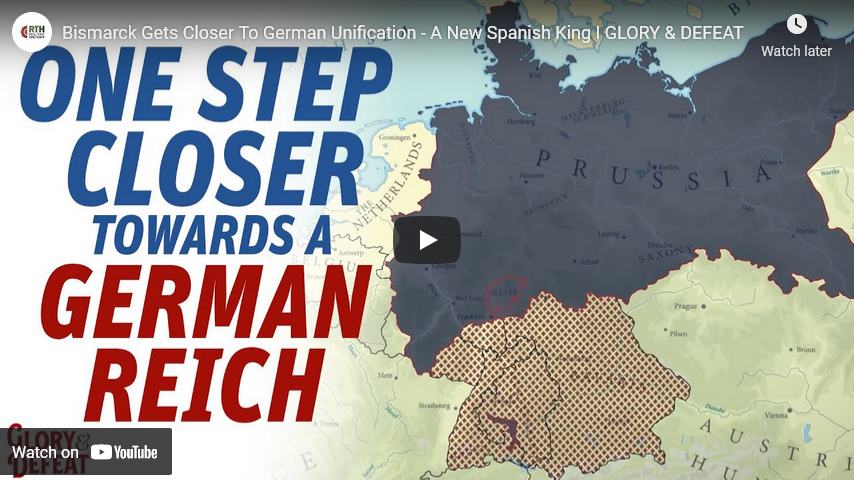
Bismarck Gets Closer To German Unification – A New Spanish King I GLORY & DEFEAT
Real Time History
Published 18 Nov 2021Sign up for Curiosity Stream and get Nebula bundled in and SAVE 26%: https://curiositystream.com/realtimeh…
While the Franco-Prussian War is continuing its messy guerilla phase, the German leaders are negotiating towards a united Germany. Hesse and Baden join the promptly renamed German Confederation — but Württemberg and Bavaria still want more concessions. Meanwhile the question of Spanish succession that started the war is solved in Madrid.
» THANK YOU TO OUR CO-PRODUCERS
John Ozment
James Darcangelo
Jacob Carter Landt
Thomas Brendan
James Giliberto
Kurt Gillies
Albert B. Knapp MD
Tobias Wildenblanck
Richard L Benkin
Scott Deederly
John Belland
Adam Smith
Taylor Allen
Jim F Barlow
Rustem Sharipov» OUR PODCAST
https://realtimehistory.net/podcast – interviews with historians and background info for the show.» LITERATURE
Arand, Tobias: 1870/71. Der Deutsch-Französische Krieg erzählt in Einzelschicksalen. Hamburg 2018Gouttman, Alain: La grande défaite. 1870-1871. Paris 2015
Koch, Roland : “Les canons à balles dans l’armée du Rhin en 1870” in Revue historique des armées, 255 (2009), p. 95-107.
» SOURCES
Braun, Lily (Hrsg): Kriegsbriefe aus den Jahren 1870/71 von Hans von Kretschman weiland General der Infanterie. Berlin 1911Carr, Raymond: Spain 1808–1939. Oxford: At the Clarendon Press, 1975
Deuerlein, Ernst: Die Gründung des Deutschen Reichs 1870/71 in Augenzeugenberichten. Düsseldorf 1970
Goncourt, Edmond de: Journal des Goncourts. II.1. 1870-1871. Paris 1890
Kühnhauser, Florian: Kriegs-Erinnerungen eines Soldaten des königlich bayerischen Infanterie Leibregiments. Partenkirchen 1898
Lowndes, Emma: Récits de femmes pendant la guerre franco-prussienne (1870-1871). Paris, 2013.
Meisner, Heinrich Otto (Hrsg.): Kaiser Friedrich III. Das Kriegstagebuch von 1870/71. Berlin, Leipzig 1926
N.N: + Amadeus von Savoyen in: Neue Presse v. 19. Januar 1890. S. 2
N. N. (Hrsg.): Bismarcks Briefe an seine Gattin aus dem Kriege 1870/71. Stuttgart, Berlin 1903
Schikorsky, Isa (Hrsg.). “Wenn doch dies Elend ein Ende hätte”. Ein Briefwechsel aus dem Deutsch-Französischen Krieg 1870/71. Köln, Weimar, Wien 1999
» OUR STORE
Website: https://realtimehistory.net»CREDITS
Presented by: Jesse Alexander
Written by: Cathérine Pfauth, Prof. Dr. Tobias Arand, Jesse Alexander
Director: Toni Steller & Florian Wittig
Director of Photography: Toni Steller
Sound: Above Zero
Editing: Toni Steller
Motion Design: Philipp Appelt
Mixing, Mastering & Sound Design: http://above-zero.com
Maps: Battlefield Design
Research by: Cathérine Pfauth, Prof. Dr. Tobias Arand
Fact checking: Cathérine Pfauth, Prof. Dr. Tobias ArandChannel Design: Battlefield Design
Contains licensed material by getty images
All rights reserved – Real Time History GmbH 2021
Comments Off on Bismarck Gets Closer To German Unification – A New Spanish King I GLORY & DEFEAT
November 9, 2021
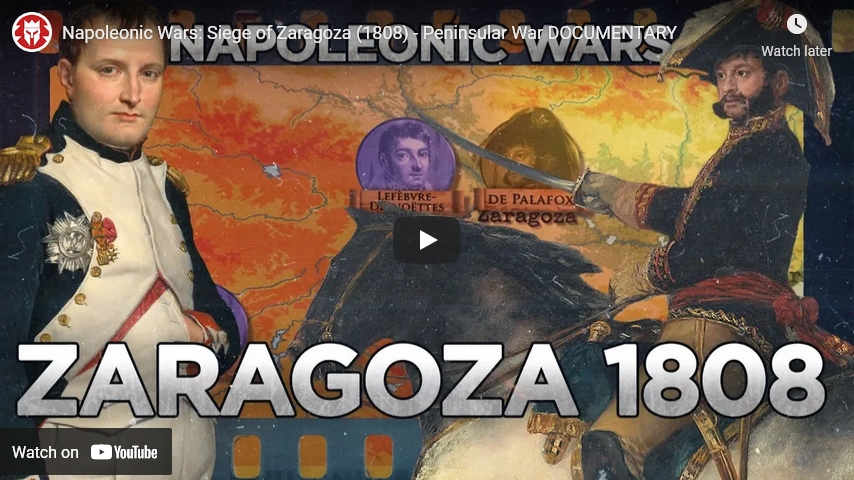
Napoleonic Wars: Siege of Zaragoza (1808) – Peninsular War
Kings and Generals
Published 30 Sep 2018
Our animated historical documentary series on the Napoleonic Wars are back with another episode covering the Peninsular War. The armies of Napoleon face more rebellions this time in Spain. And if the battle of Vimiero was crucial for the resistance in Portugal, the Siege of Zaragoza of 1808 played the similar role for the northern part of Spain. The battle of Bailen is just around the corner, and the Peninsular campaign will only get more interesting from here.This script was researched and written by Everett Rummage. Check out his brilliant Age of Napoleon podcast – http://bit.ly/2vC3cIE In our opinion, it is the best podcast on the Napoleonic era.
Support us on Patreon: http://www.patreon.com/KingsandGenerals or Paypal: http://paypal.me/kingsandgenerals
We are grateful to our patrons and sponsors, who made this video possible: https://drive.google.com/open?id=1KEV…
This video was narrated by Officially Devin (https://www.youtube.com/user/OfficiallyDevin)
Machinimas were made on NTW3 mod for Napoleon Total War by Malay Archer (https://www.youtube.com/user/Mathemed…)
✔ Merch store ► teespring.com/stores/kingsandgenerals
✔ Twitch ► https://www.twitch.tv/nurrrik_phoenix
✔ Twitter ► https://twitter.com/KingsGenerals
✔ Instagram ► http://www.instagram.com/Kings_GeneralsProduction Music courtesy of Epidemic Sound: http://www.epidemicsound.com
Napoleon Total War OST – “HMS Victory”
Napoleon Total War OST – “The Battle At Arcole”
Jon Björk – “Downfall 1”
Johannes Bornlöf – “Imperious 2”
Johannes Bornlöf – “Rise of the Phoenix 2”
Johannes Bornlöf – “Solemn”
Andreas Jamsheree – “Sunstorm 1”#Documentary #Kingsandgenerals #Napoleon
Comments Off on Napoleonic Wars: Siege of Zaragoza (1808) – Peninsular War


