
PC-brigadiers behave exactly like owners of a positional good who panic because wider availability of that good threatens their social status. The PC brigade has been highly successful in creating new social taboos, but their success is their very problem. Moral superiority is a prime example of a positional good, because we cannot all be morally superior to each other. Once you have successfully exorcised a word or an opinion, how do you differentiate yourself from others now? You need new things to be outraged about, new ways of asserting your imagined moral superiority.
You can do that by insisting that the no real progress has been made, that your issue is as real as ever, and just manifests itself in more subtle ways. Many people may imitate your rhetoric, but they do not really mean it, they are faking it, they are poseurs … You can also hugely inflate the definition of an existing offense … Or you can move on to discover new things to label “offensive”, new victim groups, new patterns of dominance and oppression.
If I am right, then Political Correctness is really just a special form of conspicuous consumption, leading to a zero-sum status race. The fact that PC fans are still constantly outraged, despite the fact that PC has never been so pervasive, would then just be a special form of the Easterlin Paradox.
Kristian Niemietz, “The economics of political correctness”, Institute of Economic Affairs, 2014-04-30.
January 30, 2021
QotD: Positional goods and social signalling
December 22, 2020
Repost – ‘Tis the season to hate the senders of boastful holiday letters
Gregg Easterbrook receives the perfect, perfect holiday letter:
Don’t you hate boastful holidays letters about other people’s fascinating lives and perfect children? Below is one Nan and I received last week.
Dear Friends,
What a lucky break the CEO sent his personal jet to pick me up from Istanbul; there’s plenty of room, since I have the entire aircraft to myself, to take out the laptop and write our annual holiday letter. Just let me ask the attendant for a better vintage of champagne, and I’ll begin.
It’s been another utterly hectic year for Chad and I and our remarkable children, yet nurturing and horizon-expanding. It’s hard to know where the time goes. Well, a lot of it is spent in the car.
Rachel is in her senior year at Pinnacle-Upon-Hilltop Academy, and it seems just yesterday she was being pushed around in the stroller by our British nanny. Rachel placed first this fall in the state operatic arias competition. Chad was skeptical when I proposed hiring a live-in voice tutor on leave from the Lyric Opera, but it sure paid off! Rachel’s girls’ volleyball team lost in the semifinals owing to totally unfair officiating, but as I have told her, she must learn to overcome incredible hardship in life.
Now the Big Decision looms — whether to take the early admission offer from Harvard or spend a year at Julliard. Plus the whole back of her Mercedes is full of dance-company brochures as she tries to decide about the summer.
Nicholas is his same old self, juggling the karate lessons plus basketball, soccer, French horn, debate club, archeology field trips, poetry-writing classes and his volunteer work. He just got the Yondan belt, which usually requires nine years of training after the Shodan belt, but prodigies can do it faster, especially if (not that I really believe this!) they are reincarnated deities.
Modeling for Gap cuts into Nick’s schoolwork, but how could I deprive others of the chance to see him? His summer with Outward Bound in the Andes was a big thrill, especially when all the expert guides became disoriented and he had to lead the party out. But you probably read about that in the newspapers.
What can I say regarding our Emily? She’s just been reclassified as EVVSUG&T — “Extremely Very Very Super Ultra Gifted and Talented.” The preschool retained a full-time teacher solely for her, to keep her challenged. Educational institutions are not allowed to discriminate against the gifted anymore, not like when I was young.
Yesterday Rachel sold her first still-life. It was shown at one of the leading galleries without the age of the artist disclosed. The buyers were thrilled when they learned!
Then there was the arrival of our purebred owczarek nizinny puppy. He’s the little furry guy in the enclosed family holiday portrait by Annie Leibovitz. Because our family mission statement lists cultural diversity as a core value, we named him Mandela.
Chad continues to prosper and blossom. He works a few hours a day and spends the rest of the time supervising restoration of the house — National Trust for Historic Preservation rules are quite strict. Corporate denial consulting is a perfect career niche for Chad. Fortune 500 companies call him all the time. There’s a lot to deny, and Chad is good at it.
Me? Oh, I do this and that. I feel myself growing and flowering as a change agent. I yearn to empower the stakeholders. This year I was promoted to COO and invited to the White House twice, but honestly, beading in the evening means just as much to me. I was sorry I had to let Carmen go on the same day I brought home my $14.6 million bonus, but she had broken a Flora Danica platter and I caught her making a personal call.
Chad and I got away for a week for a celebration of my promotion. We rented this quaint five-star villa on the Corsican coast. Just to ourselves — we bought out all 40 rooms so it would be quiet and contemplative and we could ponder rising above materialism.
Our family looks to the New Year for rejuvenation and enrichment. Chad and I will be taking the children to Steamboat Springs over spring break, then in June I take the girls to Paris, Rome and Seville while Chad and Nicholas accompany Richard Gere to Tibet.
Then the kids are off to camps in Maine, and before we know it, we will be packing two cars to drive Rachel’s things to college. And of course I don’t count Davos or Sundance or all the routine excursions.
I hope your year has been as interesting as ours.
Love,
Jennifer, Chad, Rachel, Nicholas & Emily(The above is inspired by a satirical Christmas letter I did for The New Republic a decade ago. I figure it’s OK to recycle a joke once every 10 years.)

December 17, 2020
QotD: Light rail systems are almost always an upper middle class boondoggle
[…]
The problem with light rail (and the reason it is popular with government officials) is that it is an upper middle class boondoggle. There can be no higher use of transit than to provide mobility to poorer people who can’t afford reliable automobiles. Buses fulfill this goal better than any mode of transit. They are flexible and can reach into many corners of the city. The problem with buses, from the perspective of government officials, is that upper middle class people don’t like to ride on them. They like trains. So the government builds hugely expensive trains for these influential, wealthier voters. Since the trains are so expensive, the government can only build a few routes, so those routes end up being down upper middle class commuting corridors. As the costs mount for the trains, the bus routes that serve the poor and their dispersed commuting destinations are steadily cut.
Warren Meyer, “Phoenix Light Rail Fail, 2019 Update”, Coyote Blog, 2019-11-13.
May 30, 2020
David Warren reports from “the High Doganate” (Parkdale, Toronto)
I haven’t lived in Toronto for many years now, but as David Warren highlights in his Essays in Idleness posts, things haven’t changed much in all that time:
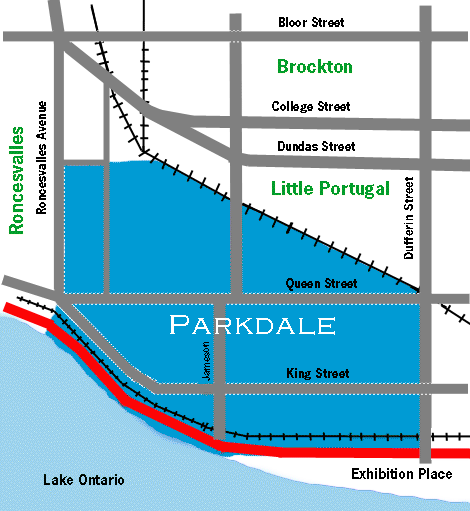
The Parkdale neighbourhood of Toronto.
Map by Alaney2k via Wikimedia Commons.
We continue to be well-as-can-be-expected, up here in the High Doganate, though stir-crazy, and over-informed about the Batflu (also known as the Kung Flu, or Peking Pox). The housefinches on our balconata persist in their social distancing, and at street level, the dogs continue to walk their masters. The brave, without a dog, may go out, without a mask, if they can stand up to the Virtue Signallers (or as I prefer to call them, the Smugly Foocklings). But that is in the respectable parts of town, at least three miles away, where designer masks are now de rigueur. There are plenty of trolleys, but they travel mostly empty. This is because the transit authorities are “committed to keeping customers and staff safe.” Knowing that most of the public health measures are fraudulent, and/or counter-productive, is not helpful to one’s peace of mind.
These measures would include the vast public doles which our guvmints have been generating, electronically. It could be taken as pay, for those who’d otherwise riot. Eventually, the guvmints hope to electronically rake it back, both from those who were paid and those who were not, in the form of much extended taxes. To understand the Batflu response, is to understand the welcome it gave to bureaucrats and their patrons, wherever the Left won the last election. They do not surrender such powers lightly.
Most of the people I hang out with are their particular targets — from freelance giguers to flea marketeers to those with religious vocations. Such people naturally resist the Kafkaesque arrangements our progressives relish and demand. The Batflu “crisis” put as many as possible of these statistically inconvenient people out of work. (Many are compulsive tax-evaders, after all!) These “little people,” especially those trying to support uncool, old-fashioned, frankly heterosexual families, are the ones for whom I most pray, as they and their children face the “green” future, which will exclude them in the name of “diversity.”
But also I think of the vast slave armies, in the “service economy,” with their idiotizing jobs, from flipping hamburgers to humping boxes in the Amazon warehouse — pinned to their minimum wages until their functions can be mechanized. (When they unionize, this happens faster.)
The “professional classes,” who can work from home, because they do nothing of value, needn’t go months without revenue, while their debts are piling up. They sneer at those who oppose a lockdown, that is perfectly comfortable for the professional classes, who at worst save money by dining in, or must order what they want through Amazon.
May 28, 2020
QotD: The decline and fall of the British aristocracy
The historical way-markers to this implosion are well-documented. The First World War delivered a demographic and psychological blow of unprecedented proportion. Yet the next generation laughed into the void. The Roaring Twenties were a whirl of parties and bankruptcies. Only with the aid of married American fortunes did a carapace of their old values remain intact. The ’60s dissolved what remained of those values in a fug of dope and good tail. Those who didn’t succumb to the new addictions succumbed to old ones they could no longer afford. Titans of the British military like Sir David Stirling — cofounder of the SAS and a descendant of Charles II — gambled away their estates at the hands of unscrupulous Mayfair casino-owners who pretended to be their friends. The aristos were co-opted for their charm — read: money — by a new milieu that promoted the glamour of sexual and social transgression. Blinded by their inherited feelings of self-worth, they never realized they were being used by people who despised them. As a result, nowhere was Britain’s postwar political direction — dubbed “The Management of Decline” — internalized as effectively as among the people who had once driven its ascent.
[…]
How could a species that once steered Britain to greatness now claim the Darwin Award in every passing decade? The simple reason is that British aristocrats are the only people on earth among whom stupidity is not only accepted but prized. As the ultimate proof against meritocracy, it is the ultimate badge of honor. As Stendhal wrote in Le Rouge et Le Noir, “It is not doing something well or badly that is the crime: but doing it at all.”
“Bunky Mortimer III”, “Class Rejects: A Guide to the British Aristocracy”, Taki’s Magazine, 2018-03-02.
May 7, 2020
QotD: Chestnuts
Which is why they have been fed to pigs, these last few hundred years; that, and the appalling propaganda mounted against chestnuts by our culinary elites. The European poor once ate them in quantity, as their filler; made bread from chestnut flour. Italians, harder to intimidate by fashion than most others, still adore their subtle flavours.
These thoughts were occasioned by a sealed bag of peeled chestnuts, casually purchased the other day as a snack while walking. They were candied in a rather disagreeable way. But worse, I unfortunately failed to read the label attentively, or would have noticed that the contents were “organic”. No intelligent consumer will buy anything on which this warning is prominently displayed. Quite apart from the doubling or tripling of the price, the product itself may be missing some important ingredient.
Children raised on “organic” food become weak and sickly. Those raised “vegan” as well are likely to die. If you find a child perishing in this way, be merciful and fill him with meat and chestnuts.
David Warren, “Chestnuts”, Essays in Idleness, 2018-01-29.
May 6, 2020
QotD: The French philosophes and the “lower orders”
The French philosophes thought the social classes were divided by the chasm not only of poverty but, more crucially, of superstition and ignorance. They despised the lower orders because they were in thrall to Christianity. The editor of the Encyclopédie, Denis Diderot, declared that the common people had no role in the Age of Reason: “The general mass of men are not so made that they can either promote or understand this forward march of the human spirit.” Indeed, “the common people are incredibly stupid,” he said, and were little more than animals: “too idiotic — bestial — too miserable, and too busy” to enlighten themselves. Voltaire agreed. The lower orders lacked the intellect required to reason and so must be left to wallow in superstition. They could be controlled and pacified only by the sanctions and strictures of religion which, Voltaire proclaimed, “must be destroyed among respectable people and left to the canaille large and small, for whom it was made.”
Keith Windschuttle, “Gertrude Himmelfarb and the Enlightenment”, New Criterion, 2020-02.
April 19, 2020
QotD: Early Greek philosophers
Democritus was still living when the new scientific movement suffered a violent reverse. It was in Athens, a center of conservatism, that the opposition arose and it was brilliantly headed. The leader was no other than Socrates, who despaired of the possibility of scientific knowledge. Even Aristotle, who pioneered in some branches of science, rejected the atomic theory. Between these two great names came that of Plato, who believed the ultimate realities to be not atoms but triangles, cubes, spheres and the like. By a kind of analogy he extended this doctrine to the realm of abstract thought. If, for example, perfect spheres exist, why should not perfect justice exist also? Convinced that such perfect justice did exist, he sought in his own way to find it. The ten books of his Republic record only part of his searchings of the mind. At the core of all this thinking lies the doctrine that the eternal, unchangeable things are forms, shapes, models, patterns, or, what means the same thing in Greek, “ideas.” All visible things are but changing copies of unchanging forms.
The Epicurean Revival
After the great triumvirate of Socrates, Plato and Aristotle had passed away the scientific tradition was revived with timely amendments by Epicurus. In his time it was the prevalent teaching that the qualities of compound bodies must be explained by the qualities of the ingredients. If the compound body was cold, then it must contain the cold element air, if moist, water, if dry, earth, and if hot, fire. Even Aristotle sanctioned this belief in the four elements. Epicurus, on the contrary, maintained that colorless atoms could produce a compound of any color according to the circumstances of their combination. This was the first definite recognition of what we now know as chemical change.
The Stoic Reaction
Epicurus was still a young man when Athenian conservatism bred a second reaction to the new science. This was headed by Zeno, the founder of Stoicism. His followers welcomed a regression more extreme than that of Aristotle in respect to the prime elements. For the source of their physical theories they went back to Heracleitus, who believed that the sole element was fire. This was not a return to the Stone Age but it was a longish way in that direction.
This Heracleitus had been a doleful and eccentric individual and became known, in contrast to the cheerful Democritus, as the weeping philosopher. His gloom was perpetuated in Stoicism, a cheerless creed, of which the founder is described as “the sour and scowling Zeno.” Epicurus, on the contrary, urged his disciples to “wear a smile while they practiced their philosophy.”
Running parallel to these contrasting attitudes toward life and physical theories was an equally unbroken social divergence. Platonism as a creed was always aristocratic and in favor in royal courts. “I prefer to agree with Plato and be wrong than to agree with those Epicureans and be right,” wrote Cicero, and this snobbish attitude was not peculiar to him. Close to Platonism in point of social ranking stood Stoicism, which steadily extolled virtue, logic, and divine providence. This specious front was no less acceptable to hypocrites than to saints. Aptly the poet Horace, describing a pair of high-born hypocrites, mentions “Stoic tracts strewn among the silken cushions.” Epicureanism, on the contrary, offered no bait to the silk-cushion trade. It eschewed all social distinction. The advice of the founder was to have only so much regard for public opinion as to avoid unfriendly criticism for either sordidness or luxury. This was no fit creed for the socially or politically ambitious.
Norman W. DeWitt, “Epicurus: Philosophy for the Millions”, The Classical Journal, 1947-01.
March 26, 2020
QotD: “Gammon”
Who voted Labor? Recent immigrants. University students. Urban professionals. The wealthy and the near wealthy. People who make their living by slinging words and images, not wrenches or hammers. Other than recent immigrants, the Labor voting base is now predominantly elite.
This is the Great Inversion – in Great Britain, Marxist-derived Left politics has become the signature of the overclass even as the working class has abandoned it. Indeed, an increasingly important feature of Left politics in Britain is a visceral and loudly expressed loathing of the working class.
To today’s British leftist, the worst thing you can be is a “gammon”. The word literally means “ham”, but is metaphorically an older white male with a choleric complexion. A working-class white male, vulgar and uneducated – the term is never used to refer to men in upper socio-economic strata. And, of course, all gammons are presumed to be reactionary bigots; that’s the payload of the insult.
Catch any Labor talking head on video in the first days after the election and what you’d see is either tearful, disbelieving shock or a venomous rant about gammons and how racist, sexist, homophobic, and fascist they are. They haven’t recovered yet as I write, eleven days later.
Observe what has occurred: the working class are now reactionaries. New Labor is entirely composed of what an old Leninist would have called “the revolutionary vanguard” and their immigrant clients. Is it any wonder that some Laborites now speak openly of demographic replacement, of swamping the gammons with brown immigrants?
It would be entertaining to talk about the obvious parallels in American politics – British “gammons” map straight to American “deplorables”, of course, and I’m not even close to first in noticing how alike Donald Trump and Boris Johnson are – but I think it is more interesting to take a longer-term view and examine the causes of the Great Inversion in both countries.
Eric S. Raymond, “The Great Inversion”, Armed and Dangerous, 2019-12-23.
March 1, 2020
“When you’re driving a fancy car, you’re an avatar for everyone else’s bad boss, useless trust-fund roommate, or absent workaholic father”
At Car and Driver, Ezra Dyer confirms what most of us already suspected about the folks who drive expensive rides:

Excuse us if you’ve already devoured the latest volume of the Journal of Transport & Health, but the March issue contains the results of a novel experiment that tested a cherished automotive stereotype. The study is entitled “Estimated Car Cost as a Predictor of Driver Yielding Behavior for Pedestrians,” but you can think of it as, “Are BMW drivers really jerks or what?”
Okay, so it was more nuanced than that. The authors of the study sent four pedestrians — black female, black male, white female, white male — to crosswalks in the Las Vegas area to see how many drivers would yield. The overall results were pretty dismal, with a yield rate of only about 28 percent out of 461 cars. Cars yielded more often to female and white pedestrians than male and nonwhite pedestrians, although not enough either way to register as statistically significant. The only factor that consistently predicted yielding behavior was the value of the car. Notably, the study’s authors estimated the book value on all 461 cars, so the 2004 Mercedes S-class that’s worth $5000 didn’t get ascribed automatic snob appeal.
[…]
However, if you’re driving an actual exotic, something way far up the food chain, behavior changes again. Everyone yields to the Rolls or the Lambo because cars like that are so over the top, they make you interesting by association. Plus: most people don’t know anybody with a car like that; thus they can’t associate it with anyone awful. The ultra-expensive car, and the driver, are a curiosity. What’s that guy’s deal? He probably invented that fake grass that goes between the pieces of sushi. And good for him! But the guy in the 911? He can wait an extra two turns at the four-way intersection. Probably deserves it.
Our not-scientific conclusions: If you expect fellow road users to demonstrate courtesy, you should drive either a 1984 Renault Alliance or a Lamborghini Aventador SVJ roadster. But either way, and to everybody in between: Yield at the damn crosswalks.
February 17, 2020
“The rails to hell are laid with good intentions”
In the National Post, Jonathan Kay explains how Canadian governments find themselves in the situation where the basic laws of the land can be flouted at will by a small extremist faction and the police are unwilling to do more than bare peacekeeping duties:

“Vancouver Solidarity with Wet’suwet’en” by jencastrotakespictures is licensed under CC BY-NC-SA 2.0


If you find yourself astounded by the current situation in Canada, whereby protesters have been allowed to shut down a rail network that remains a backbone of passenger travel and industrial transport (and whose coast-to-coast completion in 1885 became a symbol of national unity), it’s useful to revisit the accumulation of symbolic gestures that have steadily destroyed the moral authority of our governments to push back at any assertion of Indigenous rights and grievances. For years, our leaders offered reflexive acquiescence to increasingly expansive claims that Canada remains a white supremacist dystopia, culminating in last year’s campaign to convince us not only that modern Canada is a “genocide” state, but that even the act of expressing disagreement with this description makes you a sort of metaphorical train conductor on the rails to Canadian Dachau. Having publicly tattooed their guilty settler souls with every imaginable hashtag, our leaders now apparently find themselves stopped from restoring the rule of law.
The rails to hell are laid with good intentions. And there is nothing that now signals goodness in Canadian public life more than the land acknowledgment. Certainly, no one can argue with the historical truth that Indigenous peoples populated Canada for thousands of years before the arrival of Europeans. But words have meaning. And the well-understood meaning of these acknowledgments is that Indigenous peoples exercise a sort of broad, vaguely defined moral sovereignty over lands “owned” by Canadian governments, corporations and private citizens — including the lands on which we have constructed roads, rails, ports and legislatures. And since this sovereignty apparently now may be asserted at any time, for pretty much any reason, we have effectively lost the ability to enforce the systematic organization of property rights on which every functional society, Indigenous or non-Indigenous, depends.
The push to recognize Indigenous sovereignty over ancestral lands stretches back generations, an effort rooted in very real constitutional and treaty rights. But what I am describing here is not this formally bounded legal campaign, but rather the more general insistence that the entire country remains stained by original sin, and so must be purified by an open-ended, quasi-spiritual process of “decolonization.” This project began in earnest in 2017 as a counter-reaction to the perceived jingoism of the Canada 150 celebrations. Within the rarified corners of the literary and arts milieus (in which I found myself embedded at the time), decolonization quickly became a sort of state religion, complete with decolonization-themed sensitivity training and confession rituals.
[…]
The people doing the protesting are led by dissidents within one of the affected Indigenous communities, amplified by a critical mass of white environmentalists who are perfectly happy to cherry-pick Indigenous causes based on how well they line up with their own Anti-Racism/Critical Studies term-project requirements. Indeed, there is a certain type of very self-satisfied white Canadian leftist who sees himself as a real-life Lorax. Drawing on antiquated noble-savage stereotypes from the past, these decolonization super-allies cast Indigenous people as their little bar-ba-loot bears. And it just ruins their day when Indigenous leaders refuse to grab their tummies, moan for the CBC cameras, or read their bar-ba-loot scripts.
There is a larger hypocrisy at play here, too. Justin Trudeau and his entourage — currently on world tour, hoping to convince African and Caribbean leaders to hand him the shiny trophy of a UN Security Council seat — don’t take the train much. They fly. So, too, do the provincial politicians passing the buck in equal measure, not to mention the national broadcast journalists offering maudlin profiles of the demonstrators. Forcing ordinary travellers to bear the burden of upholding officially sanctioned upper-middle-class social-justice pieties isn’t “progressive.” It’s reactionary, snobbish elitism with a progressive façade.
February 9, 2020
QotD: Toronto and Vancouver
What the residents of these two cities have in common is an irrational smugness, an utterly unfounded belief that they are living in the best city in the world. We grasp desperately at warm comments from visitors, keen to be noticed by outsiders. The best of all is when we get acknowledged by international studies that rank the cities of the world. These surveys invariably come up with widely divergent results, and sometimes Toronto does well and other times it’s Vancouver.
Nicholas Pashley, Notes on a Beermat: Drinking and Why It’s Necessary, 2001.
February 1, 2020
QotD: Justifying tyranny
Deirdre McCloskey, Bourgeois Equality, 2016.
January 24, 2020
QotD: Writing as a career
Colby Cosh “Who let him in?”, ColbyCosh.com, 2005-01-19.
January 12, 2020
QotD: Progressive snobbery is part of the kink
Yes, they do. For liberals, the distinction between the “dumb masses” and their enlightened selves renders life meaningful. Disdain for ordinary folks is not just an ancillary trait of liberalism. It is fundamental to the its nature.
At its heart, liberalism is a gnostic religion, and the essence of that religion is the believer’s faith that he possesses the means of changing the world for the better. The belief that the world must be changed requires there to be a mass of individuals whose lives are in need of change. Following this logic, it is the liberal, not those deplorables in need of change, who knows what must be changed. For liberals, there must be a mass of people in need of this knowledge for life to make sense.
Above all, liberalism is a hubristic faith. Its followers share the fatal flaw of pride in their own intellectual capacity. This is why liberalism appeals so strongly to those in the knowledge trades: teachers, journalists, writers, psychologists, and social workers. The sense of “knowing more than others” is its strongest attraction – particularly to the young, who otherwise know so little. Liberalism confers, or seems to confer, almost immediate power and authority to those who embrace it.
The left’s obsession with superior knowledge runs through its entire history. As Woodrow Wilson remarked, the “instrument” of political science “is insight. A nice understanding of subtle, unformulated conditions.” Lyndon B. Johnson thought “a president’s hardest task” is “to know what is right.” And the most hubristic of all is Obama’s “We are the ones we’ve been waiting for.” Yes, we are wonderfully bright, and we’ve been waiting eons for ourselves to appear.
Jeffrey Folks, “Leftists versus the People”, American Thinker, 2018-02-24.


