
With apologies to Margaret Atwood and a thousand other dystopian novelists, we do not have to theorize about what an American police state would look like, because we know what it looks like: the airport, that familiar totalitarian environment where Americans are disarmed, stripped of their privacy, divested of their freedom of speech, herded around like livestock, and bullied by bovine agents of “security” in a theatrical process that has an 85 percent failure rate because it isn’t designed as a security-screening protocol at all but as a jobs program for otherwise unemployable morons.
Kevin D. Williamson, “O’Rourke’s America”, National Review, 2019-10-16.
November 20, 2019
QotD: Theorizing an American police state
Comments Off on QotD: Theorizing an American police state
November 8, 2019
Don’t hold your breath waiting for the Feds to tackle Quebec’s ongoing repression against minorities
Chris Selley on the situation in Quebec, where first-class citizenship is only available to those who speak French and don’t expect their religious beliefs to be respected:

One of the fascinating things about Quebec politics is that it’s often impossible to predict which absurdities will become controversial and which will be accepted as reasonable. The province’s linguistic and more recently cultural debates operate in an atmosphere so divorced from normal reality that it’s impossible to know how any new idea or event might react to its unique and volatile mixture of gases.
The classic example is Pastagate: An inspector from the Office québécois de la langue française found an Italian restaurant’s menu was riddled with Italian — calamari, antipasti — and issued the appropriate cease-and-desist notice. At no point did anyone suggest he had misinterpreted the law. Despite universal scorn and worldwide mockery, at no point did anyone successfully explain why this inspector’s actions were obviously ultra vires, while the OQLF’s other insane diktats — say, forcing a bilingual community newspaper to segregate English-language and French-language content such that English-only advertising will never appear on the same page as a French-language article — were reasonable.
As a result, Quebec politics is like a festival of trial balloons. Most recently we saw languages minister Simon Jolin-Barrette float the idea of banning merchants from greeting customers with “bonjour-hi” — a Downtown Montreal-ism that turns language hawks crimson with rage — only to have Premier François Legault shoot it down a couple of days later amidst widespread ridicule.
By contrast, we’re supposed to think it’s totally reasonable that the National Assembly voted merely to request that merchants use state-sanctioned greetings. Unanimously. Twice.
Ban religious symbols for all civil servants, or only those “in a position of authority”? Which civil servants are “in a position of authority”? Should currently employed civil servants affected by Bill 21 be grandfathered in or not? You can poll all you like, but until any given idea goes through Quebec’s intense media ringer, no one knows how it’ll shake out. With fundamental rights at stake, the majoritarian randomness of it all is truly alarming.
October 5, 2019
QotD: Individual liberty
John Stuart Mill, On Liberty, 1859.
Comments Off on QotD: Individual liberty
June 21, 2019
The PPC’s 2019 election platform on freedom of expression
Maxime Bernier’s People’s Party of Canada is posting the individual issues from their 2019 election platform online, and today’s addition was their position on freedom of expression:

The rights of Canadians to freely hold and express beliefs are being eroded at an alarming speed under the Trudeau government. Some of its recent decisions even require that Canadians renounce their most deeply held moral convictions and express opinions they disagree with.
[…]
Our Plan
What some people find politically incorrect, offensive or even hateful cannot serve as the legal basis for discrimination and censorship. Canadians should be able to enjoy maximum freedom of conscience and expression as guaranteed in Section 2 of the Charter.
A People’s Party Government will:
- Restrict the definition of hate speech in the Criminal Code to expression which explicitly advocates the use of force against identifiable groups or persons based on protected criteria such as religion, race, ethnicity, sex, or sexual orientation.
- Repeal any existing legislation or regulation curtailing free speech on the internet and prevent the reinstatement of section 13 of the Canadian Human Rights Act.
- Repeal C-16 and M-103.
- Ensure that Canadians can exercise their freedom of conscience to its fullest extent as it is intended under the Charter and are not discriminated against because of their moral convictions.
- Withhold federal funding from any post-secondary institution shown to be violating the freedom of expression of its students or faculty.
You can read the full policy statement here, or the whole platform here.
Comments Off on The PPC’s 2019 election platform on freedom of expression
June 19, 2019
BOHICA! Section 13 threatens to come back to life
Mark Steyn recently testified before the parliamentary Justice and Human Rights Committee recently. They carefully avoided having the video cameras turned on during his testimony and that of two other civil libertarian speakers. The committee clearly ignored everything that was said:

Lindsay Shepherd, Mark Steyn, and John Robson prepare to give testimony to the Parliamentary Justice and Human Rights Committee, June 2019.
Photo via Andrew Lawton.
“No monarch, no parliament, no government, and certainly no bureaucratic agency operating the pseudo-law of section 13 can claim jurisdiction over my right to think freely, to read freely, to speak freely and to argue freely.”
Those were the closing words of Mark Steyn’s testimony before parliamentarians on the Canadian House of Commons’ so-called justice and human rights committee just two weeks ago.
His call fell on deaf ears.
Yesterday, the justice committee tabled its report on “online hate” in Canada’s parliament.
The report laid out nine recommendations, one of which being that government should provide a “civil remedy for those who assert that their human rights have been violated under the Canadian Human Rights Act, irrespective of whether that violation happens online, in person, or in traditional print format. This remedy could take the form of reinstating the former section 13 of the Canadian Human Rights Act, or implementing a provision analogous to the previous section 13 within the Canadian Human Rights Act, which accounts for the prevalence of hatred on social media.”
Once you strip away the mumbo jumbo bureaucrat-speak in there, it means the Canadian Liberals wish not only to revive section 13 from the dead, but to give it untold powers to force social media companies to purge online speech from whomever the government deems the hatemongers du jour.
This is apparent in another recommendation, that lawmakers “establish requirements for online platforms and Internet service providers with regards to how they monitor and address incidents of hate speech, and the need to remove all posts that would constitute online hatred in a timely manner.”
Of course there’s no provided definition for what “hate speech” is in the context of this desired law. Just a promise to figure it out later.
Before section 13’s repeal under the previous Conservative government, there was a quasi-judicial body to decide if online posts were sufficiently “likely to expose a person or persons to hatred or contempt.” Those found guilty of violating this provision were slapped with a fine or gag order, while having none of the protections afforded to criminal defendants throughout the process.
This regime seems like child’s play compared to what’s proposed in this report – elimination of online speech by social media giants under the threat of government penalty. Not sure which I like better, actually: the opaque, unappealable hammer or the sham tribunal that at least pretends to give you a shot at beating the rap.
Comments Off on BOHICA! Section 13 threatens to come back to life
June 18, 2019
Hong Kong protests
Colby Cosh tests Betteridge’s Law by asking if the protests in Hong Kong are the birth pangs of a new nation (commonsense and a slight knowledge of Chinese history militate against answering “yes”):
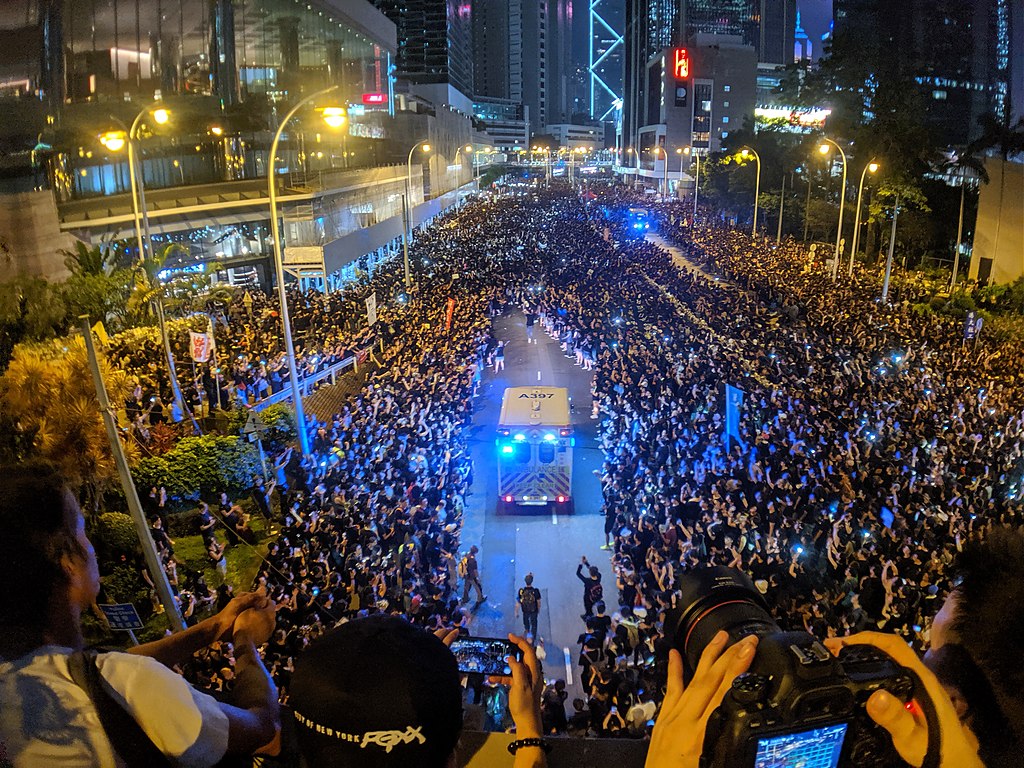
2019 Hong Kong anti-extradition law protest on 16 June, captured by Studio Incendo from Flickr.
Photo via Wikimedia Commons
For the past week, Hong Kong has been taking another step toward figuring out exactly what it is. In an unprecedented display of resistance to Chinese power, literally innumerable hordes have been taking to the streets of HK, protesting the Communist Party-anointed chief executive and her effort to introduce a law allowing for the extradition of citizens to the mainland.
To anyone who follows Hong Kong affairs, these protests seem different qualitatively from those of the past. Earlier, related demonstrations like the Umbrella Movement of 2014 could be dismissed as economic unrest acted out by the young and irresponsible — by people who had not yet entered into, or who feared being excluded from, the strange social bargain between mainland power and HK’s wealth. 2019’s mass action is new: now everyone is marching. The revolt against the extradition bill is led by students, but persons of all ages — in some cases, multiple generations of the same family — are taking to the streets. Business owners are displaying sympathy with the marchers by means of small gestures. Commuters, who would normally be as annoyed with chaos and delay as any Torontonian trying to manoeuvre around a human rights demo, are signalling solidarity. The Hong Kong legal profession, aware that unrestricted extradition would annihilate their distinct system and the freedoms China promised to preserve, staged its own silent protest march. Hongkongers abroad are joining in symbolically.
Is this the birth of a nation? Those who wanted to push Hong Kong in the direction of formal independence have always been politely outnumbered. But the challenging, explosive assertion that “Hong Kong is not China” has become a routine feature of Hong Kong life.
Hong Kong was relinquished to China in 1997 after Britain secured paper guarantees that its independent judiciary and Commonwealth-style legal procedures would survive at least until 2047. When the handover was executed, the number 2047 meant — to the British trying to extract themselves from their last imperial briar patch — “far enough in the future for mainland China to have liberalized a bit.” The advent of Xi Jinping has since shown that progress, alas, does not proceed in a predictable linear way.
Comments Off on Hong Kong protests
June 4, 2019
QotD: Freedom of speech and “balancing” competing rights
“And actually it’s no better in the United States. On the one hand you have the absence of a monarchy and free-speech absolutism, but on the other hand you prostrate yourselves before judges. I’m in the fifth year of a lawsuit that started with a 140-word blog post — there’s not much of a First Amendment when that happens. And then, on your college campuses, you have the debate about ‘acceptable’ and ‘safe’ speech. You have a tiny little Canada on each campus, with the same sort of shrunken, shrivelled public discussion. ‘Safe speech’ is a road to hell. Their goal is the abolition of hate — the abolition of a human emotion. They want everyone to have this glassy-eyed look, celebrating diversity. And they don’t recognise their own totalitarianism.”
Mark Steyn, interviewed by John Bloom, “Mark Steyn, Cole Porter and Free Speech”, Quadrant, 2017-05-11.
Comments Off on QotD: Freedom of speech and “balancing” competing rights
May 24, 2019
Ontario universities’ “quarter-million dollar club”
Being a tenured university professor is generally a well-paid job, even in Canada. But thanks to an unintended interaction between pension legislation and retirement policies, older tenured professors are required to draw their pensions (which are pretty damned good by themselves) and their salaries from the university, which boosts many of them well into the quarter-million a year range:

University College, University of Toronto, 31 July, 2008.
Photo by “SurlyDuff” via Wikimedia Commons.
Ontario is a weird place sometimes. One month ago, the government announced that it was implementing a performance-based funding plan which – if you took the government’s half-thought-out comments seriously – raised the possibility that hundreds of millions or perhaps even billions of dollars currently projected to be spent on institutions might be snatched away if institutions failed to hit some ill-defined targets in a type of contract-based funding system. You’d think this would be a big deal, something people would want to talk about and discuss.
But no. Somehow, this is not what is currently obsessing the Ontario university sector. Instead, apparently, we need to talk about how it’s a human rights violation for professors to be asked to enjoy their retirement on a six-figure annual pension.
Crazy? Well, yes. Here’s the deal. Time used to be that universities could tell professors to retire at age 65 or 67 or whenever. Over the course of the 2000s, provinces gradually got rid of mandatory retirement; in Ontario this occurred in 2006, when the provincial government amended the Human Rights Code to that effect. It should have surprised absolutely no one that more and more full professors, who towards the end of their career routinely make over $180,000 per year, decided to delay retirement not just past 65 but pretty much forever. In 2011, only 6.7% of professors were over 65 and 0.9% 70 or over. Just five years later in 2016, that was up to 10.2% and 3.3% respectively. At the time, I estimated that the compensation costs for the over-65s amounted to $1.3 billion, or enough to hire about 10,000 new junior faculty. The share of that going to the 70-pluses would amount to a little north of $400 million.
But here’s the thing: federal pension legislation requires individuals to start drawing down their pensions at age 71. You can’t opt-out. And so as a result you get individuals who are in what Carleton University economist Frances Woolley recently called the “quarter-million dollar club” (do read Frances’ piece – everything she does on higher education is excellent, but she is extra-excellent on this one). Even if you understand the legislative path that led us here, you probably – rightly – think this is an outrageous sum, particularly in light of the fact that research productivity tends to decline over time and teaching loads among full professors are not all that onerous.
On the other side of the pond, a recent tribunal ruling at Oxford’s St. John’s College points in a very different direction:
Oxford and Cambridge universities can force old professors to retire in order to boost diversity, a tribunal ruling suggests.
Prof John Pitcher, a leading Shakespeare scholar and fellow at St John’s College at Oxford, claimed that he had been unfairly pushed out at age 67 to make way for younger and more ethnically diverse academics.
He sued the College and university for age discrimination and unfair dismissal, claiming loss of earnings of £100,000 – but Judge Bedeau dismissed both claims.
Comments Off on Ontario universities’ “quarter-million dollar club”
May 10, 2019
QotD: Defining freedom
Freedom is not a synonym for the right to vote in fair and open elections. Fair and open elections with a wide franchise might – might – be a useful instrument for promoting freedom. But contrary to much shallow thinking, the right to participate in such elections is not itself “freedom”. Freedom is the right to choose and act as you please, with this right bound only by the equal right of every other peaceful individual to do the same. (Or to quote Thomas Sowell, “Freedom … is the right of ordinary people to find elbow room for themselves and a refuge from the rampaging presumptions of their ‘betters’.” I would add that freedom requires also elbow room from the rampaging presumptions – and from the enviousness, ignorance, myopia, and even the good intentions – of one’s peers and, indeed, from those of everyone.)
In practice it is sometimes difficult to identify the detailed locations of the boundaries that best ensure equal freedom for everyone. This reality, however, neither renders the goal of equal freedom of choice and action for everyone less desirable nor makes this definition of freedom less serviceable.
Don Boudreaux, “Quotation of the Day…”, Café Hayek, 2017-04-23.
Comments Off on QotD: Defining freedom
May 8, 2019
Your electronic devices and the Canadian Border Services Agency
A few years ago, many civil libertarians were upset that the US government allowed warrantless searches of electronic devices at the border, but it was less well known that the Canadian Border Services Agency does the same at the Canadian border:

“Canadian Border Sign” by jimmywayne is licensed under CC BY-NC-ND 2.0


According to the CBSA, it has the right to search electronic devices at the border for evidence of customs-related offences — without a warrant — just as it does with luggage.
If travellers refuse to provide their passwords, officers can seize their devices.
The CBSA said that between November 2017 and March 2019, 19,515 travellers had their digital devices examined, which represents 0.015 per cent of all cross-border travellers during that period.
During 38 per cent of those searches, officers uncovered evidence of a customs-related offence — which can include possessing prohibited material or undeclared goods, and money laundering, said the agency.
While the laws governing CBSA searches have existed for decades, applying them to digital devices has sparked concern in an era where many travellers carry smartphones full of personal and sometimes very sensitive data.
A growing number of lawyers across Canada argue that warrantless digital device searches at the border are unconstitutional, and the practice should be stopped or at least limited.
“The policy of the CBSA of searching devices isn’t something that is justifiable in a free and democratic society,” said Wright who ran as a Green Party candidate in the 2015 federal election.
“It’s appalling, it’s shocking, and I hope that government, government agencies and the courts, and individual citizens will inform themselves and take action.”
Comments Off on Your electronic devices and the Canadian Border Services Agency
February 21, 2019
“Excessive fines can be used … to retaliate against or chill the speech of political enemies”
The US Supreme Court delivered a unanimous body blow to excessive use of asset forfeiture by state and local police:
Timbs challenged that seizure, arguing that taking his vehicle amounted to an additional fine on top of the sentence he had already received. The Indiana Supreme Court rejected that argument, solely because the U.S. Supreme Court had never explicitly stated that the Eighth Amendment applied to the states.
On Wednesday, the high court did exactly that.
“For good reason, the protection against excessive fines has been a constant shield throughout Anglo-American history,” wrote Justice Ruth Bader Ginsburg in the opinion. “Excessive fines can be used, for example, to retaliate against or chill the speech of political enemies,” she wrote, or can become sources of revenue disconnected from the criminal justice system.
Indeed, some local governments do use fines and fees as a means to raise revenue, and that has created a perverse incentive to target residents. After the 2014 shooting of Michael Brown in Ferguson, Missouri, a federal investigation into the city government found that 20 percent of its general fund came from criminal fines. And Ferguson is not alone in relying heavily on revenue from fines. Making clear that the Eighth Amendment applies to the states will make it far easier to challenge unreasonable fines and fees — including not just asset forfeiture cases, but also situations where local governments hit homeowners with massive civil penalties for offenses such as unapproved paint jobs or Halloween decorations.
Some of those cases are already getting teed up. As C.J. Ciaramella wrote in this month’s issue of Reason, a federal class action civil rights lawsuit challenging the aggressive asset forfeiture program in Wayne County, Michigan, that was filed in December argues that the county’s seizure of a 2015 Kia Soul after the owner was caught with $10 of marijuana should be deemed an excessive fine.
Comments Off on “Excessive fines can be used … to retaliate against or chill the speech of political enemies”
January 11, 2019
“It is profoundly stupid, so most people assume it can’t be. But that’s what the law is now”
Apparently the federal government believes that drinking and driving is such a huge, intractable problem that they’ve decided it’s worth sacrificing your right to privacy in order to combat this scourge:
It may sound unbelievable, but Canada’s revised laws on impaired driving could see police demand breath samples from people in bars, restaurants, or even at home. And if you say no, you could be arrested, face a criminal record, ordered to pay a fine, and subjected to a driving suspension.
You could be in violation of the impaired driving laws even two hours after you’ve been driving. Now, the onus is on drivers to prove they weren’t impaired when they were on the road.
This isn’t a simple change of rules, it’s a wholesale abandonment of common sense.
“If you start to drink after you get home, the police show up at your door, they can arrest you, detain you, take you back to the (police station) and you can be convicted because your blood alcohol concentration was over 80 milligrams (per 100 millilitres of blood) in the two hours after you drove.”
Changes to Section 253 of the Criminal Code of Canada took effect in December giving police greater powers to seek breath samples from drivers who might be driving while impaired.
Under the new law, police officers no longer need to have a “reasonable suspicion” the driver had consumed alcohol. Now, an officer can demand a sample from drivers for any reason at any time.
But there’s no possible way this could be abused, right?
“It’s a serious erosion of civil liberties,” said Toronto criminal defence lawyer Michael Engel, whose practice focuses almost exclusively on impaired driving cases.
Engel said someone could be unjustly prosecuted. If a disgruntled business associate or spouse called police with a complaint and an officer went to investigate at the persons’ home or place of business, police could demand a breath sample.
“Husbands or wives in the course of separations would drop the dime on their partner,” Engel said, describing the potential for the law’s abuse by those calling police out of spite, for example.
Comments Off on “It is profoundly stupid, so most people assume it can’t be. But that’s what the law is now”
January 6, 2019
“Carding” is an infringement of rights that does nothing to reduce crime
Chris Selley wonders why the blatantly unconstitutional practice of “carding” people without even a hint of suspicion that they’ve done anything wrong was instituted in the first place:
… it’s far easier to make a case that carding has no effect at all on serious crime than that it has a huge one. But even if previous carding practice had “worked,” even if the new regulation had stopped it from working, it barely even amounts to a defence. As [Justice Michael] Tulloch notes, “the regulation simply gives effect to the existing law that people do not have to provide their identification when there are no reasonable grounds to believe the person has committed an offence.”
If carding “worked,” in other words, it relied on citizens not knowing or caring about their already-existing right to be left alone whilst minding their own business, or being too intimidated to exercise that right — as well they might be. Politely refusing an armed man or woman’s request to identify yourself is no small thing, all the more so if you have “nothing to hide.”
The problems inherent in such a situation are myriad. There are quantifiable harms: People were denied jobs and security clearances, and in at least one case menaced by child services, thanks to information stored in police databases that implicated them in nothing other than being included in a police database. And there are more existential harms. Imagine growing up with a squeaky-clean nose yet constantly feeling like a person of police interest. It’s profoundly alienating, especially when targets quite logically conclude, based on well-documented statistics if not their own intuition, that they’re being harassed because of their race, skin colour or some other innate characteristic. It’s no less insidious if the bias is unconscious; it might even be more so.
Nothing good can come from it, and plenty bad. It hinders police in solving crimes, for one thing: “When a segment of society believes that it has been unfairly targeted by the police,” Tulloch writes, “it will delegitimize the police in their eyes.” All those desperate calls for witnesses to come forward will be met more skeptically. Tulloch cites research showing “inappropriate interaction with police” can even “desensitize young people from guilt regarding potential acts of crime.”
Comments Off on “Carding” is an infringement of rights that does nothing to reduce crime
January 5, 2019
Leave the Strand Alone! Iconic Bookstore Owner Pleads With NYC: Don’t Landmark My Property
ReasonTV
Published on 4 Jan 2019Leave the Strand Alone! Iconic Bookstore Owner Pleads With NYC: Don’t Landmark My Property
More from the article at Reason:
If New York City moves ahead with a proposal to landmark the home of the Strand Book Store, it would be putting a “bureaucratic noose” around the business, says owner Nancy Bass Wyden. “The Strand survived through my dad and grandfather’s very hard work,” Wyden says, and now the city wants to “take a piece of it.”
Opened by her grandfather, Benjamin Bass, in 1927, the Strand is New York City’s last great bookstore — a four-story literary emporium crammed with 18 miles of merchandise stuffed into towering bookcases arranged along narrow passageways. It’s the last survivor of the world-famous Booksellers Row, a commercial district comprised of about 40 secondhand dealers along Fourth Avenue below Union Square.
On December 4, 2018, the New York City Landmarks Preservation Commission held a public hearing on a proposal to designate the building that’s home to the Strand as a historic site. If the structure is landmarked, Wyden would need to get permission from the city before renovating the interior or altering the facade.
“It would be very difficult to be commercially nimble if we’re landmarked,” Wyden tells Reason. “We’d have to get approvals through a whole committee and bureaucracy that do not know how to run a bookstore.”
Wyden’s outrage derives in part from her family’s decades of struggle to keep the business alive.
The Strand survived, she says, because of “my grandfather and my dad’s very hard work and their passion … Both worked most of their lives six days a week” and they “hardly took vacations.”
Comments Off on Leave the Strand Alone! Iconic Bookstore Owner Pleads With NYC: Don’t Landmark My Property
December 3, 2018
Eric Swalwell’s Kinsley gaffe
If you haven’t encountered it, a “Kinsley gaffe” is where a politician accidentally tells the truth (Wikipedia). Newly elected US member of the House of Representatives Eric Swalwell committed a classic Kinsley gaffe in an online discussion on social media, as Jeff Fullerton explains:
Democratic representative Eric Swalwell made a really provocative statement this week according to an article from Hot Air. Pretty much serving notice that: If we confiscate your guns and you fight back, we will nuke you.
Representative Swalwell sort of gives a disclaimer that he he was not actually advocating nuking Texas or some other disobedient red state or region — but merely trying to make a point in the fashion of the Borg from Star Trek; that resistance is futile and it is the lot of us all to be assimilated — against our will if necessary. The author of the article from Hot Air points out something that my friend and mentor Bruce the Historian pointed out long ago; that there are an awful lot weapons in the hands of private citizens capable of making it hell on earth for any federal troops deployed to disarm the population or engage in the collectivization of property and resources in a martial law scenario. Or forced relocation of people. That’s the real reason they want everyone disarmed. They know from experiences in Vietnam and the “Forever War” in the Middle East; that cracking down with overwhelming force has its limits and once they put off a nuke to burn a town in Texas they might have to burn every square mile of the nation to put an end to the uprising.
Talk about excessive force!
That they’d even talk at all about using a nuclear weapon to put down an internal insurrection proves beyond the shadow of doubt that power hungry politicians are a far deadlier existential threat to us all than any crazed mass shooter or terrorist could ever hope to be!
This congress creature bases his argument on a fallacy which is common assumption among the political class: that because the federal government is capable of mustering overwhelming force — the Second Amendment is obsolete anyway. He already contradicts himself for if we the people are impotent against the overwhelming fire and manpower of the Army and the bombs and missiles of the Air Force — then why are people like him so adamant about disarming the average Joe? I think I already answered that one. […]
There is also the issue of the military itself that the political class ought to take into consideration. It may be less monolithic than assumed. Many of them still believe in the validity of the Constitution and would side with the resistance while others among the loyalist factions would have problems of conscience when it comes to mass slaughter of fellow Americans. Still others might be fearful of the consequences of being held accountable for atrocities or even treason if they end up on the losing side of things. To attack and kill your own people who you swore to serve and protect is a grievous betrayal. It is treason of the highest order and the punishment for that is death. So if you choose such a course of action and loose the fight; you go down in historic infamy to be remembered like the Nazi war criminals who stood before the Nuremberg tribunals. And you will probably [be] shot or hanged in a public execution!
Comments Off on Eric Swalwell’s Kinsley gaffe


