
The “Liberal Party of Canada” isn’t the catchiest name for a Quebec biker gang. On the other hand, it’s no more clunkily uncool than, say, the Rock Machine or any of the province’s other biker gangs. The Liberal party is certainly a machine and it’s proving harder to crack than most rocks, and it’s essentially engaged in the same activities as the other biker gangs: the Grits launder money; they enforce a ruthless code of omertà when fainthearted minions threaten to squeal; they threaten to whack their enemies; they keep enough cash on hand in small bills of non-sequential serial numbers to be able to deliver suitcases with a couple hundred grand hither and yon; and they sluice just enough of the folding stuff around law enforcement agencies to be assured of co-operation. The Mounties’ Musical Ride received $3 million from the Adscam funds, but, alas, the RCMP paperwork relating to this generous subsidy has been, in keeping with time-honoured Liberal book-keeping practices, “inadvertently lost.”
Mark Steyn, “Exit strategy”, Western Standard, 2005-06-15
March 5, 2022
QotD: Bike gangs
February 6, 2022
Quebec Papal Zouave’s Ceremonial Gewehr 71/84
Forgotten Weapons
Published 4 Oct 2021http://www.patreon.com/ForgottenWeapons
https://www.floatplane.com/channel/Fo…
Cool Forgotten Weapons merch! http://shop.forgottenweapons.com
Here’s a rifle with an interesting twisting history …
This began life as a German military Gewehr 71/84, made in 1888. It was issued to a unit, but eventually replaced by the Gewehr 1888. It was sold to the Francis Bannerman company at some point around 1900, as part of a big batch of surplus weapons (Bannerman was a massive international dealer in arms and military equipment). Moving ahead a few years, World War One breaks out and prompts the organization of a couple Canadian “Home Guard” units. The Montreal Home Guard has some money, and buys a batch of Savage Model 99 lever action rifles (in .303 Savage, interestingly). The Quebec Home Guard isn’t quite so well-heeled, so they go to Bannerman to see what they can afford. Bannerman sells them a batch of Gewehr 71/84 tube-magazine repeating rifles, in the same configuration as when they were sold off by the German military.
Incidentally, I believe these become the only Mauser rifles formally purchased and issued by the Canadian government, when they are acquired by the Home Guard. At any rate, after the war ends, a subset of those old rifles are given to the Quebec Papal Zouaves, a ceremonial vestige of the Quebecois military volunteers who went to Italy in the 1860s to help defend the Papacy during Italian unification. By this time, the Zouaves are basically just acting as guards in parades, and they crudely cut down the 71/84s, removed their magazines, and fit them with cut-down British Snider bayonets for use as single-shot, blank-firing arms.
Quite the journey, right? And also a reminder that sometimes what looks like sporterized junk is actually something with distinct historical provenance …
Many thanks to Mike Carrick of Arms Heritage Magazine for providing me access to film this example!
Contact:
Forgotten Weapons
6281 N. Oracle 36270
Tucson, AZ 85740

December 16, 2021
The Charter of Rights and Freedoms versus Quebec’s Bill 21 (Loi sur la laïcité de l’État)
Andrew Potter characterizes our next big constitutional bun-fight as an exploded time-bomb in the Canadian Charter of Rights and Freedoms:
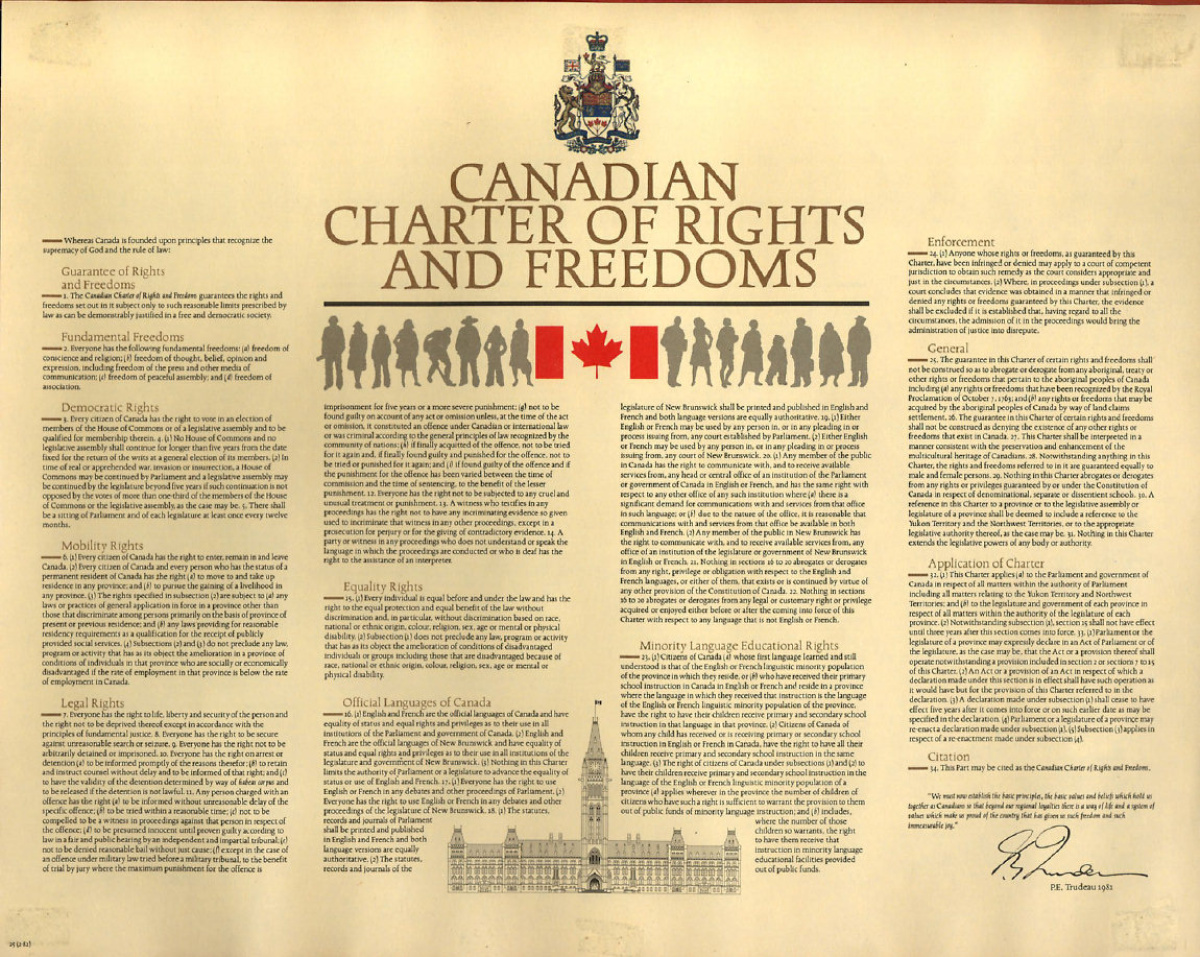
In 1982, Prime Minister Pierre Trudeau and the provincial premiers inserted a time bomb into the Canadian constitution. It finally went off last week, when an elementary school teacher in West Quebec was removed from the classroom for wearing a hijab, in violation of Bill 21, the province’s secularism law.
The case has generated no shortage of outraged commentary in Canada and abroad, with many denouncing what they see as the “bigotry” of the Quebec law. In The Line on Tuesday, Ken Boessenkool and Jamie Carroll argued that far from implementing a secular state, Quebec has simply imposed a state religion that takes precedence over private belief. In response to these criticisms, many Quebecers say that this is just another round of Quebec bashing. The rest of Canada needs to recognize that the province is different, and to mind its own business.
But it is important to realize that something like this was going to happen sooner or later. The patriation of the constitution and the adoption of the Charter of Rights and Freedoms in 1982 seriously destabilized the Canadian constitutional order, and the twin efforts of the Meech Lake and Charlottetown accords to fix that instability only made things worse. But the real ticking bomb here is s.33 of the Charter, a.k.a. the notwithstanding clause, which allows legislatures to override certain sections of the Charter for renewable five-year terms.
The basic tension is between two more or less incompatible views of the country. On the one hand there is the original concept of a federal Canada, where citizens’ political identities are shaped by and through their relationship with their provincial, and to a lesser extent, national, governments. On the other hand, the Charter created a newer understanding of Canadians as individual rights bearers with political and social identities prior to the state, underwritten by the Charter itself.
November 17, 2021
The Supreme Court of Canada — four-ninths woke
In The Line, Leonid Sirota discusses a disturbingly narrow victory for freedom of speech in the Supreme Court of Canada’s decision in Ward v Quebec (Commission des droits de la personne et des droits de la jeunesse):
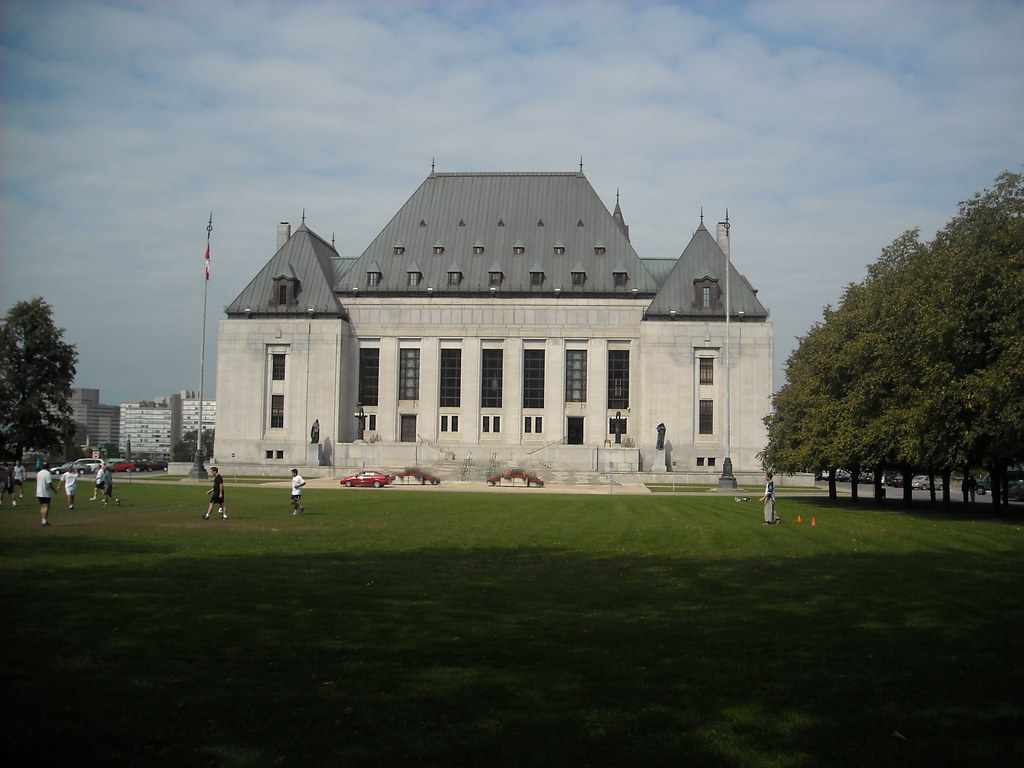
“Supreme Court of Canada, Ottawa”by daniel0685 is licensed under CC BY 2.0

The Supreme Court’s recent decision in Ward v Quebec (Commission des droits de la personne et des droits de la jeunesse) has attracted considerable public attention, and for good reason. Although no law was in danger of being found unconstitutional, the case did concern the limits of the freedom of expression, which have always been controversial, and are perhaps more controversial now than they had been in decades. In brief, the issue was whether nasty jokes by an “edgelord comedian”, as The Line‘s excellent editorial described Mr. Ward, at the expense of Jérémy Gabriel, a well-known disabled child artist, amounted to discrimination that could be punished by an award of damages.
Much has already been written about the Supreme Court’s narrow decision in favour of Mr. Ward; for my part, I have already commented on (mostly) the majority opinion on my blog. Here, I focus on the dissent, in which, as The Line put it, “[t]here’s an incredible amount of popular modern discourse seeping into judicial reasoning” that “culled plausible-sounding legalese from Twitter logic”. That sounds about right.
But let me put it slightly differently. The dissent is, in a word, woke. And I do not mean “woke” as a generic insult. Nor do I mean, incidentally, that Mr. Gabriel is a snowflake. I think he deserves sympathy on a human level, though not the protection of the law for his claim. Rather, what I mean by calling the dissent woke is that it embraces a number of specific tenets of contemporary social-justice ideology, which, if they become law ― and they were just one vote away from becoming law ― would be utterly corrosive to the freedom of expression.
For one thing, the dissent erases the line between words and actions, so that disfavoured words are treated as deeds and therefore subjected to vastly expanded regulation. Justices Abella and Kasirer (with whom two others agree) write:
We would never tolerate humiliating or dehumanizing conduct towards children with disabilities; there is no principled basis for tolerating words that have the same abusive effect. Wrapping such discriminatory conduct in the protective cloak of speech does not make it any less intolerable when that speech amounts to wilful emotional abuse of a disabled child.
In what is going to be a theme of my comment, this twists the meaning of words beyond recognition. Conduct is conduct and speech is speech. Using words instead the proverbial sticks and stones is not just a disguise. It’s the better part of civilization. The law relies on a distinction between words and actions all the time. This is a principle, and a general one, but it has also been a cornerstone of the law of the freedom of expression in Canada since the early days of the Charter. I have criticized the majority decision for disregarding precedent and doctrine. The dissent does the same, only much worse.
Besides, as I once noted elsewhere, the negation of the distinction between speech and conduct often combines with a belief that violence against some politically heretical group or other is permissible with the toxic belief that “[w]hat one says, or does, is expression; what one’s opponents say, or do, is violence.” This, in turn, means that law dissolves into a raw competition for political power, with the ability to decide whose expression will be stripped of its “protective cloak” and proscribed as the prize.
October 21, 2021
If Quebec is the model for universal childcare services, then voters will be waiting a long, long time for that promise to be fulfilled
In The Line, Andrea Mrozek talks about the promises (mostly still unfulfilled) of Quebec’s “universal” childcare service model:
Since last month’s election, many have been asking which promises the Liberals made will prove the most difficult to keep. Put child care at the top of the list: The federal government’s five-year, $30 billion Canada-wide child-care plan is rife with complicating factors. When government officials point to Quebec as the model for the rest of Canada, what that means is a system plagued by lack of access, inequality and poor quality.
When Quebec introduced its low-user fee “universal” system in 1997, the goal was to create a centre-based, publicly-funded system for all children. Fees started at $5 a day, briefly shifting to a fee structure based on income, before settling in at the current daily rate of $8.50.
The rapid reduction in fees in only one part of the child-care sector disrupted the care options parents were using in Quebec. Private providers, who were not to be included in Quebec’s system, “understandably crumbled” after the system began. Unfortunately, the public system never picked up the slack. So the Quebec government then coaxed them back into the business of child-care provision through a system of tax credits.
Consider this: We are told publicly funded child care offered at a fixed low price for parents is the way to go across Canada. Consider further that we are told Quebec is the model for said child-care system. Then consider that between 2003 and 2021, in Quebec, public (“Centres de la petite enfance” or CPE spaces) increased by about 55 per cent, or 35,000 spaces. In the same time period, private, unsubsidized spaces increased by about 4,200 per cent or 68,500 spaces. This growth in private provision is not at all what architects of public child-care provision desire. It has, however, proved unavoidable in Quebec, precisely because provision of public spaces has been so slow. Whether it’s lack of funds, political will or some other combination of factors, Quebec has been unable over two decades to build the system of CPE’s envisioned in the mid 1990s.
None of this is a secret: The Quebec auditor general reported last fall there are “not enough spaces available in subsidized child care to meet the needs of families in Quebec.” There are 98,014 spaces in CPEs but 46,000 on a waiting list for a CPE space, as per the auditor general. Does this sound like a policy success?
Further, the waitlists are now themselves a source of inequity. The same auditor-general report highlights that in Montreal in particular, “the children of low-income families are underrepresented in (CPEs).” Previous studies showed this to be a problem across Quebec. Sociologist Rod Beaujot wrote this in a 2013 paper: “In Quebec, day care is used less by children in vulnerable environments, and the services they use are of lower quality (Giguère and Desrosiers 2011). In contrast, the higher the mother’s education, and the higher the family income, the greater the usage of child-care in the Quebec program (Audet and Gingras 2011.) While the program has provisions for disadvantaged families, it would appear that other provinces are more successful in tailoring programs to families with lower incomes.”
So, it’s another “universal” program that disproportionally benefits the wealthy and well-connected (who tend to be Liberal Party supporters and voters)? Tabarnak! Who could ever have possibly seen this coming? Oh, and the Quebec model the rest of the country is supposedly eager to adopt has literally the worst ratios of adult caregivers to children, and 81% of Quebec parents say “Finding quality child care is a way bigger hassle than it should be for parents today”, which is a higher percentage than it is in any other province.
October 20, 2021
Alberta and Quebec, the dark twins of Confederation
In The Line, Jen Gerson explains why the Alberta government is consciously taking some of its strategies for dealing with the feds and other provinces from the generations-long success that has been Quebec’s planbook:
Quebec — as the single largest recipient of equalization cash — is often a target of anger in these parts, but I’d encourage any readers from thereabouts not to read too much into this fact. Both Alberta and Quebec suffer from a culture of political grievance that feed off one another. Alberta resents the fiscal balances, often casting Quebec as an ungrateful recipient of the very oil wealth that the latter regards with contempt. And I can only imagine how Quebec must read this; as a signal of its own isolation from Anglo culture more broadly. On both sides, I see politicians who have made a generational art of milking these respective grievances.
So sometimes it’s worthwhile to point this out.
Alberta doesn’t hate Quebec.
The provinces exist on flip sides of the very same coin; they are each others’ dark twins, and Alberta seeks mostly to emulate its French sibling.
Kenney made this point entirely explicitly in the days leading up to the referendum.
“We’re using this to get leverage to basically take a page out of Quebec’s playbook in having successfully dominated the political attention of the federation for the last 40 or 50 years.”
What playbook was he referencing, here?
The answer is obvious; the separation referenda of 1980 and 1995. In fact, the whole logic of Alberta’s referenda last night was predicated on a novel reading of the Quebec Secession Reference, in which a clear majority on a clear question must force the federal government to the negotiating table in good faith. The fact that this reference spoke to a secession question — and not a longstanding quibble over an item within the constitution — is a material difference from a legal point of view, but not a psychological one.
The hope is that this referenda will give us somethin akin to the “leverage” Quebec has enjoyed vs. Ottawa since its failed separation referenda; and the disproportionate financial and cultural incentives that followed in the following decades. Essentially, Alberta is asking for the leverage of a true separatist movement without suffering the risk of actually separating. We are play-acting a little Potemkin secession referendum, here. If it falls to me to point out the show is a little childish and even a touch pathetic, well, so be it.

October 16, 2021
Alberta’s Equalization referendum is “political theatre, and it’s poorly timed political theatre at that”
The province of Alberta is unhappy with the current federal-provincial equalization arrangement. This is not new … it’s been the case off-and-on for most of my life, but this year the province is undertaking a formal referendum on the issue, as Jen Gerson explains in The Line:

Let’s start with all the usual but necessary rigmarole about the Alberta referendum on equalization: a “yes” vote won’t peel equalization from the constitution; even a resounding victory may not actually force the federal government to sit with the province of Alberta to discuss the matter. I mean, it might: this was Ted Morton’s idea, and his argument. That Alberta can force Ottawa and the provinces to engage in some kind of open-hearted exchange by piggybacking on the Quebec Secession Reference is not totally impossible, I guess.
As this Fraser Institute bulletin by Rainer Knopff points out, that reference is specific to questions of, well, secession and probably can’t be re-applied willy nilly to any old provincial grievance. However, Knopff goes on to note that the referendum is necessary to create a provincial legislative resolution on the matter, which would allegedly trigger some kind of duty to negotiate — although certainly no duty to come to an agreement that Alberta would find acceptable.
Most credible individuals begin to handwave furiously when asked to nail the technical legal details about how we’re going to make Ottawa cede a damn thing. Even Morton had to point out that the referendum’s greatest power lies in granting Alberta “moral force” on the question.
In other words, it’s political theatre, and it’s poorly timed political theatre at that.
Equalization is a perennial complaint in Alberta, and not one totally without merit. Although the province doesn’t cut Ottawa some kind of novelty-sized equalization cheque at tax time, we are a comparatively wealthy province, which means the province traditionally sends more money to the federal government through its income and business tax remittances than it receives in rebates and services. There is a sense of injustice, here, which notes that equalization-receiving provinces offer services like cheap daycare, and are now racking up rainy day funds as Alberta falls ever deeper into debt. Meanwhile, we can’t seem to get a pipeline built to transport the very product that provides so much of this national bounty and wealth because other provinces oppose them.
October 10, 2021
First the Bloc Québécois, then “Wexit”, now Bloc Montréal?
Barbara Kay makes the case for Montreal to re-evaluate its position within Quebec as the Quebec government pushes toward even more legal efforts to reduce the English-speaking community to a second- or even third-class citizenship:

Oct. 7 brought an end to consultations on Quebec’s Bill 96, which amends the 1977 Charter of the French Language (Bill 101) and — unilaterally, never before attempted by a province — the Constitution Act of 1867. A few anglophone institutions were invited to the hearings, but their inclusion was pro forma. Bill 96 will pass through use of the notwithstanding clause.
The bill affirms Quebec is a nation, with French as its “common” as well as its only official language, adding several new “fundamental language rights” for French. It effectively creates both a Canadian and Quebec Charter-free zone in a wide range of interactions between individuals and the state. Even before passage, use of the P-word (“province”) has become politically charged, and quietly redacted from public usage by Bill 96 dissidents.
The impact of Bill 96 on anglophones could be momentous. One amendment, which restricts access to English health and social services to those with education-eligibility certificates, could negatively affect upwards of 500,000 anglophone Quebecers. It speaks volumes that the Minister of the French Language will take responsibility for outcomes delivery in that sector away from the Minister of Health and Social Services. Bill 96 will also negatively affect young francophones by capping their numbers at English cegeps [Collège d’enseignement général et professionnel or “General and Vocational College”].
The previous expansions of French language rights in Quebec — and corresponding contractions of English language rights in the province — drove waves of emigration to other provinces, helping Toronto surpass Montreal as Canada’s largest city and economic powerhouse. In the middle of a pandemic, it’s much harder for those who are feeling oppressed to leave Quebec, but there may be another possibility:
Montreal as a city-state, or at least a special autonomous region — a status the Cree nation of northern Quebec has enjoyed for decades — was first raised as a serious idea eight years ago. In 2013 the Parti Québécois proposed language Bill 14, as draconian as Bill 96, which died when premier Pauline Marois’s minority government couldn’t enlist enough collegial support for its passage. Nevertheless, the attempt galvanized alarm sufficient to inspire a transiently influential city-state movement.
A 2014 Ipsos poll on the subject commissioned by that group elicited these key takeaways from Montrealers: Montreal is a distinct society within Quebec (90 per cent); to stop its decline, Montreal needs to take drastic steps to improve its performance (91 per cent); and Montreal deserves special status within Quebec because it is a world-class, cosmopolitan city (74 per cent). Those numbers would likely be as high or higher today.
[…]
We need a Bloc Montréal to represent Montreal/Greater Montreal’s “distinct society” at the Quebec National Assembly in Quebec City. The pivotal moment of the 1995 referendum campaign was the revelation — one that had never before occurred to the separatists — that “if Canada is divisible, then Quebec is divisible”. That was a sobering and clarifying moment. And Montreal has a greater need for augmented representation in Quebec City than Quebec has in Ottawa. After all, Quebec profits handsomely from its affiliation with Canada, while the opposite is true of Montreal and Quebec City.
September 22, 2021
The Extremely Bizarre Engineering Rituals of Canada (And the Fascinating Way They Came to Be)
Today I Found Out
Published 31 Jul 2021This video is #sponsored by NordVPN.
Sources:
Andrews, Gordon, Canadian Professional Engineering and Geoscience: Practice and Ethics, Thomson Nelson Canada Ltd, 2005
Kipling, Rudyard, “The Hymn of Breaking Strain”, 1935, http://www.cuug.ab.ca/~branderr/risk_…
2 Esdras 4:5-10, https://thekingjamesversionbible.com/…
Bateman, Chris, The Secrets of Engineering’s Strange and Mysterious Initiation Ritual, TVO, April 24, 2018, https://www.tvo.org/article/the-secre…
“Background: The Calling of an Engineer, The Ritual of the Calling of an Engineer”, https://www.ironring.ca/background-en/
Anderson, Bill, “Why Engineering is Purple”, April 16, 2019, https://profbillanderson.com/2019/04/…
September 11, 2021
Thursday’s debate was “a grand Kabuki theatre, increasingly divorced from any grounded reality about our fiscal situation, or our ability to deliver on complex programs or problems”
In The Line, Jen Gerson offers her observations of the debate on Thursday night among most of the federal party leaders — missing, of course, the participation of the PPC’s Maxime Bernier who was pointedly not invited:
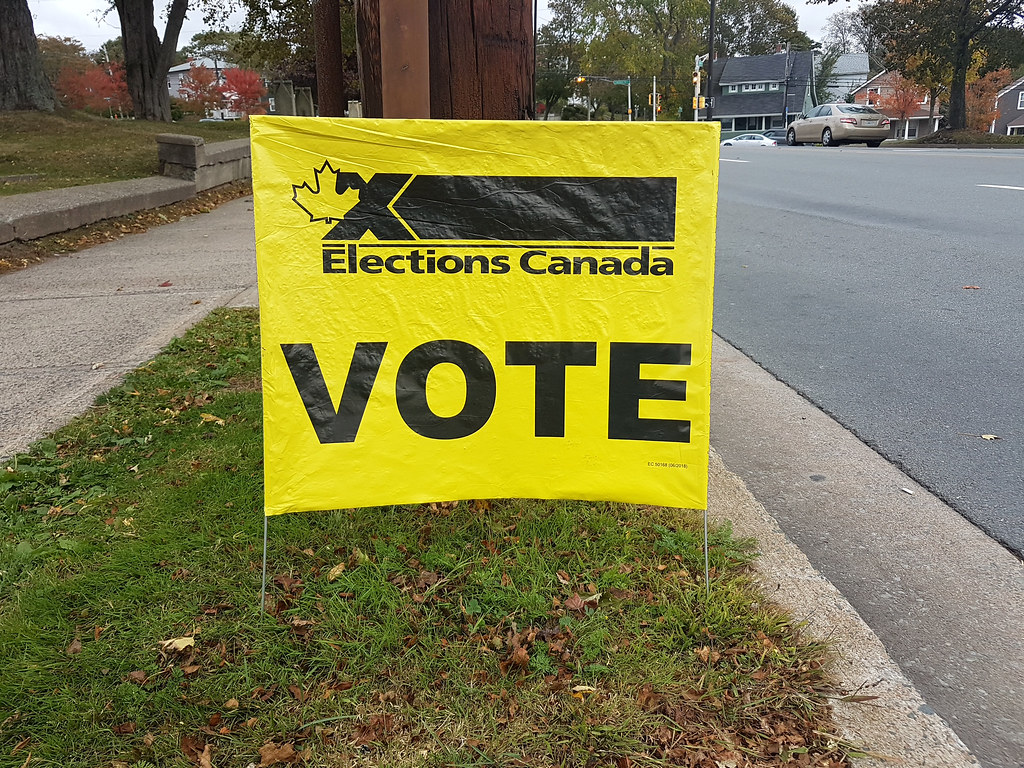
“2019 Canadian federal election – VOTE” by Indrid__Cold is licensed under CC BY-SA 2.0
No one can be said to have “won” such an exercise. You “win” these “debates” not by proposing the best policies, or offering competing philosophies, or even by presenting the best rhetoric. Rather, a “winner” is determined by who comes off the best to a general public that largely doesn’t follow the minute differences of respective platforms.
By that measure, no one really won Thursday’s debate, but Trudeau especially did not win it. I imagine that one of the problems of being raised as a spectacle of wealth, privilege and popularity is that it doesn’t quite prepare you for the moment when the worm turns, when people learn to dislike you for all the right reasons; when you are no longer given the proper deference and respect you feel is owed to you.
Trudeau came off as defensive, and flustered, taking hit after hit from other party leaders on topics ranging from his record, reconciliation and, especially, his self-interested decision to call a party in the first place. That he lacks a credible answer to why we’re holding this election at all three weeks into this campaign is a deep failure, one large and deep enough to consume his prospects of forming a majority government — and his hold on the party leadership along with it.
Annamie Paul offered the best performance of the night by far, and demonstrated that the Green party as a whole is unworthy of her. Whatever private internal dramas that may be unfolding, in public that party condemns itself to obscurity by refusing to get behind a woman who is, by every measure, impressive.
Bloc leader Yves-François Blanchet made himself into an idealized avatar of a whiny and aggrieved Quebec nationalism that puts Alberta to shame. It takes a real special lack of self-awareness to imagine that Quebecers have had it rougher in this country than Indigenous people. Or that Blanchet, by virtue of his French ancestry, has suffered from greater oppression than, say, Annamie Paul. One day, the rest of Canada is going to stop humouring these insulated, thin-skinned delusions — but not before Quebec’s seat count declines relative to the rest of the population’s. In the meantime, Blanchet’s ability to beam pure DGAF energy into the English debates at least made him seem like a human, albeit a delusional and unpleasant one.
By this measure, Erin O’Toole “won” the debate by not losing it. I can’t remember a single thing he actually said, and in such a setting this can only work to his favour.
I mean, what is there to say? On actual substantive policy issues, I couldn’t escape the sense of watching a grand Kabuki theatre, increasingly divorced from any grounded reality about our fiscal situation, or our ability to deliver on complex programs or problems.
July 2, 2021
QotD: Quebec’s legendary sensitivity to criticism
And for some reason, the rest of Canada continues to treat these tantrums as if they are very weighty and serious matters meriting news coverage and discussion by very weighty and serious people. Canada’s indulgence of Quebec’s inability to tolerate pointed criticism is probably why the province gets away with passing racist legislation like Bill 21. And no one — least of all politicians — dare say boo because they’re all too eager to win seats in a populous province perpetually in play.
Attaran’s tweets wouldn’t even be worth our lowly mention, except that they prompted response from Justin Trudeau himself, who responded by saying: “Enough of the Quebec bashing.” That’s right, what we have here is Prime Minister Brownface condemning the tweets of an Iranian-Canadian professor who called Quebec racist by declaring such comments “Quebec bashing.” People, we are down the rabbit hole.
Earlier in this dispatch, we called Attaran a bit of a dumbass, and maybe some of you found that assessment a bit harsh. Others, perhaps not. We leave ourselves open to be capably judged by you, our dear readers. But we must ask this: What kind of dumbass do you have to be to make a figure like Amir Attaran into a national hero on free speech grounds? Good lord.
“Dispatch from The Front Line: Doing the Code Dance”, The Line, 2021-03-26.
March 31, 2021
“Rosalie”: Trench Art SMLE with a Most Improbable Story
Forgotten Weapons
Published 21 Dec 2020http://www.patreon.com/ForgottenWeapons
https://www.floatplane.com/channel/Fo…
Cool Forgotten Weapons merch! http://shop.bbtv.com/collections/forg…
Henri Lecorre was a French immigrant to Canada who enlisted in the 22nd Regiment of the Canadian Army in April, 1915. He had a knack for carving things in his rifles, which he started right in basic training, with a Ross rifle he named “Josephine”. That got him sternly rebuked by his Colonel, but he would take up the habit again in 1916 when he arrived in France and began to see combat. At this point the Canadians were issuing SMLE rifles, and Lecorre named his “Rosalie”, after the French bayonet’s nickname.
Lecorre served through 14 major campaigns, and carved each name into his rifle as the years of the war dragged on. He was twice caught and punished for destruction of government property and fined for the cost of the rifle, although he managed to avoid more serious punishment both times. He only embellished the left side of Rosalie, so that his work would be hidden against his leg when standing at attention. By the summer of 1918, Rosalie’s service record included Vimy, Kemmel, St. Eloi, Hoodge, Zellebeck, Courcelette, Bully Grenay, Neuvilles Vaade, Mericour, Lievin, Lens, Cote 70, Passchendaele and Arras.
Fate eventually caught up to Private Lecorre, and in mid-1918 he was seriously wounded in an attack, and woke up in a military hospital in Dieppe. Rosalie was long gone, and Lecorre did not return to combat again.
The story is far from over, however. Rosalie was recovered from the battlefield, and sent back to Enfield with a batch of damaged rifles for refurbishment and reissue. Someone in the factory noticed the carving on it, and it was set aside. The arsenal commander took a liking to it, and it was hung in his office — where it remained for some 30 years. A Canadian officer from the 22nd Regiment noticed it at Enfield — thanks to Lecorre carving his unit’s name into it — during the Second World War, and thought it would be appropriate to return it to the unit’s home town, where the Citadelle Museum was established in 1950, with Rosalie as one of its original exhibits.
In 1956, Lecorre himself happened to visit an exhibition near Quebec City where the museum had set up, and was shocked to see his own Rosalie on display. After some understandable difficulty convincing the officer on duty that it was actually *his* rifle (which Lecorre did by reciting back its serial number unseen), a remarkable reunion took place. The rifle remained with the museum, but now with its full story known. It remains there to this day, on permanent display.
The Citadelle Museum commissioned a reproduction of Rosalie to be used for demonstrations, and it is this rifle which was graciously made available to me for filming, as the original is inaccessible on short notice because of its display case. Many thanks to the Citadelle for the opportunity to present it to you! If you are in Quebec City, make sure to take time to visit them:
https://www.lacitadelle.qc.ca/en/
Contact:
Forgotten Weapons
6281 N. Oracle #36270
Tucson, AZ 85740

November 20, 2020
Quebec makes Canada’s politics really weird
J.J. McCullough
Published 2 Mar 2019Hypocrisies and blind spots stemming from the role played by French Canadians and the French language in Canada’s politics.
FOLLOW ME:
🇨🇦Support me on Patreon! https://www.patreon.com/jjmccullough
🤖Join my Discord! https://discord.gg/xQzjBRE
👾Watch me on Twitch! https://www.twitch.tv/jj_mccullough
🇺🇸Follow me on Instagram! https://www.instagram.com/jjmccullough/
🇨🇦Visit my Canada Website http://thecanadaguide.com
October 21, 2020
“Canadian conservatism often suffers from a unique form of self-loathing”
In his latest essay for The Dominion, Ben Woodfinden reviews an old book by Peter Brimelow and how it influenced the Canadian conservative scene at the time and why the book’s insights mattered so much to Stephen Harper:
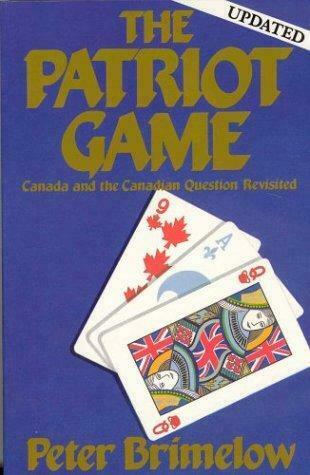
Published in 1986, The Patriot Game captures the ideas and sentiment of an entire generation of Canadian conservatism. One quick note on Brimelow. He’s a controversial figure and has been called a “leader within the alt-right.” He’s also the founder of VDARE, an American anti-immigration website. I’m not getting into a back and forth with anyone about how best to describe his views, I’ll just say that none of this means his older work like The Patriot Game should be discounted or ignored, especially given the influence it’s had.
The game Brimelow is describing is the manufacturing of a new national identity that was undertaken by what he terms “Canada’s New Class.” This is a term he borrows from Irving Kristol. It refers to Canada’s politicians, civil servants, academics, business elites, writers, and journalists, who have a disproportionate influence shaping public discourse and national consciousness.
The manufacturing of a new national identity by this class, centred on the Liberal Party, was one that both rejected our heritage and replaced it with a self-serving and contradictory ideology that serves the interests of this New Class. The strategy of the Canadian New Class throughout Canada’s history has been “to concentrate rents from a resource-based economy in Central Canadian hands.”
The nationalism they manufactured to do this was an entirely artificial one, built around multiculturalism, bilingualism, anti-Americanism and heavy federal government involvement in the economy. At its core Brimelow’s argument is that 20th-century Canada is the creation of the Liberal party, but ultimately that it is fake and built to serve the interests of the New Class. This was done especially by placating Quebec at the expense of the West, and attempting to construct a new national identity that could unite English and French Canada.
This game played by Canada’s elite to enrich them and their bases of support in places like Quebec not only took money from the West and transferred it elsewhere, it dragged down the Canadian economy by crippling it in overbearing and burdensome regulation and the heavy hand of government involvement.
The most interesting, and clarifying part of the book to me is Brimelow’s description of the identity and nationalism that he thinks the Liberals consciously destroyed and then replaced with their own. Brimelow thinks that the New Class are consciously and actively anti-British, not just anti-American, and that this new identity was built as both a rejection of British heritage and the cultural affinities English Canada has with “North American identity.”
According to Brimelow “All of Anglophone Canada is essentially part of a greater English-speaking North American nation … Canada is a sectional variation within this super nation.” Our British heritage is at the core of who we are along with our common Anglo affinities with Americans, and this new national project is doomed to failure. Brimelow suggests that “Canada’s fundamental contradictions cannot be resolved in the present Confederation” and while English Canada is currently in a strange period of identity agnosticism, it will eventually recover and “assert its North American identity.” This process will only be accelerated by regional tensions within Canada that expose the futility of this new Liberal national identity. Modern Canada, in short, is a fraud and doomed to failure.
August 19, 2020
QotD: The Canadian Broadcasting Corporation
But it is an infestation of leftist biases, and is often grossly unprofessional. For decades, despite being almost entirely funded by Canadian taxpayers, it was the principal house organ of the Quebec separatist movement, to the point that former prime minister Pierre Trudeau, shortly before the 1980 Quebec independence referendum, threatened to shut the French network down; when asked what he would replace it with, he responded with his customary vivacity of wit: “Still pictures of Chinese and Japanese vases, at least they have some cultural value.” It is compulsively misanthropic and nasty, and almost always takes a snide leftist view of everything, including foreign affairs. Brexiters were cavemen, U.S. President Donald Trump is a racist, sexist crook and moron, and it is racism and xenophobia to assert that the coronavirus originated in China. Can’t we have better and more original insights than this?
Conrad Black, “Canada needs a much better CBC”, New English Review, 2020-05-02.


