
Certain things recur eternally, in time with the rhythm of the seasons. Flowers bloom in spring. The swallows return to Capistrano. And the federal Conservatives prostitute themselves for the Quebec-nationalist vote.
Well, that’s a bit strong. Prostitutes, after all, expect to be paid. Whereas the Conservatives’ periodic efforts to sell themselves, their principles and their country to people with a proven lack of interest in all three are as notable for their unremunerativeness as they are for their self-abasement.
The Conservatives have been trying this same act now for several decades, most notably — and destructively, to both country and party — under Brian Mulroney, but in their different ways under Robert Stanfield (“deux nations“), Joe Clark (“community of communities”) and even Stephen Harper (“the Québécois nation” resolution).
Occasionally, they manage to attract some attention in the province that has remained largely indifferent to them since 1891. If they are particularly extravagant in their offerings, as under Mulroney, they may even win their votes — but only for as long as it takes to sink in that there is no support in the rest of Canada for what they are proposing, and no possibility of their being implemented.
At which point the whole exercise sinks in a heap of dashed expectations and accusations of bad faith, leaving the country divided and the Tories in ashes. Until, inevitably, some genius gets it into his head to launch the whole routine again.
Andrew Coyne, “It’s that time again, when Conservatives say anything to woo Quebecers”, National Post, 2018-05-16.
July 1, 2020
QotD: The Quebec play (that never works) (for long)
May 28, 2020
Wuhan Coronavirus versus Canadian government planning and implementation
As Chris Selley illustrates, this was a clear failure for the various levels of government:

When Ontarians look back on the COVID-19 pandemic as the moment when their government finally ponied up the big bucks and fixed the province’s long-term care system, they will likely also wonder what the hell took so long. As appalled as everyone quite rightly is by the Canadian Forces’ report into the state of five long-term care homes that were in dire enough shape to require military intervention, we really shouldn’t be shocked. As the Ottawa Citizen in particular has reported in recent years, the system’s staffing levels were designed for a much less old, much less sick and much less Alzheimer’s-afflicted population than lives in them today — and it led to some terrible outcomes in normal times.
Perhaps it was easy to blame such incidents on individual villains: Ottawa support worker Jie Xiao, who was caught on video punching 89-year-old Georges Karam 11 times in the face; or Elizabeth Wettlaufer, one of Canada’s most prolific and yet somehow least-famous serial killers, who murdered at least eight senior citizens in long-term care homes during her red flag-festooned nursing career. Perhaps tales of society’s most vulnerable being forced to wallow in their own filth, or even just left alone in confusion and misery, are too much for the human mind to contemplate at length.
In any event, it only stood to reason that a virus as potent as the one that causes COVID-19 would exploit weak points in a long-term care system. Between wandering patients, fans circulating air throughout facilities and a lack of basic sterilization control, you would almost think these five facilities wanted the virus to spread. It’s a wretched understatement to say we can do better.
We shouldn’t fool ourselves, though: Long-term care homes will always be uniquely vulnerable. And as the economy reopens, it’s essential we keep focusing on them. It’s essential that we focus, period.
There is a tendency among media in Central Canada to treat “Canada’s COVID-19” outbreak as a single thing affecting all of society. It clearly isn’t. The numbers are all over the map. Quebec has reported by far the most cases and deaths: 5,655 and 480 per million population, respectively. Ontario is at roughly one-third of that: 1,778 cases per million and 144 deaths per million. At 1,569 cases per million, Alberta has a comparable number of cases to Ontario — but far fewer deaths, at just 31 per million. British Columbia has the same death rate as Alberta, but with only one-third as many cases. Saskatchewan, Manitoba, Newfoundland and New Brunswick have reported just 18 deaths between them. Quebec has nearly 30,000 active cases; Ontario has just over 6,000; Manitoba has 16.
February 25, 2020
“Canada is no longer a viable political construct. It is a dead country walking”
David Solway outlines some of the serious issues Canada needs to tackle … but many of which are issues that the current federal government is striving to avoid tackling:
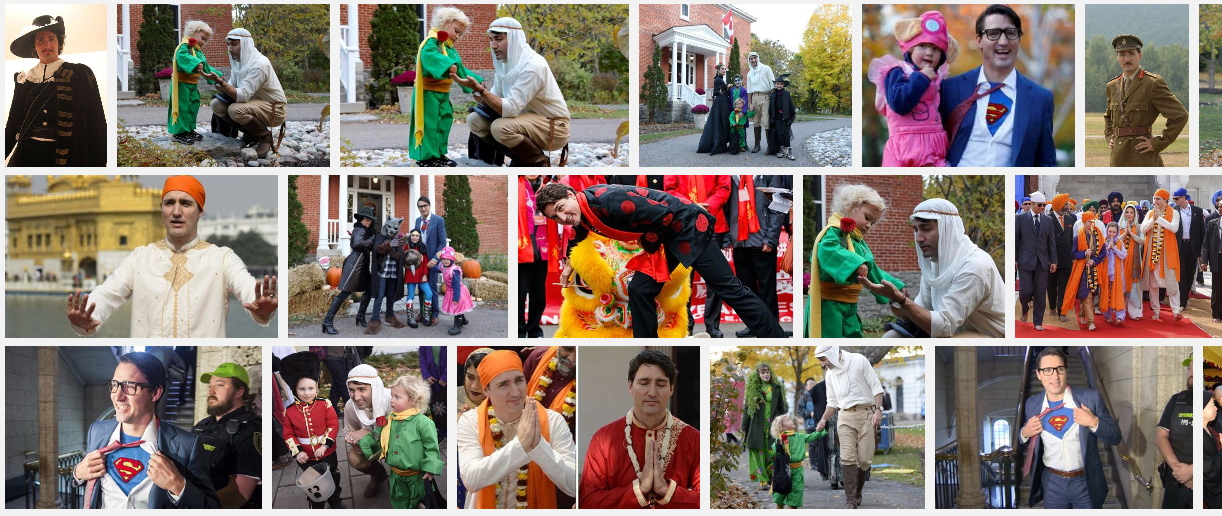
Canada is presently in the throes of social and political disintegration. A left-leaning electorate has once again empowered a socialist government promoting all the lunatic ideological shibboleths of the day: global warming or “climate change,” radical feminism, indigenous sovereignty, expansionary government, environmental strangulation of energy production, and the presumed efficiency of totalitarian legislation. Industry and manufacturing are abandoning the country in droves and heading south.
Canada is now reaping the whirlwind. The Red-Green Axis consisting of social justice warriors, hereditary band chiefs, renewable energy cronies, cultural Marxists, and their political and media enablers have effectively shut down the country. The economy is at a standstill, legislatures and City Halls have been barricaded, blockades dot the landscape, roads and bridges have been sabotaged, trains have been derailed (three crude-by-rail spillages in the last two months), goods are rotting in warehouses, heating supplies remain undelivered, violent protests and demonstrations continue to wreak havoc — and the hapless Prime Minister, who spent a weak swanning around Africa as the crisis unfolded, is clearly out of his depth and has no idea how to control the mayhem. No surprise here. A wock pupper politico in thrall to the Marxist project and corporate financial interests, Justin Trudeau is generally baffed out when it comes to any serious or demanding concerns involving the welfare of the people and the economic vitality of the nation. Little is to be expected of him in the current emergency apart from boilerplate clichés and vague exhalations of roseate sentiment.
Still, Trudeau may have been right about one thing when he told The New York Times that Canada had no core identity — although this is not what a Prime Minister should say in public. Canada was always two “nations,” based on two founding peoples, the French and the English, which novelist Hugh MacLennan famously described as “two solitudes” in his book of that title. But it may be closer to the truth to portray Canada as an imaginary nation which comprises three territories and ten provinces, two of which, Quebec and Newfoundland, cherish a near-majoritarian conception of themselves as independent countries in their own right. Newfoundland narrowly joined Confederation only in 1949 and Quebec held two successive sovereignty referenda that came a hair’s breadth from breaking up the country.
Quebec separatists don’t need to do much more than sit back, put their feet up, crack a few beers, and watch Justin Trudeau drive the country toward dissolution. Their job is so much easier now…
It is often noted that America is a nation evenly divided between progressivist and conservative populations, a civil dilemma not easily resolved. But Canada is divided approximately 65-35 by these constituencies, and if one considers that the federal Conservative Party in its present manifestation can fairly be described as Liberal Lite, the breakdown is more like 95-5. This means there is no chance of reconciliation between our political disparities, such as they are, and Canada is doomed to plummet down the esker of every failed socialist experiment that preceded it and, indeed, that is presently on display in various foundering nations around the globe — North Korea, Cuba, Venezuela, and counting.
Trudeau père invoked the War Measures Act in 1970 to quell the Quebec separatist movement, the Front de Libération du Québec (FLQ), after a series of bombings and murders. It is obvious that the son has neither the political smarts nor the strength of character to act decisively against those who are busy reducing an already patchwork country into a heap of shards and rubble. And there we find the proof that, whatever Canada may once have been and whatever the talking heads may incessantly proclaim, Canada is no longer a viable political construct. It is a dead country walking.
H/T to Blazing Cat Fur for the link.
February 5, 2020
“On this issue, Canada’s two solitudes could hardly be more starkly apparent”
Chris Selley on the vastly different reaction from Quebec media to the Trudeau government’s notion to turn the country’s news organizations into a modern version of Joseph Goebbels’ propaganda apparatus, pumping out approved-by-the-Liberals story lines:
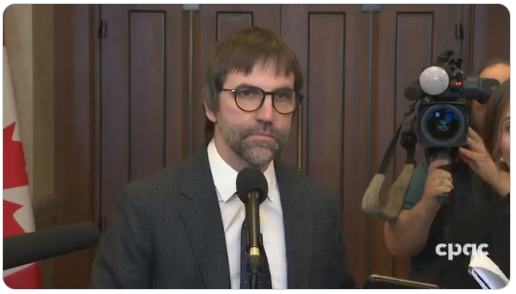
On Sunday, when CTV’s Evan Solomon pushed Heritage Minister Steven Guilbeault on the issue of issuing journalism licences to foreign media outlets, Guilbeault eventually just shrugged: “I’m not sure I see what the big deal is.”
Canadian Heritage Minister Steven Guilbeault, 3 February 2020.
Screencapture from CPAC video.The minister tried to walk it back on Monday, but the fact is many of his fellow Quebecers will also struggle to discern a big deal. There is simply much more tolerance of this sort of cultural gatekeeping among francophone Quebecers than in the Rest of Canada, and the tolerance extends well into the realm of journalism.
“In reading the (report’s) 260 pages and 97 recommendations, one word comes to mind” Sunday’s editorial in La Presse gushed: “Finally!”
Opposition to government regulation of journalism is firmly entrenched not just in anglophone Canada, but across the anglosphere. When the 2011 Leveson Inquiry proposed the British government create a powerful new press regulator, nearly every major outlet rejected the idea. Fraser Nelson, editor of The Spectator, famously vowed the magazine “will not attend its meetings, pay its fines nor heed its menaces.”
The same year, Laval University professor Dominique Payette’s report into Quebec’s struggling news media recommended the government legislate a “professional journalist” designation. The province’s largest journalists’ trade organization and the Quebec Press Council happily sat down with the government to bash out a power-sharing agreement on deciding who’s a proper journalist and who isn’t.
The English-language Montreal Gazette was dead-set against the idea, but Le Devoir called it a “logical outcome.” (The power-sharing discussions eventually fell apart, and the idea died a merciful death.)
January 28, 2020
QotD: Drinking and driving
According to BTLPTP, “Drinking drivers are responsible for one-quarter of all people killed on Ontario roads.” In other words, only 75 percent of Ontario traffic fatalities are the work of sober people. Either we have more drunks in Ontario or our sober drivers are better drivers than Britain’s. [Where “one in seven of all deaths on the road involve drivers who are over the legal limit.”]
Now, despite the damning evidence in these brochures that sober people are causing carnage on our roads, the people who know what’s good for us are busy trying to lower the legal blood alcohol limit. Early in 2001 the Quebec government announced that it was lowering the limit from eighty milligrams to fifty, throwing in a complete drinking ban for professional drivers — cabbies, bus drivers, and the like. This last measure was a reaction to — well, nothing at all. Were drunk ambulance drivers creating havoc on the roads of Quebec? No. But it gave the government of Quebec the appearance of having taken a strong stand on something. Predictably, the Ontario government immediately made noises about following suit.
Nicholas Pashley, Notes on a Beermat: Drinking and Why It’s Necessary, 2001.
November 28, 2019
“The chickens are coming home to roost … but they are, actually, Pierre Trudeau’s chickens”
Ted Campbell looks at Justin Trudeau’s plight — needing to focus on policies that will increase his party’s chances of winning more seats in Quebec — with increasing demands from south of the border to get the Canadian commitment to higher military spending moved from “aspirational goal” to actual policy:
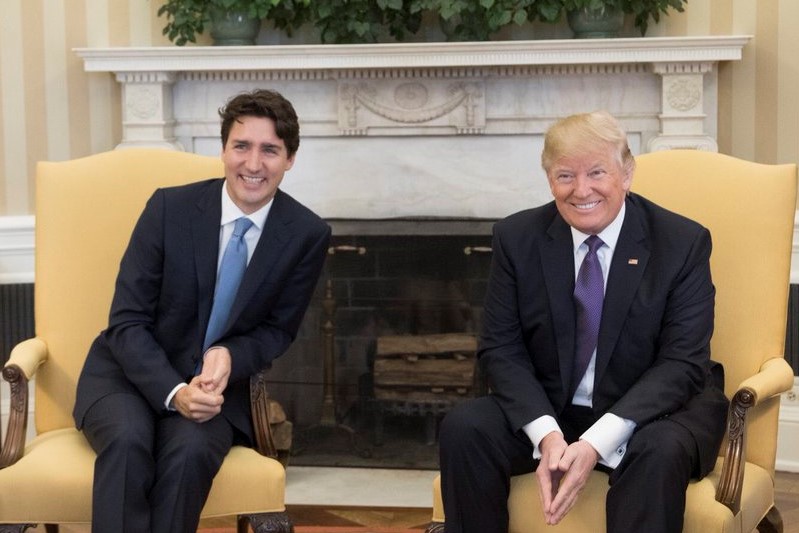
Justin Trudeau meets with President Donald Trump at the White House, 13 February, 2017.
Photo from the Office of the President of the United States via Wikimedia Commons.
Many in the media are saying, and I agree, that Justin Trudeau’s agenda for the next couple of years is about 99.9% domestic and focused, mainly, gaining seats in on Québec and holding on, at least, in Atlantic Canada and in urban and suburban Ontario and British Columbia. The overarching aim ~ the ONLY aim ~ of this government is to be re-elected with a majority.
As I mentioned a week or so ago, Donald J Trump is about to rain all over Justin Trudeau’s parade.
As Murray Brewster reports, for CBC News,
The Liberal government is facing renewed political pressure from the administration of U.S. President Donald Trump to increase defence spending to meet the benchmark established by NATO [… and …] Robert O’Brien, the new U.S. national security adviser, said it is an “urgent priority” to get allies across the board to set aside military budgets that are equal to two per cent of the individual country’s gross domestic product [… while …] Speaking with journalists at the Halifax International Security Forum on Saturday, O’Brien rattled off a list of the world’s flashpoints, including Iran and Venezuela, as well as traditional adversaries such as Russia and China [… saying …] “There are very serious threats to our freedom and our security [… and adding that …] Canada made a pledge at [the 2014 NATO Summit in] Wales to spend two per cent. We expect our friends and our colleagues to live up to their commitments, and Canada is an honourable country; it’s a great country.”
Note the choice of words by Mr O’Brien, who is “a lawyer and former U.S. State Department hostage negotiator.” He doesn’t say that President Trump and the USA “asks” Canada to keep its word (although the Harper government said that spending 2% of GDP on defence was an “aspirational goal,” rather than a firm commitment) nor did he say something like “the US hopes Canada will change its ways and spend more on defence.” He said that Donald Trump’s America “expects” Canada to live up to its “pledge.” As I mentioned before, when President Trump negotiates with friends and allies he usually has both fists in the air and his knuckles are often reinforced with unfair trade tariffs and the like. Right now he is, for example, asking Japan and South Korea to pay much, much more to support American forces in their countries because, in his mind, he (America) is providing a “service” which is all for the Asians and is not, in any way, in America’s self-interest and, therefore, he wants to be reimbursed. It’s a very Trumpian notion. I am sure he sees NATO and NORAD in very much the same light.
[…]
The issue that worries some analysts is that while Canada is, in the final analysis, protected by the US because it is in America’s best interests to protect us, NATO provides a useful counter-balance and, in effect, helps us to at least pretend to be a little less than just another American colony. And that, having the status of being little better than a US colony, is what Pierre Trudeau willed upon Canada in the late 1960s and early 1970s when he wanted to leave NATO, entirely and saddled Canada with his, juvenile, nonsensical, neo-isolationist “Foreign Policy For Canadians” white paper in 1970. Although Brian Mulroney wanted Canada to be independent – think standing up to President Reagan and Prime Minister Thatcher on South Africa – and Stephen Harper did, too, the cumulative impact of Trudeau-Chrétien-Trudeau for 30 of the last 50 years has been too much to change. When our political leaders don’t care about Canada being a leader amongst the nations and don’t, in fact, even care about Canada being a truly sovereign state then we will sink, inevitably, into the status of an American colony.
November 8, 2019
Don’t hold your breath waiting for the Feds to tackle Quebec’s ongoing repression against minorities
Chris Selley on the situation in Quebec, where first-class citizenship is only available to those who speak French and don’t expect their religious beliefs to be respected:

One of the fascinating things about Quebec politics is that it’s often impossible to predict which absurdities will become controversial and which will be accepted as reasonable. The province’s linguistic and more recently cultural debates operate in an atmosphere so divorced from normal reality that it’s impossible to know how any new idea or event might react to its unique and volatile mixture of gases.
The classic example is Pastagate: An inspector from the Office québécois de la langue française found an Italian restaurant’s menu was riddled with Italian — calamari, antipasti — and issued the appropriate cease-and-desist notice. At no point did anyone suggest he had misinterpreted the law. Despite universal scorn and worldwide mockery, at no point did anyone successfully explain why this inspector’s actions were obviously ultra vires, while the OQLF’s other insane diktats — say, forcing a bilingual community newspaper to segregate English-language and French-language content such that English-only advertising will never appear on the same page as a French-language article — were reasonable.
As a result, Quebec politics is like a festival of trial balloons. Most recently we saw languages minister Simon Jolin-Barrette float the idea of banning merchants from greeting customers with “bonjour-hi” — a Downtown Montreal-ism that turns language hawks crimson with rage — only to have Premier François Legault shoot it down a couple of days later amidst widespread ridicule.
By contrast, we’re supposed to think it’s totally reasonable that the National Assembly voted merely to request that merchants use state-sanctioned greetings. Unanimously. Twice.
Ban religious symbols for all civil servants, or only those “in a position of authority”? Which civil servants are “in a position of authority”? Should currently employed civil servants affected by Bill 21 be grandfathered in or not? You can poll all you like, but until any given idea goes through Quebec’s intense media ringer, no one knows how it’ll shake out. With fundamental rights at stake, the majoritarian randomness of it all is truly alarming.
November 2, 2019
Sir Charles Ross was a Jerk: The Martello Tower
Forgotten Weapons
Published 29 Oct 2019Note: These towers were built by the British, not the French. Sorry!
http://www.patreon.com/ForgottenWeapons
Cool Forgotten Weapons merch! http://shop.bbtv.com/collections/forg…
Sir Charles Ross was really a jerk sometimes. Not the sort of guy you would want to go into business with.
Contact:
Forgotten Weapons
6281 N. Oracle #36270
Tucson, AZ 85704
Here are the Wikipedia pages on Sir Charles Ross, Bart. and Martello towers.

October 11, 2019
The National Basketball Appeasement Association
Colby Cosh discusses the moral squalor, cowardice, avarice, and reflex appeasement gesturing of the NBA and finds a Canadian angle to the whole mess:
The National Basketball Association has spent the week trying to control the effects of a tweet by Daryl Morey, general manager of the Houston Rockets, who jeopardized his job on Friday when he told readers “Fight for freedom, stand with Hong Kong.” The tweet winked out of existence quickly, but it had prodded a sore spot. Morey faced immediate criticism from the Rockets’ owner and from the Chinese consul in Houston. Steps were taken within China to declare the Rockets personae non gratae and to cancel some NBA broadcasts.
[…]
Which leads to us to the true Canadian angle, copyright Colby J. Cosh 2019 (all rights reserved). Daryl Morey’s tweet was the 21st century’s “Vive le Quebec libre.”
All right, Morey isn’t a statesman, as de Gaulle was — but the NBA itself wants us to believe that it is a force for international harmony, and Morey is a prominent figure in the NBA. There is an amusing subplot here in that Morey has traditionally been regarded as an outsider in the league, a computer nerd who barged his way in by using technical analytics to improve team performance both on the court and at the gate. The natural assumption of a person who went to university in the 1990s is that he would be perfectly free as a matter of course to blurt out a political opinion — one that is in no way remotely controversial in the free world — on Twitter. Well, we are all learning to revise such assumptions.
When General de Gaulle uttered the 1967 version of an ill-advised, impulsive tweet, it created a small spasm of anger in English Canada, as Morey’s endorsement of an increasingly separatist protest movement in Hong Kong has. (Chinese sovereignty in Hong Kong is supposed to be as much an accepted fact as Canadian sovereignty in Quebec, and from the Party point of view, the Hong Kong protests are internal civil disorder. The same, of course, would go for China’s re-education camps full of Uyghurs, who represent the fate that pro-democracy Hong Kongers are trying to avert.)
But it was the Canadian political establishment that de Gaulle really provoked to rage with his sly, ambivalent remark. It was seen as an offence against hospitality. Canada’s mandarins — pardon the inadvertent pun — knew that de Gaulle’s resounding “liiibre” would give, above all, moral impetus to the enemies of Confederation. This proved to be the case, as far as history can tell. Et donc — vive Hong Kong! Vive Hong Kong libre!

September 18, 2019
The Canadian Charter of Rights and Freedoms* (*not all sections apply in Quebec)
Andrew Coyne on the disgraceful habit of the federal government (and nine provincial governments) to look the other way when Quebec decides that some of the guarantees in the Charter don’t apply in La Belle Province:
For many observant persons, particularly Muslims, Sikhs and orthodox Jews, this amounts to a religious hiring bar: the wearing of the hijab, the turban and the kippa are key requirements of their faith, and as such core elements of their identity. To demand that they work uncovered is, in effect, to post a sign saying Muslims, Sikhs and Jews need not apply.
We should be clear on this. It’s not just a dress code, or an infringement of religious freedom, or religious discrimination, or those other abstract phrases you hear tossed about. We are talking about a law barring employment in much of the public sector — not just police and judges, but government lawyers and teachers — to certain religious minorities.
Existing workers may have been grandfathered, but only so long as they remain in their current jobs. Should they ever move, or seek a promotion, they will face the same restrictions. The signal to the province’s religious and, let’s say it, racial minorities, vulnerable as they will be feeling already after the mounting public vitriol to which they have been exposed in the name of the endless “reasonable accommodation” debate, is unmistakable: you are not wanted here. Not surprisingly, many are getting out — out of the public service, out of Quebec.
That this is actually happening, in 2019, in a province of Canada — members of religious minorities being driven from their jobs, and for no reason other than their religion — is sickening, and shameful. That shame is not reserved to Premier Francois Legault or his CAQ government, the people responsible for designing and implementing this disgraceful exercise in segregation, this manifestly cruel attempt to cleanse the province’s schools and courts of religious minorities. It is no less shaming to the rest of us, everywhere across Canada, so long as we permit it to continue.
That is, so far as we are capable of feeling it. But experience has taught us to look the other way when it comes to Quebec, to tell ourselves that it is none of our affair, that we must not raise a fuss when the province explicitly elevates the interests of its ethnic and linguistic majority over those of its minorities, or threatens the country’s life for long years at a time — the beloved “knife at the throat” strategy — to back its escalating fiscal and constitutional demands. We dare not. We cannot. For then Quebec would leave.
September 15, 2019
Why the national polls are, at best, only a rough guide to voters’ intentions
Canadian elections have their own quirks — historical, geographical, linguistic — that cannot be accurately captured in national opinion polls:

Conservative support is heavily concentrated in Alberta and Saskatchewan. Tens of thousands of its votes are therefore likely to be wasted racking up massive majorities in a relatively small number of seats.
The Liberal vote, by contrast, is more efficiently distributed, notably in Quebec, with its tight three- and four-way races, where a winning candidate might slip through with 30 per cent of the vote or less. So even though the Liberals are projected to win fewer votes than the Conservatives, they are also projected to win a solid plurality of the seats — perhaps even a majority.
Then again, the polls are misleading in another way. A poll can project, with some uncertainty, the level of support for the various parties among the voting-age population. It is a more difficult matter to predict what proportion of each party’s supporters will actually turn out to vote. The Liberals benefited in 2015 from a surge in turnout, especially among younger voters, on the strength of Justin Trudeau’s sunny idealism. No such enthusiasm, or idealism, is detectable this time around.
It all makes for a close, unpredictable race. The Liberal challenge is the usual one: to round up the vote on the left without giving too much ground on the centre, appealing to those tempted to vote NDP or Green not to split the progressive vote lest the Tories get in.
The Conservatives, for their part, will also be fighting a two-front war, with the emergence of the People’s Party to their right imposing some constraint on their ability to reach across the centre. To date the PPC has not posed much of a threat — its support has stalled at around 3.0 per cent — but it is not impossible that it could break out of that range now that voters are paying more attention.
Of course, Maxime Bernier being actively excluded from the debates, and the pollsters often not including a choice for the PPC will also limit the PPC’s visibility to ordinary Canadian voters. Oddly, this may benefit the Milk Dud and his “Conservatives”, as the media tries to ignore Bernier’s party but gives disproportional coverage to the Green and NDP campaigns, which potentially weakens support for Trudeau and the Liberals.
Update, 16 September: I guess the media finally noticed that excluding Maxime Bernier from the debates was a sub-optimal idea for their preferred winner (Justin Dressup).
The Leaders' Debates Commission (@debats_can) has invited @MaximeBernier to the Commission’s debates on October 7 and 10 #cdnpoli https://t.co/1ZGAZRO7KU
— Power & Politics (@PnPCBC) September 16, 2019
August 28, 2019
QotD: The secret power of Quebec separatists that Western separatists lack
Colby Cosh, “Advice on Western separatism: don’t take it any more seriously than it takes itself”, National Post, 2019-07-26.
July 17, 2019
VIA Rail’s “High Frequency Rail” proposal
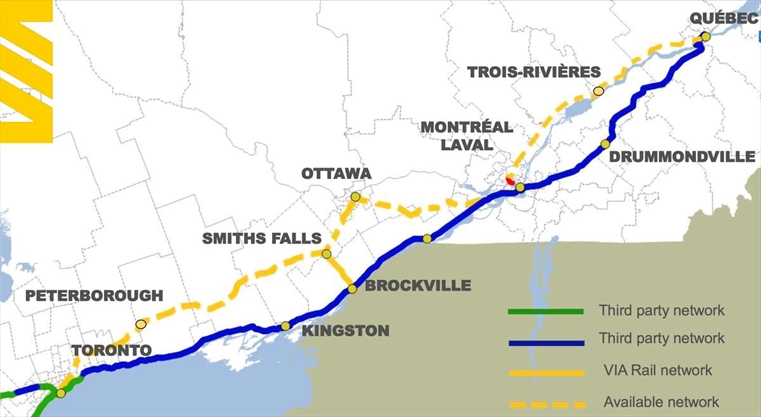
In Trains, Bill Stephens outlines some of the strikes against VIA Rail Canada’s hopes for a dedicated passenger-train-only route between Toronto and Quebec City:
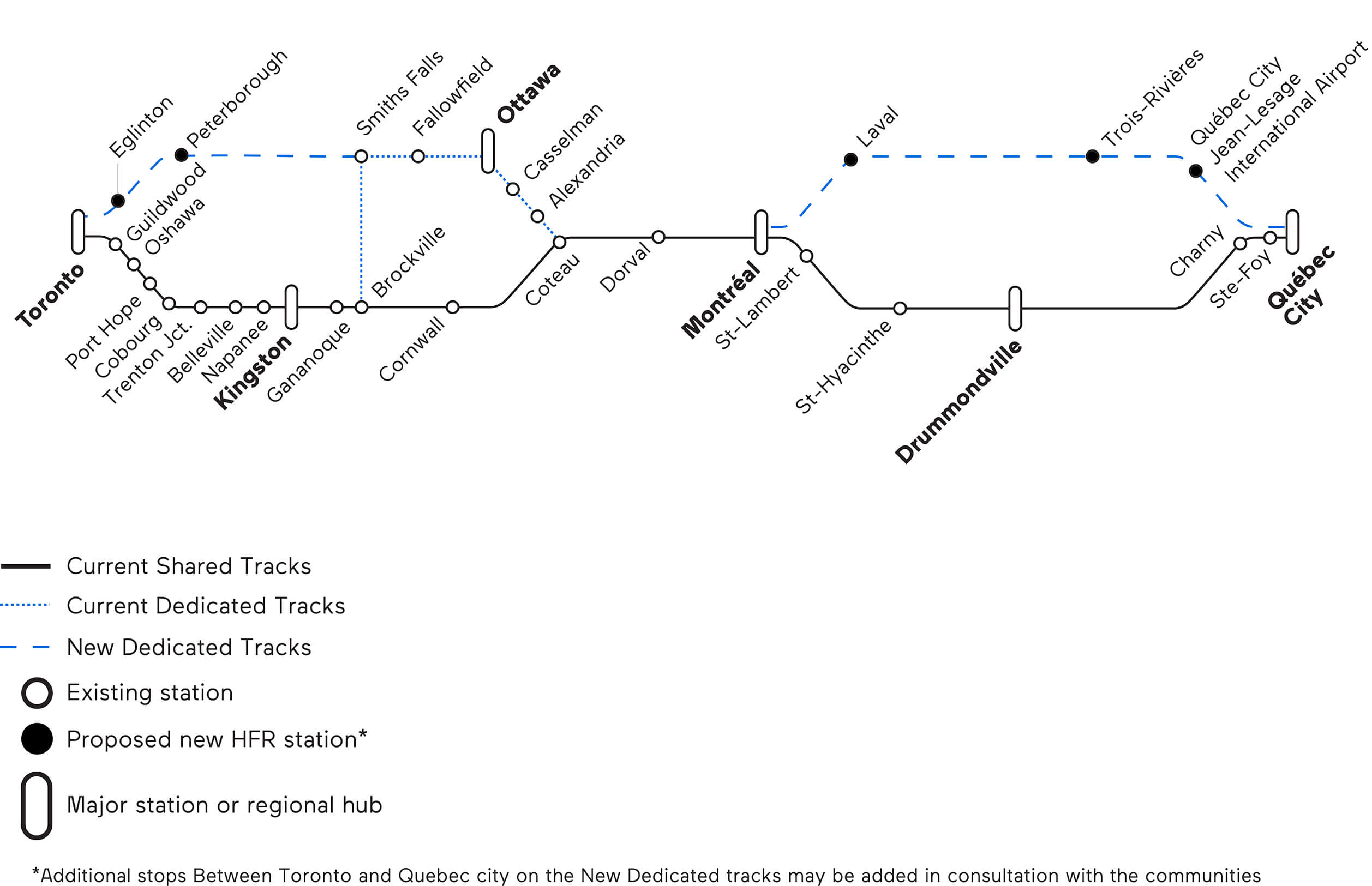
Last month VIA’s $4 billion plan got a $71 million boost that will fund additional feasibility studies. It shouldn’t take $71 million to figure out the plan is fatally flawed. Why? Because it won’t accomplish its chief aim: Eliminating the mind-boggling delays related to sharing tracks with Canadian National freight trains.
To be successful, passenger service needs to be fast, frequent, and dependable. VIA’s current service is faster than driving between Canada’s two biggest cities, Toronto and Montreal. It’s fairly frequent, too, with seven weekday departures between Toronto and Montreal. But it’s not dependable. On-time performance is in the low 70% range for the entire Toronto-Ottawa-Montreal-Quebec City corridor. VIA blames the late trains on interference from CN freights, primarily on the double-track route linking Toronto and Montreal.
So you can understand why VIA would lobby the Canadian government for a dedicated passenger route. Last year VIA’s Eastern Corridor, the Canadian equivalent of Amtrak’s Northeast Corridor, carried three-quarters of VIA’s entire ridership. It stands to reason that you can fill more seats with service that’s faster, more frequent, and more reliable.
[…]
Keeping passenger and freight trains on time takes a combination of operational discipline, the right track capacity, and a willingness to make it work. CN takes pride in its operational discipline, and executives say the Eastern portion of the railroad, between Chicago and Halifax, is underutilized. What’s missing, it seems, is a willingness to expedite VIA trains.
VIA needs a cooperative host railroad more than it needs a new route that would bypass intermediate population centers, face opposition from the not-in-my-backyard crowd, take years to build, and in the end would still have to rely on shared trackage in key areas.
Also a monumental problem without an apparent solution: Squeezing extra trains into Toronto Union Station and Central Station in Montreal on new approaches that would only complicate operations and increase conflicts with freight and commuter traffic.
May 4, 2019
Justin Trudeau’s (French) language problem
Colby Cosh reports on a recent academic paper that sticks the boots into the little potato and his, um, problematical French language issues:
Thursday’s hot-off-the-press Post contained a short summary (by CP’s Giuseppe Valiante) of a recent academic paper about how Justin Trudeau’s handling of spoken French is regarded in Quebec. In case you didn’t read Valiante’s summary, I’ll give you a four-word abstract: it drives people nuts. Obviously it’s hard to know how many Quebeckers are really annoyed or nauseated by the prime minister’s French, but if you judge by the newspapers, as Binghamton University French-language scholar Yulia Bosworth did in her article for the American Review of Canadian Studies, it seems Trudeau is the equivalent of fingernails scraping a chalkboard forever.
Hungry with curiosity, I got hold of Bosworth’s paper, entitled “The ‘Bad’ French of Justin Trudeau: When Language, Ideology, and Politics Collide.” As writing it suffers from the typical defects of published scholarship in the humanities: as the title suggests, it is one of those things in which every mental construct of any kind becomes an “ideology.” As scholarship it is pretty good: it contains a useful potted history of Quebecois linguistic self-hatred, and how “Quebec French” went from being a perennial object of shame to a rigid conscious standard, enforced with the same pride and viciousness as Parisian French within France.
But as disguised comedy, the article can’t be beat. When Bosworth wants to give the flavour of her sample corpus of Quebec newspaper abuse of Trudeau, she has to clear her throat professorially first. “Titles, arguably, play an important role in constructing public images; they constitute visible and frequently consumed newspaper content and help construct a linguistic landscape.” Zzzz. But then you get to the good stuff, the distilled liquor:
In Justin Trudeau’s case, headline readers encountered ‘a beautiful empty shell,’ ‘the little boy,’ ‘a privileged target,’ ‘a thinker of nothingness,’ ‘a deserter,’ a ‘mythical hero,’ ‘window dressing for radical individualism,’ ‘a young dilettante,’ and ‘Justin-the-Red.’ Among the many examples of negative descriptors pinned on Trudeau are: ‘smokescreen,’ ‘the call of the void,’ ‘hypocrisy,’ ‘lack of courage,’ and ‘Pee-Wee’s revenge.’ In terms of adjectives, Trudeau was called ‘slimy,’ ‘tricked,’ ‘attacked,’ ‘targeted,’ ‘troubled,’ and ‘criticized.’
Obviously there is a lot of that sort of talk around, and certainly JT gets a rough ride in the Post and the Alberta broadsheet papers from time to time, but I think only in Quebec do you find this language in headlines, rather than in the comment threads or your uncle’s Facebook feed. (“Radical individualism”? Really?)
March 10, 2019
There’s something bigger at stake in the SNC-Lavalin affair than Trudeau’s career
Chris Selley explains why SNC-Lavalin is an example of Canada’s less-than-stellar record of holding corporations to account:

… University of Michigan law professor David Uhlmann argues in a 2016 paper, “criminal prosecution of corporations upholds the rule of law, validates the choices of law-abiding companies, and promotes accountability. … When corporations face no consequences for their criminal behavior, we minimize their lawlessness, and increase cynicism about the outsized influence of corporations.”
No kidding. And in a country like Canada, not to say a province like Quebec, it’s safe to say these lines of accountability and trust get severely tangled. Once a government deems any company “too big to fail,” whether it’s because of political donations or connections, or because its pension plan is heavily invested, or because it has acquired a creepy semi-sacred status among otherwise normal people — or indeed, because of an alleged 9,000 jobs — all these nice theories about the rule of law break down. That’s what we’ve been witnessing.
But there’s an even bigger breakdown going on that’s received far less attention. Employees allegedly behind Lavalin’s Libyan capers were criminally charged as well. Between them, former vice-president Sami Bebawi and former controller Stéphane Roy faced charges including defrauding the Libyan state, money laundering, violating UN sanctions, bribing Saadi Gadhafi — Moammar’s soccer-playing, Montreal-enjoying third son — and trying to extract him from Libya once it all kicked off in 2011.
Those charges were laid in February 2014. Last month, some against Bebawi and all against Roy were dismissed because the Crown didn’t manage to bring them to trial in five blessed years. In a scathing decision, judge Patricia Compagnone characterized the Crown’s behaviour as a perfect illustration of the “culture of complacency” and the “culture of delays” the Supreme Court had assailed in its landmark 2016 Jordan decision, which established empirical standards for the Charter right “to be tried within a reasonable time.”
It is an ever-more-curious mystery that Canada’s comprehensively screwed-up justice system never rises to the level of political crisis. In the first year after the Jordan decision alone, some 200 cases were thrown out on grounds of excessive delays. Some of the accused make the Friends of Moammar look like saints. They include alleged murderers, child molesters and drunk drivers.
The charges against SNC-Lavalin were laid in February 2015. More than four years later, we’re still fighting over whether to pursue them — and not, it must be said, in a way that makes us look like a terribly serious country. How nauseatingly fitting it would be if a court threw the case out before the feds even got a chance to decide what to do with it.


