
When I first saw the name “Karen,” used in the plural, apparently for a whole class of women, I did not look it up. Context told me that I wouldn’t have to; that a Karen was simply the updated term for what I formerly knew as a Becky. There are related, more focused terms, such as “Trixie” for a Karen from upscale white Chicago, and so forth. It is one of many reasons to celebrate the black urban lexical culture from which it emerged. The image of a passive-aggressive blonde, with a pony tail, disputing her order at Starbucks, comes quickly to mind. She will be married to a “Chad” whom she met in law school.
I love stereotypes. They help us understand what the Greeks called syndromes, carrying them beyond the narrow world of medical jargon. “Karen” began as the stereotype for the woman who “wants to see the manager,” but was soon extended through a gallery of related traits. One thinks affectionately through a shortlist of the Karens one has known. For the Christian, it can impact one’s prayer life. (I found myself once praying for a certain Karen Surname, then spontaneously extending it to “Karens everywhere,” with a memorial for the Beckies. I noticed as I searched my memory that many of these Karens were biologically male.)
And today I wonder, as I have often done, at the genius of colloquial language, and the unerring way with which it uncovers fresh stereotypes, that enhance our perception of reality, in a way like painting and the other fine arts. (In a lost portrait, Leonardo depicted a Karen of the Renaissance.)
David Warren, “Karens & their kind”, Essays in Idleness, 2020-06-10.
September 11, 2020
QotD: “Karen” and other stereotypes
August 31, 2020
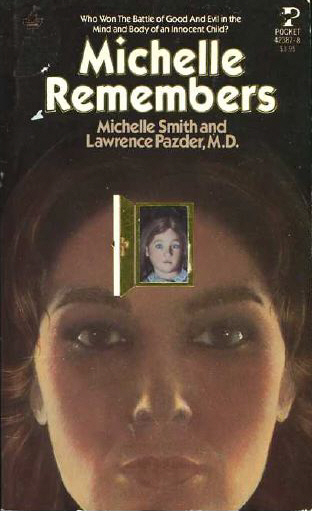
Michelle Remembers, the seminal Satanic Panic book
Jen Gerson discusses the first modern Satanic Panic and the book about the “recovered” childhood memories of a British Columbia woman in the 1970s:
QAnon may sound like something that could only have birthed in the darker corners of the internet. But QAnon predates president Donald Trump and even the internet itself; It’s just the latest iteration of a moral panic that swept the highest levels of Western society only a generation ago. One of the most polarizing and divisive social movements in modern history; it destroyed families, turned communities against one another, and sent numerous innocent men and women to prison.
And it all started in Victoria, BC.
It was known as the Satanic Panic; a conspiracy theory that convinced millions of well meaning and rational people that a secret cabal of Satanists had infiltrated the highest echelons of society in order to sexually molest children. The Satanists were accused of sacrificing animals and using women as “breeders” to create an endless supply of dead babies for use in their gory, bloody-fuelled rituals and orgies.
It destroyed lives and ripped apart families. Reports of ritualistic child abuse were reported across the English speaking-world. Almost all of them were eventually found to have been partially, or wholly fabricated, but not before dozens of innocent people were falsely accused, and sentenced to years and even decades in prison.
Born of a genuine historical injustice — society’s neglect of childhood sexual abuse — this was a panic that saw some of the world’s smartest minds taken in by accusations, that, at their root, were as preposterous as any raised during medieval European witch hunts. It was legitimized by a professional class, captivated law enforcement and proved itself a lucrative grift for fraudsters and attention seekers. Worse, as the conspiracy grew under its own weight and influence, the hysteria inspired real and horrific crimes — usually by disturbed teenagers who claimed they were sacrificing humans to Satan.
This is a case study of how badly off the rails we can go when we allow our best intentions and passions to overwhelm us.
The story begins in 1980, with the publication of a book called Michelle Remembers. It detailed the fantastic claims of Michelle Proby, who recounted several months of gory and sadistic ritualistic abuse at the hands of a cabal of Satanists when she was a child in 1950s Victoria. The memories, she alleged, were repressed for decades, until she sought help from psychiatrist Lawrence Pazder. Under a state of hypnosis, Proby began to uncover a horrifying tale of murder, torture, abduction, and molestation. She claimed to have been taken from her willing family and groomed to take part in a ritual to call the devil — one in which she witnessed the murder of children, was forced to eat human remains, covered in dead baby parts, and locked in a cage with snakes.
An explosive bestseller. Michelle Remembers would become the folkloric template for countless other claims of Satanic Ritual Abuse ostensibly uncovered during therapy during the 80s and 90s.
August 24, 2020
QotD: Progressive malevolent narcissism
These are people who will lie as readily as breathing in order to excuse their antisocial urges. They aren’t being obnoxious reluctantly, in desperation, or under duress. They harass, provoke and delight in domination because it gives them pleasure. It makes them feel important and powerful. Power being conceived solely as power over others. It’s a focus for their spite. Anything else is a fig leaf, a pretext. Among Portland’s identikit radicals, the ones exulting in the alarm and misery of others, there is no good faith. And so, you can’t engage with such creatures on their own ostensible terms.
David Thompson, “Shamelessly, He Quotes Himself”, David Thompson, 2020-08-22.
August 22, 2020
QotD: Sex-differentiated status hierarchies
Girls can win by winning in their own hierarchy — by being good at what girls value, as girls. They can add to this victory by winning in the boys’ hierarchy. Boys, however, can only win by winning in the male hierarchy. They will lose status, among girls and boys, by being good at what girls value. It costs them in reputation among the boys, and in attractiveness among the girls. Girls aren’t attracted to boys who are their friends, even though they might like them, whatever that means. They are attracted to boys who win status contests with other boys.
“whatever that means”. Heh. Shivvy way to say, “which means nothing”.
When JP discusses sex differences, he could be reading CH posts. Whatever one thinks of the criticisms leveled against him (some are valid), he does have a decent grasp of the sexual market and how men and women navigate divergent routes through an ocean of mate prospects to get what they want.
However, this is one of the rare instances when I disagree with his premise. He’s generally correct that, at least within the bounds of our current cultural arrangement, women have two status hierarchies available to them while men only have one. Our gynarcho-tyranny not only encourages but aggressively impresses upon women the urgency and even moral duty of succeeding in male domains (leaning in), while simultaneously encouraging men to sacrifice their status within their own male domains to make way for more women (and consequently rendering themselves less sexually attractive to women who are now their equal or higher in social status).
Women who do succeed in the man’s world can expect to ascend the intrafemale status ladder (more precisely, the intra-feminist status ladder), but where JP is wrong is assuming these women don’t also suffer an SMV status loss the near-equivalent of the SMV status loss suffered by men who succeed at girlie games of one-uppance.
Just as girls aren’t attracted to effeminate males, and other men are repulsed by nancyboys, the inverse is as true: men aren’t attracted to masculine, status-striving girls, and other women don’t subconsciously look up to mouthy careerist shrikes with the same mix of envy and admiration that they look up to physically beautiful women.
CH, “Sex-Based Status”, Chateau Heartiste, 2018-06-04.
August 21, 2020
QotD: Our overprotective culture
There’s a rule of thumb for dealing with elderly people in old age homes: Never do anything for anyone that they can do for themselves. It sounds cruel, but it’s not cruel.
This is one of the pathologies of our culture. A major pathology, and this is associated with a kind of immaturity and a kind of fear and this Oedipal mother problem, which is, “I don’t want you to suffer any distress right now.” Fine, but what about tomorrow and next week and next month? You might have to suffer a lot of distress right now so that you’re better next week and next month.
Jordan Peterson, “Christie Blatchford Sits Down With ‘Warrior For Common Sense’ Jordan Peterson”, National Post, 2018-02-07.
August 18, 2020
Political polarization, or why Liberals and Conservatives really don’t understand each other
John Miltimore discusses the findings of Jonathan Haidt on the differences in moral worldviews of conservative and liberal Americans which seem to explain why communication across the political “aisle” is so difficult:

Jonathan Haidt at the Miller Center of Public Affairs in Charlottesville, Virginia on 19 March, 2012.
Photo via Wikimedia Commons.
During a TED talk a number of years ago, Haidt shared his discovery that contrary to the idea that humans begin as a blank slate — “the worst idea in all psychology,” he says — humans are born with a “first draft” of moral knowledge. Essentially, Haidt argues, humans possess innate but malleable sets of values “organized in advance of experience.”
So if the slate is not blank, what’s on it?
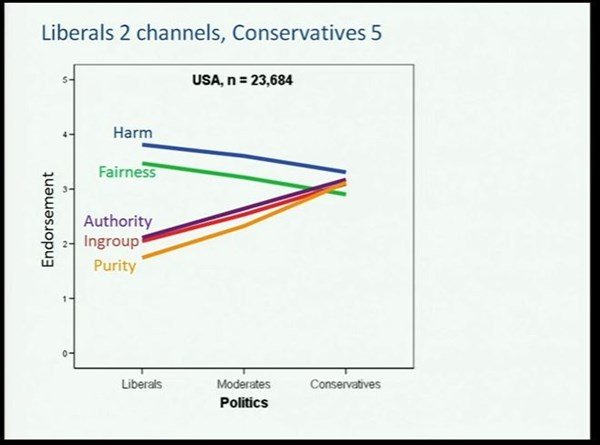
To find out, Haidt and a colleague read the most current literature on anthropology, cultural variations, and evolutionary psychology to identify cross-cultural matches. They found five primary categories that serve as our moral foundation:
- Care/harm: This foundation is related to our long evolution as mammals with attachment systems and an ability to feel (and dislike) the pain of others. It underlies virtues of kindness, gentleness, and nurturance.
- Fairness/reciprocity: This foundation is related to the evolutionary process of reciprocal altruism. It generates ideas of justice, rights, and autonomy. [Note: In our original conception, Fairness included concerns about equality, which are more strongly endorsed by political liberals. However, as we reformulated the theory in 2011 based on new data, we emphasize proportionality, which is endorsed by everyone, but is more strongly endorsed by conservatives.]
- Loyalty/betrayal: This foundation is related to our long history as tribal creatures able to form shifting coalitions. It underlies virtues of patriotism and self-sacrifice for the group. It is active anytime people feel that it’s “one for all, and all for one.”
- Authority/subversion: This foundation was shaped by our long primate history of hierarchical social interactions. It underlies virtues of leadership and followership, including deference to legitimate authority and respect for traditions.
- Sanctity/degradation: This foundation was shaped by the psychology of disgust and contamination. It underlies religious notions of striving to live in an elevated, less carnal, more noble way. It underlies the widespread idea that the body is a temple which can be desecrated by immoral activities and contaminants (an idea not unique to religious traditions).
[…]
What Haidt found is that both conservatives and liberals recognize the Harm/Care and Fairness/Reciprocity values. Liberal-minded people, however, tend to reject the three remaining foundational values — Loyalty/betrayal, Authority/subversion, and Sanctity/degradation — while conservatives accept them. It’s an extraordinary difference, and it helps explain why many liberals and conservatives in America think “the other side” is bonkers.
QotD: Stigma
But in fact there is almost a law of conservation of stigma that operates in human societies, such that if it does not attach to one thing, it will attach to another. No doubt there is more stigma in shame societies than in guilt societies, but even in the latter everyone, except perhaps the most psychopathic of psychopaths, is afraid of being shown up in some respect or another.
Stigma begins early in life and children are much guided or influenced in their conduct by the fear of it. A teacher told me the following story. A child of about seven or eight came crying to her one day because another child had called him names.
“What did he say?” she asked.
“He called me a virgin.”
“What is a virgin?” asked the teacher,
“I don’t know,” said the boy. “But I know it’s something horrible.”
Stigma is a kind of shorthand to indicate what we detest. Anyone who pretends that he never stigmatises is probably lying, or perhaps I should say not telling the truth, since not every untruth that emerges from the human mouth is a lie. There are people who can contradict themselves without disbelieving in the law of non-contradiction, and therefore people who can genuinely despise people who pass moral judgment on others.
What would living completely without stigma and stigmatisation mean? Surely that there was nothing that we or anyone else could do to make people think badly of us. One of the reasons — I don’t say the only one — that I don’t steal is that I don’t want to be stigmatised as a thief. One sin doesn’t define a person’s character, however, so that when we stigmatise we must be careful to be just and proportionate. If we called everyone a liar who had told a lie, then we should all be liars (quite apart from the fact that it is sometimes virtuous to tell a lie). We call a liar someone who habitually lies, so that untruthfulness is a central part of his character.
Stigma is one of those many things that is neither good nor bad in itself, and depends for its social beneficence or maleficence on what it attaches to and how strongly. In the company of rogues or scoundrels, one can be stigmatised for honesty. Many a cruel act has been performed to avoid the stigma of being too cowardly to be cruel.
Theodore Dalrymple, “The Situational Nature of Scorn and Stigma”, New English Review, 2020-04-28.
August 11, 2020
QotD: Our culture shapes what we can see
I have a little more insight into how culture shapes what’s possible to think, because I changed my culture as an adult. While this can be done (obviously) and immigrants should be encouraged to do it, (or go home), the acculturation is never complete. What happens is that you acquire a sort of cultural double vision. Depending on how far your acculturation goes, you’ll see the defects in thought or at least the unquestioned assumptions in one of the countries better, but also have a strong feeling of being outside enough to see some flaws in your dominant culture. In my case, for instance, I see the flaws in Portugal very clearly, like the obsession with speed over diligence or being decisive over being right, but I still see some in the US which is why sometimes I say “what people born and raised here don’t see.”
I have, of course, even more insight, due to being a conservative in the US, in a culture and profession (the arts/publishing) that is not only majority left, but majority extreme left. For many years, the only way to stay at least plausibly under cover was to see what they were seeing, and what they expected.
But without that, most people are blind to the … ah, unconscious or unthinking parts of their culture. Heck, even with what I’ve been through, I still tend to accept a lot of things unconsciously, unless I step back and go “Now wait a minute.”
Sarah Hoyt, “Slouching Into Shackles”, According to Hoyt, 2018-04-27.
August 9, 2020
QotD: The economic concept of “revealed preferences”
Now, you can’t help but notice that there is a disparity between those who say that taxes should be higher and those who act as if they should be. Clearly, an individual who really believes that the Government is more effective at spending his money would voluntarily offer up more than the legal minimum of taxation. That we have fewer people acting in this manner than are to be found writing columns and making speeches calling for higher taxation shows a certain gap, does it not, between public utterances and private actions? Why, we could make such donations a litmus test for those believers in higher taxation and state spending who want to compel all of us to pay more. Only those who show their commitment by sending a cheque to the Treasury should be treated seriously.
Cheques, by the way, should be made out to “The Accountant, HM Treasury”, and sent to 1 Horse Guards Road, London SW1A 2HQ. A 2nd-class stamp is sufficient and you are encouraged to add a covering note so that your donation is spent in the way you like.
Tim Worstall, “Show us your cheques”, Times of London, quoted in Continental Telegraph, 2020-05-07.
August 1, 2020
Why incompetent people think they’re amazing – David Dunning
TED-Ed
Published 9 Nov 2017Check out our Patreon page: https://www.patreon.com/teded
View full lesson: https://ed.ted.com/lessons/why-incomp…
How good are you with money? What about reading people’s emotions? How healthy are you, compared to other people you know? Knowing how our skills stack up against others is useful in many ways. But psychological research suggests that we’re not very good at evaluating ourselves accurately. In fact, we frequently overestimate our own abilities. David Dunning describes the Dunning-Kruger effect.
Lesson by David Dunning, directed by Wednesday Studio, music and sound by Tom Drew.
Thank you so much to our patrons for your support! Without you this video would not be possible!
Juan, Jordan Tang, Kent Logan, Alexandra Panzer, Jen, Ellen Spertus, Ryan Mehendale, Mary Sawyer, Scott Gass, Ruth Fang, Mayank Kaul, Hazel Lam, Tan YH, Be Owusu, Samuel Doerle, David Rosario, Katie Winchester, Michel Reyes, Dominik Kugelmann, Siamak H, Stephen A. Wilson, Manav Parmar, Jhiya Brooks, David Lucsanyi, Querida Owens.
Masking stupidity
In The Critic, Patrick Fagan talks about the dehumanizing aspect of mandatory facemask orders:

“Utrecht: Facemask Store” by harry_nl is licensed under CC BY-NC-SA 2.0


In Joost Meerloo’s analysis of false confessions and totalitarian regimes, The Rape of the Mind, he coins a phrase for the “dumbing down” of critical resistance – menticide. “In the totalitarian regime,” he wrote, “the doubting, inquisitive, and imaginative mind has to be suppressed. The totalitarian slave is only allowed to memorise, to salivate when the bell rings.”
[…]
Face masks can now be added to the list of mandates that make you stupid. As if Piers Morgan feverishly promoting them weren’t evidence enough, here are the facts on why you absolutely, categorically should not wear a face mask. They make you suggestible; they make you more likely to follow someone else’s direction and do things you wouldn’t otherwise do. In short, they switch off your executive function – your conscience.
A great example comes from a study by Mathes and Guest (1976), who asked participants how willing they would be, and how much they would have to be paid, to carry a sign around the university cafeteria reading “masturbation is fun” (this being 1976, doing such a thing would be considered embarrassing; these days it will probably earn you a course credit!). The results showed that when people wore a mask, they were more likely to carry the sign and required less money to do so ($30 compared to $48, on average).
Meanwhile, Miller and Rowold (1979) presented Halloween trick-or-treaters with a bowl of chocolates and told them they were allowed to take only two each. When the children thought they weren’t being watched, they helped themselves. Children without a mask broke the rule, taking more chocolates, 37% of the time, compared to 62% for masked children. The authors concluded that masks “lead to lower restraints on behaviour”.
The effect has similarly been found online: the online disinhibition effect refers to the tendency for people to act antisocially when anonymous online (Suler, 2004). There is even an infamous trolling movement calling itself Anonymous and using a mask as its symbol.
The disinhibiting effects of wearing a mask are described by psychologists in terms of a suspension of the superego’s control mechanisms, allowing subconscious impulses to take over. Saigre (1989) wrote that masks “short-cut” conscious defence systems and encourage “massive regression” to a more primitive state; Castle (1986) wrote that eighteenth century masquerades allowed mask-wearers to release their repressed hedonistic and sexual impulses; and Caillois (1962) similarly wrote about European masked carnivals involving libidinal activities including “indecencies, jostling, provocative laughter, exposed breasts, mimicking buffoonery, a permanent incitement to riot, feasting and excessive talk, noise and movement”. In the 12th Century, Pope Innocent III banned masks as part of his fight against immorality; and in 1845, New York State made it illegal for more than two people to wear masks in public, after farmers wore masks to attack their landlords.
From a neuroimaging perspective, masks are known to inhibit identity and impulse control – both associated with executive function in the prefrontal cortex (e.g., Glannon, 2005; Tacikowski, Berger & Ehrsson, 2017). In other words, masks silence the Jiminy Cricket in the brain.
July 30, 2020
QotD: The “strong female protagonist” in movies and on TV
Now I perfectly understand the legitimacy of feminist concerns regarding the portrayal of women in the media as consistently demure, retiring, and subservient to men. I grant that, in most of the action/adventure movies that I saw growing up, women would typically twist an ankle or get captured and then require rescuing by the swashbuckling male hero — and I realize how galling this must have been to generations of women. And therefore, a certain correction was undoubtedly in order. But what is problematic now is the Nietzschean quality of the reaction, by which I mean, the insistence that female power has to be asserted over and against males, that there is an either/or, zero-sum conflict between men and women. It is not enough, in a word, to show women as intelligent, savvy, and good; you have to portray men as stupid, witless, and irresponsible. That this savage contrast is having an effect especially on younger men is becoming increasingly apparent.
In the midst of a “you-go-girl” feminist culture, many boys and young men feel adrift, afraid that any expression of their own good qualities will be construed as aggressive or insensitive. If you want concrete proof of this, take a look at the statistics contrasting female and male success at the university level. And you can see the phenomenon in films such as Fight Club and The Intern. In the former, the Brad Pitt character turns to his friend and laments, “we’re thirty year old boys;” and in the latter, Robert De Niro’s classic male type tries to whip into shape a number of twenty-something male colleagues who are rumpled, unsure of themselves, without ambition — and of course under the dominance of an all conquering female.
It might be the case that, in regard to money, power, and honor, a zero-sum dynamic obtains, but it decidedly does not obtain in regard to real virtue. The truly courageous person is not threatened by another person’s courage; the truly temperate man is not intimidated by the temperance of someone else; the truly just person is not put off by the justice of a countryman; and authentic love positively rejoices in the love shown by another. And therefore, it should be altogether possible to hold up the virtue of a woman without denying virtue to a man. In point of fact, if we consult the “all conquering female” characters in films and TV, we see that they often exemplify the very worst of the traditional male qualities: aggression, suspicion, hyper-sensitivity, cruelty, etc. This is what happens when a Nietzschean framework has replaced a classical one.
Bishop Robert Barron, “The Trouble With the ‘You Go Girl’ Culture”, Word on Fire, 2016-10-18.
July 19, 2020
QotD: How to raise a God-Emperor son
Jordan Peterson, 12 Rules for Life: An Antidote to Chaos, 2018.
July 13, 2020
Sarah Hoyt on noblesse oblige
In the latest edition of the Libertarian Enterprise, Sarah Hoyt explains how noblesse oblige can and is used as a tool to benefit the powerful:
Of all the traps a culture can fall into, the fact that Americans tend to fall into Noblesse Oblige traps says very good things about us. It also doesn’t make the trap any less dangerous.
Noblesse Oblige, aka “nobility obligates” was a way that the excesses of a hierarchical society was kept in check. While the peasants were obligated to obey the nobleman, the nobleman was obligated to look after them/not put extreme demands on them/behave in certain paternalistic ways. (One of these days I need to do a post on paternalistic versus patriarchal. remind me.)
It is what is notably lacking from ideologically driven totalitarianisms and hierarchies, probably because their basis being atheistic they don’t seem the humans they have power over as being worth anything or commanding any duty from them. This is why in places like Cuba, Venezuela or China, the officials of the “democratic” government give themselves airs as long-suffering public servants while treating the people under their power worse than any of us would treat a stray animal (let alone a pet.)
In the US — where the citizen is king! — we have evolved a form of noblesse oblige best described as “Them who can, do what they can for those who can’t.”
[…]
But the noblesse oblige that affects the common individual in America is the foundation of worse traps.
Most of the idiotic compliance with ridiculous Winnie the Flu rules and restrictions hooked directly into Noblesse Oblige. For instance, the brilliant idea that you should wear masks to show you care even though we pretty much know they are completely ineffective and quite deleterious for a vast swath of people.
The idea that our kids should be forced to perform “volunteer” labor to graduate school, to “teach them to care for others.” The idea that you can always do a little more/sacrifice a little more for “those worse off” (Who often aren’t.)
When Noblesse Oblige turns into toxic altruism, it can take society apart.
Much of the “Green” mania is part of the noblesse oblige trap. They’re trying to convince us that if we just do these little things — most of them counterproductive, like, say recycling, which uses more resources and causes more issues than just using stuff — we’ll make it better for everyone.
In a bigger sense, they’re trying to make it so that we commit polite suicide so that “others live better.”
It can result in truly horrible racism, too. A great part of the left’s being convinced, say, that meritocracy is white supremacy comes from the fact that, being white, (and racist) they assume that they’re more competent than any other race, and therefore following “merit” causes white people to rise to the top.
July 10, 2020
QotD: Marcus Aurelius for the incel demographic
You just can’t beat it. But […] Our Thing has lots of potential Trigglypuffs. They’re called “incels,” I’m informed, but whatever the nomenclature, there are a lot of young single dudes out there who while away their pointless hours with video games and porn. Those are our potential storm troopers (it’s a metaphor, FBI goons). Why haven’t we weaponized them? (again: metaphor).
It’s probably as simple as giving them a role model. It goes without saying that your “incel” (or whatever) was raised by women. Even if there was a biological male living in the house during his childhood, it’s a thousand to one he was just that: a cohabiting male. Certainly not a father. And even if by some miracle he was, the poor guy can only do so much. You’ve got to let your sons out of the house sometime … where they’ll immediately be snapped up by the sour, shrieking cat ladies that control our educational system, our media, our professions, our culture. Both the son and his father have to be very, very hard-headed, and not a little lucky, to escape a poz infection …
… and that’s the best-case scenario. For the worst, look around — you’ll find incel and his soy-enfeebled twerp of a “male” parent cowering under the bed, scrubbing their hands and faces with Lysol, while Mommy scolds and caterwauls on Facebook.
There are role models out there, y’all. Stoicism in general, and Marcus Aurelius in particular, have seen a real upswing in popularity, especially on “Game” sites. This doesn’t represent a return to a Classical education; it’s that Marcus seems to be — Marcus is — a worthwhile role model for a fatherless boy. Strip out the “credits” at the start of book one and a few of the denser, more philosophical passages, and you could subtitle Meditations “how to drop your nuts on the carpet and act like a fucking man for once.” Loosely translated, of course.
Severian, “Be a Centurion!”, Rotten Chestnuts, 2020-04-07.


