
Professor Mark Crispin Miller teaches media studies at New York University (NYU) and is an expert in propaganda. Dr. Miller says just about everything concerning Covid was simply an elaborate exercise in propaganda. Dr. Miller explains, “The propaganda dimension is crucial to our understanding of what went down. Some people like to say this is a result of a number of ‘blunders’ by the health authorities and the government. ‘Blunders’. No, these are not ‘blunders’. When everything they recommend is deleterious and destructive of people’s health … When they suppress the truth about life saving remedies in furtherance of this so-called ‘vaccination program’, and when the so-called ‘vaccines’ have abysmal records for safety and effectiveness and those records are all hidden, we cannot reasonably conclude this is all the result of ‘blunders’. I have called the period from 2020 through the present a ‘Propaganda Masterpiece’. … Covid and every aspect of that whole crisis was engineered with extreme brilliance and sophistication of a propaganda operation. This was followed by the George Floyd moment. This served a number of purposes quite in line with the Covid crisis, which is to shut down society, cripple the economy and destroy the middle class … Also, another important aspect of this whole propaganda epic has been to divide the American people … No matter what side of the struggle we are on, what matters is the struggle took place at all. It is deeply divisive …”
Dr. Miller goes on to say, “I know a lot about propaganda, and this is unprecedented in the history of mass persuasion. There has never been anything like this because this is global. This has never happened before. We had Stalin’s crimes … We had Hitler’s aggression and the Holocaust. We had 911 and the ‘War on Terror’. None of those actually begin to compare to what we have now because what we have now is planetary. It’s worldwide.”
Dr. Miller does not call the CV19 bioweapon/vax a genocide. He says it is really a global democide. Meaning everyone and anyone is being murdered with the CV19 bioweapon/vax. Dr. Miller says, “My Substack is called ‘Died Suddenly’. I started it in February of 2022 when I noticed many, many people were dying suddenly for no given reason. In the history of obituaries, certainly in the United States, that is unprecedented. Obituaries always tell you why somebody died. Even if the person is very, very old, you have a cause of death. Now, all kinds of people are dropping dead for no reason and often very young … We do a weekly overview with as many pictures of these people as possible. This is the point. There are many statistical claims of the numbers of people who are dying … But as Stalin said, ‘One death is a tragedy, a million deaths is a statistic’. This is brutal, cynical wisdom, and he was absolutely right. If you read 1 million people starved in Ukraine, you say that’s too bad. If you look at page after page after page of people’s faces and names with the names of their survivors, it’s not so easy to shrug off.”
Greg Hunter, “CV19 – A Propaganda Masterpiece – Mark Crispin Miller”, USAWatchdog, 2023-06-10.
October 5, 2023
QotD: The Wuhan Coronavirus pandemic was a “propaganda masterpiece”
October 4, 2023
Douglas Murray – “Canada today looks like a nation of ignoramuses”
Writing in the National Post, Douglas Murray flays the Canadian Parliament for their shameful ignorance put on display by publicly honouring a former Waffen SS officer:
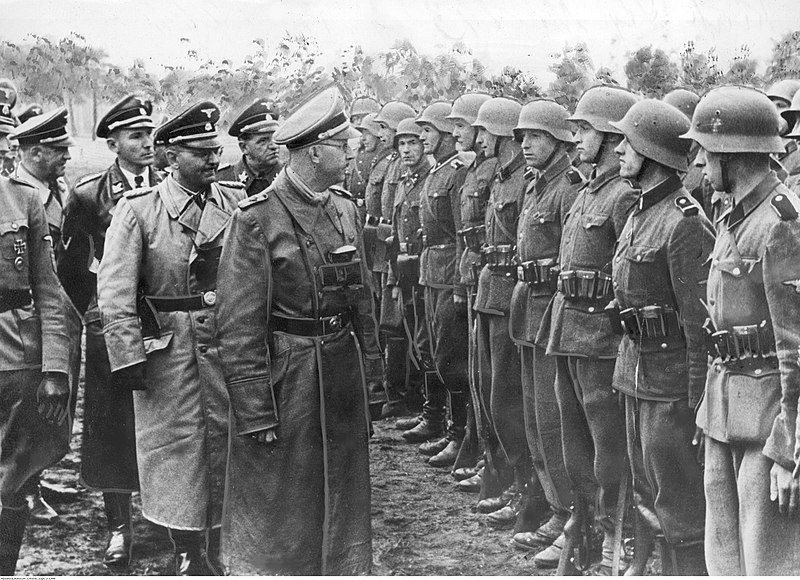
Reichsführer Heinrich Himmler (in the foreground) visiting the 14th Grenadier Division of the Waffen SS “Galizien” in May 1943.
Narodowe Archiwum Cyfrowe photo via Wikimedia Commons.
Perhaps I should say straight away that I love Canada. Some of my best friends are Canadian. That minimal throat-clearing aside, let me say — as a friendly outsider — that Canada today looks like a nation of ignoramuses.
The incident in Parliament the other week is just one case in point. Standing ovations are very rare things. They should be very special things. When a whole House stands to applaud someone they had better be very sure who they are applauding.
I know that Speaker Anthony Rota has now resigned. But here is the thing. Anybody who knows anything about the Second World War knows that if you were fighting the Soviets in Ukraine in the 1940s you were most likely fighting with the Nazis. It does not require a fine-tuned expert in the era to know this. Almost anybody could have guessed this. If almost anyone knew anything.
It seemed to be the assumption not just of Speaker Rota but of the whole Canadian Parliament that there existed in the 1940s some proto-anti-Putin fighting force and that the great cause of this moment has some direct lineage back to the fight of the 1940s. Ukrainian President Volodymyr Zelenskyy almost certainly guessed this. But it was the Canadian Parliament who was hosting him, the Canadian Parliament who embarrassed him and the Canadian Parliament who have handed the most magnificent propaganda victory to the Kremlin. In a war which Putin pretended to start in order to “de-Nazify” Ukraine, how much help has Canada given by your entire Parliament standing to applaud an actual Nazi?
What makes this worse is that this all comes after a period in which Prime Minister Justin Trudeau has been perfectly happy to call decent, ordinary Canadians Nazis. To use measures like the de-banking of his critics in moves that have horrified most of the other democracies in the West. When a bank in my country of birth — Britain — was recently found to have de-banked a politician (Nigel Farage) for what turned out to be political reasons not only did the head of the bank resign, but politicians in Britain from across the political system condemned the bank. Such moves are unlikely to be taken by another bank in Britain again. But in Canada it seems to be perfectly acceptable, because at any time the Canadian prime minister and deputy prime minister can claim that their critics are homophobes, xenophobes, racists, Nazis, misogynists and all of the rest.
The world — especially America — has looked on in horror as the Canadian government has tried to curtail speech in the country, and looked on with ever-more horror as Canadians seem willing to go along with this. It seems to be the view of the Canadian authorities that they are capable of deciding at the merest glance who is and is not allowed to speak, what is and is not acceptable speech, what any Canadians can and cannot read and who is and who is not a “Nazi”. These being the same authorities who apparently cannot even perform the most basic Google searches on their guests.
I know that Canadians often like to look down on Americans. But as someone who spends most of his time in America I can tell you that it is the American public who now wonder at what on earth is happening with our neighbour in the north.
September 17, 2023
How much mis-, mal-, and dis-information do you encounter on an average day on the internet?
I don’t know the answer to that question … although I suspect it’s a pretty big proportion of what you’ll see, especially if you stick to legacy media sites who regularly indulge in cover-up, state propaganda, and outright lies while condemning other media as “conspiracy theorists”. Chris Bray, on the other hand, thinks there are hopeful signs that we’ve passed peak disinformation as the pandemic lockdowns get further behind us:
I’ve been trying to come up with a count: If you consume a typical amount of news media and social media product, how many individual pieces of dishonest, misleading, and calculatedly or ignorantly unreal “information” do you take on board over the course of a typical day?
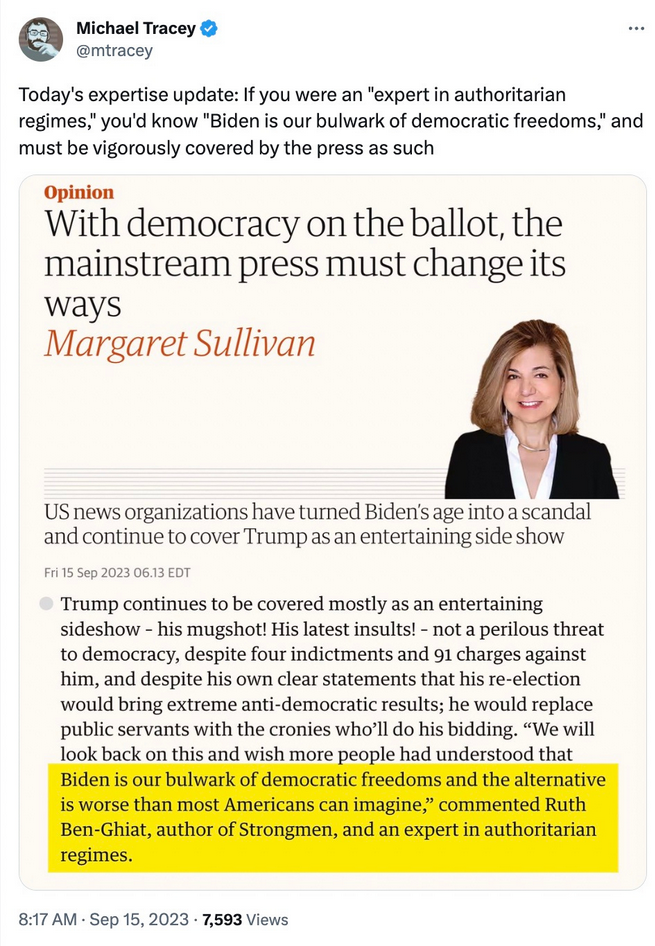
Walter Kirn’s one-sentence summary of contemporary media is stuck in my head: “This is a world-concealing layer of diversionary and illogical and internally inconsistent noise, under which the world exists somewhere.” How much noise do you have to purge to merely get to zero, not at all informed but not not deeply misinformed? And if you encounter the deep thoughts of Ruth Ben-Ghiat, does the deficit merely double, or is it much worse than that?
Democracy means you must not question or oppose the head of state
I’ve been reading on The Site Formerly Known as Twitter this week that Elon Musk’s refusal to activate the privately owned Starlink network over Crimea is a violation of the Geneva Conventions, which now apparently apply to corporate product, and also high treason, for which Elon Musk should be executed. At the risk of mixing metaphors, it’s like the Internet allows strangers to use your brain as a toilet. Although, as the Twitter randos always end up explaining, I just feel this way because I’M PUTIN’S NAZI BUTTBOY.
All day, every day, 24/7/365 — well, maybe with some breaks for sleep, but only if you stop looking at your phone at night — you take on garbage. Your brain is loaded with information barriers, dressed up as information. You read and hear sentences that are designed to prevent understanding.
QotD: One of the most successful propaganda campaigns in history
Ok, ok, is everyone done laughing yet? Go ahead, get it all out of your system; I’ll wait. Everyone back? Ok, moving on:
What the PTB actually did, of course, was a multi-level propaganda campaign. It was brilliant. It took a few years, of course, but the evidence is all around you. Quick: When’s the last time you saw anyone smoking in a mainstream movie? Even period films about the Forties, say — the ones where they take infinite pains to get just the right period-appropriate shade of Formica on the diner’s countertops — ignore the obvious historical reality of people puffing away like chimneys.
Indeed, it’s all but universal now, and has been for a long time, that characters who smoke are the bad guys.
Here again, look at college kids. I hate to keep beating this dead horse, but it’s really the best example I know of the phenomenon. Any time I taught the Early Modern period, I had to mention the massive economic and cultural effects of tobacco. So I encouraged kids to try it for themselves — everyone here is over 18, I said, so it’s perfectly legal. Want to know what all the hype was about? Just run down to the gas station, buy a pack, and light one up!
Around the turn of the century, I always had a few smokers in class, so I could say “bum one off So-and-So”. Even that would get me a few uneasy chuckles. A few years later, and not only were there no smokers in my classes, but the kids would be actively uncomfortable with the suggestion. By the end of my teaching career, when I couldn’t care less anymore, I was openly taunting them about it. You people have no problem with potheads, I’d say. I bet well over half of you are on Ritalin, Prozac, Xanax, Klonopin, shit that’s bad for you, in ways we don’t even understand yet, but you’re balking at one cigarette? It’s unsafe? Oh, come on, some of you are going to leave here and go light up a completely unfiltered ditch weed, and as for the rest of you, you know all about crazy sex fetishes I’ve never even heard of. You get blackout drunk at the football games every weekend, but oh no, you can’t have one cigarette, it’s so unhealthy.
Such is the power of propaganda, and it’s the only repression that works for the PTB when they’ve truly set their faces against a behavior …
Severian, “The Mob, Faux-tism, and the Ever-Rising Costs of Compliance”, Founding Questions, 2021-02-02.
September 4, 2023
Our own little Cyberpunk Dystopia
Kulak suggests we get comfortable with the tropes of Cyberpunk Dystopias, since we’re already living in one:

One need not spend long in radical or dissident Right discourse to encounter talk of Psy-ops and demoralization campaigns.
Some of this traces back to Yuri Besmenov’s work on subversion, some to speculation about “Operation Mockingbird” type media manipulation schemes, and some to simply obvious symbolic work being done for seeming for no reason except to horrify, offend, “blackpill”, and create a sense of helplessness amongst regime enemies.
One can point to the massive sentences for Jan 6th protestors, the recent charges of Trump (outside any norm or existing political theory or constitutional theory), or most ridiculous: Dystopia Porn news stories.
I recently heard a story repeated by a commentator of a news story of a trans-woman working with doctors to be amongst the first to receive a womb transplant which would allow a biological male to gestate a baby, this person was excited, completing the South Park plotline (seriously 2005 s09e01 “Mr. Garrison’s Fancy New Vagina” look it up), stating that they were excited that they might be the first trans-woman to get an abortion.
Why would the medical establishment play along and at least pretend to enable this obviously malicious and self-destructive wish? Why would the media bother to report such a crazy person’s putrid desire?? This religious commentator could only describe it as “satanic”, and speculated that it was a psy-op meant to break decent people’s will …
Setting aside the question of intention, and whether it wasn’t “just” medical professionals salivating at a paying guinea pig, and the media looking for clicks that aligned with their propaganda …
Why would it demoralize!?
Abortions happen by the hundreds of thousands annually, and the nightmare of the trans-medical process is visited on thousands of souls more sympathetic than this South Parkian weirdo every year … outside of the immediate outrage, such a bizarre one-off intersection of the two is basically of no broader political import … indeed if one is of the social conservative set one has seen rather major political victories on both fronts, with the overturning of Roe vs. Wade and the end of adolescent gender treatment across wide sections of Europe.
And yet for this one-off story of someone saying they would like to do something evil and stupid … you got outrage and horror and many an invocation of “It’s so over”.
What are the point of Psy-ops? What is the goal of demoralization?
Well as a perfidious leaf I am uniquely positioned to tell you, indeed, indeed one might say my country only exists because of the greatest psy-op in human history …
No not anything to do with Trudeau sr. or the liberal government’s corruption and bribery to keep Quebec from leaving …
The founding Canadian Psy-op occurred in 1812 … carried out by the greatest psychological warfare operative in human history, and Canadian national hero:
General Sir Isaac Brock
According to former President Jefferson, the conquest of Canada was to be “just a matter of marching” … indeed it should have been, the woefully outnumbered British Regulars and under-trained Canadian Militia should have been in no position to hold Upper Canada (now Ontario) and by rights should have lost what is now English Canada to American expansion … The defence of Canada depended on keeping America’s superior numbers on the far side of the St Lawrence/Great Lakes waterway bound up and unable to deploy in force for such an invasion …
… a seemingly hopeless task since they already had a beachhead for such an invasion at Fort Detroit (site of the current, well former, major city).
So Brock went on the attack, marching on Detroit with vastly inferior numbers to even the garrison.
His 1300 men of three different nationalities (British, Canadian, and Native) attacked 2500 unified defenders across the massive Detroit River, in a prepared defensive position.
It should have been suicide … he didn’t lose a single man.
Brock dressed his militia in excess redcoat uniforms of British regulars to make it appear as if he had more professionally trained soldiers … then throughout his maneuvers created the illusion that he had vastly more men than his opponent, marching his men in circles to create the illusion from the walls of the fort that he had thousands more than reality.
He then wrote to his opposite general William Hull begging him to surrender, stating that he did not believe he could control his 3000 Indian allies (in reality just 600) and prevent scalping and war crimes once battle broke out.
Hull wrote back asking for three days to arrange the surrender, Brock gave him three hours.
Once surrendered, Hull’s men spat on him seeing the inferior force they had just turned their guns over to.
At a court martial General Hull was sentenced to be shot, however, President Madison commuted his sentence to mere dismissal from the service … beginning a 200+ year-long tradition of US military retreat and lack of accountability.
In 1945 Canadian forces would repeat this obscene tactic at the battle of Zwolle, when soldier Leo Major single-handedly tricked ~1500 German soldiers into believing they were surrounded by superior forces and retreating.

September 1, 2023
How the term “the Deep State” morphed from left-wing to (extreme, scary, ultra-MAGA) right-wing jargon
Matt Taibbi wants to track the changes in political language in US usage, starting today with “Deep State”:
In July of last year David Rothkopf wrote a piece for the Daily Beast called, “You’re going to miss the Deep State when it’s gone: Trump’s terrifying plan to purge tens of thousands of career government workers and replace them with loyal stooges must be stopped in its tracks.” In the obligatory MSNBC segment hyping the article, poor Willie Geist, fast becoming the Zelig of cable’s historical lowlight reel, read off the money passage:
During his presidency, [Donald] Trump was regularly frustrated that government employees — appointees, as well as career officials in the civil service, the military, the intelligence community, and the foreign service — were an impediment to the autocratic impulses about which he often openly fantasized.
This passage portraying harmless “government employees” as the last patriotic impediment to Trumpian autocracy represented the complete turnaround of a term that less than ten years before meant, to the Beast‘s own target audience, the polar opposite. This of course needed to be lied about as well, and the Beast columnist stuck this landing, too, when Geist led Rothkopf through the eye-rolling proposition that there was “something fishy, or dark, or something going on behind the scenes” with the “deep state”.
Rothkopf replied that “career government officials” got a bad rap because “about ten years ago, Alex Jones and the InfoWars crowd started zeroing in on the deep state, as yet another of the conspiracy theories …”
The real provenance of deep state has in ten short years been fully excised from mainstream conversation, in the best and most thorough whitewash job since the Soviets wiped the photo record clean of Yezhov and Trotsky. It’s an awesome achievement.
Through the turn of the 21st century virtually no American political writers used deep state. In the mid-2000s, as laws like the PATRIOT Act passed and the Bush/Cheney government funded huge new agencies like the Department of Homeland Security, the word was suddenly everywhere, inevitably deployed as left-of-center critique of the Bush-Cheney legacy.
How different was the world ten years ago? The New York Times featured a breezy Sunday opinion piece asking the late NSA whistleblower Thomas Drake — a man described as an inspiration for Edward Snowden who today would almost certainly be denounced as a traitor — what he was reading then. Drake answered he was reading Deep State: Inside the Government Secrecy Industry by Marc Ambinder, whose revelations about possible spying on “eighteen locations in the Washington D.C. area, including near the White House, Congress, and several foreign embassies”, inspired the ACLU to urge congress to begin encrypting communications.
On the eve of a series of brutal revelations about intelligence abuses, including the Snowden mess, left-leaning American commentators all over embraced “deep state” as a term perfectly descriptive of the threat they perceived from the hyper-concentrated, unelected power observed with horror in the Bush years. None other than liberal icon Bill Moyers convinced Mike Lofgren — a onetime Republican operative who flipped on his formers and became heavily critical of the GOP during this period — to compose a report called “The Deep State Hiding in Plain Sight“.
August 26, 2023
The Cloward-Piven strategy in action
David Solway outlines the “playbook” apparently being followed in the ongoing dismantling of western civilization:

The malignant playbook of the contemporary left is generally considered to be Saul Alinsky’s 1989 Rules for Radicals, and there is certainly much truth to the story of the book’s destructive influence. But the source text for social and political upheaval is Richard Cloward and Francis Fox Piven’s far more detailed and authoritative 1997 manual, The Breaking of the American Social Compact.
The Cloward-Piven strategy seeks to hasten the fall of the free market and the republican structure of government by overloading the administrative apparatus with an avalanche of impossible demands, thus pushing society into crisis mode and eventual economic collapse. Choking the welfare rolls, for example, would serve to generate a political and financial meltdown, break the budget, jam the bureaucratic gears, and bring the system crashing down. The fear, turmoil, and violence accompanying such a debacle would provide the perfect conditions for fostering radical change.
We see the strategy in action today, forging a situation that was unnecessary from the start via a series of tactical steps, among which: the campaign against productive farming; the so-called 15-minute city herding people into condo-congested urban centers where they are readily supervised and mastered; open borders allowing for a refugee tsunami to alter the character of the nation; a censoring and disinformative media rendered corrupt to the core; the mandating of useless masks or plausibly toxic vaccines; and the implementation of a digital currency in which citizens’ spending can be monitored, restricted, or even frozen. Such phenomena have no basis in even the remotest necessity but are essential in order to prepare the ground for an imminent totalitarian state.
This is the rationale for the so-called COVID pandemic and the bugbear of “Climate Change”. A bad flu season affecting mainly the elderly with comorbidities is not a viral pandemic, as Dr. Vernon Coleman ironically shows. The climate is always changing as a matter of course — the term “climate change” is a gross oxymoron; the thesis of anthropogenic forcing obscures the fact that carbon is material for life and nitrogen for farming. COVID and Climate are tactical phantoms that have nothing to do with reality and everything to do with social control. The Clowardly rePivening put in place by the Democrat Party has only one aim: to create a crisis out of thin air and then seek to defuse it by creating a real crisis that advantages only the Party. It is the diabolical form of creation ex nihilo.
Thus, a ginned-up pandemic is a perfect excuse for mail-in ballots and ballot harvesting, especially if the voter rolls have been flooded with uncountable and counterfeit names and the voting stations have been commandeered. There is no immigration chaos unless a chain system is entrenched and the border is left wide open. There is no such thing as “white supremacy” unless it is apodictically proclaimed and false-flag operations are carried out. There is no need for costly, largely ineffective, and harmful renewable energy installations unless drilling has been rendered illegal and the oil pipelines have been shut down to avoid a bogus climate catastrophe. The bible of the Democrat left begins: Let there be a crisis. And there was a crisis.
H/T to Blazing Cat Fur for the link.
August 24, 2023
Life and Death at the heart of Nazism – On the Homefront 018
World War Two
Published 22 Aug 2023The Nazis love to spread the myth that they have transformed the German capital from a city of sin, unemployment, and Marxist street violence to the centre of a glorious new Reich. But the reality is that right now, Berliners are trapped between the Allied bombing and the Nazi regime’s tightening grip. And yet, the men and women of Berlin continue to support this war. For them, it’s a war of survival.
(more…)
August 10, 2023
“Forget global boiling … It’s global gaslighting we should be worried about”
Remember when [your local TV station/newspaper] was blaring the alarming news that your [city/town/state/province] was warming at twice the rate of everything else? All the legacy media NPCs got the same patch at the same time — and it was blatant enough that most people realized it was utter bullshit. As Brendan O’Neill explains, they’re not normally quite so clumsy in their constant attempts to gaslight us all about the climate, but they’re definitely still doing it:
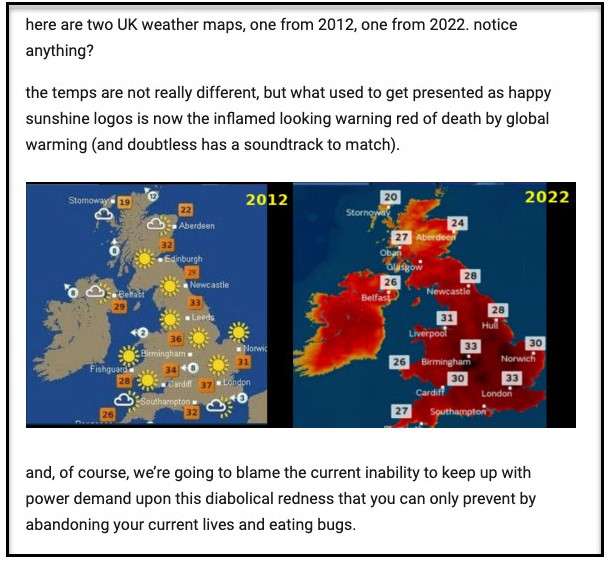
Picture the scene. You’re in London, the sky is menacingly grey, it’s drizzling. You zip your jacket against the elements, annoyed that Britain has just had one of its wettest Julys since records began. Then you reach for your copy of the Evening Standard as you head home from work, only to see splashed across the front page a Photoshopped image of the Earth on fire. “WHO WILL STOP EARTH BURNING?”, the hysterical headline asks. The drizzle turns to rain and you fold your Standard in two to use as an impromptu umbrella, turning a mad piece of global-boiling propaganda into flimsy protection from this strange, wet summer.
This was London yesterday. It really happened. It was yet another overcast day, in keeping with the record-breaking precipitation of the past month. The UK had an average of 140.1mm of rain in July, the sixth-highest level of July rainfall since records were first kept in 1836. And yet here was the freebie London paper warning us that flames will shortly engulf our celestial home. That heat death is coming. That an inferno of our own dumb making is licking at our feet. I know we live in mad times but even I never expected to see damp commuters brushing raindrops off their shoulders while surrounded by discarded papers telling us it’s so hellishly hot we might all soon die. Rarely has the gap between MSM BS and real life felt so cavernously vast.
They’re lying to us. Forget global boiling, the crazy term invented by UN chief António Guterres a couple of weeks ago. Forget global warming, even. It’s global gaslighting we should be worried about. If gaslighting, in the words of the Oxford dictionary, is “the process of making somebody believe untrue things in order to control them”, then that lunatic Standard cover was classic gaslighting. The planet is not on fire. Earth is not burning. These are untruths. This is delirium, not journalism; fearmongering, not fact-gathering. And the aim, it seems to me, is to try to control us; to frighten us with pseudo-Biblical prophesies of hellfire and doom until we obediently bow down to the eco-ideology.
Adding insult to injury, the Standard frontpage had pics of Joe Biden, Xi Jinping, Narendra Modi and Rishi Sunak next to its crackpot query, “WHO WILL STOP EARTH BURNING?”. Let’s leave to one side that President Biden doesn’t seem to know what planet he’s on half the time, never mind being able to save one; and that Rishi can’t even control Britain’s borders, far less the climate of our entire mortal coil; and that Xi and Modi are surely more concerned with their pursuit of economic development than with indulging the End Times hysteria of the Notting Hill set that writes and publishes the Standard. The more pressing point is this: no one needs to stop Earth from burning because Earth isn’t burning. You can’t put out a fire that doesn’t exist. As Bjorn Lomborg said last week, the idea that the “world is ablaze” is pure bunkum.
July 21, 2023
The Führer Adolf Hitler is Dead!?
World War Two
Published 20 Jul 2023Stauffenberg, Olbricht and the plotters launch Operation Valkyrie. The army moves in to seize power, troops surround the government quarter in Berlin, and Joseph Goebbels is arrested. But things start going wrong pretty much immediately and far away in East Prussia the Nazi fightback begins.
(more…)
July 18, 2023
Life lessons from Thomas Sowell’s memoir
Rob Henderson took a lot away from his recent reading of Thomas Sowell’s A Personal Odyssey, including some fascinating lessons from Sowell’s time in the US Marine Corps:

Trust people who value being honest more than being nice.
As the Korean War intensified, Sowell was drafted into the Marine Corps. He notes that color did not matter, as all new recruits were treated with equal disdain. Sowell describes his life in the Marine barracks in Pensacola. There were two non-commissioned officers permanently stationed to oversee the young marines. One was Sergeant Gordon, “a genial, wisecracking guy who took a somewhat relaxed view of life”. The other was Sergeant Pachuki, “a disciplinarian who spoke in a cutting and ominous way” and was always “impeccably dressed”.
Sowell and his peers preferred Sergeant Gordon, as he was more easygoing. Sowell had to go into town to pick up a package. Sowell asked his Chief Petty Officer if he could leave the base to retrieve his package. Sowell received permission.
Later, while Sowell was not on base, he was marked as absent and was accused of being AWOL (absent without leave), a serious offense. Sowell knew Sergeant Gordon, the nice one, had overheard him asking for permission to leave the base. Gordon denied having heard anything, and told Sowell, “You’re just going to have to take your punishment like a man”. Gordon fretted that if he crossed the higher-ups, he would be reassigned to fight in Korea.
But unasked, Sergeant Pachuki came forward and spoke with the colonel, explaining the situation. As a result, Sowell was exonerated and returned back to his duties.
Referring to Gordon, the “nice” sergeant who betrayed him, Sowell writes, “People who are everybody’s friend usually means they are nobody’s friend”.
A “free good” is a costless good that is not scarce, and is available without limit.
Sowell would regularly needle Sergeant Grover, another member who outranked him.
Here’s the excerpt:
Some were surprised that I dared to give Sergeant Grover a hard time, on this and other occasions, especially since he was a nasty character to deal with. Unfortunately for him, I knew that he was going to give me as hard a time as he could, regardless of what I did. That meant it didn’t really cost me anything to give him as hard a time as I could. Though I didn’t realize it at the time, I was already thinking like an economist. Giving Sergeant Grover a hard time was, in effect, a free good and at a zero price my demand for it was considerable.
Sowell learned he could receive something he enjoyed (pleasure at provoking Grover) in exchange for nothing.
Much of what you see has been carefully curated with an agenda in mind.
One of Sowell’s assignments in the Marine Corps was as a Duty Photographer on base. One day after submitting some of his photos, Sowell had the following exchange with the public information office sergeant:
“They are good pictures, he said. “But they do not convey the image that the public information office wants conveyed.”
“What’s wrong with them?” I asked.
“Well, take that picture of the reservists walking across the little wooden bridge carrying their duffle bags.”
“Yeah. What’s wrong with it?”
“The men in that picture are perspiring. You can see the damp spots on their uniforms.”
“Well, if you carry a duffle bag on a 90-degree day, you are going to sweat.”
“Marines do not sweat in public information photographs.”
“Okay, what was wrong with the picture of the reservists picking up shell casings after they had finished firing? That was one of my favorites.”
“Marines do not perform menial chores like that, in our public relations image.”
“But all these photos showed a very true picture of the reservists’ summer here.”
“We’re not here to tell the truth, Sowell,” he said impatiently. “We are here to perpetuate the big lie. Now, the sooner you understand that, the better it will be for all of us.”
When I visited the Air Force recruiter in high school, I saw the brochures with images of well-groomed airmen in their dress blues graduating from basic training. I had no knowledge that much of that training would involve mind-numbing minutia. I suppose this is true for other career fields too. You see radiant coverage of academic research in legacy media outlets, or fun twitter threads outlining interesting research findings. You see the brand new hardcover book with all the glowing blurbs and reviews. You don’t see all the drudgery of research or writing behind the scenes.
Sometimes, it doesn’t pay to have too big a reputation.
Sowell and his fellow marines would sometimes have impromptu boxing matches around the barracks on base. One day Sowell was up against another guy and threw a sloppy right hand. The guy stumbled back, tripped, and fell to the ground. Although Sowell had swung and missed, witnesses thought he had knocked the other guy out.
Later, Sowell went up against another guy named Douglas. Douglas relentlessly came at Sowell and gave him a serious beating. Douglas told Sowell afterwards that the reason he was so aggressive was that he feared Sowell’s “one punch” could turn the fight around at any time. “Sometimes,” Sowell writes, “it doesn’t pay to have too big a reputation.”
July 12, 2023
Nazi drone war begins – War Against Humanity 103
World War Two
Published 11 Jul 2023Bombing enemy civilians does nothing to advance a nation’s war effort. But now, Adolf Hitler believes that the V-1 flying bomb, the first of the Vengeance Weapons, will bring London to its knees and unite the German population behind the war effort as never before. The missiles are ready for launch and thousands more civilians will die to satisfy the Führer’s
delusions.
(more…)
July 10, 2023
“… the Western world is failing — culturally and economically — because the government now has a hand in so much of society”
The Armchair General would almost certainly agree with my frequent lament that the more the government tries to do, the less well it does everything:
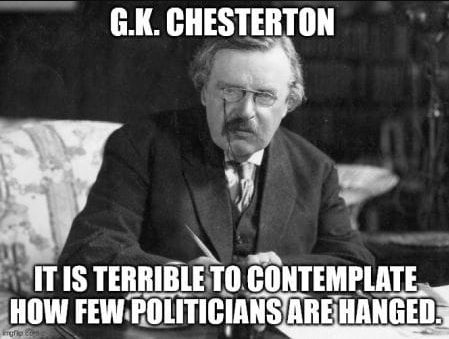
There is a famous quote by American journalist and satirist H.L. Menken, which has been deployed by many political writers over the years:
The whole aim of practical politics is to keep the populace alarmed (and hence clamorous to be led to safety) by an endless series of hobgoblins, most of them imaginary.
It is an enduring quote because it has the ring of truth1, and it certainly fits with the Machiavellian aspect of politics. This attitude was, without doubt, deployed by governments across the world during Covid (and, to some extent, still is).
Your jaundiced2 General would like to propose a related, alternative and rather more plausible soundbite that, I believe, more adequately describes the Western world in the twenty-first century:
The whole consequence of practical politics is the keep the ignorant populace alarmed (and hence clamorous to be kept in comfort) by an endless series of colossal fuck-ups, labelled as crises, caused entirely by the government.3
Every time that you see the media whipping up a frenzy about a “crisis“, you can be 99% sure that the issue in question has been caused by the state — and that the real solution is to remove the government intervention. And that is never, ever the action actually proposed.
Crises of Government Origin
Your jaundiced General refers to these phenomena as “Crises of Government Origin” (COGO), and will form the back-bone of a series of posts titled with that acronym. Many of the issues are interlinked, and most are absolutely critical if we are ever to confront the economic and social issues facing us today.These include (but are not limited to):
- the energy crisis;
- the Climate Warming / Change / Heating crisis;
- the housing crisis;
- the NHS staffing crisis;
- the police shortage crisis;
- the obesity crisis;
- the education crisis;
- the pandemic crisis;
- the productivity crisis;
- the activist “charity” crisis;
- the drugs crisis (Scottish edition);
- the rape gang crisis;
- the intersectional and gender crisis;
- just about any other “crisis” you can think of.
To be sure, the UK government is not the worst in some of these areas — but, since it is in UK that my comfy leather armchair is situated, it is the rampant stupidity of our own governments that I shall concentrate on. And no, not all of these posts will include reminding people that Grant Schapps is a prick.
I can promise that every one of them will include illustrations demonstrating the mind-gargling incompetence of our governments (of all persuasions) and “Rolls Royce” civil service4.
The law is a blunt instrument, and the government is really inefficient at doing anything at all.
Fundamentally, the Western world is failing — culturally and economically — because the government now has a hand in so much of society. And the UK is in the vanguard of this malaise as Sharon White, at the time Permanent Secretary to the Treasury (and currently fucking things up in typically Rolls Royce civil servant fashion at John Lewis), said (in a rare example of her being right) in 2015 at the Institute for Government:
The UK is “almost the most centralised developed country in the world”.
Indeed it has been observed that, by some measures, the UK is more centralised than Soviet Russia. This is why we are failing.
The Crises Of Government Origin (COGO) series aims to examine some of these failures — large and small. For starters, let’s have a look at Hate Speech laws and why they are so dangerous.
1. The same applies to Menken’s definition of Puritanism: “The haunting fear that someone, somewhere, may be happy”.
2. Caused less by poor mood than incipient liver failure. Now pass the port, would you, old chap. No, to the left, you fool!
3. Yes, yes — I realise that it needs honing, but it will do for now. Feel free to submit more elegant versions in the comments.
4. Snork.
Barbara Kay – “[M]any Canadians [suffer] from highly contagious, patriotism-suppressive Post National Syndrome”
Canadians are deluged with messages that imply — or explicitly demand — that they should be ashamed of Canada and of being Canadians. That there is nothing to celebrate in our history or cultural achievements and instead we should humbly beseech forgiveness for our many, many, many sins. Barbara Kay disagrees:
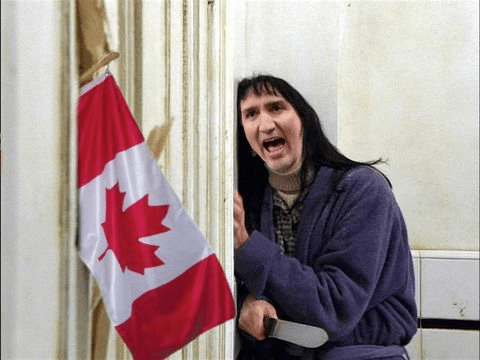
On Canada Day, near St. Sauveur, Quebec, we were treated to torrential rain, hail, nearby tornado warnings, and continually flickering power. Not a day for fireworks. Just as well, since fireworks are the last thing one craves when one suffers, as many Canadians do, from highly contagious, patriotism-suppressive Post Nationalism Syndrome.
This scourge cannot yet be cured, since it was intentionally cultivated and released into the environment by the current government. Only herd immunity can end it. However, the symptoms of Post Nationalism Syndrome can be alleviated by certain traditional antivirals, like National Postism. Last Saturday’s NP featured several commentaries that buoyed my spirits, in particular Michael Higgins’s misery-loves-company column, “Stop shaming and start celebrating Canada”.
Higgins enumerates recent examples from a tiresome litany of complaints by our elites that “want to turn us into a nation of self-flagellating penitents”. The National Gallery of Canada insinuates that Canada’s iconic artists, the Group of Seven, are linked to white supremacy; a parliamentary motion endorses the residential school system as “genocide”; the attorney general actively considers legal sanctions against “denialism” — dissent from genocide as a proper descriptor (including me); and the erasure of Sir John A. Macdonald’s name from the eponymous Parkway.
In a nearby feature, the false claim that Macdonald was a guilty party in the alleged schools genocide was handily demolished by lawyer Greg Piasetzki, titled, “John A. Macdonald saved more indigenous lives than any other prime minister”. This evidence-based rejoinder to sticky defamatory myths about Macdonald is an excerpt from a new book of essays by 20 writers, The 1867 Project: Why Canada Should be Cherished — Not Cancelled, published by the Aristotle Foundation, and edited by its founder and president, Mark Milke.
Piasetzki’s essay mirrors the 19 others in its forthright challenge of our culture’s reigning anti-western dogmas, which brand Canada as a failed nation. Every author encourages the pride in being Canadian that has not dared to speak its name since Justin Trudeau came to power. I highly recommend it. If enough Canadians read it, we might arrive at herd immunity to Post Nationalism Syndrome.
July 2, 2023
Of course they’re lying – the interesting thing is how they sell the lies
In his Friday Mailbag, Severian answers a reader question about the reports coming out of Ukraine about casualties in the recent fighting:

Back in the worst of the covid days (so far), I often said that we’re stewing in so many obvious lies, I’m starting to question the very existence of a country called “China”. Not to mention the germ theory of disease. Is there actually a war at all in Ukraine? How do we sift and weight sources?
My rules of thumb (two thumbs, two rules) for judging the underlying truthiness of a Media story are what I’ll call “the Goebbels factor” and “admission against interest”.
The “Goebbels factor” is that fellow’s well-known dictum that the best propaganda is mostly true. Outright lies — straight up, 100% false-to-facts whoppers — are actually extremely rare, even in the AINO Media. This is because out-and-out lies take a tremendous amount of effort to maintain. Not only that, their opportunity cost is off the charts, because once you’ve peddled the lie, you’re stuck with that specific lie forever. You have to keep investing in the lie, and you must also keep investing in what I guess we’ll call the “information infrastructure” surrounding that lie. It’s just not cost-effective.
The second factor — “admission against interest” — is, of course, just the second step in everyone’s favorite dance, the Media Shuffle. The first step is “That’s not happening!” The second step is “… and here’s why it’s good that it is.” Think of it as the retooling of the previous “information infrastructure.” Lies have to be supported, one way or the other. If the lie is “there’s no inflation!”, then the “information infrastructure” consists of semi-plausible (for Juggalo values of “plausible”) “explanations” of all the very obvious inflation that’s very obviously happening. You know the drill: Putin’s price hikes! Global Warming!! Systemic Racism!!!
It’s much easier to flip those around, to “explain” why all those are actually good for you, than it is to keep investing in the original lie. It’s important to note — as if y’all need the reminder! — that the “admission against interest” is ALSO chock full of lies; you have to cross check the new lies against the old lies to reach an approximation of the truth (the discipline known as FNG-ology; the practitioners of which are stoyakniks).
Given all that: Yeah, the war in Ukraine is real, and the Ukrainians really are getting keestered. My heart goes out to the Ukrainian people, who did nothing to deserve it, and I only ask that you remember who did this to you: Brandon and the Juggalos. It’s ALL on them. Putin really had no choice.


