Quotulatiousness

September 21, 2014

Dramatic Footage of British Troops Preparing for Operation Market Garden

Filed under: Britain, History, Military, WW2 — Tags: , , — Nicholas @ 11:00

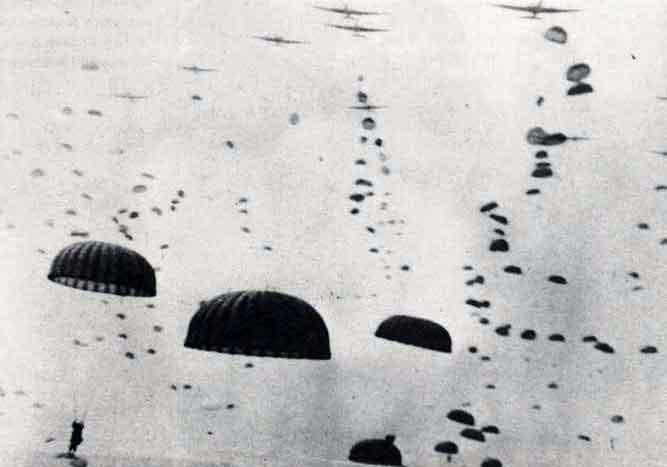
Nearly ten minutes of both British and German footage of the launch of Operation Market — the airborne assault on the Netherlands by British and American troops in September, 1944 (Operation Garden was the corresponding ground attack by Montgomery’s troops to reach the landings by one British and two American airborne divisions.

Rows-of-Dakota-Aircraft-prior-to-take-off-for-Arnhem,-Sept-17th-1944_0

Paratroopers descend enmasse at the DZs near Arnhem, September 1944 Uploaded by: Mac Magreehan. (via Forces.TV)

Paratroopers descend enmasse at the DZs near Arnhem, September 1944 Uploaded by Mac Magreehan. (via Forces.TV)

More photos of the operation can be viewed at Forces.TV.

June 22, 2014

A Frisian translation of Lois McMaster Bujold’s The Hallowed Hunt

Filed under: Books, Europe, Germany, Media — Tags: , , — Nicholas @ 00:02

Lois McMaster Bujold posted an image to her Goodreads page, showing the cover of a new translation of The Hallowed Hunt into a language I didn’t think was still spoken:

LMB - Hallowed Hunt in Frisian

She also posted a letter from the translator, which discusses some of the problems inherent in translating a fantasy novel into a language which only really became a written language quite recently:

Originally (we’re talking the early Middle Ages here), Frisian was the language closest related to English, but after more than a millennium of being heavily influenced by Dutch and German, this is no longer the case. Over the centuries, Dutch, German and the Low Saxon dialects of the eastern Netherlands and northern Germany have made such inroads into the original Frisian language area (once stretching all along the North Sea coast from what is now Belgium to Denmark), that it has crumbled into several small — or smallish — enclaves, which are still shrinking or at least remain under constant pressure. In the outside world, the term “Frisian” is generally used as if it were a monolithic language, but in fact there are three different Frisian languages, which are mutually quite incomprehensible and have been so for a long time.

• North Frisian is spoken in northern Germany, in an area along the North Sea coast and on the nearby islands directly south of the Danish border, by about 10,000 people.

• East Frisian was once spoken in the German coastal area adjacent to the Dutch border, but has gone extinct there, except for one small inland area, Saterland, which was originally surrounded by almost impassable peat bogs. Saterlandic, or Saterland Frisian, is still spoken today, by some 2,200 people.

• In the Dutch province of Friesland, Frisian is still spoken as a first language by about 350,000 people (out of a total provincial population of c.630,000). It has official status equal to Dutch, here, and some 110,000 inhabitants of the province speak it as a second language. There are a lot of Frisians who for the sake of (better) employment have moved away from Friesland, bringing the total number of native Frisian speakers in the Netherlands to c.450,000. From this point, I will refer to this language, my native tongue, as “Frisian”, which is the name we have for it (Frysk), but FYI, in English it is often called “West Frisian” (a somewhat confusing name, since in the Netherlands, that is what we call a Dutch dialect spoken in northern tip of the province of North Holland).

Today, Frisian is a minority language used by about 3% of the total Dutch population, and although a lot of things have changed for the better since the beginning of the 20th century, when the Frisian language movement first emerged, we still have to fight for our rights more often than not. To give you an impression of the situation we have to deal with, a 1994 survey showed that of the total number of inhabitants of Friesland (now c.630,000), 94% can understand Frisian, 74% can speak it, 65% can read it, and 17% can write it. (These are still the most recent numbers available; I’ve read that they’re in the process of doing a follow-up survey, but apparently the results aren’t in yet.)

On the subject of literary translations, it should be understood that this is a relatively new phenomenon for the Frisian language. The Bible was not published in Frisian until 1943, and Shakespeare’s entire oeuvre appeared in our language in eight big omnibus editions between 1955 and 1976 (although some plays, like Hamlet and A Midsummer Night’s Dream, had already been published separately in the twenties and thirties).

For any native Frisian readers who’d like to read this excellent book in your own language, you can buy the translation here.

June 14, 2014

Spain meets Nemesis (wearing Netherlands team jerseys)

Filed under: Americas, Soccer — Tags: , , , — Nicholas @ 09:51

I didn’t watch this game, but apparently I missed quite the event. A Dutch friend of mine took to Twitter to express his joy through the course of the game:

March 26, 2014

Secret Service upholds (recent) tradition in the Netherlands

Filed under: Europe, Media, USA — Tags: , , , — Nicholas @ 07:17

BBC News reports that — once again — some of the US Secret Service agents tasked with protecting the President have come to the attention of the press for reasons other than their assigned mission:

Three US Secret Service agents tasked with protecting President Barack Obama in the Netherlands have been sent home for “disciplinary reasons”.

The Washington Post reported that one was found drunk and passed out in the hallway of an Amsterdam hotel.

A Secret Service spokesman declined to give details but said the three had been put on administrative leave pending an investigation.

The service has been trying to rebuild its reputation after previous scandals.

In 2013 two agents were removed from President Obama’s security detail amid allegations of sexual harassment and misconduct.

And in 2012 several agents were dismissed following allegations that they hired prostitutes while in Cartagena, Colombia.

Secret Service spokesman Ed Donovan said the latest incident happened before President Obama’s arrival in the Netherlands on Monday for a nuclear security summit.

He said the three had been sent home for “disciplinary reasons” but declined to elaborate.

Mr Donovan added that the president’s security had not been compromised in any way.

February 26, 2014

Sometimes a direct translation fails to convey the exact meaning

Filed under: Britain, Business, Europe — Tags: , — Nicholas @ 17:42

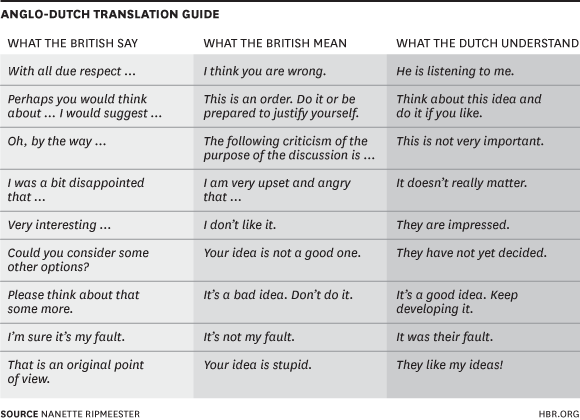
Especially if the speaker is British and the listener is Dutch:

Anglo-Dutch Translation Guide

January 21, 2014

Euthanasia on TV and in real life

Filed under: Health, Liberty, Media — Tags: , , , — Nicholas @ 12:10

It’s been many years since I watched an episode of Coronation Street, so I was a bit surprised to find that the show’s writers are “political”, at least on some issues:

Many a soap-opera storyline has created a news story in itself. So it was in the case of Hayley Cropper, a character on a British soap, Coronation Street. News of what happens to Hayley, in an episode to be shown tonight, created a furore when the press release for the story went out last Tuesday. The dilemma for the writers was how to kill off a character who had been a mainstay of the programme since 1998, when she was introduced as the first transsexual character. The answer, provided by producer Stuart Blackburn, was to have the character dying of pancreatic cancer, but finishing herself off with a cocktail of drugs in an on-screen suicide.

Julie Hesmondhalgh, the actor who plays Hayley, called for a discussion on legalising assisted suicide. She was backed by Sara Wootton, chief executive of Dignity in Dying, who praised the show’s ‘sensible and sensitive handling of assisted dying’. Lord Falconer, whose Assisted Dying Bill will be introduced in the House of Lords in the coming months, penned an article in the Sun. The Sun’s editorial called for a change in the law and the newspaper published the results of a poll indicating that 69 per cent of Britons support the legalisation of assisted suicide for the terminally ill.

[…]

It is difficult not to suspect – despite the even-handedness of the treatment of the issue (the character’s on-screen husband, Roy Cropper, opposes Hayley’s decision) – that the programme is part of the well-funded campaign to legalise assisted suicide. Stuart Blackburn had previously explored the same issue while at a rival soap, Emmerdale. (He perhaps risks becoming the Jack Kevorkian of the soap world.) Hesmondhalgh was forthright about her support for a change in the law in several interviews, and many journalists seem poised to call again for the legalisation of assisted suicide.

But it is entirely appropriate that a fictional plotline is used to promote legalising assisted suicide. The reason that so many people wish to have the ‘right to die’ is based on the morbid imagination of the ‘worried well’, traded on so effectively by right-to-die campaigners. ‘What if it happened to YOU…?’ is the plotline of Dignity in Dying and other organisations that campaign for legalised assisted suicide.

There are arguments on both sides of this issue (personally, I’m in favour of making it legal), but there are concerns that less-than-scrupulous family members might attempt to “hurry” an elderly or infirm parent or relative to a decision that wouldn’t really be voluntary.

It’s also an issue that came up this weekend, as one of my online acquaintances (we’d never met in person, but we both belonged to a special interest mailing list and had had several email discussions) committed suicide with his wife last week. Maarten and Irma apparently faced an unpleasant future in their declining years and mutually decided that their time had come. While euthanasia is legal in the Netherlands, it does not seem that Maarten and Irma followed the letter of the law in their case:

Euthanasia in the Netherlands is regulated by the “Termination of Life on Request and Assisted Suicide (Review Procedures) Act” from 2002. It states that euthanasia and physician-assisted suicide are not punishable if the attending physician acts in accordance with criteria of due care. These criteria concern the patient’s request, the patient’s suffering (unbearable and hopeless), the information provided to the patient, the presence of reasonable alternatives, consultation of another physician and the applied method of ending life. To demonstrate their compliance, the Act requires physicians to report euthanasia to a review committee.

The family is, understandably, not providing a lot of detail but said that they were found in bed, hand in hand and “together, peaceful and loving” but did not specify how they had died.

Becoming dependent on whomever or whatever, or seeing your partner slowly fading away, are situations we do not ever want to contemplate, therefore we have, in good health, clear of mind, together 150 years old, in our own bed, hand in hand, ended our lives.

At risk of sounding trite, I’m saddened that they chose to do this, but I respect their right to make that decision. It cannot have been an easy one. Rest in peace.

April 14, 2013

Differing national philosophies on child-raising

Filed under: Europe, Health, USA — Tags: , , , — Nicholas @ 10:56

In The Atlantic, Olga Khazan compares the way American parents interact with their children to the rather more relaxed parenting styles of other nations:

The biggest difference between American parents and their counterparts in Europe might be that they are far more relaxed about enrichment than we are, according to a study released this week by Sara Harkness and Charles M. Super at the School of Family Studies at the University of Connecticut.

Not only are Americans far more likely to focus on their children’s intelligence and cognitive skills, they are also far less likely to describe them as “happy” or “easy” children to parent.

“The U.S.’s almost obsession with cognitive development in the early years overlooks so much else,” Harkness told Slate.

For part of their research, the authors focused just on parents in the United States and the Netherlands. The differences are stark: American parents emphasized setting aside “special time” with each of their children, while Dutch parents spent a few hours each day together with their kids as an entire family.

American parents said they struggled to manage the sleep schedules of their babies and young children, explaining that they try to entertain or distract them when they wake up in the middle of the night.

April 10, 2013

If there’s a “Bitcoin bubble”, it doesn’t predict long term success or failure for the currency

Filed under: Economics, History, Technology — Tags: , , , , , — Nicholas @ 12:55

In Forbes, Tim Worstall explains that calling the current rise in Bitcoin value a bubble does not actually pass a judgement on whether Bitcoin will be a long term success:

And yes, I’m still of the opinion that Bitcoin is in a bubble. You know the walks like a duck, quacks like a duck idea? If it does those then it’s a duck. And the price changes that we’re seeing in Bitcoin make me and many other observers think that Bitcoin really is in a bubble. Indeed, there’s some nice work here showing that many of the Bitcoins in existence are being hoarded and that in itself is bubble behaviour.

However, do let me make one more thing clear: whether or not Bitcoin is in a bubble or not doesn’t mean that Bitcoin will succeed or not. They are entirely different questions, as different as is your wife Welsh or is your dog female? They really have no connection with each other at all.

Let us take the standard bubble example always used, the Dutch tulipmania. We could use others, the South Sea Bubble, the dot com boom, or we could even use an entirely different set of examples, say the introduction of the automobile. That last being when a new technology arrived without a speculative bubble around it.

The point of the first three, and let’s stick with tulips, is that there really was a quite obvious bubble in the prices of them. Most of the participants in the bubble (as with the other two) knew quite well that it was a bubble too. Prices were way out of line with any sort of “true value”. However, do note this very well: the tulip did indeed go on to become an important part of the Dutch economy. Indeed, it’s still there right now. Vast fields of tulips are grown there every year to supply cut flowers and bulbs for replanting that are shipped all over Europe. It’s actually become so important that other flowers, grown outside Europe, are still marketed through Holland as that’s where all the skill and infrastructure is.

March 12, 2013

If consumers were 10% better off … why did they call it a “disease”?

Filed under: Cancon, Economics, Media — Tags: , , , — Nicholas @ 09:23

In Maclean’s, Stephen Gordon illustrates the classic case of burying the lede for popular economics:

    So Dutch consumers are roughly 10% better off than they would have been, but companies have been able to compete only by paring their profit margins.

    “The Dutch disease,” The Economist, November 26, 1977

Talk about burying the lede. That sentence appears at the end of the 10th paragraph of the much-referred-to but rarely read article in The Economist that coined the phrase “Dutch Disease.” In the normal course of things, a 10 per cent increase in consumers’ purchasing power would be the stuff of banner headlines, but, for some reason, The Economist chose to hide that point deep into the story and qualify it with a caveat about how hard it had become for companies to compete. (The answer to that, by the way, is: “So what if producers are struggling?” What really matters is consumer welfare.)

My take on the Dutch Disease debate can be summed up as follows: Why are we calling it a disease?

November 23, 2012

Google the latest whipping boy in Australia over taxation

Filed under: Australia, Business, Europe, Government, Law — Tags: , , , , — Nicholas @ 09:53

Even if you scrupulously obey the multiple jurisdictional laws to legally minimize the amount of tax you pay, politicians can’t resist the opportunity to pillory you for not paying your “fair share”:

The Minister’s explanation of Google’s tax affairs is as follows:

    “While the day-to-day dealings of Australian firms advertising on Google might be with Google Australia, under the fine print of contracts Australian firms sign with Google, they are actually buying their advertising from an Irish subsidiary of Google.

    It is then argued that the source of this income — and therefore the taxing rights under our tax treaty — would be with Ireland rather than Australia. Despite Ireland’s relatively low company tax rate of 12.5 per cent, we have just started to build the sandwich.

    The next step is to route a royalty payment from the Irish operating subsidiary of Google to a Dutch subsidiary of Google, which is then paid back to a second Irish holding company subsidiary of Google that is controlled in Bermuda, which has no corporate tax.

    The first Irish subsidiary receives a tax deduction for the royalty payment to the Dutch subsidiary, substantially reducing the income subject to the 12.5 per cent Irish company tax rate.

    Under Dutch law, and because EU member countries do not charge withholding taxes on transfers within the EU, the transfers to and from the Netherlands are essentially tax free.

    And under Irish tax law, the second Irish resident subsidiary is not taxed on the royalty payment because it is controlled by managers elsewhere.

    The profits from the sale of advertising to an Australian firm then sit in a tax-free jurisdiction — possibly indefinitely.”

Tax lawyers — especially those who work on multinational levels — don’t create these situations out of whole cloth: it’s the politicians and revenue ministries that set up and maintain the tax rules. Corporations are legally required to pay taxes (as are individuals), but corporations are also legally required to conduct themselves in ways that maximize the profits for their shareholders. Finding ways to legally pay tax at a lower rate is a requirement. That companies like Apple and Google are big enough to take advantage of the “loopholes” deliberately created by the tax authorities is not a reason to bash Apple or Google. They can only take advantage of “loopholes” because this or that government tried to rig the system in a particular way. Changing or threatening to change the rules retrospectively is a really good way to indicate to foreign business that you really don’t want them operating in your territory.

Update: Snigger.

August 4, 2012

Seeking Mars colonists for one way trip

Filed under: Space, Technology — Tags: , , , — Nicholas @ 09:00

Chris Brandrick on the first civilian recruitment drive for Martian colonization:

Just as NASA’s latest rover prepares to land on the surface of Mars, one Dutch company is looking to up the ante, with plans to send humans to the distant red planet. But before you sign up for travels to faraway lands, you may want to take note that the trip is a one-way deal, meaning you’ll never be able to return home to Earth.

Mars One, the ambitious company behind the planned mission, is hoping that a number of brave civilians will be willing to embark upon the mission to be the first to occupy the planet.

The company, founded by Bas Lansdorp, wants to send a number of humans to live on our neighboring planet indefinitely by 2023. The timeline for the mission will see Mars One send out a communications satellite in 2016, with a rover being sent in 2018 to find a suitable site for a settlement. Once the company finds a suitable location, it’ll send settlement units to Mars in 2020, which the existing rover will then set-up.

Once it gets the settlement established, Mars One hopes to send a small crew that would leave Earth in December of 2022, and arrive in April of 2023.

Visiting Mars would be fantastic, but I think I’ll wait until a return booking is possible.

April 22, 2012

Danish Dutch design helps rescue the US Coast Guard from further embarrassment

Filed under: Military, USA — Tags: , , , — Nicholas @ 12:01

Strategy Page on the US Coast Guard’s latest cutters:

The U.S. Coast Guard recently commissioned the first of 58 “Fast Response Cutters.” These are 46.8 meter (154 feet) long, 353 ton vessels equipped with a 8 meter (25 foot) rigid hull boat launched and recovered internally from a ramp in the stern (rear) of the ship. Armament of the cutter (as seagoing coast guard ships are called) consists of a remotely controlled 25mm autocannon and four 12.7mm (.50 caliber) machine-guns, plus small arms. Top speed is 52 kilometers an hour and the crew of 22 has sleeping and eating facilities on board so the ship can be at sea five days at a time (and 2,500 hours, or over 100 days, a year at sea). The Fast Response Cutter is basically a slightly larger version of the Danish Dutch Damen Stan 4207 patrol vessel.

The Danish Dutch design was selected four years ago because, a year before the Coast Guard was finally forced to admit defeat in its effort to build an earlier design for 58 new patrol ships (Fast Response Cutters.) The ship builders (Lockheed Martin and Northrop Grumman) screwed up, big time. While the Coast Guard shares some of the blame, for coming up with new concepts that didn’t work out, the shipbuilders are the primary culprits because they are, well, the shipbuilding professionals, and signed off on the Coast Guard concepts. Under intense pressure from media, politicians and the shame of it all the Coast Guard promptly went looking for an existing (off-the-shelf) design, and in a hurry. That’s become urgent because of an earlier screw up.

Six years ago, the Coast Guard discovered that a ship upgrade program made the modified ships structurally unsound and subject to breaking up in heavy seas

Update: Thanks to eagle-eyed commenter Guan Yang who pointed out that the design is actually Dutch, not Danish. I’ve modified the quoted text to match the correct information.

April 13, 2012

Mapping 18th century shipping patterns

Filed under: Africa, Americas, Asia, Economics, Europe, History, Science — Tags: , , , , — Nicholas @ 09:06

An interesting post at the Guardian on tracing historical shipping patterns:


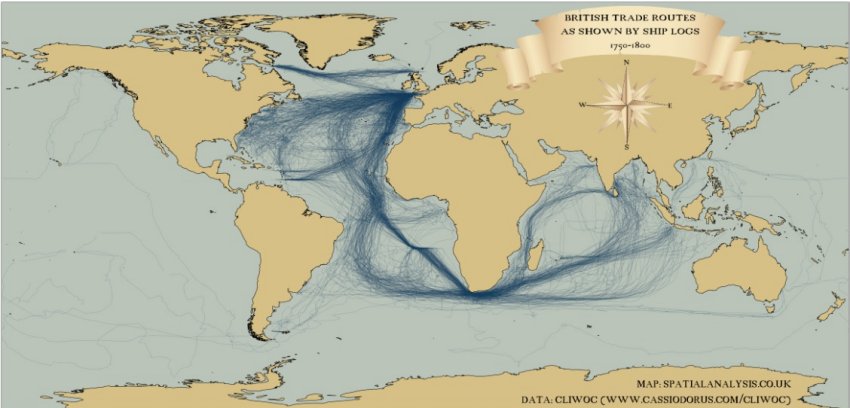
(Larger version at the original URL)

James Cheshire, of Spatial Analysis, has taken historical records of shipping routes between 1750 and 1800 and plotted them using modern mapping tools.

The first map, above, shows journeys made by British ships. Cross-Atlantic shipping lanes were among the busiest, but the number of vessels traveling to what was than called the East Indies — now India and South-East Asia — also stands out when compared to Dutch and Spanish records.

I was surprised to see how many trading voyages there were to and from the Hudson Strait — fur trade traffic, I assume.


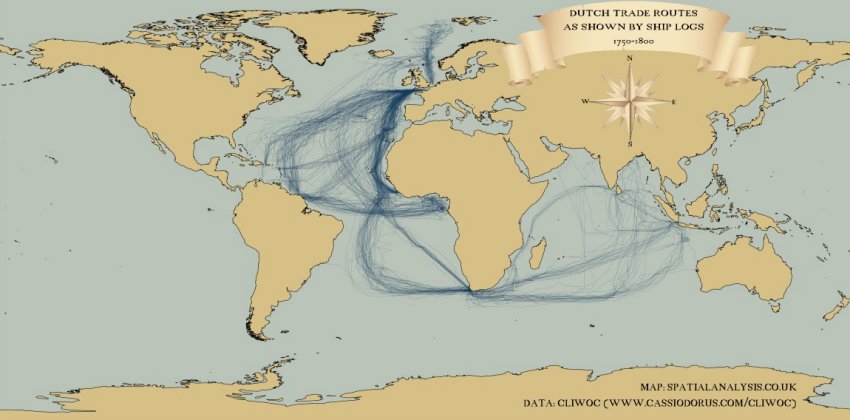
(Larger version at the original URL)

This second map shows the same data for Dutch boats. The routes are closely matched to the British ones, although the number of journeys is noticeably smaller.

You can also see the scattering of journeys made by Dutch ships to Svalbard, off the North coast of the Norwegian mainland

April 5, 2012

Paradox: maintaining the “balance of nature” generally requires intensive management

Filed under: Books, Environment, Science — Tags: , — Nicholas @ 08:27

A Matt Ridley column from the Wall Street Journal last month:

In her remarkable new book “The Rambunctious Garden,” Emma Marris explores a paradox that is increasingly vexing the science of ecology, namely that the only way to have a pristine wilderness is to manage it intensively. Left unmanaged, a natural habitat will become dominated by certain species, often invasive aliens introduced by human beings. “A historically faithful ecosystem is necessarily a heavily managed ecosystem,” she writes. “The ecosystems that look the most pristine are perhaps the least likely to be truly wild.”

In the Netherlands, for example, cattle are being used to re-create a simulacrum of a Pleistocene woodland, because their aurochs ancestors would have been vital in keeping forest patchy. To keep African national parks from deforestation, elephant control is sometimes needed. To let aspen, willow and beaver return to Yellowstone, it was necessary to reintroduce the wolf, which reduced elk numbers. To preserve Mojave Desert tortoises, it is essential to control native ravens, whose numbers have been boosted by distant landfill sites.

[. . .]

Ms. Marris’s book goes further, challenging the very idea of a balance of nature. In the first half of the 20th century, ecologists came to believe in equilibrium-that natural systems tended toward a steady state. So, for example, a bare patch of ground would be colonized by a succession of species-annual weeds, then grasses, then shrubs, then trees — until it reached its “climax” state. Conservation, therefore, was a matter of restoring this climax.

Academic ecologists have abandoned such a static way of thinking for something much more dynamic. For a start, they now appreciate that climate has always changed, and with it, ecology. Twenty thousand years ago the spot where I live was under a mile of ice. Then it was tundra, then birch forest, then pine forest, then alder, linden, elm and ash, then most recently oak, but beech was coming.

Which is its climax? We now know that oak seedlings rarely thrive under mature oaks (which rain caterpillars on them), so the oak climax was just a passing phase.

February 7, 2012

Sailing around the world solo was less trouble for this teen than dealing with the “child welfare” authorities

Filed under: Bureaucracy, Europe, Liberty — Tags: , , , , — Nicholas @ 10:09

Gabrielle Shiner on the remarkable achievement of Laura Dekker both in circumnavigating the globe and in getting around the “authorities” which were determined to stop her for her own protection:

Last month, Dutch teenager Laura Dekker became the youngest sailor ever to complete a solo circumnavigation of the world. This was a phenomenal achievement, requiring incredible personal courage and endurance. But marring her celebrations was the fact that the Guinness Book of Records failed to recognise her achievement on the grounds that it was deemed ‘irresponsible’. Furthermore, Dekker has claimed she may never return to her home country due to the treatment of her, and her parents, by meddling Dutch authorities.

[. . .]

The Dutch authorities’ reaction to Laura Dekker shows that they have become a Frankenstein of the mentality that inspired the introduction of menacing tobacco labels and countless similar policies. The doctrine that individuals need to be saved from themselves has unleashed a swarm of crusading bureaucrats who relentlessly raid our private lives. Joost Lanshage of the Netherlands Bureau of Youth Care exemplified this pervasive creed as he protested, ‘If Laura had drowned we would be accused of not doing enough to protect her.’ Lanshage assumes his responsibility over both Laura and her parents with uncanny ease. More alarming, however, is Lanshage’s testimony that this is what society has come to expect from public authorities.

Forfeiting judgment to a faceless state erodes the importance of personal interactions as it undermines our dependence on family, friends, and community. The state’s hijacking of the responsibility for our lives also robs us of the ability to exercise and develop our personal judgment. This crucial aspect of our development is being debilitated by the craze to squeeze individuals into the shrinking mould of acceptable citizenship. Denying us the right to take risks, enjoy successes and suffer through mistakes restricts our ability to act according to our individual values and develop purposefully. We’re sacrificing our individual autonomy for the comfort of apathetic mediocrity.

As this process continues, unique approaches to life and education increasingly become unacceptable. After Dekker mentioned on her blog that she had to temporarily put schoolwork aside in the face of dangerous storms at sea, Dutch authorities mounted their high horses once again and summoned Laura’s father to court. While the 16-year-old conquered innumerable challenges that the vast majority of adults would not be capable of facing alone, authorities back in the Netherlands fretted at the idea that she would fall behind with her school work. As Dekker rightfully reflected on her blog towards the end of her journey, ‘Now, after sailing around the world, with… the full responsibility of keeping myself and [her boat] Guppy safe, I feel that the nightmares the Dutch government organisations put me through were totally unfair.’

« Newer PostsOlder Posts »

Powered by WordPress