
February 20, 2012
January 28, 2012
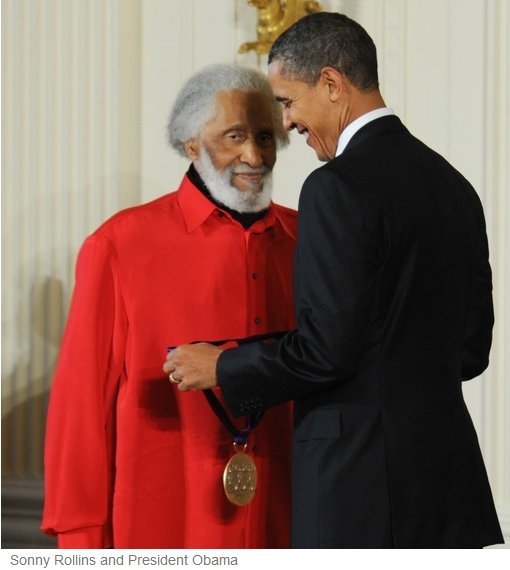
Sonny Rollins honoured, but Kennedy Center misses an opportunity
One of the best jazzmen of the 20th century was recognized in an event at the Kennedy Center recently:
Was there a single jazz musician in the audience for the Kennedy Center Honors ceremony last month? Besides Sonny Rollins, that is, who was one of the five honorees. From what I saw on the CBS telecast of the ceremony, the only jazz musicians in the house were those hired hands who were on stage playing in Sonny’s honor. Is it possible that no other jazz players were there? It’s more likely that the show’s producers wouldn’t recognize a jazz musician even at close range, so all we got were long shots of the Obamas and movie and pop stars. At least the President and First Lady looked like they’d heard jazz before they got to the Center, and surely they appreciated Bill Cosby’s irony-laced introduction. But how many people in that bejeweled crowd had ever heard a note by the Saxophone Colossus?
Granted, it was great to see Sonny getting the honor, to watch the montage of images from his career and hear the narrative voiced by Cosby. Cos described his own surprise encounters with people in far flung places abroad who in the midst of their daily routines were listening to Rollins, then concluded his remarks by welcoming Sonny “home” to his native land. But notwithstanding the primacy of jazz in American performing arts, the music long ago lost its appeal for the masses, and even the curious may know little about its history and Newk’s place in it. Thus while Cosby’s comments spoke to his personal admiration for Rollins, the occasion called for something more, the kind of critically-grounded statement that a Stanley Crouch or Gary Giddins or Bob Blumenthal could have provided. But a teaching moment like this was squandered, while the most resonant image may have been the sign of Rikers Island displayed among Rollins’s personal landmarks.
January 20, 2012
Julian Sanchez on SOPA/PIPA: “No matter how bad last season’s crops were, witch burnings are a poor policy response”
In a posting at the Cato@Liberty blog, Julian Sanchez discusses the claims of SOPA/PIPA supporters that new legislation is necessary to fight piracy:
Earlier this month, I detailed at some length why claims about the purported economic harms of piracy, offered by supporters of the Stop Online Piracy Act (SOPA) and PROTECT-IP Act (PIPA), ought to be treated with much more skepticism than they generally get from journalists and policymakers. My own view is that this ought to be rather secondary to the policy discussion: SOPA and PIPA would be ineffective mechanisms for addressing the problem, and a terrible idea for many other reasons, even if the numbers were exactly right. No matter how bad last season’s crops were, witch burnings are a poor policy response. Fortunately, legislators finally seem to be cottoning on to this: SOPA now appears to be on ice for the time being, and PIPA’s own sponsors are having second thoughts about mucking with the Internet’s Domain Name System.
That said, I remain a bit amazed that it’s become an indisputable premise in Washington that there’s an enormous piracy problem, that it’s having a devastating impact on U.S. content industries, and that some kind of aggressive new legislation is needed tout suite to stanch the bleeding. Despite the fact that the Government Accountability Office recently concluded that it is “difficult, if not impossible, to quantify the net effect of counterfeiting and piracy on the economy as a whole,” our legislative class has somehow determined that — among all the dire challenges now facing the United States — this is an urgent priority. Obviously, there’s quite a lot of copyrighted material circulating on the Internet without authorization, and other things equal, one would like to see less of it. But does the best available evidence show that this is inflicting such catastrophic economic harm — that it is depressing so much output, and destroying so many jobs — that Congress has no option but to Do Something immediately? Bearing the GAO’s warning in mind, the data we do have doesn’t remotely seem to justify the DEFCON One rhetoric that now appears to be obligatory on the Hill.
The International Intellectual Property Alliance — a kind of meta-trade association for all the content industries, and a zealous prophet of the piracy apocalypse, released a report back in November meant to establish that copyright industries are so economically valuable that they merit more vigorous government protection. But it actually paints a picture of industries that, far from being “killed” by piracy, are already weathering a harsh economic climate better than most, and have far outperformed the overall U.S. economy through the current recession. The “core copyright industries” have, unsurprisingly, shed some jobs over the past few years, but again, compared with the rest of the economy, employment seems to have held relatively stable at a time when you might expect cash-strapped consumers to be turning to piracy to save money.
January 15, 2012
Tim Tebow and David Bowie, as one: Tebowie
January 13, 2012
Movie and music piracy: what’s the real economic cost?
On the Freakonomics blog, Kal Raustiala and Chris Sprigman look at the actual costs of piracy compared to the ludicrous claimed costs:
Supporters of stronger intellectual property enforcement — such as those behind the proposed new Stop Online Piracy Act (SOPA) and Protect IP Act (PIPA) bills in Congress — argue that online piracy is a huge problem, one which costs the U.S. economy between $200 and $250 billion per year, and is responsible for the loss of 750,000 American jobs.
These numbers seem truly dire: a $250 billion per year loss would be almost $800 for every man, woman, and child in America. And 750,000 jobs — that’s twice the number of those employed in the entire motion picture industry in 2010.
The good news is that the numbers are wrong — as this post by the Cato Institute’s Julian Sanchez explains. In 2010, the Government Accountability Office released a report noting that these figures “cannot be substantiated or traced back to an underlying data source or methodology,” which is polite government-speak for “these figures were made up out of thin air.”
More recently, a smaller estimate — $58 billion — was produced by the Institute for Policy Innovation (IPI). But that IPI estimate, as both Sanchez and tech journalist Tim Lee have pointed out, is replete with methodological problems, including double- and triple-counting, that swell the estimate of piracy losses considerably.
January 6, 2012
Michael Geist: help save Canada’s liberal public domain rules
Canada’s standards for when works enter the public domain are more liberal than those in the US and Europe (that is, we provide shorter — but still generous — periods of copyright protection). Michael Geist says that these standards may be at risk soon:
Canada celebrated New Year’s Day this year by welcoming the likes of Ernest Hemingway and Carl Jung into the public domain just as European countries were celebrating the arrival of James Joyce and Virginia Woolf, 20 years after both entered the Canadian public domain. Canada’s term of copyright meets the international standard of life of the author plus 50 years, which has now become a competitive advantage when compared to the United States, Australia, and Europe, which have copyright terms that extend an additional 20 years (without any evidence of additional public benefits).
In an interesting coincidence, the Canadian government filed notice of a public consultation on December 31, 2011 on the possible Canadian entry into the Trans Pacific Partnership negotiations, trade talks that could result in an extension in the term of copyright that would mean nothing new would enter the Canadian public domain until 2032 or beyond. The TPP covers a wide range of issues, but its intellectual property rules as contemplated by leaked U.S. drafts would extend the term of copyright, require even stricter digital lock rules, restrict trade in parallel imports, and increase various infringement penalties. As I noted last month, if Canada were to ratify the TPP, it would require another copyright bill to undo much of what the government is about to enact with Bill C-11.
January 5, 2012
The MPAA over-cooks their numbers to support SOPA
Techdirt reports on the work done by Julian Sanchez at the Cato Institute to actually scrutinize the “loss” numbers used by the MPAA:
One of the things we’ve noticed in the debate over SOPA and PIPA is just how the other side is really lying with statistics. We’ve done a thorough debunking of the stats used by the US Chamber of Commerce to support both bills, as well as highlighted the misleading-to-bogus stats used by Lamar Smith in his support of the bill.
But every day, more bogus stats are rolled out. Julian Sanchez, over at the Cato Institute, has decided to dig into one specific bogus number, the supposed claim of $58 billion in “losses,” and to show how the numbers don’t hold up to any scrutiny. In fact, using the details of where the numbers came from, Sanchez makes the case that SOPA won’t save a single net job for the US economy. Read on to find out how.
First off, the $58 billion comes from an absolutely laughable report for the Institute for Policy Innovation, done every year by Stephen Siwek at a firm called Economists Incorporated. We’ve challenged this ridiculous number in the past, but not to the level of detail that Sanchez has here. He starts out by bringing up (as we have many times), Tim Lee’s excellent debunking of the ridiculous “ripple effects” that Siwek/IPI always use, despite them being a trick to double, triple, quadruple, etc count the same dollars [. . .]
December 28, 2011
“Truth and love must prevail over lies and hatred”
Matt Welch returns to Prague for Václav Havel’s funeral:
It’s a safe bet that in the history of state funerals, no former president has been sent off to the Absolute Horizon by not one but at least three different live, nationally televised rock songs about heroin.
Such was Václav Havel’s genre-straddling life and thoroughgoing conception of freedom that it seemed as natural as tartar sauce on fried cheese to bookend a portentous, Dvořák-haunted National Requiem Mass in Central Europe’s oldest Gothic cathedral with a loose-limbed, hash-scented rock and roll celebration at the Czech Republic’s most storied music venue, all while the non-VIPs on the streets of Prague (and their counterparts outside the capital) lent the most dignity of all to the three-day National Mourning by creating ad-hoc candlelit shrines in whatever patches of cobblestone reminded them of the man who made them most proud to be Czechs.
It was a remarkable memorial, one that — like Havel himself — could not have happened in any other city or country. Yet the celebration offered enough bread crumbs for non-Czechs to stumble upon the promise of forgotten political alchemies lurking just outside our daily view. I was there to pay my respects; here are some observations and pictures.
December 26, 2011
Delingpole: “I wouldn’t write a rude song about Islam if you paid me a million quid”
James Delingpole is upset with the easy laughs that comedians can get for poking fun at Christianity, yet the same comic geniuses are terrified to offend the equally parody-worthy Islam — and for good reason. Write and perform a ditty about Jesus and you’re the toast of the town and get invited to all the late-night TV talk shows. Do something remotely the same on the topic of Mohammed and get a set of real death-threats and the constant need to check under your car for explosives:
Did you hear the song Aussie comic Tim Minchin wrote savagely satirising Islam for Channel 4’s Eid special? No, I didn’t either. It didn’t happen and it never would happen: first because no broadcast station in its right mind would ever allow it; second because I don’t believe that Minchin would be stupid enough to write it.
And I’m not calling Minchin out for physical cowardice on this issue. From the Danish cartoons to the Paris bombing, we’ve seen far too many cases of artists testing the right to free speech — only to find that where certain religions are concerned, such matters are strictly verboten. But what I am definitely accusing him of is hypocrisy and moral cowardice, as regards the banned song he wrote for a Jonathan Ross Christmas special likening Jesus to a blood-drinking zombie.
[. . .]
Again, let me stress, this isn’t a plea to Minchin to acquire set of cojones and commit suicide through the medium of satire. I wouldn’t write a rude song about Islam if you paid me a million quid. Or even ten million. But what I equally wouldn’t do is compromise my integrity by laying heavily into one soft-target religion while treating a rival one, far more ripe for satire, with kid gloves. To do so would, I think, make me look a hypocrite and a fraud.
Update, 27 December: Sorry, fixed the broken link. Didn’t realize it wasn’t working properly until now.
December 23, 2011
Choosing the right historical figures to appear on Canadian banknotes
Colby Cosh has some thoughts on who we should be celebrating by including their images on our currency:
Hilarity! Both of the metropolitan broadsheets in Alberta are throwing a tantrum about the Mint’s plans to dump the Famous Five feminists of the 1920s from the $50 bill and replace them with a picture of an icebreaker. Like most pundits who take a thwack at the occasional issue of personages and emblems on our currency, the authors of these editorials act like they have never been east of Flin Flon.
I ask you to sincerely disregard the epic loathsomeness of the Famous Five — that quintet of unsmiling prohibitionists, pacifists, and white supremacists, at least three of whom bear direct personal responsibility for a four-decade regime of sexual sterilization of the “unfit” in Alberta. Leave aside, too, the fact that women would obviously have been admitted to the Senate soon enough if there had never been a Persons Case. No, I ask you merely to look at the people other countries put on their paper currency. With the exception of Australia, which shares our fetish for early female politicians utterly unknown elsewhere, you’ll find they mostly like to put world-historical figures on there. Japan honours Noguchi, who discovered the syphilis spirochete. England honours Darwin and Adam Smith. Sweden remembers Linnaeus and Jenny Lind. New Zealand commemorates Edmund Hillary and Ernest Rutherford.
He invites the readership to provide their choices for banknotization. I thought the obvious suggestion was to include Geddy Lee, Alex Lifeson, and Neil Peart — our Holy Trinity — on the banknotes.
December 18, 2011
Tyler Cowen on “aesthetic stagnation”
Responding to an article in Vanity Fair by Kurt Andersen, Cowen lists a few things that must be taken into consideration:
1. Movies: The Hollywood product has regressed, though one can cite advances in 3-D and CGI as innovations in the medium if not always the aesthetics. The foreign product is robust in quality, though European films are not nearly as innovative as during the 1960s and 70s. Still, I don’t see a slowdown in global cinema as a whole.
2. TV: We just finished a major upswing in quality for the best shows, though I fear it is over, as no-episode-stands-alone series no longer seem to be supported by the economics.
3. Books/fiction: It’s wrong to call graphic novels “new,” but they have seen lots of innovation. If we look at writing more broadly, the internet has led to plenty of innovation, including of course blogs. The traditional novel is doing well in terms of quality even if this is not a high innovation era comparable to say the 1920s (Mann, Kafka, Proust, others).
4. Computer and video games: This major area of innovation is usually completely overlooked by such discussions.
He also includes something which — at least for me — counts as a “killer app” for this kind of discussion:
7. Your personal stream: This is arguably the biggest innovation in recent times, and it is almost completely overlooked. It’s about how you use modern information technology to create your own running blend of sources, influences, distractions, and diversions, usually taken from a blend of the genres and fields mentioned above. It’s really fun and most of us find it extremely compelling
That “personal stream” is so pervasive that we generally don’t notice that it’s a hallmark of the modern era. We don’t get our news from single sources anymore: not just a single local newspaper, or a single TV newscast. We can easily find like-minded communities for just about all our niche interests with relatively minimal effort. In the past, such communities were severely distance-challenged to even form, never mind to thrive.
That we now can easily control and direct our personal streams to include and exclude in such fine gradations is something that few could even imagine 20 years ago. In a sense, we all have “clipping services” providing us with interesting and relevant snippets, but we can literally have hundreds of such services — at little or no cost — to chase down our merest whims for fresh information. It doesn’t show up on the GNP as a gain, but it’s very much a differentiator between today and just a few years back. Yet we don’t notice because we’re immersed in it.
December 16, 2011
Reason.TV: Christopher Hitchens – Bah, Humbug on Christmas
Christopher Hitchens, 1949-2011.
I’m saddened to write that the great essayist and writer Christopher Hitchens is dead at the age of 62. He had been weakened by the cancer of the esophagus that he disclosed publicly in 2010 and the treatments he had undertaken to fight his illness. Reason extends its condolences to his wife, family, and friends.
As is clear to anyone who has read even a sentence of his staggeringly prolific output, Hitchens was the sort of stylist who could turn even a casual digression into a tutorial on all aspects of history, literature, and art. As a writer, you gaze upon his words and despair because there’s just no way you’re going to touch that. But far more important than the wit and panache and erudition with which he expressed himself was the method through which he engaged the world.
The Toronto Star has a small collection of quotations which do give a sense of the man’s range and wit:
5. About Sarah Palin: “She’s got no charisma of any kind, [but] I can imagine her being mildly useful to a low-rank porn director.”
6. “If you gave [Jerry] Falwell an enema he could be buried in a matchbox.”
[. . .]
8. About Mother Teresa: “She was not a friend of the poor. She was a friend of poverty. She said that suffering was a gift from God. She spent her life opposing the only known cure for poverty, which is the empowerment of women and the emancipation of them from a livestock version of compulsory reproduction.”
9. “Everybody does have a book in them, but in most cases that’s where it should stay.”
[. . .]
12. About Michael Moore: “Europeans think Americans are fat, vulgar, greedy, stupid, ambitious and ignorant and so on. And they’ve taken as their own, as their representative American, someone who actually embodies all of those qualities.”
December 9, 2011
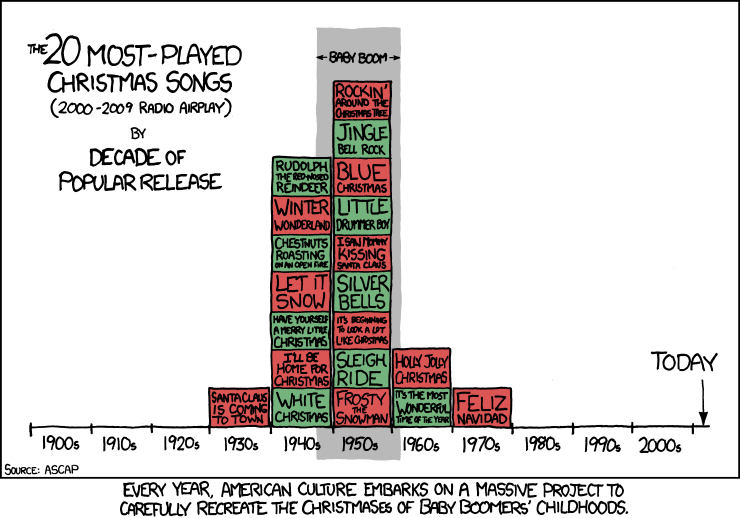
“An ‘American tradition’ is anything that happened to a baby boomer twice”
Hard to refute the latest xkcd take on Christmas music:
December 2, 2011
European anti-piracy campaign didn’t get permission to use music
In a lovely turn-about, they’re being sued by the composer whose music was, um, pirated:
Anti-piracy group BREIN is caught up in a huge copyright scandal in the Netherlands. A musician who composed a track for use at a local film festival later found it being used without permission in an anti-piracy campaign. He is now claiming at least a million euros for the unauthorized distribution of his work on DVDs. To make matters even worse, a board member of a royalty collection agency offered to to help the composer to recoup the money, but only if he received 33% of the loot.
A story currently unfolding in the Netherlands painfully exposes the double standards and corruption that can be found in some parts of the copyright industry.
It all started back in 2006, when the Hollywood-funded anti-piracy group BREIN reportedly asked musician Melchior Rietveldt to compose music for an anti-piracy video. The video in question was to be shown at a local film festival, and under these strict conditions the composer accepted the job.
However, according to a report from Pownews the anti-piracy ad was recycled for various other purposes without the composer’s permission. When Rietveldt bought a Harry Potter DVD early 2007, he noticed that the campaign video with his music was on it. And this was no isolated incident.
The composer now claims that his work has been used on tens of millions of Dutch DVDs, without him receiving any compensation for it. According to Rietveldt’s financial advisor, the total sum in missed revenue amounts to at least a million euros ($1,300,000).
H/T to occultado for the link.
November 21, 2011
Oh, good: the age of hagiographic Beatles stories may be coming to a close
Or, if not a close, at least a pause:
Given the vastness and variety of the literature, it would be incorrect to say that the Beatles story has been whitewashed, not when it includes so many get-even tell-alls and book-sized sumps of sensational gossip. But there is a quasi-official version of events, and when it is reissued periodically from the tireless Beatles public relations machine, the narrative does tend to take on the unblemished pallor of approved history. For 50 years the Beatles have been the rock group you could take home to meet Mom, and nobody close to their stupendous commercial enterprise seems eager to undo the image.
Paul, Ringo, the two widows, and what remains of the original Liverpool crowd keep the history tidy for reasons that are surely as much personal as fiduciary. Beatles Anthology, the eight-hour, supposedly definitive documentary the Beatles machine released in 1995, omitted any unpleasantness that might cast a shadow on the sunny version of the Beatles story, aside from a few inescapable anecdotes about illegal drug-taking. There was no mention of the now-legendary sybaritic excesses of Beatles tours, or the friends, wives, lovers, children, and employees betrayed or discarded on the way to the top. The sulfurous rancor that at last pulled the group apart, and which continued in punishing and pointless legal maneuvers for another generation, was mostly ignored. Even today, Paul and Ringo have stalled the rerelease of the 1970 documentary Let It Be owing to its glaring display of the group’s lassitude, self-loathing, and crisscrossing bitterness. And they’re right to keep it locked away, if the point is preserving the image of the moptops. It’s been a long time since I’ve seen Let It Be, but I don’t recall wanting to take any of those Beatles home to meet Mom.
The authorized version has been buffed in recent weeks with commemorations of the tenth anniversary of George Harrison’s death, at age 58, from cancer. There he was again, peering out from the cover of Rolling Stone, just like old times. Life magazine, always a codependent in Beatles mythmaking, disinterred itself long enough to get out a special celebratory issue. HBO aired a four-hour documentary put together by Martin Scorsese, Living in the Material World, which is also the title of a companion book of quotes and pictures released by Harrison’s widow Olivia.
The book is the size of a paving stone and as sumptuously produced as any coffee-table accessory can be. Scorsese’s movie, on the other hand, is a mess. Like too many documentaries nowadays, it lacks a single narrator, leaving the viewer helpless as the movie jumps back and forth through each stage of the Beatles story, from blitzed-out Liverpool to blissed-out Rishikesh. Anyone unfamiliar with the small but necessary roles in the dramatis personae will find himself wondering who all these people are. Where’d this Astrid woman come from, and how come Stuart Sutcliffe is dead all of a sudden — and now that you mention it, who was Stuart Sutcliffe anyway? Poor Pete Best, who he? (The answers for the uninitiated: Hamburg, Germany, where she befriended the young Beatles; a brain tumor; the Beatles’ first bass player; and . . . it’s complicated.)
Unlike most of the folks around my age, there’s almost no Beatles music in my collection (at least, by the Beatles: I’ve got Stanley Jordan’s wonderful version of Eleanor Rigby, and one or two other covers). While I wouldn’t go as far as Kathy Shaidle (“Beatles were phonier than Partridge Family, Monkees put together”), I would say that I’ve generally considered the Beatles to be over-rated.


